
Implant Hypothesis
Across abduction and close-encounter reports since the 1970s and 1980s, witnesses have described small, often sub-centimeter, metallic or crystalline objects surgically or otherwise inserted into their bodies during a UAP encounter — most commonly into the nasal cavity, an ear, or a limb — and, in a smaller number of cases, later recovered, surgically removed, and submitted for laboratory analysis by physicians or independent researchers. This file catalogues that claim honestly, as a documented recurring report distinct from any confirmed physical finding, then surveys the real forensic materials-science, dermatopathology, and mass-spectrometry work that has actually been performed on removed objects by named, credentialed, independent researchers — and states plainly what nearly every one of those analyses has actually found: ordinary, terrestrial material, not an exotic or unidentified one.
Real, Recurring Claim — Every Independently Published Analysis Finds Terrestrial MaterialCore Thesis
This file is built around a claim rather than a confirmed physical finding, and it says so plainly rather than blurring the two. Since at least the mid-1970s, a recurring detail has appeared inside abduction and close-encounter testimony, usually recovered through hypnotic regression rather than conscious contemporaneous memory: a small object, described as metallic or crystalline and typically a few millimeters to a centimeter across, inserted into a witness's nasal cavity, ear canal, or a limb during the reported encounter, sometimes migrating or working its way to the surface years later, sometimes surgically excised by a sympathetic physician. That claim is real in the sense that it recurs independently across a genuine, decades-long body of case testimony; what this file weighs honestly is what happens on the much rarer occasions when a claimed object actually reaches a credentialed, independent laboratory. A real analytical literature exists here — elemental and metallurgical analysis by university materials-science laboratories, scanning-electron-microscopy and X-ray microanalysis by academic researchers, and dermatopathological examination by board-certified physicians, several performed by scientists with no stake whatsoever in a UAP conclusion. The honest, and this file believes decisive, finding of that literature is not ambiguous: every independently published analysis of a claimed abduction implant this file's research identified found the object to be composed of ordinary terrestrial material — commonly occurring elements consistent with industrial alloys, dental amalgam, or a body's own hardened tissue growing around an embedded fiber — and not one has ever been corroborated by a second, independent laboratory replicating an anomalous isotope-ratio finding, the specific test that could in principle prove a non-terrestrial origin. Set against that record is a parallel, equally real clinical and psychological literature on how ordinary retained foreign bodies, granulomas, and confabulated hypnotic memory routinely produce claims that look, to the person experiencing them, exactly like this.
Origin & History
The implant motif entered American abduction testimony during the same mid-1970s wave of hypnotically recovered accounts that produced this site's own Stanford, Kentucky Abduction and Allagash Waterway Abduction case files. On January 6, 1976, witness Elaine Thomas described, under hypnosis conducted months after her reported encounter near Stanford, Kentucky, a “bullet-shaped” implant placed in her body during the event — a detail this site's own case file treats as one of the claim's earliest well-documented American appearances, and one that, like the great majority of implant reports this file surveys, was never physically produced or submitted for independent analysis. That same year, twin brothers Jack Weiner and Jim Weiner reported a close encounter on Eagle Lake in Maine's Allagash Wilderness Waterway; years later, during the hypnotic-regression sessions Raymond Fowler conducted for his investigation, Jim Weiner developed a mass on one leg that appeared suddenly, was surgically excised, and was “said to have been sent for outside analysis” — a physical detail this site's own case file describes candidly as never supported by “a contemporaneous, independently verifiable medical record in the public case file,” with no independently published clinical finding ever made public.
The claim moved from an incidental hypnotic detail to a central evidentiary strategy over the following decade. Investigator Budd Hopkins's 1987 book Intruders helped popularize the idea that abductees carried physical, recoverable markers of their encounters, and on November 30, 1989, Linda Cortile reported an encounter above the Brooklyn Bridge during which she recalled, under later hypnosis, a thin rod-like instrument inserted into her nostril; she subsequently reported discovering a small nasal implant, which she presented to Hopkins as corroborating evidence. This site's own case file on the incident states the finding plainly: no source its research identified documents that implant “undergoing independent, published laboratory or medical-imaging analysis capable of ruling out a mundane origin,” leaving it, like most implant claims this catalogue has reviewed, an assertion rather than a tested artifact. The claim reached its first genuine scientific test three years earlier in spirit and three years later in fact: in 1989, an abductee referred to in published accounts of the period turned a small object over to David E. Pritchard, a tenured MIT physicist who, together with Harvard psychiatrist John E. Mack, went on to chair a five-day 1992 academic conference at the Massachusetts Institute of Technology examining the abduction phenomenon. Pritchard, an experimentalist with no prior stake in the UAP question, had the object examined by MIT-trained dermatopathologist Thomas J. Flotte.
The claim's most systematic advocate emerged in the mid-1990s. Podiatric surgeon Dr. Roger Leir began investigating the phenomenon in 1995 after reviewing X-rays presented at a MUFON conference, and over the following two decades — working closely with field investigator Derrel Sims, who screened and referred candidate patients — performed a series of surgeries removing small objects he identified as candidate implants, submitting several for elemental and metallurgical analysis, most notably to the New Mexico Institute of Mining and Technology. Leir published his findings in the 1999 book The Aliens and the Scalpel. His program drew the field's most detailed skeptical examination the year before, when investigator Joe Nickell published “Alien Implants: The New 'Hard Evidence'” in the September/October 1998 Skeptical Inquirer, reporting that when a forensic medical institute asked to review Leir and Sims's specimens or photographs directly, Sims declined. Independently, and around the same period, British psychologist and skeptic Susan Blackmore arranged laboratory analysis of an object removed from the mouth of a young UK abductee, James Basil, using scanning-electron-microscopy and X-ray microanalysis equipment at the university where she taught. Leir died on March 14, 2014; the 2017 documentary Patient Seventeen, directed by Jeremy Corbell, chronicles his final implant-removal surgery and stands, as of this file's 2026 research, as the last widely distributed account of his program.
Scientific Foundations — What an Analysis Can Actually Show
A claimed implant is, in principle, one of the most straightforwardly testable physical-evidence categories in this entire subject: unlike a light in the sky or a missing block of time, it is a physical object that can be weighed, imaged, and chemically characterized by instruments used every day in materials science, forensic pathology, and cosmochemistry. This section surveys what those instruments can actually establish, and what the specific, named analyses performed on real claimed implants actually found.
1. The Real Falsifying Test: Isotope-Ratio Mass Spectrometry
Every element on the periodic table exists as a mix of isotopes whose relative abundance is set, for terrestrial material, by the specific nucleosynthetic and geochemical history of the Solar System. Material formed elsewhere — a genuine meteorite, an interplanetary dust particle, or a hypothetical fragment of extrasolar manufacture — can carry an isotope ratio measurably different from Earth's own, a principle cosmochemists already use routinely and un-controversially to identify individual presolar mineral grains, far smaller than any claimed implant, inside meteorites using isotope-ratio mass spectrometry (IRMS) and related ion-microprobe techniques. This is, in other words, mainstream, peer-reviewed, entirely non-UAP-related laboratory science, and it is precisely the test that could in principle settle a claimed implant's origin beyond reasonable dispute. It is also, this file's research found, a test that has never actually been applied to a claimed abduction implant and published with results available for independent replication. Every analysis this file was able to identify — described below — relied instead on bulk elemental composition (which elements are present and in what proportion), not isotopic ratio (which specific isotopes of those elements are present) — a materially weaker test that can rule an object in as consistent with terrestrial manufacture but cannot, on its own, rule an anomalous origin definitively out. This file treats that gap as the single most important fact in its own Material Analysis section below.
2. The Leir / New Mexico Tech Elemental Analysis
Roger Leir submitted objects recovered during his surgical program to several laboratories, most substantively to the New Mexico Institute of Mining and Technology, whose report — as independently summarized in secondary sources rather than a source this file could verify was ever published in a peer-reviewed venue — found the objects “composed of commonly found elements,” among them iron and aluminum. Leir's own book describes one specimen as containing eleven distinct elements and repeatedly draws attention to the laboratory's comparison of certain trace compositions to those found in meteorites. That comparison is the crux of this specific case's evidentiary dispute: the laboratory's own conclusion was that the material was terrestrial and ordinary; it was Leir who reinterpreted a meteorite-composition comparison as evidence the objects were “of extraterrestrial origin,” a conclusion the laboratory itself did not endorse. No isotope-ratio measurement of any Leir specimen — the test described above that could have directly tested that reinterpretation — appears in any source this file's research identified.
3. The MIT Analysis — Pritchard & Flotte
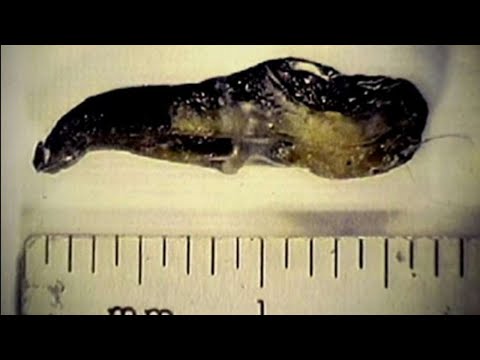
The object David Pritchard received in 1989 was, by his own account, studied for several years before he referred it to Thomas Flotte, a Harvard-trained dermatopathologist. Flotte's microscopic examination found the object to be a mass of hardened skin tissue — a callus — that had formed around a small number of embedded cotton fibers, consistent with a fragment of clothing fabric becoming lodged in the skin and the body's own healing response encapsulating it, precisely the kind of ordinary retained-foreign-body reaction described in this file's Conventional Explanation Candidate section below. Pritchard, an experienced experimental physicist with a direct professional stake in getting the physics right rather than in confirming any particular outcome, described the result candidly: “I don't have anything conclusive. What I have is just what you usually get in this business: it will provide more beliefs for the believers and will be instantly skeptified by the skeptics.”
4. The Blackmore / SEM-EDX Analysis
Susan Blackmore's investigation of the small, dull-grey object James Basil removed from his own mouth used scanning electron microscopy for direct imaging and energy-dispersive X-ray microanalysis (EDX) to determine elemental composition — genuine, standard materials-characterization instrumentation, the same class of equipment routinely used in industrial quality control and forensic science. The result was unambiguous: aside from trace calcium, silicon, and chlorine, the object was approximately 40 percent mercury, 30 percent tin, and 16 percent silver — the textbook composition of dental amalgam. The object was a filling, not an implant.
Government & Military Programs
No dedicated government forensic program for analyzing claimed abduction implants exists in the declassified record this file's research was able to identify, in sharp contrast to the FAA's HIRF certification regime this site's own Electromagnetic Interference / Vehicle Ignition-Kill Hypothesis file describes for a comparably testable physical claim. The closest any government body has come to formally engaging this specific claim is procedural rather than analytical: Joe Nickell's 1998 investigation records that when a forensic medical institute — the kind of credentialed, chain-of-custody-capable laboratory a genuine forensic inquiry would require — requested specimens or photographs from Leir's program for independent review, Derrel Sims declined to provide them. This file treats that episode as directly relevant to how much independent, replicable verification the wider implant-claim record has actually received: no FBI laboratory, military crime lab, or national materials-science facility analysis of a claimed abduction implant, with a published chain of custody and methodology, appears anywhere in the sourced literature this file surveyed. The Pentagon's All-domain Anomaly Resolution Office (AARO), which in its own Fiscal Year 2024 annual report stated it had received no reports of physiological or health impacts from UAP encounters during that period, has likewise never addressed the implant claim specifically in any report this file's research identified — a genuine absence this file notes rather than reads into.
Physical Evidence
This file's evidentiary record splits into three distinct tiers, and keeping them separate is essential to weighing the claim honestly. The first tier is objects that were actually recovered, submitted to a named, credentialed, independent laboratory or physician, and analyzed with a published or documented methodology and result: the Leir program's New Mexico Tech-analyzed specimens, the Pritchard/Flotte MIT case, and the Blackmore/Basil case. This is the smallest tier, and in every single instance in this file's research, the analysis found ordinary terrestrial material. The second, considerably larger tier is objects that were reportedly recovered or surgically removed but never independently analyzed with a published result at all — Linda Cortile's nasal implant and Jim Weiner's excised leg mass both fall here, each “said to have been sent for analysis” with no independently verifiable finding ever made public. The third tier, larger still, is objects described only in hypnotically recovered testimony and never physically produced at all, exemplified by Elaine Thomas's “bullet-shaped” implant. Leir's own claimed total — fifteen surgeries recovering sixteen objects — belongs mostly to an intermediate category this file states plainly: real surgical procedures removing real physical objects, a meaningfully larger and more directly forensic record than most abduction physical-evidence claims, but one for which this file's own research could independently verify detailed, published laboratory methodology for only a minority of the individual specimens, leaving Leir's full tally an author-reported figure rather than an independently audited one.
Supporting Case Files
Theoretical Alignment
This theory's strongest alignment, by this file's own honest assessment, is with the site's Psycho-Social Hypothesis axis, reflecting how consistently the claim's best-documented individual cases resolve to retained foreign bodies, dental work, or hypnotically confabulated detail once they actually reach independent analysis. Its alignment with the Genetic Hybridization / Monitoring theme found elsewhere on this site — visible as early as Herbert Schirmer's 1967 account (see this site's case file) of a described “breeding analysis” program, one of the earliest appearances of that broader theme — reflects how frequently implant narratives are framed by witnesses and investigators as tracking or monitoring devices tied to that larger claimed program, a narrative connection this file notes without treating it as independent evidence for either claim. Its alignment with the Extraterrestrial Hypothesis specifically is the weakest of the three and is, this file states directly, the figure most in tension with what this file's own Material Analysis section documents: every independently analyzed object found terrestrial material, which is exactly the finding a null or near-null ETH alignment would predict for this specific evidentiary category, even though the broader abduction phenomenon it is embedded in raises separate questions this file does not resolve here.
Sensor & Instrumentation Detection Profile
Unlike this site's ignition-kill or radiation-injury files, where the core problem is that no instrument was ever present at the moment of the reported event, this theory's central instrumentation gap sits downstream, at the analysis stage, and is in some ways more damning because it was avoidable. Pre-surgical localization in Leir's program used conventional X-ray and, in some cases, MRI imaging to confirm an object's presence and position before removal — real, standard medical instrumentation, and the one part of this claim's evidentiary chain that is genuinely well-instrumented. Post-removal characterization, when it happened at all, used elemental and metallurgical analysis (New Mexico Tech) or scanning electron microscopy and energy-dispersive X-ray microanalysis (Blackmore) — again, real, standard materials-science instrumentation capable of determining what an object is made of. What never happened, in any case this file's research identified, is the specific instrumented test — isotope-ratio mass spectrometry, described above — capable of directly testing whether that composition originated on Earth. Most claimed implants, meanwhile, never reach any instrument at all: Linda Cortile's and Elaine Thomas's cases both illustrate a claim that entered the record purely as testimony or was reportedly recovered but never independently imaged or analyzed with a published result at all.
Environmental & Geospatial Context
This theory does not cluster geographically the way a site-based phenomenon like ignition-kill or radiation-injury cases do, because the reported event is bodily rather than locational; what clusters instead are two other variables this file's research was able to identify. The first is anatomical: witnesses across this file's catalogue consistently report the nasal cavity, an ear, or a limb (hand, foot, or leg) as the insertion site — precisely the body regions where an ordinary retained foreign body (a splinter, a shard of glass, an aspirated or embedded fragment) is most likely to lodge, migrate slowly under the skin, and eventually present as a palpable lump, the mundane clinical pattern this file's Conventional Explanation Candidate section addresses directly. The second is investigatory: reported implant cases cluster tightly around a small number of hypnotic-regression practitioners and investigator networks — Budd Hopkins's New York-based caseload, and the California-based, MUFON-adjacent circuit Roger Leir and Derrel Sims worked, the same circuit that later carried Leir to the 2009 Istanbul UFO Congress referenced in this site's own Yeni Kent Compound Sighting case file — rather than around any particular region, terrain, or encounter setting.
Observer Credibility & Occupational Profile
This theory's central figures span a wide and, this file states directly, highly relevant credentialing range. Roger Leir was a genuinely licensed and practicing podiatric surgeon, qualified in 1964, but not a physician (he held no M.D.) and not a materials scientist — his professional surgical training qualified him to remove an object from a body, not to interpret a metallurgical lab report, a distinction this file treats as material to how his own interpretive claims about the New Mexico Tech findings should be weighed. Derrel Sims describes his own background, on his own website and in his own published materials, as including U.S. Army military-police service and CIA-linked security work; this file's research was unable to independently verify those specific claims through any source other than Sims's own self-published biography, and treats them accordingly as self-reported rather than established fact. By contrast, David Pritchard is a tenured MIT physics professor with an established, entirely separate career in atomic physics and atom interferometry, and Thomas Flotte is a board-certified dermatopathologist trained at Massachusetts General Hospital and Harvard Medical School — both credentialed specialists with no UAP-research career stake, brought in for a single technical consultation rather than as advocates. Susan Blackmore holds a doctorate in parapsychology and built her later career specifically on rigorous, skeptical testing of exactly this kind of paranormal physical-evidence claim. Skeptical investigator Joe Nickell, a Senior Research Fellow of the Committee for Skeptical Inquiry, is the field's most direct outside auditor of the Leir-Sims program's own evidentiary conduct.
Historical Precedents & Archive Matches
The implant claim's precedent record runs through several of this site's already-documented programs and figures. Budd Hopkins's Intruders (1987) is widely credited with elevating physical-implant claims to a central place in American abduction research, building directly on the hypnotic-regression methodology this site's own coverage of Martin Orne's forensic-hypnosis research treats at length elsewhere. John E. Mack's Harvard-based abduction research and his co-chairing of the 1992 MIT conference with Pritchard gave the claim its most direct exposure to mainstream academic scrutiny. Joe Nickell's 1998 Skeptical Inquirer article remains the most detailed single published skeptical audit of the Leir-Sims program specifically, concluding that the claimed implants were “most likely ordinary objects such as shards of glass or fragments of metal” that become lodged in skin through ordinary accidental injury. Psychologist Susan Clancy's later synthesis of how confabulated memory forms during hypnotic regression, discussed in this site's own coverage of her work, provides the most direct academic account of how a claim like Elaine Thomas's — recovered only under hypnosis, never physically produced — can be sincerely reported without corresponding to an external event.
Material Analysis
This is the section in which this theory's central tension is most concrete, and this file states its conclusion plainly rather than hedging it: in every case this file's research identified where a claimed implant reached a named, independent, credentialed laboratory or physician and the result was published or documented, the object was found to be composed of ordinary terrestrial material. The New Mexico Institute of Mining and Technology's analysis of Leir specimens found commonly occurring elements — iron, aluminum, and others, one sample reportedly containing eleven distinct elements — consistent with ordinary metallic or alloy material; the laboratory's own report did not conclude an extraterrestrial origin, a conclusion layered onto the findings afterward by Leir himself based on a meteorite-composition comparison the lab's own language did not endorse as evidence of non-terrestrial manufacture. Thomas Flotte's dermatopathological examination of the object David Pritchard submitted found it to be biological, not metallic at all: a callus of hardened skin tissue formed around a few embedded cotton fibers. Susan Blackmore's scanning-electron-microscopy and X-ray-microanalysis examination of the object James Basil removed from his own mouth found a composition of roughly 40 percent mercury, 30 percent tin, and 16 percent silver — standard dental amalgam. No published isotope-ratio mass spectrometry result — the specific, falsifying test described in this file's Scientific Foundations section, already routinely used in cosmochemistry to identify genuine extraterrestrial material far smaller than any claimed implant — appears anywhere in the sourced literature this file was able to review for any claimed abduction implant, proponent or skeptic alike. This file treats that absence as the honest state of the evidence: not proof that no anomalous implant could ever exist, but a plain statement that the single test capable of definitively settling the question has, as far as this file's research could establish, never actually been applied and published.
Theory Development Timeline
| Date | Development |
|---|---|
| Jan. 6, 1976 | The Stanford, Kentucky Abduction produces one of the earliest well-documented American implant claims — a “bullet-shaped” object described by Elaine Thomas under later hypnosis, never physically produced. |
| 1976–1989 | The Allagash Waterway Abduction hypnotic-regression sessions produce a report that Jim Weiner developed and had surgically excised a sudden-onset leg mass, reportedly sent for outside analysis with no published finding ever made public. |
| 1987 | Budd Hopkins publishes Intruders, helping establish the physical implant as a central evidentiary category within American abduction research. |
| 1989 | An abductee turns a small recovered object over to MIT physicist David Pritchard, who begins a multi-year examination eventually referred to dermatopathologist Thomas Flotte. |
| Nov. 30, 1989 | The Linda Cortile “Brooklyn Bridge” Abduction produces a reported nasal implant, later presented to Budd Hopkins as evidence but never independently, publicly analyzed. |
| 1992 | David Pritchard and John E. Mack chair a five-day academic conference on the abduction phenomenon at MIT. |
| 1995 | Roger Leir begins investigating claimed implants after reviewing X-rays at a MUFON conference, starting his surgical-removal program with field investigator Derrel Sims. |
| 1998 | Joe Nickell publishes “Alien Implants: The New 'Hard Evidence'” in Skeptical Inquirer, reporting Derrel Sims's refusal to submit specimens to an independent forensic institute. |
| 1999 | Roger Leir publishes The Aliens and the Scalpel, detailing his surgical program and the New Mexico Institute of Mining and Technology's elemental analysis of removed objects. |
| Mid-1990s | Susan Blackmore arranges SEM/EDX analysis of an object removed by UK abductee James Basil, finding it to be dental amalgam. |
| March 14, 2014 | Roger Leir dies in Thousand Oaks, California, at age 78. |
| 2017 | Filmmaker Jeremy Corbell releases Patient Seventeen, a documentary chronicling Leir's final implant-removal surgery. |
Weighing the Evidence
Supporting Arguments
- The claim recurs independently across a genuine, decades-long, geographically dispersed body of hypnotically and, in a few cases, consciously recalled testimony, not a single anecdote or a single investigator's caseload
- A real, credentialed surgical and materials-science program (Leir, New Mexico Tech) produced actual physical specimens with documented elemental composition, a meaningfully more concrete evidentiary record than most abduction physical-evidence claims
- Two of this file's independent analyses (Pritchard/Flotte, Blackmore) were conducted by credentialed academic scientists with no UAP-advocacy incentive of any kind, demonstrating the claim can in principle be tested rigorously when a specimen actually reaches a qualified lab
- Pre-surgical X-ray and MRI imaging in the Leir program did confirm the physical presence of a genuine subdermal object in several cases prior to its removal
Skeptical Arguments
- Every independently published analysis this file identified — New Mexico Tech, Pritchard/Flotte at MIT, and Blackmore's SEM/EDX case — found ordinary terrestrial material: common alloy elements, a skin callus around cotton fibers, and dental amalgam, respectively
- No published isotope-ratio mass spectrometry result — the specific test capable of directly distinguishing terrestrial from non-terrestrial origin — has ever been applied to a claimed implant and made available for independent replication
- When a forensic medical institute requested specimens or photographs from the Leir-Sims program for independent review, Derrel Sims declined, per Joe Nickell's 1998 published investigation
- The great majority of implant claims in this file's own catalogue, including two of its three supporting case files, were never physically produced or independently analyzed at all, resting entirely on testimony recovered under hypnosis — a technique this site's own coverage of Martin Orne and Elizabeth Loftus documents as reliably increasing confidence in recovered memory without increasing its accuracy
Conventional Explanation Candidate
This section rates the most commonly proposed conventional explanations for the pattern individually, since — as with this site's other physics- and medicine-literate files — blending a strong general-mechanism case with a weak specific-instance case into a single verdict would understate genuine complexity in both directions.
Retained Foreign Body / Granuloma (Splinter, Glass, Metal Fragment)
Strongly SupportedRigorously established, routinely diagnosed clinical medicine, independent of any UAP claim: ordinary foreign material embedded through accidental injury can migrate under the skin for years and present as a palpable lump. Joe Nickell's own explicit conclusion for the great majority of Leir-program cases.
Confabulated Memory From Hypnotic Regression
Strongly SupportedWell-established cognitive-science and clinical-psychology finding (see this site's own coverage of Martin Orne, Elizabeth Loftus, and Susan Clancy) that hypnosis increases confidence in recovered memory without increasing accuracy. Directly applicable to cases like Elaine Thomas's, where the implant was described only under hypnosis and never physically produced.
Mundane Material Misidentified as an Implant (Dental Work, Fiber-Callus, Debris)
Directly DemonstratedNot merely plausible but directly confirmed in this file's two most rigorously analyzed cases: a dental filling (Blackmore/Basil) and a skin callus formed around cotton fibers (Pritchard/Flotte), each identified by a credentialed independent specialist using standard diagnostic instrumentation.
A Genuine Non-Terrestrial or Otherwise Anomalous Implanted Object
Not Supported by Any Independently Published AnalysisEvery independently published analysis this file identified found ordinary terrestrial material. The specific test that could most directly establish a non-terrestrial origin — isotope-ratio mass spectrometry — has never been applied to a claimed implant and published for independent review, leaving this explanation untested rather than merely unconfirmed, but with zero analyzed cases supporting it to date.
Theoretical Assessment Profile
Six-domain evaluation of this hypothesis
Key Proponents
Dr. Roger Leir
Performed the field's most systematic surgical-removal program, reporting fifteen surgeries and sixteen recovered objects between 1995 and 2014, and submitted specimens to the New Mexico Institute of Mining and Technology for elemental analysis.
Derrel Sims
Screened and referred candidate abductee-patients for Leir's surgical program and developed an ultraviolet-fluorescence field-screening method; declined a forensic medical institute's request for independent specimen review, per Joe Nickell's 1998 published investigation.
David E. Pritchard
Personally examined a claimed implant over several years and referred it to a dermatopathologist for definitive analysis, co-chairing MIT's 1992 academic abduction-study conference with no personal stake in confirming an anomalous result.
Thomas J. Flotte
Conducted the definitive microscopic examination of the object Pritchard submitted, identifying it as a skin callus formed around embedded cotton fibers rather than any exotic material.
Susan Blackmore
Arranged scanning-electron-microscopy and X-ray-microanalysis testing of a claimed UK implant, identifying it as ordinary dental amalgam — one of this file's two most rigorously instrumented analyses.
Joe Nickell
Published the field's most detailed skeptical audit of the Leir-Sims program in 1998, documenting the program's refusal to submit specimens to an independent forensic institute.
Related Cases
Further Reading
The Aliens and the Scalpel
Leir's own account of his surgical-removal program and the New Mexico Institute of Mining and Technology's elemental analysis of the objects he recovered — essential for understanding the claim's most systematic proponent case.
Close Encounters of the Fourth Kind
A journalist's account of the 1992 MIT abduction-study conference chaired by David Pritchard and John E. Mack, including the Pritchard/Flotte implant analysis this file draws on directly.
Abducted: How People Come to Believe They Were Kidnapped by Aliens
A Harvard psychologist's account of how sincere abduction and implant memories form through hypnotic suggestion and cultural narrative, without requiring deception or mental illness on the part of the witness.
Witnessed: The True Story of the Brooklyn Bridge UFO Abductions
Hopkins's own investigative account of the Linda Cortile case, including the reported nasal implant this file's own research found was never independently, publicly analyzed.
Abduction: Human Encounters with Aliens
The Harvard psychiatrist's book-length account of his abduction-research patients, including physical-marker and implant claims, from the researcher who co-chaired MIT's 1992 academic conference on the phenomenon.
DISCLOSURE: Some links above are affiliate links. If you purchase through them, OverClassified receives a small commission at no additional cost to you. This helps support independent research.
Essential Viewing


Sources Cited
- "Roger Leir," Wikipedia.
- "David E. Pritchard," Wikipedia.
- Nickell, J. "Alien Implants: The New 'Hard Evidence'," Skeptical Inquirer, September/October 1998.
- Blackmore, S. "Scientific Analysis of an 'Alien Implant'," SusanBlackmore.uk.
- "Full Biography," Dr Susan Blackmore.
- "Susan Blackmore," Wikipedia.
- "Dr. Thomas J. Flotte, MD," US News Doctors.
- "New Mexico Institute of Mining and Technology," Wikipedia.
- Leir, R.K. The Aliens and the Scalpel: Scientific Proof of Extraterrestrial Implants in Humans, The Book Tree, 1999.
- Bryan, C.D.B. Close Encounters of the Fourth Kind: A Reporter's Notebook on Alien Abduction, UFOs, and the Conference at M.I.T., Knopf, 1995.
- Clancy, S.A. Abducted: How People Come to Believe They Were Kidnapped by Aliens, Harvard University Press, 2005.
- Hopkins, B. Witnessed: The True Story of the Brooklyn Bridge UFO Abductions, Pocket Books, 1996.
- Mack, J.E. Abduction: Human Encounters with Aliens, Scribner, 1994.
- "The Linda Cortile 'Brooklyn Bridge' Abduction," case file, OverClassified. /case-files/the-linda-cortile-brooklyn-bridge-abduction.html
- "Stanford, Kentucky Abduction," case file, OverClassified. /case-files/stanford-kentucky-abduction.html
- "Allagash Waterway Abduction," case file, OverClassified. /case-files/allagash-waterway-abduction.html
- "Yeni Kent Compound Sighting," case file, OverClassified. /case-files/yeni-kent-compound-sighting.html
- "Herbert Schirmer (1967)," case file, OverClassified. /case-files/herbert-schirmer-1967.html
- "Patient 17," Wikipedia.
- "Patient Seventeen (2017)," IMDb.
- "Derrel Sims Bio," The Alien Hunter (self-published).
- "John E. Mack," Wikipedia.
- "Alien Implants," Wikipedia.
Have corrections, additional research, or peer-reviewed sources? Help improve this entry.
Suggest an Edit