
Close Encounters of the Fourth Kind
A Reporter's Notebook on Alien Abduction, UFOs, and the Conference at M.I.T. — The 1992 Meeting, Reported by an Outsider
Core Thesis
Close Encounters of the Fourth Kind is the primary record of the single moment when the abduction claim came closest to academic legitimacy. In the summer of 1992 a five-day closed conference on the abduction phenomenon was held at the Massachusetts Institute of Technology, co-chaired by John Mack of Harvard Medical School and David Pritchard, an MIT molecular physicist. C. D. B. Bryan — a Yale-educated novelist and journalist with no prior involvement in the subject, best known for Friendly Fire — attended, took notes, interviewed participants and experiencers at length, and produced 496 pages. Knopf published it in 1995. It is the fullest account of what was said in that room, by someone who came in without a position.
About the Author
C. D. B. Bryan was a serious literary journalist and novelist rather than a writer on anomalous subjects. Yale-educated, he was best known for Friendly Fire (1976), a National Book Award-nominated account of an American family's pursuit of the truth about their son's death by American artillery in Vietnam, which was adapted as a television film. He wrote for The New Yorker and The New York Times Magazine.
That background is the reason the book exists in this form. Bryan came to the MIT conference as an assignment, with no prior investment in the subject, no relationship with the abduction research community, and a professional method built on extended interviewing and close attention to what people actually said. The result is the only account of the abduction field's central moment written by someone with nothing at stake in it.
His method here is reportage rather than assessment. He reproduces the conference sessions, the presentations, the disputes, and above all the experiencers' own accounts, at length and in their own words. He interviews participants on both sides. He does not adjudicate, and readers looking for a verdict will not find one.
That neutrality has been read in opposite ways and both readings are defensible. Sceptics have found the book too accepting — a professional writer's sympathy for his subjects shading into credulity. Believers have found it insufficiently committed. Bryan's own position, as far as the book states one, is that he found the experiencers sincere and the phenomenon unexplained, which is where a careful reporter would land.
It should be said plainly that he was not equipped to evaluate the methodology, and did not claim to be. The book's central evidential question — whether hypnotic regression recovers or generates the accounts it produces — is a technical matter in experimental psychology, and Bryan reports the dispute rather than resolving it.
Historical Context & Origins
The 1992 conference was the abduction field's high-water mark and the circumstances explain why. John Mack was a Pulitzer Prize-winning professor of psychiatry at Harvard Medical School with an unimpeachable academic record who had begun working with people reporting abduction experiences; David Pritchard was a molecular physicist at MIT. Two figures of that standing convening a five-day meeting on the subject at MIT was, in 1992, a genuinely new development.
The conference was closed, working, and organised as a scientific meeting rather than as a public event. Presentations covered the phenomenology of reports, the demographics of experiencers, the physical-evidence claims, the methodological questions, and the psychological literature, with abductees present and giving accounts.
The field arriving at that meeting had been built substantially by two men. Budd Hopkins' Intruders (1987) and David Jacobs' work had established the modern abduction narrative and the regression-based methodology that produced most of its case material.
The methodological problem was already visible and was discussed at the conference. Hypnotic regression was the technique behind the overwhelming majority of abduction accounts, and the experimental psychology of memory was in the process of establishing that it reliably generates detail rather than recovering it. The recovered-memory controversy was breaking around exactly this question in the same years.
Mack's own trajectory after the conference is inseparable from the book's significance. He published Abduction in 1994; Harvard Medical School convened a committee to review his work; and the resulting inquiry, and its eventual outcome, became the most consequential institutional episode in the subject's modern history.
Bryan's book appeared in 1995, between Mack's book and the resolution of the Harvard review, and its publication by Knopf — a major literary house, not a paranormal imprint — placed the material in front of a general readership at the exact moment the question of academic legitimacy was live.
What followed was decline rather than consolidation. The regression methodology's evidential standing collapsed over the following decade, Susan Clancy's Harvard research on the same population produced a psychological account published as Abducted in 2005, and no comparable academic meeting on the subject has been held since.
Core Arguments & Key Concepts
The conference happened and its participants were who they say they were. The book's foundational documentary claim and its most durable contribution. A five-day working meeting on the abduction phenomenon took place at MIT in 1992, co-chaired by a Harvard Medical School professor and an MIT physicist, and Bryan was in the room for it. That is a fact about the history of the subject regardless of what one concludes about the phenomenon.
The experiencers were sincere and were not obviously ill. The observation Bryan makes most consistently and the one that most affected readers. The people giving accounts at the conference were ordinary, employed, articulate and evidently distressed, and they did not present as the population a straightforward psychopathology explanation would predict. That observation is correct and it is also compatible with several explanations that are not the one they favoured.
An outsider's report is a different kind of document. Bryan's implicit methodological claim. Every other account of the abduction field in this period was written by a participant — a researcher, a therapist, an experiencer, or a debunker with a position. A professional journalist with no stake, reproducing what was said at length, produces a record the participants could not.
The methodological dispute is the whole question and the conference knew it. The book's most useful analytical content. The regression problem was raised, argued and left unresolved at MIT in 1992, and Bryan reports that accurately. A reader who wants to know whether the field's leading figures understood the objection will find that they did.
The absence of physical evidence was acknowledged in the room. Also creditably reported. The implant claims, the scar and mark evidence, and the trace material were discussed and did not survive the discussion as anything decisive, and the conference did not pretend otherwise.
The book's weakest feature is that it will not conclude. Reportage without adjudication is a legitimate form and it has a cost: 496 pages of extended sympathetic testimony, presented without a verdict, will move most readers toward the accounts rather than away from them. Bryan's neutrality is real and its practical effect is not neutral.
Sincerity is the wrong axis and the book keeps returning to it. The most important criticism to make. Whether experiencers believe their accounts has never been in dispute; almost everyone on all sides agrees they do. The question is what produced the accounts, and a book organised around the impressiveness of the witnesses' sincerity is organised around the one variable nobody contests.
Key Cases & Evidence Discussed
The MIT abduction conference, June 1992. The five-day closed meeting co-chaired by John Mack and David Pritchard, its sessions, its participants and its disputes — the book's subject and the field's most institutionally significant event.
The experiencer testimony. The extended first-person accounts Bryan reproduces from abductees who presented at or attended the conference, in their own words and at length. The book's bulk and its emotional centre.
John Mack's clinical work. The Harvard psychiatrist's approach to experiencers, presented at the conference and developed in Abduction two years later — and the institutional review that followed it.
David Pritchard's physical-evidence programme. The MIT physicist's attempt to bring laboratory standards to the implant and trace claims, including the examination of purported physical specimens — the most scientifically serious strand at the conference and the one that produced least.
The Hopkins and Jacobs methodology. The regression-based case-generation approach behind most of the corpus, its defenders at the conference, and the objections raised to it there.
The hypnosis dispute. The argument, live in the room, over whether regression recovers or generates accounts — the field's central methodological question, discussed at its most respectable moment and left unresolved.
The implant claims. The reported physical objects recovered from experiencers, the analytical results, and the failure of any specimen to survive independent examination as anything anomalous.
The demographic and phenomenological surveys. The attempts presented at the conference to characterise the experiencer population statistically and to establish which narrative features recurred — the closest the field came to a systematic empirical programme.
Critical Reception & Controversies
The book was published by Knopf and reviewed in the general press as a serious work of literary journalism, which was itself the point: a National Book Award-nominated author writing about alien abduction for a major literary house was a cultural event in 1995 regardless of the contents.
Reviews divided along a predictable line and the division has persisted. Readers who came to it sceptically found Bryan too sympathetic — a professional interviewer's rapport with his subjects shading, over 496 pages, into something close to endorsement. Readers already interested in the subject found the book insufficiently committed and were frustrated by the refusal to conclude.
The substantive criticism is that the book is organised around the wrong question. Bryan returns repeatedly to how ordinary, credible and sincere the experiencers were, and that has never been contested by anyone. What is contested is whether hypnotic regression produced the accounts, and a work of reportage cannot settle a technical question in experimental psychology.
The hypnosis material has aged the least well, through no fault of the author. In 1992 regression was still defended by respectable practitioners; by 2005 the experimental case against it was decisive, and Susan Clancy's Harvard research on the same population had produced a psychological account of the phenomenon that did not require anything unexplained. A book reporting an unresolved dispute reads differently once the dispute has resolved.
What has aged best is the documentary value. The MIT conference is now a historical event of some consequence — the field's closest approach to academic legitimacy, and the immediate context for the Harvard review of Mack's work — and Bryan's is the fullest record of it. That would be true even if every claim made in the room were false.
The book's relationship to Mack's fate is also worth noting. Bryan was reporting on a Harvard professor at the moment of maximum exposure, and the account he produced is one of the principal sources on what Mack actually said and did before his institution reviewed him. It is used that way by people writing about the episode.
The fair placement is as the best available record of a significant historical moment, written by a capable outsider, organised around a question that does not decide anything, and best read alongside the psychological literature that resolved what the conference could not.
There is one more thing the book records that has become more valuable with time, and it is easy to miss among the testimony. The conference discussed its own evidential problems openly — the reliance on regression, the absence of any surviving physical specimen, the difficulty of establishing a base rate for the reported experiences in the general population — and it did so among people who wanted the phenomenon to be real. A field is not usually generous about its own weaknesses in front of a reporter, and the fact that this one was, at its most confident moment, is a point in favour of the people in the room even though it did not save the argument.
Influence & Legacy
The book is the standard reference for the 1992 MIT conference, and the conference is a landmark in the subject's institutional history regardless of one's view of the phenomenon. Anyone writing about the abduction field's relationship with academia goes to Bryan for what was said.
It also carried the abduction claim into general literary readership at a level of seriousness the field has not since achieved. A Knopf book by a National Book Award-nominated author is a different cultural object from a paranormal-imprint paperback, and for a period in the mid-1990s the subject was being discussed in venues that have not returned to it.
Its relationship to Mack's Harvard review gives it an unintended historical importance. Bryan documented, in detail and contemporaneously, the clinical and intellectual approach that an institution then examined, and his account is among the principal sources on that episode.
The cautionary legacy is about sincerity as evidence, and it is the most transferable thing in the book. Bryan spent 496 pages establishing that the experiencers were genuine, articulate, distressed and not obviously ill — all true, all agreed by every serious party, and none of it bearing on what produced the accounts. Recognising when a book has organised itself around an uncontested variable is one of the more useful skills a reader of this literature can acquire, and this is where to practise it.
It is also worth registering what has not happened since. No comparable academic meeting on the abduction question has been convened in the thirty-four years since, at MIT or anywhere else, and the institutional review of the conference’s co-chair is the reason most often given. Whatever one concludes about the phenomenon, the practical effect of the 1992 conference and its aftermath was to close the door it had opened, and this book is the record of the brief period when it stood ajar.
The Book
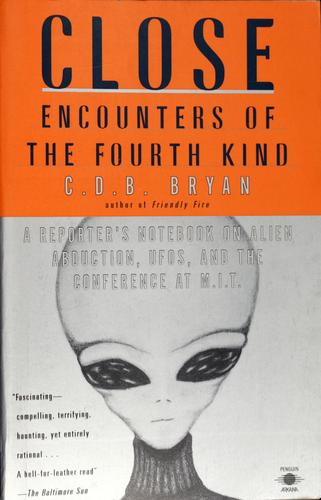
Close Encounters of the Fourth Kind
A Reporter's Notebook on Alien Abduction, UFOs, and the Conference at M.I.T. — The 1992 Meeting, Reported by an Outsider
Find on Amazon →As an Amazon Associate, OverClassified may earn from qualifying purchases made through this link, at no extra cost to you.
Why This Is Essential Reading
Read it as history, and supply the assessment it declines to give. Close Encounters of the Fourth Kind is the fullest record of the five-day 1992 MIT conference on the abduction phenomenon — the closest the claim ever came to academic legitimacy, co-chaired by a Harvard Medical School professor and an MIT physicist — written by a serious literary journalist who arrived with no position and reported at length what was said. That documentary value is real and permanent. Its limitation is structural: 496 pages organised around how sincere and ordinary the experiencers were, on a question nobody disputes, while the question that decides everything — whether hypnotic regression recovered or generated the accounts — is reported as an open dispute and left there. It was open in 1992; it is not open now. Read it with Mack's own Abduction, which is what the conference's co-chair went on to publish, and against Abducted, which studied the same population at the same university with laboratory controls and reached the answer this book could not.
Related Cases & Theories
Sources Cited
- Bryan, C. D. B. Close Encounters of the Fourth Kind: A Reporter's Notebook on Alien Abduction, UFOs, and the Conference at M.I.T. Alfred A. Knopf, New York, 1995; Penguin Books paperback, June 1, 1996, 496 pp. ISBN-10 0140195270 / ISBN-13 9780140195279. amazon.com
- Internet Archive holding, Close encounters of the fourth kind: a reporter's notebook on alien abduction, UFOs, and the conference at M.I.T. — the full scanned text. archive.org
- Stanford University Libraries SearchWorks catalogue record — the authoritative bibliographic record for the Knopf 1995 first edition. searchworks.stanford.edu
- Open Library edition record, ISBN 0140195270 — bibliographic verification and cover-art source. openlibrary.org
- Goodreads edition record — edition data, reader reception, and the description of the five-day MIT conference co-chaired by John Mack of Harvard Medical School and MIT molecular physicist David Pritchard. goodreads.com
- AbeBooks catalogue record, ISBN 9780140195279 — the Penguin 1996 paperback, its 496-page extent and edition verification. abebooks.com
- ThriftBooks catalogue record — independent bibliographic listing and description. thriftbooks.com
- Wikipedia, "C. D. B. Bryan" — his career, his Yale education, Friendly Fire and its adaptation, and his journalism. en.wikipedia.org
- Wikipedia, "John E. Mack" — the Harvard Medical School professor of psychiatry who co-chaired the conference, his Pulitzer Prize, his abduction work and the Harvard review that followed. en.wikipedia.org
- Wikipedia, "David E. Pritchard" — the MIT molecular physicist who co-chaired the conference and led its physical-evidence strand. en.wikipedia.org
- Wikipedia, "Abduction phenomenon" — the claim, its case literature, the role of hypnotic regression in generating it and the psychological assessment. en.wikipedia.org
- Wikipedia, "Massachusetts Institute of Technology" — the institution that hosted the 1992 conference. en.wikipedia.org
- Wikipedia, "Hypnotic regression" — the technique behind most of the abduction corpus, and the experimental evidence on what it produces. en.wikipedia.org
Have corrections, additional research, or peer-reviewed sources? Help improve this entry.
Suggest an Edit