
Witnessed
The True Story of the Brooklyn Bridge UFO Abductions
Core Thesis
Witnessed is Budd Hopkins' 1996 account of the case he considered the crowning achievement of his career: the claimed November 30, 1989 abduction of Manhattan housewife Linda Cortile (later publicly identified as Linda Napolitano), who reported being floated from her twelfth-floor apartment window in Lower Manhattan in a beam of light and drawn aboard a hovering craft near the Brooklyn Bridge. Hopkins presents the case as the most thoroughly corroborated abduction in the history of UFO research, built on testimony from a claimed twenty-plus witnesses, including two self-described security personnel and a senior United Nations diplomat who allegedly witnessed the event directly. This site's own research draws on it for two pages that cite it directly: the Linda Cortile "Brooklyn Bridge" Abduction case file, where this site's own investigation treats the book's central secondary-witness claims as the single most consequential and most poorly corroborated element of the entire case, and the Implant Hypothesis theory page, which cites the book for its reported nasal implant, an object this site's own research found was never independently, publicly analyzed.
About the Author
Budd Hopkins (1931-2011) was a New York-based professional visual artist by primary trade who became one of the most prominent American investigators of alien-abduction claims, largely through his 1981 book Missing Time and his 1987 follow-up Intruders, both of which helped codify the hypnotic-regression abduction narrative as a recognized category within ufology. He was not a psychologist, psychiatrist, or licensed hypnotherapist by training, having instead taught himself hypnotic-regression technique through his own abduction-research work beginning in the late 1970s, and he conducted the great majority of his regression sessions alone, without a credentialed clinician present or reviewing the sessions independently -- a working method this site's own case-file research identifies as a specific, disclosed methodological weakness running through his broader body of work.
By the time Cortile's case reached him in 1989, Hopkins was already deeply established within the field: Cortile herself had joined one of his abduction support groups and read Intruders roughly five months before her own alleged experience, a sequence this site's own research treats as directly relevant to assessing the case's evidentiary independence, since it means the central witness was already immersed in Hopkins' specific abduction framework before the event she would go on to report.
Hopkins spent roughly seven years developing the Cortile case before Witnessed reached print in 1996, during which its cast of characters grew from a single housewife's missing-time report into a story involving, in his own published telling, more than twenty distinct individuals who had allegedly observed some portion of the November 1989 event. Working alongside historian David Jacobs, Hopkins went on to develop an increasingly elaborate "genetic hybridization program" theory that this site's own Genetic Hybridization Program Hypothesis file examines directly, arguing that hundreds of independently conducted hypnotic-regression sessions revealed a coordinated, cross-generational alien breeding initiative.
Hopkins married documentary filmmaker Carol Rainey in the mid-1990s, and she co-authored his 2003 follow-up book Sight Unseen: Science, UFO Invisibility, and Transgenic Beings and worked alongside him on UFO-related film projects for roughly a decade even as her own doubts about his investigative rigor grew. After his death in 2011, Rainey became the case's most consequential public critic -- a reversal this site's own research treats as carrying particular weight precisely because of her unusually close, long-term proximity to Hopkins' own investigative process, a vantage point few other critics of his work possessed.
Historical Context & Origins
Witnessed arrived at a specific moment in the abduction genre's development: Hopkins' own two earlier books had already established the hypnotic-regression abduction narrative as a recognized category, and Whitley Strieber's 1987 Communion and John E. Mack's 1994 Abduction: Human Encounters with Aliens had brought the broader phenomenon substantial mainstream attention. Hopkins presented the Cortile case specifically as a qualitative leap beyond his own earlier work -- not merely another hypnotically recovered account, but a case built on independent, waking-state third-party corroboration, the exact category of evidence abduction researchers had long identified as the field's most urgent unmet need.
The book's own escalation pattern -- a modest 1989 missing-time report growing, primarily through Hopkins' continued investigation rather than through independently generated new evidence, into a claimed twenty-plus-witness case involving a named world leader -- recurs, per this site's own research, across several of the highest-profile hypnotic-regression abduction cases this catalogue documents, and is treated here as a general evidentiary caution about the genre rather than something unique to Cortile's account specifically.
The case's most consequential internal challenge came not from an outside skeptic but from within organized ufology itself. In January 1993, three researchers -- MUFON investigators Joseph Stefula and Richard Butler, and George P. Hansen, a professional parapsychology researcher with eight years of laboratory experience at the Rhine Research Center and the Psychophysical Research Laboratories -- circulated a detailed critical paper documenting specific, checkable investigative gaps: Hopkins had never conducted a face-to-face interview with the two secondary witnesses or the alleged diplomat; he had not verified basic contextual details like the night's weather; and the building's twenty-four-hour guard booth, its hundreds of surrounding residents, and a nearby loading dock with regular overnight truck traffic produced no independent corroboration of anything unusual, despite the craft's described brightness.
That internal critique met organized resistance rather than engagement: MUFON's International Director, Walt Andrus, told Stefula the organization "had no interest in publishing any material critical of this case," and when the three researchers raised the possibility of a formal law-enforcement investigation into an alleged April 1991 assault on Cortile, Hopkins, Andrus, and Center for UFO Studies vice president Jerome Clark reportedly "appeared to literally panic" at the suggestion. This site's own research treats that institutional response as independently significant, separate from the specific factual findings the three researchers reported: a genuine, good-faith interest in getting a spectacular claim right would ordinarily welcome scrutiny raising the possibility of an actual unreported violent crime against the case's own central witness, rather than resist it.
Core Arguments & Key Concepts
The book's central argument is that the Cortile abduction achieved something no prior case had: genuine, independent, waking-state corroboration from multiple third parties who had no prior connection to Hopkins, Cortile, or the broader abduction-research community, elevating the case above the evidentiary limitations of hypnotically recovered testimony alone.
A second major argument concerns the two self-described secondary witnesses, "Richard" and "Dan," who contacted Hopkins by letter in 1991 claiming to have watched the abduction from a car near the Brooklyn Bridge while providing security for a senior UN diplomat, later identified in the narrative as then-UN Secretary-General Javier Pérez de Cuéllar. Hopkins argued that stylistic differences between the two men's letters -- varying paper size and handwritten corrections in Richard's, uniform typing in Dan's -- indicated two distinct, unsophisticated authors rather than a single fabricator; this site's own research notes that stylistic variation of this kind is equally consistent with a single author deliberately or unconsciously varying voice across two invented correspondents, a possibility Hopkins' own analysis did not appear to rule out through independent forensic document examination.
A third argument treats the men's later, increasingly erratic claims -- including Richard's professed romantic feelings for Cortile and his belief her son might be his own biological child -- as evidence of trauma from a claimed secondary abduction rather than as grounds for doubting their reliability. This site's own case-file research finds this specific interpretive move methodologically troubling: it inverts the ordinary relationship between witness instability and evidentiary weight, folding escalating erratic behavior into the case as further proof of anomalous experience rather than treating it as a reason for increased scrutiny.
A fourth argument concerns an alleged April 1991 "second abduction" of Richard and Dan themselves, culminating in a claim that one of the men took Cortile to a beach house, forced her into a matching nightgown, and attempted to drown her before his own partner intervened. This site's own research finds that if accurate, this episode would constitute a serious violent felony under New York law, and finds it correspondingly significant that no police report, hospital record, or other independent contemporaneous documentation of the incident was ever filed by Cortile, Hopkins, or anyone else with knowledge of it -- and that Hopkins is reported to have strenuously resisted later researchers' proposal to pursue a formal investigation into exactly this claim.
A fifth, foundational argument rests on Pérez de Cuéllar's identity as the claimed diplomat witness, treated within the book as the case's single most prestigious and consequential piece of corroboration. This site's own research treats Pérez de Cuéllar's own on-the-record denial of any involvement or knowledge of the events described -- issued once the claim became public -- as evidentially decisive against that specific element of the case, regardless of how the broader Cortile abduction claim is ultimately assessed.
Key Cases & Evidence Discussed
The Linda Cortile "Brooklyn Bridge" Abduction is this book's sole subject, and this site's own case file traces its full evidentiary arc in detail: the original November 30, 1989 bedroom encounter; the 1991 arrival of Richard and Dan's letters; Marilyn Kilmer's early-1990s videotaped corroboration, later withdrawn with only the statement "Budd and Linda know the truth"; retired telephone operator Janet Kimball's independently volunteered but ultimately abandoned corroborating memory; and Philip J. Klass's contemporaneous Skeptics UFO Newsletter tracking of the case's pattern of retroactive expansion, which this site's own research finds was directly vindicated once Pérez de Cuéllar's denial became public. The case culminated decades later in Netflix's October 2024 three-part documentary The Manhattan Alien Abduction, which Napolitano unsuccessfully sued to block, and in which Carol Rainey -- recording her testimony before her August 2023 death -- served as the production's central skeptical voice, telling filmmakers Hopkins "cherry-picked compelling details but ignored anything that presented difficult questions."
The Implant Hypothesis theory page cites Witnessed for its reported nasal implant, which Cortile said she discovered following a hypnotically recovered memory of a thin, ball-tipped instrument being inserted into her nostril during the onboard medical examination. This site's own theory-page research finds the implant claim significant primarily for what did not happen next: no source available to this site's research documents the object undergoing independent, published laboratory or medical-imaging analysis capable of ruling out a mundane origin, leaving it, like the great majority of alleged abduction implants this catalogue has documented elsewhere, an assertion rather than a tested physical artifact.
Critical Reception & Controversies
This book carries a moderate, genuine Goodreads record: 3.8 out of 5 stars averaged across 259 ratings and 28 written reviews, checked August 2026 -- a reasonably substantial sample for a three-decade-old specialist title, reflecting its lasting status as one of the most widely discussed single abduction cases in the genre.
This site's research also attempted to verify an Amazon rating for this title, but Amazon's bot-detection system blocked automated requests to the listing during this session, the same persistent pattern encountered across every title checked this session; per this site's own Amazon Rating Display Protocol, this gap is disclosed honestly here rather than fabricated or silently omitted.
The book's critical reputation within ufology itself split sharply and early: MUFON and the Center for UFO Studies publicly promoted the case as one of the most important abduction cases on record even as three credentialed internal researchers documented specific, checkable investigative gaps in Hopkins' own handling of it -- a division this site's own research treats as more revealing of institutional dynamics within organized ufology than of the case's underlying truth.
The most consequential critical verdict came from within Hopkins' own household: in a widely circulated 2011 essay published shortly after his death, Carol Rainey wrote that Hopkins' most prominent published cases, including Cortile's, "are not the norm for abduction experiences," and that he and fellow researcher David Jacobs worked "almost exclusively alone... without supervision (and are unwilling to accept any), and without any training in medicine or psychiatry or neurology." Rainey separately described directly witnessing Hopkins privately identify Cortile's voice on the telephone impersonating another person entirely -- cited by Rainey as firsthand evidence Cortile was capable of fabricating corroborating testimony under a false identity, one of the few elements of the hoax case resting on a named eyewitness's own direct observation rather than documentary inference.
Influence & Legacy
The clearest evidence of this book's lasting significance is the sheer durability of the controversy it generated: nearly three decades after publication, the underlying dispute over whether the Cortile case was genuine or fabricated remained active enough to drive a three-part Netflix documentary series in 2024 and an accompanying lawsuit, filed by Napolitano and later joined by Hopkins' own estate, seeking to block the production's release.
That lawsuit's own language is itself revealing: rather than directly rebutting Carol Rainey's specific, checkable on-camera claims, the filed complaint focused principally on discrediting her personally, describing her in explicitly personal terms as an "embittered, alcoholic ex-wife hell bent on revenge" engaged in "a last dying act of retribution." This site's own case-file research treats that pattern -- attacking a credible insider critic's character rather than her specific factual claims -- as one it has observed elsewhere in this catalogue when a case's defenders are confronted with challenges they cannot easily refute on the facts.
Within this site's own research, this book's greatest continuing value lies in what its own documented history demonstrates about how the most dramatic claims in abduction research are actually built and defended: a case's escalation driven primarily by an investigator's continued contact with self-selected correspondents rather than independently generated evidence; an internal critique met with institutional suppression rather than engagement; and a key claimed corroborator who, once identifiable, simply denied the story outright.
The book also gives this site's own Implant Hypothesis theory page one of its clearest illustrations of a recurring pattern across the wider abduction literature: a physical object presented as decisive evidence that, on closer examination, was never subjected to the kind of independent, published forensic analysis that could have settled the question either way.
The Book
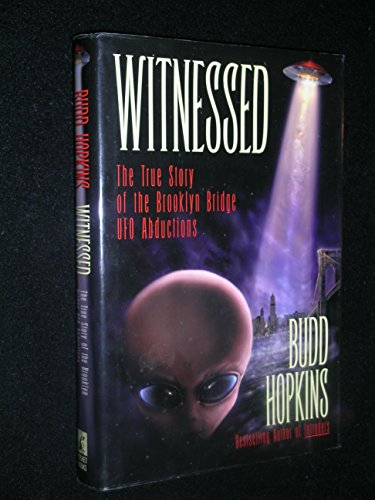
As an Amazon Associate, OverClassified may earn from qualifying purchases made through this link, at no extra cost to you.
Why This Is Essential Reading
Witnessed earns its place on this list not because its central evidentiary claims hold up under scrutiny -- this site's own research, like the internal MUFON critique it provoked and Hopkins' own former wife's later public allegations, finds the book's most dramatic corroboration substantially unverified or directly contradicted -- but because it remains one of the most consequential single case studies in the entire abduction literature for understanding how such cases are actually constructed. Budd Hopkins' account of the Cortile case gives this site's own Linda Cortile "Brooklyn Bridge" Abduction case file a uniquely well-documented evidentiary trail to examine, from Philip J. Klass's contemporaneous, ultimately vindicated skepticism through the Stefula-Butler-Hansen critique's suppression to Carol Rainey's posthumously amplified hoax allegation. Its continued cultural relevance, driven all the way to a contested 2024 Netflix documentary and lawsuit nearly thirty years after publication, confirms this site's own assessment: the book's lasting importance lies not in what it proves about extraterrestrial contact, but in what it reveals about the gap between an investigator's own conviction and the independent verification his most spectacular claims never received.
Related Cases & Theories
Essential Viewing

Sources Cited
- Hopkins, Budd. Witnessed: The True Story of the Brooklyn Bridge UFO Abductions. Pocket Books, 1996 (ISBN 978-0-671-56915-0, cited here).
- "Witnessed." Goodreads (3.8 average rating, 259 ratings, 28 reviews, checked August 2026). goodreads.com
- "Witnessed." Open Library bibliographic record (Pocket Books, New York, 1996, xiv + 399 pages; LCCN 96027856; OCLC 34973491). openlibrary.org
- "The Manhattan Alien Abduction | Official Trailer | Netflix." YouTube (Netflix's 2024 three-part documentary trailer; video verified via oEmbed). youtube.com
- Rainey, Carol. "The Priests of High Strangeness." Essay, 2011 (cited in this site's own Linda Cortile case file).
- Stefula, Joseph, Richard Butler, and George P. Hansen. "A Critique of Budd Hopkins' Case of the UFO Abduction of Linda Napolitano." 1993 (cited in this site's own Linda Cortile case file).
- This site's own resources library: Full Reading List, where this book is cited across 2 separate pages.
- This site's own key-figures entry: Budd Hopkins, for his full biography and site-wide connections.
- This site's own case file: The Linda Cortile "Brooklyn Bridge" Abduction, citing this book directly.
- This site's own theory page: Implant Hypothesis, citing this book directly.
- This site's own essential-reading entry: Missing Time, Hopkins' 1981 book that first established the hypnotic-regression abduction narrative this book builds on.
- This site's own locations entry: Lower Manhattan, New York, the site of the claimed abduction.
Have corrections, additional research, or peer-reviewed sources? Help improve this entry.
Suggest an Edit