
Gravitomagnetic Frame-Dragging Propulsion Hypothesis
Proposes that UAP propulsion could exploit frame-dragging — a real, experimentally confirmed general-relativistic effect, distinct from and often confused with metric-contraction “warp drive” proposals — by artificially inducing a strong local field to drag space-time itself, and the craft riding within it.
Real Physics, Speculative Engineering LeapCore Thesis
Frame-dragging — the Lense-Thirring effect — is not a fringe idea. It is a genuine, peer-reviewed prediction of Einstein's general relativity, first derived in 1918, and it has since been directly measured twice by independent teams: NASA's Gravity Probe B gyroscope satellite and the Italian-led LAGEOS/LARES laser-ranging program. A rotating mass measurably drags the local inertial frame of space-time around with it. This theory's speculative leap begins exactly where the confirmed physics ends: proponents propose that a sufficiently dense mass, spun at sufficiently extreme speed, could be engineered to produce a local frame-dragging field strong enough to carry a craft — and its occupants' inertia — along with it, explaining injury-free extreme accelerations without violating relativity. The honest problem is scale: Earth's own frame-dragging effect, measured in milliarcseconds of gyroscope drift per year, is astronomically smaller than anything an engineered propulsion device could use, and no known or foreseeable technology can rotate a mass dense and fast enough to close that gap.
Origin & History
The Gravitomagnetic Frame-Dragging Propulsion Hypothesis proposes that UAP flight characteristics — particularly extreme, apparently injury-free accelerations — could result from a craft artificially generating its own local frame-dragging field, a real general-relativistic phenomenon in which a rotating mass drags the surrounding fabric of space-time around with it. Unlike most speculative propulsion theories catalogued on this site, this one does not begin with a fringe claim; it begins with a fully mainstream, century-old piece of theoretical physics that has since been directly measured in orbit around Earth. The theory's speculative content is confined entirely to a single question the underlying physics itself does not answer: could that real effect ever be engineered at a scale large enough to move a craft, rather than merely perturb a gyroscope by a few thousandths of an arcsecond per year?
The effect's theoretical origin traces to Vienna in 1918, barely three years after Einstein published the field equations of general relativity. Austrian mathematician and astronomer Josef Lense and theoretical physicist Hans Thirring, working through the new field equations' weak-field, slow-rotation approximation — and drawing directly on correspondence with Einstein himself, who had raised closely related questions about rotating reference frames a few years earlier — derived that a slowly spinning, massive spherical body should perturb the orbit of a nearby test particle in a specific, calculable way: not merely by its ordinary gravitational pull, but by an additional effect arising purely from its rotation. A 2007 historical analysis by physicist Herbert Pfister argued the effect might more accurately be called the “Einstein-Thirring-Lense effect,” given how directly Einstein's own unpublished correspondence anticipated the result — a naming footnote this file mentions because it underscores how early, and how mainstream, this physics really is, in sharp contrast to the reputational history of several other propulsion theories this site catalogues.
It is worth being explicit, this early in the file, about what frame-dragging is not — because it is routinely confused, including in some UAP-propulsion literature, with this site's own Alcubierre Warp Drive Model. The two are entirely different general-relativistic mechanisms, and the difference matters for evaluating either theory honestly. The Alcubierre metric proposes actively contracting space-time ahead of a craft and expanding it behind, riding the resulting bubble like a surfer on a wave — a solution to Einstein's equations that requires negative energy density and has never been directly measured in any laboratory or astronomical setting. Frame-dragging requires no such exotic ingredient: it is what ordinary, positive-mass-energy does automatically whenever it rotates, exactly the way a spinning ball dragged through honey twists the honey around it, only here the “honey” is space-time itself. Where the Alcubierre metric is a mathematically valid but wholly unconfirmed hypothesis, frame-dragging is confirmed, measured physics; where the Alcubierre metric's engineering obstacle is a form of matter that may not be producible at any usable scale, frame-dragging's engineering obstacle is scale itself — the effect is real everywhere a mass rotates, but usably strong nowhere within reach of any technology anyone has proposed building.
Frame-dragging's connection to UAP-propulsion speculation is more recent, and more circumstantial, than its physics. Because a strong-enough local frame-dragging field would, in principle, carry a craft's local inertial frame along with it — meaning occupants inside that frame would experience no relative acceleration even as the craft repositioned dramatically against the outside world — some UAP researchers and propulsion-physics writers, working in the same speculative-engineering tradition as this site's Inertial Mass Reduction (Pais Effect) Hypothesis file, have proposed it as a candidate explanation for the g-force-defying maneuvers reported across many high-credibility case files. Notably, Eugene Podkletnov's disputed 1992 claim that a rotating superconductor could “shield” gravity — already covered in full technical and replication history on this site's Pais Effect file — is sometimes described in fringe literature as a frame-dragging-adjacent phenomenon, since type-II superconductors under rotation are theoretically predicted by mainstream physics to generate a genuine, if vanishingly small, gravitomagnetic field. This file does not re-litigate Podkletnov's specific claim; it exists to examine the real underlying physics of frame-dragging itself, on its own terms, and the honest engineering literature — genuinely speculative, but genuinely grounded in confirmed physics — that has grown up around the question of whether that physics could ever be engineered rather than merely observed.
Scientific Foundations
Frame-dragging's mathematical foundation is a direct consequence of Einstein's field equations, applied to a rotating rather than a static source of mass-energy. The clearest way to understand it is through the “gravitomagnetic” analogy that has become standard in the physics literature since the mid-20th century: just as a moving electric charge generates, in addition to its ordinary electric field, a magnetic field that exerts new forces on other moving charges, a rotating mass generates, in addition to its ordinary gravitational field, a “gravitomagnetic” field that exerts a new, rotation-dependent force on nearby moving (or even stationary, spinning) test objects. Because gravity is roughly 1036 times weaker than electromagnetism at the scale of fundamental particles, this gravitomagnetic effect is correspondingly minuscule for any rotating body of ordinary astronomical mass — which is precisely why it took until 2004 and 2011, respectively, for two independent experimental teams to measure it around a body as large as Earth.
1. The Lense-Thirring Effect & Frame-Dragging
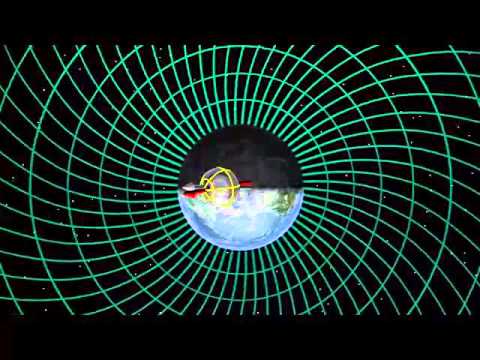
The core prediction, in its simplest form, is that the local inertial frame near a rotating mass is not fixed relative to the distant “fixed stars” the way Newtonian mechanics assumes — it is dragged around in the direction of the rotation. A gyroscope orbiting close to a spinning body will precess, not because any external torque acts on it, but because the very definition of “not rotating” is itself being twisted by the spinning mass beneath it. Lense and Thirring's original 1918 calculation, restricted to the weak-field, slow-rotation limit appropriate to ordinary astronomical bodies, produced a specific, quantitative prediction for how large this drag should be for a body of a given mass, radius, and rotation rate — the same formula, refined but not fundamentally altered, that NASA's Gravity Probe B team tested against Earth eighty-six years later.
2. Gravity Probe B: The First Direct Confirmation
NASA's Gravity Probe B (GP-B) mission, launched April 20, 2004, was purpose-built to measure frame-dragging directly, rather than infer it from an existing satellite's orbital data. Four ultra-precise gyroscopes — quartz spheres machined to within 40 atomic layers of a perfect sphere and coated in a thin layer of superconducting niobium — were placed in a polar orbit and pointed at a distant guide star, IM Pegasi, whose own position had been independently, precisely mapped by radio astronomy beforehand. General relativity predicted the gyroscopes' spin axes should drift, relative to that guide star, in two distinct ways: a larger “geodetic” drift from the simple curvature of space-time around Earth's mass, and a much smaller frame-dragging drift from Earth's rotation specifically. After a year of cryogenically cooled data collection and roughly five additional years of painstaking analysis — complicated by unexpected electrostatic “patch effect” torques on the gyroscope rotors that were only fully understood after science operations ended — Francis Everitt, the mission's Principal Investigator, announced GP-B's final results at a NASA press conference in May 2011: a measured frame-dragging precession of 37.2 ± 7.2 milliarcseconds per year, against a general-relativistic prediction of 39.2 mas/yr — a result confirming frame-dragging to within roughly 19% of its predicted value, published in Physical Review Letters. The geodetic effect, measured far more precisely, matched prediction to better than half a percent.
3. LAGEOS and LARES: An Independent Confirmation Using an Entirely Different Method
Gravity Probe B was not the only, or even the first, direct measurement of Earth's frame-dragging. Italian physicist Ignazio Ciufolini, working with Erricos Pavlis, took a completely different experimental approach: rather than building dedicated gyroscopes, they analyzed more than a decade of laser-ranging tracking data from two existing passive satellites, LAGEOS (launched by NASA in 1976) and LAGEOS 2 (launched jointly by NASA and the Italian Space Agency in 1992), each a dense sphere covered in retroreflectors with no moving parts of its own. Because frame-dragging causes a satellite's orbital plane itself to slowly precess, Ciufolini and Pavlis were able to extract the effect from the two satellites' combined orbital histories, publishing a 2004 paper in Nature reporting a measurement of 99% ± 5% of general relativity's predicted value — a result that drew genuine methodological criticism over uncertainty in the models of Earth's own lumpy gravitational field, but one substantially corroborated seven years later by Gravity Probe B's independent gyroscope-based result using a completely different measurement technique. Ciufolini went on to lead the LARES (2012) and LARES-2 (2022) satellite missions — purpose-built, geodetically optimized passive spheres designed specifically to cancel out the Earth-gravity-model uncertainties that had limited the original LAGEOS analysis — pushing the combined measurement's precision toward roughly one part in a thousand, an order-of-magnitude improvement over both original 2004 and 2011 results.
4. The Honest Engineering Gap
This is the section where this theory's confirmed physics ends and its genuinely speculative engineering literature begins, and the scale of the gap between the two is the central, unavoidable fact any honest treatment of this hypothesis must state plainly. Earth's own measured frame-dragging effect — a body with a mass of roughly 5.97 × 1024 kg, rotating once per day — produces a gyroscope precession of only about 39 milliarcseconds per year, an angle so small it would take roughly 10,000 years to rotate a distant gyroscope's spin axis by a single degree. For an engineered device to produce a usable, craft-scale propulsive frame-dragging field within, say, a few meters, rather than a barely-detectable effect measured over years across an orbit thousands of kilometers wide, the source mass would need to combine extraordinary density with extraordinarily fast rotation — the gravitomagnetic field scales with a rotating body's angular momentum, meaning a source needs to be simultaneously far denser and far faster-spinning than anything humans have ever built or moved to produce an effect strong enough to be useful over any practical distance, rather than merely measurable with a cryogenically cooled, atomically precise gyroscope after a year in orbit. The astrophysical objects that do produce strong, easily observed frame-dragging — rapidly spinning neutron stars and black holes, whose frame-dragging has been indirectly inferred from X-ray binary jet precession and, in a 2020 Science paper, from microsecond-precision pulsar-timing of a fast-rotating white dwarf in a binary system — are themselves the products of stellar collapse, involving densities and rotation rates no engineering process remotely approaches. No peer-reviewed proposal exists describing a credible pathway to rotating any producible mass fast enough, or packing it densely enough, to generate a frame-dragging field with any practical propulsive strength, and the small body of genuinely speculative engineering literature that does exist on gravitomagnetic and vacuum-metric propulsion — discussed further in Historical Precedents below — treats this gap as the field's central, unsolved problem rather than a detail to be waved away.
The scale of the gap is worth stating in concrete, physical terms rather than leaving it abstract. A neutron star's crust reaches densities on the order of 1017 kilograms per cubic meter; even osmium, the densest naturally stable element available to any human engineering process, manages only about 22,600 kilograms per cubic meter — a shortfall of roughly thirteen orders of magnitude before rotation rate is even considered. Rotation rate has its own hard physical ceiling, independent of density: any solid, producible material spun fast enough will eventually exceed its own tensile strength and fly apart, well before it reaches anything close to the rotation rates neutron stars achieve through gravitational collapse rather than mechanical spin-up. This is precisely the constraint Robert L. Forward's own 1963 speculative treatment of gravitomagnetic force generation, discussed further below, identified as the field's core practical limitation, more than four decades before Gravity Probe B or the LAGEOS satellites gave the underlying physics its first direct experimental confirmation. No material-science advance proposed anywhere in the engineering literature — carbon nanotube composites, theoretical metallic hydrogen, or any other exotic high-strength material discussed elsewhere on this site — closes a gap this large; closing it would require a change in the fundamental strength-to-density ratio of matter itself, not merely a better engineering material.
Government & Military Programs
Every government program with a documented, substantive connection to frame-dragging research has been a mainstream fundamental-physics effort, not a UAP-motivated one — a distinction worth stating plainly given how often this site's other propulsion theories involve at least some military or intelligence-community interest in the underlying claim itself. NASA's Gravity Probe B was conceived as early as 1959 by Stanford physicists Leonard Schiff, William Fairbank, and Robert Cannon, formally proposed to NASA in 1961, and funded, developed, and flown across more than four decades before its 2011 results were announced — one of the longest-running experiments in NASA's history, and, at a total program cost estimated near $750 million across its full lifetime, also one of its most expensive single fundamental-physics tests. Francis Everitt joined the effort in 1962 as its first full-time researcher and became Principal Investigator in 1981, ultimately steering the program from a still-unbuilt concept through the technological development of ultra-precise gyroscopes, cryogenic dewars, and drag-free satellite control that the experiment itself required, since much of the necessary technology, in Stanford's own words, “did not exist when the experiment was conceived.”
The LAGEOS/LARES program represents a parallel but organizationally distinct government investment, run jointly by NASA and the Italian Space Agency (Agenzia Spaziale Italiana, ASI) rather than by NASA alone. LAGEOS itself, launched in 1976, was originally built for satellite geodesy and plate-tectonics research rather than relativity testing specifically; its use for frame-dragging measurement, developed by Ciufolini beginning in the 1980s and 1990s, was an application layered onto an existing piece of space infrastructure rather than a purpose-built mission from the outset. LARES-2, by contrast, launched in July 2022 aboard the European Space Agency's inaugural Vega-C rocket, was purpose-built from the start specifically to improve the precision of the frame-dragging measurement, reflecting a continued, decades-long Italian government commitment to this specific line of fundamental-physics research that has run in parallel with, rather than in competition against, NASA's own gyroscope-based program.
Gravity Probe B's roughly four-decade development history also involved a wider set of institutional partners beyond NASA and Stanford alone: Lockheed Martin served as the mission's prime aerospace contractor, responsible for building the spacecraft bus and integrating Stanford's own gyroscope payload, and Saudi Arabia's King Abdulaziz City for Science and Technology (KACST) later joined as an international partner during the mission's extended data-analysis phase. This combination of a university-led science team, a major aerospace contractor, and an international government partner is itself a fairly conventional structure for a large NASA fundamental-physics mission, offering no evidence of the kind of classified, compartmented program structure this site's other propulsion theories sometimes document.
No declassified U.S. military or intelligence document that this file's research was able to identify describes a program to investigate frame-dragging specifically as a UAP-propulsion mechanism, in contrast to this site's Pais Effect and Vacuum Polarizability files, both of which document real, named Navy patents and internal test programs. NASA's own Breakthrough Propulsion Physics Program (1996–2002), covered in greater depth in this site's Zero-Point Energy Extraction Hypothesis file, assessed a range of revolutionary-propulsion concepts including gravitomagnetic and vacuum-metric-engineering proposals; program manager Marc Millis's own published summaries treat frame-dragging-adjacent gravity-shielding claims (including Podkletnov's) as unconfirmed rather than validated, consistent with the broader honest-limitation framing this file maintains throughout.
Physical Evidence
No recovered UAP hardware or crash debris anywhere in this site's catalogue is identified as, or claimed to function as, a frame-dragging propulsion device, and this theory predicts no distinctive material signature the way this site's metamaterial or exotic-alloy theories do — frame-dragging is a property of rotating mass acting on space-time itself, not a chemical or structural property of any particular material. What physical apparatus does exist in this theory's confirmed-physics half is real, well-documented scientific hardware: Gravity Probe B's four niobium-coated quartz gyroscopes and their cryogenic dewar, now preserved and displayed at the Smithsonian National Air and Space Museum, and the LAGEOS and LARES satellites themselves, each a dense, inert, retroreflector-covered sphere with no moving parts, still in orbit and still being tracked by ground-based laser stations today.
The theory's speculative propulsion half predicts a physical signature that is, by its own internal logic, almost entirely unobservable by ordinary means: a genuine frame-dragging propulsion field would not produce a chemical exhaust, a combustion byproduct, or an aerodynamic control surface, since (like the Alcubierre metric's warp bubble) the craft would never be mechanically interacting with the surrounding air or vacuum in the way a jet or rocket engine does. Unlike the Alcubierre metric, frame-dragging also predicts no optical signature at its boundary — no gravitational lensing, Cherenkov radiation, or vacuum polarization glow — because it involves no metric contraction or negative energy density, only the rotational dragging of an otherwise ordinary space-time. This makes the theory, if true, close to invisible to the same categories of physical-trace evidence this site's other propulsion theories are tested against, a limitation discussed further in Material Analysis below.
Supporting Case Files
Theoretical Alignment
This hypothesis aligns awkwardly with the Extraterrestrial Hypothesis specifically, because nothing about frame-dragging physics requires or implies a non-human origin — it is exactly as available, in principle, to a sufficiently advanced human engineering program as to a non-human one, which is why it is rated here as a relatively weak, incidental fit for ETH on its own. Its strongest and most honest alignment is with this site's broader category of speculative-but-physics-literate human engineering proposals, the same category occupied by the Pais Effect and Vacuum Polarizability files: a real, confirmed physical phenomenon that credentialed physicists have written about as a hypothetical (if currently unbuildable) propulsion mechanism, distinct from theories built on no confirmed physics at all. Its alignment with sensor or kinematic misidentification is rated moderate rather than low, in fair acknowledgment that many of the extreme-acceleration cases this theory is invoked to explain also have non-exotic, conventional candidate explanations (radar/optical parallax, aircraft-relative motion illusions) that require no new physics of any kind — a point this file's own Conventional Explanation Candidate section returns to directly. Taken together, these three percentages describe a theory whose real physics is exceptionally strong but whose case-specific explanatory reach is deliberately modest; this file does not claim frame-dragging explains any particular case file's data better than a conventional account, only that it remains a physically coherent, non-exotic-matter candidate mechanism worth cataloguing alongside this site's other zero-inertia propulsion theories.
Sensor & Instrumentation Detection Profile
A genuine, craft-scale engineered frame-dragging field would be difficult to detect with almost any conventional UAP-investigation instrument, and that difficulty is itself informative about how this theory could ever be confirmed or ruled out. Because the effect involves no metric contraction, no exotic energy density, and no interaction with the electromagnetic spectrum, it predicts none of the optical, spectroscopic, or infrared signatures this site's Alcubierre and Vacuum Polarizability files describe for their own proposed mechanisms — no gravitational lensing at a bubble boundary, no Cherenkov-like glow, no exhaust-plume heat signature. The only instrument class ever built specifically to detect frame-dragging directly is the one Gravity Probe B itself used: an ultra-precise, cryogenically stabilized gyroscope referenced against a distant guide star, an apparatus requiring a year of data collection and roughly five years of analysis to extract a signal from Earth's own comparatively enormous, well-understood mass. No UAP case file's sensor suite — radar, FLIR, ATFLIR gimbal camera, or ground-based visual observation — is remotely capable of measuring anything resembling a gyroscopic precession signature in real time during a fleeting encounter.
What this theory can, in principle, be evaluated against is purely kinematic: if a craft's local inertial frame were genuinely being dragged along with it by an engineered gravitomagnetic field, radar and visual tracking data should show the same discontinuous, near-instantaneous velocity changes this site's other zero-inertia propulsion theories predict — a track signature at least consistent with, though never uniquely diagnostic of, this specific mechanism over an Alcubierre-style metric bubble or a Pais-style vacuum-polarization inertial-mass reduction, since all three predict broadly similar kinematics by different physical routes. This is exactly the evidentiary limitation the Sensor & Instrumentation sections of this site's other zero-inertia theories describe: an object's kinematic track can rule mechanisms in as broadly compatible, but no sensor system fielded during an actual UAP encounter can distinguish between three physically distinct hypothetical mechanisms that happen to predict similar outward motion.
It is worth noting what real scientific instrumentation, as opposed to a fielded military sensor suite, would in principle be capable of detecting, since this theory's own confirmed-physics half was proven using exactly this class of hardware. Ground-based very-long-baseline interferometry (VLBI), the same radio-astronomy technique used to independently map Gravity Probe B's guide star IM Pegasi to the precision the mission required, can in principle detect frame-dragging-scale perturbations in a distant radio source's apparent position, though only against a source whose baseline position is already known to extraordinary precision, exactly as IM Pegasi's was. Satellite laser ranging, the technique underlying the LAGEOS and LARES-2 measurements, requires a purpose-built, corner-cube-reflector-equipped satellite tracked continuously from multiple ground stations over years, not a single fleeting encounter. Modern gravity gradiometers — instruments capable of measuring minute local variations in the gravitational field gradient, already used commercially in geological surveying and mineral exploration — represent, in principle, the closest thing to a portable frame-dragging detector, but even the most sensitive laboratory gradiometers built to date operate many orders of magnitude above the sensitivity Gravity Probe B's purpose-built, cryogenically isolated gyroscopes required to extract Earth's own comparatively enormous mass's frame-dragging signal. No portable, field-deployable instrument capable of detecting a genuine gravitomagnetic field at UAP-encounter range and timescale currently exists, which is itself a meaningful limitation on how this theory could ever be directly tested against a live sighting rather than argued from kinematics alone.
Environmental & Geospatial Context
As a proposed universal physical mechanism rather than a location-specific phenomenon, this theory carries no dedicated UAP sighting geography of its own; its confirmed-physics half is anchored entirely to space-based and laboratory-adjacent research infrastructure — Stanford University and NASA's own polar-orbit satellite operations for Gravity Probe B; Sapienza University of Rome and the joint NASA/Italian Space Agency LAGEOS and LARES-2 satellite program for Ciufolini's independent confirmation. Its three supporting case files span markedly different settings with no shared geography: the USS Nimitz encounter occurred over open Pacific waters off the Southern California coast in 2004, tracked by a carrier strike group's own multi-sensor suite; the Belgian UFO Wave unfolded over densely populated Belgian towns and cities across the 1989–1990 winter, generating an F-16 radar-lock intercept alongside thousands of civilian witness reports; and the Coyne Helicopter Incident occurred near Charles Mill Lake outside Mansfield, Ohio, involving a U.S. Army Reserve helicopter crew and independent ground witnesses on the night of October 18, 1973.
No environmental or geophysical variable proposed anywhere in the sourced frame-dragging literature — altitude, latitude, local magnetic field, or atmospheric density — is predicted to meaningfully affect a hypothetical craft-scale gravitomagnetic field's operation, since general relativity's frame-dragging prediction depends only on the source mass's own density, size, and rotation rate, not on its surrounding environment. This is a meaningful contrast with this site's electromagnetic and plasma-propulsion theories, several of which do predict altitude- or atmosphere-dependent behavior.
The confirmed-physics half of this theory does carry one genuine geospatial dependency worth noting for completeness, even though it has nothing to do with UAP sightings: Gravity Probe B's own measurement required a polar orbit specifically, rather than an equatorial or arbitrary inclination, so that its gyroscopes' guide-star-referenced drift would accumulate the geodetic and frame-dragging signals in geometrically separable directions over each orbit. Ciufolini's LAGEOS-based method carries no comparable orbital-geometry constraint, since it extracts the effect from a decade-plus of accumulated orbital-plane precession rather than from a single, carefully chosen orbital inclination — part of why the two experiments' broad agreement, despite such different observational geometries, is treated as a meaningfully strong cross-check in the physics literature.
Observer Credibility & Occupational Profile
This theory's confirmed-physics chapter carries an unusually strong credentialing record among the propulsion hypotheses this site catalogues. Josef Lense was a credentialed Austrian mathematician and astronomer who went on to a four-decade academic career at the Technical University of Munich; Hans Thirring led the University of Vienna's Institute for Theoretical Physics until his forced 1938 retirement under Nazi rule, a dismissal driven in part by his public defense of Einstein's relativity against ideologically motivated attacks. Francis Everitt, Gravity Probe B's Principal Investigator, spent nearly five decades of his career — from 1962 until the mission's 2011 results announcement — on a single experiment, a degree of sustained institutional commitment matched by few other propulsion-adjacent claimants on this site. Ignazio Ciufolini, working independently at Sapienza University of Rome, has spent a comparably long career building and refining the LAGEOS/LARES satellite-laser-ranging measurement using an entirely different experimental method than Everitt's team, and the fact that two independently funded, independently designed, methodologically unrelated experiments converged on compatible results is a genuinely strong credibility signal, of a kind this site's other speculative-physics theories rarely have available to them.
The theory's speculative propulsion-engineering half rests on a much thinner and more mixed credibility record. The genuine, peer-reviewed engineering-feasibility literature on gravitomagnetic and vacuum-metric propulsion — discussed in Historical Precedents below — comes from a small number of credentialed physicists (including Hal Puthoff and NASA Breakthrough Propulsion Physics program manager Marc Millis) writing in a deliberately speculative, exploratory mode about physics that remains within the boundaries of general relativity rather than inventing new laws, a meaningfully different credibility posture than claimants whose underlying mechanism itself has already failed independent replication (as in this site's Pais Effect file). No credentialed physicist associated with the confirmed Lense-Thirring/Gravity Probe B/LAGEOS physics has personally endorsed a UAP-propulsion application of their own work; that extension belongs entirely to secondary, UAP-focused commentary rather than to the original researchers. Robert L. Forward, whose 1963 paper is the closest thing this theory has to a founding engineering-speculation document, is a partial but instructive exception: a credentialed physicist (Ph.D., University of Maryland, 1965) writing in a mainstream peer-reviewed journal, but writing explicitly and only about the physics itself, decades before any UAP-propulsion framing existed to apply it to — his own later, extensive body of hard-science-fiction writing kept a deliberate, self-imposed line between speculative fiction and his separately published technical physics, a distinction this file's own treatment of the theory tries to preserve.
Historical Precedents & Archive Matches
Frame-dragging's conceptual ancestor predates general relativity itself. English physicist Oliver Heaviside speculated as early as 1893 that gravity, like electromagnetism, might have a magnetic-like analogue arising from moving mass, a purely speculative extension of Maxwell's equations offered decades before Einstein's field equations existed to formally justify it — a genuine historical curiosity that anticipated the “gravitomagnetic” language this file uses to explain frame-dragging today, without itself constituting a real theoretical prediction. Austrian physicist Ernst Mach's late-19th-century arguments about inertia being determined by the distribution of all the matter in the universe — “Mach's principle,” which directly influenced Einstein's own development of general relativity — is frequently cited in the frame-dragging literature as a closely related conceptual precedent, since frame-dragging is, in a real sense, a local, quantitative demonstration that nearby rotating mass measurably influences what “non-rotating” means for a test gyroscope.
The genuinely speculative propulsion-engineering literature on this subject begins, in a documented and citable form, with physicist Robert L. Forward's 1963 paper “Guidelines to Antigravity,” published in the mainstream, peer-reviewed American Journal of Physics — more than four decades before either Gravity Probe B or the LAGEOS satellites gave frame-dragging its first direct experimental confirmation. Forward, then a physicist at Hughes Aircraft Company working toward the doctorate in gravitational-radiation detection he would earn from the University of Maryland in 1965, systematically catalogued several little-known, non-Newtonian gravitational effects permitted by general relativity, including the rotational and acceleration-dependent dragging forces a spinning or accelerating mass exerts on nearby test bodies, and explicitly proposed the same rotating-shell frame-dragging mechanism this theory describes as a candidate, if extraordinarily impractical, propulsion and force-generation concept. Forward's own paper is notable for reaching essentially the same honest conclusion this file does: the required source-mass densities and rotation rates place any practical device far outside the reach of any material science he could foresee, a limitation later, independent physics (the tensile-strength ceiling on rotating solids) has only reinforced rather than resolved.
Later physicist Hal Puthoff's papers on vacuum and space-time-metric engineering for interstellar flight — published across peer-reviewed and NASA-adjacent venues from the early 2000s onward — discuss gravitomagnetic field generation as one of several general-relativistic mechanisms a sufficiently advanced propulsion technology might someday exploit, alongside metric-contraction (Alcubierre-style) and polarizable-vacuum concepts, while explicitly treating the required engineering as far beyond any current or near-term capability. NASA's own Breakthrough Propulsion Physics Program (1996–2002) is the clearest institutional precedent for treating this kind of question as a legitimate, if long-shot, subject for formal literature review rather than either uncritical advocacy or dismissal without examination; Marc Millis's published program summaries situate gravitomagnetic propulsion concepts within the same honest “interesting physics, no known engineering pathway” category this file itself uses. DARPA's separate 100 Year Starship study, launched in 2011, likewise catalogued gravitomagnetic and metric-engineering concepts as part of a broader, publicly acknowledged feasibility survey of exotic interstellar-propulsion physics, situating this theory within the same wider pattern of U.S. government-funded interest in propulsion physics documented on this site's Alcubierre Warp Drive file, without ever funding a dedicated frame-dragging-propulsion engineering program of its own. Eugene Podkletnov's disputed 1992 rotating-superconductor claim — covered in full on this site's Pais Effect file — sits adjacent to, but conceptually distinct from, this precedent chain: type-II superconductors under rotation are theoretically predicted by mainstream physics to generate a real, if minuscule, gravitomagnetic field, several orders of magnitude smaller than Podkletnov's reported 0.3% weight-change effect, which is precisely why NASA/UAH's and Gregory Hathaway's independent replication attempts found nothing at Podkletnov's claimed scale. This file treats that connection as a genuine, honest cross-reference rather than supporting evidence for either claim.
Material Analysis
Like the Alcubierre metric, a genuine frame-dragging propulsion mechanism predicts an almost total absence of the conventional material-trace evidence this site's other propulsion theories are tested against: no reaction mass, no combustion byproduct, no aerodynamic debris, and — unlike Alcubierre specifically — not even the electromagnetic or optical boundary signature a warp-bubble wall would produce, since frame-dragging involves no metric contraction or exotic energy density of any kind. What the theory's confirmed-physics half does predict, and what genuinely exists, is entirely instrumental rather than material: Gravity Probe B's gyroscope-precession data and the LAGEOS/LARES satellites' laser-ranging orbital-precession data, both of which are real, peer-reviewed, and available for independent re-analysis, unlike a chemical or metallurgical sample. Cross-referenced against this site's other materials-based theories, this is a meaningful evidentiary contrast in the opposite direction from, say, the Metallic Hydrogen & Exotic Metamaterials file's Ubatuba magnesium fragments: this theory's best evidence is a precisely quantified numerical measurement, not a physical object, and that measurement (whether GP-B's 19%-uncertainty result or LAGEOS/LARES's tighter figure) is exactly as re-testable and re-analyzable today as it was the day it was published, since the underlying satellites remain in orbit and continue to be tracked. This also means the theory's confirmed-physics half is unusually resistant to the kind of "lost sample" or "unavailable for re-testing" problem that limits several of this site's other physical-evidence-based theories: any physicist with access to Gravity Probe B's published gyroscope data or the LAGEOS/LARES-2 tracking archive can, in principle, independently re-derive the same frame-dragging measurement from the same underlying dataset, a genuine scientific-transparency advantage this theory's speculative propulsion half does not share, since no comparable public dataset exists for any proposed engineering device.
Theory Development Timeline
| Date | Development |
|---|---|
| 1918 | Austrian physicists Josef Lense and Hans Thirring publish the first calculation of frame-dragging, deriving how a slowly rotating massive body should perturb a nearby orbit within the newly published framework of Einstein's general relativity. |
| 1959–1961 | Stanford physicists Leonard Schiff, William Fairbank, and Robert Cannon conceive of a satellite gyroscope experiment to directly test general relativity's frame-dragging and geodetic predictions, formally proposing what would become Gravity Probe B to NASA in 1961. |
| 1962 | Francis Everitt joins the Gravity Probe B program at Stanford as its first full-time researcher. |
| 1976 | NASA launches the LAGEOS satellite, originally for geodesy and plate-tectonics research; its orbital data would later be repurposed for frame-dragging measurement. |
| 1992 | NASA and the Italian Space Agency jointly launch LAGEOS 2, giving Ignazio Ciufolini and Erricos Pavlis two independent satellites to cross-reference for a frame-dragging measurement. |
| Apr. 20, 2004 | Gravity Probe B launches into polar orbit, carrying four cryogenically cooled gyroscopes pointed at guide star IM Pegasi. |
| Oct. 2004 | Ciufolini and Pavlis publish their LAGEOS/LAGEOS 2 frame-dragging measurement in Nature, reporting 99% ± 5% of the general-relativistic prediction. |
| May 2011 | Francis Everitt announces Gravity Probe B's final results at a NASA press conference: frame-dragging confirmed to within roughly 19% of prediction (37.2 ± 7.2 mas/yr measured vs. 39.2 mas/yr predicted), published in Physical Review Letters. |
| 2012 | Italy's LARES satellite launches, designed to improve on the original LAGEOS measurement's precision by reducing Earth-gravity-model uncertainty. |
| 2020 | A Science paper reports microsecond-precision pulsar timing detecting Lense-Thirring precession induced by a fast-rotating white dwarf in a binary system — an independent, astrophysical-scale confirmation of the same underlying physics. |
| Jul. 2022 | LARES-2 launches aboard the European Space Agency's inaugural Vega-C rocket, purpose-built to push the combined LAGEOS/LARES frame-dragging measurement toward roughly one part in a thousand precision. |
| 2017–present | Following renewed public and journalistic attention to UAP flight kinematics, frame-dragging is increasingly cited — alongside the physically distinct Alcubierre and Pais Effect mechanisms — as a candidate explanatory physics for injury-free extreme acceleration, despite the enormous engineering gap between Earth's measured effect and any usable propulsion device. |
Weighing the Evidence
Supporting Arguments
- Frame-dragging is a genuine, peer-reviewed prediction of general relativity, first derived in 1918, requiring no exotic matter or unconfirmed physics of any kind — unlike this site's Alcubierre or Pais Effect theories
- The effect has been directly measured twice, by two independently funded, methodologically unrelated experiments: NASA's Gravity Probe B gyroscopes (2011) and the Ciufolini-led LAGEOS/LARES-2 satellite-laser-ranging program (2004–2026)
- A sufficiently strong local frame-dragging field would, in principle, carry a craft's local inertial frame with it, offering a physically coherent (if currently unbuildable) explanation for injury-free extreme accelerations
- NASA's own Breakthrough Propulsion Physics Program treated gravitomagnetic propulsion as a legitimate, if speculative, subject for formal literature review rather than dismissing it outright
Skeptical Arguments
- Earth's own measured frame-dragging effect is astronomically small — about 39 milliarcseconds of gyroscope precession per year — and no known or foreseeable engineering process can rotate a producible mass densely or fast enough to generate a craft-scale, propulsively usable field
- The astrophysical bodies that do produce strong frame-dragging (neutron stars, black holes) achieve it through stellar-collapse densities and rotation rates with no conceivable engineering analogue
- No peer-reviewed proposal anywhere in the sourced literature describes a credible engineering pathway from the confirmed physics to a working propulsion device
- The theory predicts almost no independently testable material or optical signature, since it involves no metric contraction, exotic energy density, or electromagnetic interaction — making it, like the Alcubierre metric, essentially unfalsifiable as applied to any specific UAP case
Conventional Explanation Candidate
Mainstream physics does not dispute that frame-dragging is real; unlike this site's more contested propulsion theories, there is no genuine scientific controversy over whether the Lense-Thirring effect exists. The controversy, such as it is, concerns only the propulsion application layered on top of it. This is a genuinely unusual position for a theory on this site to occupy: most of the Conventional Explanation Candidate sections elsewhere in this catalogue weigh a proposed exotic mechanism against a mundane, non-exotic alternative explanation for the same observed data. Here, the "conventional" explanation and the theory's own confirmed physics are the same thing — the open question is entirely about a downstream engineering application, not about whether the underlying phenomenon is real. This section rates three distinct claims separately, deliberately avoiding the common error of blending a confirmed phenomenon and a speculative application into a single verdict.
Frame-Dragging as a Real Physical Phenomenon
ConfirmedDirectly measured by two independent, methodologically unrelated experiments — Gravity Probe B's gyroscopes and the LAGEOS/LARES-2 satellite-laser-ranging program — with results converging on general relativity's predicted value. This is genuinely settled, mainstream physics, not a disputed or fringe claim.
An Engineered, Propulsively Usable Frame-Dragging Device
Highly ImplausibleEarth's own measured effect is tens of milliarcseconds per year of gyroscope drift — the source mass and rotation rate required to produce a craft-scale, propulsively usable field vastly exceeds anything achievable with any known or foreseeable engineering technology. No peer-reviewed proposal describes a credible pathway to close this gap.
Podkletnov's Rotating Superconductor as Confirmed Frame-Dragging
UnprovenCovered in full on this site's Pais Effect file: NASA/UAH's and Gregory Hathaway's independent replication attempts found no weight-modification effect at Podkletnov's claimed 0.3% scale, and no peer-reviewed theoretical framework derives a mechanism by which a rotating type-II superconductor could produce gravitomagnetic shielding anywhere near that magnitude.
Theoretical Assessment Profile
Six-domain evaluation of this hypothesis
Key Proponents
Josef Lense
Co-derived the 1918 calculation, working from Einstein's newly published field equations, that a rotating mass drags the local inertial frame of space-time around with it — the effect that would not be directly measured for another 86 years.
Hans Thirring
Co-authored the 1918 frame-dragging prediction with Josef Lense; later led the University of Vienna's Institute for Theoretical Physics until his forced 1938 retirement under Nazi rule, partly for his public defense of Einstein's relativity.
Francis Everitt
Steered NASA's Gravity Probe B satellite gyroscope experiment from 1962 through its 2011 final results, directly confirming frame-dragging around Earth to within roughly 19% of general relativity's predicted value.
Ignazio Ciufolini
Led the independent LAGEOS/LARES satellite-laser-ranging measurement of frame-dragging, first published in 2004 and refined through the 2022 LARES-2 mission, using an entirely different experimental method than Gravity Probe B.
Dr. Eric Davis
Has written for defense-adjacent research organizations on the theoretical feasibility of general-relativistic propulsion concepts — including gravitomagnetic and metric-engineering mechanisms alongside warp and wormhole physics — as potential, if currently unbuildable, explanations for advanced UAP performance.
Related Cases
Further Reading
Was Einstein Right? Putting General Relativity to the Test
A leading relativist's account of how general relativity's predictions — including frame-dragging — have been experimentally tested, from the classic bending-of-light observations through the satellite era.
Black Holes and Time Warps: Einstein's Outrageous Legacy
Nobel laureate physicist Kip Thorne's account of general relativity's most extreme predictions, including the frame-dragging of space-time around rotating black holes — the astrophysical extreme this theory's engineering gap is measured against.
Relativity: The Special and the General Theory
Einstein's own popular account of the theory whose field equations, published just two years earlier, gave Lense and Thirring the mathematical foundation for their 1918 frame-dragging prediction.
Gravity: An Introduction to Einstein's General Relativity
A widely used physics-track textbook covering the Lense-Thirring metric and gravitomagnetism in accessible technical detail, for readers wanting the underlying mathematics rather than a popular account.
The Physics of Star Trek
A physicist's accessible tour of which speculative propulsion and field-engineering concepts remain within known physics versus which require genuinely new laws — useful context for weighing this theory's confirmed physics against its speculative engineering leap.
DISCLOSURE: Some links above are affiliate links. If you purchase through them, OverClassified receives a small commission at no additional cost to you. This helps support independent research.
Essential Viewing
Sources Cited
- "Lense–Thirring Precession," Wikipedia, summarizing the 1918 derivation and subsequent experimental confirmations.
- "Josef Lense," Wikipedia.
- "Hans Thirring," Wikipedia.
- Everitt, C.W.F. et al. "Gravity Probe B: Final Results of a Space Experiment to Test General Relativity," Physical Review Letters 106, 221101, 2011.
- Stanford University / NASA. "GP-B Status Update — May 4, 2011," Gravity Probe B official mission site.
- "Gravity Probe B: Testing Einstein's Universe," Stanford University official mission website.
- "Gravity Probe B Concludes Its 50-Year Quest," Physics Today, July 2011.
- "Gravity Probe B Confirms Einstein's General Relativity," CERN Courier, June 6, 2011.
- "Gravity Probe B Confirms the Existence of Gravitomagnetism," NASA Astronomy Picture of the Day, May 10, 2011.
- Will, Clifford M. "Finally, Results from Gravity Probe B," Physics (APS) 4, 43, 2011.
- Ciufolini, I. & Pavlis, E. C. "A Confirmation of the General Relativistic Prediction of the Lense-Thirring Effect," Nature 431, 958–960, 2004.
- Ciufolini, I. et al. "Test of General Relativity and Measurement of the Lense-Thirring Effect with Two Earth Satellites," arXiv:gr-qc/0209109.
- "LARES-2 Satellite Measures Frame-Dragging Effect Around the Earth," Nature, 2026.
- Ciufolini, I. et al. "An Improved Test of the General Relativistic Effect of Frame-Dragging Using the LARES and LAGEOS Satellites," arXiv:1910.09908.
- "Lense–Thirring Frame Dragging Induced by a Fast-Rotating White Dwarf in a Binary Pulsar System," Science 368, 2020.
- Millis, Marc G. "Prospects for Breakthrough Propulsion From Physics," NASA Glenn Research Center / NASA Technical Reports Server, 2004.
- "Breakthrough Propulsion Physics Program," Wikipedia, citing NASA program records.
- Puthoff, H. E. "Advanced Space Propulsion Based on Vacuum (Spacetime Metric) Engineering," arXiv:1204.2184.
- Podkletnov, E. & Nieminen, R. "A Possibility of Gravitational Force Shielding by Bulk YBa2Cu3O7−x Superconductor," Physica C 203, 1992.
- NASA Marshall Space Flight Center. "On the Mechanism for a Gravity Effect Using Type II Superconductors," NASA Technical Reports Server, 1999.
- Alcubierre, Miguel. "The Warp Drive: Hyper-fast Travel Within General Relativity," Classical and Quantum Gravity 11, 1994.
- "Inertial Mass Reduction (Pais Effect) Hypothesis," theory file, OverClassified (full Podkletnov replication and NAWCAD test-program history).
- "Alcubierre Warp Drive Model," theory file, OverClassified (comparison mechanism: metric contraction vs. rotational frame-dragging).
Have corrections, additional research, or peer-reviewed sources? Help improve this entry.
Suggest an Edit