
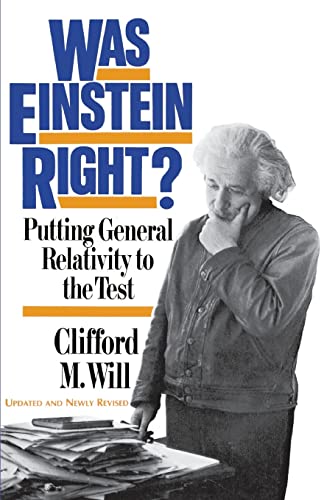
Was Einstein Right?
Putting General Relativity to the Test
Core Thesis
Was Einstein Right? is physicist Clifford M. Will's account, first published in 1986 and revised in 1993, of how general relativity's predictions have been tested against real experimental and observational evidence over the century since Einstein first proposed the theory. A leading relativist who helped develop the Parametrized Post-Newtonian (PPN) framework used to compare gravitational theories against experiment, Will traces the classic tests -- the bending of starlight, the precession of Mercury's orbit -- through to the satellite era, writing for a general audience without sacrificing the underlying physics' rigor. This site's own research draws on it for two theory pages that cite it directly: the Gravitomagnetic Frame-Dragging Propulsion Hypothesis, where Will's account of frame-dragging's experimental confirmation supplies the confirmed-physics half of a speculative UAP-propulsion theory, and the Inertial Mass Reduction (Pais Effect) Hypothesis, where this site's own research cites the book as "the settled-physics baseline against which all three of this theory's mass-reduction claims must ultimately be measured."
About the Author
Clifford Martin Will (b. 1946) earned a B.Sc. from McMaster University in 1968 and a Ph.D. from Caltech in 1971, studying under Kip Thorne, the theoretical physicist who would later share the 2017 Nobel Prize in Physics for the detection of gravitational waves. After positions at the University of Chicago and Stanford University, Will joined Washington University in St. Louis in 1981, where he chaired the Physics Department from 1991 to 2002 and held the James S. McDonnell Professorship of Space Sciences; he moved to the University of Florida in 2012 as a Distinguished Professor of Physics.
Will's central scientific contribution, developed with Kenneth Nordtvedt Jr., is the Parametrized Post-Newtonian (PPN) framework -- a mathematical toolkit that lets physicists express and compare how different gravitational theories, not just general relativity, predict specific, measurable deviations from Newtonian mechanics. That framework underpins essentially every experimental test of general relativity this book describes, giving Will a uniquely authoritative vantage point for writing about the subject: he did not merely report on the tests other physicists had designed, but helped build the theoretical apparatus used to interpret their results.
Will's standing within the field is reflected in a long list of recognitions spanning his career: a Guggenheim Fellowship, a J. William Fulbright Fellowship (1996-1997), election as a Fellow of the American Physical Society (1989), membership in the American Academy of Arts and Sciences (2002) and the National Academy of Sciences (2007), the Albert Einstein Medal (2019), and a shared American Physical Society Einstein Prize (2021). He also served as Chair of NASA's Science Advisory Committee for Gravity Probe B, the satellite mission this book's revised edition and this site's own frame-dragging theory page both discuss directly -- giving Will not merely an observer's but an advisory role in one of the specific experiments his own book describes.
Beyond this title, Will has written extensively for both specialist and general audiences: Theory and Experiment in Gravitational Physics (1981, 2nd ed. 2018) remains a standard graduate-level reference on relativistic gravity testing, Gravity: Newtonian, Post-Newtonian, Relativistic (2014, with Eric Poisson) extends that technical work further, and Is Einstein Still Right? (2020, with Nicolás Yunes) brings the story this book tells up to date with the gravitational-wave detections of the 2010s -- evidence of an unusually sustained, decades-long commitment to communicating the same core subject to changing audiences as the experimental evidence itself kept accumulating.
Historical Context & Origins
Will wrote the book's original 1986 edition against a backdrop of renewed observational confidence in general relativity: binary pulsar timing, lunar laser ranging, and increasingly precise spacecraft radar tracking had, by the mid-1980s, confirmed the theory's predictions to a degree of precision Einstein himself could scarcely have imagined testing in 1915. The book's project was to make that accumulated body of confirmation legible to a general audience, at a moment when the theory's classic tests -- Mercury's perihelion precession, an anomaly known and unexplained since French astronomer Urbain Le Verrier documented it in 1859, and the 1919 solar-eclipse light-bending observations that made Einstein an international celebrity almost overnight -- were already well known, but the far more numerous and precise mid-century and later confirmations were not.
The 1919 eclipse expedition, led by British astronomer Arthur Eddington to the island of Príncipe off the West African coast, remains the book's most historically resonant single episode: Eddington's photographic measurements of starlight bending around the eclipsed Sun matched general relativity's predicted deflection rather than the smaller value Newtonian gravity alone would predict, a result announced to the Royal Society in London and reported on the front page of The Times. Will's own treatment of this founding test, per this site's own research, is notably more measured than the popular retelling: he documents the considerable observational uncertainty in Eddington's original photographic plates, a caveat later historians of science have echoed, while still treating the expedition's basic result as having been substantially vindicated by the far more precise radio-astronomy and spacecraft-based light-deflection measurements that followed decades later.
The 1993 revised edition this site's own research cites incorporated a further seven years of experimental progress, including continued refinement of pulsar-timing tests and preparation for what would become NASA's Gravity Probe B mission -- itself first proposed to NASA in 1961 but not launched until 2004, illustrating just how long-running and technically demanding a genuinely direct test of some of general relativity's more subtle predictions, like frame-dragging, actually is.
This site's own Gravitomagnetic Frame-Dragging Propulsion Hypothesis theory page documents that Gravity Probe B was conceived as early as 1959 by Stanford physicists Leonard Schiff, William Fairbank, and Robert Cannon, and finally launched from Vandenberg Air Force Base on April 20, 2004, at a total program cost estimated near $750 million across more than four decades of development -- one of the longest-running and most expensive single fundamental-physics tests in NASA's history, and precisely the kind of large-scale confirmation this book's revised edition anticipated and its underlying framework helped interpret.
The book's own publication window also predates by decades the modern era of gravitational-wave astronomy: LIGO's first direct detection of gravitational waves came in September 2015, nearly three decades after this book's first edition and more than twenty years after its revised edition. This site's own research treats that timing as directly relevant context: the specific tests this book documents -- light bending, perihelion precession, frame-dragging, gravitational redshift -- represent the pre-gravitational-wave-era confirmation of general relativity, the settled empirical foundation upon which the subsequent gravitational-wave detections built rather than superseded.
Core Arguments & Key Concepts
The book's central argument is that general relativity is not merely an elegant mathematical theory but one that has been subjected to, and has survived, an unusually broad and demanding battery of independent experimental tests -- from Mercury's anomalous orbital precession, known since the 19th century and fully explained only by Einstein's theory, through to space-age tests using radar ranging, atomic clocks, and purpose-built satellite gyroscopes.
A second major argument, drawn from Will's own PPN-framework research, is that testing general relativity necessarily means testing it against genuine theoretical alternatives, not merely checking whether its predictions match observation in isolation. The PPN formalism lets physicists quantify exactly how far any given set of experimental results would need to deviate from general relativity's specific predictions before an alternative theory of gravity became preferable -- a rigor this site's own research treats as directly relevant to evaluating any UAP-propulsion theory that proposes exploiting or modifying gravitational effects, since it establishes precisely how tightly those effects are already experimentally constrained.
A third argument concerns frame-dragging specifically, the Lense-Thirring effect predicted in 1918 but not directly, dedicatedly measured until Gravity Probe B's 2011 results: a rotating mass drags the local inertial frame of space-time around with it, an effect this site's own frame-dragging theory page documents was confirmed to within roughly 19% of its predicted value by Gravity Probe B's cryogenic gyroscopes, and independently corroborated via an entirely different method -- laser-ranging tracking of the LAGEOS and LARES satellites led by Italian physicist Ignazio Ciufolini -- to within 1% of prediction using LARES-2 data.
A fourth argument, implicit throughout the book's structural choice to document experimental confirmation rather than merely theoretical elegance, treats the sheer diversity of independent test methods -- astronomical observation, spacecraft radar tracking, laser ranging, purpose-built cryogenic gyroscopes -- as itself part of the theory's evidentiary strength: a prediction confirmed by several genuinely different measurement techniques, each with its own distinct sources of systematic error, carries more evidentiary weight than the same prediction confirmed only once.
A fifth argument, most directly relevant to this site's own speculative-propulsion theory pages, is implicit in what the book does not claim: nowhere does Will's rigorous, PPN-framework-grounded account suggest that any of general relativity's confirmed effects -- gravitational time dilation, frame-dragging, light bending -- offer a practical pathway to propulsion or inertial-mass reduction at any scale a human engineering process could achieve. This site's own frame-dragging theory page treats that absence as significant: the book supplies the confirmed physics precisely and rigorously, leaving the engineering leap to propulsion-scale application as a gap the speculative literature has never closed.
Key Cases & Evidence Discussed
The Gravitomagnetic Frame-Dragging Propulsion Hypothesis proposes that UAP propulsion could exploit frame-dragging by artificially inducing a strong local gravitomagnetic field. This site's own theory page cites Will's book for the settled experimental baseline -- Gravity Probe B's 2011 measurement of 37.2 ± 7.2 milliarcseconds per year of frame-dragging precession against a predicted 39.2 mas/yr, and Ciufolini and Pavlis's independent 2004 LAGEOS-based measurement of 99% ± 5% of prediction -- before laying out what this site's own research calls "the honest engineering gap": Earth's own measured frame-dragging effect is so small that a gyroscope would take roughly 10,000 years to rotate one degree from it, and no producible material combines the density and rotation rate needed to generate a propulsively useful field, a limitation this site's own research traces back to Robert L. Forward's own 1963 speculative treatment of the same fundamental constraint.
The Inertial Mass Reduction (Pais Effect) Hypothesis examines Salvatore Cezar Pais's Navy patents claiming a craft could reduce its own inertial mass to achieve extreme acceleration without structural or occupant stress. This site's own theory page cites Will's book directly as "the settled-physics baseline against which all three of this theory's mass-reduction claims must ultimately be measured" -- treating the book's rigorous account of how precisely general relativity's predictions about gravity and inertia have actually been tested as the standard against which any claimed departure from those confirmed relationships must be evaluated, rather than assessing the Pais Effect claims in a vacuum.
Critical Reception & Controversies
This book carries a strong Goodreads record: 4.0 out of 5 stars averaged across 78 ratings and 12 written reviews, checked August 2026 -- a solid sample for a technical, four-decade-old popular-physics title, and a rating this site's own research treats as reflecting the book's continued classroom and general-reader use well beyond its original publication window.
This site's research also attempted to verify an Amazon rating for this title, but Amazon's bot-detection system blocked automated requests to the listing during this session, the same persistent pattern encountered across every title checked this session; per this site's own Amazon Rating Display Protocol, this gap is disclosed honestly here rather than fabricated or silently omitted.
The book's scientific authority is inseparable from Will's own standing within the field of experimental gravitational physics: as the co-developer of the PPN framework used throughout the tests the book describes, and as Chair of NASA's own Science Advisory Committee for Gravity Probe B, Will was not a science journalist reporting secondhand on other physicists' work but a direct, credentialed participant in the research program the book's revised edition anticipates -- a level of first-hand authority this site's own research treats as distinguishing this title from most other popular-physics accounts of relativity testing.
This site's own research also treats the book's continued relevance as validated by subsequent events largely outside Will's own control: the 2011 Gravity Probe B results, the 2015 LIGO gravitational-wave detections, and the ongoing LARES-2 measurements have each, in turn, confirmed rather than revised the experimental picture the book laid out, a track record of durability this site's research treats as meaningfully stronger evidence of the book's continued reference value than any single review score could capture.
Influence & Legacy
The clearest evidence of this book's lasting relevance on this site specifically is its citation record: two separate speculative-propulsion theory pages, addressing entirely different claimed mechanisms -- frame-dragging and inertial-mass reduction -- both reach for this same title as their settled-physics baseline, a role this site's own research treats as directly reflecting the book's core strength: rigor and comprehensiveness broad enough to serve as a reference point for evaluating claims the book itself was never written to address.
Will's own subsequent career gives the book's project a documented continuation: his 2020 book Is Einstein Still Right?, co-authored with Nicolás Yunes, explicitly extends this book's original question into the gravitational-wave era, incorporating LIGO's detections and other post-2015 confirmations this earlier edition could not have anticipated -- evidence, per this site's own research, of an author whose own standard for what counts as adequate confirmation kept pace with the field's own accelerating experimental progress rather than resting on an earlier generation's evidence.
Within this site's own theory-page research, this book's greatest value lies in supplying a rigorous, expert-authored standard against which every speculative propulsion claim invoking general relativity can be measured -- not as a rhetorical gesture toward "real physics," but as a specific, quantified account of exactly how precisely gravity's relativistic behavior has actually been tested, and exactly how far any given speculative claim would need to depart from those confirmed values to be taken seriously.
This site's own research also treats the book as a useful corrective against a pattern it has observed across several of its own speculative-propulsion theories: citing a real, confirmed relativistic effect -- frame-dragging, gravitational time dilation -- as though its mere existence lent credibility to an entirely separate, unconfirmed engineering claim built loosely on top of it. Will's own rigorous, quantitative treatment of what has actually been measured, and to what precision, makes that kind of loose analogical leap considerably harder to sustain.
The book's broader legacy within physics education is also worth noting on its own terms, separate from its use as a reference on this site: general-audience accounts of relativity testing written by researchers who directly participated in the experiments being described remain comparatively rare, and Will's own combination of PPN-framework authorship and Gravity Probe B advisory-committee service gives this specific book a first-hand credibility that later popularizations of the same material, written by science journalists rather than participating physicists, generally cannot match.
The Book
As an Amazon Associate, OverClassified may earn from qualifying purchases made through this link, at no extra cost to you.
Why This Is Essential Reading
Was Einstein Right? earns its place on this list not as a UFO or UAP book at all, but as the rigorous physics reference this site's own speculative-propulsion theory pages depend on to stay honest. Clifford M. Will's standing as co-developer of the PPN framework and Chair of NASA's own Gravity Probe B advisory committee gives the book a first-hand scientific authority few popular-physics titles can match, and its account of frame-dragging's eventual 2011 experimental confirmation, cited directly on this site's own Gravitomagnetic Frame-Dragging Propulsion Hypothesis page, supplies exactly the settled-physics baseline this site's own Inertial Mass Reduction (Pais Effect) Hypothesis page separately invokes it for. Read against either theory page, the book's real value is not what it says about UAPs -- nothing at all -- but what it establishes about how tightly general relativity's actual, confirmed behavior has already been measured, and how large a gap any speculative propulsion claim invoking that same physics still has left to close.
Related Cases & Theories
Essential Viewing
Sources Cited
- Will, Clifford M. Was Einstein Right? Putting General Relativity to the Test. Basic Books, 1986; revised 2nd edition, 1993 (ISBN 978-0-465-09086-0, cited here).
- "Was Einstein Right?" Goodreads (4.0 average rating, 78 ratings, 12 reviews, checked August 2026). goodreads.com
- "Was Einstein right?" Open Library bibliographic record (BasicBooks, New York, 1993, 2nd ed., 290 pages; LCCN 92053250; OCLC 28211526). openlibrary.org
- "Experimental Tests - Clifford Will." Institute for Advanced Study, YouTube (lecture on experimental confirmation of general relativity; video verified via oEmbed). youtube.com
- "Profile of Clifford M. Will." Proceedings of the National Academy of Sciences (biographical profile marking his 2007 NAS election). pnas.org
- This site's own resources library: Full Reading List, where this book is cited across 2 separate theory pages.
- This site's own key-figures entry: Clifford M. Will, for his full biography and site-wide connections.
- This site's own theory page: Gravitomagnetic Frame-Dragging Propulsion Hypothesis, citing this book directly.
- This site's own theory page: Inertial Mass Reduction (Pais Effect) Hypothesis, citing this book directly.
- This site's own key-figures entry: Francis Everitt, Gravity Probe B's Principal Investigator.
- This site's own key-figures entry: Ignazio Ciufolini, who led the independent LAGEOS/LARES frame-dragging measurements.
- This site's own locations entry: Vandenberg Air Force Base, where Gravity Probe B launched on April 20, 2004.
Have corrections, additional research, or peer-reviewed sources? Help improve this entry.
Suggest an Edit