
UFOs in Wartime
What They Didn't Want You to Know — A Military-Aviation Novelist's Survey of the Phenomenon Along the Front Lines, From Constantine to the Gulf
Core Thesis
UFOs in Wartime: What They Didn't Want You to Know makes one structural decision and derives everything from it: organise the reporting record by conflict rather than by chronology. Mack Maloney's survey runs from the fourth century to Operation Desert Storm, and the sections are wars — the ancient and early-modern accounts, the First World War, the foo fighters of 1944–45, the Scandinavian ghost rockets of 1946, Korea, the Cold War missile-site flaps, Vietnam, and the Gulf. The argument that emerges from that arrangement is not stated as a thesis and does not need to be: reports of unidentified aerial objects cluster around organised armed conflict and around the infrastructure of strategic weapons, across four centuries of transformative change in what aircraft, weapons and observers actually were. Whether that pattern reflects something about the objects, about the observers, or about which reports get written down and preserved is the question the book poses. Its answer is largely implicit, and readers should supply their own scepticism about the third possibility, which the book does not seriously weigh.
About the Author
Mack Maloney came to this material from military-aviation fiction rather than from ufology or from history. He is a prolific novelist — the Wingman series and a substantial body of related military-adventure work — whose professional stock in trade is aircraft, weapons systems, unit structures and how a military operation actually runs. That background is the book's principal asset and its principal risk.
The asset is fluency. A writer who has spent decades getting aircraft types, squadron designations and operational procedure right for fiction reads a wartime sighting report differently from someone who has not. When a bomber crew describes an object pacing them, Maloney knows what the aircraft could do, what the crew's workload was, and what the reporting chain looked like — the kind of contextual knowledge that separates a plausible account from an impossible one.
The risk is narrative gravity. Maloney is a professional storyteller, and this book is written to be read straight through. It moves fast, it foregrounds the vivid over the well-documented, and it does not distinguish sharply between an account with a surviving unit journal entry behind it and one that reaches us through a memoir written forty years later. That is a real limitation, and it is why this article treats the book as a survey rather than as a source.
He has continued working the subject since, including further UFO and paranormal-adjacent titles and a long-running podcast. Readers should place him alongside Frank Edwards rather than alongside Michael David Hall: a capable popular writer bringing a real body of reports to a large readership, without the archival apparatus that would let a reader check any individual claim.
Historical Context & Origins
The wartime clustering the book documents is a genuine, long-noticed feature of the reporting record, and it has more than one plausible explanation. Armed forces put unusually large numbers of trained observers into the sky and on watch at night; they operate radar and other instrumentation continuously; they have formal reporting channels that generate documents; and they preserve those documents in national archives. A phenomenon reported more often during wars may be more common during wars, or may simply be more thoroughly observed and better recorded.
The foo fighters are the strongest section and the best-documented case for the book's framing. From late 1944, allied aircrew over Europe and the Pacific reported small luminous objects pacing their aircraft, sometimes for extended periods, apparently under control and apparently harmless. The reports were taken seriously enough to be investigated for a possible German secret weapon; nothing was found; and after the war German and Japanese records showed their crews had been reporting the same thing and suspecting the allies. This site's Foo Fighters case file covers it in full.
The 1946 Scandinavian ghost rockets are the second pillar and the more institutionally interesting one, because the Swedish military ran a real investigation with real resources and shared findings with British and American intelligence. This site's Swedish Ghost Rockets file covers the sequence, which is the clearest pre-1947 instance of a state treating anomalous aerial objects as a defence problem.
The Cold War missile-site material is where the book's pattern becomes hardest to dismiss. The best-documented instance is the March 1967 missile-shutdown sequence at Malmstrom Air Force Base in Montana, in which multiple Minuteman ICBMs went off alert while security personnel reported an object over the launch facility — an event with surviving personnel testimony, including from former launch officer Robert Salas, and a real operational consequence. This site covers it in its Malmstrom AFB Missile Shutdowns file, and Robert Hastings built an entire body of work on the same pattern.
The Vietnam material connects to a case this site documents in detail. Maloney reports that an Air Force commander described being 'plagued' by UFOs, and the class of report he is describing is exactly what this site's Chu Lai Egg-Shaped Object Incident file examines: a January 6, 1969 entry in the 23rd Infantry Division's daily journal recording Tower 72's report at Chu Lai of a silent glowing object 'shaped like a big egg,' 15 to 20 feet across, settling near the base's ammunition supply point, with the base radar showing nothing. That document sat unread in a records box for forty-two years until National Archives archivist Joe Gillette found it in 2011 — the same year this book was published, and a good illustration of how much wartime material remains unworked.
Core Arguments & Key Concepts
Conflict is the organising variable. The book's structural claim. Sorting the record by war rather than by year makes visible a clustering that decade-by-decade chronologies obscure, and it puts the observers — trained, alert, instrumented, and required to report — at the centre of the analysis.
Strategic weapons infrastructure attracts reports. The Cold War sections argue that nuclear weapons storage, missile fields and test ranges show a disproportionate concentration of incidents. This is a real pattern in the reporting record and the subject of a substantial dedicated literature; this site treats it computationally in its own Nuclear Facility Proximity Analysis, and in book form in Robert Hastings' UFOs & Nukes.
The military reporting chain is the best-preserved evidence source. Implicit throughout, and correct. Unit journals, incident reports, radar logs and intelligence summaries are generated at the time, filed by procedure, and preserved by statute — which is why the strongest cases in the entire field are disproportionately military.
Continuity backwards is asserted more than argued. The ancient and early-modern material — Constantine's vision before the Milvian Bridge in 312, and claims about the American Revolution — is the book's weakest strand. This site covers the Constantine account in its Constantine's Vision at the Milvian Bridge entry, where the historiographical problems (a single ecclesiastical source, written decades later, by a partisan biographer, about a conversion narrative) are treated at the length they require. Maloney does not engage them.
Official suppression is the book's stated frame, and it is oversold. The subtitle promises 'what they didn't want you to know,' and the book leans on withholding as its explanatory scheme. The better-supported reading of the wartime record — visible in the Chu Lai case — is more mundane and in some ways more damning: the reports were filed openly, through normal channels, and then simply sat unexamined in archives for four decades because nobody went looking.
What the book does not distinguish. Its most consequential omission is any consistent signalling of evidentiary quality. A radar-corroborated multi-witness incident with a surviving unit log and a single recollection from a wartime memoir appear in the same register. A reader has to bring that discrimination themselves.
A pattern the book notices without pressing. Running through the wartime material is a recurring institutional response that Maloney records but does not analyse: in almost every conflict he covers, the first official reaction to a cluster of unexplained aerial reports is to suspect the enemy has a new weapon. The foo fighters were investigated as a possible German device; the ghost rockets were assumed to be Soviet tests of captured V-weapon technology; Korean-war reports were checked against Chinese and Soviet capabilities; the missile-site incidents were treated as possible Soviet electronic interference. That reflex is worth noticing on its own terms, because it means the earliest and most thorough investigations of these reports were conducted by people asking a completely different question, and their negative findings — no German weapon, no Soviet rocket — are consequently a much better-motivated piece of evidence than a later ufological investigation would be.
Key Cases & Evidence Discussed
The foo fighters (Europe and the Pacific, 1944–45). The book's best material, and the reports most resistant to conventional explanation because all sides reported them and each suspected the other. See this site's Foo Fighters file.
The Scandinavian ghost rockets (1946). The Swedish military's investigation, and the British and American intelligence interest in it. See The Swedish Ghost Rockets.
The Chu Lai egg-shaped object (Quảng Tín Province, South Vietnam, January 6, 1969). This site's case file cites this book for the broader comparative context it provides on how 'unidentified' reports recurred across different wars and command structures. The Chu Lai document — a real-time daily journal entry from the Americal Division, logged like any other contact report, with the base's own radar showing nothing — is exactly the kind of primary material Maloney's framing predicts and exactly the kind his book does not itself dig out.
The Malmstrom AFB missile shutdowns (Montana, March 1967). The Cold War section's centrepiece and the most operationally consequential incident in the American record. See this site's Malmstrom AFB Missile Shutdowns file.
Korea (1950–53). A genuinely under-covered theatre in the UFO literature, and one where Maloney's military-aviation fluency pays off. This site's Wonsan-Sunchon UFO Incident covers a documented instance.
Constantine at the Milvian Bridge (312 CE). Included as the book's deep-historical anchor and the least defensible item in it. See this site's ancient entry for what the sources actually support.
Critical Reception & Controversies
The book was published by Berkley, a major commercial imprint, into the general-interest market rather than the research one, and its reception reflects that: reader reviews, no substantive treatment by researchers, and no engagement from the sceptical literature. That is the ordinary fate of a mass-market survey, and it is not evidence of anything about its quality.
The substantive criticism a researcher would make is about sourcing granularity. Maloney assembles a genuinely useful body of material, but the book does not let a reader distinguish a claim resting on a surviving Air Force document from one resting on a postwar interview, and it does not consistently cite either. For a survey whose value is precisely the breadth of its collection, that is a serious limitation.
The suppression framing does real damage to the book's credibility on its strongest material. The foo fighter reports were investigated at the time; the ghost rocket investigation was shared with allied intelligence; the Chu Lai report was filed openly and preserved by the National Archives. A book that presents this record under 'what they didn't want you to know' is misdescribing its own best evidence, which was mostly available to anyone who went and looked.
The ancient material is the section most likely to lose a careful reader early, and it is placed first. Constantine's vision rests on Eusebius' account, written decades later by the emperor's own Christian biographer, in a text whose purpose was hagiographic; the Revolutionary War claims are worse. A survey that opens with its weakest evidence invites readers to discount the well-documented twentieth-century material that follows.
Against all of that: the organising insight is genuinely good, and it has been substantially vindicated. The 2017–2025 UAP disclosure period has been driven almost entirely by military sensor data and military witnesses — the Nimitz and Roosevelt encounters, the Navy's confirmation of the FLIR videos, the congressional reporting requirements. Maloney's central observation, that the phenomenon's best-documented record is a military one, was the right thing to build a book around in 2011.
Influence & Legacy
The book's contribution is organisational rather than evidentiary. Arranging the record by conflict is a genuinely useful frame that this site's own analytical pages take further — the Nuclear Facility Proximity Analysis tests computationally what Maloney observes narratively, and reaches a more careful conclusion because it is working from resolved coordinates rather than from impression.
Its practical use is as a finding aid. Maloney's collection surfaces incidents and theatres that dedicated researchers can then take to the archives — Korea in particular is badly under-served in the serious literature, and the Vietnam-era material has barely been worked at all. The Chu Lai discovery, made by an archivist doing routine processing in the same year this book appeared, is the proof of concept: the wartime record contains a great deal nobody has read.
Within this site's library it is cited exactly for that comparative function, by the Chu Lai case file, and not relied on for any individual claim. Where this site needs a wartime fact, it goes to the unit journal, the intelligence summary or the national archive; where it needs to know that a pattern exists across theatres, this book is a reasonable place to start.
The larger lesson is one this site keeps arriving at from different directions. The strongest UFO evidence is military, the military generates and preserves documents by statute, and the overwhelming majority of that documentary record has never been examined by anyone. A popular survey that makes readers aware of that is doing something worthwhile even when its own sourcing does not meet the standard it points toward.
The Book
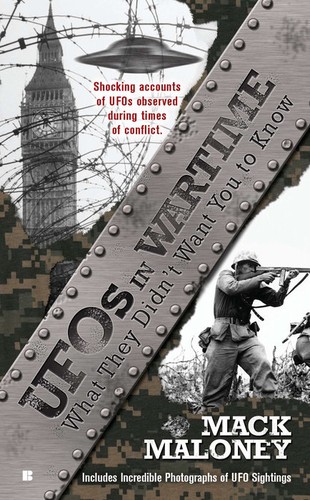
UFOs in Wartime
What They Didn't Want You to Know — A Military-Aviation Novelist's Survey of the Phenomenon Along the Front Lines, From Constantine to the Gulf
Find on Amazon →As an Amazon Associate, OverClassified may earn from qualifying purchases made through this link, at no extra cost to you.
Why This Is Essential Reading
A good frame wrapped around uneven material. Mack Maloney's decision to organise the UFO record by conflict rather than by decade is genuinely illuminating, and his military-aviation background gives him a real feel for what a wartime sighting report means operationally. The foo fighter, ghost rocket, Korea, Vietnam and Cold War missile-site sections are worth reading and point toward archives nobody has worked. But the book does not distinguish a radar-corroborated unit-journal entry from a fifty-year-old recollection, its 'what they didn't want you to know' framing misdescribes a record that was mostly filed openly and simply never read, and opening with Constantine's vision costs it credibility it needs later. Use it as a finding aid for theatres and incidents worth chasing, take the individual claims to the documents, and read Hastings on the nuclear sites for the same argument made with the sourcing this one lacks.
Related Cases & Theories
Sources Cited
- Maloney, Mack. UFOs in Wartime: What They Didn't Want You to Know. New York: Berkley Books, December 6, 2011, 320 pp. ISBN-10 0425240118 / ISBN-13 9780425240113. amazon.com
- Penguin Random House publisher page, UFOs in Wartime by Mack Maloney — publisher record, publication date and page count. penguinrandomhouse.com
- Bookshop.org listing, UFOs in Wartime: What They Didn't Want You to Know, ISBN 9780425240113 — independent bibliographic confirmation. bookshop.org
- Kobo edition listing, UFOs in Wartime — publisher description covering the foo fighters, the Cold War ICBM flaps, the Constantine (312 CE) material and the Vietnam-era 'plagued by UFOs' commander quotation. kobo.com
- Barnes & Noble listing, UFOs in Wartime by Mack Maloney — independent bibliographic confirmation and reader reception. barnesandnoble.com
- Goodreads edition record, UFOs in Wartime: What They Didn't Want You To Know — reader ratings and edition history. goodreads.com
- Hastings, Robert L. UFOs & Nukes: Extraordinary Encounters at Nuclear Weapons Sites, 2008 — the dedicated, better-sourced treatment of the book's strongest pattern. OverClassified breakdown
- Amazon UK listing, UFOs in Wartime by Mack Maloney, Berkley — independent bibliographic confirmation. amazon.co.uk
- Hall, Michael David. UFOs: A Century of Sightings, Galde Press, 2000 — the archival-historian counterpart to this survey. OverClassified breakdown
- OverClassified case file, Chu Lai Egg-Shaped Object Incident — cites this book for comparative context on how 'unidentified' reports recurred across different wars and command structures; source for the January 6, 1969 Tower 72 report, the 23rd Infantry Division daily journal entry, the negative radar check, and archivist Joe Gillette's 2011 rediscovery.
- OverClassified case file, The Foo Fighters (WWII Aerial Phenomena).
- OverClassified case file, The Swedish Ghost Rockets — the 1946 Scandinavian investigation.
- OverClassified case file, The Malmstrom AFB Missile Shutdowns.
- OverClassified case file, The Wonsan-Sunchon UFO Incident — a documented Korean War-era case.
- OverClassified ancient record, Constantine's Vision at the Milvian Bridge — this site's treatment of the book's deep-historical anchor, and of the source problems it raises.
- OverClassified data page, Nuclear Facility Proximity Analysis — the computed test of the pattern this book observes narratively.
Have corrections, additional research, or peer-reviewed sources? Help improve this entry.
Suggest an Edit