
Flying Saucers — Serious Business
The Broadcaster's Bestseller That Put UFOs on America's Coffee Tables — and Got the Details Wrong
Core Thesis
Flying Saucers — Serious Business is the book that took the UFO subject out of the specialist newsletters and put it, in 1966, onto ordinary American coffee tables. Its argument is contained in its title: the phenomenon is not a joke, not a fad, and not a job for the entertainment pages, and the accumulated weight of two decades of sightings — military, civilian, radar-confirmed, photographed — demands institutional seriousness the U.S. government has refused to give it. Frank Edwards was uniquely equipped to make that case to a mass audience and uniquely ill-equipped to make it accurately. He was a career radio newsman, not a field investigator: a Mutual Broadcasting System news analyst from 1942 to 1952 who had broken Donald Keyhoe's True magazine story to a national radio audience in December 1949, and who by 1966 had spent nearly twenty years telling UFO stories on the air. The book reads exactly like that: propulsive, confident, structured as a sequence of short, vivid case narratives, and — case by case — considerably less reliable than the writing of the researchers whose files he was drawing on. Both facts matter, and this article treats them as inseparable, because the book's enormous reach and its documented sloppiness are two effects of the same cause.
About the Author
Frank Allyn Edwards (August 4, 1908 – June 23, 1967) was an Indiana broadcaster who came to national prominence as a news analyst for the Mutual Broadcasting System, where he worked from 1942 to 1952 hosting a nationwide news and opinion program sponsored by the American Federation of Labor. He was, by any measure, a pioneer of the medium — the Indiana Broadcasters Association later placed him in its Hall of Fame — and his relationship with the UFO subject predated almost every organized civilian research group. In December 1949 he broke Donald Keyhoe's True magazine flying-saucer story to a national radio audience, one of the first times the subject was treated as hard news on network radio.
Edwards' dismissal from Mutual in August 1954 became, in his own telling, the founding grievance of his UFO career. He claimed the president of the sponsoring American Federation of Labor had objected that he "talked too much about flying saucers," and he published that account as "The Plot to Silence Me" in Fate magazine in June 1957. The story is checkable only in part. What is documented is that Edwards' broader on-air style had already drawn hostile press attention: columnist Victor Lasky attacked his editorial approach and what Lasky called "wildly irresponsible charges" in The Daily American in November 1952 — criticism that had nothing to do with UFOs at all. That does not disprove Edwards' version, but it does mean a reader should treat the censorship narrative as his claim rather than as an established fact, exactly as one would treat any other single-source account in this field.
After Mutual, Edwards worked at smaller stations and created the syndicated program Stranger Than Science, a Fortean anthology show that became a 1959 book of the same name and, in turn, a series of paperback bestsellers on strange phenomena generally. He joined NICAP's Board of Governors under Keyhoe's leadership in the late 1950s and remained on it until his death, and he was a contributing editor at Fate. By 1966 he had, as the publisher's copy accurately put it, made "an intensive study of the UFO phenomenon" for about twenty years — though "study" here means sustained journalistic attention rather than field investigation, and the distinction turns out to matter a great deal.
Edwards died on June 23, 1967 — on the opening day of the Congress of Scientific Ufologists in New York, a coincidence the field noted at the time. He was 58. Flying Saucers — Serious Business and its 1967 sequel Flying Saucers — Here and Now! were the last major work of a broadcaster who had, more than any other single American, made the subject audible.
Historical Context & Origins
1966 was the year the American UFO story broke containment for the second time. Project Blue Book was still nominally the Air Force's answer to the question, but its credibility had been shredded by the March 1966 Michigan sightings and J. Allen Hynek's subsequent "swamp gas" press conference — an episode that produced congressional hearings, a young Gerald Ford calling for an inquiry, and the commissioning of what became the Condon Committee. Lyle Stuart published Edwards' book into precisely that gap: a public that had just been told by the Air Force's own consultant that a mass sighting was marsh gas, and did not believe it.
The book's commercial performance reflected that timing. It ran 319 pages with 32 pages of photographs, sold heavily enough in hardcover to be reissued in mass-market paperback by Bantam, and was still in print two decades later under Citadel Press — the 1987 edition whose cover, still carrying the line "The Original Coast-to-Coast Bestseller," is reproduced on this page. For most American readers of the late 1960s and 1970s, this was the UFO book, in the same way that Keyhoe's 1950 paperback had been for the previous generation.
It also arrived at a moment when the gap between what popular UFO books said and what organized civilian research groups had actually established was widening fast. APRO, NICAP, and the newly formed research community were producing case files with witness interviews, correspondence, and physical-trace measurements; Edwards was producing prose. His book drew on those files without reproducing their apparatus, and the resulting mismatch — authoritative-sounding narrative built on other people's fieldwork, compressed and occasionally garbled — is the reason the book generated so much friction inside the field it was popularizing.
One further piece of context is worth stating plainly, because it recurs throughout the book: Edwards had genuinely attended U.S. Air Force UFO briefings in the early 1950s and had a working relationship with Keyhoe and with NICAP's leadership. His access was real. What he did with it — convert it into short, dramatic, memorable set pieces for a general reader — was a broadcaster's instinct applied to material that needed an investigator's discipline.
Core Arguments & Key Concepts
The volume argument. Edwards' central rhetorical move is accumulation rather than analysis. Rather than building an evidentiary case around a handful of best-documented incidents, he presents a long, fast-moving sequence of cases from the 1940s through 1965 and lets the sheer count carry the argument: no conventional explanation, he contends, can plausibly cover this many independent reports from this many kinds of observer across this many countries. It is a genuinely effective structure for a mass readership and a genuinely weak one epistemically, since a chain of individually under-verified cases does not become stronger by being longer.
Official secrecy as the operative fact. Like Keyhoe before him, Edwards treats the U.S. government's public posture as itself the primary evidence — the argument being that the specific pattern of official denial, dismissal, and rapid on-scene military recovery is not what an institution does about nothing. The Kecksburg chapter is his showcase for this claim, and it is where the book made its most durable contribution.
The phenomenon is international, not American. A real strength of the book, and one that distinguishes it from most contemporaneous American titles, is its attention to non-U.S. cases. Edwards devotes substantial space to the December 1954 Venezuelan wave — including the Petare close encounter — at a time when almost no English-language treatment existed. Whatever its errors, the book functioned as a translation layer, moving South American and European case material into the American conversation.
Seriousness as a demand, not a conclusion. The title is not incidental. Edwards' actual thesis is procedural: he is arguing for institutional attention, congressional inquiry, and an end to official ridicule, rather than for any specific explanation of what the objects are. He is more restrained than his reputation suggests about the extraterrestrial hypothesis itself, and considerably less restrained than he should be about the individual facts he marshals in support of the demand.
Key Cases & Evidence Discussed
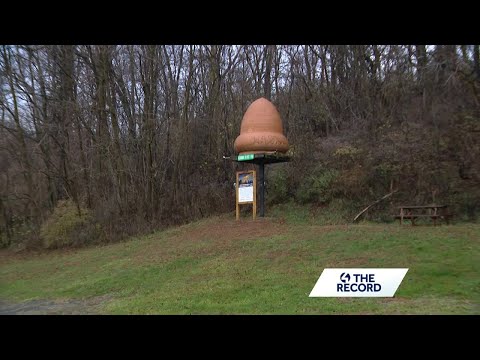
The Kecksburg Incident (Pennsylvania, December 9, 1965). This is the book's most historically significant chapter and the reason it is cited on this site at all: it is one of the earliest published accounts of the Kecksburg crash and of the immediate media response to it, appearing only months after the event. This site's Kecksburg Incident case file cites this book specifically for that early documentation. Edwards was writing while the event was still fresh, before NASA's later Cosmos 96 attribution, before the 1990 Unsolved Mysteries reconstruction that produced the acorn-shaped replica now displayed by the Kecksburg fire department, and long before the multi-decade FOIA litigation over the recovery records. His account is therefore a genuine primary document of how the case looked in 1966 — which is a different and more useful thing than being a reliable account of what happened.
The 1954 Venezuelan wave and the Petare encounter. Edwards' treatment of the December 1954 Venezuelan cases, including the Petare encounter near Petare, brought that wave to English-language readers not long after it occurred, and this site's own case file credits the book with exactly that introductory role. The Venezuelan wave is one of the better-corroborated South American sequences of the 1950s, and its long absence from American UFO literature before Edwards is a real gap he helped close.
The Socorro landing (New Mexico, April 24, 1964) — and the book's clearest documented failure. Edwards' account of the Lonnie Zamora case drew an unusually direct rebuke from inside the research community. Writing in the APRO Bulletin in 1966, Coral Lorenzen stated that Edwards' presentation of Socorro "contained at least 12 errors," and diagnosed the cause bluntly: "Edwards is a writer and radio announcer… mainly entertainment-oriented and not research-oriented." Since APRO's own investigators had worked the Socorro case directly, this is not a rival theorist's complaint about interpretation — it is the people who did the fieldwork saying the popularizer got their facts wrong.
Roswell. Edwards' book contains one of the very few pre-1978 mentions of the 1947 Roswell events in a mass-market UFO title — a genuinely notable fact, given that the case was effectively dormant in the literature for three decades until Stanton Friedman's interviews with Jesse Marcel reopened it. But Kevin Randle's 2016 review of the pre-Friedman Roswell literature concluded that while Edwards did mention the case, he "got almost all the details wrong." The chapter is thus valuable as evidence about what was circulating in 1966 and worthless as a description of what happened in 1947 — a distinction that applies, in miniature, to the whole book.
Critical Reception & Controversies
The book's reception splits cleanly along a line that still runs through UFO publishing: it was a major commercial and cultural success and a recurring source of irritation to the researchers whose work it popularized. Coral Lorenzen's "at least 12 errors" verdict on the Socorro chapter, published in APRO's own bulletin, is the sharpest contemporaneous statement of the second view, and it is worth noting that Lorenzen was not a debunker — APRO was a serious civilian research organization that believed the phenomenon was real. The complaint was about craft, not about conclusions.
Kevin Randle's later assessment of the Roswell material reaches the same place from a different direction. Randle, himself a longtime advocate for the crash-retrieval case, examined the pre-1978 literature specifically to establish what had been publicly known and when, and found Edwards' account substantively unreliable despite being one of the few that existed. For a historian of the field, that combination — important because it exists, untrustworthy in its particulars — is the defining characteristic of this book.
Skeptical criticism of Edwards has generally been less specific and less damaging than the criticism from inside the field, for the straightforward reason that the internal critics had the case files to check him against. Philip J. Klass's books from the following decade largely engage with the primary cases directly rather than with Edwards' renditions of them.
Against all of that stands the book's actual measured achievement: it sold in numbers no research monograph of the period approached, it stayed in print for more than twenty years, and it is demonstrably where a large fraction of the American reading public first encountered Kecksburg, the Venezuelan wave, and the broader claim that the Air Force's public explanations did not survive contact with its own case files. Books that shape a subject's audience are not always the books that shape its evidence. This one shaped the audience.
A candid note on the sourcing of this article: Flying Saucers — Serious Business has no substantial body of formal published reviews to draw on — it was a mass-market title in a genre academic and literary reviewers ignored in 1966. The critical assessments quoted above come from inside the UFO research community (APRO's bulletin, Randle's historiographical work) rather than from mainstream criticism, and readers should weigh them accordingly: they are expert, they are specific, and they are also partisan in the sense that everyone involved had a stake in how the subject was presented.
Influence & Legacy
The book's clearest measurable legacy is Kecksburg. Without Edwards' 1966 chapter, the case would have entered the 1970s with essentially no published national footprint at all, and the local recollections that later investigators, Unsolved Mysteries' 1990 reconstruction, and two decades of FOIA litigation all built on would have had far less to anchor to. This site's own Kecksburg case file traces that documentary chain back to this book.
Its second legacy is structural and less flattering. Flying Saucers — Serious Business established the commercially dominant template for popular UFO writing: the rapid-fire case anthology, narrated with total confidence, assembled from other researchers' files, with no apparatus allowing a reader to check any individual claim. Nearly every mass-market UFO paperback of the following two decades follows it, and so does the specific failure mode Lorenzen identified — errors introduced in compression, then repeated by later authors who took the popular account rather than the source file as their reference. Tracing a garbled detail back through this book to the APRO or NICAP original it came from is a routine task in UFO historiography, and the reason it is routine is that this book worked.
Within this site's library, Edwards occupies the same slot as several other well-read but unreliable popularizers: cited for what it documents about its own moment, never relied on for a fact that has a better source. Where it is the earliest surviving published account of something — as with Kecksburg — that is a genuine and irreplaceable contribution. Where a researcher's own case file exists, that file wins.
The Book
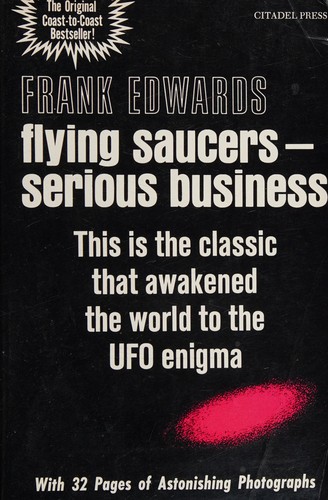
Flying Saucers — Serious Business
The Broadcaster's Bestseller That Put UFOs on America's Coffee Tables — and Got the Details Wrong
Find on Amazon →As an Amazon Associate, OverClassified may earn from qualifying purchases made through this link, at no extra cost to you.
Why This Is Essential Reading
Read this one as a historical artifact rather than as a reference. Flying Saucers — Serious Business is the most commercially successful American UFO book of the 1960s and the reason a mass audience knew the names Kecksburg and Petare at all; it is also a book whose account of the Socorro landing was publicly catalogued by the investigating organization as containing at least a dozen errors, and whose Roswell chapter a leading crash-retrieval advocate later judged almost entirely wrong. Both things are true and neither should be discounted. Treat it as a snapshot of what one very influential broadcaster was telling America about UFOs in 1966 — a genuinely important thing to know — and go to the underlying APRO, NICAP, and Blue Book files for anything you intend to rely on.
Related Cases & Theories
Essential Viewing
Sources Cited
- Edwards, Frank. Flying Saucers — Serious Business. New York: Lyle Stuart, 1966 (319 pp., 32 pages of photographs). Citadel Press paperback, 1987, ISBN-10 0806510609 / ISBN-13 9780806510606. amazon.com
- Internet Archive, scanned copy of Flying saucers — serious business (Edwards, Frank, 1908–1967). archive.org
- Wikipedia, "Frank Edwards (writer and broadcaster)" — biographical dates, Mutual Broadcasting System tenure (1942–1952), the August 1954 dismissal and the AFL "talked too much about flying saucers" claim, NICAP Board of Governors service, and the Stranger Than Science radio program. en.wikipedia.org
- Encyclopedia.com, "Edwards, Frank (Allyn) (1908–1967)" — reference biography covering his broadcasting career and Fortean writing. encyclopedia.com
- Indiana Broadcasters Association Hall of Fame, Frank Edwards entry. indianabroadcasters.org
- The Saucers That Time Forgot, "Frank Edwards: Making UFOs Newsworthy" (June 2024) — source of the Coral Lorenzen "at least 12 errors" quotation from the 1966 APRO Bulletin, the Kevin Randle (2016) assessment of Edwards' Roswell details, the December 1949 Keyhoe broadcast, the "Plot to Silence Me" (Fate, June 1957) claim, and the Victor Lasky criticism in The Daily American, November 1952. thesaucersthattimeforgot.blogspot.com
- Lorenzen, Coral E. APRO Bulletin, 1966 — the Aerial Phenomena Research Organization's contemporaneous assessment of Edwards' Socorro chapter (quoted via the source above).
- Randle, Kevin D. (2016) — historiographical review of pre-1978 published references to the Roswell events, including Edwards' 1966 treatment (quoted via the source above).
- Goodreads, Stranger Than Science by Frank Edwards — edition and publication record for the 1959 radio-derived collection. goodreads.com
- ThriftBooks edition record, Flying Saucers — Serious Business by Frank Edwards — printing history and page count. thriftbooks.com
- Unsolved Mysteries official archive, "Kecksburg UFO" — the September 19, 1990 episode and the life-size replica built for it, now displayed by the Kecksburg fire department. unsolved.com
- Space.com, "Is Case Finally Closed on 1965 Pennsylvania 'UFO Mystery'?" — NASA's later Cosmos 96 attribution and the FOIA record dispute. space.com
- OverClassified case file, The Kecksburg Incident — cites this book as one of the earliest publications documenting the crash and the immediate media response.
- OverClassified case file, The Petare Close Encounter — cites this book for introducing the December 1954 Venezuelan wave to English-language readers.
- OverClassified case file, Socorro / Lonnie Zamora Landing — this site's own treatment of the case Edwards is documented to have misreported.
Have corrections, additional research, or peer-reviewed sources? Help improve this entry.
Suggest an Edit