
Alien Mysteries, Conspiracies and Cover-Ups
More Than a Hundred Cases in One Reference Volume — Including a Great Many the Author Rejects
Core Thesis
Alien Mysteries, Conspiracies and Cover-Ups is a 352-page reference volume covering more than a hundred sightings, events and controversies, and its distinguishing feature is what it includes rather than what it claims. Kevin D. Randle runs from prehistoric claims and Indian cave paintings through the Peruvian Ica stones, MJ-12, the Allende letters, faked photographs, the Condon Committee, the Roswell bodies, the alien autopsy film, Project Moon Dust and the Phoenix Lights to ancient-astronaut theory — and a substantial proportion of the entries are things he considers demonstrated hoaxes. A reference book on this subject whose author is as interested in the fakes as in the cases is genuinely unusual, and it is the reason this one is worth owning.
About the Author
Kevin D. Randle is a retired United States Army lieutenant colonel with a tour in Iraq and master's degrees in psychology and in the art of military science. The publisher's description of the book as thoroughly investigated by a former Army officer drawing on hundreds of historical and government documents and in-person interviews is, unusually for such copy, an accurate description of his method.
His position in the field is genuinely double-sided and it is the reason to read him. He co-authored the influential 1990s Roswell investigations that made the crash claim mainstream; he also co-wrote The Abduction Enigma, which dismantles the abduction literature, and he has spent years checking military claimants' service records and publishing what he finds.
That habit of checking has produced some of the most useful work in this subject and it recurs elsewhere in this library — his examination of Clifford Stone's service record, discussed in the article on UFOs Are Real, is the clearest example.
He has also revised in public, most substantially on Roswell testimony he once helped establish. In a field where almost nobody retracts, a researcher who has abandoned positions under his own name is a different kind of source, and it materially affects how much weight his negative judgements deserve.
This volume is a companion to The Government UFO Files, published by the same house in the same series the following year. Read together they cover the case record and the documentary record respectively, and they share the same virtues and the same production problems.
The standing complaint about Randle is editing rather than research, and it applies here. Visible Ink produces attractively illustrated reference volumes at a pace, and readers have consistently found the writing and copy-editing the weakest element of his catalogue.
Historical Context & Origins
A single-volume reference on this subject has to make a choice most of them evade: whether to include material known to be false. The standard approach is to cover the cases the field considers strong and pass over the embarrassments; Randle's is to cover both and label them.
The hoaxes he includes are among the most consequential documents in the field's history. The Ica stones of Peru — engraved rocks depicting humans with dinosaurs, produced by a local farmer — are a demonstrated modern fabrication that nonetheless underpins an entire strand of alternative-history writing.
The Allende letters, sent to the Office of Naval Research in the mid-1950s by Carlos Allende, are the origin of the Philadelphia Experiment legend and one of the most durable pieces of manufactured material in the subject's history. Their author's identity and the fabricated character of the claim are both established.
MJ-12 is the third and most damaging. The documents circulated in 1987 purporting to describe a high-level committee overseeing recovered extraterrestrial material have been rejected by the National Archives, the FBI and the Air Force, and their circulation reoriented a substantial part of American ufology toward a narrative that had no documentary basis.
The alien autopsy film, broadcast in 1995 and later acknowledged as a fabrication, is the most recent large-scale example and the one whose collapse was most public. Randle covers it alongside the earlier faked photographs, and the sequence — hoax, defence, exposure, partial persistence — is the same in every case.
Against that, the volume also covers material with real standing. The Phoenix Lights of March 1997 produced thousands of witnesses across Arizona and remains substantially unresolved; Project Moon Dust is a documented Air Force recovery programme; the Condon Committee is the study that closed Project Blue Book.
The 2013 publication date puts it just before the modern disclosure era, which makes it a useful snapshot of the field's case inventory as it stood before the post-2017 material arrived and reorganised the subject's priorities.
Core Arguments & Key Concepts
A reference volume should include the hoaxes and say so. The book's organising decision and the thing that most distinguishes it. The Ica stones, the Allende letters, MJ-12 and the alien autopsy are all here, all identified as fabrications, and all treated as part of the record rather than as material to be quietly omitted.
Knowing the fakes is a research skill, not a distraction. The argument implicit in that decision. A reader who knows how the Ica stones were made, who Carlos Allende was, and what happened to MJ-12 is equipped to recognise the same patterns in new material, and a reference work that omits the failures leaves its readers less able to assess the successes.
The record is continuous and much older than 1947. The book's chronological argument, running from prehistoric claims and cave paintings forward. Randle handles this material sceptically — the ancient-astronaut readings are covered as claims rather than endorsed — but the long chronology is a real feature of the reporting record.
Some of it survives, and the survivors are identifiable. The positive half. The Phoenix Lights, the Blue Book unknowns, the documented recovery programmes and a set of pilot and radar cases come through Randle's filter, and a reader can see which ones and why.
Government documents establish institutional behaviour rather than exotic contents. Consistent with his other book and correct: the record shows agencies that collected, classified and denied, which is a fact about bureaucracies and not by itself evidence about what they collected.
The weakest structural feature is compression. More than a hundred entries in 352 illustrated pages leaves two to three pages per case, and complex controversies are necessarily reduced. A reader cannot follow Randle's reasoning on any individual case from this book; they can only take his verdict.
Its production quality does not match its research. The complaint readers make about Randle generally applies here. Visible Ink's format is handsome and heavily illustrated; the writing and editing are the weak point, and the book reads as a set of entries rather than as a composed work.
Key Cases & Evidence Discussed
The Ica stones. The Peruvian engraved rocks depicting humans with dinosaurs, produced by a local farmer and still cited in alternative-history literature — a demonstrated fabrication with a long afterlife.
The Allende letters. Carlos Allende's mid-1950s correspondence to the Office of Naval Research, the origin of the Philadelphia Experiment legend, and one of the field's most durable manufactured documents.
MJ-12. The 1987 documents purporting to describe a committee overseeing recovered material, rejected by the National Archives, the FBI and the Air Force, and the single most consequential fabrication in the subject's modern history.
The faked photographs. The photographic hoaxes running through the field's history from the contactee era onward, and the analytical techniques by which they were identified.
The alien autopsy film, 1995. The broadcast footage claimed to show a post-mortem on a recovered body, subsequently acknowledged as a fabrication, and the most public collapse of a claim in the field's history.
The Condon Committee. The Edward Condon study at the University of Colorado whose report ended Project Blue Book in December 1969, covered separately in this library through the report itself.
Project Moon Dust. The documented Air Force programme for recovery of foreign or unidentified aerospace objects — real, released under FOIA, and covered in this library through Clifford Stone's compilation.
The Roswell bodies. The testimony about recovered occupants that Randle himself helped establish in the 1990s and has substantially revised since — the entry where his willingness to retract is most visible.
The Phoenix Lights, March 1997. The Arizona mass sighting over Phoenix with thousands of witnesses, covered in this site's case file and among the strongest entries to survive the book's filter.
Ancient astronauts. The claim that prehistoric artefacts and structures record extraterrestrial contact, treated here as a body of claims to be assessed rather than as a thesis to be advanced.
Critical Reception & Controversies
The book received no mainstream reviews and was published as a reference title for a general audience rather than as an argument. Its reception has been through reader ratings and through use: it functions as a look-up volume and is treated that way.
The consistent reader criticism is the one that follows Randle everywhere: the writing and editing are weaker than the research. Visible Ink's format is handsome and well illustrated, and the prose does not match it.
The substantive criticism is compression. Covering more than a hundred cases in 352 pages leaves no room to show working, and a reader who disagrees with a verdict has no way to engage it from the book. This is a reference work in the strict sense — it tells you what the author concluded, not how.
What has aged best is the hoax coverage. Ten years on, the Ica stones, the Allende letters, MJ-12 and the alien autopsy are all more clearly settled than they were, and a reference volume that had labelled them correctly in 2013 looks better for it than the many that did not.
The author's own Roswell history is the honest complication and it should be weighed rather than ignored. Randle was central to establishing testimony that was subsequently discredited, and any reference work he writes on this subject is partly an account of his own revisions. That is a reason to read him carefully — and, because he does revise, a reason to trust his negative verdicts more than most.
It is also worth noting what the book does not do. It does not advance a thesis, does not argue for the extraterrestrial hypothesis, and does not construct a cover-up narrative despite what its title suggests. Readers expecting the second half of that title to be delivered will not find it, and the book is better for the absence.
The fair placement is as a first-stop reference with a usable filter. Look a case up here to find out what it is and what Randle thinks of it, then go to the case-level literature for the evidence.
There is a broader point about reference works in this subject that this book brings out well. Most of them are assembled by enthusiasts and are, in effect, inventories of the strongest available version of every claim — which produces a picture of a field far more evidentially healthy than it is. A compiler willing to record that a famous item is a fabrication, and to do so for the Ica stones, the Allende letters, MJ-12 and the alien autopsy in the same volume that covers the Phoenix Lights and Project Moon Dust, is producing something closer to an actual survey of the record. That is a modest editorial virtue and it is very unevenly distributed across this shelf.
Influence & Legacy
The book's function is practical rather than argumentative and that is its contribution: a single volume in which a reader can look up more than a hundred cases and get a verdict from someone who has checked. Reference works of that kind are scarce in this subject and this one is among the more reliable.
Its treatment of hoaxes has had a quiet influence on how the field's reference literature is written. Including known fabrications, labelled, rather than omitting them, is now more common than it was, and it produces a healthier picture of what the record actually contains.
It also documents the case inventory as it stood immediately before the modern disclosure era. A reader comparing this 2013 list with what the field discusses now can see clearly how much the post-2017 material reorganised the subject's priorities — and how much of the older inventory simply dropped out of the conversation without ever being resolved.
The cautionary legacy is about reference works generally. A book that supplies verdicts without working invites the reader to substitute the author's judgement for their own, and that is a reasonable trade only when the author has demonstrated that he will change his mind. Randle has; most compilers in this field have not; and knowing which is which is the skill a reader needs before trusting any reference volume on this subject.
It is worth adding what the book quietly demonstrates about the shape of the record. If a competent, sceptical compiler surveying more than a hundred of this field’s best-known items finds that a substantial fraction of them are demonstrated fabrications, that is a finding about the field rather than about the compiler. No other area of enquiry has a case inventory in which the fakes are so numerous, so famous, and so persistent after exposure, and any reader planning to spend time in this literature should absorb that fact before choosing what to spend it on.
The Book
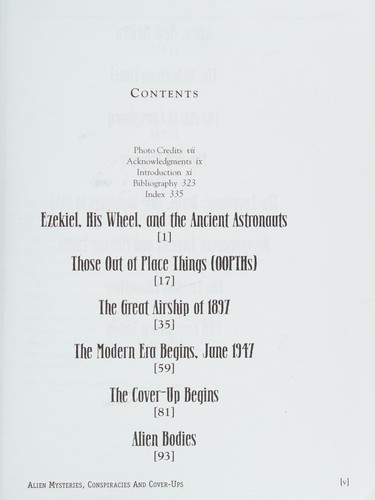
Alien Mysteries, Conspiracies and Cover-Ups
More Than a Hundred Cases in One Reference Volume — Including a Great Many the Author Rejects
Find on Amazon →As an Amazon Associate, OverClassified may earn from qualifying purchases made through this link, at no extra cost to you.
Why This Is Essential Reading
Own it as a reference and use it for the hoaxes. Alien Mysteries, Conspiracies and Cover-Ups covers more than a hundred cases in 352 illustrated pages, from prehistoric claims and the Ica stones through MJ-12, the Allende letters, the alien autopsy and the Phoenix Lights, and its distinguishing decision is to include the demonstrated fabrications and say so rather than quietly omitting them. That is rarer than it should be and more useful than another survey of the strong cases, because a reader who knows how the Ica stones were carved and what happened to MJ-12 can recognise the same patterns in whatever comes next. Its limitations are real: two to three pages a case leaves no room to show working, and the writing is the weakest thing about it. Read it beside its companion volume The Government UFO Files, and give particular weight to its negative verdicts — they come from one of the few people in this field who has publicly abandoned a case he helped build.
Related Cases & Theories
Sources Cited
- Randle, Kevin D. Alien Mysteries, Conspiracies and Cover-Ups. Visible Ink Press, April 1, 2013, in The Real Unexplained! Collection. 352 pp. ISBN-10 1578594189 / ISBN-13 9781578594184. amazon.com
- Internet Archive holding, Alien mysteries, conspiracies and cover-ups by Kevin D. Randle — the full scanned text. archive.org
- Open Library edition record, ISBN 1578594189 — bibliographic verification and cover-art source. openlibrary.org
- Google Books record, Alien Mysteries, Conspiracies and Cover-Ups — Visible Ink Press, 2013, and the publisher description of more than a hundred sightings, events and discoveries, thoroughly investigated by a former Army officer from hundreds of historical and government documents and in-person interviews. books.google.com
- AbeBooks catalogue record, ISBN 9781578594184 — edition verification and the contents list: prehistoric UFO sightings, Indian cave paintings, the Peruvian Ica stones, the Majestic-Twelve documents, the Allende letters, the faked photographs, the Condon Committee, the Roswell bodies, the alien autopsy, Project Moon Dust, the Phoenix Lights and ancient astronauts. abebooks.com
- ThriftBooks catalogue record — independent bibliographic listing and reader reception. thriftbooks.com
- Wikipedia, "Kevin D. Randle" — his Army service and rank, his degrees, his Roswell work and his public revisions. en.wikipedia.org
- Wikipedia, "Ica stones" — the Peruvian engraved rocks, their production by a local farmer, and their persistence in alternative-history writing. en.wikipedia.org
- Wikipedia, "Carlos Allende" — the author of the letters to the Office of Naval Research and the origin of the Philadelphia Experiment legend. en.wikipedia.org
- Wikipedia, "Philadelphia Experiment" — the legend that grew from the Allende letters and its documented origins. en.wikipedia.org
- Wikipedia, "Majestic 12" — the 1987 documents and their rejection by the National Archives, the FBI and the Air Force. en.wikipedia.org
- Wikipedia, "Alien autopsy" — the 1995 film and its subsequent acknowledgement as a fabrication. en.wikipedia.org
- Wikipedia, "Phoenix Lights" — the March 1997 Arizona mass sighting, its witness numbers and its unresolved status. en.wikipedia.org
- Wikipedia, "Ancient astronauts" — the claim covered in the book's prehistoric chapters and treated there as a body of claims to be assessed. en.wikipedia.org
Have corrections, additional research, or peer-reviewed sources? Help improve this entry.
Suggest an Edit