
Abducted!
The Story of the Intruders Continues — The Two Sisters From Budd Hopkins' Book, Under Their Own Names
Core Thesis
Abducted! is the book in which the two most famous anonymous abductees in the literature stopped being anonymous. Debbie Jordan and her sister Kathy Mitchell were 'Kathie' and 'Laura Davis' in Budd Hopkins' Intruders (1987), the book that established the modern abduction narrative around events in an Indianapolis backyard. Seven years later they published their own account under their real names, with an introduction by Hopkins. The document is rarer than it sounds — the subjects of a famous investigation writing for themselves — and its most revealing feature is how much wider their claims are than the abduction story Hopkins told.
About the Author
Debbie Jordan, later Debra Jordan-Kauble, is the central witness of the case examined in this site's Kathie Davis / Copley Woods file. She reported, on June 30, 1983, being struck by a blinding light in her parents' Indianapolis backyard and losing roughly two hours, and she became the subject of Budd Hopkins' most influential book under the pseudonym Kathie Davis.
Kathy Mitchell is her sister, 'Laura Davis' in Hopkins' account, and a co-author here on equal terms. The book is genuinely a joint work rather than one sister's memoir with the other appended, and the two voices are distinguishable.
Neither is a researcher, and the book is not an investigation. It is the account of two women who had been written about extensively, whose identities had become public, and who decided to set out their own version — including a great deal that had not appeared in Hopkins' book because it did not fit the abduction frame.
Jordan-Kauble returned to the subject much later with Extraordinary Contact: Life Beyond "Intruders" (2021), a first-person account of the four decades since. Reading the 1994 and 2021 books together is the most instructive thing a reader can do with either, because the interval is nearly thirty years and the claims did not stay still.
Hopkins wrote the introduction, which places the book inside his framework even as its contents strain against it. That endorsement was commercially necessary in 1994 and it is part of why the volume reads as a supplement to Intruders rather than as an independent statement.
Historical Context & Origins
Intruders in 1987 is the necessary background. Hopkins built the modern abduction narrative substantially around this one case, and its central and most consequential element — the claim of alien-directed reproduction, of a pregnancy that vanished and a hybrid child later shown to the mother — became the template for a decade of subsequent abduction literature.
The methodology behind that account was hypnotic regression, and by 1994 it was in serious trouble. The recovered-memory controversy was at its height, experimental psychology was establishing that regression generates plausible detail rather than recovering it, and the technique that had produced most of the abduction corpus was losing its standing.
The sisters' decision to publish under their own names was consequential for them personally. Anonymity had been the condition on which most abduction witnesses cooperated; going public meant accepting permanent public identification with the most contested claim in the field, and it is not a decision that made either of them money or comfort.
The 1994 publishing environment was favourable. Intruders had been a bestseller and a CBS miniseries in 1992, the abduction phenomenon was at its commercial peak, and a first-person account from the case's actual subjects was a saleable proposition for a mainstream house.
The MIT abduction conference had been held two years earlier and is the moment against which this book should be read; this library covers it through C. D. B. Bryan's account. The field was at its most institutionally respectable and its evidential foundations were simultaneously eroding.
The content that goes beyond abduction is the book's most distinctive and least discussed feature. As the Publishers Weekly reviewer noted at the time, the sisters' account takes in a very wide range of paranormal claims rather than confining itself to the encounter narrative Hopkins had constructed.
That breadth is the reason the book matters analytically. Hopkins' method involved selecting, from what witnesses reported, the material that fitted an abduction framework; this book shows what the same witnesses said when nobody was selecting. The difference between the two is a measurement of how much the investigator shaped the case.
One further piece of context is easy to overlook and matters for how the book should be read. By 1994 the case had been dramatised: CBS had broadcast an Intruders miniseries in 1992, watched by a very large audience, in which the sisters’ experiences were rendered as television drama with actors playing them under the pseudonyms. Writing your own account after your life has been adapted for prime time, while you are still living in the same town under your own name, is a specific and difficult position, and it shapes this book more than any of its critics have allowed for.
Core Arguments & Key Concepts
The witnesses are entitled to their own account, and it differs from the one made famous. The book's foundational claim and its real contribution. Two people written about at length by someone else, under names not their own, setting out their version directly — that is a document type the abduction literature almost entirely lacks.
Going public was necessary and cost them something. The sisters' explicit argument for abandoning anonymity: that being written about pseudonymously while the case became internationally famous was itself intolerable, and that speaking under their own names was the only way to have any control over their own story.
The experiences were lifelong and continuous, not a discrete event. A recurring theme and one of the book's more interesting claims. The 1983 backyard incident that anchors Intruders is presented here as one episode within a pattern running through both sisters' lives, which is a different shape of claim from the one Hopkins' narrative constructs.
The reproductive claims are central and are stated directly. The account of a 1977 pregnancy attributed to alien intervention, and of being shown a hybrid child in 1983, is set out by the woman who made it rather than mediated through an investigator — and it is the element on which the entire case, and much of the abduction literature that followed it, rests.
The book's own breadth undermines its central claim, and its first reviewer said so. The decisive criticism, made by Publishers Weekly on publication: the inclusion of virtually every topic in the world of the paranormal is enough to overwhelm the credibility of even those open-minded on the subject. That is a fair and damaging observation and it has never been answered.
Almost everything here derives from hypnotic regression, and the book does not say so. The methodological problem the volume inherits wholesale. The detailed content of the abduction accounts came from regression sessions conducted by or for Hopkins, and the technique that produced it was already failing when this was published.
A witness's own account is not independent corroboration of an investigator's account of them. The structural point a reader must hold. Jordan and Mitchell had by 1994 read Intruders, been interviewed extensively about it, participated in regression sessions with Hopkins, and lived for seven years inside the narrative he built. Their agreement with it is not a second source.
Key Cases & Evidence Discussed
The June 30, 1983 Copley Woods incident. The Indianapolis backyard event — the blinding light, the missing time, the physical marks and the ground trace — that anchors Intruders and is examined in this site's case file.
The 1977 pregnancy claim. Jordan's account of a pregnancy she attributed to alien intervention and which she says vanished — the single most consequential claim in the modern abduction literature and the origin of the hybrid-programme narrative.
The 1983 hybrid-child encounter. The account of being shown a semi-human child, which became the emotional centre of Hopkins' book and of the 1992 television adaptation.
The lifelong pattern. Both sisters' accounts of experiences running from childhood through adulthood, presented here as continuous rather than as discrete incidents — a framing that differs from the case as Hopkins told it.
Kathy Mitchell's own experiences. The second sister's material, given equal weight here and considerably less prominent in Intruders, where she appears principally as corroboration.
The wider paranormal material. The poltergeist activity, psychic experiences and other phenomena the sisters report alongside the abduction accounts — the content Publishers Weekly identified as overwhelming the book's credibility, and the most analytically revealing thing in it.
The consequences of going public. The chapters on what identification cost them — the least sensational material in the book and, for anyone interested in how this field treats its witnesses, the most useful.
What came later: Extraordinary Contact (2021). Jordan-Kauble's own account of the following four decades, covered separately in this library, and the necessary comparison for anyone assessing how the claims developed over thirty years.
Critical Reception & Controversies
The book was reviewed by Publishers Weekly on publication in August 1994, and that review remains the most useful external assessment. It correctly identified the book's relationship to Intruders, summarised the reproductive claims, and delivered a judgement that has held up: the inclusion of virtually every topic in the world of the paranormal is enough to overwhelm the credibility of even those who are open-minded on the subject.
That criticism is worth dwelling on because it is diagnostic rather than dismissive. A witness account confined to the abduction experiences would be difficult to assess but coherent; one that also takes in poltergeist activity, psychic phenomena and a wide range of other claims is exhibiting the pattern that the psychological literature on this population predicts — and which Susan Clancy's Harvard research would later characterise directly.
Within the field the book was received as a supplement to Intruders rather than as an independent contribution, and Hopkins' introduction encouraged that reading. It has never displaced his account as the standard reference for the case.
The sceptical assessment has always turned on the same structural point. Jordan and Mitchell had by 1994 spent seven years inside a narrative constructed by a skilled and committed investigator, including extensive hypnotic regression sessions, and their account cannot be independent corroboration of it. That is not a claim about their honesty; it is a claim about what their testimony can establish.
It should also be said that the 1994 book contains the field's most consequential single claim — the missing pregnancy and the hybrid child — and that no physical evidence for it has ever existed. No medical record has been produced, no examination has been performed, and the entire hybrid-programme literature that grew from it rests on this account.
The comparison with Extraordinary Contact in 2021 is where a careful reader should end up. Twenty-seven years separate the two books, the intervening period saw the collapse of hypnotic regression's standing, and the way the claims are framed changes across the gap. That change is data.
The fair placement is as an important primary document about a foundational case, written by its subjects, whose value lies in showing what the witnesses said when no investigator was selecting — and whose contents, on that showing, undercut the tightly framed narrative that made them famous.
Influence & Legacy
The book's most durable contribution is unintentional. By setting out the sisters' full range of reported experiences rather than the abduction-specific subset Hopkins used, it provides a rare measurement of investigator selection — the difference between what witnesses report and what appears in the case literature built on them.
It also established a small but significant precedent: abduction witnesses writing for themselves, under their own names, without an investigator's mediation. Very few have done so, and the experiencer-authored literature that exists today runs back through this book.
For the Copley Woods case specifically it is a necessary primary source. Anyone assessing the case that founded the modern abduction narrative has to read what its subjects said about it directly, and this and the 2021 volume are where they said it.
The cautionary legacy concerns corroboration, and it generalises across the whole field. A witness confirming an investigator's account of them, seven years and many regression sessions later, adds no independent weight whatever — and the abduction literature has repeatedly treated exactly that kind of confirmation as though it did.
There is also a point here about how this field uses the people it writes about. The sisters were pseudonymous subjects of a bestseller, then characters in a network miniseries, then authors trying to reclaim their own account, and finally — in Jordan-Kauble’s case — a memoirist writing at seventy about what the whole thing cost. Very little of the abduction literature follows its witnesses that far, and the four-decade arc visible across Intruders, this book and Extraordinary Contact is one of the few places where a reader can see what happens to someone after the investigator has moved on.
The Book
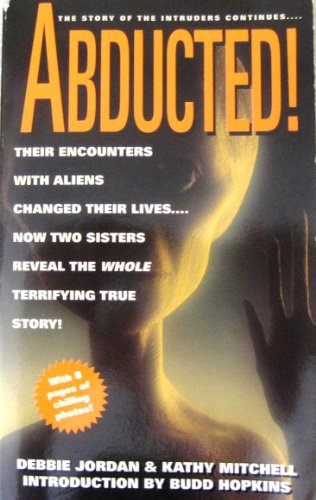
Abducted!
The Story of the Intruders Continues — The Two Sisters From Budd Hopkins' Book, Under Their Own Names
Find on Amazon →As an Amazon Associate, OverClassified may earn from qualifying purchases made through this link, at no extra cost to you.
Why This Is Essential Reading
Read it as primary testimony and notice what it accidentally shows. Abducted! is the account of the case that founded the modern abduction narrative, written by the two women Budd Hopkins had made famous as 'Kathie' and 'Laura Davis' — a document type this literature almost entirely lacks, and valuable for that alone. Its most consequential content is Jordan's own statement of the 1977 pregnancy and the 1983 hybrid child, for which no physical evidence has ever existed and on which a decade of subsequent abduction writing was built. Its most analytically useful content is everything else: the poltergeist activity, the psychic experiences, the wide range of other claims that Publishers Weekly said in 1994 were enough to overwhelm the book's credibility — and which show how much of this case Hopkins selected. Read it with Intruders for the framed version, with Extraordinary Contact for the same witness twenty-seven years later, and with this site's Copley Woods case file for the assessment.
Related Cases & Theories
Sources Cited
- Jordan, Debbie, and Kathy Mitchell. Abducted! The Story of the Intruders Continues... Carroll & Graf Publishers / Richard Gallen, New York, 1994, 268 pp., ISBN-10 0786701293 / ISBN-13 9780786701292; Dell mass-market paperback, 1995, 309 pp., ISBN-10 0440221161. Introduction by Budd Hopkins. amazon.com
- Publishers Weekly, review of Abducted!: The Story of the Intruders Continues, August 29, 1994 — the contemporaneous critical assessment: the Carroll & Graf publication at 268 pages, the sisters' relationship to Hopkins' 1987 Intruders as 'Kathie' and 'Laura Davis', the 1977 alien impregnation and 1983 hybrid-offspring claims, and the judgement that the inclusion of virtually every topic in the world of the paranormal is enough to overwhelm the credibility of even those who are open-minded on the subject. publishersweekly.com
- AbeBooks catalogue record, ISBN 9780786701292 — the Carroll & Graf 1994 first edition, its 268-page extent, the Richard Gallen imprint and the Budd Hopkins introduction. abebooks.com
- Goodreads edition record, Abducted! The Story of the Intruders Continues... — the September 1994 first publication, the 309-page Dell paperback, and the description of the sisters' account. goodreads.com
- Google Books record, Abducted!: The Story of the Intruders Continues — bibliographic data. books.google.com
- Open Library edition record, ISBN 0786701293 — bibliographic verification for the Carroll & Graf hardcover. openlibrary.org
- Blackwell's catalogue record, ISBN 9780786701292 — independent bookseller listing. blackwells.co.uk
- Wikipedia, "Budd Hopkins" — the artist and abduction researcher whose Intruders made the sisters famous and who wrote this book's introduction. en.wikipedia.org
- Wikipedia, "Abduction phenomenon" — the claim, its case literature, the hybrid-programme narrative this case originated, and the psychological assessment of it. en.wikipedia.org
- Wikipedia, "Hypnotic regression" — the technique behind the detailed content of the accounts, and the experimental evidence on what it produces. en.wikipedia.org
- Wikipedia, "False memory" — the memory literature that was dismantling the abduction corpus's evidential basis at the time this book was published. en.wikipedia.org
- Wikipedia, "Poltergeist" — the phenomenon reported alongside the abduction material and part of the breadth Publishers Weekly identified as undermining the book. en.wikipedia.org
- Wikipedia, "Indianapolis" — the city in whose suburbs the Copley Woods events were reported. en.wikipedia.org
Have corrections, additional research, or peer-reviewed sources? Help improve this entry.
Suggest an Edit