
The Virginia Coast Navy UAP/USV Swarm
Buried in the Pentagon's Fiscal Year 2025 Consolidated Annual Report on Unidentified Anomalous Phenomena, released July 21, 2026, is a single-paragraph disclosure: U.S. Navy assets operating off the coast of Virginia reported approximately 100 airborne UAP operating in coordination with two, likely uncrewed, surface systems. It was the only maritime-domain case among 319 new reports the All-domain Anomaly Resolution Office (AARO) received that fiscal year, and the office states the event remains under active investigation in coordination with the reporting unit. No date, sensor type, encounter duration, or attribution has been publicly released. The location sits adjacent to the largest concentration of U.S. naval power in the world, including Naval Station Norfolk and Naval Air Station Oceana, and follows a documented history of unexplained drone activity around Navy warships, most notably the 2019 incidents off the California coast.
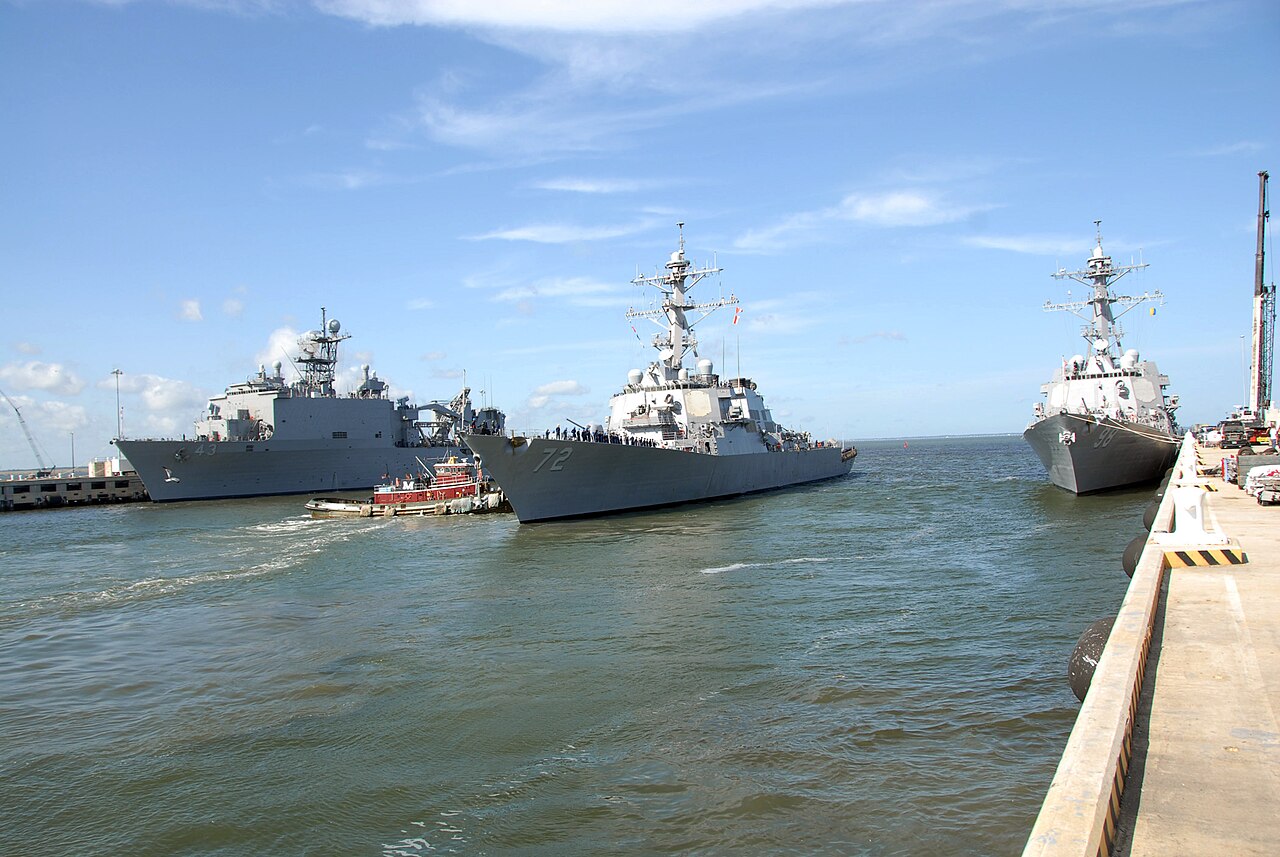
Pictured: a U.S. Navy Arleigh Burke-class guided-missile destroyer, USS Mahan, departing Naval Station Norfolk, Virginia. This is not a vessel confirmed to be involved in the AARO-documented case; no photograph or video of the reported swarm has been publicly released. U.S. Navy, public domain.
Theoretical Alignment
This file weights "Man-Made / Unrecovered Object" highest because the reported combination — a coordinated swarm of airborne objects operating alongside uncrewed surface vessels — is a textbook description of a drone/USV exercise or an adversarial reconnaissance effort, and because the area sits directly adjacent to the world's largest naval base and its associated live-exercise ranges. It retains meaningful weight for Extraterrestrial only because AARO itself has released almost no corroborating detail, leaving the case's true scale, sensor basis, and context essentially unverifiable from the public record alone.
That fifteen percent for Extraterrestrial is not a judgment that the case is likely otherworldly; it reflects only how little public information exists to rule the possibility out on the merits, in either direction. AARO's own resolved caseload offers useful calibration: across the office's entire Fiscal Year 2025 reporting cycle, none of the 114 cases it closed that year were attributed to advanced foreign or non-human technology, and the office's public position, reiterated across its annual reports since 2022, remains that no case resolved to date has produced material evidence of exotic origin. Absent any comparable finding specific to this file, and absent any of the kinematic "impossible" behaviors — instantaneous acceleration, sudden appearance or disappearance, sustained hypersonic velocity without a thermal signature — that anchor this site's more strongly ETH-aligned cases, this file declines to weight Extraterrestrial any higher than the residual uncertainty produced by AARO's own silence on the point. Interdimensional alignment sits lower still, at five percent, for the same reason it runs low across nearly every case in this archive involving multiple, discretely countable objects moving in apparent formation with conventional-looking surface vessels: the IDH framework predicts singular, reality-warping intrusions, not what is described here — roughly a hundred separate airborne contacts behaving like a coordinated fleet alongside two surface craft.
Background
AARO's Fiscal Year 2025 Consolidated Annual Report on Unidentified Anomalous Phenomena, covering new reports received between June 2, 2024, and May 30, 2025, disclosed a total of 319 new cases, of which the office resolved 114, placed 191 into an "active archive" for insufficient data, and referred 9 for further analysis. Of these, only one fell within the maritime domain: a report from U.S. Navy assets operating off the coast of Virginia. The area is home to the largest concentration of U.S. naval power in the world, including Naval Station Norfolk, Norfolk Naval Shipyard, Naval Air Station Oceana, Joint Base Langley-Eustis, and Newport News Shipbuilding, the sole builder of U.S. nuclear-powered aircraft carriers — a density of strategic military assets that makes any unexplained coordinated incursion in the area a matter of direct national security relevance.
AARO's Institutional Mandate
AARO was established on July 20, 2022, by direction of the Deputy Secretary of Defense, under Section 1683 of the National Defense Authorization Act for Fiscal Year 2022. It was not built from scratch: the office absorbed the functions of the Navy-led Unidentified Aerial Phenomena Task Force, stood up in August 2020, by way of an intermediate rebrand, the Airborne Object Identification and Management Synchronization Group, created in late 2021. Pentagon spokesperson Susan Gough described the 2022 change at the time as both a renaming and a genuine mission expansion, reflecting a broadened statutory scope that explicitly covers anomalous, unidentified objects across the air, space, maritime, and transmedium domains — the last of these meaning, specifically, objects reported moving between two or more of those environments. That maritime and transmedium scope is precisely what makes the Virginia coast case reportable to AARO at all, rather than remaining a purely internal Navy safety-of-flight or force-protection matter. The office's founding director, laser and materials physicist Sean Kirkpatrick, led AARO from 2022 through 2023; Dr. Jon T. Kosloski, a physicist with a National Security Agency Research Directorate background, became its second director in August 2024 and was still in that role when the FY2025 report, and this case, were released.
By statute, AARO must deliver a classified annual report to Congress with an unclassified public version, sorting each fiscal year's new reports into resolved cases, an "active archive" of cases lacking sufficient data for resolution (not a dismissal, but a holding category pending better evidence), and a smaller number referred elsewhere for specialized analysis. As of the close of the FY2025 window, AARO's cumulative case holdings stood at 1,870 reports since the office's creation, of which the 319 counted in this reporting cycle represent a single year's intake. The Virginia coast case is one new entry within that much larger, multi-year institutional record — the only one, across the entire FY2025 cycle, that AARO classified as maritime domain rather than air or space.
Hampton Roads: The World's Largest Concentration of Naval Power
The specific stretch of coastline implicated in this case is not an arbitrary patch of open ocean. Naval Station Norfolk alone supports roughly 75 ships and 134 aircraft across 14 piers and 11 aircraft hangars on more than 4,600 acres, with a workforce of approximately 55,000 active-duty personnel and another 17,000 Department of Defense civilians, and it runs an average of 275 aircraft operations a day — a takeoff or landing roughly every six minutes, around the clock. It is the headquarters of U.S. Fleet Forces Command, and, since the Navy reestablished U.S. 2nd Fleet on August 24, 2018, in direct response to renewed Russian submarine and surface activity in the North Atlantic, it has also hosted 2nd Fleet's own headquarters. NATO followed suit in 2019, formally activating Joint Force Command Norfolk as an allied command co-located with, and led by the same officer as, 2nd Fleet — making Hampton Roads one of only two places in the world, alongside NATO's own European headquarters, where a single American admiral holds both a U.S. and a NATO operational command.
Ringing that core are the other installations already named in this file's opening paragraph. Naval Air Station Oceana, established in 1943, has served as the Navy's East Coast master jet base ever since and is now home to all sixteen East Coast F/A-18E/F Super Hornet strike-fighter squadrons under Commander, Strike Fighter Wing Atlantic, with F-35C operations beginning to phase in as the fleet transitions; it is, notably, the same home station from which the F/A-18F squadrons of Carrier Air Wing 1 — including Lieutenant Ryan Graves's own unit — deployed aboard USS Theodore Roosevelt during the 2014–2015 "Gimbal" and "GoFast" encounters discussed later in this file. Joint Base Langley-Eustis, home to the U.S. Air Force's 1st Fighter Wing and its F-22 Raptors, adjoins NASA's Langley Research Center; and Newport News Shipbuilding is the only shipyard in the United States capable of building nuclear-powered aircraft carriers, and one of only two yards in the country building nuclear submarines. No other stretch of American coastline packs a comparable density of carrier strike groups, fighter squadrons, shipyards, and allied command infrastructure into so small a geographic footprint. That density cuts in two directions for this case: it means an unexplained, large-scale incursion here carries far higher stakes than an equivalent event over open, unpopulated ocean, but it also means the area hosts an enormous volume of routine, legitimate military air and sea traffic — exercises, transits, deliveries, and testing — against which any single anomalous report has to be disentangled.
The Maritime Domain Reporting Gap
One statistic from AARO's FY2025 report deserves its own attention: of 319 new reports, 274 were classified as air domain and only 1, this case, as maritime domain — roughly three-tenths of one percent of the year's total intake. That imbalance is not obviously proportional to how much genuine unexplained activity occurs at sea versus in the air; it more plausibly reflects a structural gap in how maritime encounters get observed, reported, and routed to AARO in the first place. Military aircrew fly with dedicated cockpit sensor recording, an established post-flight debrief culture, and, since 2019, an explicit Navy directive normalizing UAP reporting through ordinary channels. A destroyer or littoral combat ship's bridge and Combat Information Center watchstanders operate under comparable institutional expectations, but a "maritime domain" UAP report specifically has fewer well-worn reporting pathways behind it than an air domain one, and open-ocean surface and subsurface sensor coverage is, even for a modern Aegis-equipped warship, far less complete than the layered radar and satellite coverage blanketing domestic and allied airspace. A single maritime report standing out sharply against 274 air domain reports in the same year is therefore more likely a signal about reporting infrastructure than about the true relative rarity of unexplained maritime activity — a point this file raises not to inflate the Virginia case's significance, but to caution against reading its statistical rarity within AARO's report as evidence, on its own, that it is unusually important.
Complete Timeline
| Date | Event |
|---|---|
| June 2, 2024 | AARO's Fiscal Year 2025 reporting window opens. |
| Unspecified, FY2025 | U.S. Navy assets operating off the coast of Virginia report approximately 100 airborne UAP and two likely uncrewed surface vessels operating together. |
| May 30, 2025 | AARO's Fiscal Year 2025 reporting window closes; 319 new cases have been received in total. |
| July 21, 2026 | The Department of War publicly releases the Fiscal Year 2025 Consolidated Annual Report, disclosing the Virginia case for the first time. |
| July 21, 2026 (ongoing) | AARO states the case remains under active investigation in coordination with the reporting unit; no further public update has followed. |
AARO's Fiscal Year 2025 Report in Full Context
The Virginia coast paragraph is a single entry inside a much larger document. Of the 319 new reports AARO logged for FY2025, 274 fell within the air domain, 44 within the space domain, and just 1 — this case — within the maritime domain; no new report that year was categorized as purely transmedium. Of the 114 cases AARO resolved, the great majority closed to unremarkable, specific causes: balloons, birds, satellites, conventional aircraft, small unmanned aircraft systems, one rocket launch, and, in a detail that has drawn some derisive press commentary for how far it sits from popular expectations of UAP investigation, one manned jet pack. Separately from that year's new intake, AARO also reported resolving 238 older backlogged cases using a newly deployed three-dimensional modeling and all-source analysis capability, attributing all 238 to satellite flaring — reflected sunlight off satellite surfaces that can produce a bright, moving nocturnal light easily mistaken for a maneuvering craft. The office credited that tool with meaningfully improving its overall resolution rate for the year.
On the broader qualitative findings that frame every individual case in the report, including this one, AARO stated that none of the cases it has resolved to date indicate advanced foreign adversarial capabilities or breakthrough technologies in any domain; that it has verified no adverse health effects attributable to UAP encounters; and that it holds no evidence of recovered or exploited UAP materials. Of reports with a describable shape, roughly 40 percent were characterized as spherical and about 33 percent as simple, undifferentiated lights, and most airborne sightings across the year were logged at altitudes between 10,000 and 35,000 feet — context that makes the low-altitude, near-surface profile implied by "two, likely uncrewed, surface systems" operating alongside airborne contacts in the Virginia case somewhat atypical of the office's broader FY2025 caseload. The report also logged zero UAP-related flight-safety incidents for the year, and it directly acknowledged its own principal constraint in plain language: a lack of timely and actionable sensor data continues to limit how many cases the office can actually resolve, one way or the other.
That constraint has a second, less technical dimension worth noting: the FY2025 reporting window closed on May 30, 2025, but the report itself was not made public until July 21, 2026 — a gap of just under fourteen months between the close of the window in which the Virginia event was reported and the first public acknowledgment that it had happened at all. Because AARO did not disclose where within that eleven-month collection window (June 2024 through May 2025) the Virginia event actually occurred, it could, as of publication, have been anywhere from a matter of weeks old to nearly two years old — a meaningful variable for how "warm" any investigative trail, sensor recording, or eyewitness memory is likely to still be.
What AARO Actually Disclosed
The entirety of AARO's public disclosure on this case consists of a single paragraph in the FY2025 report: "The single maritime domain UAP case AARO received involved a report from U.S. Navy assets operating off the coast of Virginia. The report described approximately 100 airborne UAP and two, likely uncrewed, surface systems. AARO is actively investigating this event in coordination with the reporting unit." No exact date, no named vessel or unit, no sensor type used to generate the count, no encounter duration, and no indication of whether the surface systems were determined to be American, allied, or foreign has been released. This file finds the report's brevity itself analytically significant: unlike several other cases in AARO's public reporting history, this one carries no interim skeptical assessment, no resolution category, and no context beyond the bare disclosure, suggesting either a genuinely unresolved and sensitive ongoing investigation or simply a case AARO has not yet had the resources to fully characterize publicly.
The specific wording is worth sitting with. AARO did not write "uncrewed surface systems"; it wrote "likely uncrewed," a hedge that could mean several different things, each with different implications. It could mean the reporting unit never got close enough, or held the right sensor angle long enough, to visually confirm the absence of a crew, leaving "uncrewed" as an inference from behavior (speed, maneuvering, lack of running lights, or similar) rather than direct observation. It could mean the assessment came from radar or infrared returns alone, with hull size or wake characteristics suggesting an unmanned platform without ruling out a small crewed boat. Or it could simply reflect AARO's own general caution about overstating any case's certainty in a public document, a pattern visible across the office's reporting since 2022. Because AARO released no supporting detail, this file cannot resolve which of those readings is correct, and treats "likely uncrewed" as exactly what it says: a probabilistic assessment, not a confirmed fact.
Set against that hedge, five concrete gaps define the limits of what can be responsibly said about this case at all: the exact date and time of the encounter; the sensor modality (radar, infrared, visual, electro-optical, or some combination) that produced the "approximately 100" count; the total duration of the encounter; whether the two surface systems were ever determined, even privately, to be American, allied, or of unknown/foreign origin; and the current disposition or last known location of those surface systems. Until AARO or another official source fills in even one of those five blanks, virtually every downstream question this file raises — how the count was generated, whether it overlaps with a known exercise, whether it is even the same order of magnitude as previously documented Navy drone encounters — remains provisional by necessity. That is also, notably, one of AARO's least detailed public case disclosures on record for an event of this reported scale; the office has, in other instances, released far more granular sensor timelines, named locations, and even resolution methodology for cases involving a single object, which makes the comparative silence here for a hundred-object, dual-domain event stand out.
A Pattern of Navy Swarm Incidents Off the U.S. Atlantic Seaboard
The Virginia coast case does not sit in isolation. Across roughly the past decade, U.S. Navy and Air Force personnel operating from installations within a few hundred miles of Hampton Roads have reported at least three other well-documented episodes of unexplained, coordinated aerial activity near military assets, each independently investigated, each eventually acknowledged in some form by the responsible service, and none of them ever definitively attributed to a named operator. Read together with this file's own AARO-sourced case, they describe a pattern specific to the U.S. Atlantic seaboard's military corridor, not merely to "the Navy" in the abstract.
2014–2015: "Gimbal," "GoFast," and the Pilots of Carrier Air Wing 1
Beginning in the summer of 2014 and continuing into the spring of 2015, F/A-18F Super Hornet aircrew of the USS Theodore Roosevelt (CVN-71) Carrier Strike Group reported near-daily radar and infrared contacts with unidentified objects during training operations off the coast of Virginia and Florida. Two of those encounters, recorded on January 21, 2015, produced the infrared cockpit videos now known as "Gimbal" and "GoFast." Lieutenant Ryan Graves, who went on to found the pilot-advocacy group Americans for Safe Aerospace and later testified before Congress, has stated on the record that he and his fellow aircrew encountered these objects almost daily during that period. The Pentagon did not officially confirm the videos' authenticity for another five years, doing so only in 2020. This site's dedicated USS Theodore Roosevelt: The "Gimbal" & "GoFast" Encounters file covers that case, and its more skeptical readings, in full. It is, notably, the only one of the three prior cases discussed here to have occurred in essentially the same offshore corridor as the AARO Virginia case now on file — a full decade earlier, and with no public evidence connecting the two beyond geography.
July 2019: The Southern California Destroyer Swarm
In July 2019, a Navy surface action group built around the Arleigh Burke-class destroyers USS Kidd, USS Rafael Peralta, USS Russell, USS John Finn, and USS Paul Hamilton, operating inside Warning Area W-291 off Southern California, logged repeated multi-night encounters with small unmanned aircraft that matched the ships' speed, hovered over flight decks for as long as 90 minutes at a time — well beyond the endurance of typical 2019-era consumer drones — and, on at least two occasions, appeared to shine a searchlight or camera device directly onto a destroyer's own bridge. The task group tried and failed to intercept the objects with a live 5-inch gun test, man-portable RF jammers, and a shipboard electronic-warfare system. Chief of Naval Operations Admiral Michael Gilday confirmed on the record in April 2021 that the Navy had never identified what the objects were. A leaked night-vision recording of apparently pyramid-shaped objects over USS Russell, publicized by Jeremy Corbell and George Knapp, became one of the most widely circulated UAP videos of the early 2020s before Deputy Director of Naval Intelligence Scott Bray testified in May 2022 that the Pentagon was "reasonably confident" the triangular appearance was a night-vision camera artifact, and that the underlying objects correlated to unmanned aerial systems. Reporters Adam Kehoe and Marc Cecotti of The War Zone, working from FOIA'd deck logs cross-referenced against civilian ship-tracking data, produced the reconstructions that first brought the case to public attention in 2021. This site's 2019 Navy Destroyer Drone Swarm file documents the full multi-week timeline.
December 2023: The Langley AFB Incursions, Ninety Miles Up the Coast
Over 17 nights between December 6 and 23, 2023, dozens of unmanned aircraft — some estimated at roughly 20 feet long, exceeding 100 miles per hour at altitudes of 3,000 to 4,000 feet, and reportedly crossing the James River toward Norfolk and Hampton — repeatedly violated restricted airspace over Joint Base Langley-Eustis, arriving most nights roughly 45 to 60 minutes after sunset. A Pentagon spokesperson said at the time that the activity did not appear to display hostile intent, but the incursions were persistent enough that the Air Force relocated F-22 Raptors of the 1st Fighter Wing to a nearby base to protect them. NORAD and U.S. Northern Command Commander General Gregory Guillot testified before the Senate Armed Services Committee in March 2024, acknowledging the incursions and the military's operational difficulty tracking and neutralizing them; the Department of Defense stated publicly, months later, that it still had not determined the drones' origin. In a separate but geographically overlapping incident the following month, a Chinese national, Fengyun Shi, was arrested after flying a drone over nearby Newport News Shipbuilding and photographing the shipyard, resulting in Espionage Act charges and a guilty plea; investigators and public reporting treated that case as unconnected to the sustained, far larger Langley incursions. Virginia's senior senator, Tim Kaine, a member of the Senate Armed Services Committee, said publicly he remained "very frustrated" by the lack of answers, and later helped secure new installation-protection authorities against unmanned aerial systems in the Fiscal Year 2026 National Defense Authorization Act, citing the Langley incursions directly. This site's dedicated Langley AFB UAP Incursions file, which also documents veteran geospatial analyst Dylan Borland's related 2012 sighting testimony, covers the case in full.
Assessing the Pattern
Taken together, these three prior episodes and the current AARO-sourced Virginia case share a recurring structure: multiple to dozens (or, in the newest case, roughly a hundred) simultaneous or near-simultaneous objects; a strong night-time reporting bias; professional military observers using dedicated sensor and visual-identification procedures; official acknowledgment that the objects were tracked without ever being successfully intercepted, recovered, or attributed to a specific operator; and, in every instance, a public disclosure that lagged the underlying events by months or years. None of the three earlier cases was ever definitively resolved. Two of them — 2019 and 2023 — were assessed by the responsible service as very likely involving human-made drones without a confirmed source; the third, 2014–2015, remains genuinely disputed a decade later, with both a conventional-sensor-artifact camp and a still-unexplained camp actively engaged. This file treats that pattern as important context, not as proof of anything about the Virginia case specifically: the Virginia disclosure is, notably, the only one of the four in which AARO records surface vessels operating alongside airborne objects, a combined air-and-sea profile with no exact precedent among the other three, which cautions against assuming this is simply "another one of those" without better data.
Key Figures
Dr. Jon T. Kosloski
Led AARO during the compilation and July 21, 2026 release of the Fiscal Year 2025 Consolidated Annual Report, which publicly disclosed the Virginia coast maritime case for the first time and confirmed the office's investigation remains active. Kosloski, a physicist and National Security Agency Research Directorate veteran, became AARO's second director in August 2024, succeeding founding director Sean Kirkpatrick. In cases where the underlying data supported it, Kosloski has generally favored resolving high-profile reports with granular, sensor-specific detail, as in his November 2024 preview testimony on the 2013 Aguadilla FLIR video, later formalized in AARO's March 2025 case-resolution report. The Virginia disclosure's comparative brevity, by contrast, suggests either an active, still-sensitive investigation, or a case for which AARO itself does not yet have data granular enough to characterize any further in public.
The Five Observables Assessment
Applying the Five Observables framework to the reported activity:
Assessment: This case is unusual among Five Observables cases in this archive in that AARO's summary provides essentially no data on individual object performance — no reported acceleration, altitude, or speed — leaving those observables unratable rather than confirmed absent. Its most notable characteristic is structural rather than kinematic: a large number of airborne objects reportedly coordinated with distinct surface vessels, a combined air-and-sea profile more consistent with a coordinated drone/USV operation, whether friendly exercise or adversarial reconnaissance, than with a single anomalous craft.
The absence of kinematic data is worth dwelling on, because it is not neutral: it actively shapes which theoretical framework the case can support. This site's more strongly ETH-aligned cases — the ones scoring highest on Anti-Gravity Lift, Instant Acceleration, and Hypersonic Velocity — are, almost without exception, built on a specific piece of released sensor data showing a single object doing something a known aircraft cannot: a FLIR track showing near-instantaneous deceleration from supersonic to a dead stop, for instance, or radar returns implying a multi-thousand-mile-an-hour turn. AARO's Virginia paragraph contains none of that. It reports a count and a rough category ("airborne," "surface," "likely uncrewed") but not a single performance claim, which means the two observables this file does mark Present — Coordinated Swarm Behavior and Trans-Medium Coordination — are doing all of the analytical work. Both are behavioral rather than physics-defying: a hundred small objects operating in apparent concert with two surface vessels is exactly the operational signature one would expect from a deliberately coordinated drone/USV exercise, friendly or otherwise, and it is a signature this file has now seen, in less extreme form, in three separate documented incidents along this same general stretch of coastline over the preceding decade (see "A Pattern of Navy Swarm Incidents Off the U.S. Atlantic Seaboard," below).
Evidence Assessment
Supporting Continued Active Investigation
- The report originates from an official U.S. government source (AARO's congressionally mandated annual report) rather than an anonymous or secondhand account.
- AARO explicitly states the case remains under active investigation rather than resolved or dismissed, an unusually direct acknowledgment of ongoing uncertainty for a single case in a public report.
- The scale reported — approximately 100 coordinated airborne objects plus surface vessels — if accurately characterized, would represent one of the largest coordinated incursions near U.S. naval assets on record, dwarfing the largest single-night object counts logged during the 2019 California destroyer encounters, where the maximum simultaneous count on any given night appears to have topped out at roughly four to six objects rather than a hundred.
- The U.S. Coast Guard's own July 29, 2026 market survey soliciting commercially available systems to detect and defeat uncrewed underwater and surface vehicles around American ports and military facilities — issued just eight days after AARO's FY2025 report became public — indicates the broader U.S. government continues to treat the uncrewed-surface-vehicle threat picture near sensitive installations as current and operationally live, not merely historical.
- The pattern of institutional acknowledgment without resolution seen in this case closely mirrors three earlier, independently documented Navy and Air Force cases along the same general stretch of coastline (2014–2015, 2019, and 2023), none of which was ever definitively attributed to a specific operator despite sustained official investigation.
Supporting a Conventional Explanation
- The area is adjacent to extensive routine U.S. Navy exercise activity, including large-scale multinational exercises such as UNITAS, which have involved coordinated small airborne and surface autonomous systems.
- The U.S. Navy operates its own uncrewed surface and aerial systems, including small autonomous boats such as the Global Autonomous Reconnaissance Craft, raising the possibility of a friendly-exercise misattribution rather than an unknown incursion.
- AARO's own report reiterates that none of the UAP cases it has resolved to date indicate advanced foreign adversarial capabilities or breakthrough technologies in any domain.
- No sensor specifications, duration, or independent corroborating account has been released, making the raw "approximately 100" figure impossible to independently verify.
- A 2025 study of drone activity over the Hampton Roads area recorded periods with well over 600 detected flights, underscoring how routinely saturated the regional airspace already is with legitimate small unmanned traffic against which any count of "approximately 100" objects would first have to be disentangled.
- AARO's own phrasing is explicitly approximate ("approximately 100") rather than a precise sensor-derived tally, consistent with a rapid, high-stress operational report rather than a carefully verified post-event count — and fast-moving, low-light swarm events are a well-documented setting for observer overcounting.
Why "Open"
This case is rated Open because AARO itself has explicitly and directly stated the investigation remains active, an unusually unambiguous status for a case in an official government annual report; this file follows the government's own stated position rather than assigning a resolved rating that outpaces the available evidence in either direction.
It is not rated Credible or Verified because the entire public record consists of a single unelaborated paragraph with no independently verifiable detail, and it is not rated Disputed or Debunked because no specific conventional explanation has been confirmed, only a plausible and reasonably strong candidate (a Navy exercise or uncrewed-systems misattribution) that AARO has neither confirmed nor ruled out in public.
What would move this case off Open in either direction is fairly specific. Toward Resolved: release of even one of the five missing data points discussed above — a date that overlaps a documented exercise, a named sensor system, or confirmation the surface craft were friendly GARC-type vessels — the same kind of granular detail AARO has supplied for other individual cases, including Director Kosloski's own November 2024 preview testimony on the Aguadilla FLIR video ahead of that case's formal March 2025 resolution. Toward Credible or a stronger anomalous rating: release of any sensor data showing the objects performing outside the bounds of known technology, which nothing in AARO's paragraph currently claims or implies. Until one of those two things happens, this file treats "Open" as the only rating that does not outrun the evidence, and will revisit the rating if AARO's next annual report, expected on a roughly similar mid-2027 publication cycle, updates the case's status.
Observer Credibility & Occupational Profile
The witnesses are U.S. Navy personnel operating official naval assets, a category this archive generally treats as carrying strong institutional credibility given professional training in sensor operation and threat assessment. However, the released report provides no detail on the specific unit, vessel class, sensor systems used, or number of independent observers involved, meaning this file can credit institutional Navy reporting broadly but cannot assess the specific credibility markers — corroboration count, sensor redundancy, training level — that typically distinguish stronger cases in this archive from weaker ones.
That said, the broader institutional context around Navy UAP reporting has shifted substantially since the era the earlier precedent cases occurred in. As early as March 2019, the Navy formally updated its internal guidance to instruct pilots and crews to report unidentified aerial phenomena through normal channels rather than staying silent for fear of stigma or ridicule, a policy shift documented independently at the time and confirmed publicly by defense reporters the following month. By the time of the 2019 California destroyer swarm, ships in that task group were already running formal SNOOPIE (Ship's Nautical Or Otherwise Photographic Interpretation and Exploitation) visual-identification procedures — a standing shipboard process, not an improvised response — specifically to document and characterize unidentified contacts. There is no public indication that anything has regressed in that reporting culture since; if anything, the existence of a maritime-domain reporting pathway direct to AARO, exercised in this very case, is itself evidence the institutional infrastructure for taking naval UAP reports seriously has matured rather than atrophied. That institutional maturity is a meaningful, if indirect, credibility signal for this case even in the total absence of named individuals: a report that clears AARO's own vetting and reporting-unit-coordination process, and is judged worth flagging in an annual report to Congress, has already passed a higher bar than an anonymous, unverified sighting report submitted through a public tip line.
It is also worth being explicit about a real, well-documented capability gap that cuts against reading Navy silence on sensor specifics as unusual or suspicious in itself: modern warship radar and combat systems, including the AN/SPY-1 phased-array radar carried by the Arleigh Burke-class destroyers involved in the 2019 California case, were designed primarily to track aircraft- and missile-sized threats at long range, not to reliably discriminate small, slow, low-flying drones or low-freeboard uncrewed surface craft from sea clutter, birds, or debris. That gap is not this file's own speculation; it is the same gap NORAD Commander General Guillot acknowledged in sworn testimony regarding the Langley AFB incursions, and it is the same gap the F-22 intercepts attempted against the 2019 destroyer-swarm drones ran into, when pilots and shipboard forward-looking infrared systems alike struggled to obtain anything better than an unresolvable blur of a target flying well below and slower than the systems were built to engage. A Navy report that describes "approximately 100" objects and "likely uncrewed" surface systems, without further sensor specificity, is entirely consistent with observers doing their best with equipment not optimized for exactly this kind of small, numerous, low-altitude, near-surface contact — which is itself one more reason this file treats the absence of technical detail as a data point about known sensor limitations, not as evidence of concealment.
Historical Precedents & Archive Matches
This case is directly comparable to three other cases in this archive, each discussed at greater length above under "A Pattern of Navy Swarm Incidents Off the U.S. Atlantic Seaboard": the USS Theodore Roosevelt "Gimbal" & "GoFast" Encounters (2014–2015, off the Virginia and Florida coasts), the 2019 Navy Destroyer Drone Swarm (off Southern California), and the Langley AFB UAP Incursions (December 2023, roughly ninety miles up the Virginia coast from Hampton Roads). All four cases share the pattern of multiple coordinated unidentified contacts detected by professional military sensor operators near fleet or installation assets, official acknowledgment of the activity without ever achieving interception or firm attribution, and a public disclosure that arrived months to years after the underlying events. What distinguishes the Virginia AARO case from the other three is scale and domain: it reports roughly an order of magnitude more simultaneous airborne objects than the 2019 or 2023 cases, and it is the only one of the four in which surface vessels are formally part of the same reported event rather than a separate or unconnected sighting.
It is also the only one of the four to reach the public exclusively through a formal annual government report rather than through investigative journalism, FOIA litigation, or a leaked recording. The 2014–2015 Gimbal/GoFast case became public through congressional and press disclosure years after the fact; the 2019 California swarm surfaced through independent FOIA requests and reconstruction work by outside reporters; the 2023 Langley incursions became public through local Virginia news coverage before the Pentagon formally confirmed them. The Virginia coast case, by contrast, exists in the public record only because AARO itself chose to include it in a statutorily required report to Congress. That is a meaningfully different disclosure pathway, and this file reads it as a modestly positive credibility signal in its own right: nothing about this case depended on a document leak, a successful lawsuit, or a persistent reporter's records request to become known at all.
Material Analysis
No physical material, imagery, or sensor data from this case has been publicly released. The entirety of the public record is the single paragraph contained in AARO's Fiscal Year 2025 Consolidated Annual Report.
That absence is worth putting in comparative perspective rather than treating as automatically suspicious. Coordinated drone and uncrewed-surface-vessel activity is, almost by definition, one of the least likely categories of UAP report to ever generate recovered physical material: a small unmanned aircraft or surface craft that is not shot down, does not crash, and is not physically boarded simply flies or sails away at the end of its mission, typically retrieved by its own operator rather than by whoever observed it. That is a structurally different evidentiary situation from this archive's alleged crash-retrieval cases, where a physical debris field or wreckage claim is central to the case and its absence is itself a point of contention. Here, the absence of material evidence is exactly what would be expected under every candidate explanation this file considers plausible — a Navy exercise, an allied exercise, a foreign reconnaissance operation, or simple observer overcounting — and so, unlike in a crash-retrieval case, it does not meaningfully discriminate between them.
Supporting Continued Legitimate Interest
- An official U.S. government oversight body has confirmed the report's existence and stated the case remains actively under investigation, rather than dismissing or resolving it.
- The reported scale of the event — roughly a hundred coordinated airborne objects paired with two likely-uncrewed surface vessels — would, if the count holds up, be operationally significant regardless of the objects' ultimate origin, since it describes a real gap in the ability to identify a hundred-object contact near sensitive U.S. naval infrastructure in real time.
Supporting a Conventional Explanation
- The near-total absence of released detail, combined with the region's extensive routine drone and uncrewed-vessel exercise activity, leaves substantial room for a mundane military-exercise explanation.
- The absence of any recovered material, sensor imagery, or wreckage is exactly what every leading conventional candidate for this case would predict, and therefore carries little independent weight toward an anomalous interpretation.
The Conventional Explanation Candidates
This file weighs three distinct, non-exclusive conventional explanation candidates for the Virginia coast case, ranked from most to least plausible given the available public record. None has been confirmed or ruled out by AARO, and more than one could be simultaneously true — a real drone/USV exercise, for instance, misperceived and overcounted by a reporting unit not read into it.
Candidate One: A Misattributed Navy or Allied Uncrewed Systems Exercise
The leading, and this file's most heavily weighted, conventional explanation candidate is that the reported airborne objects and surface vessels were part of a U.S. Navy or allied uncrewed systems exercise whose activity was not properly cross-referenced by the reporting unit at the time. The U.S. Navy operates small autonomous surface vessels, including the Global Autonomous Reconnaissance Craft (GARC) — 16-foot aluminum boats with a range of roughly 700 nautical miles at 22 knots — as part of its growing uncrewed systems fleet, alongside a range of small airborne drones used in coordinated exercises. GARCs have been documented operating in exactly this general theater: during UNITAS 2025, the 66th iteration of the world's longest-running multinational maritime exercise, the Navy deployed GARC units in the Atlantic Ocean along the stretch of coastline running from Naval Station Mayport, Florida to Naval Station Norfolk, Virginia, training alongside other uncrewed systems — including fixed-wing V-BAT aircraft, LASSie, and Orca autonomous platforms operated from the littoral combat ship USS Cooperstown, which served as the exercise's dedicated robotics-and-autonomous-systems hub — specifically to practice defending against drone swarms. A large multinational exercise of that kind, generating a coordinated mix of small airborne drones and autonomous surface craft in the immediate vicinity of Hampton Roads, offers a directly plausible mundane origin for both the "approximately 100" airborne count and the "likely uncrewed" surface vessels, particularly if the reporting unit itself was not read into the concurrent exercise's full scope, a known and recurring failure mode in multi-command training environments.
The GARC program is also, independently, mature enough to make a large-scale, multi-unit deployment credible rather than speculative. Beyond training exercises, the Navy has tested GARC in a genuinely offensive, expendable role: during a Sinking Exercise (SINKEX) against the decommissioned amphibious assault ship ex-USS Peleliu, a GARC unit loaded with an explosive charge was deliberately driven into the target hull, opening a hole in the ship's side as a proof-of-concept for uncrewed kamikaze-style strike craft. A program far enough along to be trusted with a live warshot demonstration is also, straightforwardly, a program far enough along to be deployed in numbers during a routine coastal exercise — reinforcing that "two, likely uncrewed, surface systems" operating off Virginia is well within the Navy's own current operational repertoire, independent of whatever specifically happened in this case.
A Misattributed Navy or Allied Uncrewed Systems Exercise — Plausibility Rating: PLAUSIBLE, WELL-SUPPORTED BY DOCUMENTED REGIONAL EXERCISE ACTIVITY, BUT UNCONFIRMED
Candidate Two: Reporting Elasticity and the Absence of a Sensor Baseline
A second, complementary candidate treats the "approximately 100" figure itself as the primary thing needing explanation, independent of what the objects actually were. AARO's own phrasing is explicitly approximate rather than a precise, sensor-verified tally, which is consistent with a report generated under real-time operational pressure rather than a carefully reconciled post-event count. Object counts generated during fast-moving, low-light, multi-observer events are well documented, across both military and civilian aviation-safety literature, as vulnerable to overcounting: the same object re-acquired after briefly losing track, or several genuinely distinct but visually similar contacts, can inflate a raw impression into a round, attention-grabbing number. That risk is amplified here by how saturated the regional airspace already is with legitimate small unmanned traffic entirely apart from any exercise: a 2025 study of drone activity over the Hampton Roads area recorded periods with well over 600 detected flights, a baseline density that makes distinguishing a discrete, anomalous hundred-object swarm from ordinary background clutter considerably harder than it would be over open, unpopulated ocean. Because AARO disclosed no sensor modality for the count — radar, infrared, and visual-only estimates all carry different, well-understood error profiles — this file cannot rule in or rule out overcounting, only note that nothing in the public record excludes it.
Reporting Elasticity / Overcounting — Plausibility Rating: PLAUSIBLE, CANNOT BE TESTED WITHOUT RELEASED SENSOR DATA
Candidate Three: An Unattributed Foreign Intelligence-Gathering Operation
A third, lower-probability but not dismissible candidate treats the swarm as a deliberate reconnaissance or capability-probing operation by an unidentified, possibly foreign, actor, testing the sensor coverage, reaction time, and counter-drone response of assets operating near the world's largest concentration of U.S. naval power. This file weights it below the exercise-misattribution candidate because AARO's own report explicitly states that none of the UAP cases it has resolved to date indicate advanced foreign adversarial capabilities in any domain, and because no public source has offered any direct evidence, of the kind that would meaningfully update this assessment, tying the Virginia case to a specific foreign platform or operator.
A caveat on leaning on AARO's aggregate track record: "none of our resolved cases indicate foreign adversarial capabilities" is a weaker claim than it can sound like in isolation — it describes only the cases AARO has chosen to close, not the ones left open or never fully investigated, and an office reporting on its own caseload has an ordinary institutional incentive to describe that caseload as reassuring. This file still weights the foreign-intelligence candidate lowest because no case-specific evidence supports it, not primarily because AARO's aggregate statement rules it out. It draws what limited support it has from indirect and precedent-based signals rather than anything specific to this case: the unproven, never-confirmed 2019 Navy suspicion that a nearby Hong Kong-flagged bulk carrier may have facilitated or conducted surveillance of that year's Southern California destroyer swarm; the general, publicly acknowledged concern within AARO's own institutional history (voiced most directly by founding director Sean Kirkpatrick in 2023 congressional testimony) that a small percentage of unresolved cases could reflect foreign, and specifically Chinese, technology; and the U.S. Coast Guard's own July 29, 2026 market survey — issued days after AARO's report went public — seeking commercial systems to detect and defeat uncrewed underwater and surface vehicles near American ports and military facilities, which at minimum demonstrates the federal government is currently treating the broader uncrewed-surface-vehicle threat as real and unresolved rather than purely hypothetical. None of that constitutes evidence specific to this case; it constitutes evidence that the broader question this case raises is one the government is actively spending money to address.
An Unattributed Foreign Intelligence-Gathering Operation — Plausibility Rating: POSSIBLE MINORITY CANDIDATE, NO CASE-SPECIFIC EVIDENCE, UNCONFIRMED
Weighing the Three Candidates Together
None of these three candidates is mutually exclusive, and this file's own reading is that the most likely single explanation is some combination of the first two: a genuine U.S. or allied uncrewed systems exercise, of the kind documented at UNITAS 2025 and comparable East Coast drills, whose scale was then further inflated by the reporting difficulties inherent to counting a hundred small, fast-moving contacts at night with sensors not optimized for that task. That combined reading does not require assuming bad faith, incompetence, or an exotic origin on anyone's part; it simply requires that the reporting unit was not fully read into a concurrent exercise, and that the resulting count carries the same kind of upward uncertainty documented in comparable swarm-reporting events elsewhere in this archive. The foreign-surveillance candidate remains open only because AARO itself has not closed it, and because the U.S. government's own recent procurement activity around uncrewed-surface-vehicle detection shows the underlying concern is being taken seriously at an institutional level, independent of this specific case. What would meaningfully move the needle between these candidates is exactly the information AARO has not yet released: a date to check against exercise schedules and notices to mariners, a sensor type to establish how the count was actually generated, and any indication of the surface vessels' current disposition. Until then, this file's overall assessment is that a misattributed exercise remains the single most probable explanation, while stopping well short of treating that as confirmed.
Related Cases
Confirmed Documents & Official Records
The official AARO annual report to Congress disclosing the Virginia coast maritime case.
PUBLIC RECORD (freely accessible)Search Government Archives Directly
Further Reading — Recommended Literature
UFO: The Inside Story of the US Government's Search for Alien Life Here—and Out There
An extensively researched history of U.S. government UAP records, including AARO's founding and reporting structure.
UFOs: Generals, Pilots, and Government Officials Go on the Record
A compilation of credentialed military and official UFO testimony, directly relevant to weighing Navy institutional reporting.
Inside The Black Vault: The Government's UFO Secrets Revealed
A guide to obtaining and interpreting declassified UFO-related government documents and annual reports like AARO's.
The UFO Experience: A Scientific Inquiry
The foundational text on scientifically rigorous UFO classification and institutional report evaluation.
Watch the Skies! A Chronicle of the Flying Saucer Myth
A skeptical history of the flying saucer phenomenon, useful comparative context for the exercise-misattribution explanation candidate.
DISCLOSURE: Some links above are affiliate links. If you purchase through them, OverClassified receives a small commission at no additional cost to you. This helps support independent research.
Essential Viewing
Pentagon Releases New Files on UAPs
13News Now (Hampton Roads/Norfolk, VA) — local coverage of the AARO FY2025 report that disclosed this case.

AARO Chief Testifies to Senate Committee
The Economic Times — AARO leadership discussing the office's investigative findings and limitations.
Sources
- "Pentagon Investigating Mysterious UAP Event Reported by the Navy near Virginia's Coast," DefenseScoop. Read online →
- "AARO's Latest UAP Report Finds No Evidence of Exotic Technology, But Mysteries Remain," The Debrief. Read online →
- "The Navy UAP Swarm Off Virginia, Explained," UAP Times. Read online →
- "Pentagon Scrambled to Investigate Swarm of 100 UFOs Off Virginia Coastline," Slay News. Read online →
- "Massive Swarm Of Mysterious Objects Off U.S. Coast Sparks Pentagon Investigation," The Daily Wire. Read online →
- "Navy UFO Swarm: 100 UAP Off Virginia Coast, Pentagon Investigating," WatchTheStars. Read online →
- "Latest Pentagon Report on Aerial Phenomena Has Sighting Off Virginia Beach Coast," AOL News. Read online →
- "Pentagon UAP Office Reports 202 New Unresolved Sightings," Sentinel News. Read online →
- "Presidential Unsealing and Reporting System for UAP Encounters," U.S. Department of War. Read online →
- Graff, Garrett M. UFO: The Inside Story of the US Government's Search for Alien Life Here—and Out There. Avid Reader Press, 2023.
- Kean, Leslie. UFOs: Generals, Pilots, and Government Officials Go on the Record. Harmony Books, 2010.
- Greenewald, John, Jr. Inside The Black Vault: The Government's UFO Secrets Revealed. Rowman & Littlefield, 2019.
- Hynek, J. Allen. The UFO Experience: A Scientific Inquiry. Da Capo Press, 1998 (orig. 1972).
- Peebles, Curtis. Watch the Skies! A Chronicle of the Flying Saucer Myth. Smithsonian Institution Press, 1994.
- "File: US Navy 110825-N-PS473-151 The Arleigh Burke-class guided-missile destroyer USS Mahan (DDG 72) departs Naval Station Norfolk," U.S. Navy, public domain. View file →
- "Establishment of the All-domain Anomaly Resolution Office," Memorandum, Deputy Secretary of Defense, July 20, 2022. Read online →
- "Navy Tests Autonomous Vessels in Recent Multilateral Exercises," USNI News, October 6, 2025. Read online →
- "Pentagon Confirms That Unidentified Drones Flew Over Langley Air Force Base Over 17 Days Last December," 13News Now. Read online →
- "Drones Swarmed an Air Base for Days. They're Still a Mystery," Task & Purpose. Read online →
- "Sen. Tim Kaine 'Very Frustrated' by Lack of Answers on Drone Incursions at Langley Air Force Base," Fox News. Read online →
- "Kaine Statement on Fiscal Year 2026 National Defense Bill Becoming Law," Office of U.S. Senator Tim Kaine. Read online →
- "Navy Reestablishes U.S. 2nd Fleet to Face Russian Threat," USNI News, May 4, 2018. Read online →
- "Former U Student from China Given 6-Month Prison Term for Taking Drone Photos Over Naval Shipyard," Star Tribune. Read online →
- "Naval Station Norfolk," Military.com Base Guide. Read online →
See something inaccurate? Have additional information or sources?
Suggest an Edit →Last Updated: August 2026