
The 2023 Alaska High-Altitude Object Shootdown
On February 10, 2023, a U.S. Air Force F-22 Raptor scrambled from Joint Base Elmendorf-Richardson fired an AIM-9X Sidewinder missile at a small, car-sized cylindrical object flying at roughly 40,000 feet over the Beaufort Sea near Deadhorse, Alaska. Pilots who flew visual inspection passes described the object as silver-gray, apparently unpiloted, and drifting with the wind at 20–40 miles per hour with no visible means of propulsion. It was the first of three unidentified objects the United States and Canada shot down within a single 72-hour window, following the destruction of a confirmed Chinese surveillance balloon six days earlier. Despite a multi-agency search involving the U.S. Navy, Coast Guard, and FBI, no debris was ever recovered from the ice-covered Arctic waters, and the search was formally abandoned on February 18. A classified Canadian memo later obtained by CTV News revealed that, internally, officials were told the object's "full exploitation" had not been completed even after the U.S. ended its own search. President Joe Biden later said it was probably a civilian or research balloon. The object has never been formally identified.
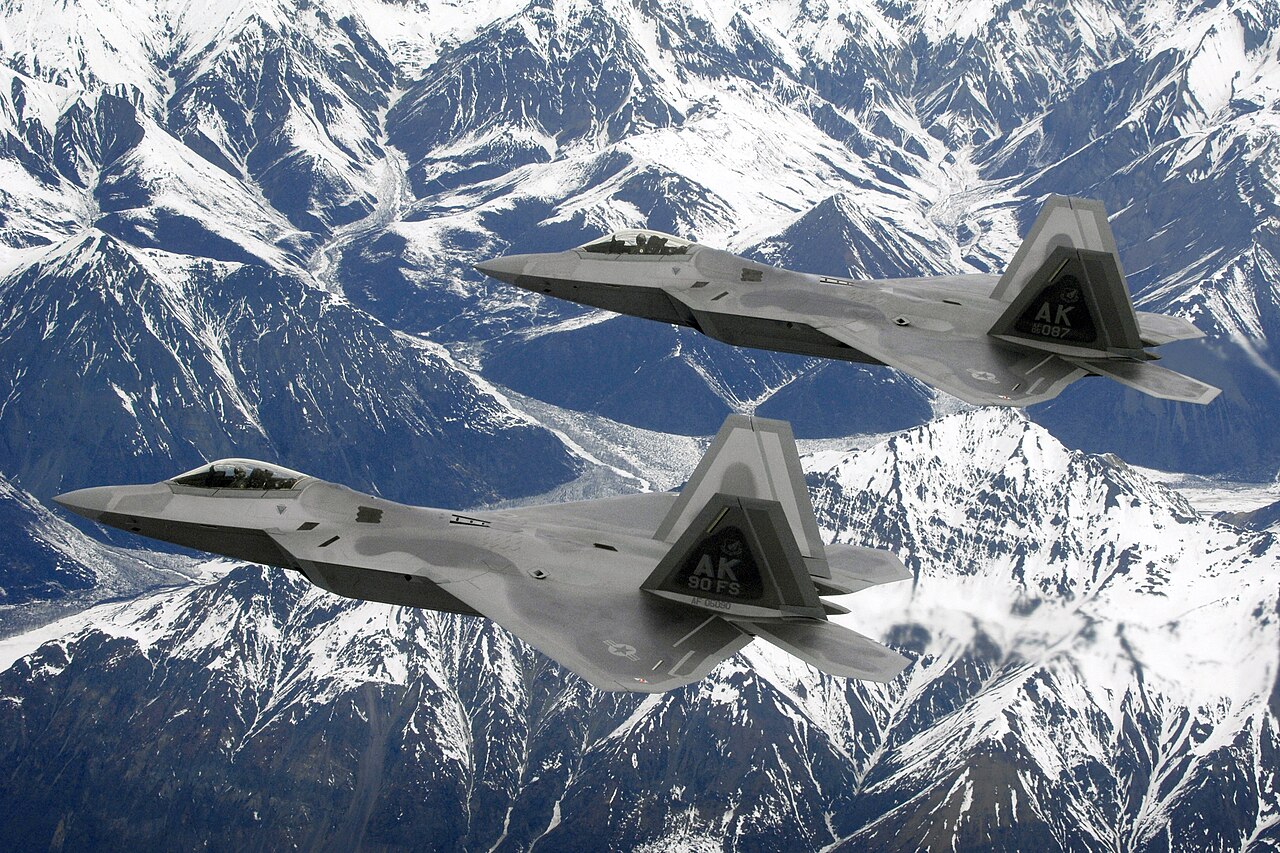
Pictured: a pair of U.S. Air Force F-22 Raptors flying over Alaska, the same aircraft type and unit (based at Joint Base Elmendorf-Richardson) that shot down the object on February 10, 2023. This is not the object itself; no photograph of the object has ever been publicly released. U.S. Air Force, public domain.
Theoretical Alignment
This file weights "Man-Made / Unrecovered Object" highest because every physical characteristic reported by pilots and radar — small size, slow wind-driven drift, no propulsion, no maneuvering, an altitude and profile consistent with a high-altitude balloon — points toward a mundane origin, and a specific, named hobbyist balloon (K9YO-15, flown by the Northern Illinois Bottlecap Balloon Brigade) went missing along a broadly consistent trajectory that same week. It is not classified as Psycho-Social/Mundane because the object was independently detected and tracked by military radar and confirmed by two separate fighter jet visual passes rather than resting on any single observer's perception, and because the case remains genuinely unresolved: no wreckage was ever recovered to confirm or rule out any specific origin. The 10% weighting on Extraterrestrial reflects General VanHerck's own repeated public refusal, under direct questioning, to rule out any explanation for the broader February 2023 object wave — not any positive evidence of non-human origin, of which this file finds none. That residual weighting is institutional caution on the record, not an independent assessment that the object's behavior itself was anomalous; on that score, as the Five Observables section below sets out, this case scores lower than most files in this archive.
Background
The shootdown occurred amid the most intense period of North American airspace scrutiny in decades. A large Chinese high-altitude surveillance balloon first entered U.S. airspace near the Aleutian Islands in late January 2023, transited Canadian territory, and re-entered the continental United States over Idaho and Montana, where it was publicly spotted drifting near Malmstrom Air Force Base's intercontinental ballistic missile fields outside Billings on February 1 — prompting the FAA to briefly ground-stop the local airport. Secretary of State Antony Blinken postponed a long-planned visit to Beijing on February 3 rather than let the incident overshadow the trip, telling reporters the balloon had "created the conditions that undermine the purpose of the trip" and separately calling its presence over U.S. territory "a clear violation of U.S. sovereignty and international law." On February 4, an F-22 Raptor from the 1st Fighter Wing at Joint Base Langley–Eustis fired a single AIM-9X Sidewinder from roughly 58,000 feet at the balloon — itself around 90 feet wide and flying at 60,000 to 65,000 feet — downing it about six nautical miles off the South Carolina coast in shallow water. That detail mattered later: the Chinese balloon's debris field was recoverable in a way the Alaska object's, in the ice-choked Beaufort Sea, would not be.
In the days that followed, the disclosure that at least three earlier Chinese surveillance balloons had transited U.S. airspace undetected during the prior administration, identified only retroactively by the intelligence community, forced General Glen VanHerck to publicly concede a detection failure. Asked how NORAD had missed those earlier incursions, he told reporters plainly: "I will tell you that we did not detect those threats. And that's a domain awareness gap that we have to figure out." Under pressure from the White House and Congress, NORAD moved to close that gap by adjusting its radar filtering to pick up smaller, slower-moving high-altitude objects that had previously been screened out as clutter. Within days, radar operators began detecting a wave of additional unidentified objects across North American airspace, the first of which appeared over Alaska on the evening of February 9, 2023.
Complete Timeline
| Date | Event |
|---|---|
| Jan. 28, 2023 | A Chinese high-altitude surveillance balloon enters U.S. airspace near the Aleutian Islands and crosses into mainland Alaska. |
| Feb. 4, 2023 | A U.S. F-22 shoots down the Chinese balloon off the coast of South Carolina; NORAD adjusts radar filtering in the following days, revealing previously undetected slow-moving high-altitude objects. |
| Feb. 9, 2023, ~9:00 PM AKST | U.S. ground radar detects an unidentified object over Alaska; F-35 and F-22 fighters conduct visual inspection flypasts that evening and the following morning. |
| Feb. 10, 2023, ~10:45 AM AKST | President Biden authorizes the shootdown; an F-22 Raptor from Joint Base Elmendorf-Richardson fires an AIM-9X Sidewinder missile, downing the object over the Beaufort Sea near Deadhorse. |
| Feb. 10–18, 2023 | U.S. Navy, Coast Guard, and FBI personnel conduct search and recovery operations in Arctic ice conditions. |
| Feb. 11, 2023 | A second unidentified object is shot down over Canada's Yukon Territory — the subject of this site's Yukon UAP Shootdown file. |
| Feb. 12, 2023 | A third unidentified object is shot down over Lake Huron — the subject of this site's Lake Huron UAP Shootdown file. |
| Feb. 14, 2023 | The Canadian government's Privy Council briefs Prime Minister Trudeau in a classified memo referring to the Alaska object as "UAP #20," noting its "full exploitation" remained incomplete. |
| Feb. 14, 2023 | The Northern Illinois Bottlecap Balloon Brigade reports its pico balloon K9YO-15 "missing in action" after last contact near Alaska on Feb. 11. |
| Feb. 16, 2023 | President Biden states the objects were probably tied to "private companies, recreation, or research institutions." |
| Feb. 18, 2023 | The U.S. military formally abandons the search for debris; no wreckage from the Alaska object is ever recovered. |
The Radar Recalibration: Why These Objects Suddenly Appeared
NORAD's continental radar network had, since the Cold War, been tuned primarily to detect fast-moving threats — Soviet bombers, and later cruise missiles and aircraft — rather than small, slow objects drifting at high altitude. General VanHerck explained the underlying technical tradeoff at an on-the-record Pentagon briefing on February 13, 2023: "Radars essentially filter out information based on speed. So you can set various gates — we call them velocity gates — that allow us to filter out low-speed clutter." Left unfiltered, he explained, the radar picture would be overwhelming: "If you have radars on all the time that are looking at anything from zero speed up to, say, 100, you would see a lot more information." In the days after the Chinese balloon shootdown, NORAD adjusted those velocity gates, along with its altitude filters, specifically to improve detection of the kind of small, slow, high-altitude object the balloon represented: "We have adjusted some of those gates to give us better fidelity on seeing smaller objects... You can also filter out by altitude. And so, with some adjustments, we've been able to get a better categorization of radar tracks now." VanHerck attributed the resulting wave of newly tracked objects directly to that recalibration combined with heightened attention: "that's why I think you're seeing these overall. Plus, there's a heightened alert to look for this information."
This context bears directly on the Alaska case: the object detected over Deadhorse on the night of February 9 was, by NORAD's own account, a category of object the network would very likely not have flagged as significant only two weeks earlier. The Arctic radar coverage over Alaska is itself the legacy of an older strategic mission entirely. The North Warning System — a chain of 11 long-range AN/FPS-117 and 36 short-range AN/FPS-124 radars stretching nearly 3,000 miles from Alaska to Labrador — was built in the 1980s to replace the 1950s-era Distant Early Warning Line and give NORAD advance notice of Soviet bombers and cruise missiles approaching over the pole, not to catalog small, unpowered objects drifting with the jet stream. The February 2023 recalibration effectively repointed a Cold War missile-warning architecture at a different, and until that week largely unmonitored, category of traffic passing through the same airspace.
That renewed attention to Alaskan airspace did not occur in a strategic vacuum. Alaska sits at the northern approach to the American homeland, hosting the aerospace warning, aerospace control, and maritime warning infrastructure that anchors NORAD's mission, and 2023 saw a documented rise in coordinated Russian and Chinese military activity in the surrounding Arctic and North Pacific approaches, including joint naval exercises off Alaska's coast that U.S. officials and news outlets described as unprecedented in scale. Governor Mike Dunleavy's public statement calling the shootdown a matter of national security, rather than simply a curiosity, reflected that broader context: an object of unknown origin flying at 40,000 feet near Deadhorse was, whatever it actually turned out to be, detected and destroyed inside a region the Pentagon was already treating as a growing point of great-power friction. Dunleavy made the point geographically explicit in his own statement the day of the shootdown, noting that "Russian territory is only a few miles away" and that Alaska is "the one state closest to the Korean Peninsula and China," and he closed by describing his state as "the most strategic place on earth for both geopolitics and national defense." He also used the moment to criticize the earlier decision not to intercept the Chinese balloon while it was still over the Aleutian Islands days before, arguing for a faster, more forward-leaning intercept posture in Alaskan airspace generally — a policy debate that the Alaska shootdown, arriving less than a week later, effectively settled in his favor.
The Shootdown
NORAD radar detected the object over Alaska on the evening of February 9, 2023, prompting the scramble of F-35 and F-22 fighters for visual assessment. Pilots described the object as cylindrical and silver-gray, roughly the size of a small car, showing no sign of propulsion and appearing to drift at the mercy of the wind at an estimated 20 to 40 miles per hour. Some pilots reported sensor interference during their passes, though accounts varied. On the morning of February 10, President Joe Biden authorized the shootdown "out of an abundance of caution," citing the object's proximity to civilian air traffic at 40,000 feet. An F-22 Raptor fired a single AIM-9X Sidewinder missile, destroying the object over the Beaufort Sea near Deadhorse — marking only the second confirmed air-to-air kill in the F-22's two-decade operational history, and the first not against a conventional aircraft.
The visual assessment came in two waves. On the evening of February 9, F-35 Lightning IIs from Eielson Air Force Base near Fairbanks flew the first inspection passes, followed by additional flights — including F-22s from Joint Base Elmendorf-Richardson — into the morning of February 10 as commanders weighed whether the object posed a threat. Accounts of sensor interference were inconsistent between aircrews: National Security Council spokesman John Kirby later told reporters that "some pilots said that the object interfered with their sensors" on their aircraft, while "other pilots did not report this," a discrepancy the government never resolved. Kirby also acknowledged the government could not rule out that the object had been used for surveillance, even though nothing about its behavior suggested it: "While we have no specific reason to suspect that they were conducting surveillance of any kind, we couldn't rule that out." No sensor pod, antenna array, or other equipment consistent with a surveillance payload was ever visually reported by any pilot on either day.
Why a Fighter Missile, Not a Gun
The choice of an AIM-9X Sidewinder over the F-22's internal cannon was not incidental. Firing a gun accurately would have required the Raptor to close to within a few hundred meters of the object at nearly 60,000 feet of altitude, where thin air severely degrades an aircraft's maneuverability and increases the risk of a midair collision with debris. There was also a documented precedent for gunfire simply failing against a lightweight target: in 1998, Canadian CF-18s fired more than 1,000 rounds at a runaway weather balloon without bringing it down, because bullet holes in a helium-filled envelope — helium being non-flammable — caused only a slow leak rather than a rapid deflation, and the balloon drifted uncontrolled across Canada for nearly a week afterward. A missile's fragmentation warhead, by contrast, could inflict enough structural damage in a single detonation to collapse the object's envelope and bring it down immediately, and could be fired from a stand-off distance of several kilometers, keeping the launching aircraft clear of any falling debris. Modern AIM-9X seekers no longer require a hot exhaust plume to lock on; at high altitude, "just about anything man made is going to give off more of an IR signature than the surrounding air," making the missile broadly effective against an unpowered, unheated target. The tactic came with a public cost, however: each AIM-9X was publicly estimated at roughly $400,000, a price tag that fueled sustained criticism once the leading theory shifted toward a harmless hobbyist balloon. The F-22 itself had entered operational service in 2005 as an air-superiority fighter designed and built for high-end confrontations with advanced enemy aircraft, and had gone almost eighteen years without ever recording a confirmed air-to-air kill before the Chinese balloon shootdown on February 4; the Alaska engagement six days later made the Raptor's second confirmed kill, in its entire operational history, a probable hobbyist balloon rather than any adversary aircraft it had originally been built to fight.
The Failed Recovery
U.S. Northern Command coordinated an extensive multi-agency search involving Navy and Coast Guard vessels, aircraft, and FBI personnel, using airborne sensors, surface inspection, and subsurface scans of the debris field. Arctic conditions — sub-zero wind chill, active sea ice, and limited winter daylight — severely hampered the effort. On February 18, 2023, the Department of Defense formally ended the search without recovering any debris. Pentagon Press Secretary Pat Ryder confirmed the operation had been called off, acknowledging the country might never conclusively determine what the object was, how it was powered, or where it came from.
The search relied on a mix of military and civilian assets working in extremely difficult terrain: Coast Guard and Air Force crews flew CH-47 Chinook and HH-60 Pave Hawk helicopters and HC-130 fixed-wing aircraft over the presumed debris field, while Navy and FBI personnel attempted surface and subsurface searches using ice-capable vessels and sonar. Unlike the Chinese balloon, which came down in shallow water close to shore off South Carolina, the Alaska object fell into a remote stretch of the ice-choked Beaufort Sea, tens of miles from Deadhorse — the nearest settlement and industrial hub — with none of the port infrastructure or logistics available on the Atlantic coast. Describing the difficulty to reporters days into the effort, John Kirby said only that "we're working this as hard as we can. And we will keep you informed as we learn more," cautioning that recovery "could take a long time, given the sea state and weather conditions and the degree to which when we have to protect the safety of the divers" — a caveat that, in the Alaska case, proved decisive. No diver ever entered the water, and no debris was ever surfaced. The FBI's participation reflected standard practice for a national-security-relevant recovery of unknown origin: any material eventually located would need a documented chain of custody sufficient to support both an intelligence assessment and, if warranted, a criminal or counterintelligence referral, regardless of whether the underlying object ultimately proved to be foreign, domestic, or entirely private in origin. That evidentiary framework was never tested in this case, because there was never any material for it to be applied to.
The Leaked Memo: "UAP #20"
A previously classified Canadian government memo, obtained by CTV News through an access-to-information request and authored by Privy Council Clerk Janice Charette on February 14, 2023, referred to the Alaska object internally as "UAP #20" and was addressed to Prime Minister Justin Trudeau and his national security advisor, Jody Thomas. The memo stated that "the full exploitation of UAP #20, which was engaged by the U.S. on February 10, 2023, has not yet been completed" — despite the U.S. military calling off its own search only days later. This file finds the memo's language a genuinely significant, if ambiguous, piece of evidence: it is unclear whether "full exploitation" refers to physical debris recovery, remaining sensor and radar data analysis, or both, but it directly documents that at least one allied government did not consider the case fully closed at the point the public search ended.
The memo's language on UAP #20 went beyond that single line. Charette wrote that basic facts about the object remained undetermined even after its destruction, noting that "the function, method of propulsion, or affiliation to any nation-state...remains unverified," and that Canadian officials could not rule out a threat scenario for an object their own government had neither engaged nor examined: "It is unknown whether it poses an armed threat or has intelligence collection capabilities." The same memo briefly addressed the following day's Yukon shootdown, tracked under a separate internal number, UAP #23, describing that object — based on visual reports relayed by Canadian personnel — as having a metallic top quarter, a white remainder, and a roughly 20-foot wire hanging below it with "a package of some sort" suspended from it, a more specific physical description than has ever been released for the Alaska object. NORAD's practice of numbering unidentified radar tracks sequentially, the memo noted, reflected the sheer volume of clutter the recalibrated radars were now generating — tracks that were "not immediately identified" but, on cross-examination, found in most instances to be innocuous. That the Alaska object still carried an open file number and an unresolved "full exploitation" status four days after being shot down is the closest the public record comes to an official acknowledgment that the case was not closed.
The Congressional Response
Frustration in Congress mounted through the week, culminating in a classified briefing for senators on the morning of February 14, 2023 — the same day Charette's memo was being circulated in Ottawa. The briefing was led by Assistant Secretary of Defense for Homeland Defense and Hemispheric Affairs Melissa Dalton, Joint Staff Director of Operations Lt. Gen. Douglas Sims, General VanHerck, Deputy Director of National Intelligence Morgan Muir, and AARO Director Sean Kirkpatrick, whose office had itself only existed for seven months at that point — the All-domain Anomaly Resolution Office was established on July 20, 2022, under a mandate from that year's National Defense Authorization Act, with Kirkpatrick as its founding director, and the Alaska object was among the highest-profile cases it inherited within months of standing up. Senators of both parties left the room saying they had learned little. Senate Minority Leader Mitch McConnell was blunt in his assessment of the string of briefings that week: "the complete absence of any useful information has been what has been most on display here." Senator Kirsten Gillibrand, who chaired the Armed Services subcommittee with oversight of UAP matters, said the decision on whether to address the public directly rested with the President, noting he "can make his own decision about whether...this rises to the level that he needs to address the nation." The bipartisan pressure for a public accounting, rather than another closed-door briefing, is what led directly to President Biden's remarks two days later.
Reaction on the House side ran in a different direction. House Intelligence Committee Chairman Mike Turner, appearing on CNN's "State of the Union" the same weekend the Yukon and Lake Huron objects were destroyed, argued the administration had erred on the side of caution too rarely, not too often, telling host Jake Tapper: "I would prefer them to be trigger-happy than to be permissive." Turner's framing — that a wrongly destroyed hobbyist balloon was an acceptable cost of a more aggressive posture toward unidentified airspace incursions — sat in direct tension with the Senate's complaints that the government was destroying objects it could not identify and then failing to account for what they actually were. Both critiques were, in their own way, responses to the same underlying fact this file documents: an object was engaged and destroyed under real uncertainty, and that uncertainty was never subsequently resolved.
Biden's Address and the Pentagon's Walk-Back
On February 16, 2023, President Biden delivered public remarks specifically on the three objects shot down since the Chinese balloon — the first time he addressed the wave of shootdowns directly rather than through spokespeople. He was careful to distinguish the three unidentified objects from the confirmed Chinese surveillance balloon: "We don't yet know exactly what these three objects were. But nothing — nothing right now suggests they were related to China's spy balloon program or that they were surveillance vehicles from any other country." He offered the administration's working theory, that the intelligence community's current assessment was the objects were "most likely" tied to "private companies, recreation, or research institutions" studying weather or conducting other scientific research. Press Secretary Karine Jean-Pierre addressed the extraterrestrial speculation the shootdowns had generated head-on: "I know there have been questions and concerns about this but there is no — again, no — indication of aliens or extraterrestrial activity with these recent take-downs."
Two days earlier, at the White House podium, Kirby had already begun the walk-back from the danger-postured language of the shootdown week, telling reporters that "the intelligence community is considering as a leading explanation that these could just be balloons tied to some commercial or benign purpose." This marked a significant shift in framing, from the initial description of the Alaska object as a "threat" justifying an AIM-9X engagement, to a probable hobbyist or scientific balloon destroyed largely out of caution rather than any confirmed danger. The walk-back did not, however, come with a confirmed identification for any of the three objects — including the one shot down near Deadhorse — because none of the debris had been, or ever would be, physically recovered and examined. Biden also announced that National Security Advisor Jake Sullivan would lead an interagency review of the government's detection and response procedures, and said he wanted the resulting policy to produce "sharper rules" that could "distinguish between those that are likely to pose safety and security risks that necessitate action and those that do not" — an implicit acknowledgment that the threshold applied to the Alaska object on February 10 had not reliably made that distinction. Sullivan's interagency team, which also drew in Secretary of State Blinken, Secretary of Defense Lloyd Austin, and Director of National Intelligence Avril Haines, was charged with studying "the broader policy implications for detection, analysis, and disposition of unidentified aerial objects that pose either safety or security risks" and briefing the results to Congress and affected state and local officials — a direct institutional legacy of the Alaska shootdown and its two sibling cases, even though the review's specific findings were never made public in a form this file can independently verify or cite.
The Diplomatic Fallout with China
Though the Alaska object itself was never linked to Beijing, the shootdown occurred squarely inside the diplomatic crisis triggered by the Chinese balloon days earlier, and Chinese officials treated the broader wave of shootdowns as part of the same affront. Beijing had already reacted furiously to the February 4 shootdown, with its Foreign Ministry calling it "an unacceptable and irresponsible action" over what China insisted was a civilian weather balloon blown off course by "force majeure." Spokesperson Wang Wenbin went further, turning the surveillance accusation back on Washington, calling the United States "without a doubt the world's largest surveillance habitual offender and surveillance empire," and claiming U.S. high-altitude balloons had flown over Chinese airspace without permission more than ten times since early 2022 — a claim the U.S. government denied. Secretary Blinken had already postponed his planned Beijing trip on February 3, and the additional shootdowns over Alaska, the Yukon, and Lake Huron in the following week — even though none was ever tied to China — kept U.S.-China relations frozen at a moment the Biden administration had hoped to use that visit to stabilize them. The two countries' top diplomats did not meet face to face until February 18, on the margins of the Munich Security Conference, more than two weeks after the balloon shootdown and a week after the Alaska object was destroyed. A senior State Department official described Blinken as "very direct and candid" in the hour-long session, opening by telling Wang Yi how "unacceptable and irresponsible" it had been for a Chinese surveillance balloon to cross U.S. airspace, and that a repeat "must never happen again." The unidentified objects shot down that same week were not the subject of that complaint — the U.S. never alleged Chinese involvement in any of the three — but they nonetheless unfolded inside, and were read internationally against the backdrop of, the same diplomatic rupture.
Key Figures
Joe Biden
Authorized the shootdown "out of an abundance of caution" and later stated the object was probably a civilian or research balloon, though no confirmation was ever obtained.
General Glen VanHerck
Led the military tracking and intercept operations and publicly acknowledged the military could not determine the object's propulsion or origin, describing the newly visible objects as a consequence of NORAD's post-balloon radar recalibration.
John Kirby
Served as the primary White House spokesperson briefing the public on the detection, shootdown, and recovery efforts, describing the object as "much, much smaller" than the Chinese surveillance balloon shot down days earlier.
Mike Dunleavy
Called the incident a national security concern and emphasized Alaska's strategic geopolitical importance following the shootdown in the state's airspace, thanking the Alaska-based military for acting before the object reached land while also criticizing the earlier decision not to intercept the Chinese balloon while it was still over the Aleutian Islands.
Dr. Sean Kirkpatrick
Briefed senators in the classified February 14, 2023 session on the three shootdowns. AARO has since attributed the large majority of the UAP reports it has resolved to prosaic causes such as balloons, though no formal AARO assessment specific to the Alaska object has ever been publicly released.
Aftermath: How the Shootdowns Changed NORAD's Playbook
The cost of the response drew sustained public criticism once the leading explanation shifted toward harmless balloons: each AIM-9X Sidewinder used that week was publicly estimated at roughly $400,000, prompting pointed questions about the economics of using a fighter jet and a guided missile against what the government itself came to believe was, in at least some cases, a hobbyist's science project. The Senate Armed Services Committee subsequently moved to formalize rather than avoid that judgment call, expanding the military's defined criteria for aerial threats requiring a response beyond unknown or hostile aircraft to explicitly include "air vehicles with low-closure rate, such as helicopters, small drones, and high-altitude balloons" — codifying, in effect, that slow-moving objects like the one destroyed over the Beaufort Sea were now a recognized category of concern rather than an ambiguous edge case.
NORAD's own internal process changed in a more concrete way. Before February 2023, the command had no practice of checking the open hobbyist ballooning community before scrambling jets. Steven Armstrong, NORAD's chief of strategic engagement, later explained the shift plainly: "We didn't look at any websites for balloons prior to February 2023," he said, adding that "now we have several that we follow." The command began by searching for hobbyist tracking sites and then built relationships with members of the ballooning community itself to identify additional resources. The new process was credited with preventing at least one unnecessary intercept: in April 2024, NORAD identified an unknown radar track as a hobbyist balloon without scrambling interceptors, and Armstrong said they "were able to make contact with the owner of the balloon, who verified that he launched it." By the mid-2020s, NORAD reported identifying roughly a dozen hobby or weather balloons over North America every week — traffic that, before the February 2023 shootdowns, would very likely have gone entirely unremarked, exactly the kind of object this case file concerns.
The Alaska object's fate should also be read against AARO's broader case-resolution record rather than in isolation. In its first consolidated annual report, covering the period from August 2022 through April 2023 and published in October 2023, AARO logged 291 total UAP reports, and in the reporting periods since has resolved the substantial majority of the cases it closes to prosaic causes — balloons, drones, birds, and conventional aircraft chief among them. That broader pattern is part of why this file weights a mundane balloon explanation as the leading candidate for the Alaska object specifically. But pattern is not the same as proof in an individual case, and AARO's public reporting has never listed the February 10, 2023 Alaska object among its resolved cases by name; unlike the general run of balloon and drone sightings AARO closes out administratively, this object was destroyed by a live missile under presidential authorization and briefed to the Senate as a matter of national urgency, and it has never received the kind of individual, publicly documented resolution that would let this file upgrade its status past Open.
A caveat on leaning on AARO's aggregate resolution rate: an office's overall closure statistics are a weaker form of evidence than a case-specific finding, and this file treats them accordingly — AARO has an institutional incentive to report a high resolution rate regardless of how thoroughly any individual case was actually investigated, and outside researchers have no way to audit the rigor behind each closed file. This file weights the balloon explanation as merely the leading, unconfirmed candidate rather than a settled one precisely because it declines to let a favorable aggregate pattern substitute for the individual, publicly documented resolution this specific object has never received.
General VanHerck himself returned to Congress in the following months to argue that the "domain awareness gap" he had first admitted to reporters in the days before the Alaska shootdown was a hardware problem as much as a filtering-software one, and needed a hardware fix. In subsequent testimony he pressed lawmakers for roughly $211 million to field nine mobile long-range radars and argued for investment in over-the-horizon radar, calling it a "proven, affordable technology" that would meaningfully improve NORAD's ability to detect threats "from surface to space in the approaches to North America." He framed the underlying problem in blunt terms that apply directly to this case: "Domain Awareness: Hey, you can't deter, you can't defeat something if you can't detect it." The Alaska object was, in that sense, a demonstration case for VanHerck's own argument — a target NORAD had only recently gained the ability to see at all, engaged within hours of becoming visible, and then lost permanently to the ice before it could be examined.
The Five Observables Assessment
Applying the Five Observables framework to the reported behavior:
Assessment: This case scores lower on the Five Observables than most files in this archive: the object exhibited no acceleration, no maneuvering, and no unusual velocity, behaving consistently with a passive, wind-driven balloon rather than a controlled craft. Its principal anomaly is procedural rather than physical — it went undetected by NORAD's prior radar configuration — and its case strength rests almost entirely on the fact that it was destroyed and never identified, not on any exotic observed performance. This distinguishes it sharply from the archive's higher-scoring files, where pilots or sensors documented behavior — instantaneous acceleration, sustained hypersonic velocity, apparent trans-medium transition — that resists a conventional engineering explanation. Here, the only thing that resists a conventional explanation is the paperwork: a genuinely unidentified object was destroyed by a live missile, and the government never closed the loop on what it actually was. Readers coming to this file expecting a case built on anomalous flight characteristics should recalibrate their expectations accordingly; readers interested in how an object can be tracked by multiple independent government sensors, visually confirmed by two separate fighter crews, and physically destroyed by the U.S. military, and still end up with no confirmed identity three and a half years later, will find that this is exactly this file's real subject.
Evidence Assessment
Supporting Continued Unresolved Status
- The object was independently confirmed by military radar and two separate fighter jet visual passes, not a single observer's account.
- No debris was ever recovered despite a genuine, extensive, multi-agency search effort, leaving the object's true identity formally unconfirmed.
- A leaked internal Canadian government memo indicates officials did not consider the case's "full exploitation" complete even after the public search ended, raising real if unanswered questions about what analysis, if any, continued privately.
- NORAD Commander General VanHerck publicly declined to rule out any explanation, including extraterrestrial origin, for the broader February 2023 object wave.
Supporting a Conventional Explanation
- Every physically observed characteristic — small size, slow uncontrolled drift, no visible propulsion, no maneuvering — is consistent with a small high-altitude balloon rather than a controlled craft.
- A specific, named hobbyist pico balloon (K9YO-15, launched by the Northern Illinois Bottlecap Balloon Brigade) went missing along a broadly consistent trajectory the same week, offering a concrete, identifiable candidate explanation, even though it was never confirmed as the object destroyed.
- President Biden's own subsequent public assessment attributed the object wave to civilian, recreational, or research balloon activity.
- The object only became visible to NORAD after a routine radar sensitivity adjustment, consistent with a small, low-radar-cross-section balloon rather than a sophisticated craft evading detection.
Weighed together, these two columns do not point toward a symmetrical "genuine mystery." The physical evidence lopsidedly favors a mundane balloon; what keeps the case classified as unresolved rather than closed is entirely evidentiary and procedural — the missing debris, the still-open Canadian file, and the government's own admission it has no confirmed identification. A reader looking for anomalous performance data in this case will not find it here; a reader interested in how thin institutional confirmation can be, even for a case with radar tracking, two independent visual fighter passes, and a live missile engagement, will find this one of the more instructive files in the archive.
Why "Open"
This case is rated Open rather than assigned a resolved status because it combines strong circumstantial evidence for a mundane explanation with the simple, hard fact that no debris was ever recovered or examined. Every behavioral characteristic reported by trained military pilots is consistent with a small balloon, and a specific hobbyist balloon vanished along a plausible trajectory the same week — but "plausible and uncorroborated" is not the same as "confirmed," and this file will not round up to Debunked without physical verification that never occurred.
It is not rated Disputed or higher because, unlike many cases in this archive, there is no reported anomalous performance — no acceleration, maneuvering, or unexplained velocity — for a stronger explanation to compete against; the entire live question is one of identity and confirmation, not of anomalous behavior. The case remains open specifically because the U.S. government destroyed evidence of unknown origin and then failed to recover or publicly identify it, and because an allied government's own internal memo indicates the matter was not considered fully closed.
The passage of time has, if anything, reinforced that rating rather than resolved it. Both sibling cases from the same week eventually produced at least some public visual record once government declassification processes caught up to them years later — the Yukon object in a leaked photograph, the Lake Huron object in a declassified infrared video — while the Alaska object has produced none. A case that remains the least documented of three closely related shootdowns, more than three years on, has not earned a downgrade to Debunked; it has, if anything, earned continued scrutiny.
Observer Credibility & Occupational Profile
This case's evidentiary weight rests on institutional rather than individual witness credibility: trained U.S. Air Force fighter pilots conducting deliberate visual identification passes, NORAD radar operators independently tracking the same object, and on-record statements from the NORAD commander, National Security Council, and the President of the United States. This file finds the multiplicity of independent institutional confirmation to be the case's principal credibility strength, offset by the fact that none of these sources ultimately produced a confirmed identification.
It is worth noting what that institutional record does and does not establish. The fighter pilots involved were not asked, and were not in a position, to render a scientific verdict on the object's origin — their job was visual threat assessment at speed and altitude, not forensic examination, and their own accounts of sensor interference during the passes were inconsistent with each other. The NORAD commander's on-the-record refusal to rule out any explanation, repeated under direct press questioning, reflects institutional caution rather than a considered technical judgment that the object displayed non-human characteristics; VanHerck said as much himself, framing it as declining to speculate rather than flagging genuine anomalous performance. Read in full, the credibility profile here is unusually strong on process — multiple independent institutions agreeing on what was observed — and unusually weak on conclusion, since none of those same institutions ever confirmed what was actually destroyed.
Historical Precedents & Archive Matches
This case is the first of three unidentified objects shot down over North America within 72 hours in February 2023 and belongs to this site's broader case cluster on that event chain, directly comparable to the Yukon UAP Shootdown of February 11 and the Lake Huron UAP Shootdown of February 12, both of which share several key figures, the same NORAD radar recalibration context, and the same ultimate lack of recovered physical evidence. All three followed the confirmed February 4 shootdown of a Chinese surveillance balloon off South Carolina, making four objects downed by U.S. or Canadian fighters in a single eight-day span — an operational tempo without precedent in NORAD's history, and one that has not been repeated since. The three unidentified-object cases share more than a timeline: General VanHerck commanded the intercepts in all three, John Kirby fielded press questions on all three from the White House podium, and Sean Kirkpatrick's newly formed AARO was looped into the briefing chain for all three. A reader of this file who wants the fullest possible picture of the wave should treat the three case files together, since no single one of them was investigated, briefed, or resolved in isolation from the other two.
The three unidentified objects diverged in their evidentiary aftermath in ways worth tracking. The Yukon object was more specifically described at the time — a metallic-topped cylinder with a tethered payload — and a leaked photograph of it eventually reached the public in September 2024, nineteen months after the shootdown, following a Canadian access-to-information request. The Lake Huron object was described by the Pentagon at the time as flying at a lower altitude, around 20,000 feet, and shaped like an octagon; a declassified infrared cockpit video of its destruction was released in May 2026 as part of the Department of War's PURSUE declassification effort, showing fragments that cooled rapidly on the infrared sensor in a pattern analysts said was consistent with balloon material rather than a solid airframe. The Alaska object, by contrast, has no equivalent released image, video, or radar export of any kind — making it, three years on, the least visually documented of the three.
Material Analysis
No physical material from the object has ever been recovered, examined, or publicly described. The case's evidentiary record consists entirely of radar data, pilot visual reports, government statements, and the leaked Canadian Privy Council memo referencing "UAP #20." This stands in direct contrast to the February 4 Chinese balloon, where investigators recovered a "significant amount of debris" from shallow water off South Carolina that was reportedly useful in confirming the balloon's surveillance payload, and even to the Lake Huron object, whose destruction was at least captured on infrared cockpit video and some debris of uncertain origin was later recovered from the lakeshore weeks after the official search ended. The Alaska object sits at the empty end of that spectrum: no confirmed debris, no released imagery, and no sensor product of any kind that the public has ever seen.
Supporting Continued Legitimate Interest
- The object was destroyed by a live military missile engagement, an extraordinary step for what the government itself later suggested may have been a harmless hobbyist balloon, and no confirmation of that theory was ever physically obtained.
Supporting a Conventional Explanation
- Every reported physical characteristic of the object is consistent with an ordinary small high-altitude balloon, and a specific, named balloon disappeared along a broadly matching trajectory that same week.
The Conventional Explanation Candidate: A Civilian or Hobbyist High-Altitude Balloon
The leading, and this file's assessed, conventional explanation candidate is that the object was a small civilian, research, or hobbyist high-altitude balloon, consistent with President Biden's own public assessment and with the object's entirely passive, wind-driven flight profile.
The K9YO-15 Pico Balloon Theory
The Northern Illinois Bottlecap Balloon Brigade (NIBBB) is an amateur radio ("ham radio") club that builds and launches pico balloons — small, foil party-balloon-class envelopes carrying a solar-powered radio tracker weighing only a few grams — as a licensed FCC amateur radio activity, with tracking data shared openly online for the wider hobbyist community to follow. Pico balloon flights of this kind routinely circle the globe multiple times riding the stratospheric jet stream, and are tracked in real time by a network of amateur radio receivers rather than any government sensor. NIBBB had launched one such balloon, K9YO-15, on October 10, 2022; by mid-February 2023 it had nearly circumnavigated the Earth seven times over 123 days of flight. The group's tracking log showed K9YO-15 last reporting in at 00:48 UTC on February 11, 2023, near Hagemeister Island in the Bering Sea off Alaska's southwest coast, after which it went "missing in action" — a location well over 500 miles from the Beaufort Sea site of the February 10 Alaska shootdown, and closer in space and time to the following day's Yukon engagement. Trajectory modeling cited by the group suggested the balloon's projected path would have carried it generally north and east around the time of the shootdowns, a coincidence the group itself was careful to describe only as speculative in the absence of any recovered wreckage confirming the connection either way.
This file notes that the K9YO-15 trajectory theory has been most directly associated with the February 11 Yukon object, and that its applicability to this specific February 10 Alaska shootdown — which occurred roughly a day before the balloon's last confirmed position, and hundreds of miles away from it — is considerably less precisely established than press coverage sometimes implies. It remains part of the same general pattern of hobbyist balloon activity cited as a plausible explanation for the broader February 2023 object wave, and after February 2023 NORAD itself began treating that hobbyist community as a relevant intelligence source rather than background noise, but K9YO-15 specifically is best read as circumstantial context for this file rather than a proposed identity for the object actually destroyed near Deadhorse.
The scale mismatch between the balloon and the response it may have prompted became a talking point in its own right. K9YO-15 was, by NIBBB's own description, a roughly 32-inch-wide latex envelope that cost the club under $15 to build, carrying a roughly 10-gram payload consisting of a radio tracker, a small solar panel, and an antenna — launched from the Chicago area the previous October. Amateur radio operator Douglas Malnati, describing the pico-ballooning hobby generally, put the safety profile bluntly: "They are no more harmful than a party balloon with a penny taped to it." Mike Pappas of Edge of Space Sciences, an educational ballooning nonprofit, raised a different worry once the shootdowns made national news — that a regulatory crackdown aimed at preventing a repeat could sweep up the low-cost student and hobbyist programs that use near-identical hardware to teach basic aerospace engineering, discouraging exactly the kind of amateur experimentation that produces future engineers.
A Civilian or Hobbyist High-Altitude Balloon — Plausibility Rating: PLAUSIBLE BUT UNCONFIRMED
Related Cases
Confirmed Documents & Official Records
The War Zone's analysis of the memo obtained by CTV News, referring to the Alaska object internally as "UAP #20."
PUBLIC RECORD (freely accessible)Search Government Archives Directly
Further Reading — Recommended Literature
UFO: The Inside Story of the US Government's Search for Alien Life Here—and Out There
An extensively researched history of U.S. government UAP records and disclosure, including the 2023 balloon and object shootdown wave.
UFOs: Generals, Pilots, and Government Officials Go on the Record
A compilation of credentialed military and official UFO testimony, directly relevant to weighing NORAD and Pentagon statements on this case.
Inside The Black Vault: The Government's UFO Secrets Revealed
A guide to obtaining and interpreting declassified UFO-related government documents, relevant to the leaked "UAP #20" memo central to this case.
The UFO Experience: A Scientific Inquiry
The foundational text on scientifically rigorous UFO classification and evaluation of official investigations.
Watch the Skies! A Chronicle of the Flying Saucer Myth
A skeptical history of the flying saucer phenomenon, useful comparative context for the balloon-hobbyist explanation candidate.
DISCLOSURE: Some links above are affiliate links. If you purchase through them, OverClassified receives a small commission at no additional cost to you. This helps support independent research.
Essential Viewing
US Fighter Jets Shoot Down Unidentified Object
BBC News — contemporaneous coverage of the February 10, 2023 Alaska shootdown.
What Pilots Said About the Object
CNN — reporting on pilot accounts from the Alaska visual inspection passes.
Sources
- "2023 Alaska high-altitude object," Wikipedia. Read online →
- "US shoots down unknown 'high-altitude object' over Alaska, White House says," ABC News. Read online →
- "What we know about the unidentified object shot down over Alaska," CNN Politics. Read online →
- "'High-altitude object' shot down over Alaska, U.S. says," The Washington Post. Read online →
- "Secret Memo Raises More Questions About UFO Shootdowns Over Alaska, Canada," The War Zone. Read online →
- "U.S. ends search for objects shot down over Arctic Alaska, Lake Huron," Anchorage Daily News. Read online →
- "3 Downed Objects Still Unrecovered, Says US Military," VOA News. Read online →
- "US Recovery of Object Downed Over Alaska Faces Arctic Conditions," Bloomberg. Read online →
- "U.S. ends its search for remnants of aerial objects shot down over Alaskan airspace and Lake Huron," NBC News. Read online →
- "Northern Illinois Bottlecap Balloon Brigade from Illinois says small balloon last reported over Alaska 'missing in action,'" ABC7 Chicago. Read online →
- "Mystery object shot down over Yukon may have been harmless 'pico balloon,'" Global News. Read online →
- "Governor Dunleavy Issues Statement on Unidentified Object Shot Down Over Alaska," Office of the Governor of Alaska. Read online →
- "Alaska Again at Center of Mystery as Pentagon Releases UFO Files and Videos," The Alaska Story. Read online →
- Graff, Garrett M. UFO: The Inside Story of the US Government's Search for Alien Life Here—and Out There. Avid Reader Press, 2023.
- Kean, Leslie. UFOs: Generals, Pilots, and Government Officials Go on the Record. Harmony Books, 2010.
- Greenewald, John, Jr. Inside The Black Vault: The Government's UFO Secrets Revealed. Rowman & Littlefield, 2019.
- Hynek, J. Allen. The UFO Experience: A Scientific Inquiry. Da Capo Press, 1998 (orig. 1972).
- Peebles, Curtis. Watch the Skies! A Chronicle of the Flying Saucer Myth. Smithsonian Institution Press, 1994.
- "File: F-22 Raptor pair over Alaska - 081010-F-1234X-924.jpg," U.S. Air Force, public domain. View file →
See something inaccurate? Have additional information or sources?
Suggest an Edit →Last Updated: August 2026