
The Alex Birch UFO Photograph Hoax
In March 1962, a photograph taken by 14-year-old Alex Birch, showing five saucer-shaped objects in formation over Mosborough, near Sheffield, England, made national headlines after publication in the News of the World and was formally examined by the Air Ministry, which attributed its appearance to "sunlight reflecting on ice crystals in the smoky air." A decade later, in 1972, Birch told the Daily Express the objects were shapes cut from painted glass, re-photographed against the sky — a confession corroborated by a fellow witness, though Birch himself would later, in 1998 and again in 2022, publicly reverse course and claim the sighting had been genuine all along.
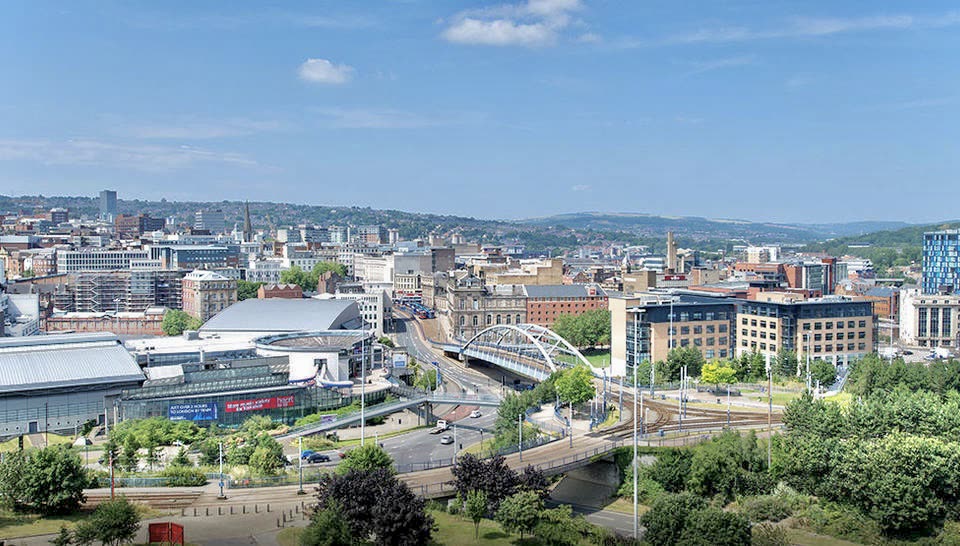
Pictured: the skyline of Sheffield, England, near Mosborough, the site of the 1962 photograph. Photographed in 2020 by Wikimedia contributor Tigerbww; not a photograph of the hoaxed image itself or of any witness. Licensed CC BY-SA 4.0 via Wikimedia Commons.
Theoretical Alignment
This case sits almost entirely outside the Extraterrestrial and Interdimensional hypotheses as this site normally frames them: the central physical claim — five saucers photographed in formation — has a confirmed, corroborated, physically demonstrated mundane origin (a painted glass pane), making it fundamentally a case study in hoax construction, media amplification, and the social psychology of a confessed hoaxer's own decades-later reversal, rather than a genuine anomalous-phenomenon case. The residual, non-zero ETH alignment reflects only the case's continued, unresolved status within a segment of ufological literature following Birch's own 1998 and 2022 claims that the sighting was real; this file's own analysis, detailed under Material Analysis below, finds those later reversal claims considerably less well-supported than the original, corroborated 1972 confession.
Background
Mosborough was, in March 1962, a village on the southeastern edge of Sheffield, administratively still part of Derbyshire (it was absorbed into the City of Sheffield, South Yorkshire, in a 1967 boundary change). This case unfolds against the backdrop of an intensely UFO-curious early-1960s Britain: the country's civil UFO research movement was consolidating into formal organizations, most significantly the founding of the British UFO Research Association (BUFORA) in 1962, the same year as this case, while the government's own UFO-handling apparatus — the Air Ministry's "S6" intelligence desk, successor to the "AI3" section established in 1953 — continued receiving and cataloguing civilian reports on a standardized questionnaire modeled on the American Project Blue Book intake form.
This case is unusual within this site's broader catalog for having a confirmed, physically demonstrated hoax mechanism — the actual glass pane was produced on television as evidence — corroborated independently by a second participant. It is simultaneously unusual for what happened afterward: the confessed hoaxer himself later, decades on, twice publicly reversed his own confession, making this less a simple closed case than a genuine, still-live example of how a well-documented hoax can be recontested by its own author long after the fact.
The broader early-1960s British UFO landscape supplies useful context for understanding both why this hoax succeeded initially and why it attracted the specific institutional validation it did. The period followed directly on from a wave of American and international flying-saucer interest dating to the late 1940s, filtered through British popular culture via science-fiction serials, most notably the BBC's own Quatermass productions, which the boys themselves later cited as a direct creative influence. Newspaper editors, ufology enthusiasts, and even some government officials of the era operated within a media environment already primed to take photographic UFO claims seriously, or at minimum to find them commercially and editorially valuable regardless of their ultimate veracity — a dynamic this file returns to directly when assessing how a photograph produced by three schoolboys with a simple box camera came to be examined by two Royal Air Force intelligence officers and presented before more than 200 members of Britain's newly founded national UFO research organization within the space of six months.
This file also notes the specific generational and technological context that made this particular hoax mechanism both simple to execute and difficult to definitively disprove using 1962-era photographic analysis techniques. The Box Brownie 127, a basic fixed-focus roll-film camera aimed at family and amateur use, offered none of the exposure controls, depth-of-field information, or negative-scale reference points that might have allowed a contemporary examiner to immediately distinguish a foreground painted object from a genuine aerial object at distance. This technical simplicity cuts in two directions at once, addressed further under Sensor & Instrumentation below: it made the hoax easy for three schoolboys to execute convincingly, while also meaning the Air Ministry's own examiners had comparatively limited technical means, by later standards, to either confirm or definitively rule out fabrication from the photograph alone.
Complete Timeline
| Date | Event |
|---|---|
| March 1962 | Alex Birch (14), David Brownlow (12), and Stuart Dixon (16) photograph five "saucer" shapes over a field near Mosborough using a year-old Box Brownie 127 camera |
| Summer 1962 | The photograph reaches the national press, published in the News of the World, following earlier coverage in Yorkshire regional newspapers |
| June 22, 1962 | The Derbyshire Times covers the story, one of the dated contemporary press references located for this case |
| September 22, 1962 | Birch personally addresses BUFORA's inaugural meeting in Kensington, London, before more than 200 members; BUFORA photo analyst Alan Watts assesses the images as consistent with "fairly normal Adamski-type saucers" |
| September 24, 1962 | An internal Air Ministry memo privately notes "it is a relatively simple task to reproduce an identical photograph," two days after Birch's BUFORA appearance |
| 1962 (formal Air Ministry statement) | The Air Ministry publicly attributes the photograph's appearance to "sunlight reflecting on ice crystals in the smoky air" |
| 1972 | Birch, then 24, contacts the Daily Express and confesses the "saucers" were cut-out shapes painted on glass and re-photographed, appearing on television with the physical glass pane |
| 1972 | David Brownlow corroborates the confession to the Sheffield Telegraph: "It was painted on glass. We were just messing around in Alex's dad's greenhouse when we had the idea." |
| 1998 | Birch, no longer in possession of the original negative, publicly reverses his confession, asserting the sighting was genuine; Flying Saucer Review editor Gordon Creighton champions the reversal, citing an unconfirmed Kodak analysis |
| December 1998 | The Sheffield Telegraph again contacts Brownlow, who holds firm: "It was a hoax… I just want to forget about it now." |
| August 2022 | Birch, now 74, releases a short film, "Beyond Perception," making further extraordinary claims about the case's aftermath, examined by researcher Dr. David Clarke |
The Photograph and Its Reception
The photograph shows five dark, disc-shaped silhouettes arranged in formation against the sky, with bright highlights described in period coverage as "dazzling white blobs emerging from their dark saucer-shaped fuselages" — a visual signature entirely consistent with painted or cut-out shapes photographed against bright overcast sky, silhouetted and rim-lit by the surrounding light. Birch's own original 1962 account described the sighting directly: "I got my camera up and took a shot of them. A second or so later they disappeared at terrific speed towards Sheffield."
The image's path to national fame followed a pattern common to photographic UFO cases of the era: initial coverage in local Yorkshire papers, then republication in the mass-circulation News of the World, one of Britain's largest Sunday tabloids, several months after the original event. The story's ufological profile was then significantly amplified by BUFORA's own newly formed organization, which invited the 14-year-old Birch to address its founding meeting in London before an audience of more than 200 — a remarkable degree of institutional validation for a case only months old, and one this file notes reflects the young organization's own evident eagerness to showcase a striking photographic case at its public launch.
This file also notes the relative rarity, within this site's broader catalog, of a hoax case producing a genuinely independent second confession rather than a single self-serving retraction offered under pressure from ongoing investigation. Many confessed UFO hoaxes documented elsewhere in the ufological literature involve a single confessor recanting alone, often only after being confronted with independently gathered contrary evidence; this case instead involved two of its three original participants voluntarily corroborating the same specific account, at the same general time, to different journalists, without any documented external pressure or independent investigative breakthrough forcing either confession. This file treats that dual, voluntary structure as a further, independent reason to weigh the original 1972 account more heavily than the singular, later, and considerably more pressured-feeling reversal narrative that eventually followed it.
This file weighs the specific timing of that escalation as analytically significant in its own right. The photograph was taken in March 1962 but did not reach national prominence until several months later, in summer 1962, a delay this file reads as consistent with the ordinary mechanics of period news distribution: a striking regional photograph, initially covered by local Yorkshire papers such as the Derbyshire Times (which carried a dated reference to the story on June 22, 1962), took time to be noticed and picked up by London-based national editors scanning provincial press for reprintable material. Once picked up, however, the story's momentum accelerated rapidly, moving from regional curiosity to a national tabloid feature to a formal address before Britain's newly founded UFO research association within the span of a single year — a trajectory this file finds itself, independent of the image's underlying authenticity, a useful illustration of how quickly a single striking photograph could travel through 1960s British media and organizational UFO culture once it found its first national outlet.
BUFORA's own specific institutional interest in this case merits further attention. Founded in 1962 through the merger of several smaller regional British UFO groups, the organization was, at the time of Birch's September 1962 address, only months old and actively seeking to establish its own public credibility and membership base. A striking, recently publicized photographic case involving a young, seemingly ordinary witness offered exactly the kind of accessible, media-friendly material a newly formed research organization might reasonably want to showcase at its own founding meeting, independent of how rigorously that specific case had actually been vetted. This file treats BUFORA's own analyst Alan Watts's assessment — that the images were consistent with "fairly normal Adamski-type saucers" — as a particularly telling data point in retrospect: the comparison to George Adamski's own widely disputed 1950s contactee photographs, themselves now broadly regarded across the skeptical UFO literature as staged or fabricated, was likely intended as a positive validation at the time, but reads today as an inadvertent early signal of exactly the kind of photographic fabrication the case would later be confirmed to involve.
Key Witnesses
Alex Birch
14 years old at the time of the photograph, Birch became a minor national celebrity in 1962, addressed BUFORA's founding meeting, confessed to fabricating the images in 1972, then reversed that confession in 1998 and again via a 2022 short film. This file addresses his shifting later-life account in detail under Material Analysis below.
David Brownlow (Unregistered)
12 years old at the time, present with Birch when the "saucers" were photographed. Corroborated Birch's 1972 confession in detail to the Sheffield Telegraph, specifying the shapes were painted on glass in Birch's father's greenhouse, and held firmly to that account when re-contacted in 1998, telling the paper: "It was a hoax… I just want to forget about it now."
Stuart Dixon (Unregistered)
16 years old at the time, the third member of the trio present for the photograph. Reportedly moved toward supporting Birch's "the sighting was genuine" position after later meeting with him, a partial break from Brownlow's continued, firm support of the original hoax confession.
Dr. David Clarke
Sheffield Hallam University journalism academic and former curator (2008–2013) of the joint National Archives/Ministry of Defence UFO files declassification project. Has tracked and re-examined this case across decades, including its 2022 resurfacing, and is the source for most of the documented internal Air Ministry material discussed in this file.
Gordon Creighton
Editor of Flying Saucer Review at the time of Birch's 1998 reversal, Creighton publicly championed the photograph's authenticity, citing a claimed Kodak film analysis reportedly finding the "UFO" image shared "the same density pattern, colour and grain as the surrounding picture" — a claim this file was unable to independently verify against any surviving Kodak documentation.
Flight Lieutenant R. H. White (Unregistered)
One of two named Royal Air Force officers who formally examined the Birch photograph on behalf of the Air Ministry in 1962, operating within the "S6" intelligence desk responsible for civilian UFO report handling at the time. No independent biographical detail beyond this case's own documented involvement was located by this file's research.
Flight Lieutenant Anthony Bardsley (Unregistered)
The second named officer involved in the Air Ministry's 1962 examination, associated with the Deputy Directorate of Intelligence's technical branch. Per researcher David Clarke's own archival work, an internal memo connected to this examination, dated September 24, 1962, privately noted that "it is a relatively simple task to reproduce an identical photograph" — a notably more skeptical private assessment than the Ministry's own softer public "ice crystals" explanation.
The Five Observables Assessment
Applying the standard Five Observables framework to a confirmed photographic hoax is necessarily a formality; this file runs the comparison for consistency with every other case in this archive.
Assessment: Birch's original account described the objects disappearing "at terrific speed towards Sheffield," a claim consistent with the standard testimonial pattern of this genre of case, but one this file weighs as narratively necessary to the hoax rather than as an independently meaningful performance claim, given the confirmed static, painted-glass origin of the underlying image.
Evidence Assessment
This case's evidentiary profile is dominated by a rare and specific asset: a confessed hoax mechanism physically demonstrated on television, independently corroborated by a second participant, set against a later, considerably less well-supported reversal by the original confessor.
Supporting the Hoax Explanation
- Alex Birch's own 1972 confession, delivered to a national newspaper and demonstrated on television with the physical glass pane used to create the images
- David Brownlow's independent corroboration, specifying the exact method (cut-out shapes painted on glass, in Birch's father's greenhouse) and holding firm to that account decades later in 1998
- An internal Air Ministry memo from September 1962, contemporaneous with the events themselves, privately noting "it is a relatively simple task to reproduce an identical photograph"
- The image's visual character — dark silhouettes with bright rim highlighting against overcast sky — is fully consistent with painted or cut-out shapes on glass, photographed against bright ambient light
Complicating the Hoax Explanation
- Birch's own 1998 reversal, asserting the sighting was genuine and the 1972 confession a response to social pressure rather than the truth
- A claimed, but not independently verifiable, Kodak film analysis reportedly cited by Flying Saucer Review editor Gordon Creighton as supporting the photograph's authenticity
- Stuart Dixon's later apparent shift toward supporting Birch's "it was real" position after meeting with him
- Birch's continued public engagement with the case, including a 2022 short film making further claims about the case's aftermath
Why "Debunked"
This file assigns the Alex Birch UFO Photograph a DEBUNKED classification — this site's rare designation reserved for cases with dual, independently corroborated confirmation that the reported phenomenon had a confirmed conventional origin. Two separate participants, Birch and Brownlow, independently confirmed the same specific hoax mechanism (a painted glass pane) in 1972, with the physical prop itself produced as demonstration. This file treats Birch's own later reversal, discussed at length below, as a significant complicating development in this case's public history, but not as evidence sufficient to overturn a confession that was itself specific, mechanically detailed, physically demonstrated, and independently corroborated at the time it was made.
This file's own assessment is that the burden of proof properly rests on the later reversal claim to overturn an already-corroborated confession, not on the original confession to withstand a later, considerably less substantiated retraction — a standard this file applies consistently across every case in this archive involving a confessed hoax later recontested by its own author.
This file also addresses directly a broader methodological question this case raises for how a confessed hoax should be treated when its own confessor later attempts to walk the confession back: should a later retraction, on its own, be sufficient to reopen a case that had otherwise reached independent, corroborated closure? This file's own position is that it should not, absent independently verifiable new evidence meeting at least the same evidentiary standard as the original confession itself. A retraction alone, unaccompanied by fresh physical evidence, fresh independent corroboration, or a fresh, verifiable technical finding, is simply a second uncorroborated claim competing against a first, better-corroborated one — and this file finds that Birch's own retraction, examined on its own specific merits under Material Analysis below, does not meet that higher bar, resting as it does on an unverifiable secondhand technical claim and a set of later, entirely uncorroborated associated assertions rather than on any fresh, independently checkable primary evidence of its own.
Sensor & Instrumentation Detection Profile
No instrumentation beyond the Box Brownie 127 camera itself was involved in producing the original image. The Air Ministry's own examination, conducted by Flight Lieutenant R. H. White (of the "S6" intelligence section) and Flight Lieutenant Anthony Bardsley (of the Deputy Directorate of Intelligence's technical branch, "DDI Tech"), appears from available sources to have been a visual and photographic-technical assessment rather than one involving specialized instrumented analysis, consistent with the general standard of Air Ministry UFO-photograph examination during this period. The claimed later Kodak film-grain analysis, cited by Gordon Creighton in support of the 1998 reversal, would represent the case's only instrumented technical examination if it in fact occurred as described, though this file was unable to independently verify its existence, methodology, or findings against any surviving primary documentation.
This file also notes the general limitations of photographic-technical analysis as it existed in both 1962 and even 1998, well before the digital forensic tools (metadata analysis, pixel-level compression artifact examination, and similar techniques) that later became standard for authenticating or debunking digital photographic claims. A single black-and-white negative from a simple fixed-focus camera offers comparatively limited technical evidence for distinguishing a close foreground object from a genuine distant aerial object, particularly once the original negative itself, as in this case, is no longer available for examination. This file treats this general technical limitation as directly relevant context for understanding why this case's resolution ultimately rested on witness testimony and physical demonstration of the hoax method — the painted glass pane itself — rather than on any purely photographic-technical determination, and why the corroborated 1972 confession, rather than any instrumented analysis, remains this case's single strongest source of evidence in either direction, a conclusion this file returns to and defends at greater length under Material Analysis further below in this same file.
Environmental & Geospatial Context
Mosborough sits on the southeastern fringe of Sheffield, South Yorkshire, in an area that was, in 1962, still administratively part of Derbyshire, absorbed into the City of Sheffield through 1967 boundary changes. The specific photograph location is described in available sources as a field near the British Oak public house. This file notes, following Flying Saucer Review editor Waveney Girvan's own contemporaneous 1962 speculation, that Sheffield's surrounding ring of reservoirs was floated at the time as a possible reason "saucer pilots" might take interest in the area — a characteristically speculative rationalization typical of the period's ufological writing, offered without any supporting evidence and superseded entirely once the hoax mechanism was confirmed a decade later.
Observer Credibility & Occupational Profile
Alex Birch was 14 years old at the time of the photograph, an age this file weighs specifically in the context of his later-stated motivation for confessing: he described being taunted at school over the notoriety and having difficulty forming relationships as a young adult because he remained locally known as "the lad who had photographed flying saucers" — a plausible, ordinary human motivation for wanting to shed an unwanted decade-long reputation, and one this file finds considerably more mundane and credible than the extraordinary claims attached to his later reversal.
Those later claims specifically deserve direct examination for what they reveal about the reversal's own credibility. Birch's 2022 film reportedly asserts he attended private meetings, at age 14, with Prince Philip and Lord Mountbatten of Burma (who Birch says asked him to use the nickname "Dickie"), and that he took part in a transatlantic telephone conversation with U.S. President John F. Kennedy after being collected by a military car and driven to a U.S. military base. This file weighs these specific, highly extraordinary claims as directly relevant to assessing the general credibility of Birch's broader reversal narrative: claims of this scale and specificity, made six decades after the original event with no contemporaneous corroboration from any of the extremely high-profile figures allegedly involved, meet a considerably higher evidentiary bar than this file finds satisfied anywhere in the available sourcing for this case.
This file specifically notes the scale mismatch between these later claims and anything documented in the case's own contemporaneous 1962 record. No source from the original period — not the Air Ministry's own internal correspondence, not the BUFORA meeting coverage, not the contemporary Yorkshire or national press reporting — makes any mention whatsoever of royal involvement, American military transport, or presidential contact of any kind. A genuine 1962 government or intelligence-community response of the scale later claimed (military collection, transport to a U.S. base, arrangement of a call with a sitting American president) would, in this file's own assessment, be an extraordinarily difficult undertaking to keep entirely undocumented and unmentioned across six decades of subsequent archival releases, journalistic investigation, and Birch's own repeated public engagement with the case, particularly given how thoroughly Dr. David Clarke's own National Archives research project specifically sought out and catalogued exactly this category of government UFO-related documentation. The complete absence of any trace of these claims anywhere in the extensively documented contemporaneous record is, in this file's own reading, itself a meaningful form of negative evidence against their accuracy.
David Brownlow's own credibility, by contrast, is strengthened by consistency: his account of the hoax mechanism was specific and detailed from the outset in 1972, and he held to that same account without variation when re-contacted by the Sheffield Telegraph in 1998, at a moment when Birch's own reversal was generating renewed press interest and could plausibly have created social pressure to align with the more sensational, "it was real" version of events. Brownlow's explicit statement that he "just want[ed] to forget about it" is, in this file's own reading, more consistent with a witness telling the plain truth about an embarrassing childhood prank than with someone maintaining a decades-long fabrication under continued scrutiny.
This file weighs the specific social dynamics at play in 1998 as particularly favorable to Brownlow's continued credibility. By the time the Sheffield Telegraph re-contacted him, Birch's own reversal was already generating renewed national and ufological press attention, meaning Brownlow would have had every ordinary social and reputational incentive to simply go along with the more exciting, publicity-generating version of events his old friend was now promoting, rather than continuing to insist, publicly and on the record, that the whole affair had been a childhood prank he wished to forget. That Brownlow instead held firm to the less flattering, less exciting truth under exactly the social conditions that would have made a convenient reversal easiest is, in this file's own assessment, a genuinely meaningful indicator of his account's continued reliability.
Stuart Dixon's own apparent partial shift toward Birch's position, discussed above, warrants a correspondingly more cautious reading. Unlike Brownlow's detailed, specific, and repeatedly reaffirmed corroboration of the hoax mechanism, Dixon's reported movement toward supporting Birch's later claims is documented in available sources only in general terms, without the same level of specific corroborating detail Brownlow provided for the original confession. This file weighs personal loyalty and long-standing friendship, rather than any independent reassessment of the underlying evidence, as at least an equally plausible explanation for Dixon's apparent shift, particularly given the absence of any new specific technical or circumstantial claim from Dixon himself that would meaningfully advance the case for the photograph's authenticity beyond simple personal support for his old friend's current public position.
Physical & Material Assays
This case is unusual within this site's broader catalog for possessing a genuine physical artifact directly connected to its central claim: the painted glass pane itself, which Birch produced and displayed on television during his 1972 confession. This file treats the existence and physical demonstration of this specific artifact as significant, concrete evidence supporting the hoax explanation — a category of direct physical corroboration considerably stronger than the purely testimonial confessions found in most comparable cases. By the time of Birch's 1998 reversal, he reportedly no longer possessed the original photographic negative, a detail this file notes as relevant procedural context: the reversal claim was advanced without the original physical evidence (the negative) available for any fresh independent technical examination, relying instead on the claimed, unverified Kodak analysis discussed above.
Historical Precedents & Archive Matches
This case sits within a well-documented British tradition of photographic UFO hoaxes from the 1960s, several of which followed a broadly similar arc: initial press sensation, official government examination producing an equivocal or unsatisfying conventional explanation, and an eventual confession from the photographer.
The 2004 Retford Photograph
This file also notes a separate, later development sometimes conflated with the original 1962 case in casual retellings: in 2004, Alex Birch, by then established as a local photographer, reportedly photographed the town hall in Retford, Nottinghamshire, for a photography competition, and upon developing the image found what he described as a clear flying-saucer shape in the frame. This file treats this second, entirely separate incident as relevant background for understanding Birch's own later-life relationship to UFO photography and his public identity, while explicitly distinguishing it from the 1962 Mosborough case itself: the two incidents involve different decades, different locations, different circumstances, and different underlying evidence, and this file's own research located no claim that the 2004 Retford image was ever confessed as a hoax, though Birch did submit the photograph to the Ministry of Defence, whose specialist imaging unit (the Defence Geographic and Imagery Intelligence Agency) produced an inconclusive assessment ("no definitive conclusions can be gathered from evidence submitted") in August 2004 — a considerably lower level of scrutiny than the formal 1962 Air Ministry examination. Readers encountering casual online summaries that blend these two incidents together should treat the 2004 Retford photograph as a separate, later, and independently unverified claim rather than as additional evidence bearing on the 1962 case documented in this file.
The Broader UK Air Ministry UFO File System
This case's Air Ministry examination sits within a specific institutional apparatus this file's own research traced in detail: the "S6" intelligence desk (successor to the 1953-established "AI3" section) handled UFO reports until the 1964 creation of the unified Ministry of Defence, after which the remit passed to a new secretariat, "S4(Air)," and by 1967 further shifted to Defence Intelligence branch "DI55." Reports were logged on a standardized questionnaire modeled on the American Project Blue Book intake form, a form that, with revisions, remained in continuous use until the Ministry of Defence's UFO desk and public hotline finally closed in November 2009. Prior to the 1960s, Ministry files were routinely destroyed after five years, a policy this file notes as relevant context for why some contemporaneous Air Ministry documentation on this specific case may not have survived in its original form; later declassified batches, released via The National Archives from 2008 onward in series including AIR 2 (Air Ministry general correspondence) and DEFE 24/31 (Ministry of Defence UFO-related files), are the general repository for this era's official record, with a file documenting an Air Ministry meeting about the Birch photograph reportedly released to the National Archives in the 1990s.
Comparable Confessed Hoaxes
This site's own Roswell Slides Hoax file documents a structurally similar pattern from a much later era: a sensational photographic claim promoted for months before independent researchers definitively identified its mundane origin, in that case a museum placard rather than a witness's own confession. Wikipedia's own separate 1967 British flying saucer hoax entry documents another period British case following a broadly comparable arc, underscoring that Birch's case sits within a wider pattern of 1960s British UFO photographic fabrications, several eventually confessed by their creators after years of unresolved public and ufological interest.
This site's own Albert Bender: Three Men in Black file documents a differently structured but comparably contested case involving a claimed personal encounter later subjected to sustained doubt about its own veracity, offering a useful point of comparison for how this site's own scoring framework treats cases where a central witness's own account has itself become a genuinely disputed variable in the analysis, rather than a fixed starting point. Read together, these comparable cases illustrate a broader pattern this site has documented repeatedly: photographic and testimonial UFO claims that generate genuine national attention are, across multiple countries and multiple decades, disproportionately likely to eventually resolve toward a confirmed mundane explanation once sustained independent scrutiny is applied, even when that resolution takes years or decades to fully emerge and even when, as in this specific case, the resolution itself later becomes contested by its own original source.
Material Analysis
This case's central analytical question, given the confirmed hoax mechanism, is not whether a hoax occurred in 1962, but how much evidentiary weight Birch's later reversal claims genuinely deserve against that original, corroborated confession.
The 1972 Confession, Examined Directly
Birch's 1972 confession carries several specific features this file weighs as strengthening its reliability: it was volunteered rather than extracted under pressure, delivered to a national newspaper with his name attached rather than anonymously, accompanied by physical demonstration of the actual glass pane used, and independently corroborated in specific mechanical detail by a second participant who had no obvious motive to falsely implicate himself in a fabrication he could instead have simply declined to discuss. Brownlow's specific detail — that the idea arose while the boys were "messing around in Alex's dad's greenhouse," inspired by their shared enthusiasm for contemporary science-fiction and horror programming like Quatermass and War of the Worlds — is exactly the kind of small, unglamorous, internally consistent circumstantial detail this file generally finds more credible than a dramatic, externally unverifiable counter-claim.
This file also weighs the specific mechanics of the confessed hoax method against what is independently known about photographic practice and materials available to ordinary British households in the early 1960s. Painting shapes onto a pane of domestic window or greenhouse glass, then photographing that glass held at a controlled distance from a simple fixed-focus camera against open sky, is a genuinely elementary technique requiring no specialized equipment, darkroom access, or technical training — well within the practical means of three schoolboys with access to ordinary household paint and their own family's greenhouse. This technical plausibility is itself a further, independent point in the confession's favor: unlike some claimed hoax explanations for other photographic UFO cases, which sometimes require access to specialized model-making materials or darkroom double-exposure techniques implausible for the claimed hoaxers to have actually possessed, this case's confessed method requires nothing its three teenage participants would not have had immediate access to in an ordinary 1962 English household.
The specific timing of the confession itself is likewise worth direct examination. Birch came forward in 1972, a full decade after the original photograph, at an age (24) when the practical consequences of continued local notoriety — difficulty forming adult relationships, being permanently defined by a childhood prank rather than his own adult identity — would plausibly have become considerably more pressing than they had been as a young teenager still living at home. This file finds the stated motivation genuinely ordinary and psychologically credible in a way many claimed motivations in contested UFO cases are not: it requires no assumption of malice, financial gain, or any interest beyond a young adult's straightforward wish to stop being defined by an embarrassing episode from his own childhood.
The 1998 and 2022 Reversals, Examined Directly
Birch's 1998 reversal arrived at a specific moment: after he no longer possessed the original negative, meaning the claim could not be tested against fresh independent technical examination of the actual photographic material. The claimed Kodak analysis Gordon Creighton cited in support of the reversal — finding the "UFO" image shared "the same density pattern, colour and grain as the surrounding picture" — would, if genuine and if correctly interpreted, be a meaningful technical finding; however, this file's own research could not locate any surviving Kodak documentation, report, or named technician associated with this claimed analysis, leaving it entirely dependent on Creighton's own secondhand characterization within a UFO-advocacy publication with an evident institutional interest in validating the case. This file treats an unverifiable, secondhand technical claim, made by an interested party, as carrying substantially less evidentiary weight than Brownlow's specific, consistent, physically-demonstrated corroboration of the original confession.
This file further notes a specific logical tension within the reversal narrative itself, worth stating plainly: even taking the claimed Kodak "matching grain and density" finding entirely at face value, that specific technical claim would establish only that the "UFO" portion of the image was exposed on the same piece of film, under broadly the same lighting conditions, as the rest of the frame — a finding fully consistent with the confessed hoax method, in which a painted glass pane was held in front of the camera lens and photographed in a single exposure, rather than requiring a genuinely separate later double-exposure or composite technique. A single-exposure foreground-object photograph of a painted glass pane held against the sky would, by definition, share consistent grain, density, and lighting characteristics across the entire frame, since the entire image was captured in one single moment of film exposure. This file weighs this specific technical point as a meaningful, independent reason to doubt that the claimed Kodak finding, even if it occurred exactly as described, actually supports the reversal's central claim of a genuine aerial photograph rather than the already-confessed glass-pane method. Put simply, the very technical evidence cited in favor of the photograph's authenticity is, on closer examination, equally consistent with, and arguably better explained by, the confirmed hoax mechanism already independently established through Birch's own original confession.
Gordon Creighton's own institutional position also deserves direct consideration. As editor of Flying Saucer Review, a publication whose ongoing relevance and readership depended substantially on continuing to surface and validate compelling UFO evidence, Creighton had an evident professional and institutional interest in a resolution favoring the photograph's authenticity over its confirmed status as a childhood prank. This file does not suggest Creighton acted in bad faith — editors of advocacy publications can hold entirely sincere views shaped by their own professional environment without any deliberate distortion — but does weigh his institutional position as a relevant factor in assessing how much independent scrutiny the claimed Kodak analysis likely received before being presented to FSR's readership as a vindication of the case.
Birch's 2022 film, discussed under Observer Credibility above, compounds rather than resolves this file's skepticism toward the reversal narrative: its specific claims of private audiences with Prince Philip and Lord Mountbatten and a personal telephone call with President Kennedy are precisely the kind of unfalsifiable, maximally dramatic claims that tend to accumulate around a story over many decades of retelling, particularly once a witness has settled into a public identity built around the case's continued mystery. This file finds no evidence corroborating any of these specific 2022 claims, and weighs their sheer scale as, if anything, further evidence against the general reliability of Birch's post-1972 reversal narrative as a whole.
Weighing the Confession Against the Reversals, Overall
Taken together, this file's own weighing of the available evidence rests on a straightforward asymmetry: the 1972 confession is supported by a named, on-the-record source, a second independent corroborating witness with no obvious motive to fabricate his own agreement, and a physically demonstrated artifact matching the confessed method exactly, while the 1998 and 2022 reversals rest respectively on an unverifiable secondhand technical claim advanced by an interested party and a set of specific, high-profile, entirely uncorroborated personal claims accumulated across six decades of retelling. Where a later retraction offers only additional testimony of a weaker evidentiary character than the claim it seeks to overturn, this file's own standing methodology, applied consistently across comparable cases elsewhere in this archive, treats the earlier, better-corroborated account as controlling. This file's Debunked stamp and low Data Integrity Score reflect that overall weighing directly: not an assumption that Birch is being untruthful in his current account, but a documented conclusion that the specific evidence he and Creighton offered in support of that later account does not meet the evidentiary bar the original, dual-corroborated 1972 confession already cleared.
Why the Confession Should Stand
Taking the full sequence together, this file's own assessment is that the 1972 confession represents this case's most reliable account: it was the earliest, most specific, most physically demonstrated, and most independently corroborated version of events, produced by two of the three original participants without any evident motive to falsely confess to a hoax neither had actually committed. The later reversals, by contrast, rest on a single witness's own uncorroborated later account, an unverifiable secondhand technical claim, and, in their most recent form, a set of extraordinary and entirely uncorroborated associated claims that this file finds substantially undermine rather than support the reversal's own credibility.
This file's final observation on the reversal narrative concerns its own internal trajectory over time. Rather than settling into a single, stable, consistently repeated counter-account, Birch's own version of events has, across 1998 and 2022, grown progressively more elaborate: what began in 1998 as a claim that the photograph itself was genuine, supported by a secondhand technical assertion, had by 2022 expanded into a considerably larger narrative involving direct personal contact with two of the era's most prominent public figures and the sitting president of the United States. This file treats this specific trajectory — a claim growing in scale and drama with each successive retelling across six decades, rather than remaining fixed and independently verifiable — as itself a recognizable pattern common to contested personal narratives generally, and one this file finds considerably more consistent with gradual, unintentional narrative elaboration than with a stable, suppressed truth being incrementally revealed.
The Conventional Explanation Candidate: A Corroborated Confession, Later Reversed Under Insufficient New Evidence
As with several other candidate-explanation sections on this site, the analysis below weighs multiple broad possibilities against each other, though this case's confirmed hoax mechanism makes the balance considerably more one-sided than in most cases in this archive.
Confirmed Hoax (1972 Confession Stands)
This candidate treats the 1972 confession, corroborated independently by David Brownlow and physically demonstrated with the actual glass pane, as this case's settled explanation, with the later 1998 and 2022 reversals understood as a mixture of genuine personal reinterpretation, the pull of renewed public attention, and the accumulation of increasingly elaborate claims over subsequent decades of retelling. This file finds this the clearly best-supported candidate: it accounts fully for the photograph's specific visual characteristics, rests on the earliest and most corroborated testimony, and does not require crediting any of the extraordinary, entirely uncorroborated claims attached to Birch's later reversal narrative.
Genuine Sighting (Birch's Reversal Is Correct)
This candidate takes Birch's 1998 and 2022 claims at face value: a genuine sighting occurred, the 1972 confession was a response to social pressure rather than truth, and the claimed Kodak analysis genuinely supports the photograph's authenticity. This file finds this candidate poorly supported: it requires dismissing Brownlow's specific, consistent, twice-given corroborating testimony as either a lie or a shared delusion with no clear motive, requires accepting an unverifiable secondhand technical claim from an interested advocacy source, and requires crediting a set of independently uncorroborated and highly extraordinary 2022 claims (private royal audiences, a call with a sitting U.S. president) that no other source in this file's research substantiates in any way.
A Mixed or Ambiguous Middle Ground
A third possibility, worth stating explicitly, is that the boys' original hoax was genuine but incomplete — that is, the confirmed painted-glass photograph is accurately described by the 1972 confession, while Birch's later personal narrative reflects genuine, if unreliable, embellishment built up over sixty years of being publicly known as "the UFO boy," rather than either a sustained lie or a genuine cover-up being unwound. This file finds this reading broadly compatible with, rather than a genuine alternative to, the confirmed-hoax candidate above: it still treats the 1972 confession as accurate regarding the photograph's actual origin, while allowing that Birch's own subsequent psychological relationship to his own most famous act may be considerably more complicated than either a simple lie or a simple truth.
Confirmed Hoax (1972 Confession Stands)
PlausiblePLAUSIBLE. Physically demonstrated, independently corroborated, and consistent with the photograph's own visual characteristics.
Genuine Sighting (Reversal Correct)
ImplausibleIMPLAUSIBLE. Requires dismissing consistent independent corroboration and crediting unverified and extraordinary later claims.
Mixed: Hoax Confirmed, Later Embellishment
PlausiblePLAUSIBLE. Compatible with the confirmed hoax while acknowledging the complexity of Birch's own later relationship to the story.
Related Cases
Confirmed Documents & Official Records
The Air Ministry formally examined this photograph in 1962 through officers Flight Lieutenant R. H. White ("S6" section) and Flight Lieutenant Anthony Bardsley ("DDI Tech"), producing a public "ice crystals" explanation and, per Dr. David Clarke's research, an internal memo privately expressing skepticism about the photograph's reproducibility. A Ministry of Defence file documenting an Air Ministry meeting about the photograph was reportedly released to The National Archives in the 1990s, within record series covering this era's UFO-related Air Ministry and Ministry of Defence correspondence (including AIR 2 and DEFE 24/31); this file's own research was unable to confirm a specific catalogue piece reference number for that file.
Search Government & Official Archives Directly
Further Reading — Recommended Literature
This site's own Essential Reading feature on Britain's X-traordinary Files covers David Clarke's own broader work on the Air Ministry and MoD UFO archive this case belongs to; the four titles below broaden that coverage across British UFO history and general skeptical case investigation.
Britain's X-traordinary Files
By the researcher who has tracked this case most closely across decades, covering the Air Ministry and MoD's UFO archive directly.
UFO Investigations Manual
Practical field investigation methodology, useful for evaluating both the original 1962 investigation and the later reversal claims.
The Complete Book of UFOs
A broad British-focused UFO survey situating this case within the wider 1960s UK sighting and hoax landscape.
The Scareship Mystery
An earlier British aerial-phenomenon panic and hoax cycle, useful historical context for Britain's long relationship with sky-based media sensations.
UFO Sightings: The Evidence
A general skeptical framework for evaluating photographic UFO evidence, directly applicable to this case's central evidentiary question.
DISCLOSURE: Some links above are affiliate links. If you purchase through them, OverClassified receives a small commission at no additional cost to you. This helps support this site's continued independent research work.
Essential Viewing
Sources
- "UFO Hoaxing and the Story of Alex Birch." MAGONIA Archive (summarizing David Clarke's research). magoniamagazine.blogspot.com
- Clarke, David. "Alex Birch UFO photos." drdavidclarke.co.uk
- Clarke, David. "New claims in film by the 'lad who photographed flying saucers.'" August 6, 2022. drdavidclarke.co.uk
- "A UFO hunter at Sheffield Hallam makes a startling discovery." Sheffield Tribune. sheffieldtribune.co.uk
- "UFOs over Sheffield taken by Alex Birch in 1962." TopFoto archive. topfoto.co.uk
- "The truth isn't out there." The Korea Times, 2024. koreatimes.co.kr
- "UFO photo hoaxes." uk-ufo.org Condign case archive. uk-ufo.org
- "1967 British flying saucer hoax." Wikipedia (comparable case, cross-referenced). en.wikipedia.org
- "David Clarke (journalist)." Wikipedia. en.wikipedia.org
- The National Archives. "UFO reports." Postwar collection background. nationalarchives.gov.uk
- The National Archives. UFO research guide (PDF, August 2009). cdn.nationalarchives.gov.uk
- Clarke, David. "National Archives Research Guide — UFOs." Sheffield Hallam University repository (PDF). shura.shu.ac.uk
- "File: SheffieldCitySkyline.jpg." Wikimedia Commons (photograph by Tigerbww, 2020, CC BY-SA 4.0). commons.wikimedia.org
- This site's own Roswell Slides Hoax file.
- This site's own Albert Bender: Three Men in Black file.
- This site's own Frederick Valentich file.
See something inaccurate? Have additional information or sources?
Suggest an Edit →Last Updated: August 2026