
Red Bluff UFO Incident
At 11:50 p.m. on August 13, 1960, California Highway Patrol officers Charles A. Carson and Stanley Scott, eastbound on Hoag Road east of Corning looking for a speeding motorcyclist, saw what they took for “a huge airliner dropping from the sky.” In their report the next day they wrote that it fell in “absolute silence” to within 100–200 feet of the ground, then “suddenly reversed completely, at high speed,” climbed about 500 feet and stopped. It was a glowing round or oblong object with a red light at each end. Twice it came toward their car and “swept the area with a huge red light.” Their radio suffered interference each time it came near. They watched it for about two hours and fifteen minutes, until it and a second object disappeared below the eastern horizon. Two sheriff’s deputies who had driven to Los Molinos also saw it, as did the county’s night jailer. By telephone the operator at Red Bluff Air Force Station confirmed an unidentified target. The next day the officers were refused permission to speak to him. The Air Force attributed the sighting to refraction of Mars and the stars Aldebaran and Betelgeuse. NICAP pointed out that none of the three was above the horizon when the sighting began, and the Air Force switched to Mars and Capella.
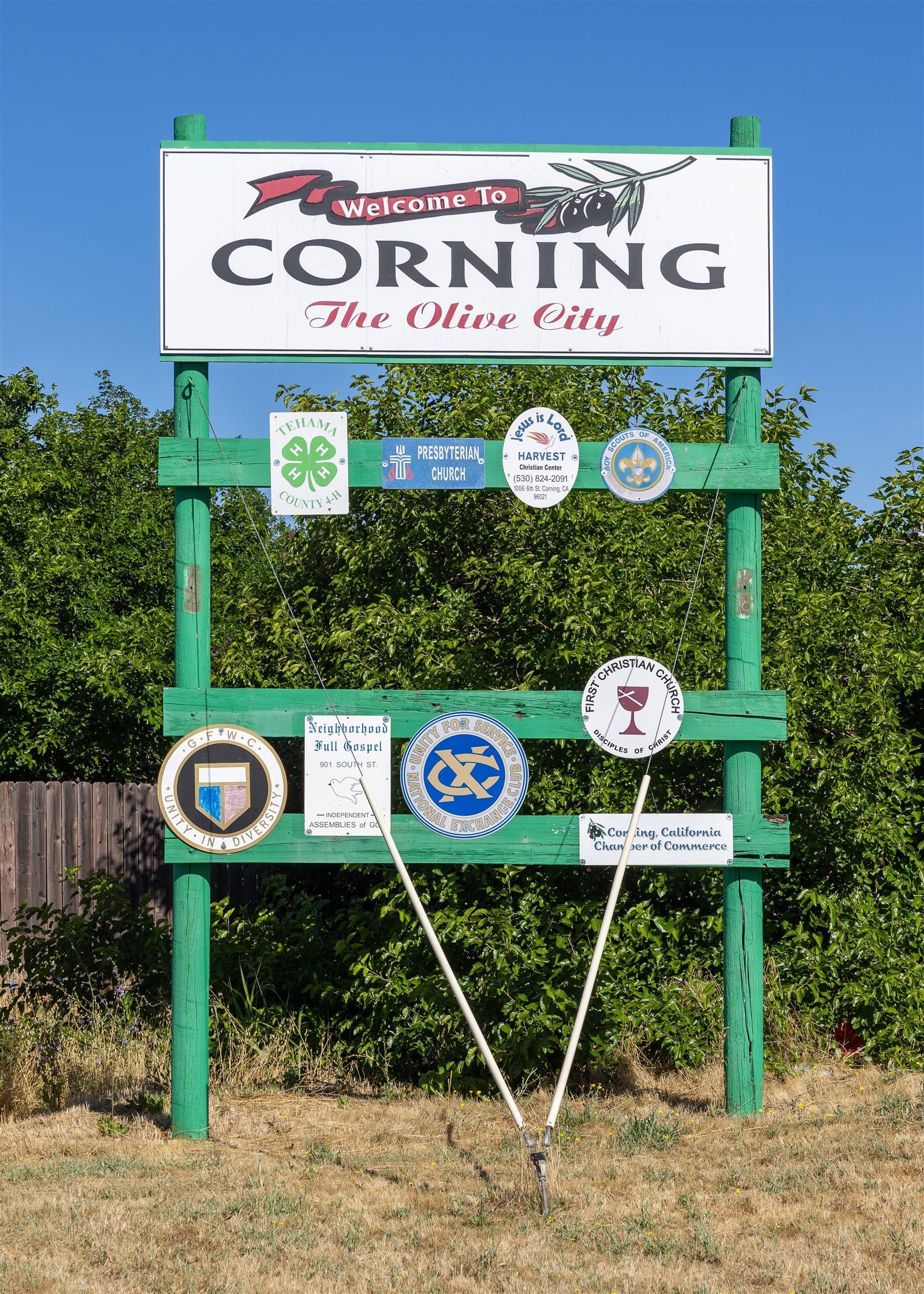
Pictured: the "Corning, The Olive City" welcome sign in Corning, Tehama County, California — not a photograph of the incident itself, which occurred after 11 PM on a rural county road and left no photographic record. No public-domain or rights-clear photograph of Hoag Road, the patrol car involved, or the Red Bluff Air Force Station radar room as they existed in August 1960 is known to survive; this is a real, rights-clear photograph of the actual town the officers were patrolling east of that night. (CC BY-SA 4.0, Frank Schulenburg, Wikimedia Commons.)
Theoretical Alignment
The case aligns most readily with the Extraterrestrial Hypothesis insofar as the officers describe a large, silent, structured object that reversed a steep descent, hovered, and approached and retreated from their car, behaviour that matches no aircraft of 1960 and no natural phenomenon proposed for it. It aligns poorly with Psycho-Social explanations. The two primary witnesses were on duty, wrote a signed report the same night, and were described by their area commander as men who “were not publicity minded.” Two deputies at Los Molinos and the night jailer reported seeing the object at the same time from different places. The ETH score is held down because the account rests on visual testimony and a telephoned radar confirmation that left no surviving record.
Background
By the summer of 1960, the California Highway Patrol was fourteen years removed from Kenneth Arnold's 1947 "flying saucer" sighting and deep into a decade in which the U.S. Air Force's Project Blue Book — then under the nominal direction of Major Robert Friend, with astronomer J. Allen Hynek serving as its scientific consultant — had settled into a pattern that critics were increasingly willing to challenge in public: attributing the large majority of reports to misidentified aircraft, balloons, and astronomical objects, while a persistent minority of cases resisted those categories entirely. Tehama County, in the upper Sacramento Valley roughly 130 miles north of Sacramento, was unremarkable ground for a major UFO case: an agricultural county built around rice, olives, and cattle, its county seat of Red Bluff home to a Cold War-era Air Defense Command radar station, one of dozens ringing the continental United States as part of the SAGE early-warning network built in direct response to the perceived Soviet bomber threat. It was against this backdrop — ordinary farm country, watched over by an ordinary radar station built for an entirely different purpose — that two patrolmen on a routine graveyard shift encountered something neither could explain.
Officer Charles A. Carson (badge No. 2358) and Officer Stanley Scott (No. 1851) were working out of the CHP’s Red Bluff area office; their report is addressed to the Area Commander, Red Bluff. Carson told NICAP investigator Walter N. Webb that he had “served 4 years with the Air Force” and that Scott “served as a paratrooper during the Korean Conflict.” Their patrol car carried a red light, which Scott would later turn on the object.
The organization that did most to keep the Red Bluff case in circulation, the National Investigations Committee on Aerial Phenomena (NICAP), had been founded in 1956 and by 1960 was led by retired Marine Corps Major Donald Keyhoe. NICAP valued exactly the kind of witness Red Bluff produced: named, on-duty officers willing to put a detailed account in writing. Its adviser Walter N. Webb obtained a copy of the officers’ report, Carson’s drawings and a letter from Carson, and NICAP published the case in The UFO Evidence (1964, p. 61).
Complete Timeline
| Date / Time | Event |
|---|---|
| Aug 13, 1960, 11:50 PM | Officers Charles A. Carson and Stanley Scott, eastbound on Hoag Road east of Corning between Highways 99W and 99E looking for a speeding motorcyclist, see what they take for “a huge airliner dropping from the sky” directly in front of them. They stop and leap out, expecting a crash, and notice “an absolute silence.” |
| Moments later | At an estimated 100–200 feet above the ground the object “suddenly reversed completely, at high speed, and gained approx. 500’ altitude. There the object stopped.” It is half a mile to a mile away. |
| Shortly after | The object, “surrounded by a glow making the round or oblong object visible,” shows a red light at each end and at times about five white lights between them. Carson later sketched it as an ellipse about 150 feet long and 40 feet high, “about the size of a DC-6 without wings.” |
| Over the next ~2 hours | On two occasions the object comes directly toward the patrol car; each time it turns and “swept the area with a huge red light.” When Scott turns the car’s red light on it, “it immediately went away from us.” The officers see the red beam used “approximately 6 or 7 times.” |
| Same period | At one point it comes within about 150 yards, “easy pistol range”; the officers have their pistols ready and are debating whether to fire when it stops (Harder; McDonald). “Each time the object neared us we experienced radio interference.” |
| Early in the sighting | The officers radio the Tehama County Sheriff’s Office, which handles their night dispatching, and ask it to contact the local radar base. Their report says “the radar base confirmed the U.F.O.—completely unidentified.” Deputies Clarence Fry and Max Montgomery then drive to Los Molinos and watch the object from there. |
| Later | The object moves slowly east and the officers follow. At the Vina Plains Fire Station they see it approached by “a similar object from the south”; both stop for some time, occasionally emitting the red beam, then “disappeared below the eastern horizon.” Total observation: about 2 hours 15 minutes. |
| About 2 AM | Back at the Sheriff’s Office, Carson and Scott meet Fry and Montgomery, who “had seen the U.F.O. clearly and described to us what we saw”; the night jailer also saw it briefly (he later took his prisoners onto the jail roof to look, per Harder). The officers call the radar base again, and the operator describes the object’s movements on his scope while they listen on extensions (Harder, Appendix I). |
| Aug 14 | Carson and Scott write and sign their report to the CHP Area Commander, Red Bluff. |
| Aug 14, daytime | The officers drive to Red Bluff Air Force Station. They are told no such radar sighting was made, are refused permission to speak to the operator who had been on duty, and get what Carson called the “ice water treatment” from the commanding officer. |
| Aug 14, evening | Deputies Fry and Montgomery report another sighting, also seen by a Corning police officer (about.com account). Other reports follow over the next week, and Carson receives letters from motorists who saw the object from Highway 99E. |
| Aug 16–17 | Dr. James A. Harder of UC Berkeley and Dr. Carl Johannessen record a half-hour taped interview with the officers three days after the sighting. |
| Autumn 1960 | In a letter to a NICAP member, the Air Force attributes the sighting to “a refraction of the planet Mars and the bright stars Aldebaran and Betelgeux,” with inversions and a layer of forest-fire smoke as contributing factors. The case also comes up in a USAF briefing to members of the House Armed Services Committee on December 8, 1960. |
| Nov 14, 1960 | Carson writes to NICAP adviser Walter N. Webb of the Hayden Planetarium, Boston, enclosing the report and drawings: “no one will ever convince us that we were witnessing a refraction of light.” |
| Jan 3, 1961 | Capt. Blohl, the CHP Area Commander at Red Bluff, tells an interviewer that Carson and Scott had worked for him for three or four years, that he had “the highest regard for their honesty,” and that they “were not publicity minded” (Harder, Appendix I). |
| 1964 | NICAP publishes the case, compiled by Richard H. Hall, in The UFO Evidence, its landmark documentary survey of unexplained sightings. |
| Undated | After a NICAP astronomical adviser finds that Mars, Aldebaran and Betelgeuse were not in the sky at the time, Blue Book changes the explanation to Mars and Capella. McDonald notes that Capella, the only one actually up at 11 PM, was “nowhere near the location of the sighted object.” |
| Oct 27, 1966 – Apr 22, 1967 | James E. McDonald interviews Carson by telephone and features the case as “Case 4” in his April 22, 1967 paper “UFOs: Greatest Scientific Problem of Our Times?” He disputes Donald Menzel’s claim of “fantastic multiple inversions,” saying the radiosonde data he obtained “does not fit that description.” |
| July 29, 1968 | At the House Committee on Science and Astronautics symposium, Dr. James A. Harder opens his statement on UFO propulsion with the Corning sighting and appends the officers’ report; psychologist Dr. Robert L. Hall cites it as a case that does not fit mass hysteria. |
| 1977 | J. Allen Hynek discusses the case in The Hynek UFO Report (pp. 92–94). |
The Sighting Begins
Officers Carson and Scott were eastbound on Hoag Road, a rural road east of Corning between Highways 99W and 99E, “looking for a speeding motorcycle when we saw what at first appeared to be a huge airliner dropping from the sky.” Their report goes on: “The object was very low and directly in front of us. We stopped and leaped from the patrol vehicle in order to get a position on what we were sure was going to be an airplane crash. From our position outside the car the first thing we noticed was an absolute silence. Still assuming it to be an aircraft with power off we continued to watch until the object was probably within 100’ to 200’ of the ground when it suddenly reversed completely, at high speed and gained approx. 500’ altitude. There the object stopped.” Harder, who interviewed them three days later, adds that the object went “back up the 45-degree glide path it had been taking,” at a distance of half a mile to a mile.
“At this time it was clearly visible to both of us, and obviously not an aircraft of any design familiar to us,” the report continues. “It was surrounded by a glow making the round or oblong object visible. At each end, or each side of the object, there were definite red lights. At times about 5 white lights were visible between the red lights.” In his November 1960 letter to Webb, Carson wrote that “the object was shaped like a football” and that the “glow was emitted by the object, was not a reflection of other lights.” He estimated it at about the size of a DC-6 without wings, and his sketch shows an ellipse about 150 feet long and 40 feet high.
The Standoff: Approaches, the Red Beam, and Drawn Sidearms
What followed was an extended encounter in which the object seemed to react to the officers. “On two occasions the object came directly towards the patrol vehicle,” their report says. “Each time it approached the object turned, swept the area with a huge red light.” Carson told McDonald that one of the lights was about six feet in diameter. The officers saw the red beam used “approximately 6 or 7 times, sweeping the sky and ground areas.” Harder summarised the movement as able to “move in any direction without altering its orientation,” at times very slowly or motionless, at times at very high speed.
“Officer Scott turned the red light on the patrol vehicle towards the object and it immediately went away from us,” the report says. In his letter to Webb, Carson described a kind of hide and seek: “We made several attempts to follow it, or I should say get closer to it, but the object seemed aware of us and we were more successful remaining motionless and allow it to approach us, which it did on several occasions.” Harder’s summary says it “seemed always to know they were there and always kept about half a mile away.”
At its closest, Harder wrote, the object drifted toward them “and got within some 150 yards of them, easy pistol range.” McDonald, who interviewed Carson, wrote that “they had their pistols ready and were debating whether to fire when it stopped.” The report also records that “each time the object neared us we experienced radio interference,” and McDonald adds that their first attempts to radio the dispatcher failed because of it.
Radar Corroboration and the Air Force's Reversal
The officers radioed the Tehama County Sheriff’s Office, which did their night dispatching, and asked for more cars and for a check with the radar base. Their signed report states simply: “The radar base confirmed the U.F.O.—completely unidentified.” Harder’s summary says that “by telephone the radar operator confirmed the UFO and stated that it was unidentified,” and McDonald that the call “brought confirmation that they were tracking an unknown moving in the manner reported.” The secondary accounts credit Deputy Clarence Fry with the call. Harder’s Appendix I adds a second contact: after the officers returned to the Sheriff’s Office “they called the radar base again, and talked with the operator while all of them listened in on various extensions. He described to them some of the movements of the object as he had observed it on the radar screen; these corresponded to the movements they had observed.” Red Bluff Air Force Station, about 4 miles west-southwest of Red Bluff, was home to the 859th Radar Squadron (SAGE), which had been redesignated from the 859th Aircraft Control and Warning Squadron that July.
That confirmation did not survive the next day. When Carson and Scott drove to the station, McDonald wrote, “they were informed that no such radar sighting had been made. Their request to the officer in charge to speak with the radarman on duty at the time of the incident was denied.” Harder records that they got what Carson called the “ice water treatment” from the commanding officer. No radar log or plot has been published, so there is no way now to tell whether the operator saw a real target that matched the object, saw something else, or was mistaken. The confirmation rests on what the officers and the Sheriff’s Office heard on the telephone.
The Object's Reported Behavior in Detail
The details that set Red Bluff apart come from three close-in sources: the officers’ signed report, Carson’s November 14, 1960 letter to Walter Webb, and the taped interview Harder and Carl Johannessen recorded three days after the sighting. Harder drew four points from them: there was no observable noise; the object could hover and “seemed to float as if it were in water”; it could accelerate and move very rapidly; and it hovered or moved slowly for at least two hours. Carson insisted that the glow came from the object itself, and he explained how the officers had judged speed and size: “Our observations and estimations of speed, size, etc. came from aligning the object with fixed objects on the horizon.” Earlier versions of this page added two details found in none of these sources: a beam that could not move independently of the object, and Scott describing the object “jumping” over a rise. Both have been removed.
Subsequent Nights and Independent Corroboration
The officers were not the only witnesses. Their report says that when they returned to the Sheriff’s Office they met Deputies Fry and Max Montgomery, “who had gone to Los Molinos after contacting the radar base. Both had seen the U.F.O. clearly and described to us what we saw. The night jailer also was able to see the object for a short time, each described the object and its maneuvers exactly as we saw them.” Harder’s appendix adds that the deputies watched it “simultaneously, though at a greater distance,” from Los Molinos; that the jailer “marched his several prisoners out onto the roof of the jail, each of whom saw it”; and that newspaper publicity brought Carson letters from motorists who had seen the object from Highway 99E. Harder also wrote that “during that night, and several succeeding nights, there were many reports of UFO’s over northern California.” The about.com account adds a sighting the next evening by Fry and Montgomery that a Corning police officer also saw. Earlier versions of this page placed the deputies at the “substation in town” and described a separate sighting of four objects in a line near Los Molinos; neither detail appears in the sources found.
The Case in the Broader Blue Book Controversy
Red Bluff became one of the standard cases in the 1960s argument over whether Project Blue Book’s explanations were real attempts to account for reports. James E. McDonald, the University of Arizona atmospheric physicist, made it “Case 4” in his April 22, 1967 paper “UFOs: Greatest Scientific Problem of Our Times?” He interviewed Carson by telephone on October 27, 1966, and spoke with two other people involved. When the House Committee on Science and Astronautics held its symposium on July 29, 1968, it was Dr. James A. Harder of UC Berkeley who used the case at length: he opened his statement on the “UFO propulsion problem” with it and appended the officers’ report. Psychologist Dr. Robert L. Hall cited it as a calm, prolonged, radar-checked observation that did not resemble documented mass hysteria. McDonald’s own statement at that symposium is not known to discuss Red Bluff.
The skeptical side was put by Harvard astronomer Donald Menzel, who in print (McDonald cites p. 254 of a Menzel book) accepted the Air Force explanation and wrote of a night of “fantastic multiple inversions of temperature and humidity,” such that he would have expected many more UFO reports. McDonald replied: “I should like to know what radiosonde data Dr. Menzel is citing, since the data I obtained does not fit that description.” He added that he could not share the readiness of Menzel and Blue Book to think that patrolmen “draw their .44s in uneasiness over looking at a refracted image of Capella.”
Key Researchers
- Dr. James E. McDonald (1920–1971) — University of Arizona atmospheric physicist who interviewed Carson by telephone in October 1966, spoke with two other people involved, disputed Menzel’s inversion claim against the radiosonde data he obtained, and featured the case as “Case 4” in his April 1967 paper “UFOs: Greatest Scientific Problem of Our Times?”
- Dr. James A. Harder — UC Berkeley engineering professor who, with Dr. Carl Johannessen, taped a half-hour interview with the officers three days after the sighting, and presented the case, with the officers’ report, to the House Committee on Science and Astronautics on July 29, 1968.
- Richard H. Hall — NICAP's principal compiler, who documented the case in the organization's 1964 landmark survey The UFO Evidence.
- Walter N. Webb — Hayden Planetarium astronomer and NICAP field investigator who corresponded directly with Officer Carson, obtaining his original report, diagrams, and a detailed follow-up letter dated November 14, 1960.
- Dr. Donald Menzel — Harvard astronomer, director of the Harvard College Observatory, and the era's most prominent professional UFO skeptic, whose books through the 1950s and 1960s built the case that essentially all UFO reports could be traced to optical, atmospheric, or psychological causes. He defended Blue Book's refraction explanation for Red Bluff by citing an alleged multiple temperature-and-humidity inversion — a claim McDonald said the radiosonde data he obtained did not support, making Red Bluff one of the more direct, documented exchanges between the two men's opposing positions on how rigorously Blue Book's explanations should be tested.
- J. Allen Hynek — Project Blue Book’s scientific consultant, who later discussed the case in The Hynek UFO Report (1977, pp. 92–94).
Key Witnesses
Officer Charles A. Carson
Primary witness and co-author of the signed report to the CHP Area Commander, Red Bluff (badge No. 2358). He supplied NICAP adviser Walter N. Webb with the report, drawings and a letter dated November 14, 1960, and was interviewed by McDonald in 1966. He had served four years in the Air Force and said he was familiar with the northern lights and weather balloons, both of which had been suggested to him. Of the Air Force explanations he told McDonald: “I’d sure hate to take one of my cases into court with such weak arguments.” In the letter to Webb: “no one will ever convince us that we were witnessing a refraction of light.” Six years on he told McDonald, “I’ve never seen anything like it before or since.”
Officer Stanley Scott
Co-witness and co-signer of the report (badge No. 1851), a former paratrooper in the Korean War. Scott turned the patrol car’s red light on the object, after which “it immediately went away from us.” His area commander said Scott “would rather take a knife or a gun away from a man than make a speech.”
Deputy Clarence Fry
Tehama County deputy who, after the radar base was contacted, drove with Deputy Montgomery to Los Molinos and watched the object at the same time as the patrolmen, at a greater distance. The officers’ report says he “had seen the U.F.O. clearly and described to us what we saw.” Secondary accounts credit him with the telephone call to the radar station, and with a further sighting the next evening alongside a Corning police officer.
Deputy Max Montgomery
Tehama County deputy who went with Fry to Los Molinos on the night of the sighting and, according to the officers’ report, saw the object clearly and described the same maneuvers. He is also named in the account of the next evening’s sighting.
The Five Observables Assessment
Assessment: The object's arrested dive and stationary hover imply a form of lift with no visible means of propulsion, but because the encounter is testimonial rather than instrumented, this is classified as speculative rather than confirmed. The reversal from a near-ground dive to a stable 500-foot hover happened quickly enough that both officers described it as instantaneous, but again without radar or photographic timing data this is speculative rather than a hard-confirmed instant-acceleration event. No hypersonic speeds were reported at any point — the object's movements, aside from the dive reversal, were described as deliberate and at times slow. Low observability is explicitly absent: the object was brightly self-illuminated and visually tracked without difficulty for over two hours by multiple observer groups. No air-to-water or other trans-medium transition was reported.
Evidence Assessment
Supporting Anomalous Origin
- Two independent, on-duty, professionally trained law-enforcement officers gave detailed, consistent, and court-conscious testimony
- Two deputies at Los Molinos and the night jailer saw the object at the same time from other places and described the same maneuvers, according to the officers’ report
- Harder reports letters from motorists on Highway 99E who saw the object, and a further sighting the next evening involved the deputies and a Corning police officer
- By telephone, the Red Bluff radar operator confirmed an unidentified target, and in a second call described its movements, which matched what the officers had seen
- The object's reported performance (silent, near-instant dive reversal into a stable hover, apparent responsiveness to the patrol car's spotlight) has no straightforward conventional analogue for 1960
- Blue Book’s first explanation named Mars, Aldebaran and Betelgeuse, all of which were below the horizon when the sighting began; its revision to Capella placed the source in the wrong part of the sky
- McDonald said the radiosonde data he obtained did not fit Menzel’s “fantastic multiple inversions”
- Carson's November 1960 letter and diagrams to NICAP were produced under his own name, with nothing to gain and professional risk to lose by fabricating a report
Supporting Conventional Explanation
- The radar confirmation was denied the next day, the officers were not allowed to speak to the operator, and no radar record has been published
- No physical evidence, photograph, or instrumented recording of any kind exists
- The officers' initial impression — a descending airliner — shows that even trained observers can misjudge an unfamiliar light source at night, at least in the first moments of a sighting
- Regional wildfire smoke haze, a genuine environmental condition that night, is a documented source of optical distortion for bright celestial and terrestrial light sources alike
- The case is now 65+ years old, and no further physical or documentary evidence has surfaced since the original NICAP correspondence to test the account against
Why "Credible"
The rating rests on the witnesses and on the record they left. Two on-duty officers wrote and signed a detailed report the same night. Their commander vouched for them, and they gave a taped interview three days later. Two deputies and a jailer reported seeing the object at the same time from other places. The officers twice heard a radar operator say he had it on his scope. The case has a real limitation: the radar confirmation exists only as what was heard on the telephone, it was denied the next day, and no record has been published. There is no photograph or physical trace. The official explanation, however, plainly fails. All three bodies first named were below the horizon when the sighting began, and the substitute, Capella, was low in the north-northeast, nowhere near where the object was seen. No other conventional explanation has been offered that fits a silent object descending, reversing, hovering and approaching for two hours. That combination of strong testimony, a broken official explanation and missing instrumental proof supports a Credible rating in the upper 60s.
Sensor & Instrumentation Detection Profile
The only instrument data in the case is what the radar operator at Red Bluff Air Force Station said on the telephone. According to the officers’ report, the Sheriff’s Office contacted the radar base and “the radar base confirmed the U.F.O.—completely unidentified.” After the sighting, the officers called again and listened on extensions as the operator described movements that matched what they had seen (Harder, Appendix I). In 1960 the station operated AN/FPS-6 and AN/FPS-6A height-finder radars and an AN/MPS-11 search radar, and its unit had become the 859th Radar Squadron (SAGE) on July 15, 1960. The next day the officers were told there had been no radar sighting and were refused access to the operator. No log, plot or written statement from the operator has ever been published.
Environmental & Geospatial Context
Hoag Road runs east from Corning across open Sacramento Valley farmland between Highways 99W and 99E; the officers followed the object east as far as the Vina Plains Fire Station. Los Molinos, where the deputies watched, lies to the north-east of the first sighting, and Red Bluff Air Force Station about 4 miles west-southwest of Red Bluff, roughly 18 miles north-northwest of the sighting. Harder records “a very clear night, with no clouds.” Computed from JPL Horizons for the location, the Moon, just past half (about 49% lit), rose in the east-northeast at about 12:20 AM PDT, roughly half an hour into the sighting. Mars rose at about 1:00 AM and Aldebaran at about 1:15 AM, both in the east-northeast; Betelgeuse not until after 3 AM. Capella was just above the horizon in the north-northeast (about 5° up at 11:50 PM) and climbing.
Observer Credibility & Occupational Profile
The case rests largely on its witnesses. Charles A. Carson and Stanley Scott were on-duty California Highway Patrol officers who put their account in a signed report to their area commander the same night. Carson had served four years in the Air Force and Scott was a Korean War paratrooper. Carson stressed that “both of us are aware of the tricks light can play on the eyes during darkness. We were aware of this at the time.” Their area commander, Capt. Blohl, said they were honest, not publicity minded, and that their story “stood up unaltered.” The corroborating witnesses were Deputies Clarence Fry and Max Montgomery at Los Molinos and the county’s night jailer.
It is also worth being precise about what CHP training in 1960 did and did not select for. Highway Patrol officers of the era were trained and evaluated specifically on their ability to give clear, defensible verbal and written accounts of fast-moving, ambiguous roadside events — the exact skill set most relevant to correctly perceiving and later describing an unfamiliar aerial object under stress. They were not, by contrast, trained aviators or radar operators, and neither Carson nor Scott ever claimed specialized expertise in aircraft recognition beyond what any patrol officer would pick up recognizing civil air traffic over a rural beat. This cuts in the case's favor on the reliability of the raw observation — two officers whose job depended on accurate incident reporting gave a detailed, mutually consistent account — while leaving open, and properly so, a degree of uncertainty about whether either officer could have reliably distinguished a genuinely novel craft from an unfamiliar but conventional one. What the record does not support is any suggestion that either man was an unreliable or untrained observer; every documented critique of the case attacks the Air Force's proposed explanations, not the officers' competence to report what they saw.
Physical & Material Assays
No physical trace evidence exists in this case. Nothing was recovered from the ground, no debris or landing traces were reported, and no photograph or film of the object is known to survive. The only quasi-physical record is the verbal radar return described above, which itself was never preserved as a printed track and was retracted rather than confirmed in writing. The absence of any material evidence is itself a meaningful data point: unlike cases with alleged trace evidence of contested origin, Red Bluff has never generated a competing chain-of-custody dispute, because there was never any physical object to dispute.
Historical Precedents & Archive Matches
Red Bluff belongs to a recognizable group of Blue Book-era reports in which police officers, rather than private citizens, gave the primary testimony and a radar check was claimed. Comparable radar-visual cases that McDonald also investigated and cited include the Lakenheath–Bentwaters case of 1956 and the RB-47 case of 1957. The town also appears in an earlier, unrelated Blue Book “unknown”: on August 19, 1952, Ground Observer Corps observer Albert Lathrop at Red Bluff watched two objects “shaped like fat bullets” fly straight and level for 25 seconds (NICAP Blue Book unknowns list).
The broader wave of "police officer" UFO cases that Red Bluff helped inaugurate would recur throughout the following decade, most famously in the 1966 Portage County, Ohio pursuit involving multiple sheriff's deputies across two states, and in numerous smaller, less-publicized reports from highway patrol and municipal police officers across the country through the late 1960s and 1970s. Researchers cataloging these cases have repeatedly noted the same structural pattern first visible at Red Bluff: an initial, unguarded confirmation from an on-duty government employee (a radar operator, a second patrol unit, a dispatcher), followed by a more cautious or flatly contradictory statement once the report worked its way up an institutional chain of command. Whether that pattern reflects a genuine, if informal, policy of institutional caution around embarrassing reports, or simply reflects that duty operators without supervisory review are more likely to speak plainly, remains an open and explicitly unresolved question in the literature — but Red Bluff is one of the clearest, best-documented early instances of it on record.
Material Analysis
There is no physical or material evidence associated with the Red Bluff case in any conventional sense — no soil disturbance, no recovered fragments, no burn marks, no metallurgical or isotopic samples of any kind. The event was, from beginning to end, a visual and (briefly) radar-based encounter with no landing, no close-range material interaction, and no claimed physical aftermath to the witnesses or the surrounding terrain. The single quasi-material record generated by the case is the Red Bluff Air Force Station's radar return itself, which functioned analogously to physical evidence in that it was, for a matter of hours, an independently generated instrument record existing outside the witnesses' own testimony — and which was then effectively withdrawn from the record when the station's command declined to release or confirm any printed track. Carson's hand-drawn diagrams, submitted to NICAP alongside his November 1960 letter, constitute the closest thing to a durable, physical case artifact: not evidence of the object itself, but a contemporaneous, witness-authored visual record created within three months of the sighting, before the passage of decades could reasonably be blamed for memory drift.
Supporting Non-Terrestrial or Genuinely Anomalous Origin
- The radar return, however briefly confirmed, was an independent instrument detection consistent with the visual account, obtained before any denial was issued
- Carson's diagrams and letter are a preserved, dated, witness-authored primary record rather than a decades-later reconstruction
Supporting Terrestrial or Misidentification Origin
- The complete absence of any physical trace, sample, or recovered material is consistent with a purely optical or atmospheric phenomenon, which by definition leaves nothing behind
- Without a preserved radar track, the "confirmation" cannot be independently re-examined by modern researchers the way an archived Blue Book case file often can
The Sky That Night
Because the Air Force’s explanation was astronomical, it can be tested directly. For an observer on Hoag Road (about 39.9°N, 122.1°W) the sighting began at 11:50 PM PDT on August 13, which is 06:50 UT on August 14. At that moment Mars was about 7° below the horizon and rose at about 1:00 AM PDT in the east-northeast (JPL Horizons). Aldebaran was about 14° below and rose at about 1:15 AM, and Betelgeuse was more than 30° below and did not rise until after 3 AM. Capella was the only one of the four in the sky: about 5° up in the north-northeast, climbing slowly. The Moon, about 49% lit, rose in the east-northeast at about 12:20 AM. The object, by contrast, was first seen “directly in front” of eastbound officers, came down to within a few hundred feet of the ground, approached to within about 150 yards, and was followed east for two hours before it and a second object “disappeared below the eastern horizon.” A rising star or planet moves the other way: it climbs away from the eastern horizon over the course of a night. On these numbers, the original explanation fails on timing and the revised one on direction and motion.
The Conventional Explanation Candidate
Project Blue Book's official position, and the two most commonly proposed alternatives to it, deserve full and honest evaluation on their own terms — OverClassified's editorial standard is to weigh the best available conventional case exactly as seriously as the anomalous one, not to wave it away because the case is a favorite of ufology.
Astronomical Refraction (Mars, Aldebaran & Betelgeuse, later revised to Mars & Capella)
The Air Force’s explanation, in a letter to a NICAP member, was that the officers “witnessed a refraction of the planet Mars and the bright stars Aldebaran and Betelgeux,” projected upward by temperature inversions “as the planet Mars was quite low in the skies,” with “a layer of smoke” from forest fires as a contributing factor. This explanation deserves the most scrutiny because it is the one the government committed to in writing. A NICAP astronomical adviser found that none of the three was in the sky at the time; McDonald summarised that they “were not even in the California skies.” The computed positions above agree for the start of the sighting at 11:50 PM: Mars and Aldebaran rose in the east-northeast only around 1:00–1:15 AM, and Betelgeuse after 3 AM. Blue Book then substituted Capella for the two stars. McDonald noted that Capella, “the only one of those celestial bodies that was even in the sky at 2300, was nowhere near the location of the sighted object.” The about.com account adds that Capella would have risen through the sighting while the objects ended by sinking below the eastern horizon. Separately, Donald Menzel defended refraction by invoking “fantastic multiple inversions of temperature and humidity.” McDonald replied that the radiosonde data he obtained “does not fit that description.”
Aircraft or Balloon Misidentification
The officers' own first impression was that they were watching an airliner in distress, which is worth taking seriously: it shows that even trained observers can misjudge an unfamiliar light source in the first seconds of an unusual event. But the aircraft explanation does not survive contact with the rest of the sighting. No aircraft of 1960 could arrest a steep, high-speed dive at 100–200 feet and climb silently back to a stationary hover; no aircraft could sustain a motionless hover for the better part of two hours; and no aircraft could plausibly explain the repeated, apparently deliberate approaches toward the patrol car followed by a sweeping red beam, nor the object's retreat when Officer Scott aimed the car's own spotlight at it. A weather balloon, meanwhile, cannot execute directed movement, reverse a dive, or sweep a beam of light at all, and Carson explicitly and specifically rejected the weather-balloon explanation when it was informally offered to him.
Signal/Radar Anomaly or Ground-Radar Misread
A plausible, narrower explanation for the radar component alone is that the Red Bluff operator misread a transient anomalous propagation return, a ground clutter artifact, or an unrelated aircraft track, and that his subsequent retraction — rather than a cover-up — reflected an honest correction once the scope data was reviewed more carefully in daylight. This is a genuinely plausible partial explanation for the radar leg of the case specifically, and it is the most defensible conventional account on offer: 1959-vintage height-finder and search radar was capable of transient false returns, and a duty operator relaying an unconfirmed contact over the phone, without a supervisor’s review, is a realistic scenario. Against it, the operator spoke to the officers a second time and described movements that matched theirs. It does not address the visual sighting, which the two officers, two deputies at Los Molinos and the night jailer all reported.
Astronomical Refraction (Mars/Aldebaran/Betelgeuse → Mars/Capella)
ImplausibleIMPLAUSIBLE. Mars, Aldebaran and Betelgeuse were all below the horizon when the sighting began at 11:50 PM; Mars and Aldebaran rose in the east-northeast only around 1:00–1:15 AM. The substitute, Capella, was low in the north-northeast, not where the object was, and no refracted star can account for a large object descending, reversing, hovering and approaching for two hours.
Aircraft or Balloon Misidentification
ImplausibleIMPLAUSIBLE as a complete explanation. Plausible only for the officers' first few seconds of misperception before the object's actual behavior became clear; cannot account for the hover, the directed approaches, or the responsive red-beam behavior.
Ground-Radar Anomaly or Misread
Inconclusive (radar leg only)INCONCLUSIVE, and the single most defensible conventional candidate on offer — but it addresses only the radar confirmation, not the extended, multi-witness visual sighting that anchors the case.
Related Cases
Confirmed Documents & Official Records
The National Archives' finding aid and overview page for the full Project Blue Book collection (1947–1969), within which the Red Bluff case file is catalogued chronologically among the roughly 12,600 reports the Air Force investigated.
UNCLASSIFIED (declassified)NICAP's original case summary, drawn from Officer Carson's report and correspondence, as published in The UFO Evidence (1964).
Private archive (non-government)NICAP's directory entry cross-referencing the case against Richard Hall's original report and Dr. McDonald's later commentary.
Private archive (non-government)Search Government Archives Directly
Further Reading — Recommended Literature
The Hynek UFO Report
Project Blue Book's own longtime scientific consultant discusses the Red Bluff case (pp. 92–94) among the Blue Book cases he came to believe were inadequately explained.
Firestorm: Dr. James E. McDonald's Fight for UFO Science
A biography of James E. McDonald, who interviewed Carson, disputed the inversion defense of Blue Book’s Red Bluff explanation against radiosonde data, and used the case as an example of Blue Book’s shortcomings.
The UFO Evidence
NICAP’s 1964 documentary survey, which summarises the Red Bluff case (p. 61, with further references on pp. 112 and 170, per McDonald) alongside hundreds of other reports organized by evidentiary category.
DISCLOSURE: Some links above are affiliate links. If you purchase through them, OverClassified receives a small commission at no additional cost to you. This helps support independent research.
Essential Viewing
Sources
- Hall, Richard H. (compiler). "The Red Bluff Case." NICAP, 1960–1964. nicap.org
- NICAP. "Red Bluff UFO Case Directory," cross-referencing Hall's report and McDonald's commentary. nicap.org
- McDonald, James E. Comments on the Red Bluff case from "UFOs: Greatest Scientific Problem of Our Times?" (1967 presentation), archived by NICAP. nicap.org
- Gross, Patrick (compiler). "UFOs at Close Sight: Red Bluff Case, USA, August 1960 — by James E. McDonald." Patrick Gross UFO History archive. patrickgross.org
- Gross, Patrick (compiler). "UFOs at Close Sight: Red Bluff Case, USA, August 1960 — by About.com" (quotes the Air Force letter and Carson's November 14, 1960 letter). Patrick Gross UFO History archive. patrickgross.org
- Patrick Gross UFO History archive. "UFOs at Close Sight: Red Bluff Case, USA, August 1960" (case index page). patrickgross.org
- UFO Evidence. "Red Bluff Incident — Red Bluff, California, United States — August 13, 1960," Case 107. ufoevidence.org
- UFO Casebook Files. "Red Bluff Incident." ufocasebook.com
- Hynek, J. Allen. The Hynek UFO Report, Dell Publishing, 1977, pp. 92–94.
- Hall, Richard H. (ed.) The UFO Evidence, National Investigations Committee on Aerial Phenomena, 1964, p. 61.
- Druffel, Ann. Firestorm: Dr. James E. McDonald's Fight for UFO Science, Wild Flower Press, 2003.
- U.S. House of Representatives, Committee on Science and Astronautics. Symposium on Unidentified Flying Objects, July 29, 1968 (statement of Dr. James A. Harder, pp. 113 ff., with Appendix I, additional witnesses, and Appendix II, the officers’ report; remarks of Dr. Robert L. Hall). govinfo.gov
- NASA/JPL Solar System Dynamics. Horizons ephemeris for Mars and the Moon from 39.93°N, 122.10°W, August 14, 1960 06:00–09:00 UT; star altitudes computed from catalogue positions (October 2026). ssd.jpl.nasa.gov
- Klass, Philip J. UFOs Explained, Random House, 1974 (contemporaneous skeptical treatment of Blue Book-era radar/visual cases).
- U.S. National Archives and Records Administration. "Project BLUE BOOK: Unidentified Flying Objects." archives.gov
- NICAP. "The Project Blue Book 'Unknowns'" (lists the separate August 19, 1952 Red Bluff Ground Observer Corps sighting by Albert Lathrop). nicap.org
- Wikipedia contributors. "Red Bluff Air Force Station" (859th Aircraft Control and Warning Squadron; radar equipment and station history, used only for orientation on the station's known, uncontested operational facts). en.wikipedia.org
- California State Military Museum. "Red Bluff Air Force Station." militarymuseum.org
- Calendar-12.com. "Moon Phases Calendar for August 1960" (lunar illumination data for the night of the sighting). calendar-12.com
- Tutiempo Network. "Lunar Calendar, Moon Phases August 1960." tutiempo.net
- Star Walk. "Astronomical Events: Orion and the Winter Stars' Return to the Pre-Dawn August Sky" (general background on the winter stars' return to the August pre-dawn sky; the rising times on this page are computed). starwalk.space
- Corning, California entry, Wikimedia Commons (location/coordinate reference for the hero photograph; used only for the photo caption's geographic facts, not for case narrative). commons.wikimedia.org
Corrections (October 2026)
This page was checked in October 2026 against the officers’ signed report to the CHP Area Commander, Red Bluff, and Dr. James A. Harder’s statement and appendices in the printed record of the House Committee on Science and Astronautics symposium of July 29, 1968 (which also contains Dr. Robert L. Hall’s remarks). Other sources were McDonald’s “Case 4” (April 22, 1967); NICAP’s summary from The UFO Evidence (p. 61); the about.com and Patrick Gross compilations, which quote the Air Force letter and Carson’s letter to Webb; and a JPL Horizons ephemeris for the place and time. Confirmed: Hoag Road east of Corning; the airliner impression, the silence, the 100–200 ft descent, reversal and 500 ft hover; the red end lights and five white lights; two approaches with a red beam; Scott’s red light; radio interference; the second object at the Vina Plains Fire Station; about 2 hours 15 minutes; Deputies Fry and Montgomery and the night jailer; the telephoned radar confirmation and next-day denial; the Mars–Aldebaran–Betelgeuse and later Mars–Capella explanations; Carson’s November 14, 1960 letter to Walter Webb and his “refraction of light” and “into court” quotations; and Menzel’s “fantastic multiple inversions.”
Following this review, the rating was changed from Credible 70 to Credible 68 (October 27, 2026), because the higher rating had rested partly on claims corrected or removed above.
Corrected: the sighting began at 11:50 PM (“2350 hours”), not around 11 PM, and so ran to about 2:05 AM. The deputies watched from Los Molinos at the same time as the officers, not from the “sheriff’s substation in town.” The officers were refused access to the radar operator and given the “ice water treatment”; they had also heard the operator a second time, describing the object’s movements. The case was presented to Congress in 1968 by Harder (and cited by Robert L. Hall), not by McDonald. McDonald’s inversion check used radiosonde data, as he put it, not “Weather Bureau records” in general. Aldebaran rose at about 1:15 AM, not 3 AM, and Mars at about 1:00 AM, so both were below the horizon when the sighting began but rose before it ended. The Moon was about 49% lit and rising about 12:20 AM, not “58% waning gibbous.” The “Capella was rising” argument comes from the about.com account; NICAP and McDonald objected that Capella was in the wrong place. Red Bluff Air Force Station was about 18 miles from the sighting, not 15, and its unit had become the 859th Radar Squadron (SAGE). The Patrick Gross pages were wrongly credited to Loren E. Gross. Firestorm was published in 2003.
Removed as unsupported: a sighting by Fry and Montgomery of “four objects crossing the western sky in a straight line” near Los Molinos on August 14; a red beam “fixed” to the object so that the whole object had to turn to aim it; Scott describing the object as “jumping” over a rise; McDonald citing Red Bluff in his 1968 testimony; Hynek classifying the case as a Nocturnal Light; and the description of Jerome Clark’s encyclopedia entry and of NICAP’s book as “the first publication to compile the case in full.”
See something inaccurate? Have additional information or sources?
Suggest an Edit →Last Updated: October 2026