
The Neuvelle-lès-Lure Gamekeepers' Sighting
Around 11:15 PM on May 30, 1989, three men on a night anti-poaching watch near La Neuvelle-lès-Lure, a small farming commune on the Haute-Saône plateau — a national hunting warden with seventeen years' service, a trainee warden, and a student on placement with the departmental hunters' federation — saw three powerful lights, arranged in a triangle, flashing violently directly above them. The lights held still for some seconds, moved in a sawtooth pattern, climbed vertically until almost out of sight, dropped back just as fast to stop above the witnesses, and then, as a red light came on at their center, left in a few zigzags. The whole sequence lasted about two minutes and was completely silent. At 11:25 PM a Mirage from the nearby air base flew over, and at 11:30 another aircraft; the witnesses heard both engines and said neither resembled what they had seen (GEIPAN's summary calls the aircraft a Jaguar). The next day the senior warden phoned the air base control tower, which told him nothing had been picked up; the local gendarmerie at first declined to act, and the case reached SEPRA only after the hunters' federation intervened. Registered as GEIPAN case 1989-05-01176, the sighting remains classified D: unidentified.
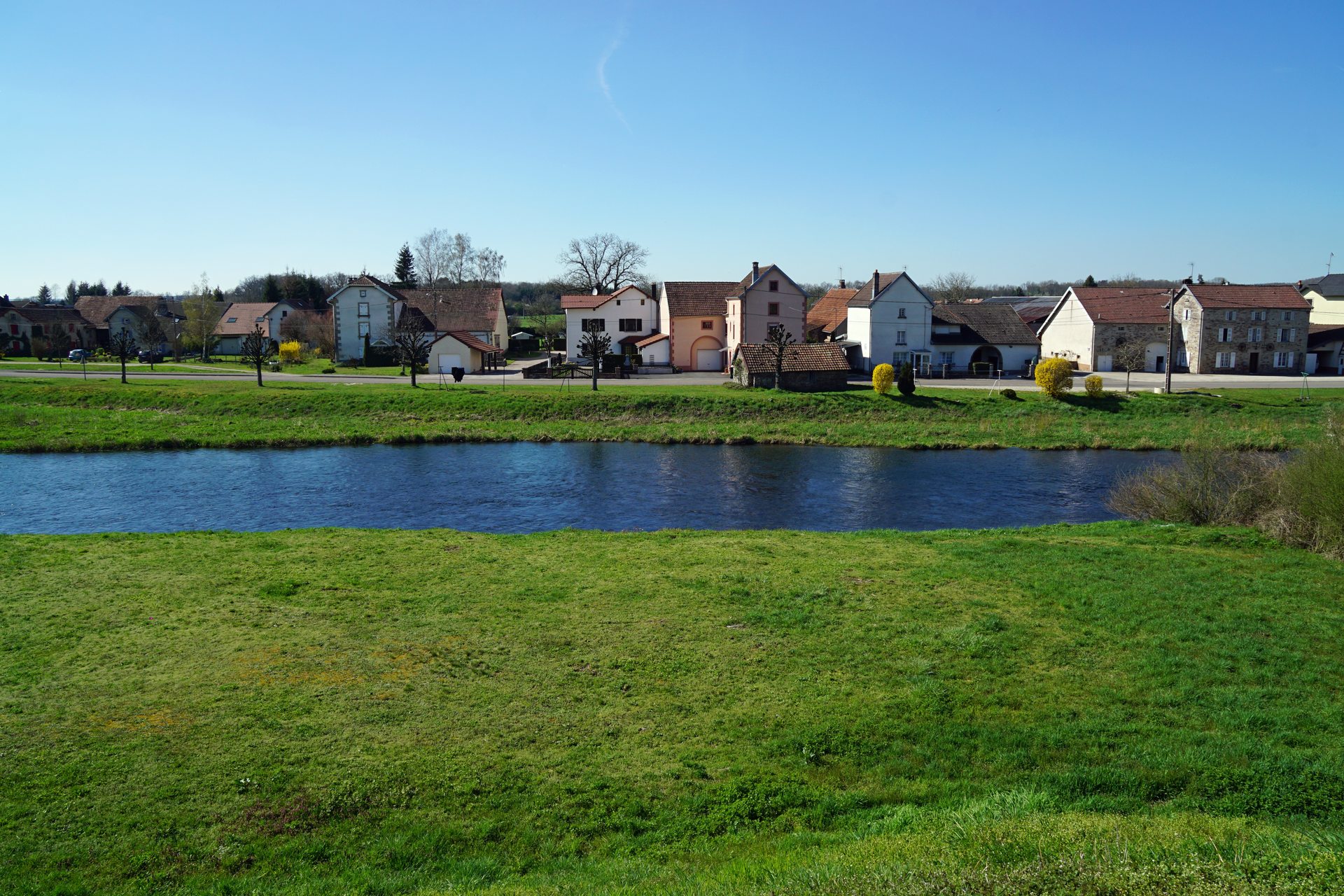
Pictured: houses along the Ognon river in La Neuvelle-lès-Lure, Haute-Saône — not the field where the three witnesses made the sighting, whose name is blacked out in the published file. No photograph, video, or other direct visual recording of the object itself is known to exist; the evidentiary record consists of the witnesses' statements and reports. Photo by Wikimedia Commons contributor A.BourgeoisP (2016), released under CC BY-SA 4.0.
Theoretical Alignment
This case's weighting leans further toward Extraterrestrial framing than most of this site's single-instant French sightings, for reasons specific to its own structure. Three witnesses on a night anti-poaching watch, led by an experienced national hunting warden, described a genuinely multi-phase behavioral sequence — a sustained hover, sawtooth movements, a vertical climb, a return to the same point, a color change, and a final multi-directional departure — that is considerably richer than the single-instant light phenomena more typical of this site's GEIPAN archive. The witnesses' own explicit distinction between the silent phenomenon and the audible aircraft that passed about ten minutes later is itself a meaningful anti-misidentification signal, the kind of specific negative detail this site's methodology treats as harder to produce by simple confusion than a vague, generic light report. Psycho-Social framing still carries real weight, rooted mainly in the sighting's age (1989) and the corresponding thinness of the surviving public documentation, and in the fact that the three were together throughout and were heard by the gendarmerie only two and a half months later. Interdimensional framing draws the least support, as in nearly every case in this site's archive, resting on the total absence of any photographic or instrumented corroboration rather than anything distinctive about the witnesses' account itself.
Background
Three threads of context matter for this case: the small Haute-Saône farming commune where the sighting occurred, the NATO-era military airfield that turns out to sit substantially within that same commune, and the state of GEIPAN's predecessor agency at the specific moment, in mid-1989, this sighting was reported.
La Neuvelle-lès-Lure: From "Subtus Novam Villam" to a Rural Commuter Village
La Neuvelle-lès-Lure is a small commune of roughly 302 residents (2023) on the Haute-Saône plateau, within the sous-Vosgian depression of the Bourgogne-Franche-Comté region (Franche-Comté alone, prior to the 2016 regional merger), in the arrondissement of Lure, a few kilometers from that town. Its name is first documented in 1209 in the Latinized form Subtus novam villam ("below/near the new village"), later evolving into La Novale and eventually its modern form; an 1855 discovery of roughly 100 silver medals near a local Roman road hints at settlement activity considerably older than the medieval written record. The commune's land use today is roughly half agricultural (50.4%), a quarter industrial (26.2%, reflecting the former military airfield within its boundaries), and just over a sixth forested (17.4%), with the Ognon river running north to south through the territory and a stone bridge spanning it among the commune's few listed built landmarks, alongside a war memorial and traditional wayside calvaires. Unlike many communes in this site's published French archive, La Neuvelle-lès-Lure's population has been declining rather than growing in recent decades — from 487 residents in 1851 down to 302 by 2023, a 9.31% drop since 2017 alone, consistent with the broader rural depopulation pattern affecting much of inland Haute-Saône. The commune's subsoil holds one further, largely forgotten chapter: in June 1914, following the discovery of coal (houille) beneath the territory, it was formally integrated into the Saint-Germain coal concession — but the outbreak of the First World War only weeks later, followed by decades of broader economic uncertainty, meant that, per the commune's own recorded history, "aucun chantier d'exploitation n'a lieu" (no mining operation ever actually took place), leaving the concession a purely administrative footnote rather than an active industrial site.
Lure-Malbouhans: A NATO Airfield Inside the Commune Itself
The former Lure-Malbouhans aerodrome, designated Base Aérienne 184 (BA184) during its military era, sits mostly within the communes of Malbouhans and La Neuvelle-lès-Lure, spilling into Lure, Saint-Germain, Froideterre, Roye and La Côte. Created as a grass airfield in 1936, it was used by the French Air Force reconnaissance group GR II/55 from late August 1939 and then by Luftwaffe reconnaissance units, which enlarged it in 1942. It became BA184 in 1948 and, during the Cold War, a secondary NATO base with a concrete 04/22 runway laid in the 1950s, hosting first F-100s and then Mirage IIIs as a dispersal field for BA116 Luxeuil-Saint-Sauveur, about 16 kilometers to the northwest. It was withdrawn from aeronautical use in 1998. At BA116 itself, the first Mirage 2000N nuclear-strike aircraft had arrived on March 30, 1988, the "Dauphiné" squadron had taken up nuclear alert from July 1988, and the last Mirage IIIE flights took place on November 10, 1988; the "La Fayette" squadron joined the alert on July 1, 1989. The air base the witnesses telephoned is not named in the published file (place names are blacked out), but they described themselves as used to seeing fighters, helicopters and airliners because of "the proximity of the base and of the airport."
SEPRA, One Year Old: The State of French UAP Investigation in Mid-1989
GEPAN, the agency's founding predecessor established under Claude Poher in 1977, gave way to SEPRA (Service d'Expertise des Phénomènes de Rentrée Atmosphérique) in November 1988, so the service was about six months old when this sighting happened. The published file shows how the report reached it. The senior warden wrote a report to the president of the departmental hunters' federation on June 5, 1989. The federation's president wrote on July 3, 1989 to a military office (the address reads "B.P.R.O. – Division espace"), because "the competent territorial Gendarmerie" had not wanted to follow the matter up. The gendarmerie then heard the three witnesses separately on August 16, 1989, and a transmittal slip sent a gendarmerie report (PV no. 2178/2 of August 4, 1989) and the federation's letter to SEPRA at the Toulouse space center. GEIPAN's case page today carries a short summary, three separate witness forms (T1–T3), and that bundle of documents as a single PDF; it was last updated on March 22, 2007.
Complete Timeline
| Date | Event |
|---|---|
| 1209 | Earliest documented reference to La Neuvelle-lès-Lure, recorded in Latin as "Subtus novam villam." |
| 1855 | Roughly 100 silver medals are discovered near a Roman road within the commune, suggesting older settlement activity. |
| 1936 | The Lure-Malbouhans airfield, later BA184, is developed as a grass landing strip. |
| 1948 | The field is formally designated Base Aérienne 184 (BA184). |
| 1950s | BA184 becomes a secondary NATO base with a concrete runway, used as a dispersal field for BA116 Luxeuil-Saint-Sauveur. |
| 1977 | GEPAN, GEIPAN's founding predecessor, is established at CNES under Claude Poher. |
| 1988 | Mirage 2000N aircraft arrive at BA116 (March 30) and the last Mirage IIIE flights take place (November 10); GEPAN gives way to SEPRA in November. |
| May 30, 1989, approx. 23:15 | Sighting begins. On a night anti-poaching watch at the edge of a fir wood, three men see three powerful lights in a triangle, flashing violently, directly overhead. |
| Same night, after some seconds | The lights, after holding still (ten to twenty seconds in different accounts), move in a sawtooth pattern and climb vertically until almost out of sight. |
| Same night, moments later | The lights drop back just as fast and stop above the witnesses; one of them radios two colleagues about 500 m away; a red light comes on at the center. |
| Same night, immediately after | Final departure. In a few zigzags and seconds the lights leave toward a nearby hill; the two other wardens see only one or two flashes vanishing at the horizon. About two minutes in all, in complete silence. |
| 23:25 and 23:30 | A Mirage from the nearby base passes overhead, then a second aircraft; the witnesses hear both engines and say the aircraft lights looked nothing like what they had seen. (GEIPAN's summary calls the aircraft a Jaguar.) |
| May 31, 1989 | The senior warden telephones the air base control tower to ask whether radar picked anything up; he is told nothing abnormal was reported and is sent to the gendarmerie. The Air gendarmerie refers the wardens to the local brigade, whose duty officer does not take the report further. |
| June 5 – August 16, 1989 | The senior warden reports to the federation (June 5); the federation writes to a military office (July 3); the gendarmerie hears the three witnesses separately (August 16) and the file is sent to SEPRA. GEIPAN later classifies the case D (page last updated March 22, 2007). |
| 1998 | BA184 Lure-Malbouhans is withdrawn from aeronautical use. |
| 2005 | SEPRA is reorganized into GEIPAN. |
Detailed Narrative
Three Gamekeepers on Patrol
According to the gendarmerie hearings and the senior warden's report, the three witnesses were on a planned night watch against poaching, at the edge of a fir wood in open fields about 400 meters from a village. The senior man was a garde national de la chasse (a national hunting warden; the report is signed "Le Garde O.N.C.," for the Office National de la Chasse) with seventeen years' service in the department, who said he went out at night about a hundred times a year; with him were a trainee national warden and a student from a school (its name is blacked out) on placement with the departmental hunters' federation. GEIPAN's witness forms record three men aged 50, 30 and 20. Two other national wardens were posted under fir trees about 500 meters away. The weather, the witnesses said, was calm, without wind or rain, the sky starry with only a few small transparent clouds.
Three Lights, Flashing "à Intervalles Très Rapprochés"
GEIPAN's summary describes "3 projecteurs émettant des flashes très lumineux à intervalles très rapprochés" — three projector-like lights emitting very bright flashes at very short intervals. The witnesses' own statements add that the three lights were round, very powerful, arranged in a triangle and directly overhead, and that the flashes were so violent that no shape could be made out behind them; one witness saw no beam, another said they seemed to shine straight down. At arm's length the senior warden put the spread of the lights at about two fingers. All three of GEIPAN's witness forms describe a single object, a triangle of three lights (one form adds the red center light), and one records the colors as yellow, amber and white. The lights were at first stationary for some seconds (about fifteen in one hearing, ten to twenty in other accounts).
The Zigzag Ascent
The accounts differ in detail on the order of what followed. In the senior warden's June 5 report the "thing" moved an unestimated distance at "dizzying" speed and in a sawtooth pattern (en dents de scie), several times, and then suddenly climbed vertically until they almost lost sight of the flashes. In GEIPAN's summary the lights "partent à la verticale avec une très grande vitesse et en faisant des zigzags." The senior warden estimated the speed at five times that of a low-flying Mirage at least, "rather the speed of a flash of lightning," and said it was the speed and the initial sawtooth movement that impressed him most. The trainee put the minimum altitude at about 1,000 meters; the senior warden put it a little higher than that of the Mirage that flew over later.
The Return, the Red Light, and the Final Departure
GEIPAN's summary states that "après quelques secondes, le phénomène revient au-dessus des témoins pour s'immobiliser à son point de départ" — after a few seconds, the phenomenon came back above the witnesses and stopped at its starting point. As it did, one of the three radioed the two wardens under the fir trees and asked them to come out and look; while he was speaking, "une lumière rouge s'allume alors au milieu des trois phares" — a red light came on in the middle of the three lights — and the object left in a few zigzags and seconds toward a nearby hill, over which they lost it. The two wardens under the trees had time to see only one or two flashes disappearing at the horizon. The senior warden's report puts the whole sequence at "about two minutes, no more"; one hearing says two to three minutes.
Total Silence, From Start to Finish
GEIPAN's case summary describes "un objet se déplaçant sans bruit" (an object moving without noise), and all three witness forms record "Aucun, Silence total." The witnesses' statements are consistent on this: they looked up because no engine noise could be heard, as it could with aircraft; they felt no vibration, heat or draught; and their radio worked normally, without interference. The senior warden added that he would have said nothing had he been alone, for fear of being called a liar.
The Jaguar That Passed — and Was Not Mistaken for Anything
GEIPAN's summary states that "Un avion de chasse Jaguar est passé peu après mais il ne pouvait être confondu avec le phénomène observé qui est resté silencieux" — a Jaguar fighter passed shortly afterward but could not be confused with the observed phenomenon, which stayed silent. The witnesses' own statements in the file describe the aircraft differently: at 23:25 "a Mirage" from the nearby base flew over, with its usual flashing lights and landing light on, and at 23:30 a second aircraft crossed in another direction; both were heard. The trainee said the first aircraft, identified as a Mirage by the senior warden, was smaller and much less powerful than the lights they had seen and flew a straight route. The type is therefore uncertain: the witnesses said Mirage, GEIPAN's summary says Jaguar. Either way, this is a real, specific contrast the witnesses drew at the time and repeated to the gendarmerie: the aircraft they saw minutes later was audible and looked nothing like the phenomenon. Mirage 2000N aircraft were based at BA116 Luxeuil-Saint-Sauveur at the time; the French Air Force's Jaguar wings were at Saint-Dizier and Toul-Rosières, roughly 125 to 160 kilometers away.
An Air Base That Could Not Confirm
GEIPAN's summary states that "les investigations menées auprès de la base aérienne proche n'ont pas permis de confirmer le témoignage des 3 témoins." The file shows what those investigations were. On the afternoon of May 31, during a meeting at the federation, the senior warden telephoned the air base control tower to ask whether the object had been picked up on radar; he was told that nothing abnormal had been reported and that he should make a statement to the gendarmerie. The Air gendarmerie sent the wardens to the local brigade, where, according to the report, the duty officer "did not take our statement seriously and did nothing." The base is not named in the published file; its blacked-out name, the witnesses' remark about living near "the base and the airport," and the Mirage that flew over all fit BA116 Luxeuil-Saint-Sauveur, but that is this site's inference. The negative answer is a single telephone reply given the next day, not a documented search of radar records.
The Three Hearings, Side by Side
The gendarmerie heard the three men separately on the morning of August 16, 1989, at 08:30, 08:45 and 08:50, more than eleven weeks after the sighting. Read side by side, the statements agree on the core and differ on the details, as separate recollections usually do. The senior warden said the lights first held still for a few seconds while the group discussed what they were, that the speed and the initial sawtooth movement impressed him most, that he was "formal" the object made no noise, and that the flashes were so violent he could not make out its shape. He reported the sighting to his superiors the next day, telephoned the control tower, and wrote his report on June 5. One of his companions said the lights stayed still for about fifteen seconds, climbed until they were nearly lost from view, came straight back down, with a fixed red light lit at the center throughout the descent, and stopped overhead; he estimated the minimum altitude at 1,000 meters, saw no shape or shadow, heard nothing, and put the whole event at two to three minutes. The third said the round lights seemed to shine straight down, stayed in place for some seconds, shot up "en chandelle" until only a faint glow remained, came back down vertically to about the same spot, and left, after the red light came on, with two horizontal zigzags "at an incredible speed" toward a nearby hill.
The statements also record what happened afterward. The wardens continued their watch for about two more hours without seeing anything else. On the Wednesday evening they went to the Air gendarmerie, which referred them to the local brigade; on the Thursday afternoon the brigade's duty officer received them but, in the senior warden's words, did not take the declaration seriously and did nothing. That is why the departmental hunters' federation wrote directly to a military office on July 3, 1989, saying the competent territorial gendarmerie had not wanted to follow the matter up, and why the formal hearings took place only in August. The order of events matters for weighing the testimony: the June 5 report, written within a week, is the closest to the event, and the three August statements came after it had been written and circulated. The details on which the three agree — the triangle of violently flashing lights, the climb almost out of sight and the return overhead, the red center light, the zigzag departure, the silence, and the audible aircraft that followed — are the core of the case.
Key Witnesses
T1 — Witness, aged 50 (identity withheld)
GEIPAN publishes three separate witness forms for this case. T1's form records a single object, a triangle formed by three projectors emitting flashes, described as conical, yellow, amber and white, with a trail, fast, totally silent, changing direction and flight level, in forest surroundings under a clear night sky. The published file does not say which form belongs to which of the three men; the gendarmerie hearings identify them as a garde national de la chasse with seventeen years' service, a trainee national warden, and a student on placement, and the 50-year-old is presumably the senior warden, but that pairing is this site's inference.
T2 — Witness, aged 30 (identity withheld)
T2's form records "3 lumieres formant un triangle et une lumière rouge au centre" (three lights forming a triangle and a red light at the center), fast and totally silent, seen from forest surroundings on a clear night. In the gendarmerie hearings one witness described the lights as so bright that he could see no shape behind them, put the minimum altitude at about 1,000 meters, and said the aircraft that passed later was smaller, less powerful and audible.
T3 — Witness, aged 20 (identity withheld)
T3's form records "3 projecteurs avec lumières fortes formant un triangle et une lumière rouge au centre" (three projectors with strong lights forming a triangle and a red light at the center), fast, totally silent, changing direction and flight level. The three men were heard separately by the gendarmerie on August 16, 1989; their accounts agree on the triangle of flashing lights, the climb and return, the red center light, the silence and the aircraft that followed, and differ on details such as the order of the sawtooth movements and the duration of the first hover.
The Five Observables Assessment
The Five Observables framework, developed by the Pentagon's Advanced Aerospace Threat Identification Program to describe performance characteristics beyond known conventional technology, is applied here for comparative consistency across this site's case files. This sighting's multi-phase structure — two separate hovering phases, a zigzagging vertical climb, and a repeatedly redirected departure, all in total silence and directly contrasted by the witnesses against a real, audible aircraft — gives it one of the richer behavioral profiles in this site's published GEIPAN archive.
Assessment: The silence is unusually well attested for a 1989 file: the witnesses did not merely assert it in the abstract but contrasted the phenomenon with two audible aircraft that passed within about fifteen minutes. This site now rates Low Observability as speculative rather than present, because silence describes sound, not radar or visual signature, and the only radar check was a next-day telephone call. Anti-Gravity Lift and Instant Acceleration are rated Present on the witnesses' description: lights holding still overhead twice, separated by a climb and sawtooth movements they described as extremely fast. Those ratings rest entirely on the witnesses' estimates of distance and speed; with no shape visible behind the lights, the distance to the lights, and so their true speed and size, is unknown. Hypersonic remains Speculative: the senior warden's "five times a low-flying Mirage" is an impression, not a measurement.
Evidence Assessment
Supporting an Anomalous Origin
- Three witnesses on a planned night anti-poaching watch, led by a national hunting warden with seventeen years' service who said he went out at night about a hundred times a year and was used to fighters, helicopters and airliners, described a multi-phase sequence (hover, sawtooth movements, vertical climb, return, red center light, zigzag departure); they were heard separately by the gendarmerie
- The witnesses contrasted the silent lights with two audible aircraft that passed at 23:25 and 23:30, one identified as a Mirage from the nearby base, and said the aircraft lights looked nothing like what they had seen
- The phenomenon's reported flight profile — sustained motionless hover, high-speed zigzag ascent, a second hover at the same point, and a multi-directional final departure — matches no conventional aircraft, flare, or signal-device behavior this site's research was able to identify
- The senior warden phoned the air base control tower the next day and was told nothing abnormal had been picked up
- GEIPAN's own file states the phenomenon "n'a pu être identifié" (could not be identified) despite the investigation conducted
Supporting a Conventional/Mundane or Inconclusive Origin
- Only three people saw the full sequence; two other wardens about 500 m away, alerted by radio, saw only one or two flashes vanishing at the horizon
- The sighting is more than 37 years old; the witnesses were heard by the gendarmerie only two and a half months later, after the local brigade had initially declined to take a statement
- No photograph, video, radar track, or other instrumented data of any kind exists; the entire evidentiary record rests on witness testimony and an official written report filed after the fact
- The "investigation with the nearby air base" was a single next-day telephone call to the control tower, not a documented search of radar records
- All three witnesses were together on the same patrol at the same time, meaning their accounts, however individually credible, are not methodologically independent corroboration in the strictest sense
Why "Open"
This case is stamped Open on the strength of three witnesses on night duty, led by an experienced warden used to military aircraft, describing a structured, multi-phase sequence and contrasting it, at the time and again to the gendarmerie, with audible aircraft that passed minutes later. That detail — witnesses comparing the anomaly with a real aircraft rather than simply reporting "something in the sky" — is a meaningfully stronger form of evidence than an undifferentiated light report, and the published file preserves it in the witnesses' own words.
At the same time, the case sits in the middle rather than the upper tier of this site's GEIPAN archive. No photograph, video, radar record or physical trace corroborates the account; the three witnesses were together throughout; the only institutional check was a next-day phone call to a control tower; the hearings took place two and a half months after the event; and with no shape visible behind the lights, their distance, size and speed are unknown. The plain "D" classification is not itself a mark against the case: GEIPAN's page was last updated in March 2007, and the D1/D2 subdivision GEIPAN applies to later files was not applied to it.
Sensor & Instrumentation Detection Profile
No photograph, video, radar track, or other live sensor recording captured this sighting, consistent with the general absence of instrumented documentation across most of GEIPAN's pre-2000s case files. The one cross-check in the file is the senior warden's telephone call to the air base control tower on May 31, 1989, asking whether the object had been picked up on radar; he was told nothing abnormal had been reported. That is a weaker check than in this site's Villers-lès-Luxeuil Triangle file, where GEIPAN confirmed a four-aircraft Mirage 2000-5F exercise from BA116 the same evening and then tested it against the witnesses' account. The radio the wardens used during the sighting worked normally, without interference, according to the hearings.
The base the witnesses called is blacked out in the published file. An earlier version of this page argued at length that it was the Lure-Malbouhans dispersal field (BA184) or BA116 Luxeuil-Saint-Sauveur; the documents show only that it had a control tower and was close enough for the witnesses to be used to its aircraft. BA116, about 16 kilometers from La Neuvelle-lès-Lure and home to Mirage 2000N aircraft at the time, fits that description, but the identification is this site's inference.
Environmental & Geospatial Context
Geographically, the sighting occurred in open fields at the edge of a fir wood, about 400 meters from a village, near La Neuvelle-lès-Lure, on the Haute-Saône plateau within the sous-Vosgian depression, a commune whose land is roughly half agricultural, a quarter industrial and transport land (including the former BA184 airfield) and about a sixth forest, crossed by the Ognon river. The lights left toward a nearby hill, whose name is blacked out in the file. An earlier version of this page described the night as falling in a window of "unusually reduced" activity at BA116 between the Mirage IIIE and Mirage 2000N eras; that was wrong. Mirage 2000Ns had been at BA116 since March 1988 and on nuclear alert since July 1988, and the witnesses themselves saw a Mirage fly over at 23:25.
The witnesses described a calm night without wind, rain or storm, and a starry sky with only a few small, transparent clouds; all three witness forms record "Soleil ou Nuit claire." ERA5 reanalysis (via Open-Meteo) for the commune gives no rain after 18:00, very light wind (about 3 km/h) and modelled cloud cover of 70–78% between 21:00 and 23:00 local time; on a grid of about 25 km that figure does not override the witnesses' description of the sky overhead. According to NASA JPL Horizons, the Moon, 21% illuminated (waning crescent), was about 31° below the horizon at 23:15, so it played no part in the sighting.
Within this site's own published GEIPAN archive, the most directly relevant point of comparison for this sighting's aircraft-versus-phenomenon contrast is the Villers-lès-Luxeuil Triangle, investigated thirty years later in the same BA116 Luxeuil-Saint-Sauveur orbit, discussed further in the Historical Precedents section below.
Observer Credibility & Occupational Profile
This case's strongest credibility factor is specific: the senior witness was a national hunting warden with seventeen years' service in the department who, by his own account, went out at night about a hundred times a year against poaching and was used to seeing fighters, helicopters and airliners; he said the object "had nothing to do with" those in shape, color, immobility or speed. His two companions were a trainee warden and a student on placement, so only one of the three was an experienced professional observer. The witnesses were heard separately by the gendarmerie, and their statements agree on the main sequence.
This site's analysis credits, in particular, the witnesses' contrast between the phenomenon and the aircraft that passed at 23:25 and 23:30. Rather than settling on "probably a plane" once real aircraft appeared, they described specific differences — the aircraft's usual flashing lights and landing light, its engine noise, its smaller and weaker light, its straight route — and repeated them to the gendarmerie. The senior warden also reported the sighting to his superiors, the air base and the gendarmerie the next day, and wrote it up within a week, while saying he would have kept quiet had he been alone.
What this does not resolve is independence: the three men were together throughout and discussed what they were seeing as it happened, and the gendarmerie heard them only on August 16, 1989, after the senior warden's written report had circulated. The two wardens 500 meters away, who could have provided independent confirmation, saw only one or two distant flashes. This site's Palau-del-Vidre Black Triangle and Étrelles High-Speed Object files discuss the same question of witness interdependence.
Physical & Material Assays
No physical trace evidence exists in this case, and GEIPAN's own published file gives no indication that any ground-level search for trace material was ever conducted. The phenomenon remained airborne throughout the entire observed sequence — hovering, climbing, returning, and departing, but never landing or otherwise contacting the ground — and no scorching, vegetation disturbance, or other ground-level physical effect was ever described by any of the three witnesses. Accordingly, this case has no soil, vegetation, or material sample of any kind associated with it, and no metallurgical, isotopic, or trace-chemical assay was performed or would have been applicable given the sighting as described, a limitation compounded, as with several other aspects of this case, by the more than three and a half decades since separating the sighting from any present-day attempt at renewed investigation. Even had a ground search been attempted at the time, the specific field or wooded parcel the three gamekeepers were patrolling that night is not identified in GEIPAN's published file with enough precision for this site's research to locate or meaningfully re-examine today.
Historical Precedents & Archive Matches
This case's most useful points of comparison within this site's own published GEIPAN archive fall into two categories: other cases sharing the same BA116 Luxeuil-Saint-Sauveur institutional orbit, and other cases where GEIPAN's investigators (or, as here, the witnesses themselves) directly weighed a real, confirmed nearby aircraft against the reported phenomenon.
Villers-lès-Luxeuil: The Same Air Base, Thirty Years Later
The Villers-lès-Luxeuil Triangle (Open, case #251) gives this site its closest institutional comparison, sharing the same BA116 Luxeuil-Saint-Sauveur orbit as this case, three decades on. There, GEIPAN's investigators specifically confirmed a real, four-aircraft Mirage 2000-5F exercise had launched from BA116 within the same general time window as the November 26, 2019 sighting, then tested that confirmed aircraft activity against the witnesses' reported size, elevation, and timing, finding each element conflicted with what was actually seen. This case's own institutional check inverts that structure: rather than GEIPAN confirming a specific aircraft and then testing whether it explained the sighting, the witnesses themselves encountered and explicitly contrasted real aircraft (a Mirage, in their statements; a Jaguar, in GEIPAN's summary) with what they had seen, at the time, before any formal GEIPAN investigation had even begun. Read together, both cases illustrate the same underlying base's long institutional relationship with this site's published GEIPAN archive — a NATO-era, nuclear-capable air base whose routine and exercise flight activity has been directly and specifically tested against, and found not to explain, two separate unexplained sightings separated by thirty years.
Douai: An Institutional Check That Also Came Back Negative
The Douai Prison-Adjacent Sighting (Open, case #253) offers a further comparison in how GEIPAN handles a negative institutional result. There, investigators contacted drone-operating companies around the site (one replied, knowing of no such flight) and consulted a Marine Nationale drone instructor about military drone lighting, none of which matched the sighting — a targeted negative result that, like this case's telephone call to the control tower, neither confirms nor explains the sighting.
The Broader Haute-Saône GEIPAN Record
Set against this site's other Haute-Saône case, the Villers-lès-Luxeuil Triangle (classified D1), this case's plain-D classification reflects when it was classified rather than a weaker judgment: its GEIPAN page was last updated in March 2007, and it was never given a D1/D2 sub-class. Both cases share the same department, the same BA116 orbit and a broadly similar evidentiary shape (multiple witnesses, no photo or video, a specific real-aircraft comparison); the thirty-year gap between them is the largest difference in how each file reads today.
Material Analysis
As with the Physical & Material Assays section above, this case involves no physical or trace evidence of any kind. The phenomenon remained airborne throughout the entire observed sequence, and no landing, low-altitude ground approach, or other ground-level effect was ever reported that could have produced a testable trace.
Supporting Non-Terrestrial Origin
- No confirmed physical evidence exists to test in the first place, so no terrestrial material-composition finding contradicts an anomalous interpretation either
- Three witnesses on night duty describing a specific, multi-phase sequence, and contrasting it at the time with audible aircraft, remains unresolved by GEIPAN, which states the phenomenon "n'a pu être identifié"
Supporting Terrestrial Origin
- With no shape visible behind the lights, their distance — and so their real size and speed — is unknown, which leaves room for misjudged conventional lights
- The sighting's age (1989) and its correspondingly thin surviving public documentation foreclosed the kind of detailed follow-up investigation, witness cross-checking, and instrumented corroboration this site's newer GEIPAN files typically have available
The Conventional Explanation Candidate: Military Aircraft, Flares, and the Limits of a 1989 Investigation
GEIPAN's published summary for this case addresses one specific candidate directly (the aircraft that passed afterward) and reports one institutional check (the telephone call to the air base); this site's own research adds two further considerations it weighed and found insufficient to resolve the case.
The Aircraft That Passed Afterward (Mirage or Jaguar)
GEIPAN's summary says a Jaguar passed shortly after the sighting but "ne pouvait être confondu avec le phénomène observé qui est resté silencieux." The witnesses' statements say a Mirage from the nearby base passed at 23:25 and a second aircraft at 23:30, both audible, with ordinary navigation and landing lights. Whatever the type, the witnesses compared these aircraft directly with what they had seen ten to fifteen minutes earlier, and this site found no basis to question that contrast. Three triangularly arranged flashing lights that stopped overhead twice, in silence, are not a good match for a fast jet.
Signal Flares, Military Pyrotechnics, or Ground-Based Lighting
GEIPAN's own published file does not name a flare, pyrotechnic, or ground-lighting hypothesis directly for this case, and this site's own research found this candidate a poor descriptive fit regardless: military signal flares and comparable pyrotechnic devices generally follow a ballistic arc (rising, decelerating, and falling under gravity, typically with a smoke trail) rather than the specific hover-zigzag-hover-departure sequence the three witnesses described, and none of the standard flare or signal-light colors and behaviors this site's research reviewed match the account's specific detail of three synchronized flashing lights followed by a separate, later-appearing fixed red light at their center.
Weather Balloon, Meteorological Sonde, or Airborne Debris
This site's own research also weighed, and found a poor fit for, a weather balloon, radiosonde, or similar lighter-than-air device, a hypothesis GEIPAN's own published file does not raise directly for this case. A drifting balloon or sonde is fundamentally at the mercy of ambient wind, producing a comparatively smooth, wind-driven drift rather than the specific, structured sequence described here — a sustained motionless hover, a fast vertical zigzag climb, a return to the exact same hovering point, and a final departure changing direction multiple times. Nothing in the standard behavior of a released balloon or sonde, this site's research found, accounts for a return to a precise prior position or for the kind of sharp, repeated directional changes both the ascent and the final departure are described as making.
The Limits of a Thirty-Six-Year-Old Investigation
This site's own research raises the general limitation that any review of a 1989 sighting faces today: the radar data for that night, the control-tower log, and any follow-up by SEPRA are not in the published file, and the gendarmerie took statements only after two and a half months. This is not a conventional explanation candidate in the same sense as an aircraft or a flare, but it is a structural reason the evidentiary base is narrower than for a similar sighting reported today.
This limitation cuts in both directions. On one hand, no radar log or contemporaneous press coverage survives in the public record to corroborate or refute the account. On the other hand, no specific conventional candidate — a particular flight, exercise or launch — has survived to explain it either, unlike this site's Villers-lès-Luxeuil Triangle, where a specific, confirmed Mirage 2000-5F exercise could be checked against the witnesses' account. The resulting gap is symmetrical: both the anomalous and conventional readings of this case rest on the witnesses' testimony.
Mirage / Jaguar Aircraft
ImplausibleContrasted directly by the witnesses, at the time and in their gendarmerie statements, on the basis that the aircraft were audible, carried ordinary lights and flew straight; GEIPAN's summary preserves the contrast (naming a Jaguar).
Signal Flares or Pyrotechnics
ImplausibleNot named in GEIPAN's own file; a poor fit given the reported hover-zigzag-hover-departure sequence, which bears no resemblance to a flare's characteristic ballistic rise-and-fall arc.
Weather Balloon or Sonde
ImplausibleNot named in GEIPAN's own file; a poor fit given the reported precise return to the original hovering point and the sharp, repeated directional changes on both the climb and final departure, neither typical of wind-driven balloon behavior.
Unconfirmed Military Activity (Other Than the Aircraft Seen)
InconclusiveThe air base control tower told the senior warden the next day that nothing abnormal had been reported; a single telephone reply is not a records search, so this site treats it as ambiguous rather than a clean exclusion.
Fabrication or Collective Misperception
InconclusiveWeighed against the senior warden's experience, the separate gendarmerie hearings and the witnesses' contrast with real aircraft; this site found no specific basis in the record to suspect fabrication, though the case's age and the witnesses' interdependence limit how thoroughly this can be tested today.
Related Cases
Confirmed Documents & Official Records
The official French government case summary: the three gamekeepers' testimony, the Jaguar distinction, the unconfirmed air-base inquiry, and the D classification.
GEIPAN's own published definitions, including the baseline D category (unexplained despite available evidence) applied to this case, distinct from the more granular D1/D2 tiers used on several of this site's more recently investigated files.
GEIPAN's own account of its institutional lineage, establishing that this case was investigated during SEPRA's first year of existence, sixteen years before the agency's 2005 transparency reform.
Official French national statistics for the commune, including its historical population series.
Further Reading — Recommended Literature
Passport to Magonia: On UFOs, Folklore, and Parallel Worlds
Vallée's foundational catalog of centuries of French and international sightings offers direct background for reading this case within a much longer national tradition of reported anomalous aerial phenomena.
UFOs and Government: A Historical Inquiry
Includes a dedicated chapter on French government UAP investigation, directly relevant to the GEPAN/SEPRA institutional framework that would have received this case in 1989.
CONFRONTATIONS: A Scientist's Search for Alien Contact
Vallée's personal investigation of forty international UFO cases, useful for its methodological attention to multi-witness accounts and to military-aircraft comparison points, both central to this case.
Identified Flying Objects: A Multidisciplinary Scientific Approach to the UFO Phenomenon
Argues UFO occupants may be time-traveling human descendants studying our own evolutionary past — included here as a contrasting theoretical framework rather than for methodological guidance on this case's witness-credibility questions.
UFOs: Generals, Pilots, and Government Officials Go on the Record
A collection built substantially around credentialed, professional witnesses across multiple countries, directly relevant to weighing this case's own three on-duty gamekeeper witnesses and their real-time military-aircraft comparison.
DISCLOSURE: Some links above are affiliate links. If you purchase through them, OverClassified receives a small commission at no additional cost to you. This helps support independent research.
Essential Viewing
No Videos Available
Sources
- GEIPAN (CNES), "NEUVELLE-LES-LURE (LA) (70) 30.05.1989", Case 1989-05-01176 — official case summary
- GEIPAN (CNES), official case archive & public portal — geipan.fr
- GEIPAN (CNES), Glossaire du GEIPAN — official classification definitions, A/B/C/D/D1/D2 (Internet Archive copy, September 2021)
- GEIPAN (CNES), Son histoire — institutional history: GEPAN (1977), SEPRA (1988), GEIPAN (2005)
- Wikipedia (English), "La Neuvelle-lès-Lure" — population, coordinates, and administrative data
- Wikipédia (français), "La Neuvelle-lès-Lure" — village history, etymology, geography, and the former Lure-Malbouhans aerodrome
- Wikipédia (français), "Aérodrome de Lure – Malbouhans" — BA184 history, NATO dispersal role, and 1998 closure
- Anciens Aérodromes, "Lure – Malbouhans" — BA184 construction history and formal 1998 decommissioning
- Forgotten Airfields, "Malbouhans" — wartime and Cold War airfield history
- DGAC (Direction Générale de l'Aviation Civile), Atlas des aérodromes — Plate-forme de LURE-MALBOUHANS — official French civil aviation record for the site (the DGAC atlas page, formerly at atlas.aviation-civile.gouv.fr/html/aero362.htm, is no longer online)
- Wikipédia (français), "Base aérienne 116 Luxeuil-Saint Sauveur" — Mirage 2000N arrival (March 30, 1988), first alerts (July 1988), last Mirage IIIE flights (November 10, 1988), "La Fayette" alert (July 1, 1989)
- INSEE, Dossier complet — Commune de La Neuvelle-lès-Lure (70385) — official French national statistics for the commune
- Wikimedia Commons, File: 2016-04 - La Neuvelle-lès-Lure - 01.JPG, photo by A.BourgeoisP (2016), CC BY-SA 4.0 — licensing and attribution
- This site, case-files/villers-les-luxeuil-triangle.html — comparative GEIPAN case, the same BA116 institutional orbit thirty years later
- This site, case-files/douai-prison-adjacent-sighting.html — comparative GEIPAN case, a comparable negative institutional check
- This site, case-files/etrelles-high-speed-object.html — comparative GEIPAN case, a contrasting post-2005-reform file with denser public documentation
- This site, key-figures.html, entry on Claude Poher — GEPAN founding and early institutional history
- This site, locations/index.html, entry on BA116 Luxeuil-Saint-Sauveur — the air base for which the nearby Malbouhans field served as a dispersal site
- GEIPAN (CNES), case page 1989-05-01176, Internet Archive copy — February 12, 2025 (summary, update date March 22, 2007, document list)
- GEIPAN (CNES), witness forms T1–T3 — T1, T2, T3 (Internet Archive copies)
- GEIPAN (CNES), NEUVELLE-LES-LURE (LA) (70) 30.05.1989 [T-M PV T S,A] 1989309787-905-89-R.pdf — gendarmerie hearings of August 16, 1989, the senior warden's report of June 5, 1989, the hunters' federation letter of July 3, 1989, and the transmittal to SEPRA (Internet Archive copy; names and places blacked out; text read from the scan's OCR layer)
- NASA JPL Horizons, Moon observer ephemeris from 47.72°N, 6.56°E, May 30, 1989 21:15 UT — ssd.jpl.nasa.gov
- Open-Meteo historical weather API (ERA5 reanalysis), hourly cloud cover, precipitation and wind, 47.72°N, 6.56°E, May 30, 1989 — open-meteo.com
Corrections (October 2026)
An earlier version of this page was written from GEIPAN's short summary alone and filled the gaps with inference; the documents attached to GEIPAN's case page (read from Internet Archive copies) correct much of it. The witnesses were not "three professional gamekeepers": they were a national hunting warden with seventeen years' service, a trainee warden and a student on placement (GEIPAN's forms give ages 50, 30 and 20). The page said the public file was a single combined document; GEIPAN publishes three separate witness forms plus a PDF of the gendarmerie hearings, the senior warden's report and the federation's letter. The page described "three separate lights"; all three witnesses describe a triangle of lights forming one object. The duration ("several minutes") is about two minutes in the senior warden's report. The weather, said to be unrecorded, is described in the statements (starry, calm, a few transparent clouds). The aircraft that passed afterward is a Mirage in the witnesses' statements and a Jaguar only in GEIPAN's summary. The "investigation with the nearby air base," which the page attributed to GEIPAN or SEPRA investigators and linked to BA184 or BA116 at length, was the senior warden's own telephone call to the base control tower the next day; the base is not named in the file.
Other corrections: the page described May 1989 as a window of "unusually reduced" activity at BA116, but Mirage 2000Ns had been based there since March 1988; BA116 lies about 16 km northwest of the Malbouhans field, not northeast; the Luftwaffe used Malbouhans for reconnaissance units, not glider operations; the January 5, 1998 closure date and a 1951–1955 expansion date were not found and now read "1998" and "the 1950s"; Jaguar bases at Saint-Dizier and Toul-Rosières are about 125–160 km away, not 100–140; the "plain D" classification was presented as a lower-confidence verdict but reflects a page last updated in 2007; a Crozon naval-base comparison attributed to the Palau-del-Vidre file does not appear there and was removed; the Douai comparison now matches GEIPAN's summary (drone companies and a Marine Nationale instructor); the low-observability rating was changed from "present" to "speculative"; and the computed Moon (23%) and weather ("moderate rain") fields were replaced with JPL Horizons and hourly ERA5 values. Added from the documents: the hearings' chronology, the senior warden's experience and speed estimate, the minimum-altitude estimate, the radio check, the two other wardens' partial view, and the gendarmerie's initial refusal to act.
See something inaccurate? Have additional information or sources?
Suggest an Edit →Last Updated: August 2026