
Identified Flying Objects
A Multidisciplinary Scientific Approach to the UFO Phenomenon
Core Thesis
Identified Flying Objects argues that UAP occupants described across decades of contact and abduction testimony are not visitors from another star system but our own distant biological descendants, traveling backward through time from a future point in human evolution to observe — and, in Michael P. Masters' reading of the genetic-sampling narratives embedded in cases like Betty and Barney Hill's, to sample — their own species' evolutionary and cultural past. Masters, a tenured biological anthropology professor at Montana Technological University with a genuine, peer-reviewed publication record in human craniofacial and orbital anatomy, builds the case in two connected halves. The first is evolutionary: he extrapolates two long-documented trends in the hominin fossil and living-population record — encephalization (a deep-time increase in relative brain and braincase size across the hominin lineage) and neoteny or paedomorphism (the retention into adulthood of juvenile features such as large eyes relative to a small, gracile face, reduced brow ridges and jaw prognathism, and reduced body hair) — forward in time, arguing that a sufficiently distant future human population would plausibly present with the large head, oversized dark eyes, small stature, and hairless pale skin repeatedly described as "Grey" alien morphology in UFO contact literature. The second is physical: Masters cites real, mainstream, peer-reviewed general-relativity research on closed timelike curves — Kurt Gödel's 1949 rotating-universe solution, Frank Tipler's 1974 rotating-cylinder paper, and Kip Thorne and Michael Morris's 1988 traversable-wormhole paper — as establishing that backward time travel is not forbidden by known physics, without claiming any of those physicists ever applied their own work to UAP sightings. The book's title is a deliberate rhetorical inversion of "Unidentified Flying Objects": Masters' argument is that the craft and their occupants can, in fact, be positively identified — not as alien, but as human, separated from witnesses by time rather than by interstellar distance, which he frames as requiring fewer unexplained assumptions than a genuinely extraterrestrial origin. As this entry's Critical Reception section documents in detail, that evolutionary extrapolation runs directly against a specific, well-documented complication in the actual paleoanthropological record: hominin brain size has measurably declined, not grown, over roughly the last 20,000 to 100,000 years since the Neanderthal-era peak.
About the Author
Dr. Michael P. Masters earned a B.A. in Anthropology and French from Ohio University in 2000 and a Ph.D. from The Ohio State University in 2009, with dissertation research on modern human variation in orbital and craniofacial anatomy and on long-term hominin trends in encephalization and reduced facial prognathism — the same two evolutionary trend-lines that would later become the biological backbone of Identified Flying Objects. Before joining Montana Technological University in Butte, Montana, he taught anthropology, archaeology, and sociology at Ohio State, Columbus State Community College, and Ohio Dominican University. He has held a faculty position at Montana Tech since 2009, rising from Assistant Professor (2009–2013) to Associate Professor (2013–2018) to full Professor of Biological Anthropology (2018–present), teaching courses spanning introductory and upper-division anthropology, sociology, and communications.
Masters' mainstream academic record is genuine and independently verifiable: his peer-reviewed publications on human ocular, orbital, and craniofacial morphology — including papers in Frontiers in Neuroanatomy (2014), the Journal of Anatomy (2015 and 2017), and Medical Hypotheses (2012), examining the relationship between eye, orbit, and brain morphology and proposing an evolutionary explanation for the modern incidence of juvenile-onset myopia — have collectively drawn well over 200 citations in the mainstream anatomical and anthropological literature, a genuine credential distinct from, and predating, his UFO-related work. That mainstream research is also the direct source of the encephalization and neoteny framework Identified Flying Objects extrapolates forward in time.
Identified Flying Objects (2019) was self-published through Masters' own imprint, Masters Creative LLC, though the full text is also archived by Montana Tech's own institutional repository, DigitalCommons @ Montana Tech, under the university's Interdisciplinary Arts and Sciences collection. Masters followed it with The Extratempestrial Model (Full Circle Press, 2022), which applies the same time-traveler framework specifically to documented abduction and contact-modality case studies, and Revelation: The Future Human Past (2023), a satirical science-fiction novel dramatizing the same hypothesis. In 2024, Masters reached a genuinely peer-reviewed academic venue: co-authoring, with Harvard Human Flourishing Program researchers Tim Lomas and Brendan Case, "The Cryptoterrestrial Hypothesis: A Case for Scientific Openness to a Concealed Earthly Explanation for Unidentified Anomalous Phenomena" in Philosophy and Cosmology (Vol. 33, 2024) — a taxonomy paper, discussed further in this site's own Cryptoterrestrials entry, that formally classifies UAP-explanation hypotheses and situates "unconventional terrestrial" origin theories, the broader family his own chrononaut model belongs to, as a distinct category from both conventional and extraterrestrial explanations. He has since appeared on The Joe Rogan Experience and the History Channel's The Proof Is Out There, is represented by the Leigh Bureau speakers' agency, and participated in the Sol Foundation's October 2025 symposium in Baveno, Italy.
Historical Context & Origins
The idea that UAP might originate from human time rather than alien space predates Masters' book by decades, though always as a passing suggestion rather than a sustained, book-length case. Jacques Vallée raised the possibility in his 1975 The Invisible College, suggesting UFO origins "could come from a place in time" rather than a place in space; British researcher Jenny Randles coined the term "extra-tempestrial" in 1979 and later devoted a full book, Time Storms (2001), to temporal-anomaly explanations of high-strangeness encounters; astrophysicist J. Allen Hynek speculated separately that a craft's apparent instantaneous materialization and disappearance might reflect a temporal or dimensional component rather than a purely spatial one; and Philip J. Corso and William J. Birnes reported in The Day After Roswell (1998) that physicist Hermann Oberth had privately speculated the Roswell craft might be a time machine.
One specific earlier case anticipates Masters' central genetic-sampling motif almost exactly, and is worth noting precisely because the chronology runs the opposite direction from what a casual reader might assume: under hypnosis in September 1994, Sergeant Jim Penniston — a witness in the December 1980 Rendlesham Forest incident at Rendlesham Forest, Suffolk, England — described receiving a telepathic message from a craft's occupants explaining they had come from Earth's own future to collect genetic material because their population was dying out, a claim that surfaced twenty-five years before Identified Flying Objects was published and cannot have been influenced by Masters' book. British astronomer and UFO investigator Ian Ridpath has separately argued, on his own research site, that Penniston's account bears a striking structural resemblance to the plot of Official Denial, a made-for-television film broadcast on the Sci-Fi Channel in November 1993 and released on home video in May 1994, only months before Penniston's hypnosis session — a case study, independent of Masters' book but thematically adjacent to it, in how a nearly identical "time-traveling genetic scavengers" narrative can plausibly enter testimony well before any formal academic version of the hypothesis existed.
Identified Flying Objects arrived in March 2019, roughly fifteen months after the December 2017 New York Times reporting on the Pentagon's Advanced Aerospace Threat Identification Program and the U.S. Navy "Tic Tac" video had pulled UAP research back into mainstream visibility for the first time in a generation — a climate that created real appetite for books promising a "scientific" rather than purely anecdotal treatment of the subject. Where earlier ancient-astronaut and extraterrestrial-hypothesis literature this site's own Essential Reading library already covers argues for visitation across interstellar distance, Masters' book is, per this site's own Time-Traveler Hypothesis theory file (Theory File TTH-001), "the only book-length attempt to apply [closed-timelike-curve] physics specifically to UAP occupant reports" published to date — the first sustained, multidisciplinary case for temporal rather than spatial displacement as the explanation for reported UAP occupants, built not from new fieldwork or classified sources but from combining Masters' own genuine anthropological training with existing, published general-relativity physics that no relativist had ever applied to ufology.
Core Arguments & Key Concepts
The book's evolutionary argument rests on two documented trends in hominin biology, both real areas of Masters' own peer-reviewed research. Encephalization describes the long-term increase in relative brain and braincase size across the hominin lineage from early Australopithecines through archaic and modern Homo; neoteny, or paedomorphism, describes the retention into human adulthood of features that are juvenile in other primates — a large, rounded braincase relative to a small, flat face, reduced brow ridges and jaw projection (prognathism), sparse body hair, and, Masters argues, proportionally large eyes. Extrapolating both trends further into the future, Masters proposes that later-generation Homo sapiens would plausibly present with an even larger cranium, a further-reduced face, oversized eyes, minimal body hair, and pale, unpigmented skin from reduced outdoor sun exposure in a technologically mediated environment — a physical profile he argues matches, feature for feature, the classic "Grey" alien morphology reported across decades of abduction and contact testimony.
Masters' physics chapters do not claim time travel has been achieved or that any specific craft uses a specific mechanism; instead, they survey real, peer-reviewed closed-timelike-curve (CTC) solutions within general relativity as evidence that backward time travel is not ruled out by known physics. He draws on Kurt Gödel's 1949 rotating-universe solution to Einstein's field equations, physicist Frank Tipler's 1974 paper describing a theoretical rotating, infinitely long cylinder capable of producing a CTC, and Kip Thorne and Michael Morris's 1988 traversable-wormhole paper — all genuine, mainstream general-relativity scholarship, none of it written with UFOs in mind and none of its authors ever having endorsed Masters' application of it. The gap between "CTCs are mathematically permitted" and "UAP occupants are demonstrably using one" is the load-bearing inferential leap the rest of the book's argument depends on.
Where earlier abduction researchers read genetic-sampling elements of contact testimony — forced physical examinations, described interest in reproductive material — as evidence of an alien hybridization program, Masters reinterprets the same reported details as future humans working to counteract genetic homogenization within their own population, collecting DNA, eggs, and sperm from a more genetically diverse ancestral population (that is, us) rather than cross-breeding with a separate species. He applies this reading most directly to the 1961 Betty and Barney Hill abduction, treating Betty Hill's account of a physical examination and her later star-map testimony not as evidence of an extraterrestrial Zeta Reticuli origin but as consistent with a future-human research expedition into its own species' past.
The book's title encapsulates its rhetorical strategy: rather than accept "Unidentified Flying Objects" as inherently unknowable, Masters argues the pattern of reported occupant morphology, combined with a physically permitted (if unproven) time-travel mechanism, is sufficient to positively identify UAP occupants as human — separated from observers by millennia rather than light-years. Framed as a matter of relative parsimony, Masters presents this as requiring fewer additional unknowns than the extraterrestrial hypothesis, since it does not require a separately evolved alien biology, an unrelated technological civilization, or a solution to the vast distances and timescales interstellar travel between stars would otherwise demand.
Key Cases & Evidence Discussed
The book's central case study is the 1961 abduction claim of Betty Hill and Barney Hill near Indian Head, New Hampshire — covered in full in this site's own Betty & Barney Hill Abduction case file (Case File #006, 1961). Masters reinterprets two specific, well-documented elements of the Hills' account through the chrononaut framework: Betty Hill's star-map testimony, conventionally read (and popularized by researcher Marjorie Fish) as pointing to the Zeta Reticuli star system as the occupants' origin, and her description of a physical examination involving the collection of biological samples, which Masters reads as future-human researchers gathering genetic material from their own ancestral population rather than an alien species conducting cross-species research.
Beyond the Hill case, the book works primarily at the level of pattern rather than individual incident, surveying the broader body of reported "Grey" alien morphology — large hairless heads, oversized dark eyes, small gracile bodies, minimal secondary sexual characteristics — across the wider abduction and contact literature and arguing that this consistency of physical description, rather than any single case, is the strongest evidentiary thread supporting a common future-human origin. Masters' own follow-up book, The Extratempestrial Model (2022), later expanded this case-by-case analysis considerably further than Identified Flying Objects itself does, applying the same framework to a wider set of documented abduction and contact-modality accounts.
Critical Reception & Controversies
The most widely circulated skeptical response came from UFO skeptic Robert Sheaffer, quoted in Leonard David's January 20, 2020 profile of the book for Space.com: Sheaffer said there was "nothing here to take seriously, as it depends on the belief that 'time travel' is not only possible, but real." British astronomer and science writer David J. Darling, quoted in the same piece, granted the book's internal logic while rejecting its premise: "if some UFOs are 'alien' craft, it's just as reasonable to suppose that they might be time machines from our own future than that they're spacecraft from other stars. The problem is the 'if.' ... Outside of the popular mythos of flying saucers and archetypal, big-brained aliens, there's precious little credible evidence that they exist. So, my issue with the [Masters] book is not the ingenuity of its thesis, but the fact that there's really no need for such a thesis in the first place."
The most detailed point-by-point rebuttal of the book's specific evolutionary and physical claims appeared not in a published review but in an extended discussion thread on the skeptical UFO-research forum Metabunk. Posters there raised a cluster of specific, checkable objections: that Masters' extrapolation implicitly assumes a Lamarckian mechanism (that increased brain use by living individuals would cause larger brains in their offspring, which is not how natural selection works); that grey-alien-style imagery is independently documented in fiction and art predating the modern UFO era, including H.G. Wells' 1895 The Time Machine and Aleister Crowley's 1918 "Lam" drawing; and, most directly damaging to the book's central premise, that Betty Hill's hypnotically recovered account has been compared by researchers to a 1964 The Outer Limits television episode broadcast less than two weeks before her session, raising an independent cultural-contamination explanation for the same testimony Masters treats as raw evidentiary data.
That Metabunk discussion also surfaced the single most concrete factual complication for the book's evolutionary argument: contrary to the straightforward continued-encephalization narrative Identified Flying Objects depends on, published hominin cranial-capacity data show that average brain size actually peaked with Neanderthals and early anatomically modern humans (commonly cited at roughly 1,600 to 1,750 cubic centimeters) and has measurably declined, not grown, over approximately the last 20,000 to 100,000 years, with living humans averaging closer to 1,300 to 1,400 cubic centimeters — a real, published trend reversal in the same craniofacial literature Masters' own peer-reviewed academic work draws on, and one the book's forward extrapolation of continuous encephalization does not directly address.
The book's physics also draws a specific, published objection from within the very closed-timelike-curve literature it cites for legitimacy. Physicist Stephen Hawking's 1992 Chronology Protection Conjecture argues that quantum effects should generically prevent a closed timelike curve from ever fully forming in the first place, meaning the same body of general-relativity research Masters cites as permitting backward time travel also contains a serious, mainstream theoretical objection to it ever being physically realized. Separately, quantum physicist Fabio Costa has noted the more basic "two doors" constraint on any CTC- or wormhole-based time machine: such a device could only ever send a traveler back to a point in time no earlier than the machine's own construction, meaning "people from the future cannot visit us ... unless someone has already invented a time machine" — a structural problem for any claim of visitors arriving from centuries or millennia in the future using technology that, on this reading, could not yet exist to be sent backward that far.
According to Wikipedia's own sourcing, astrophysicist Neil deGrasse Tyson has been described as calling the broader time-traveler hypothesis "illogical," though that specific characterization traces back through a secondary citation — Masters' own 2022 book quoting Tyson, plus a 2018 podcast appearance — rather than an independently reported primary statement, a sourcing chain worth flagging honestly rather than repeating as a clean, freestanding quotation. On the more sympathetic side, then-MUFON executive director Jan Harzan was quoted in the same Space.com profile expressing openness to the hypothesis, and retired NASA aerospace engineer Larry Lemke has separately called the underlying relativistic physics "intriguing" without endorsing its application to any specific sighting — a reminder that reception within the ufology community itself has been mixed rather than uniformly dismissive, even as mainstream physics and anthropology have not engaged with the book's central claims at all.
Influence & Legacy
Identified Flying Objects' clearest documented legacy is on this site itself: this site's own Time-Traveler Hypothesis theory file (Theory File TTH-001) is built almost entirely around Masters as, in that page's own words, the theory's primary proponent, and credits his 2019 book as the first and, to date, only book-length attempt to apply closed-timelike-curve physics specifically to UAP occupant reports — a direct, traceable case of a single self-published book substantially defining how at least one research archive organizes an entire category of UAP explanation.
Masters followed the book with two further extensions of the same framework: The Extratempestrial Model (2022), which applies the chrononaut reading to a much wider set of documented abduction and contact-modality cases than the original book covered, and Revelation: The Future Human Past (2023), a satirical science-fiction novel dramatizing the same premise. In 2024, the hypothesis's broader intellectual neighborhood reached genuine peer review when Masters co-authored, with Harvard Human Flourishing Program researchers Tim Lomas and Brendan Case, a taxonomy paper in Philosophy and Cosmology classifying "unconventional terrestrial" explanations for UAP as a category distinct from conventional and extraterrestrial origins — documented in full in this site's own Cryptoterrestrials entry — giving Masters a rare foothold in citable academic literature that most single-proponent ufology hypotheses never achieve.
The book also helped popularize "aliens might be us, from the future" as recognizable shorthand well beyond ufology's usual audience: Masters has appeared on The Joe Rogan Experience and the History Channel's The Proof Is Out There, is represented for public speaking by the Leigh Bureau agency, and took part in the Sol Foundation's October 2025 symposium in Baveno, Italy. Wikipedia's own article on the broader hypothesis documents the framing being invoked afterward by figures with no direct connection to Masters' book itself, including British ESA astronaut Tim Peake discussing it on Good Morning Britain in 2022 and director Steven Spielberg referencing the general idea in a 2023 late-night television interview — evidence less of the book's own direct influence on any one of them than of how thoroughly the framing it helped popularize circa 2019–2020 has since entered general public conversation about UAP.
Read against Ian Ridpath's independent 2021 analysis of Jim Penniston's 1994 hypnotic testimony from the Rendlesham Forest incident — a nearly identical "time-traveling genetic scavengers" narrative that, as this entry's Historical Context section documents, actually predates Masters' book by twenty-five years — the honest legacy of Identified Flying Objects is less that it introduced an entirely new idea to ufology than that it was the first to package a recurring, decades-old narrative motif inside a genuine academic's peer-reviewed evolutionary-anthropology credentials and a real body of general-relativity physics, giving a familiar story a new and considerably more scientific-sounding vocabulary.
The Book
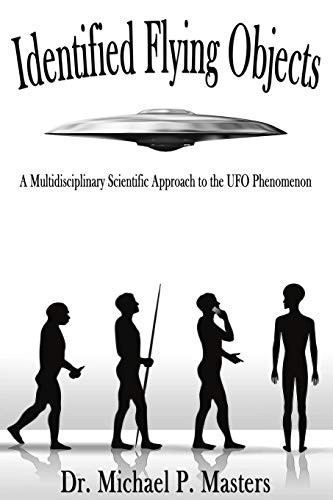
Identified Flying Objects
A Multidisciplinary Scientific Approach to the UFO Phenomenon
Find on Amazon →As an Amazon Associate, OverClassified may earn from qualifying purchases made through this link, at no extra cost to you.
Why This Is Essential Reading
Identified Flying Objects earns its place on this list not because its central claim holds up — the book's own load-bearing evolutionary premise runs against a real, published trend reversal in hominin brain size that Masters' own academic discipline has documented, and its physics chapters cite a body of general-relativity research whose own most prominent extension, Stephen Hawking's Chronology Protection Conjecture, argues against the very mechanism the book depends on — but because it is a genuinely instructive case study in how a credentialed academic's real, peer-reviewed research program in one field (human craniofacial and orbital anatomy) can be extended, in a separate self-published book, into a much larger and far less rigorously supported claim in an entirely different domain (UAP occupant identity). Michael P. Masters did not fabricate the encephalization and neoteny trends the book opens with, and did not invent the closed-timelike-curve physics it closes with; both are real, and both are accurately, if selectively, described. What the book does is extrapolate the first trend well past the point the fossil record actually supports and treat the second as license for a specific historical claim — that UAP occupants are our own future descendants — that none of the physicists behind the underlying mathematics have ever endorsed. Read alongside this site's own Time-Traveler Hypothesis theory file and its Betty & Barney Hill case file, it is essential less as a reliable account of who or what UAP occupants are than as a clear, checkable example of how a real academic credential in one field does not automatically transfer to authority in another — and of how a decades-old narrative motif, first voiced by ordinary witnesses like Jim Penniston years before any formal theory existed to explain it, can be repackaged with genuine science and mistaken, by readers unfamiliar with either discipline, for a genuinely scientific conclusion.
Related Cases & Theories
Sources Cited
- "Time-traveler UFO hypothesis." Wikipedia (hypothesis history, proponents, criticism section including Sheaffer, Darling, deGrasse Tyson, and Ridpath/Penniston material). en.wikipedia.org
- David, Leonard. "Are the aliens us? UFOs may be piloted by time-traveling humans, book argues." Space.com, January 20, 2020 (Sheaffer and Darling quotes, Masters' own statements, Jan Harzan and Larry Lemke reactions). space.com
- "Are the Aliens Us? UFOs May be Piloted by Time-Traveling Humans." ExoNews (republication of Leonard David's Space.com article, used to cross-verify direct quotes). exonews.org
- "Identified Flying Objects: A Multidisciplinary Scientific Approach to the UFO Phenomenon." DigitalCommons @ Montana Tech, Interdisciplinary Arts and Sciences Books (bibliographic record: publisher, ISBN, description, disciplines). digitalcommons.mtech.edu
- Michael Masters, faculty profile. Department of Interdisciplinary Arts and Sciences, Montana Technological University (education, career history, research areas, courses taught). mtech.edu
- "Identified Flying Objects: A Multidisciplinary Scientific Approach to the UFO Phenomenon." Amazon.com product page (ASIN 1733634061, publisher, publication date, page count). amazon.com
- Dr. Michael P. Masters, Google Scholar profile (peer-reviewed publication list and citation counts for craniofacial/orbital anatomy research, alongside UFO-related titles). scholar.google.com
- "Claim: Time-Travelling Humans are Causing Close Encounter Experiences." Metabunk forum discussion thread (detailed skeptical dissection of the evolutionary, physical, and evidentiary claims in Masters' hypothesis). metabunk.org
- "Identified Flying Objects." Open Library, work record OL24931054W (bibliographic record and cover art source, cover ID 11843667). openlibrary.org
- "The Extratempestrial Model" by Dr. Michael P. Masters. Biblio.com (bibliographic record: Full Circle Press, 2022, ISBN 9781733634045). biblio.com
- Lomas, Tim; Case, Brendan; & Masters, Michael P. "The Cryptoterrestrial Hypothesis: A Case for Scientific Openness to a Concealed Earthly Explanation for Unidentified Anomalous Phenomena." Philosophy and Cosmology, Vol. 33, 2024, pp. 67–122. ispcjournal.org
- Dr. Michael P. Masters, official author site (bibliography, media appearances, speaking representation). idflyobj.com
- Ridpath, Ian. "Official Denial – the source of a false memory?" ianridpath.com, March 2021 (analysis of Jim Penniston's 1994 hypnotic testimony and its resemblance to the 1993/1994 film Official Denial). ianridpath.com
- This site's own key-figures entry: Dr. Michael P. Masters, for his full biography and case connections.
- This site's own theory file: Time-Traveler Hypothesis (Theory File TTH-001), for this book's place within the broader hypothesis this site tracks.
- This site's own case file: Betty & Barney Hill Abduction (Case File #006, 1961), for the primary case Masters reinterprets through the chrononaut framework.
- This site's own case file: The Rendlesham Forest Incident (Case File #004, 1980), for Jim Penniston's independent, earlier articulation of the same genetic-sampling time-traveler narrative.
- This site's own essential reading entry: The Cryptoterrestrials, for the 2024 peer-reviewed taxonomy paper Masters co-authored situating unconventional-terrestrial UAP hypotheses within the wider literature.
Have corrections, additional research, or peer-reviewed sources? Help improve this entry.
Suggest an Edit