
The Douai Prison-Adjacent Sighting
At 9:30 PM on March 27, 2022, a woman watching the stars from her garden in Douai, Nord, while letting her dogs out, was looking for Orion's belt when she noticed three small, star-like lights just to the right of her neighbor's roof antenna that seemed to move and to sit "a little too much in a triangle." She looked down as she stepped back from a step; when she looked up again she saw, in almost the same place, a sharp-edged triangle glowing a soft pinkish-orange — "between orange and pink... salmon... coral" — with yellow lights along the two sides leading to its front point. It moved steadily, silently and fairly fast across about 150° of sky, from south to north-northwest, before disappearing behind a row of tall firs after about fifteen seconds. She sent GEIPAN a questionnaire the next day. Because her house is a few hundred meters from the Maison d'Arrêt de Douai, the town's remand prison, GEIPAN's investigation weighed a drone on a surveillance or scouting flight alongside the airliners on military radar. It ruled out the airliners, found that the object was probably about a meter long, some 30–35 m away and just above the treetops, rated the drone hypothesis at only 0.35, and classified the case unidentified after investigation.
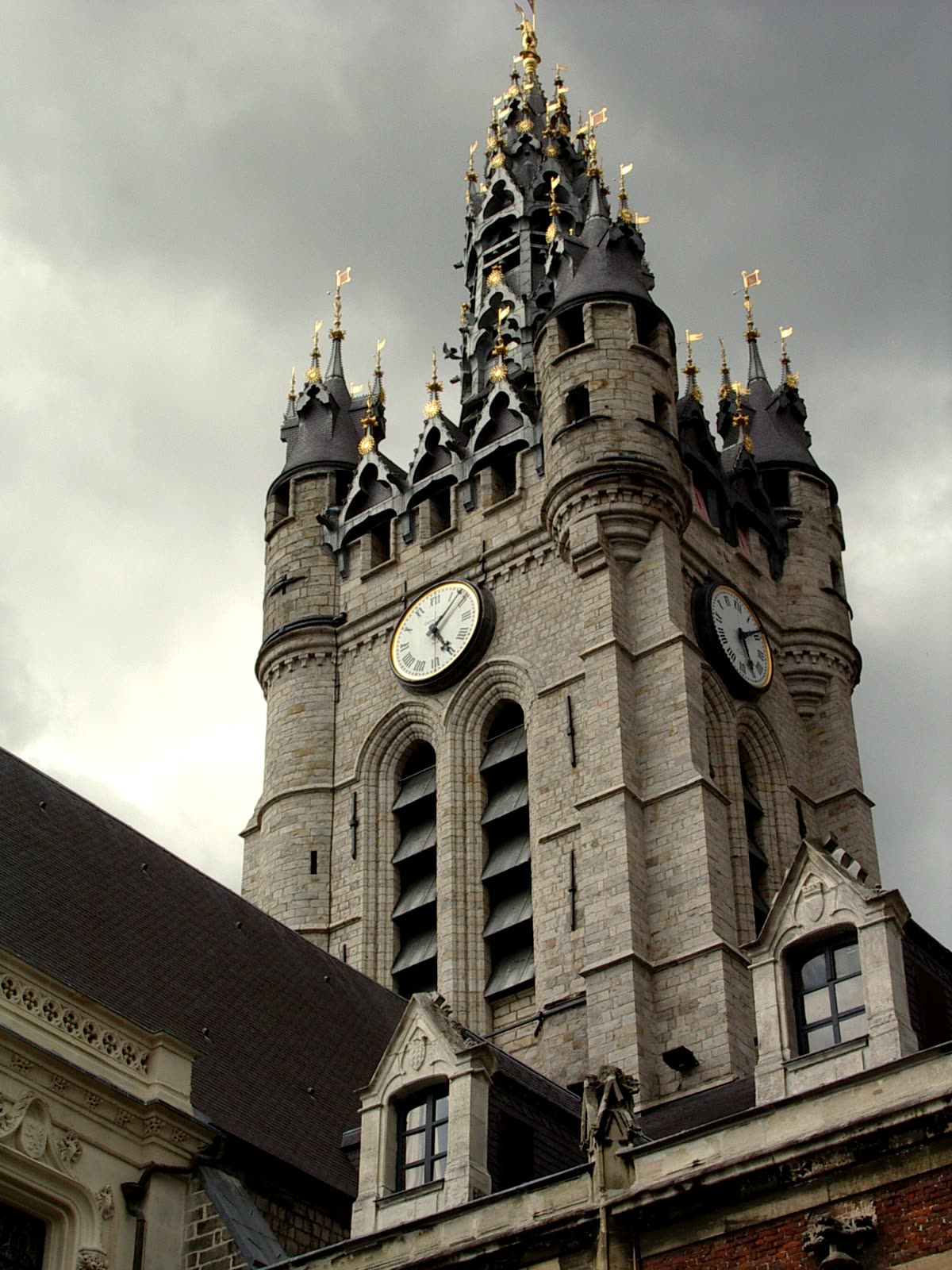
Pictured: the Beffroi de Douai (belfry), a UNESCO World Heritage-listed Gothic watchtower in the center of Douai, Nord, France — the town where the sighting took place. This is not a photograph of the phenomenon itself, nor of the witness's specific garden or the nearby Maison d'Arrêt de Douai, whose exact location relative to the sighting GEIPAN's published summary does not disclose in detail; no photograph or video of the coral-colored triangle is known to exist. Photo by Wikimedia contributor HUOT Jean-Louis, released into the public domain (CC0) via Wikimedia Commons.
Theoretical Alignment
This case aligns most strongly with the Extraterrestrial Hypothesis among the frameworks this site tracks, on the strength of a structured-triangle morphology: a sharp-edged, regular triangle with organized leading-edge lighting, moving silently along a steady path. Interdimensional alignment is weak because the object's departure was ordinary: it passed behind a real line of fir trees. Psycho-Social framing carries real weight because of two details in the witness's own account: her difficulty settling on a color, and the brief break in her observation between noticing three star-like points while hunting for Orion's belt and seeing the full triangle. GEIPAN's tests also found she overestimated the Moon's apparent size by about a factor of three. None of this amounts to a debunking; the report treats the account as detailed and consistent.
Background
Weighing why a single, next-day-reported account led to a military radar check, a field reconstruction, direct outreach to drone companies and a consultation with a French Navy drone specialist requires understanding both Douai itself and the sensitive facility a few hundred meters from the witness's home.
Douai: A Fortified Flemish Town Remade by Coal, Then by Renault
The commune of Douai, a sub-prefecture of some 40,000 residents on the Scarpe river in the Nord department, grew up as a medieval textile and administrative center under the counts of Flanders and, successively, the dukes of Burgundy, the Habsburgs and Spain, before Louis XIV's troops captured it in 1667 and the 1668 Treaty of Aix-la-Chapelle confirmed it as French. Its Gothic belfry, begun in 1380 and completed in 1410, rises 61 meters and holds a 62-bell carillon; it was inscribed on UNESCO's World Heritage List in 2005 as part of the Belfries of Belgium and France. Douai also has a place in aviation history: the La Brayelle airfield hosted one of the world's first aviation meetings, from June 28 to July 18, 1909, at which Louis Blériot won the speed prize and some 20,000 people attended on July 9; during the First World War the airfield was used by German units, among them that of Manfred von Richthofen. In the twentieth century the area moved from coal mining toward car manufacturing, and Renault's Douai plant now builds electric vehicles.
Like much of the Nord-Pas-de-Calais coal basin, Douai saw coal mining decline sharply from the 1960s, and Renault's plant helped absorb that transition. None of that bears directly on the 2022 sighting, but it establishes Douai as a sizeable, ordinary town, not an obviously military location. GEIPAN's report notes that there is no military base nearby likely to use drones; France's military drones (MQ-9 Reapers) are based at BA 709 Cognac. The one sensitive site close to the witness is the prison.
The Maison d'Arrêt de Douai: The Facility That Shaped the Investigation
What does distinguish this case is the proximity of the witness's home, at the edge of town near the neighboring commune of Cuincy and the D643 road, to the Maison d'Arrêt de Douai, a remand prison a few hundred meters away. Built in 1907 on Rue de Cuincy, it keeps its original star-shaped plan, covers nearly seven hectares and has 368 places in a men's detention wing, a semi-liberty unit and an intake unit (Ministry of Justice directory). In a courtyard there, on June 23, 1977, Jérôme Carrein was guillotined — the last execution of a French citizen and the second-to-last in France before abolition in 1981. That history has no bearing on the sighting, but the prison's present use does: drones have been used to deliver contraband to detainees in prisons in the region, and GEIPAN cites press reports of three men charged over drug deliveries by drone to Hauts-de-France prisons, so an aerial object near a prison naturally raises the question of a scouting or surveillance flight.
GEIPAN's Investigative Machinery, Applied to a Security-Adjacent Case
GEIPAN, based at the Centre National d'Études Spatiales (CNES) in Toulouse and descended from GEPAN, the unit Claude Poher founded in 1977 and later reorganized as SEPRA under Jean-Jacques Velasco, has two CNES staff (the head and deputy) plus about 1.5 posts of documentation and IT support, about twenty trained volunteer investigators, and some fifteen outside scientific experts. By its own figures it receives about 500 contacts a year, about 200 lead to a published investigation, and about 10% of cases receive a field investigation. This case was one of them: after a remote phase, two investigators visited the witness on April 7, 2023, about a year after the sighting, and the report was finalized on September 9, 2025.
What makes this case investigatively distinctive is its subject matter. Besides the usual aircraft analysis, done here with a military radar reconstruction from the air force's CAPCODA centre, investigators had to weigh whether an unidentified object near a prison could be a surveillance or scouting flight. That meant contacting drone companies, asking the prison administration about its own use of drones, and consulting a naval drone specialist on military lighting.
This is a familiar concern for French prisons, which have faced growing numbers of drone flights, mostly attempts to drop phones, drugs or tools to detainees. GEIPAN's report notes that such attempts have been made at Douai itself, but that the drones involved are small leisure quadcopters with nothing in common with what the witness described. The object's steady transit, rather than any descent toward the prison walls, also fits poorly with a delivery flight, though not with a passive scouting pass.
Complete Timeline
| Date | Event |
|---|---|
| 1907 | The Maison d'Arrêt de Douai is built on Rue de Cuincy in a star-shaped layout; it covers nearly 7 hectares and today has 368 places (Ministry of Justice directory). |
| June 23, 1977 | Jérôme Carrein is guillotined in a courtyard of the prison — the last execution of a French citizen and the second-to-last in France. |
| 1977 | GEIPAN's predecessor, GEPAN, is founded within CNES in Toulouse under Claude Poher. |
| March 27, 2022 | France moves to summer time at 2 a.m., the day of the sighting. |
| March 27, 2022, 9:30 PM | Sighting begins. Watching the stars from her garden while letting her dogs out, the witness looks for Orion's belt and notices three small, star-like lights just right of her neighbor's roof antenna that "move a little" and are "a little too much in a triangle." |
| March 27, 2022 (seconds later) | She looks down while stepping back from a step, then looks up in the same direction and sees a luminous triangle "approaching, almost in the same place" as the three lights, between her neighbor's antenna and her own. |
| March 27, 2022 (about 15 seconds in all) | The triangle, pinkish-orange with yellow lights along its two front edges, moves steadily, silently and "fairly fast" from about 182° (south) to about 330° (north-northwest), its elevation falling from about 54° to 34°, then disappears behind a row of tall firs in a neighbor's garden. |
| March 28, 2022 | The witness sends GEIPAN a completed technical questionnaire. While waiting for a reply she also contacts MUFON, which places a call for witnesses in the local press; no one responds. |
| Remote phase | GEIPAN obtains a military radar reconstruction (CAPCODA) showing two airliners near the line of sight, a Ryanair Boeing 737 (FR4796) and a KLM Boeing 737 (KL1676), and rules both out on direction, elevation and duration. |
| April 7, 2023 | Field investigation at the witness's home with two GEIPAN investigators, including a cognitive interview, compass and inclinometer measurements, a timed re-enactment (15 seconds) and Moon-size tests. |
| June 1, 2023 | GEIPAN contacts four drone companies operating around Douai (CL Drone, E.N.C. drone, Dronidrone, Image'in air); only Dronidrone replies, saying it knows of no such equipment. GEIPAN also asks whether the prison administration flies surveillance drones, but cannot obtain confirmation. |
| During the investigation | A Marine Nationale/Aéronavale drone instructor says no known military lighting scheme resembles the one described, and that military drones on exercise are designed to be quiet and inconspicuous; he adds that military drones can also fly long distances without lights. |
| September 9, 2025 | Final classification. GEIPAN's report scores the drone hypothesis at only 0.35 and classifies the case as unidentified after investigation (case 2022-03-51336), with a strangeness of 0.65 and a consistency of 0.72. The report text and case page say class "D"; the classification chart in the report is labeled "D1." |
Detailed Narrative
A Shape Beside the Antenna
The witness's account opens with a nightly habit. Interested in the sky, she watches the stars for a few minutes every night while her dogs are in the garden, and she systematically looks for Orion's belt. That evening, she wrote, the sky was black and full of stars despite the town lights, with no visible Moon. Looking above her neighbor's roof, she noticed three tiny lights, star-sized, that seemed odd because they were not in a straight line like Orion's belt but in a V pointing toward her. They "moved a little." She looked down as she stepped back from a step, then looked up again in the same direction.
Now she saw a luminous triangle "approaching, almost in the same place as the three little stars," positioned between her neighbor's antenna and her own and a little higher than her satellite dish. She could see its three edges clearly, with several round lights beneath it and a soft, non-dazzling pinkish-orange glow; she counted about five yellow lights along its perimeter, forming a V from the edges to the front point but none at the back. She could not see any thickness, since she was looking up from below. On Pantone charts she later placed the color between 163U (salmon) and 121U (yellow), "with a slightly coral side." She told investigators she did not know whether the three initial points were related to the triangle; she had focused on the triangle and not looked for them again.
A Silent, Regular Transit Along the Rear Street
From then on the description is consistent: the triangle moved fluidly, "fairly fast," in a straight line at steady height, with no sound and no flashing lights, passing visually just above her roof and over her right-hand chimney before heading for the row of trees to the north. GEIPAN's report stresses that its appearance — shape, color, brightness, speed and apparent size — did not change at all. She contrasted the silence with the aircraft she often hears, but noted that she lives beside a busy road. She stayed outside for several minutes afterward watching the sky, then drew the garden and wrote up the sighting so as not to forget details.
The sighting ended without drama: the object passed behind a dense row of tall firs in a neighbor's garden and she could not see it again, even by moving. Unlike the Crozon or Hem cases, where the departures were themselves anomalous, this disappearance needs no explanation — the open question is what passed behind the trees.
The Prison Question
The prison's proximity is noted in GEIPAN's report from the start, and it shaped the drone analysis. GEIPAN pursued it through three channels: four drone companies operating around Douai, contacted on June 1, 2023, of which only one replied (knowing of no such equipment); the prison administration, from which GEIPAN could not obtain confirmation of whether it used drones for surveillance; and a naval drone instructor on military lighting. None produced a matching drone.
GEIPAN did not find evidence that a surveillance drone was responsible: no operator, civilian or official, was identified, and nothing was recovered. Nor did it rule the idea out. Its calculations put the object at about a meter long, flying a curved path some 30–35 m from the witness just above the 14–19 m firs, at around 20 km/h — a size that only professional or military drones reach, and a shape and color no known drone has. On noise, the report is internally divided: its analysis says a drone's sound at that distance was "possible but difficult to quantify" given road traffic and wind, while its conclusion says such a drone should have been audible. The honest state of the record is the classification: unidentified after investigation, not confirmed as surveillance.
What the Report Withholds
GEIPAN's report withholds the witness's identity, occupation and exact address, and leaves out a map of the possible trajectories "for reasons of confidentiality." It does name the four drone companies contacted. The prison administration was approached but gave no confirmation either way, so no institutional answer comparable to the naval-base confirmation in the Crozon case exists. The report also records that the witness contacted MUFON while waiting for GEIPAN, and that MUFON's call for witnesses in the local press drew no response.
Inside GEIPAN's Reconstruction
The field visit on April 7, 2023, turned the witness's account into numbers. Standing where she had stood, she pointed out where she first saw the lights: just to the right of the rake-style TV antenna on her neighbor's house, at a compass bearing of 182° (due south) and an inclinometer elevation of 54°. The complete triangle, when she looked up again, sat between that antenna and her own, a little higher than her satellite dish. From there the object passed behind, or partly behind, her own antenna — she does not remember seeing the antenna silhouetted against it — then appeared to run along just above her roof and over the right-hand chimney before heading for the row of trees to the north. Halfway across, its elevation was about 40°; it vanished at a bearing of 330° and an elevation of 34°. She had not needed to strain her neck, which put the maximum elevation below about 60°. Re-enacting her movements, she took 15 seconds.
The apparent size proved harder. On the night, in her questionnaire, she described a triangle about 8 cm on a side at arm's length, the shape you make by joining your thumbs and forefingers; on site, against a ruler held at arm's length, she measured 4.5 cm from the base to the point. GEIPAN preferred the earlier figure, as less exposed to memory drift, and then tested her judgment of size. By phone she had put the full Moon at the size of her thumbnail, about 1.5 cm at arm's length, against a true value of about 6 mm; on site she placed it between 10 and 15 mm, and the setting Sun between 15 and 20 mm. Concluding that she overestimated angular sizes by about a factor of three, GEIPAN worked with a corrected apparent size of about 2.3 cm.
With that figure and a 65 cm arm, simple proportion gives the object's length for any assumed distance. Leisure drones range from about 4 to 57 cm, which would put them between about 1 m and 16 m from the witness to look that size. But the object passed behind her own roof antenna, so it was at least about 10 m away horizontally and about 14 m in a straight line, and probably more. At 14, 20, 28 and 35 m the object would have been about 0.5, 0.7, 1.0 and 1.24 m long. Because its size and shape did not appear to change across roughly 150° of sky, GEIPAN reasoned that it must have curved to the right around the witness at a roughly constant distance. On a straight path at those distances it would have been moving at 25 to 63 km/h; on a curved path, at only 8 to 22 km/h.
The trees narrowed it further. Using photographs taken on site and the IPACO image-analysis software, investigators measured the firs that hid the object at the end as 14 to 19 m tall. At 14 m distance and 34° elevation, the object would have disappeared only about 8 m up, below the treetops, and the trees would have hidden it at a bearing of about 5°, some 35° from where the witness saw it vanish. At 20, 28 and 35 m it would have vanished about 11, 15.6 and 19.6 m up. GEIPAN therefore concluded that the object was probably more than 28 m away and likely beyond 35 m: about a meter long, following a more or less pronounced curve some 30–35 m from the witness, just above the trees at around 15–20 m, at about 20 km/h.
The Hypothesis Scorecard
GEIPAN set out the drone hypothesis item by item, each scored from −1 to +1. Shape scored −0.30: a triangle is possible in theory but has never been seen on a drone. Color scored −0.30: pastel orange-pink is unusual for a drone, with none of the usual green or red, and improbable for a military drone meant to be inconspicuous. Apparent size scored 0.00: it allows a drone over a meter long, but drones that size are professional or military. The curved, roughly circular path and the slow apparent speed each scored +0.80. The date and time scored +0.40: 21:30 is plausible for a prison or military drone and illegal for a private one, though some pilots ignore the rules. The absence of noise scored 0.00: the road was quiet at that hour and her hearing was good, but the wind was only partly favorable and the drone's loudness is unknown. The context scored −0.30: illegal drug-delivery drones have been confirmed near the prison, but they are too small and of the wrong shape and color. The overall reliability of the drone hypothesis came to 0.35, which on GEIPAN's scale counts as "low." No other hypothesis was scored; the airliners had already been ruled out.
Two smaller points in the report bear on how the scorecard should be read. First, timing: France had switched to summer time at 2 a.m. that same day, so 21:30 local time was 19:30 UTC, the time base GEIPAN used for the radar data, in which the Ryanair flight passed at 21:25 and the KLM flight at 21:34 local time. Second, the military option: the naval drone instructor GEIPAN consulted said that military drones can fly long distances with no lights at all, which cuts both ways — a military drone would not need conspicuous lights, but it would not be expected to show them either. The French military drones GEIPAN considered, MQ-9 Reapers based at BA 709 Cognac, are fixed-wing aircraft that cannot fly slower than about 100 km/h, five times GEIPAN's estimated speed, and the report notes that no military base near Douai is likely to operate drones.
The Witness in Her Own Words
The questionnaire records a witness who anticipated most of the questions an investigator would ask. During the sighting, she wrote, she felt "attentive, curious, calm and observant"; afterward she stayed outside for several minutes watching the sky, then sketched the garden and wrote up her observation "clearly, so as not to forget details." She told only her husband and son, fearing her words could not convey what she saw without being misread. She ruled out, in her own judgment, an illusion, an aircraft or satellite, a meteor, a Thai lantern, a laser or a drone, while conceding that it looked somewhat like one; she said she had seen very large drones before. "Either it is a triangular military aircraft of an unconventional kind," she wrote, "or it is something else unknown to me." She also searched the internet for other witnesses without success, and contacted MUFON while waiting for GEIPAN; MUFON's appeal in the local press brought no one forward. She said she would not be disappointed by "a credible, convincing and justified explanation" and regretted only having no second witness with whom to compare impressions.
In the follow-up interview she added that the television had been on indoors and that two non-flashing light garlands were lit in the room, while the garden itself was dark; she had checked that there was no reflection of the TV screen in the window. Back inside, she used the TV programme to estimate that she had been outside for five or six minutes, and no more than ten. She also volunteered her surprise that no one else had reported it, given the traffic on the road behind and the lit windows of the flats opposite.
Key Witnesses
The Douai Primary Witness (identity withheld per GEIPAN's standard anonymization practice)
A resident of Douai living a few hundred meters from the town's prison, who watches the stars for a few minutes every night while her dogs are out. On March 27, 2022, she saw a sharp-edged, pinkish-orange triangle with yellow lights along its front edges pass silently over her roofline for about fifteen seconds. She sent GEIPAN a questionnaire the next day and took part in a field reconstruction and cognitive interview in April 2023. GEIPAN rated the testimony's consistency good (0.72), noting that it was very detailed and made the day after; her hearing was tested and found good, and she wears well-corrected glasses for myopia. She described herself as interested in UAP "in a scientific, not esoteric way," and wrote that she would "not be disappointed" by a credible explanation.
The Five Observables Assessment
The Five Observables framework, developed by the Pentagon's Advanced Aerospace Threat Identification Program to describe performance characteristics beyond known conventional technology, is applied here for comparative consistency across the site's case files. This case registers a notably restrained profile: its object displayed no extreme performance characteristics at all, its entire evidentiary weight resting instead on its structured shape and the absence of any conventional match for that shape and its lighting.
Unlike several other GEIPAN cases on this site, this file registers no confident positive match on any of the five observables; its interest lies in the unmatched combination of a sharp triangular shape, a warm pastel color, structured lighting and silence near a sensitive site, not in any extreme performance. GEIPAN's own estimate of the motion (about 20 km/h on a curved path) is entirely ordinary. Low Observability is rated speculative because the military radar reconstruction shows only the two airliners, and a small object 15–20 m up would not be expected to appear on it.
Evidence Assessment
Supporting an Anomalous Origin
- A detailed single-witness account, written up the day after, rated "good" for consistency (0.72), with a field reconstruction and cognitive interview
- No known drone, civilian or military, matches the sharp triangular shape or the pastel orange-pink color; GEIPAN scored shape and color as arguments against a drone
- GEIPAN's reconstruction puts the object at about 1 m long and 30–35 m away, a size reached only by professional or military drones, which are multirotors of a different shape
- Four local drone companies were contacted; the one that replied knew of no matching equipment
- A Marine Nationale/Aéronavale drone instructor knew of no military lighting scheme resembling the one reported
- A military radar reconstruction ruled out the two airliners near the line of sight; GEIPAN judged a small, silent, low-flying aircraft without a transponder "highly improbable"
Supporting a Conventional/Mundane or Inconclusive Origin
- This remains a single, uncorroborated witness account with no second observer, no photograph, and no video of the phenomenon itself
- The witness's observation began with three star-like points while she was looking for Orion's belt, and was interrupted when she looked down at a step; the full triangle was seen only after that break
- Her Moon-size tests showed she overestimated angular sizes by about a factor of three, and her own estimate of the triangle's size changed between the questionnaire (8 cm at arm's length) and the reconstruction (4.5 cm)
- A drone flown by a public authority (prison administration or armed forces) cannot be totally excluded; the prison administration gave no answer on its use of drones, and only one of four drone companies replied
- The object's disappearance behind a real, physical line of trees requires no anomalous explanation whatsoever — the object could, in principle, have been an ordinary drone or aircraft that was simply never identified rather than one that behaved anomalously
Why "Open"
This case is stamped Open because GEIPAN's investigation left it unidentified after an unusually thorough process for a single-witness file. The witness's next-day report and "good" consistency rating (0.72) put the account on firmer footing than several other single-witness GEIPAN cases on this site. GEIPAN ruled out the airliners with military radar data, reconstructed the sightline on site, worked through the size, distance and speed a drone would need, contacted drone companies and the prison administration, and consulted a military drone specialist.
Set against that, "Credible" would overstate what a single, uncorroborated account with no photograph or video can support. The witness began by watching moving star-like points while looking for a constellation, overestimates angular size, and saw the object at night against town lights. GEIPAN's own best mundane candidate, a drone of about a meter flying a curved path just above the trees at about 20 km/h, is physically possible; it fails mainly on shape and color, which a customized LED rig could in principle produce, as a 2021 drone hoax by the French video maker Rémy Gaillard showed for color though not for shape. The surveillance-drone question is neither confirmed nor eliminated, which is the state "Open" is meant to describe.
Sensor & Instrumentation Detection Profile
This case's instrumented record is a military radar reconstruction from the air force's CAPCODA centre. It shows two airliners near the line of sight: Ryanair FR4796 (Castellón–Brussels, Boeing 737-8AS), passing about 1.85 km from the witness at about 7,000 m and roughly 75° elevation, slightly behind her, at 21:25; and KLM KL1676 (Barcelona–Amsterdam, Boeing 737-8K2), passing about 1.55 km away at about 11,000 m and roughly 82° elevation, at 21:34. GEIPAN ruled both out: neither passed through the observed azimuths at the right elevation, their shape and color could not have been seen at that distance, and the KLM aircraft would have been visible far longer than 15 seconds. Other airliners flew farther away at 10,000 m or more and were also judged incompatible. GEIPAN supplemented the radar with human sources: four drone companies, the prison administration and a naval drone instructor. No photograph, video or audio recording of the phenomenon exists.
Environmental & Geospatial Context
GEIPAN's report gives the weather from Météo-France stations (Douai, less than 2 km away; Cambrai-Epinoy; Arras; Lille-Lesquin) and satellite images: clear sky, 10.1–12.3°C, a light north-northeasterly wind, and moderate horizontal visibility of about 5–8 km. The witness described "a clear night sky, very fine weather, mild spring temperature, no clouds." GEIPAN's Stellarium check found no Moon and no naked-eye planet; the brightest objects were the winter stars Capella, Betelgeuse, Procyon, Rigel and Sirius in the southwest, and Arcturus 13° up in the east-northeast. NASA JPL Horizons puts the Moon 60° below the horizon (23% illuminated) at 21:30. The on-site measurements gave an apparent path from azimuth 182° at 54° elevation to azimuth 330° at 34°, and GEIPAN's distance analysis placed the object probably beyond 28–35 m.
Geographically, the sighting's most consequential feature is the prison a few hundred meters away. That proximity makes a scouting or surveillance flight a real possibility, which is why GEIPAN pursued the drone hypothesis so far; it also gave GEIPAN an institution to ask, though the prison administration gave no confirmation either way. The area is a no-drone zone on the official Géoportail map, and French rules forbid civilian night flights there, so any civilian drone matching the description would have been flying illegally.
GEIPAN's maps place the witness's home at the edge of town near Cuincy and the D643, with the prison blurred out on its map for confidentiality, and the report describes the object's path as running south to north-northwest over the witness's own roof. The report does not say that the object flew over the prison itself, and its reconstructed path does not require it.
Observer Credibility & Occupational Profile
The witness's occupation is not disclosed. The file documents a careful reporter: a questionnaire filed the next day, a sketch made that night, honest uncertainty about the color and about whether the three initial points were connected to the triangle, and a willingness to be told it was something ordinary. GEIPAN also tested her: her hearing was good, her glasses well corrected, and her Moon-size estimates about three times too large, a common overestimate that GEIPAN corrected for in its size calculations.
The structural limitation is the one shared by most single-witness reports: however detailed one account is, it cannot carry the weight of a second witness, a photograph or an instrumented record. The prompt report and GEIPAN's 0.72 consistency rating make this one of the stronger single-witness profiles among the GEIPAN cases on this site.
Her account also limits its own claims. She did not claim the object was watching the prison, and said she could not estimate its height or distance. She did offer an interpretation — "either an unconventional triangular military aircraft or something else unknown to me" — and she wrote that she was convinced such phenomena are real, which GEIPAN records without comment.
Historical Precedents & Archive Matches
This case's most useful comparisons on this site fall into two groups: other "dark/structured triangle" sightings where a drone hypothesis was tested and failed, and the site's other prominent GEIPAN drone-hypothesis case built around a distinctive, undocumented lighting configuration.
Villers-lès-Luxeuil (2019) — A Triangle With a Radar Candidate
The Villers-lès-Luxeuil Triangle (Open, 50/100) is this case's closest structural analog: another French sighting of a triangle with a white or colored light at its front point, moving slowly and silently at low altitude near a town. The two investigations ended differently. At Villers-lès-Luxeuil, military radar placed a light aircraft landing at a nearby air base over the village at almost exactly the right time, and GEIPAN rated it the leading hypothesis (0.45) while still classifying the case D1 because the dark triangular shape and size did not fit. Here the radar showed only distant airliners, and GEIPAN's best candidate, a drone, scored 0.35, failing on shape and color. Read together, the two cases show GEIPAN declining to force a conventional explanation onto the triangle shape even when a real aircraft was in the right place.
The Hem Ring-Light Triangle (2022) — The Same Investigative Question, a Different Lighting Puzzle
The Hem Ring-Light Triangle (Open, 34/100), also from Nord and from 2022, is the most direct parallel among this site's GEIPAN files: a triangular arrangement of lights whose configuration — there, three toroidal lights; here, yellow lights along a glowing triangle — matched no documented drone. The evidentiary strength differs: Hem's account was rated "medium" consistency and reported about a year late, while this one was reported the next day and rated 0.72. An unmatched lighting configuration is useful negative evidence, but it supports a well-reported account more than it can rescue a weak one.
Crozon Peninsula (2020) — Institutional Outreach as a Model, Applied to a Different Question
The Crozon Peninsula Red Rectangles (Open, 45/100) demonstrates the same investigative instinct seen here — reaching directly to institutional and military sources rather than relying solely on desk-based analysis — applied to a different underlying question. Crozon's investigators contacted a naval air base directly to rule out its own aircraft and drones; this case's investigators contacted commercial drone operators and a military drone specialist to assess an entirely different possibility: not "was this a known local operator's routine flight," but "could this have been deliberate surveillance of a sensitive civilian facility." Both approaches reflect the same underlying GEIPAN practice of testing a hypothesis against real institutional knowledge wherever a plausible institutional source exists, rather than treating "no obvious explanation" as license to stop investigating.
The comparison also highlights a genuine asymmetry in how completely each case's institutional outreach could resolve its central question. At Crozon, a single, clearly-defined institution — the Lanvéoc-Poulmic naval air base — was in a position to give a comprehensive, dated answer about its own aircraft and drone activity, because any relevant flight would necessarily have originated from that one base. This case's own institutional landscape is more diffuse: an unknown number of commercial drone operators could, in principle, have been active anywhere in or near Douai that evening, and only one of those contacted actually responded, meaning the "no known matching operation" result covers, at most, a small and self-selected fraction of everyone who might plausibly have been flying a drone in the area. That is not a flaw in GEIPAN's approach so much as an unavoidable structural difference between a case with one obvious institutional gatekeeper and a case without one — but it does mean this file's negative institutional findings should be read as suggestive rather than as comprehensive as Crozon's.
Sainte-Foy-de-Peyrolières (2018) — A Different Kind of Interrupted Observation
The Sainte-Foy-de-Peyrolières Five-Phase Sighting (Open, 47/100) offers a useful comparison on a narrower, more methodological point: how GEIPAN's investigators weigh an account that unfolds across multiple distinct phases of observation, some more detailed than others, rather than as one single continuous look. That case's witness experienced five separate phases of an evolving encounter over several minutes; this case's witness experienced a much shorter, two-part observation — an initial vague glimpse, a brief self-interrupted gap, and a second, far more detailed look — compressed into ten to twenty seconds. Both cases required investigators to weigh how much interpretive weight a later, more detailed impression should carry relative to an earlier, less resolved one, and in both cases GEIPAN ultimately treated the fuller, later description as the account's evidentiary core rather than discounting it merely for having followed a less clear initial impression.
Material Analysis
This case involves no physical or trace evidence of any kind — no landing marks, no recovered material, no soil or vegetation sample, and no biological or physiological effect on the witness beyond her own visual observation. The object never approached the ground or the witness's immediate reach at any point in the account; it remained airborne throughout its brief transit before passing behind the neighboring property's trees. There is accordingly nothing to sample, test, or physically examine after the fact — only the witness's next-day description, GEIPAN's on-site measurements and radar check, and its outreach to drone operators and a military specialist.
Supporting Non-Terrestrial Origin
- No physical evidence exists to test in the first place, so no terrestrial material-composition finding contradicts an anomalous interpretation either
- The object's reported clean equilateral triangular shape, ambiguous warm-toned coloring, structured leading-edge lighting, and total silence, if accurately perceived, do not correspond to any conventional aircraft or documented drone GEIPAN's investigators were able to identify
Supporting Terrestrial Origin
- The complete absence of any physical trace is itself consistent with a purely distant, airborne phenomenon that never approached the ground closely enough to leave one
- No mechanical, electromagnetic, or biological secondary effect on the witness or any nearby structure is recorded anywhere in the file
The Conventional Explanation Candidate: Aircraft, Civilian Drone, and the Surveillance-Drone Question
GEIPAN's own file organizes its analysis around a conventional aircraft and, in greater depth, a drone hypothesis further split between an ordinary civilian operator and a possible public-authority (penitentiary or military) platform tied to the nearby prison. None, in GEIPAN's own final assessment, conclusively identifies the phenomenon.
Conventional Aircraft
GEIPAN's analysis of the military radar data ruled out the two airliners nearest the line of sight (a Ryanair and a KLM Boeing 737, at about 7,000 and 11,000 m) and other more distant traffic. Only a small aircraft flying very low, silently and without a transponder remained, a scenario GEIPAN judged "highly improbable"; it would also not explain the triangular shape and yellow lights.
Civilian Drone with Custom LED Lighting
The drone was GEIPAN's only remaining hypothesis, and it scored just 0.35 ("low"). Because the object's apparent size and shape did not change across about 150° of sky, GEIPAN concluded it must have flown a curved path at a roughly constant distance. Since it passed behind the witness's roof antenna, it was at least about 14 m away; since it disappeared above firs 14–19 m tall at an elevation of 34°, it was probably more than 28–35 m away. Correcting the witness's size estimate for her threefold overestimate of the Moon, GEIPAN put the object at about 1 m long, about 15–20 m up and moving at about 20 km/h — speeds and a path a drone can fly. Against it: drones of that size are multirotors used professionally or by the military, and no drone has this shape or pastel color; leisure drones range from 4 to 57 cm. A civilian flight there at night would have been illegal, and the drones caught delivering contraband to prisons in the region are small quadcopters. GEIPAN noted that a hobbyist could customize a drone with LEDs, as Rémy Gaillard did for a 2021 hoax video, whose yellowish-white light came close to the color but not the shape. Of four drone companies contacted, only one replied, knowing of no such equipment.
Public-Authority Drone (Penitentiary Administration or Armed Forces)
Considered because of the prison's proximity, but not confirmed. GEIPAN noted that an official drone would normally be identified, authorized and fitted with regulation night lights, and it could not obtain confirmation from the prison administration of whether it uses drones for surveillance. The naval drone instructor knew of no military lighting scheme like the one described, and said that military drones on exercise are designed to be quiet and inconspicuous — though they can also fly long distances with no lights at all. France's MQ-9 Reapers, based at BA 709 Cognac, stall at about 100 km/h, far faster than the estimated speed, and no nearby military base uses drones.
Conventional Aircraft
Highly ImprobableRadar ruled out the airliners in the area; only a silent, transponder-less, very-low-flying aircraft could fit, which GEIPAN calls highly improbable.
Civilian Drone (Custom LEDs)
InconclusiveA ~1 m drone on a curved path at ~20 km/h is physically possible (GEIPAN: 0.35), but no known drone has this shape or color, and the noise question is unresolved.
Public-Authority / Military Drone
UnresolvedCannot be totally excluded given the prison's proximity; the prison administration gave no confirmation, and no known military lighting scheme matches.
Related Cases
Confirmed Documents & Official Records
The official French government investigation summary: the witness's full account, the aircraft/drone hypotheses tested, the outreach to drone operators and a Marine Nationale drone instructor, and the final Class D determination.
GEIPAN's full field investigation report, including the technical questionnaire response, the aircraft/drone hypothesis analysis, and the drone-instructor and operator consultations.
The French Ministry of Justice's own directory listing for the prison referenced in this case, including its address, capacity, and facility type.
GEIPAN's own published definitions for classifications A, B, C, D, D1, and D2.
Further Reading — Recommended Literature
UFOs: Generals, Pilots, and Government Officials Go on the Record
Kean's survey of credentialed witness testimony and official investigative bodies worldwide, including a chapter on France's GEIPAN, offers context for the agency's institution-driven investigative approach.
Wonders in the Sky: Unexplained Aerial Objects from Antiquity to Modern Times
A catalog of historical aerial anomaly reports useful for weighing how this case's structured triangular morphology fits within the broader historical pattern of "dark triangle" sightings.
The UFO Evidence
The foundational documentary approach to cataloging and cross-referencing witness testimony that GEIPAN's own case-file methodology, including its formal consistency ratings, descends from in spirit.
The UFO Experience: A Scientific Inquiry
Hynek's strangeness-and-probability rating of reports is a forerunner of the strangeness and consistency scores GEIPAN publishes for cases like this one.
DISCLOSURE: Some links above are affiliate links. If you purchase through them, OverClassified receives a small commission at no additional cost to you. This helps support independent research.
Essential Viewing
No Videos Available
Sources
- GEIPAN (CNES), "DOUAI (59) 27.03.2022", Case 2022-03-51336 — official case summary
- GEIPAN (CNES), Compte Rendu d'Enquête, DOUAI (59) 27.03.2022 — full investigation report (PDF)
- GEIPAN (CNES), official case archive & public portal — geipan.fr
- GEIPAN (CNES), Glossaire du GEIPAN — official classification definitions, A/B/C/D/D1/D2
- GEIPAN (CNES), "Missions, méthodes et résultats" — investigative structure and statistical case outcomes
- Ministère de la Justice (France), Maison d'Arrêt de Douai, official facility directory — address, capacity, and facility type
- France Info, "Livraison de téléphones ou de stupéfiants... Comment la police tente de lutter contre les drones aux abords des établissements pénitentiaires" — national context on drone contraband deliveries and anti-drone systems at French prisons
- Wikipédia (français), "Maison d'arrêt de Douai" — facility history, architecture, and the 1977 execution of Jérôme Carrein
- Wikipedia (English), "Douai" — commune history, geography, and the Beffroi de Douai
- Wikimedia Commons, File: Beffroi de douai 2009.JPG, photo by "HUOT Jean-Louis," CC0 1.0 — licensing and attribution
- Wikimedia Commons, Category: Beffroi de Douai — image archive for the belfry
- This site, case-files/villers-les-luxeuil-triangle.html — comparative GEIPAN "dark triangle" case in which a radar-tracked light aircraft was the leading but unconfirmed candidate
- This site, case-files/hem-ring-light-triangle.html — comparative GEIPAN case with no matching drone lighting found for a structured multi-light PAN
- This site, case-files/crozon-peninsula-red-rectangles.html — comparative GEIPAN case with direct institutional (naval base) outreach
- This site, case-files/sainte-foy-de-peyrolieres-five-phase-sighting.html — comparative single-witness GEIPAN Class D case
- This site, key-figures.html, entry on Claude Poher — GEPAN founding and early institutional history
- This site, key-figures.html, entry on Jean-Jacques Velasco — SEPRA leadership and methodology evolution
- This site, locations/index.html, entry on Toulouse — CNES/GEPAN/SEPRA/GEIPAN institutional headquarters
- Ministère de la Justice, Maison d'Arrêt de Douai directory entry (built 1907, star-shaped plan, nearly 7 ha, 368 places). justice.gouv.fr
- Wikipédia (français), "Beffroi de Douai" (1380–1410, 61 m, 62-bell carillon, UNESCO 2005); Wikipedia (English), "La Brayelle Airfield" (1909 meeting). fr.wikipedia.org
- NASA JPL Horizons. Observer ephemeris for the Moon, 50.37°N 3.08°E, March 27, 2022, 19:20–19:40 UT. ssd.jpl.nasa.gov
Corrections (October 2026)
This page was rechecked against GEIPAN's full 32-page investigation report (dated September 9, 2025), read from an Internet Archive copy because geipan.fr was returning 404. The earlier version described the witness as a man; the report's quotations from the witness use feminine forms throughout, and the page now describes her as a woman. It said no dedicated radar reconstruction was done and that aircraft were dismissed only informally; in fact GEIPAN obtained a CAPCODA military radar reconstruction and ruled out two named airliners. It said the prison administration was apparently never asked; GEIPAN asked and could not obtain confirmation. It omitted that the sighting began with three star-like points noticed while the witness was looking for Orion's belt, that she put the object's lights at about five yellow lights, that GEIPAN found she overestimated the Moon's size about threefold, and that the drone hypothesis was scored at 0.35. It said the weather was unspecified; the report gives a clear sky, 10.1–12.3°C and a light north-northeasterly wind.
Following this review, the rating was changed from Open 49 to Open 44 (October 27, 2026), because the higher rating had rested partly on claims corrected or removed above.
Other corrections: the field investigation took place on April 7, 2023, and four named drone companies were contacted on June 1, 2023. GEIPAN's distance analysis puts the object probably beyond 28–35 m, about 1 m long and 15–20 m up, not at roof level; the report's analysis calls drone noise at that range "possible but difficult to quantify," while its conclusion says it should have been audible. The report gives strangeness 0.65 and consistency 0.72; its chart is labeled "D1" while its text and the case page say "D." Douai's belfry is 61 m tall, not 80 m. The comparison with the Villers-lès-Luxeuil case was rewritten: there GEIPAN's leading candidate was a light aircraft on radar, not a rejected Mirage. A computed Moon phase (27%) was replaced with JPL Horizons values (23%, well below the horizon), and a computed weather reading was replaced with the report's station data.
See something inaccurate? Have additional information or sources?
Suggest an Edit →Last Updated: October 2026