
The Close Encounters Man
How One Man Made the World Believe in UFOs
Core Thesis
Drawing on what he describes as unprecedented access to J. Allen Hynek's personal and professional files preserved at the Center for UFO Studies, screenwriter-turned-biographer Mark O'Connell argues that the standard version of Hynek's story — a hired Air Force skeptic who had a single epiphany and became ufology's most credentialed advocate — flattens a far messier, more human arc. The Close Encounters Man reconstructs that arc in narrative detail for the first time: a methodical astronomer who privately nursed lifelong mystical interests he never dared discuss publicly, who paid a real institutional price at Northwestern for his growing "Mr. UFO" notoriety, and whose 1970s reinvention as a public figure was inseparable from a specific, previously undocumented dispute with the producers of a Steven Spielberg film over the unauthorized use of his own terminology.
About the Author
Mark O'Connell came to Hynek's story from outside both ufology and professional biography. Credited early in his career as Mark Gehred-O'Connell, he spent years as a working television writer, contributing story and teleplay credits to Star Trek: The Next Generation and Star Trek: Deep Space Nine, including the fan-favorite DS9 episode "Who Mourns for Morn?" He has also developed feature film projects for studios including Walt Disney and DreamWorks Animation, taught screenwriting as an adjunct professor at DePaul University in Chicago and UCLA Extension, and is a Lifetime Member of the Writers Guild of America, East.
O'Connell's own long-running interest in the UFO subject predates this book by years: he founded and wrote the UFO-focused blog High Strangeness, and has said in interviews that he set out to write "a UFO book people wouldn't need to hide from other people" — a framing that shapes this book's approach as narrative biography built around scene and character rather than a case-by-case argument for or against the phenomenon's reality. The Close Encounters Man, published in 2017, is his first book.
That screenwriter's instinct for scene construction is inseparable from the book's reporting: O'Connell spent years working through Hynek's papers at the Center for UFO Studies archive in Evanston and conducted original interviews with some of Hynek's surviving colleagues and family, producing biographical detail — correspondence, private asides, institutional friction — that does not appear in Hynek's own published writing. He lives in Wisconsin with his wife, Monica.
Historical Context & Origins
No full biography of J. Allen Hynek existed before this one. For three decades after his 1986 death, the public record consisted almost entirely of Hynek's own books — The UFO Experience (1972) and, with Jacques Vallée, The Edge of Reality (1975) — plus scattered magazine profiles and the Air Force's own Project Blue Book paperwork. O'Connell's book, published in June 2017, was the first attempt to reconstruct Hynek's entire life as a connected narrative from outside sources rather than through Hynek's own published voice.
The book arrived inside a specific window of renewed mainstream UFO interest: it was published the same year as the fortieth anniversary of Spielberg's Close Encounters of the Third Kind, and just months before the December 2017 New York Times story on the Pentagon's Advanced Aerospace Threat Identification Program reopened UFOs as a legitimate subject for mainstream American newsrooms. History Channel's dramatized series Project Blue Book followed in January 2019, giving Hynek his widest-ever screen exposure and, not incidentally, driving new readers to O'Connell's book as the corrective, fact-based account of the same events.
O'Connell's research is anchored in material Hynek himself never published: personal correspondence, unpublished manuscript drafts, and internal CUFOS records held at the organization's Evanston archive, supplemented by original interviews with people who had known Hynek personally. That access is also the subject of the book's most pointed criticism — discussed below in Critical Reception — since O'Connell has acknowledged some of Hynek's former colleagues and family members declined to speak with him at all.
Core Arguments & Key Concepts
The book's central biographical argument complicates the popular shorthand that Hynek's March 1966 "swamp gas" press conference was the single hinge point of his transformation from Air Force skeptic to open advocate. O'Connell traces private discomfort with the Air Force's dismissive posture back further than that one press conference, presenting the shift less as a sudden conversion than as a years-long private drift that only became a public, career-defining break once the Michigan case forced Hynek's hand in front of the national press.
O'Connell devotes sustained attention to a side of Hynek his own published work never mentioned: a private, lifelong mystical streak he kept carefully separate from his public scientific persona. The book documents a teenage Hynek spending a significant sum — by one contemporary estimate, roughly $1,300 in today's dollars — to buy Manly P. Hall's esoteric tome The Secret Teachings of All Ages, and traces an enduring interest in philosopher Rudolf Steiner's concept of "supersensible knowledge." O'Connell recounts Hynek and at least one scientific colleague privately admitting to each other that they were each open to phenomena outside conventional science, while agreeing they had to keep that admission private, since the scientific community of their era would not have accepted it.
The book also documents real professional cost: as Hynek's public reputation as "Mr. UFO" grew through the 1960s and 1970s, it created friction with Northwestern University colleagues uneasy about the association, a tension O'Connell traces without fully resolving — a gap noted by at least one critical reviewer, discussed below. His 1973 founding of the Center for UFO Studies, run independently of his day job at Northwestern University, in this reading, was as much a declaration of institutional independence from that friction as it was a scientific undertaking.
One of the book's most concrete, previously undocumented contributions concerns Hynek's actual dealings with Close Encounters of the Third Kind: O'Connell reports that Hynek wrote a pointed letter to the film's producers after learning they intended to use his own "Close Encounter" terminology and ideas without credit or payment, and that the resulting negotiation — not an unprompted invitation — is what brought him on as a paid technical consultant, reportedly for roughly $1,000 for the title's use, another $1,000 for story rights, and $1,500 for three days of on-set consulting, alongside his now-famous background cameo as the pipe-smoking scientist who steps forward to greet the mothership.
Structurally, O'Connell also reframes the arc's ending: the book follows Hynek through his 1984 resignation from the Evanston-based CUFOS he founded, his 1985 relocation to Scottsdale, Arizona to launch a short-lived and underfunded International Center for UFO Research, and his death from a brain tumor on April 27, 1986 — closing on the detail, also highlighted by outside commentators since, that Hynek was born in May 1910 during one visible approach of Halley's Comet and died within a year of the comet's next return in 1986.
Key Cases & Evidence Discussed
The book's most sustained single-incident treatment is the Michigan “Swamp Gas” UFO Wave of March 1966, which O'Connell uses as the narrative hinge between the skeptical Air Force consultant of the 1950s and the public UFO advocate Hynek became afterward — material that overlaps with, but is told from a different vantage point than, Hynek's own brief treatment of the same episode in The UFO Experience, this site's companion entry on Hynek's own 1972 book.
O'Connell also covers the October 1973 Coyne Helicopter Incident, notable here because its exhaustive independent field investigation was conducted not by Hynek personally but by his own former research assistant, Jennie Zeidman, illustrating how Hynek's post-Blue Book CUFOS operation extended his methodology through a trained circle of investigators rather than resting on his own casework alone.
The book gives extended treatment to Hynek's direct, documented dealings with Steven Spielberg's production of Close Encounters of the Third Kind — not a case file in the traditional sense, but, in O'Connell's account, the single episode that did the most to convert Hynek's specialist reputation into worldwide public recognition, discussed in detail in Core Arguments above.
Readers who want Hynek's own analytical framework in his own words — the Close Encounter classification system and the strangeness/probability rating scale, developed from his direct access to Project Blue Book's raw case files — should pair this biography with this site's own entry on The UFO Experience, Hynek's 1972 primary source. The two books answer different questions about the same man: O'Connell's explains who Hynek was and what shaped him; Hynek's own book explains how he thought a UFO report should be evaluated.
Critical Reception & Controversies
Reception on publication was largely favorable and frequently framed around the same accomplishment: separating Hynek's story from the tired "do UFOs exist?" debate. Writing in The Los Angeles Review, B.J. Hollars praised the book for how it "smartly refuses to simplify" Hynek's story, calling it an effective attempt, in O'Connell's own words quoted in the review, "to rectify Dr. Hynek's story, to find the heroism, humor, and humanity in a man whose name has been relegated to a basement." In The Washington Post, Sarah Kaplan described Hynek as "methodical and undogmatic," and noted O'Connell's evident sympathy for Hynek's eventual conviction that the phenomenon deserved serious study.
Other reviewers focused on O'Connell's storytelling craft specifically: Nick Ripatrazone, writing in The Millions, credited the book with showing how "cultural history is often the result of unlikely coincidence," while J.W. McCormack at Vice singled out O'Connell's ability to build a mainstream-readable UFO narrative around Hynek's credibility as a working scientist. Eric Boehm, reviewing the book for Reason, focused on Hynek as "a rational person looking at an irrational subject" and highlighted the range of cases in Blue Book's files, from the mundane to the absurd, that Hynek had to sort through.
The most substantive critical pushback came from within ufology's own research establishment. Veteran researcher Jerome Clark, reviewing the book in Fortean Times, objected specifically to the subtitle's overreach — arguing Hynek did not literally "make the world believe" in UFOs, but rather made the subject more respectable to a meaningful swath of the public, a narrower and more defensible claim than the marketing copy makes. Clark also faulted O'Connell for not contacting a wider circle of Hynek's surviving colleagues and family members; O'Connell has responded in interviews that some of those people declined, in whole or in part, to speak with him.
Religious-studies scholar and UFO historian David Halperin raised a related but distinct critique on his own blog: that O'Connell's book, while sound on the institutional and Air Force material, underdevelops the "occultist Hynek" it also documents — the Manly Hall purchase, the Steiner interest — and, in Halperin's reading, mischaracterizes Hynek as "completely areligious" when the archival evidence instead points to a lifelong, if private, spiritual seeker. Halperin also noted a practical research complaint: the book's endnotes omit page numbers, making specific claims difficult to trace back to their sources.
Influence & Legacy
The book's clearest downstream cultural effect was its collision with History Channel's dramatized series Project Blue Book (2019–2020), which brought a fictionalized Hynek to a mass television audience for the first time. O'Connell became one of the show's most visible on-record critics, publicly cataloguing its historical inaccuracies in interviews and podcast appearances — a role that positioned his own book as the standing, fact-checked counter-record against the dramatization it had, in effect, helped popularize the appetite for.
More broadly, the book landed at the start of a multi-year resurgence of mainstream UFO coverage — the December 2017 Pentagon program revelations, the 2020s push toward congressional UAP hearings — and has been repeatedly cited in that coverage as the standard biographical reference on Hynek, cementing O'Connell's status as a go-to media commentator on Hynek's specific legacy and the history of the Close Encounter classification system.
Within CUFOS and the wider ufological research community, the book renewed interest in Hynek's own archive, and O'Connell has continued to serve as a public custodian of that legacy, including as an executive producer on later UFO-focused documentary programming and as a recurring speaker at UFO research conferences and book festivals discussing Hynek's life.
On this site specifically, this exact edition is already cited on the Michigan “Swamp Gas” UFO Wave case file for its detailed treatment of that incident as the most professionally damaging, and ultimately most transformative, episode of Hynek's Air Force consulting career.
The Book
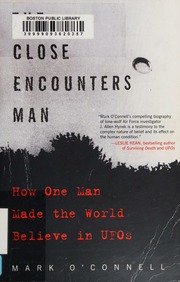
As an Amazon Associate, OverClassified may earn from qualifying purchases made through this link, at no extra cost to you.
Why This Is Essential Reading
The Close Encounters Man earns its place on this list as the biography this site's own primary-source entry on The UFO Experience cannot be: where Hynek's own 1972 book explains his method, O'Connell's 2017 biography explains the man who built it, using archival access to CUFOS's own files and original interviews to recover a private mystic and an institutional outsider that Hynek's own careful public writing never revealed. It is not a flawless replacement for that access — named critics from Jerome Clark to David Halperin have identified real gaps, from an overstated subtitle to underdeveloped occult material and a thin circle of interviewed colleagues — but as the first and, to date, only full-length biography of the single most consequential scientific figure in American ufology, it remains the essential starting point for understanding who J. Allen Hynek actually was, not just what he argued.
Related Cases & Theories
Essential Viewing
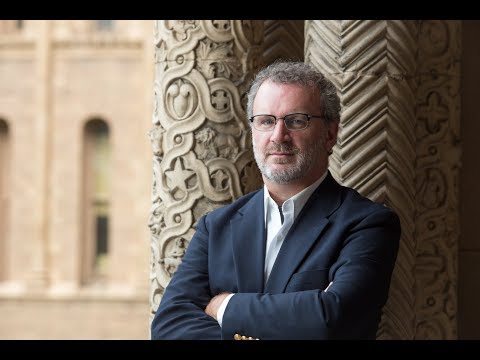
Mark O'Connell, Dr J. Allen Hynek, The Close Encounters Man 08-02-2017
Podcast UFO Live Shows — O'Connell discusses his research into Hynek's life and papers shortly after the book's 2017 publication. Verified via YouTube oEmbed before inclusion.
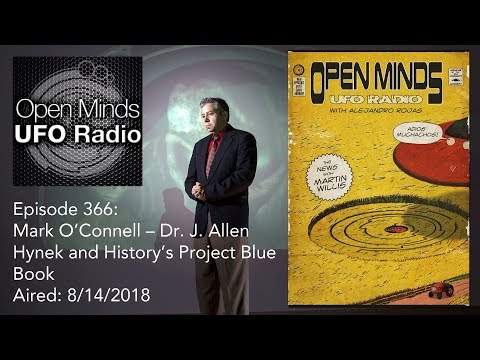
Open Minds UFO Radio - Mark O'Connell: Dr. J. Allen Hynek and History's Project Blue Book
OpenMindsTV — O'Connell compares the real historical record documented in his book against History Channel's dramatized Project Blue Book series. Verified via YouTube oEmbed before inclusion.
Sources Cited
- O'Connell, Mark. The Close Encounters Man: How One Man Made the World Believe in UFOs. Dey Street Books, 2017 (ISBN 9780062484178 / 0062484176, matching the edition already cited on this site's own resources library). amazon.com
- "The Close Encounters Man: How One Man Made the World Believe in UFOs." Goodreads. goodreads.com
- Hollars, B.J. "Book Review: The Close Encounters Man: How One Man Made the World Believe in UFOs by Mark O'Connell." The Los Angeles Review. losangelesreview.org
- Boehm, Eric. "The Close Encounters Man." Reason, November 1, 2017. reason.com
- "All Book Marks reviews for The Close Encounters Man by Mark O'Connell," including excerpted reviews from Vice (J.W. McCormack), The Millions (Nick Ripatrazone), and The Washington Post (Sarah Kaplan). Book Marks / Lit Hub. bookmarks.reviews
- Halperin, David. "'The Close Encounters Man' — Mark O'Connell on J. Allen Hynek." davidhalperin.net. davidhalperin.net
- "Jerome Clark." Wikipedia (identifying the Fortean Times reviewer cited above as a longtime professional UFO researcher and author of The UFO Encyclopedia). en.wikipedia.org
- "How Did 'Close Encounters of the Third Kind' Receive Input From Astronomer Dr. J. Allen Hynek?" The Take (details on Hynek's letter to the production and his consulting fees). the-take.com
- "Unexplained Phenomena." Isthmus (Madison, WI), on O'Connell's research approach and goal of writing "a UFO book people wouldn't need to hide." isthmus.com
- "J. Allen Hynek." Wikipedia (birth, death, Halley's Comet detail, and career chronology). en.wikipedia.org
- "J. Allen Hynek — Project Blue Book, Quotes & Facts." Biography.com. biography.com
- Mark O'Connell author biography and Star Trek writing credits. Wisconsin Book Festival. wisconsinbookfestival.org
- "Mark Gehred-O'Connell." Memory Alpha (Star Trek: Deep Space Nine writing credits, including "Who Mourns for Morn?"). memory-alpha.fandom.com
- This site's own case file: Michigan “Swamp Gas” UFO Wave, which already cites this exact book directly.
- This site's own essential-reading entry: The UFO Experience, Hynek's own 1972 primary-source book, the direct companion piece to this biography.
- This site's own key-figures entry: J. Allen Hynek, for his full biography and site-wide case connections.
Have corrections, additional research, or peer-reviewed sources? Help improve this entry.
Suggest an Edit