
The Crozon Peninsula Red Rectangles
At 7:48 a.m. on Monday, January 13, 2020, still in darkness, a driver on a work trip along a small, unlit country road on the Crozon peninsula, Finistère, was driving slowly through a storm — heavy wind gusts, a low cloud ceiling, heavy rain — when he saw, above the crowns of a pine grove on his left, two identical horizontal red rectangles of light. A third identical rectangle appeared beside them, equally spaced. The three lights, which looked large to him and sat relatively high in the sky, moved along the road as he approached a junction, then stopped almost in front of him as he halted at the give-way line. He judged them to span two-thirds of his windshield, had to lean forward over the wheel to see them all, and described them as looking like truck tail-lights: vivid red, sharply outlined, and filled with small moving "beads" of light. Although gusts were rocking his van, the shapes stayed perfectly still for about thirty seconds. They then left toward the south, keeping their formation and shrinking as they went, dropping in "ricochets" toward the horizon before accelerating and vanishing almost instantly into the sky at 7:50, without interacting with the clouds. GEIPAN rated the account's consistency 0.65 and its strangeness 0.55, checked with the nearby Lanvéoc-Poulmic naval air base and a Marine Nationale drone instructor, studied eight hypotheses in a 70-page report, and found none satisfactory, classifying the case D1, unexplained.
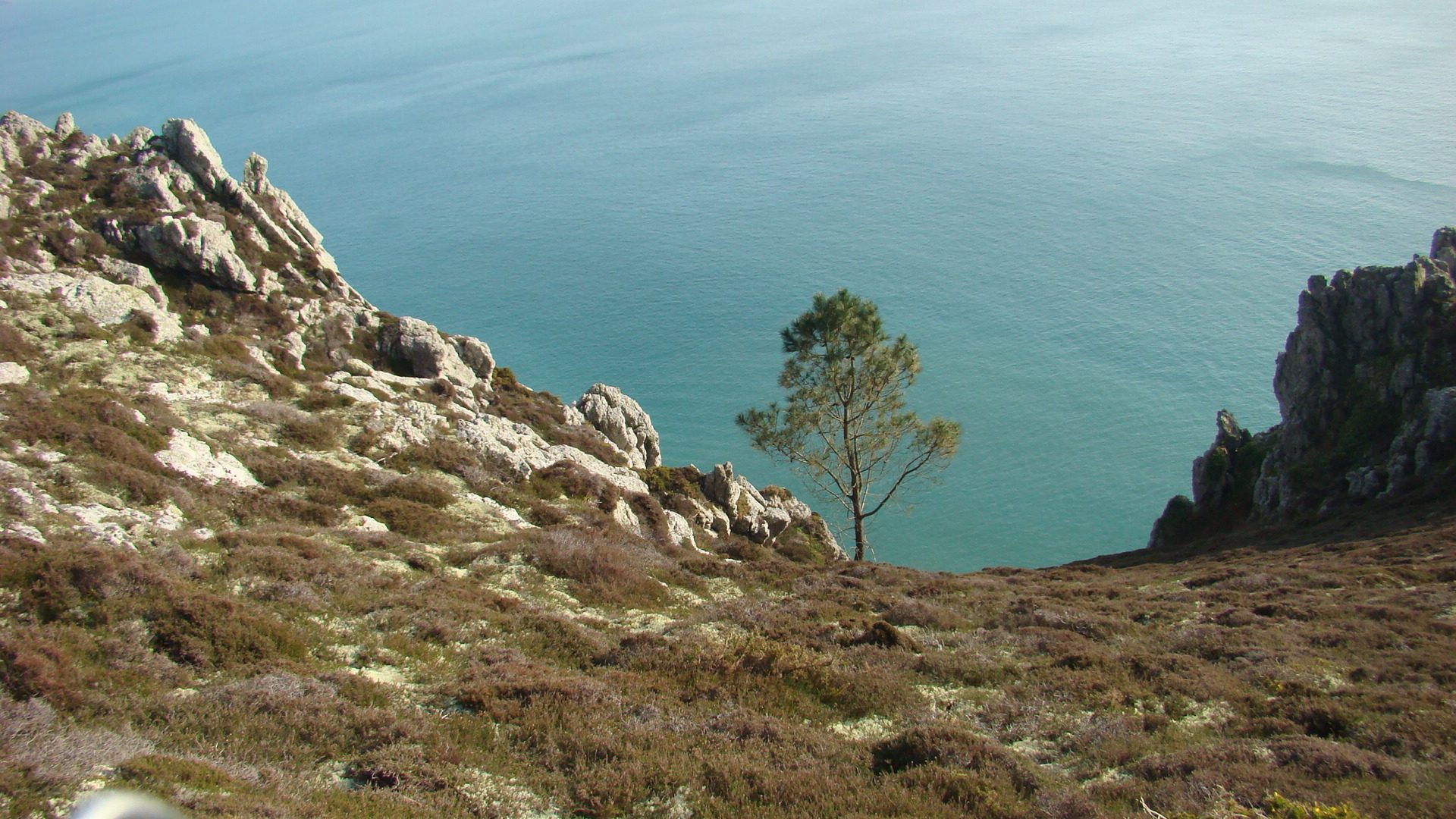
Pictured: the sea cliffs (falaises) of the Crozon peninsula, Finistère, France — the rugged Atlantic headland on which the sighting's rural road is located. This is not a photograph of the phenomenon itself; no photograph or video of the three red rectangular lights is known to exist. GEIPAN did produce a video-simulation reconstruction of the witness's account, but it recreates the reported geometry rather than depicting a real recorded image. Photo by Wikimedia contributor Ballaven Patricia, taken March 13, 2016, released under CC BY-SA 4.0 via Wikimedia Commons.
Theoretical Alignment
This case aligns most strongly with the Extraterrestrial Hypothesis among the frameworks this site tracks, on the strength of a structured, geometrically rigid craft-like object — three fixed, evenly spaced, identically shaped light-forms holding a stationary formation against gale-force wind for roughly two minutes, then departing under what the witness described as controlled, patterned motion ending in a burst of near-instantaneous acceleration. It carries modest Interdimensional alignment on the strength of the object's reported "ricochet" descent-then-vanish motion profile — a stepped, bouncing loss of apparent altitude followed by a sudden vertical disappearance is the kind of non-ballistic, non-aerodynamic motion IDH proponents cite as inconsistent with ordinary solid, terrestrial flight. Psycho-Social framing carries comparatively little weight here specifically because GEIPAN's investigators directly tested and eliminated the two most obvious psycho-social candidates — a windshield reflection of an interior cabin light, and a laser or disco-style projector — on the specific grounds that neither could produce three separately positioned, well-defined, internally structured rectangles that remained rigidly fixed across a full two minutes of observation from a moving, then stationary, vehicle.
Background
Understanding why GEIPAN treated a single-witness account with this level of institutional follow-through — direct outreach to a naval air base, a dedicated consultation with a military drone specialist, and formal testing of eight distinct hypotheses — requires understanding both the specific military geography of the Crozon peninsula and the investigative apparatus France has built for exactly this kind of report.
Crozon: A Fortified Peninsula at the Edge of Finistère
The commune of Crozon, home to roughly 7,500 residents, sits at the heart of the peninsula that bears its name on the western coast of Finistère, in Brittany — a rugged headland of sea cliffs, heathland and pine groves reaching into the Atlantic between the Rade de Brest to the north and the Baie de Douarnenez to the south. It is a canton seat in the arrondissement of Châteaulin, the birthplace of the actor Louis Jouvet in 1887, and host each August to the Festival du Bout du Monde. Its more consequential distinction, for this case, is military. Within about 4 to 10 kilometers north of the witness lay the Île Longue base of France's ballistic-missile submarines and its missile assembly and storage annex, and about 9 kilometers to the northeast lay the naval air base of Lanvéoc-Poulmic, according to GEIPAN's report. Few civilian sighting locations on this site sit this close to this much sensitive French military infrastructure — a relevant fact for the drone and helicopter hypotheses GEIPAN tested directly against the base itself.
Lanvéoc-Poulmic began life in 1920 as one of thirty-seven seaplane stations built along the French coast for maritime surveillance, became a "Centre d'Aéronautique Maritime" in 1935, and took its current name in 1937. It was bombed eighteen times during the Second World War, and after the war took in the École Navale (French Naval Academy), whose permanent buildings General de Gaulle inaugurated in 1965. The Defense Ministry description GEIPAN quotes gives the base about 1,200 personnel. Its history page, also quoted by GEIPAN, shows the helicopter fleet in transition at the time of the sighting: Flottille 32F had been placed in abeyance in 2016, Flottille 33F flew the NH90 Caïman Marine on search-and-rescue alert, Flottille 34F was due to retire its Lynx in 2020, and the training squadron (ESHE/22S) had taken on Dauphin N3s. Any sighting of unusual lights on this peninsula raises the question of whether a naval asset is responsible, which is the question GEIPAN put directly to the base.
The peninsula's own deeper history reinforces just how long this stretch of coastline has mattered strategically to whoever has controlled it. Crozon's own territory carries traces of human settlement stretching back to megalithic monument-builders, followed by Gallo-Roman occupation exploiting the natural anchorage of the Rade de Brest, and centuries of Breton maritime life oriented around fishing and coastal trade before the French state's own military footprint began expanding here in earnest in the early twentieth century. During the Second World War, German occupying forces recognized the same strategic value the French Navy had already identified, fortifying the peninsula as part of the wider Atlantic coastal defense network guarding the approaches to Brest; the eighteen Allied bombing raids Lanvéoc-Poulmic endured between 1940 and 1944 were a direct consequence of that fortification. Postwar, rather than winding down, the peninsula's military role deepened further with the Cold War-era decision to base France's nascent strategic submarine deterrent at Île Longue, cementing Crozon's status as one of the most militarily consequential stretches of coastline in metropolitan France relative to its small civilian population. That is the specific landscape — equal parts working fishing communities, exposed Atlantic cliffs, and dense, decades-deep military infrastructure — against which this sighting's driver was navigating a rural road in a January storm.
GEIPAN's Investigative Machinery: A Small Core, a Wide Network
GEIPAN, based at the Centre National d'Études Spatiales (CNES) in Toulouse, traces back to the GEPAN unit founded in 1977 under astrophysicist Claude Poher, later reorganized as SEPRA under Jean-Jacques Velasco before taking its current name. It works with a small permanent staff, volunteer field investigators and an outside "comité des experts" convened on its most complex cases. Of the 3,368 case summaries in GEIPAN's public catalogue (as scraped by this site in August 2026), 942 are classed A (identified), 1,306 B (probably identified), 1,014 C (unidentifiable for lack of data) and 106 D (unexplained despite adequate data) — about 3.1%.
What distinguishes this case is the depth of the investigation recorded in GEIPAN's 70-page report. The witness mailed his questionnaire on June 29, 2020, five and a half months after the sighting; an investigator met him at home on January 30, 2021 for a cognitive interview and then reconstructed the sighting on site, measuring elevations and angular sizes; a supplementary questionnaire followed in May 2021; the expert committee reviewed the case on May 19, 2022, after which the witness was asked about military helicopter markings; GEIPAN corresponded with the naval air base in July and August 2022; the investigator visited the Cap de la Chèvre semaphore and the Morgat lighthouse sightlines at night in September and October 2022; and a Marine Nationale drone instructor was consulted in December 2022. The report is dated July 24, 2023.
Complete Timeline
| Date | Event |
|---|---|
| 1920 | The seaplane station that becomes Lanvéoc-Poulmic naval air base is established on the Crozon peninsula. |
| 1977 | GEIPAN's predecessor, GEPAN, is founded within CNES in Toulouse under Claude Poher. |
| January 13, 2020, 07:48 (Phase 1) | Sighting begins. Driving at about 60 km/h on the unlit Menez-Kerlouantec road on the Crozon peninsula, in darkness, wind and heavy rain, with his high beams on and the radio off, the witness sees two large, vivid red rectangles above pines 15–20 m tall on his left. |
| January 13, 2020 (Phase 2) | Slowing his vehicle, the witness sees a third identical red rectangle appear to the left of the first two, spaced at exactly the same interval. |
| January 13, 2020 (Phase 3) | The three-light formation, appearing large and sitting relatively high in the sky, tracks along the road on the witness's left as he continues driving toward a road junction ahead. |
| January 13, 2020 (Phase 4) | The three lights come to a stop directly over the junction, facing the witness; he stops his own car a short distance before the junction to observe them, now judging them to span roughly two-thirds of his windshield. |
| January 13, 2020 (Phase 5, about 30 seconds) | Close observation: the witness leans forward to see the full formation, describing three sharply outlined, vivid-red, truck-taillight-like shapes, each containing small moving spheres of light, that remain perfectly still despite gusts strong enough to rock his car. |
| January 13, 2020 (Phase 6) | The three lights depart southward, still facing the witness and holding their exact formation and appearance, shrinking in apparent size — first descending in apparent height via a series of "ricochet" bounces toward the horizon, then suddenly accelerating and vanishing almost instantly upward into the sky, never passing behind or interacting with the clouds. Total observation duration: approximately 2 minutes. |
| June 29, 2020 | GEIPAN receives the witness's completed technical questionnaire by post, with his sketches, a map of his route and two daytime photo reconstructions; no other witness is found. |
| During the investigation | GEIPAN's expert committee (comité des experts) reviews the case in depth, formulating eight distinct hypotheses: military or civilian drone(s), a helicopter, a lighthouse or semaphore beam, a wind-turbine warning beacon, a laser or discotheque projector, a windshield reflection of an interior cabin light, a conventional aircraft, and the reflective plates/position lights of a truck. |
| During the investigation | Investigators deepen the three most plausible-seeming candidates — drones, helicopter, lighthouse/semaphore — while eliminating and documenting the remaining five on independent grounds. |
| January 30, 2021 – August 2022 | An investigator conducts a cognitive interview at the witness's home and an on-site reconstruction (January 30, 2021); a supplementary questionnaire follows (May 2021); the expert committee reviews the case (May 19, 2022); the Lanvéoc-Poulmic naval air base replies (early August 2022) that no aircraft, helicopter or drone based there was flying and no "special activity" was under way, and its pilots suggest the red obstruction lights of the Goulien wind farm across the Baie de Douarnenez. |
| September–December 2022 | The investigator checks the Cap de la Chèvre semaphore and the Morgat lighthouse sightlines at night in similar weather (no light visible from the witness's position); a Marine Nationale drone instructor, consulted in December 2022, says the lights could not have been military drone markings. |
| July 24, 2023 | GEIPAN signs its 70-page investigation report; a video-simulation reconstruction of the sighting is published with it on the case page. |
| Final classification | Final classification. GEIPAN concludes that none of the hypotheses studied "gives satisfaction" against the testimony and classifies the case D1, an unexplained phenomenon (case 2020-01-50998; strangeness 0.55, consistency 0.65). Its investigator's own evaluation of the three main hypotheses: drones 0.45, helicopters 0.25, lighthouse 0.25. |
Detailed Narrative
Two Rectangles, Then Three: The Opening Phase
The witness's account begins in motion, on a small country road crossing the Crozon peninsula, in weather GEIPAN's own file describes plainly as bad: strong wind gusts, a low cloud ceiling, and rain. Driving at about 60 km/h at 7:48 a.m., in full darkness on an unlit road, he noticed, partly masked by the crown of a pine grove standing beside the road on his left, two identical horizontal rectangles of red light. The detail of partial obstruction by real, describable foreground vegetation is itself a small but genuine piece of corroborating context: a witness inventing or badly misremembering a sighting is less likely to spontaneously include a specific, checkable visual obstruction that complicates rather than clarifies what he saw. As he slowed his vehicle to get a better look, a third identical red rectangle appeared to the left of the first two, spaced at what he judged to be exactly the same interval as the gap between the original pair — suggesting, if accurately perceived, a coherent three-unit structure or formation rather than three independently drifting lights that happened to align by chance.
The three-light formation appeared large to the witness and sat relatively high in the sky. Rather than remaining static, it began tracking along the road, staying on his left side as he continued driving toward a junction of roads a short distance ahead. This tracking behavior — the lights maintaining a roughly constant angular position relative to the moving vehicle, rather than the vehicle simply passing beneath a fixed object, or the object crossing the sky independent of the car's motion — is a detail GEIPAN's investigators would need to account for however they ultimately explained the incident, since a genuinely fixed object (a lighthouse beam, a wind-turbine beacon) cannot itself "track" a moving vehicle in the way the witness described, while a genuinely mobile object doing so raises its own separate strangeness.
The Stop at the Junction: A Sustained, Close-Range Observation
The case's most evidentially significant phase is also its longest and closest. As the witness approached the junction, the three lights came to a halt directly over it, facing him; he, in turn, brought his own car to a stop a short distance before reaching the junction specifically in order to observe them at length. This is the point in the account where casual passing perception gives way to sustained, close, deliberate observation — the witness was no longer glancing at something in his peripheral vision while driving, but stationary, facing the phenomenon directly, for what GEIPAN's summary calls "a few seconds" and the witness put at about thirty seconds, within a total observation of about two minutes.
From this stopped, close vantage point, the witness offered his most specific measurements and descriptions. He judged the three-light formation, taken together, to span roughly two-thirds of the width of his windshield, positioned slightly to his left rather than dead ahead — a detail suggesting the object's exact bearing rather than a vague "in front of me" recollection. He had to lean forward in his seat, over the steering wheel, to take in the full formation at once, implying an apparent angular size large enough that it did not comfortably fit within a single relaxed sightline. His description of the individual lights themselves was specific and unusual: each resembled the tail-light cluster of a large truck, vivid red, sharply and cleanly outlined rather than diffuse or glowing, and — the account's single strangest visual detail — each rectangle appeared to contain small spheres or points of light that moved within its border, as though the illumination inside each panel were not uniform or static but composed of discrete, mobile internal elements. Despite wind gusts strong enough to physically rock his stationary car on its suspension, all three shapes held perfectly rigid, unmoving formation throughout this entire close-range phase.
Departure: A Bouncing Descent, Then Near-Instant Disappearance
After holding position for about thirty seconds, the three lights began to move again, departing toward the south (toward the Morgat semaphore point, in the witness's words) while still facing him, without breaking their spacing or changing appearance. The witness described the departure in two tempos. First the formation moved "following the ground" at a moderate pace, shrinking and dropping in apparent height in a series of steps — GEIPAN records his word, "ricochets" — down to the level of the horizon. Then it accelerated sharply and climbed out of sight "at very high speed" toward the sky. GEIPAN's summary notes that the lights did not interact with the low clouds; at the end of the sighting the witness placed them at 0° elevation, in front of the last hill on the horizon. The whole sighting lasted about two minutes, ending, he told the investigator, at exactly 7:50.
A Uniquely Institutional Investigation
What sets this case apart is the breadth of the hypotheses GEIPAN worked through. Its expert committee listed eight: one or more drones, helicopters, a lighthouse or semaphore, wind-turbine obstruction lights, a laser or discotheque projector, a reflection on the windshield of a light inside the vehicle, an aircraft, and a truck's reflectors, position or clearance lights. The report deepened the first three in its scoring, but it also analyzed each of the others in detail. It placed the lights, from on-site measurements, at 23–30° wide and 28–50° above the horizon; depending on their unknown distance, the formation would have been 16 m across at 30 m, 27 m at 50 m, or 80 m at 150 m. The witness's first thought had been the back of a truck, which GEIPAN took seriously because "the first impression of a witness is quite often the right one," before rejecting it on elevation, lighting and geometry.
The aeronautical hypotheses led investigators to Lanvéoc-Poulmic, about 9 km to the northeast. The base replied in early August 2022 that no aircraft, helicopter or drone based there was flying at the time and no "special activity" was under way; its most experienced pilots suggested the red obstruction lights of the eight-turbine Goulien wind farm across the Baie de Douarnenez. GEIPAN also checked the collaborative ADS-B site ads-b.nl and found no military flights listed over the peninsula for January 2020. GEIPAN's own aeronautical expert noted that some military helicopters or drones could carry red markings resembling the lights, but three craft would have had to fly in tight formation in a storm, with no navigation or anti-collision lights and, for helicopters, no audible noise despite a south-southwesterly wind blowing from the lights toward the witness. In December 2022 a Marine Nationale drone instructor said the lights could not be military drone markings. GEIPAN noted that drones from another base or a private operator could not be excluded, but judged three civilian drones holding such a stable formation in rain and strong wind unrealistic. Its investigator nonetheless scored drones as the best of the hypotheses, at 0.45.
What the Case File Does Not Contain
The full report fills in much that the case summary leaves out. The witness, who wears glasses, was driving a Citroën Jumper on a work trip from Crozon toward the hamlet of Brégoulou; he was alone in the front of the vehicle, had his high beams and dashboard lights on, and heard only the wind and his engine. He told GEIPAN that he had been an aircraft mechanic and had spent five years as flying personnel, "so I know aircraft," and that he had first thought of the back of a truck but rejected it "because of the height." In his written account the rectangles, at their closest, were about 10 m in front of him and 12 m up. He returned to the site several times afterward and did not go to the gendarmerie for fear of ridicule. GEIPAN also tested how he estimated the size of the Moon: he overestimated it by a factor of about 20, a result GEIPAN said it treated with caution, since such tests often reflect people's mental picture of the Moon more than their perception. The exact road and junction appear in the report, but the witness's name and employer do not.
A Note of Institutional Caution
GEIPAN's case summary does not treat this thoroughness as license for full confidence. It says GEIPAN "remains cautious" because the technical questionnaire was written and sent five months after the sighting and the field investigation and reconstruction were carried out a year after it, delays that in GEIPAN's experience "can disturb or even modify" a testimony. The full report adds a counterpoint: the witness's size estimates in June 2020 and on site in January 2021 did not contradict each other, and "if a problem of memory reconstruction were really present, one does not see why it would apply between the observation and the first account in the questionnaire five months later, but not between that first account and the one made on the ground seven months later." It described the witness as "perfectly coherent and measured."
Key Witnesses
The Crozon Peninsula Primary Witness (identity withheld per GEIPAN's standard anonymization practice)
A driver on a work trip who, at 7:48 a.m. on January 13, 2020, observed the full sequence — two red rectangles becoming three, a stop of about thirty seconds near a road junction, and a two-phase departure ending in near-instantaneous disappearance — over about two minutes in a storm. A former aircraft mechanic who had spent five years as flying personnel, he wears glasses and knew the area well. He mailed GEIPAN a detailed technical questionnaire five and a half months later, then took part in a cognitive interview and an on-site reconstruction in January 2021 and answered a supplementary questionnaire in May 2021. GEIPAN rated his account 0.65 for consistency and 0.55 for strangeness, while flagging the reporting delays.
The Five Observables Assessment
The Five Observables framework, developed by the Pentagon's Advanced Aerospace Threat Identification Program to describe performance characteristics beyond known conventional technology, is applied here for comparative consistency across the site's case files. This case registers one clean positive match, two genuinely ambiguous speculative ratings, and one notable evidentiary gap distinct from comparable cases on this site.
Assessment: This case's cleanest positive observable is Instant Acceleration: the witness's own account distinguishes a first, slower phase of "ricochet"-style descent from a distinctly separate, sudden final burst of upward acceleration and disappearance, mapping directly onto AATIP's canonical category with little of the interpretive hedging that qualifies this case's other observables. Anti-Gravity Lift is rated speculative rather than present specifically because the witness never described any visible lift mechanism — only the striking fact that gale-force wind, strong enough to physically move his own vehicle, produced no visible effect whatsoever on three ostensibly airborne light-forms holding a fixed geometric arrangement. Low Observability stands out for a different reason than in comparable radar-checked cases elsewhere on this site: rather than a clean negative result (Montluel) or a partial, mistimed one (Sainte-Foy-de-Peyrolières), this case has no radar data at all: GEIPAN checked public ADS-B flight listings and asked the naval base and a drone instructor, rather than reconstructing radar tracks — a different, and in some ways less complete, evidentiary gap.
Evidence Assessment
Supporting an Anomalous Origin
- An unusually detailed, internally consistent single-witness account rated 0.65 for consistency and 0.55 for strangeness, supported by sketches, photo reconstructions and on-site measurements
- GEIPAN formulated and tested eight distinct hypotheses, deepening the three most plausible, without settling on any explanation that survived scrutiny
- The nearby Lanvéoc-Poulmic naval air base reported that no aircraft, helicopter or drone based there was flying and no special activity was under way
- A Marine Nationale drone instructor's expert professional opinion found the reported lighting signature matched no known military drone platform
- The lighthouse hypothesis was judged very unlikely on several grounds (the Morgat light's regular occultations and vertical red sector, no visible beam in the rain, a diffuse light unable to form sharp shapes, the witness's familiarity with the area), and the investigator found no light visible from the witness's position on a similar rainy night
- The reported final acceleration and near-instantaneous disappearance maps cleanly onto the AATIP Five Observables framework's "instant acceleration" category
Supporting a Conventional/Mundane or Inconclusive Origin
- This remains a single, uncorroborated witness account with no second observer, no photograph, and no video of the phenomenon itself
- The technical questionnaire was sent five months after the sighting and the field investigation and reconstruction were carried out a year after it — delays GEIPAN's summary flags as able to disturb or modify a testimony
- No radar data were obtained; the air-traffic check relied on ADS-B records, which show only transponder-equipped aircraft
- The base and drone-instructor consultations, while negative, rest on institutional self-reporting, and GEIPAN noted that drones from another base or a private operator could not be excluded; its investigator rated drones the best hypothesis at 0.45, and a powerful laser remained "very interesting" in the report's words
Why "Open"
This case is stamped Open rather than Credible, Disputed, or Debunked because GEIPAN's own investigation reached precisely that state: an unusually institution-facing, multi-hypothesis inquiry that directly contacted the single most obvious potential conventional source — a nearby naval air base — and came back with a specific negative answer, without ever securing the kind of second witness, photograph, or instrumented data that would justify a stronger designation in either direction. The case earns real, substantial credit for the specificity of its negative institutional findings: a dated confirmation from Lanvéoc-Poulmic that no aircraft or drones of its own were active, a named-role military drone instructor's professional judgment that the lighting signature matches no known platform, and a lighthouse/semaphore hypothesis eliminated on three independent technical grounds rather than dismissed casually. Eight formally tested hypotheses on a single-witness case, with three genuinely deepened rather than merely listed, sits toward the more thorough end of the investigative effort this site has documented.
Set against that, "Credible" would overstate what the public record actually supports: this remains, in the end, a single witness with no photographic or video evidence and no second observer, and unlike several comparable cases on this site, no radar data were obtained, only an ADS-B listing — a real evidentiary gap. GEIPAN's summary also flagged that the questionnaire came five months after the sighting and the field investigation a year after it, delays that can disturb testimony, tempering how much weight even a "good" consistency rating should carry. A case whose own investigating agency reached out directly to a military installation, obtained a specific negative answer, tested eight hypotheses in total, and still concluded that nothing it could verify explains what was reported — while candidly flagging its own investigation's timing limitations — is exactly the state "Open" is meant to capture: genuinely, thoroughly investigated, and genuinely unresolved.
Sensor & Instrumentation Detection Profile
This case's instrumented evidence is entirely institutional rather than radar- or sensor-based. No air-traffic or air-defense radar data were obtained for this sighting (GEIPAN checked only the public ADS-B listing site ads-b.nl, which showed no military flights over the peninsula that month), a genuine point of difference from several comparable GEIPAN cases on this site (Montluel's negative CAPCODA/CNOA check, Fauville-Évreux's positive uncorroborated contact, and Sainte-Foy-de-Peyrolières's partial, mistimed Toulouse-Blagnac data), each of which at least attempted some radar-based cross-check. In place of radar, GEIPAN's investigators substituted direct institutional confirmation: a formal query to the Lanvéoc-Poulmic naval air base, which reported that no aircraft, helicopter or drone based there was flying and no special activity was under way, and a consultation with a Marine Nationale drone instructor, who assessed the reported lighting signature against known military drone platforms and found no match. No photograph, video, or audio recording of the phenomenon itself exists; the visual records connected to the case are the witness's own sketches and daytime photo reconstructions, GEIPAN's on-site angular measurements, and its video-simulation reconstruction, published on the case page with the report — reconstructions, not documentary evidence of the sighting itself.
Environmental & Geospatial Context
The sighting occurred during genuinely poor weather — strong wind gusts, a low cloud ceiling, and rain — conditions GEIPAN's investigators treated as directly relevant to at least two of the hypotheses tested. The absence of any visible beam beneath the three light-forms, despite rainy conditions in which a genuine lighthouse or powerful ground-based beam would be expected to scatter visibly off falling rain, weighed directly against the lighthouse/semaphore hypothesis. Separately, the wind's strength — sufficient to rock the witness's own stationary vehicle — became a key data point cutting against a helicopter explanation, since a helicopter large and close enough to produce the reported angular size should, under GEIPAN's investigators' own reasoning, have been more rather than less audible in gusty conditions carrying sound toward the witness, not less.
Geographically, the sighting occurred on the Crozon peninsula, a stretch of Finistère coastline carrying an unusually dense concentration of French military infrastructure for a rural area of its size: the naval air base at Lanvéoc-Poulmic about nine kilometers to the northeast, and the highly sensitive Île Longue strategic submarine base within Crozon's own commune territory. This military density cuts in two directions at once for evaluating the case: it means genuine, mundane military air activity (a helicopter transit, a drone exercise) is a background possibility any investigator must take seriously here more than in a purely civilian area — which is exactly why GEIPAN contacted the base directly rather than assuming an answer — but it also means that base's specific, dated negative confirmation carries real evidentiary weight precisely because a false or careless answer would have been unusually easy to check against, given how much of the surrounding area's air traffic that single base could plausibly account for.
The peninsula's exposure to Atlantic storm systems is itself an ordinary, year-round feature of the local climate rather than an unusual event in its own right — Finistère's western coastline routinely absorbs the first landfall of winter depressions tracking in off the North Atlantic, and January is climatologically among the windiest and wettest months in the department. That baseline matters for weighing the case in two opposite directions at once. On one hand, it means the specific weather conditions present that morning were unremarkable for the season and region, and cannot themselves be treated as an unusual contributing factor requiring separate explanation. On the other, it means the witness — as a resident of an area accustomed to this kind of weather, and, per GEIPAN's own reasoning on the lighthouse hypothesis, already familiar with how the area's genuine navigational lighting looks under comparable storm conditions — was not an inexperienced observer encountering an unfamiliar visual environment for the first time. A witness who already knows what the local coastline's real lights, beacons, and beams look like in bad weather, and who still could not identify what he was seeing as any of them, is a materially different kind of report than one from a visitor unfamiliar with the area's ordinary nighttime and storm-lit skyline.
Observer Credibility & Occupational Profile
GEIPAN's full report gives more of the witness's background than its summary: he was driving a Citroën Jumper on a work trip, wears glasses, knew the area, and described himself as a former aircraft mechanic with five years as flying personnel. His cooperation is documented in detail: a technical questionnaire with sketches, a route map and photo reconstructions, a cognitive interview and on-site reconstruction a year after the sighting, a supplementary questionnaire, and further questions about military helicopter markings. The investigator called him "perfectly coherent and measured." GEIPAN's investigators themselves rated the resulting account's consistency 0.65, "good" — a rating earned despite, not because of, the case's evidentiary limitations, since a single uncorroborated account with no photograph must earn that rating purely on internal coherence and specificity rather than any external cross-check.
The case's structural limitation is the one shared by the majority of single-witness UAP reports generally: however internally consistent and specific one account is judged to be, it cannot by itself carry the same evidentiary weight as independent corroboration from a second observer, a photograph, or an instrumented data source. That limitation is compounded here by GEIPAN's own candid acknowledgment that the five-month gap before the technical questionnaire, and the roughly year-long gap before the field reconstruction, are exactly the kind of delays that can, per the agency's own accumulated experience, disturb elements of a witness's testimony — a genuine, self-identified caveat this case carries that several faster-documented cases on this site do not.
Historical Precedents & Archive Matches
Comparing this case against the other GEPAN/GEIPAN-investigated French sightings already published on this site highlights both its distinctive investigative profile and where its evidentiary strength sits relative to comparable files.
Sainte-Foy-de-Peyrolières (2018) — Two Different Models of Investigative Thoroughness
The Sainte-Foy-de-Peyrolières Five-Phase Sighting (Open, 42/100) offers the closest comparison in overall investigative intensity: another single-witness, no-photograph case that received unusually thorough treatment, there via two separate expert-committee reviews and a formal field reconstruction with cognitive interview. This case received comparable treatment — a cognitive interview, an on-site reconstruction and an expert-committee review — and GEIPAN's investigators also reached outward, contacting a naval air base and consulting a military drone instructor. Both approaches reflect real investigative effort; neither produced a conventional explanation that survived scrutiny.
Montluel (2022) and Fauville-Évreux (1978) — The Radar Check This Case Never Had
The Montluel cloud-distorting object (Open, 44/100) and the Fauville-Évreux radar sighting (Open, 38/100) both involved a genuine air-defense or air-traffic radar cross-check — a clean negative result in Montluel's case, a positive uncorroborated contact in Fauville-Évreux's. This case's investigation proceeded along a different track: no radar data, only a public ADS-B listing, together with direct confirmation from the nearby naval base and a drone instructor. Whether an institutional confirmation of this kind is weighed as comparably strong to a negative radar result, or as a genuinely different and less independently verifiable category of evidence, is a fair question this case's own file leaves open, and this site does not attempt to resolve it definitively in either direction.
Montayral (2015) and Bornel (2014) — Single-Witness Cases at Different Consistency Levels
The Montayral aerodrome object (Open, 28/100) is the site's other single-witness, no-photograph case with the least additional corroboration, its consistency rated only "just sufficient." This case's own 0.65 consistency rating sits meaningfully higher, though still below Sainte-Foy-de-Peyrolières's 0.72 — a genuine middle position reflecting a detailed, specific account that nonetheless lacks that case's multi-phase structural richness. The Bornel conservatory fireball (Open, 45/100), by contrast, benefits from two corroborating witnesses and an inconclusive but real photograph — the kind of multi-source corroboration this Crozon file, like most single-witness cases on this site, simply does not have, however unusually thorough its underlying investigation was.
Material Analysis
This case involves no physical or trace evidence of any kind — no landing marks, no recovered material, no soil or vegetation sample, and no biological or physiological effect on the witness beyond his own visual observation. Nothing in the account places the object at ground level or within the witness's physical reach at any point; the three light-forms remained airborne throughout, at a distance the witness himself judged as relatively high in the sky even during the closest phase of observation. There is accordingly nothing to sample, test, or physically examine after the fact — only the witness's own detailed verbal and questionnaire-based description of what he observed, and the specific negative confirmations GEIPAN obtained from the nearby naval base and its drone instructor.
Supporting Non-Terrestrial Origin
- No physical evidence exists to test in the first place, so no terrestrial material-composition finding contradicts an anomalous interpretation either
- The object's reported rigid formation-holding against gale-force wind, its internally structured "moving spheres" lighting pattern, and its final near-instantaneous acceleration, if accurately perceived, describe a performance envelope and physical construction outside any conventional aircraft, drone, or fixed light source GEIPAN identified
Supporting Terrestrial Origin
- The complete absence of any physical trace is itself consistent with a purely distant, airborne phenomenon that never approached the ground closely enough to leave one
- No mechanical, electromagnetic, or biological secondary effect on the witness, his vehicle's systems, or any nearby structure is recorded anywhere in the file
The Conventional Explanation Candidate: Eight Hypotheses, None Satisfactory
GEIPAN's own file is unusual among the cases published on this site in tying its final classification directly to a specific number of tested hypotheses: eight, spanning aviation, maritime infrastructure, entertainment lighting, optical illusion, and ground-vehicle misidentification. Three — drones, a helicopter, and a lighthouse or maritime semaphore beam — were judged substantial enough to deepen; the remaining five were examined and set aside on more immediate grounds. None, in GEIPAN's own words, "gives satisfaction" against the witness's testimony.
Military or Civilian Drone(s)
The most directly tested hypothesis, given the sighting's proximity to Lanvéoc-Poulmic. The base's own confirmation that no military drones were flying that night, combined with a Marine Nationale drone instructor's professional judgment that the reported lighting — three fixed, sharply outlined red rectangles with internally moving light points — matches no signage scheme used by any known military drone platform, leaves this hypothesis without institutional or technical support. A civilian drone capable of producing this specific appearance, holding rigid formation with two other identical units against gale-force wind, for two full minutes, at the apparent altitude and size the witness described, is not accounted for by any drone technology GEIPAN's investigators identified as available in 2020.
Helicopter
The angular size the witness reported — the formation spanning roughly two-thirds of his windshield at closest approach — implies, at any plausible real-world altitude, a position close enough to the witness that a helicopter of matching size should have been clearly audible, especially given wind conditions that, if anything, should have carried engine noise toward him rather than away. No sound of any kind was reported at any point during the two-minute observation. The hypothesis also does not account for three separate, identically shaped, rigidly fixed red rectangles rather than a single fuselage with conventional position lighting.
Lighthouse or Maritime Semaphore Beam
Judged very unlikely after detailed study. Within 10 km of the witness the only major lights are the Toulinguet lighthouse, about 9.3 km northwest, whose red sector points southwest, about 90° away from the witness, and the Morgat lighthouse, about 2.9 km east, whose red sector points south-southwest, almost toward him. The Morgat light could explain the color, but it occults four times every 12 seconds while the witness saw no flashing, its red panel is a vertical rectangle rather than three horizontal ones, no beam was visible in the rain, its diffuse light cannot form sharp shapes on cloud, and it cannot move in "ricochets." The Toulinguet semaphore had closed in September 2019, and the Cap de la Chèvre semaphore emits no light. On a rainy night with low cloud in October 2022 the investigator found no light from the Morgat lighthouse visible, directly or indirectly, from the witness's position, and the witness, who knew the area, would probably have recognized it.
Wind-Turbine Warning Beacon
Suggested by the naval air base's own pilots and examined in detail. The eight Goulien turbines across the Baie de Douarnenez, about 18 km from the witness, carry red lights at 134–142 m above sea level that could theoretically be seen just above an intervening hill. GEIPAN rejected them: the wind farm lay at 186–191° while the lights were seen between 100 and 180°, the whole wind farm spans about 5° against the 23–30° the witness reconstructed, the turbine lights would sit only about 13–14° above the horizon against measured elevations of 28–50°, and the lights are flashing and not necessarily synchronized.
Laser or Discotheque-Style Projector
Not ruled out. A discotheque projector was judged improbable: such spots on cloud are usually round or oval, white or blue and fuzzy-edged, a beam should have been visible in the rain, and the only discotheque within 20 km was unlikely to be running on a winter Monday morning. But GEIPAN wrote that a more powerful, concentrated laser (a LIDAR or handheld laser) "remains very interesting," because the witness's "small moving beads" inside the rectangles recall laser speckle. No source for such a laser was identified, and the absence of a visible beam remains unexplained.
Reflection on the Windshield of an Interior Cabin Light
A genuine windshield reflection is inherently tied to the observer's own head position and the geometry of the vehicle's interior, and would not be expected to remain fixed, structured, and consistent across both a moving-vehicle phase and a later stationary, close-range observation phase, nor to appear to move and hold formation independently as the vehicle itself changed position and orientation approaching the junction.
Conventional Aircraft
A single aircraft, considered as the simplest possible candidate, cannot account for three separately positioned, identically appearing rectangular light-forms holding rigid mutual spacing, nor for the total absence of any engine sound despite favorable wind conditions for sound propagation and an implied close range.
Reflective Plates or Position Lights of a Truck
Eliminated on straightforward geometric grounds: a truck's reflectors or position lights are fixed to a ground-level vehicle and cannot appear "relatively high in the sky," track a separate moving vehicle from that elevation, or depart upward and vanish into the sky at the end of the encounter.
Military or Civilian Drone(s)
ImplausibleThe nearby naval base confirmed no military drones were flying; a Marine Nationale drone instructor found the lighting matches no known military drone platform.
Helicopter
ImplausibleThe implied close range for the reported angular size should have produced audible engine noise, especially in gusty wind; none was reported.
Lighthouse / Maritime Semaphore
Very UnlikelyNo local lighthouse is powerful enough for this effect; no beam was visible under the rectangles despite rain; the witness knew the area's real lighthouse lighting already.
Wind-Turbine Warning Beacon
ImplausibleA single fixed beacon cannot produce three coordinated, structured, vehicle-tracking rectangles.
Laser / Discotheque Projector
InconclusiveNo plausible source produces three separately positioned, sharply outlined rectangles sustained for two full minutes.
Windshield Reflection
ImplausibleA reflection tied to the observer's head position would not hold a fixed, structured appearance across both a moving and a stationary observation phase.
Conventional Aircraft
ImplausibleCannot account for three identical, rigidly spaced rectangles or the total absence of engine sound.
Truck Reflectors / Position Lights
ImplausibleGround-level fixtures cannot appear high in the sky, track a separate vehicle, or depart upward into the sky.
Related Cases
Confirmed Documents & Official Records
The official French government investigation summary: the witness's full account, the eight tested hypotheses, the Lanvéoc-Poulmic and drone-instructor consultations, and the final Class D determination with published strangeness (0.55) and consistency (0.65) ratings.
GEIPAN's full field investigation report, including the technical questionnaire results, the hypothesis-by-hypothesis analysis, and the institutional correspondence with Lanvéoc-Poulmic.
GEIPAN's own published definitions for classifications A, B, C, D, D1, and D2, and the strangeness/consistency evaluation criteria applied to this case.
GEIPAN's own account of its investigative structure — the roughly twenty trained field investigators and fifteen-member scientific expert committee — and its statistical case outcomes, providing institutional context for this case's unusually institution-facing investigation.
Further Reading — Recommended Literature
UFOs: Generals, Pilots, and Government Officials Go on the Record
Kean's survey of credentialed witness testimony and official investigative bodies worldwide provides useful comparative context for weighing GEIPAN's own institution-facing investigative approach against how other national UAP investigation programs operate.
Wonders in the Sky: Unexplained Aerial Objects from Antiquity to Modern Times
A catalog of historical aerial anomaly reports useful for weighing how genuinely unusual this case's specific rigid, formation-holding, structured-light phenomenon is against the broader historical pattern of reported aerial phenomena.
The UFO Evidence
The foundational documentary approach to cataloging and cross-referencing witness testimony that GEIPAN's own case-file methodology, including its formal consistency and strangeness ratings, descends from in spirit.
The UFO Experience: A Scientific Inquiry
Hynek's own multi-hypothesis evaluation framework anticipates the eight-hypothesis, institution-consulting methodology GEIPAN applied to this exact case, making it a natural comparative reference.
DISCLOSURE: Some links above are affiliate links. If you purchase through them, OverClassified receives a small commission at no additional cost to you. This helps support independent research.
Essential Viewing
Sources
- GEIPAN (CNES), "CROZON (29) 13.01.2020", Case 2020-01-50998 — official case summary
- GEIPAN (CNES), Compte Rendu d'Enquête, Crozon (29) 13.01.2020 — full investigation report (PDF)
- GEIPAN (CNES), official case archive & public portal — geipan.fr
- GEIPAN (CNES), Glossaire du GEIPAN — official classification definitions, A/B/C/D/D1/D2
- GEIPAN (CNES), "Missions, méthodes et résultats" — investigative structure, expert committee methodology
- Wikipédia (français), "Base d'aéronautique navale de Lanvéoc-Poulmic" — base history, founding, current squadrons
- Wikipedia (English), "Crozon" — commune geography, population, Île Longue reference
- World Airport Codes, "Lanvéoc-Poulmic Air Base" — ICAO LFRL, coordinates, facility data
- Ministère des Armées (Archives), "Base d'aéronautique navale Lanvéoc-Poulmic" — official Marine Nationale historical record
- Mémorial national des marins morts pour la France, "Base aéronavale Lanvéoc-Poulmic" — wartime and institutional history
- This site, case-files/sainte-foy-de-peyrolieres-five-phase-sighting.html — comparative single-witness GEIPAN Class D case with twice-reviewed expert committee
- This site, case-files/montluel-cloud-distorting-object.html — comparative GEIPAN case with a clean negative radar check
- This site, case-files/montayral-aerodrome-object.html — comparative single-witness GEIPAN D1-family case
- This site, case-files/fauville-evreux-radar-sighting.html — comparative GEPAN/GEIPAN positive radar case
- This site, case-files/bornel-conservatory-fireball.html — comparative two-witness GEIPAN case with inconclusive photograph
- Wikimedia Commons, File: Falaises de Crozon.jpg, photo by "Ballaven Patricia" (March 13, 2016), CC BY-SA 4.0 — licensing and attribution
- YouTube (C dans l'air / France Télévisions), "Geipan : la France aussi s'intéresse aux ovnis" — oEmbed-verified video, general GEIPAN institutional coverage
- This site, key-figures.html, entry on Claude Poher — GEPAN founding and early institutional history
- This site, key-figures.html, entry on Jean-Jacques Velasco — SEPRA leadership and methodology evolution
- This site, locations/index.html, entry on Toulouse — CNES/GEPAN/SEPRA/GEIPAN institutional headquarters
- GEIPAN (CNES), case page 2020-01-50998 as archived by the Internet Archive (December 9, 2025): classification D1, strangeness 0.55, consistency 0.65, documents and video reconstruction. web.archive.org
- GEIPAN (CNES), Compte rendu d'enquête, Crozon (29) 13.01.2020, dated July 24, 2023 (70 pp.), read in full from the Internet Archive copy of May 19, 2024. web.archive.org
- This site, data/geipan_cases.json (GEIPAN catalogue scraped August 2026): case summary text and class counts (3,368 cases; A 942, B 1,306, C 1,014, D 106).
- NASA JPL Horizons, observer ephemeris (Sun, Moon) for 48.226°N, 4.536°W, January 13, 2020 06:48–06:50 UTC, QUANTITIES 4,10. ssd.jpl.nasa.gov
Corrections (October 2026)
A fact-check against GEIPAN's full 70-page investigation report (dated July 24, 2023) and the archived case page found that the earlier version of this page had missed or misstated much of the investigation. It said the exact time was unpublished; the report gives 07:48 to 07:50, before dawn. It said the file described no field reconstruction or cognitive interview; an investigator conducted both on January 30, 2021, a year after the sighting (not a year after the questionnaire). It said no air-traffic check was sought; GEIPAN checked ADS-B listings, though no radar data were obtained. It said the laser hypothesis was eliminated; GEIPAN wrote that a powerful laser "remains very interesting" because the witness's "small moving beads" recall laser speckle. It said the witness's occupation was undisclosed; the report describes him as a driver on a work trip and former aircraft mechanic. The classification is D1, not plain D.
Other corrections: the naval air base is about 9 km from the witness, not 5 km; Crozon is a canton seat in the arrondissement of Châteaulin, not the seat of the arrondissement; the base's units around 2020 were 33F (Caïman Marine), 34F (Lynx, retiring) and the ESHE/22S training squadron (Dauphin N3), with 32F in abeyance since 2016, not "32F, 33F and 34F flying the H160, Caïman and Dauphin"; the wind-turbine hypothesis concerned the Goulien wind farm 18 km away and was rejected on bearing, angular size and elevation, not simply as "single, unstructured points"; the stationary phase lasted about 30 seconds by the witness's account; the video reconstruction has been published; GEIPAN noted that drones from another base or a private operator could not be excluded and scored drones its best hypothesis (0.45); the unsourced GEIPAN staffing and intake figures were replaced with catalogue counts; the comparison scores were updated; and the computed Moon and weather rows were replaced with JPL Horizons and Météo-France values.
See something inaccurate? Have additional information or sources?
Suggest an Edit →Last Updated: August 2026