
The Bornel Conservatory Fireball
On the evening of April 24, 2014, a retired couple in Bornel, a commune in the Oise, were watching television in their conservatory when, at 10:26 p.m., the husband (T1) saw an orange light through one of the room's skylights: an incandescent orange ball ringed with flickering flame-like edges, with no trail, coming from the east under a low, overcast sky. Thinking it was an aircraft on fire, he asked his wife (T2) to photograph it in case there was a civil aviation inquiry. There was no sound. According to T1, the light then stopped abruptly, descended, and turned, and he saw that it was carried on the edge of a grey triangle about four metres across, which hovered for about ten seconds before rising and leaving to the south-west, where it disappeared behind trees. T2, busy with her phone, saw only the fireball moving in a straight line before it seemed to melt into the clouds. The whole sighting lasted about a minute. Of her four photographs, one shows a small glow that GEIPAN's investigator could not match to any ordinary light source. The investigator weighed a drone, a sky lantern, an aircraft and ball lightning; GEIPAN called the drone hypothesis "the least bad" and classified the case D1: an unexplained phenomenon of medium strangeness.
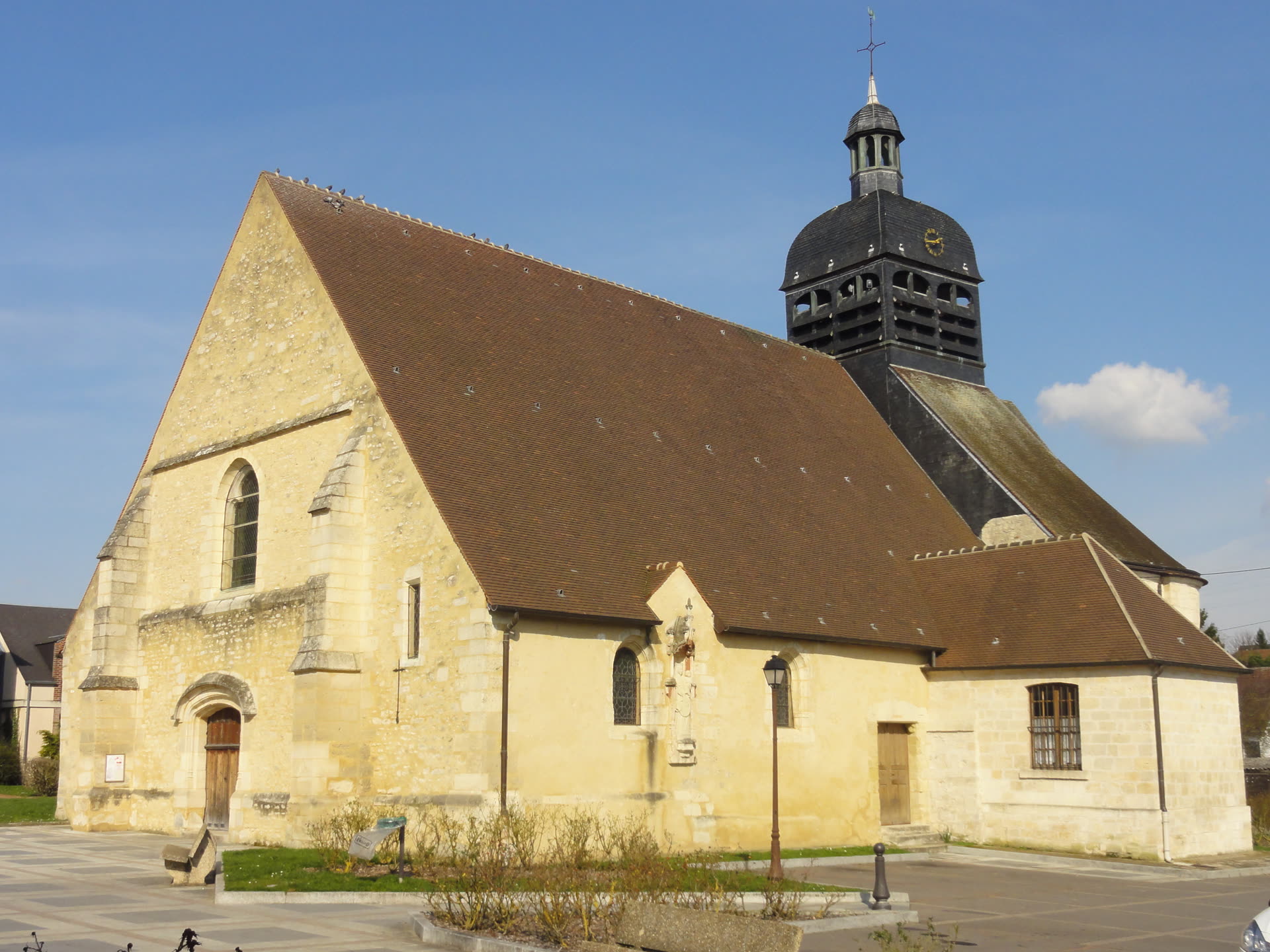
Pictured: the Église Saint-Denis, the parish church of Bornel, Oise — the commune where the sighting occurred, not the disputed photographed object itself. The witnesses' own inconclusive cellphone photograph remains held within GEIPAN's archival case file rather than freely licensed for reproduction here. This image is included only to ground the case's real, verifiable location. Photo by Wikimedia contributor P.poschadel, taken February 26, 2016, released under CC BY-SA 4.0 via Wikimedia Commons.
Theoretical Alignment
This case aligns most strongly with the Extraterrestrial Hypothesis on the strength of a real structural-craft detail — the grey triangular structure the primary witness says he saw during a ten-second hover — layered atop an otherwise simple luminous-sphere sighting, a combination GEIPAN's own investigators found difficult to map cleanly onto any known aircraft, balloon, or drone silhouette. Interdimensional alignment is low; nothing in the account involves the kind of morphological transformation, missing time, or boundary imagery IDH proponents typically point to, beyond the same triangular-structure detail already counted toward ETH. Psycho-Social alignment carries modest weight mainly because of the account's genre-typical character — a glowing orange orb witnessed through a domestic window at night is among the single most common UAP report patterns worldwide, and GEIPAN's own file explicitly notes the triangular-structure detail "recalls other similar testimonies," and that a "stereotype" exists that can influence testimony.
Background
Understanding this case means understanding both the small Oise commune where it occurred and the specific circumstances — a couple settled in for an ordinary evening of television — that put two witnesses, rather than the more typical single observer, in a position to see it.
Bornel: A Rural Commune Transformed by the Railway
Bornel is a commune of roughly 4,800 residents in the Oise department, in the Hauts-de-France region (historically Picardy), about 18 kilometers north-northeast of Pontoise and within the broader commuting orbit of the northern Paris region. The name is usually derived from borda, a plank hut, and the earliest documented reference to the settlement dates to the year 751, when Pépin, Mayor of the Palace and father of Charlemagne, confirmed the Abbey of Saint-Denis's possession of the fief "in pago cambiencence loco qui diciter Bornello" — "in the pays of Chambly, a place called Bornel" (Geneawiki, drawing on local history). The area had earlier hosted the Celtic Bellovaci tribe and Roman settlement, Work on the A16 motorway uncovered prehistoric settlement traces and flint workshops, and on March 16, 1962 an excavator unearthed two sarcophagi, dated to the Merovingian period by a ritual vase, which are now displayed inside the parish church.
From 1331 through 1791, Bornel's population held essentially steady at around 500 people across roughly 147 households, remaining a modest agricultural community built on grain, vines, and livestock, with as many as six working water mills at various points in its history. The Industrial Revolution changed that trajectory decisively: the Persan-Méru railway line reached the commune in 1875, and factories followed, including the Louyot works in 1888 and the Vermand works in 1894, driving the population from 582 in 1831 to 1,662 by 1935 (Geneawiki). On January 1, 2016 — not quite two years after this sighting — the neighboring communes of Anserville and Fosseuse were formally merged into Bornel, expanding it to its present form. The commune's other notable claim to fame is considerably lighter: tennis champion Amélie Mauresmo joined Bornel's tennis club at the age of six, before going on to win Grand Slam singles titles and reach the world No. 1 ranking.
An Ordinary Evening, Interrupted
What makes this case structurally different from the majority of GEIPAN's single-witness files is simply the mundane domestic setting in which it occurred: not a lone observer outdoors at night, but a married couple sitting together watching television in their own conservatory, an enclosed glass-roofed room specifically built to let in a view of the sky. That ordinary circumstance is precisely what put two people, rather than one, in a position to potentially observe the same event — even though, as GEIPAN's investigation established, only the husband initially noticed the light through the skylight, with his wife's attention drawn to it only once he called it to her attention and asked her to photograph it.
The commune's own most visible piece of built heritage, the Château du Ménillet, sits at a comfortable remove from the residential area where the sighting occurred, but is worth noting for the layered history it represents: a mid-19th-century construction built on the Ménillet domain, where an older seigneurial house is thought to have stood, itself said to have been built on the foundations of a Roman villa. That kind of continuous, centuries-deep occupation of the same patch of ground is typical of the Oise more broadly, a department whose deceptively quiet, rural-suburban present sits atop a much longer and more eventful past — the same tension between an ordinary present-day setting and a genuinely deep local history that runs through this case's own circumstances: two retirees relaxing in a glass conservatory built for exactly this kind of domestic comfort, briefly interrupted by something neither of them could readily explain.
GEIPAN's own figures help calibrate how unusual a D classification is: only a few percent of the cases it has published remain unexplained (class D), and most are resolved as misidentifications or left at "insufficient information." What sets this file apart is the depth of the investigation rather than the evidence itself: two witnesses interviewed separately, a filmed reconstruction, a second site visit, a radar search and a forty-page report, all for an observation that lasted about a minute.
Complete Timeline
| Date | Event |
|---|---|
| 751 CE | Pépin, Mayor of the Palace, confirms the Abbey of Saint-Denis's possession of "Bornello" — the earliest documented reference to Bornel. |
| 1875 | The Persan-Méru railway reaches Bornel, triggering the industrialization that transforms the commune's population and economy. |
| April 24, 2014, ~22:25–22:27 | Sighting begins. T1, watching television in the conservatory, sees an orange light through the farthest skylight, coming from the east (azimuth 84–90°, elevation about 30°). The first photograph is time-stamped 22:26:17 by the phone; the phone was later found to be 25 seconds slow. |
| April 24, 2014 (first ~35 s) | T1 describes an incandescent orange ball with a ring of flickering flame-like edges and no trail, moving slowly and silently to the south. He thinks it is an aircraft on fire and asks T2 to photograph it; she takes photo 1 through the glass door with the flash firing. |
| April 24, 2014 (~35–50 s) | According to T1, the light stops abruptly, descends vertically and rotates, and he sees that it is carried on the right leading edge of a light slate-grey triangle about 4 m across, which hovers for about ten seconds with its point toward him, then rises, turns and resumes its course. T2 misses this phase; her next photograph, ten seconds after the first, shows the family dog. |
| April 24, 2014 (~1 minute) | The light leaves to the south-west (azimuth 222–224°, elevation 7–8°). T1 sees it disappear behind trees; T2 says it seemed to melt into the clouds. Photos 2 and 3 (22:26:40 and 22:27:03) show only motion blur and a streetlight. |
| April 28–29, 2014 | The couple e-mail GEIPAN on April 28; T1's questionnaire arrives on April 29. They do not go to the Gendarmerie. T2 has posted the photos on Facebook and searched for incidents at nearby airfields, which is how she found GEIPAN. |
| May 17, 2014 | Field investigation. A GEIPAN investigator conducts separate cognitive interviews with T1 and T2 at their home, followed by a filmed reconstruction. Further questions follow by phone on May 20. |
| June 14, 2014 | Second visit. The investigator checks that the glow in photo 1 is not a reflection or any indoor or outdoor light source, and calibrates the phone's camera to place the glow at azimuth ~203° and elevation above 23.7°. |
| 2014 | Radar search. Secondary radar shows Air France AFR1063 about 5 km to the south at 22:20–22:21 and Ryanair RYR89EE about 6 km to the south at 22:25–22:26; the air force's CNOA finds one primary track within 30 km, probably a light aircraft, offset by several kilometres and more than five minutes. The investigator rates four hypotheses: drone 30%, sky lantern 25%, aircraft 25%, ball lightning 20%. |
| Sep 19 – Oct 18, 2019 | Final classification. GEIPAN's investigation report is dated September 19, 2019, and the case page (2014-04-50829) is updated on October 18, 2019: class D1, "phénomène inexpliqué d'étrangeté moyenne," strangeness 0.70, consistency 0.76. |
| January 1, 2016 | The neighboring communes of Anserville and Fosseuse merge into Bornel, expanding the commune to its present territory — a purely administrative change unrelated to the sighting, noted here only as a chronological landmark. |
Detailed Narrative
A Burning Aircraft, or Something Else
T1's very first working hypothesis, formed in the moment, was among the most mundane and urgent possible: he thought he might be watching a stricken aircraft, on fire and descending toward a crash, and his first instinct — asking his wife to photograph it — was explicitly driven by the thought that documentation might later matter to a civil aviation accident inquiry. This detail matters for reading the rest of the case correctly, because it establishes that T1's baseline assumption leaned toward the most conventional explanation available to him, not toward an anomalous interpretation; whatever the object actually was, the witness did not arrive at the sighting already primed to see something extraordinary. What changed his assessment, by his own account, was not a single dramatic detail but an accumulating set of small inconsistencies with the burning-aircraft hypothesis: no engine noise of any kind reached the conservatory despite the object's apparent proximity and the room's large glass skylights, and, in his questionnaire, "l'étrangeté du vol : horizontal avec passages en vertical" (the strangeness of the flight: horizontal with vertical passages). He also wondered at the time whether it might be a Chinese lantern or a drone.
The Object Itself: An Incandescent, Flame-Fringed Sphere
T1's description of the object's appearance was specific and consistent across his initial report and the later field interview: a ball of incandescent orange color, bordered by a fringe of orange flame-like flickers, moving through the overcast sky with no visible trail or exhaust of any kind. The "flame-fringed" detail is worth pausing on, because it is more specific than a simple uniform glowing sphere — it implies an irregular, flickering, fire-like edge around a more solidly orange-colored core, a visual profile that does not straightforwardly match either a simple point-source light (a drone's LED array, for instance) or a classic uniform sky lantern or balloon silhouette. T1 estimated its angular size at 1.5° when it first appeared, and T2 at 2°; he compared its colour to Pantone 165 and said it was more orange than the nearby streetlight. He judged it to be within 100 m at first, "and surely much less." In the reconstruction, the investigator placed it most probably about 120 m away during the hover, near houses on a neighbouring street lit by streetlights.
A silent, flame-coloured ball of light with no trail is the classic description of a sky lantern, and the investigator said so: the first phase of the sighting "evokes those well-known objects," the light came from the east on a north-east wind, and it moved at about the speed of that wind. What sets this account apart is the second phase, which only T1 saw.
The Triangular Detail
The most significant detail in T1's account is the triangle. In his questionnaire he wrote that after about 400 metres the object hovered, rotated three-quarters of a turn to its right, and that he then saw it was triangular, 3 to 4 metres on a side, "and seemed to be made of several superimposed elements." In the cognitive interview he described a light slate-grey triangle, lit from below by the streetlights, about 4 m across the base and 50 cm thick, its surface made of a dozen or more rounded, "tubular" elements on each side, like spaceship surfaces in Star Wars or Stargate films, with no navigation lights. GEIPAN treats the detail with caution: the triangle "recalls other testimonies, even if these remain controversial and a 'stereotype' exists at this level, which can potentially influence testimonies." The investigator also noted that T1 never mentioned the branches of a cherry tree in his line of sight, which should have partly blocked his view during the descent and climb; T1 said the leaves were small at that date and he was looking beyond the tree.
The Photographs: Genuine, Difficult, and Ultimately Inconclusive
T2 took four photographs with a Nokia Lumia 920, all with the flash firing. Photo 1 (22:26:17), taken through the glass door, was first thought to have failed but turned out to be the most useful: using the reflection of the flash in the glass and a calibration of the phone, the investigator placed a small glow at azimuth about 203° and elevation above 23.7°, measuring 0.16° by 0.39°. A second visit on June 14 confirmed that the glow was not a reflection and "not one of the sources of light of the normal environment, whether indoor or outdoor." Its pinkish-violet tint differs from the streetlight's, which the investigator noted could indicate an intense near-infrared source, though the bluish flash reflection alone could also explain it. Photo 1.5, ten seconds later, shows the family dog on the floor; T2 has no memory of taking it. Photo 2 (22:26:40) is badly motion-blurred, and photo 3 (22:27:03) shows only the streetlight. GEIPAN's summary: the only usable image "does not really confirm the presence of the PAN, even though the glow finds no explanation from the ambient elements."
The Field Investigation and Cognitive Interview
GEIPAN appointed an investigator in May 2014, and the cognitive interviews took place at the witnesses' home on May 17, three weeks after the sighting, first with T1 and then with T2, followed by a filmed reconstruction of their movements. The interviews revealed inconsistencies in the order of events, which the investigator resolved partly from the photo time stamps: photo 1 was taken earlier than T2 remembered, before the complex manoeuvres T1 described. Neither witness had a continuous view, because to reach the glass door each had to walk around a post. The investigator recorded that T1 had spent his career on investigations that required memorising as many details of a scene as possible, that his visual acuity is estimated at 12/10 (16/10 when young) and that he practises archery; neither witness was on medication or had been drinking. T2 said she trusted her husband's memory more than her own observation. The interviews "revealed no element against the reliability of the testimonies."
Weighing the Drone Hypothesis Against 2014-Era Reality
The investigator rated four hypotheses. A drone, which T1 himself suggested, scored highest at 30%: drones vary widely in shape, their lighting is not standardised and their speed and changes of height fit the account, but a triangular shape was "rather rare (in 2014)," there were no other lights, a drone would be unstable tilted forward as described, and it would be hard to make out surface details at about 120 m. GEIPAN's conclusion says the drone hypothesis "remains the least bad, but rests largely on the fact that in this area the field of the possible is broader than the field of the truly known. If all shapes and lighting are possible, one does not for all that meet them in reality, especially in 2014. It is moreover unrealistic and dangerous to fly at night in an urban area (beyond the simple fact that it is prohibited)." The other hypotheses, it said, are "even more fragile."
Two Versions of the First Account
T1's written questionnaire, completed five days after the sighting, tells the story a little differently from his later interview. In writing, he says his eye was caught by "an elongated object whose front right part emitted an orange light," which he took for an aircraft with an engine on fire; that its flight was "horizontal with vertical passages"; that "after 400 metres of flight" it hovered and made "a rotation of 3/4 of a turn to its right," at which point he saw it was "triangular, 3 to 4 metres on a side (apex toward me)" and "seemed to be composed of several superimposed elements"; and that it then left toward the Bornel wood, its orange light remaining constant. In the cognitive interview he described first seeing only a ball of fire and realising only during the hover that the light was carried by a triangle, which had by then turned three-eighths of a turn. The investigator noted such differences openly: the elements collected on site "were sometimes more precise and sometimes different from those from the questionnaire." Several days after the interview, once both had noticed that photo 1 showed something, T1 added that as the light moved away it had taken on a vertically elongated look, which matches the shape of the glow in the photograph.
What T2 Saw
T2 was lying on the sofa when her husband said, "Look, there's a plane going over with an engine on fire," or, in another version, "a plane with an orange ball." Through the skylights she saw the fireball: not flames trailing behind it, as she would have expected from a burning engine, but small flickers all around it. Told to fetch her camera, she took her mobile phone because it was easier to reach than her reflex camera, and while she was busy with it she heard her husband describing strange movements. In every phase in which she looked at it, the object was moving in a straight horizontal line, away from them. "It was going away, then it was as if it melted into the clouds," she said; she described a progressive, fairly rapid fading rather than a sudden disappearance behind trees. The next day she searched online for incidents at nearby air bases and airports (Roissy, Bernes, Taverny, Creil), which is how she found GEIPAN. She had already posted the photographs on Facebook to tell friends about the evening. Asked about the wind, she said from local experience that it must have come from where the object came from, which Météo-France data confirmed.
Reconstructing the Minute
Much of the investigation went into timing. The phone's clock stamped photo 1 at 22:26:17; on May 17 the same phone was 25 seconds slow, and allowing for clock drift the investigator put photo 1 somewhere between 22:25:40 and 22:27:44. The reconstruction gave a total duration of about a minute, with photo 1 about 40 seconds after the start. Photo 1.5 followed ten seconds later and photo 2 thirteen seconds after that, which shows that T2 stepped back about 2.5 m from the window, out of view of the sky, during the period when her husband was describing the hover; she has no memory of doing so. Photo 3 came 23 seconds after photo 2 and was aimed at the streetlight, below the treetops, at a moment when the object had probably already gone. During the reconstruction, at 18:06, an airliner passed along a path similar to the object's, according to the witnesses; it was TAP Air Portugal flight TAP793, followed two minutes later by Transavia TRA79N.
The investigator also estimated the object's size from T1's angular estimate of 2° for the triangle's base. At the maximum plausible distance of 270 m (the tree line), the base would be about 9.4 m wide; at 200 m, about 7 m; at the 123 m distance of the streetlight, about 4.3 m, matching T1's own estimate of 4 m. Those figures depend entirely on T1's angular estimate and on the assumed distance, and the investigator stressed that no single trajectory fitted all of the witnesses' angles and timings.
The Verdict: Classification D1
Having found no hypothesis that fitted the whole account, and having rated the testimony consistency at 0.76, GEIPAN classified the Bornel sighting D1: "phénomène inexpliqué d'étrangeté moyenne" (an unexplained phenomenon of medium strangeness), with a strangeness rating of 0.70. In GEIPAN's scheme the D1/D2 split concerns strangeness: D1 cases are unexplained and moderately strange, D2 cases unexplained and highly strange. GEIPAN noted that "the level of consistency makes it possible to validate an unexplained character at this stage to this observation."
Key Witnesses
T1 — The Primary Witness (identity withheld per GEIPAN's standard anonymization practice)
A retired resident of Bornel who first noticed the orange glow through his conservatory skylight while watching television with his wife. His initial working hypothesis was a burning aircraft. He alone reports the abrupt stop, descent, hover and the grey triangle. GEIPAN credits him with having had "a substantial time to observe" and with "excellent visual acuity and his specific professional practice," which the investigator describes as a career of investigations requiring him to memorise details of action scenes. His view was not continuous: he had to walk around a post to reach the glass door.
T2 — The Second Witness and Photographer (identity withheld)
T1's wife, who was alerted by her husband and took four phone photographs. By her own account she missed the strange part of the sighting and saw only the fireball moving in a straight line before it seemed to fade into the clouds; she did not see the triangle. Her account of the fireball's appearance (no trail, a ring of small flame-like flickers, silence) matches her husband's. GEIPAN says her testimony is "unfortunately less rich" because she was occupied with the photographs, but that it "reinforces" his.
The Five Observables Assessment
The Five Observables framework, developed by the Pentagon's Advanced Aerospace Threat Identification Program to describe performance characteristics beyond known conventional technology, is applied here for comparative consistency across the site's case files. This is a slower-moving, less kinematically extreme case than several comparable GEIPAN files on this site, and its observable profile reflects that.
Assessment: The object's speed was low throughout, so Hypersonic Velocity is absent. T1, but not T2, describes an abrupt stop without apparent deceleration, a vertical descent, a silent hover of about ten seconds, a rotation and a climb; these are counted only as speculative for Instant Acceleration and Anti-Gravity Lift because they rest on one witness, seen partly through a cherry tree, at an estimated 120 m, and are well within what a drone or helicopter can do. The case's main anomalies are qualitative: a flame-like light that stayed visible from every angle, and the grey triangle T1 says carried it. Low Observability is speculative: a radar search found no matching track, but the object was low and small.
Evidence Assessment
Supporting an Anomalous Origin
- Two witnesses, interviewed separately three weeks later; GEIPAN rated the consistency 0.76 and found "no element against the reliability of the testimonies"
- Photo 1 shows a small glow at the right time and place which, after a calibrated analysis and a second site visit, matches no indoor or outdoor light source
- The primary witness's own starting hypothesis (a burning aircraft) was conventional, and he himself suggested a lantern or a drone
- GEIPAN's leading candidate (a drone, 30%) is described in its file as "the least bad" hypothesis, and no candidate scored above 30%
- GEIPAN notes that a night drone flight over a built-up area would have been prohibited and dangerous, and that a triangular drone was rare in 2014
- The witness with the more detailed account is credited by GEIPAN with excellent visual acuity and professional training in observation
Supporting a Conventional/Mundane or Inconclusive Origin
- No photograph shows the triangle; photo 1 shows only a small glow 0.16° by 0.39°, which may be smeared by motion blur
- The triangle, the hover and the manoeuvres were seen by T1 alone; T2 saw only a fireball moving in a straight line, and GEIPAN notes that a triangle "stereotype" can influence testimony
- The radar search found no track matching the object; the investigator could not fit the witnesses' angles and timings to any simple trajectory
- The first phase fits a sky lantern well (silent, flame-coloured, no trail, moving with the north-east wind at about wind speed), which the investigator rated at 25%
Why "Open"
This case is stamped Open because it splits into two parts that point in different directions. The first part, seen by both witnesses — a silent, flame-coloured ball moving with the wind — looks like a sky lantern. The second, seen only by T1 — an abrupt stop, a hover and a grey triangle about four metres across — fits no known object, and GEIPAN's investigator could not make the witnesses' angles and timings fit a single trajectory. GEIPAN left it unexplained, with a drone as the "least bad" of four weak hypotheses.
Set against that, "Credible" would overstate the case: the photograph shows only a small glow, the structural detail rests on one witness, and GEIPAN itself flags the triangle as a familiar report pattern. It is a well-investigated, unexplained two-witness sighting whose most striking element is single-witness.
Sensor & Instrumentation Detection Profile
The only instrumented data are radar searches made by the investigator and T2's phone photographs. Secondary radar (transponder replies) showed two airliners nearby in the right window: Air France AFR1063, about 5 km to the south at 22:20–22:21 heading west then south-west, and Ryanair RYR89EE, about 6 km to the south at 22:25–22:26 heading east-south-east. The air force's CNOA searched primary radar within 30 km between 20:10 and 20:30 UT and found a single track, flying too low for its altitude to be determined, with no IFF, which it judged to be an aircraft, possibly a local plane from Pontoise; the investigator noted it was several kilometres off and more than five minutes out of step with the sighting. Photo 1 gives a calibrated azimuth and elevation for the glow. No audio or video exists.
The investigator also tried to reconstruct the trajectory from three passage points (appearance at azimuth 84–90° and 30° elevation; photo 1 at about 203° and 24°; disappearance at about 222° and 8.5°) and could not find a simple path that fitted: between the second and third points the object would have had to travel in 15 seconds as far as it had in the first 35, and on the computed heading the light should have been hidden by the triangle's leading edge well before photo 1. If the object moved at the wind speed (about 15 km/h), it would have covered about 146 m in 35 seconds, close to the distance implied for the first leg.
Environmental & Geospatial Context
The sighting occurred at night under a low cloud base. The nearest hourly weather record, at Pontoise-Cormeilles, gives a north-east wind averaging 15 km/h, 14.4°C, 77% humidity, cloud cover of 7 oktas, visibility 4.6 km and falling, mist arriving around 23:00, and no rain. JPL Horizons shows Mars about 31° up in the south-east and Jupiter about 39° up in the west at 20:26 UT, with the Moon (23% lit) below the horizon; GEIPAN found no visible ISS pass. The witnesses live in a hamlet of about 130 houses surrounded by fields and woods, at about 89 m altitude, with a tree line 200–330 m away on a small rise. The Persan-Beaumont airfield is about 8 km away, and Roissy-Charles de Gaulle and Pontoise airports are within 40 km. The couple's own neighbourhood enquiry found no one else who had seen anything that night.
The broader Oise department, historically part of Picardy and now in the Hauts-de-France region, mixes small industrial towns along 19th-century rail lines with open farmland. A north-east wind matters here: it would carry a lantern released to the east of the witnesses toward the south-west, the direction in which the light left, and T2 independently said the wind came from where the object came from.
Observer Credibility & Occupational Profile
Neither witness's occupation is named, but the investigation report describes T1 as a man whose work involved many investigations and objective analyses, and memorising "the maximum of details" of action scenes; his visual acuity is estimated at 12/10. Both are retirees, cooperated fully, and were described as measured in their reactions. T1's first instinct was a conventional one (a burning aircraft), and he himself suggested a lantern or a drone.
The case's corroboration is narrower than "two witnesses" suggests. T2 confirms the first phase — the fireball, its flickering edge, the silence — but by her own account missed the stop, the hover and the triangle, and one of her photographs, taken ten seconds after the first, shows her pointing the phone at the floor with no memory of doing so. The triangle is therefore a single-witness observation.
It is worth being precise about what kind of corroboration the case offers. T2 had her own direct view of the fireball and was interviewed separately, and the investigator found her account independent rather than an echo of her husband's. But she also said, "I have more confidence in what my husband could have told me than in what I could have seen," and after the event she felt uneasy, as if the object had been watching them, an impression based on his account rather than her own view. The investigator also recorded that the couple's dog stopped eating for three days afterwards and developed a patch of hair loss with eczema that lasted about eight days; nothing links that to the sighting.
Historical Precedents & Archive Matches
Comparing this case against the other GEPAN/GEIPAN-investigated French sightings already published on this site highlights both its distinctive strengths and where its evidentiary profile sits relative to comparable files.
Sainte-Foy-de-Peyrolières (2018) — Two Witnesses and a Photograph, Versus One Witness and Richer Detail
The Sainte-Foy-de-Peyrolières five-phase sighting (Open), published alongside this case, makes an instructive direct comparison: a single witness there produced an unusually dense, five-phase account rated 0.72 consistency, but with no second witness and no photograph of any kind. This Bornel case inverts that trade-off — a real second witness and a genuine, if inconclusive, photograph, rated a slightly higher 0.76 consistency, though the most complex part of the Bornel account, the hover and triangle, also rests on one witness. Neither evidentiary profile is straightforwardly stronger than the other; they represent two different, genuinely complementary categories of single-file corroboration GEIPAN's caseload produces.
Montluel (2022) and Montayral (2015) — The Single-Witness Baseline This Case Exceeds
Both the Montluel cloud-distorting object (Open, 46/100) and the Montayral aerodrome object (Open, 28/100) are single-witness, no-photograph cases — the baseline evidentiary profile the large majority of GEIPAN's D-tier files share. This Bornel case's second witness and its photograph place it above that baseline in documentation, though GEIPAN's D1 label itself refers to medium strangeness, not to the number of witnesses.
Fauville-Évreux (1978) — Positive Radar Contact, Versus a Negative Search Here
The Fauville-Évreux radar sighting (Open, 48/100) carries a weak but genuine positive radar contact. At Bornel a radar search was made but found no matching track.
A Broader Pattern Across This Site's GEIPAN D1/D2-Family Cases
Taken together, the GEIPAN files this site has now published trace out a fairly clear evidentiary spectrum, useful for placing this specific Bornel case in context rather than reading it in isolation. At one end sit the pure single-witness, no-documentation D cases (Montluel, Montayral), whose entire evidentiary weight rests on one account's internal consistency and the thoroughness of GEIPAN's own hypothesis testing. This Bornel case and the Sainte-Foy-de-Peyrolières file published alongside it occupy a middle tier, each adding exactly one additional evidentiary dimension beyond the single-witness baseline — a second witness and a calibrated photograph here; an unusually dense, multi-phase single account there — without either reaching the higher tier occupied by cases with laboratory-tested physical trace evidence (the Trans-en-Provence sighting) or a full multi-person aircrew account paired with a positive military radar track (the Air France Flight 3532 / Capt. Duboc sighting). GEIPAN's D1/D2 labels grade strangeness rather than evidence, so the spectrum above is this site's comparison, not GEIPAN's.
Material Analysis
This case involves no physical or trace evidence beyond the witnesses' testimony and T2's photographs. No landing marks, recovered material, or environmental trace of any kind was reported or investigated, and nothing in the account places the object anywhere near ground level or within physical reach at any point — it remained airborne throughout, at a distance and altitude that placed it well beyond any possibility of physical investigation. The single item of physical documentation, T2's usable photograph, is itself digital and non-physical in the sense relevant to material analysis; there is no film negative, print, or other tangible artifact beyond the digital image file GEIPAN's investigators examined.
Supporting Non-Terrestrial Origin
- The glow in photo 1 does not correspond to any identifiable ambient light source, and its tint differs from the nearby streetlight's
- T1's description of a structured grey triangle carrying the light does not match a lantern, ball lightning, or the aircraft found on radar
Supporting Terrestrial Origin
- The complete absence of any physical trace or ground-level evidence is consistent with a purely distant aerial phenomenon that never approached closely enough to leave one
- No mechanical or electromagnetic effect was reported; the dog's later skin problem is recorded but not linked to the sighting
The Conventional Explanation Candidate: A Drone, and the Weaker Alternatives
GEIPAN's investigator rated four conventional hypotheses: a drone (30%), a sky lantern (25%), an aircraft (25%) and ball lightning (20%). None scored above "low" on GEIPAN's own scale. The drone was the "least bad" because it could, in principle, account for both phases of the sighting; the others each fit only the first phase.
The Drone Problem
The drone hypothesis was T1's own suggestion. In its favour, drone shapes vary widely, their lighting is not standardised, and the speed, changes of height and silence fit. Against it: a triangular shape was "rather rare (in 2014)"; there were no other lights and no blinking; a drone "can hardly remain stable in a forward-tilted position," as T1 described; it is hard to see surface details at about 120 m; and, as GEIPAN put it, flying at night over a built-up area is "unrealistic and dangerous (beyond the simple fact that it is prohibited)." France's drone rules of the time (the arrêtés of April 11, 2012) governed such flights.
The Sky Lantern and Ball Lightning
A sky lantern fits the first phase well, and the investigator said so: the flame colour, the silence, the lack of a trail, the start and end azimuths and elevations, and the direction and speed of travel all match a lantern carried on the north-east wind. A private party could explain a release on a Thursday night. Against it, the grey triangle, the stop, the descent and hover, and the size during the second phase are "in total contradiction" with a lantern. Ball lightning, rated at 20%, can be flame-like, silent and move horizontally, but there was no stormy weather and it cannot explain a grey structured object either.
How the Hypotheses Were Scored
GEIPAN's investigator scored each hypothesis item by item, from −1 (incompatible) to +1 (fully compatible), before giving an overall probability. For the sky lantern, the start and end azimuths and elevations each scored +1.00 as compatible with the prevailing wind, as did the silence; the speed scored +0.20, compatible except for the stationary phase; the date scored −0.30, since a Thursday is not a usual night for lantern releases, though a private birthday party could explain one; the shape and apparent size each scored −0.50 because of the structured second phase; and the trajectory −0.30. Ball lightning scored +1 on trajectory, azimuth, elevation, speed and duration but −0.50 to −0.70 on shape, colour and size of the grey structure, and −0.60 for the absence of any suitable weather. The aircraft scored well on azimuth, elevation and duration but −0.50 to −0.70 on shape, lights, the hover and the radar timing. The drone scored +1.00 on elevation changes, speed and battery endurance, +0.80 on silence and +0.70 on trajectory (allowing for instability when tilted), 0 on shape and lighting, and −0.50 on context, because night flight over houses was "unrealistic and dangerous" as well as prohibited. The resulting probabilities, between 20% and 30% for every hypothesis, all fall in what GEIPAN's scale calls "low."
The Aircraft and the Radar
An aircraft, rated at 25%, fits the overall straight path, and radar shows two airliners passing 5–6 km to the south in the right minutes and one low primary track within 30 km. But no navigation lights were seen, no engine was heard (even after the witnesses went out onto the terrace), the hover and rotation would require a helicopter, and the one plausible radar track was several kilometres off and more than five minutes out of step.
The underlying difficulty is that the two phases favour different explanations. Taken alone, the part seen by both witnesses is a good match for a lantern. The part seen only by T1 is not a good match for anything. If T1's description of the hover and the triangle is accurate, a drone carrying an unusual light is the least strained conventional reading; if his perception of a small, distant light was mistaken during those seconds, a lantern explains everything else.
Civilian Drone
Inconclusive (Least-Bad Candidate)GEIPAN's leading candidate (30%), the only one able to account for both phases, but a triangular, flame-lit drone flying illegally at night over houses in 2014 would be very unusual.
Sky Lantern
InconclusiveRated 25%; fits the first phase (colour, silence, no trail, direction and speed with the wind) but is "in total contradiction" with the hover and the grey triangle T1 reports.
Aircraft
ImplausibleRated 25%; no lights or engine noise, a hover only a helicopter could perform, and the one candidate radar track was kilometres away and minutes out of step.
Ball Lightning
ImplausibleRated 20%; can look flame-like and travel horizontally, but there was no stormy weather and it cannot account for a grey structured object.
Related Cases
Confirmed Documents & Official Records
GEIPAN's case page (offline in October 2026; archived copies read): summary, D1 classification, strangeness 0.70, consistency 0.76, and links to the 40-page investigation report (dated September 19, 2019), T1's questionnaire and the photographs.
GEIPAN's published definitions of its classes. Class D covers phenomena that remain unexplained after investigation; within it, D1 denotes medium strangeness and D2 high strangeness.
The 2012 French regulation on the use of airspace by unmanned aircraft, in force at the time of this sighting (repealed from January 1, 2016). GEIPAN's conclusion notes that a night drone flight over a built-up area would have been prohibited.
Further Reading — Recommended Literature
The Nature of Ball Lightning
A scientific survey of incandescent, self-luminous atmospheric spheres directly relevant to weighing this case's central visual detail — an orange, flame-fringed ball of light — against the closest known natural electrical phenomenon, even though GEIPAN's own file does not identify ball lightning as a tested hypothesis for this specific case.
Ball Lightning: A Popular Guide to a Longstanding Mystery in Atmospheric Electricity
A more recent, accessible survey of luminous atmospheric sphere phenomena, useful comparative background for readers weighing how this case's incandescent, flame-fringed object does or does not resemble established (if still poorly understood) natural electrical phenomena.
Predator: The Secret Origins of the Drone Revolution
A history of drone technology's development, useful context for understanding just how limited civilian and hobbyist drone capability actually was in April 2014, the same year this sighting occurred, and why GEIPAN's own investigators found no drone matching the object's described appearance.
Why People Believe Weird Things: Pseudoscience, Superstition, and Other Confusions of Our Time
A skeptical framework directly relevant to GEIPAN's own candid observation that this case's triangular-structure detail could reflect a recurring UAP reporting pattern rather than a confirmed independent observation — useful for weighing that possibility fairly against the case's genuine corroborating strengths.
How UFOs Conquered the World: The History of a Modern Myth
Clarke's history of recurring UFO reporting patterns and cultural stereotypes provides exactly the kind of background needed to weigh GEIPAN's own honest caveat about this case's triangular-structure detail without dismissing the sighting's genuine two-witness corroboration.
DISCLOSURE: Some links above are affiliate links. If you purchase through them, OverClassified receives a small commission at no additional cost to you. This helps support independent research.
Essential Viewing
Sources
- GEIPAN (CNES), "BORNEL (60) 24.04.2014", Case 2014-04-50829 — official case summary
- GEIPAN (CNES), official case archive & public portal — geipan.fr
- GEIPAN (CNES), Glossaire du GEIPAN — official classification definitions, including D1/D2 distinction
- GEIPAN (CNES), "Missions, méthodes et résultats" — field investigation and cognitive-interview methodology
- République Française / Légifrance, Arrêté du 11 avril 2012 relatif à l'utilisation de l'espace aérien par les aéronefs qui circulent sans personne à bord — official 2012 French civil drone regulation, in force at the time of this sighting
- Ministère de la Transition Écologique, "Exploitation de drones en catégorie ouverte" — current French drone regulation, night-flight and urban-airspace restrictions (general regulatory principle context)
- Mairie de Bornel, "Histoires" — commune founding, medieval history, Château du Ménillet
- INSEE, "Dossier complet — Commune de Bornel (60088)" — official population and demographic statistics
- Wikipedia (English), "Bornel" — commune geography, 2016 merger with Anserville and Fosseuse
- Wikipédia (français), "Église Saint-Denis de Bornel" — parish church history, Romanesque origins
- This site, case-files/sainte-foy-de-peyrolieres-five-phase-sighting.html — comparative single-witness GEIPAN case published alongside this one
- This site, case-files/montluel-cloud-distorting-object.html — comparative single-witness GEIPAN case with a clean negative radar check
- This site, case-files/montayral-aerodrome-object.html — comparative single-witness GEIPAN D-family case
- This site, case-files/fauville-evreux-radar-sighting.html — comparative GEPAN/GEIPAN positive radar case
- Wikimedia Commons, File: Bornel (60), église Saint-Denis, vue depuis le sud-ouest 2.JPG, photo by P.poschadel (February 26, 2016), CC BY-SA 4.0 — licensing and attribution
- YouTube (France 3 Hauts-de-France), "OVNI en Picardie — Épisode 3 — Les agents du GEIPAN" — oEmbed-verified video, regional GEIPAN field-investigation coverage
- This site, key-figures.html, entry on Claude Poher — GEPAN founding and early institutional history
- This site, key-figures.html, entry on Jean-Jacques Velasco — SEPRA leadership and methodology evolution
- This site, locations/index.html, entry on Toulouse — CNES/GEPAN/SEPRA/GEIPAN institutional headquarters
- GEIPAN (CNES), "Compte rendu d'enquête, cas d'observation BORNEL (60) 24.04.2014," Toulouse, September 19, 2019 (40 pp.; read via the Internet Archive copy of cnes-geipan.fr, as the GEIPAN site was offline in October 2026). web.archive.org
- GEIPAN (CNES), case page "BORNEL (60) 24.04.2014," case 2014-04-50829, updated October 18, 2019 (Internet Archive copy, February 2026). web.archive.org
- GEIPAN (CNES), T1 questionnaire "Questionnaire terre-R," BORNEL (60) 24.04.2014 (Internet Archive copy).
- Geneawiki, "60 - Bornel (Commune déléguée)" — local history: 751 charter, 1962 sarcophagi, population, railway, factories, Château du Ménillet, Amélie Mauresmo. fr.geneawiki.com
- NASA/JPL Horizons System, observer ephemerides for 49.19°N, 2.18°E at 2014-04-24 20:26 UT (Sun, Moon, Mars, Jupiter). ssd.jpl.nasa.gov
Corrections (October 2026)
A reading of GEIPAN's full 40-page investigation report (September 2019) found that the earlier version of this page misdescribed the sighting and the investigation. It described a slow, level drift with no manoeuvres and a triangular outline glimpsed "just before" the object vanished; T1 in fact reported an abrupt stop, a vertical descent, a hover of about ten seconds and a rotation, during which he saw a grey triangle about 4 m across carrying the light, before it resumed its course. The page said T2 independently corroborated the triangle and the silence; she saw only the fireball and by her own account missed the strange phase. It said no radar check was made; GEIPAN searched secondary and primary radar and found two airliners 5–6 km away and one offset low track. It also said the D1 class reflected a second witness and a photograph, whereas D1 denotes medium strangeness.
Following this review, the rating was changed from Open 51 to Open 45 (October 27, 2026), because the higher rating had rested partly on claims corrected or removed above.
Other corrections: GEIPAN's investigator rated four hypotheses (drone 30%, sky lantern 25%, aircraft 25%, ball lightning 20%), and the sky lantern fits the first phase, including the north-east wind, rather than being "implausible"; T2 took four photographs, not "several" of which one was usable by chance; the sighting lasted about a minute; the interviews took place on May 17, 2014 with a second visit on June 14; the weather was overcast with no rain, not "light drizzle"; the Merovingian sarcophagi were found in 1962, not dated to "562 CE" during A16 construction; the Persan-Beaumont airfield is about 8 km away. Removed as unsupported: the 1102 Louis VI siege, the Montmorency and Malherbe ownership of the Ménillet domain, GEIPAN national statistics, the regulatory specifics attributed to the 2012 drone arrêté, and computed weather and lunar fields. The France 3 video does not cover this case.
See something inaccurate? Have additional information or sources?
Suggest an Edit →Last Updated: October 2026