
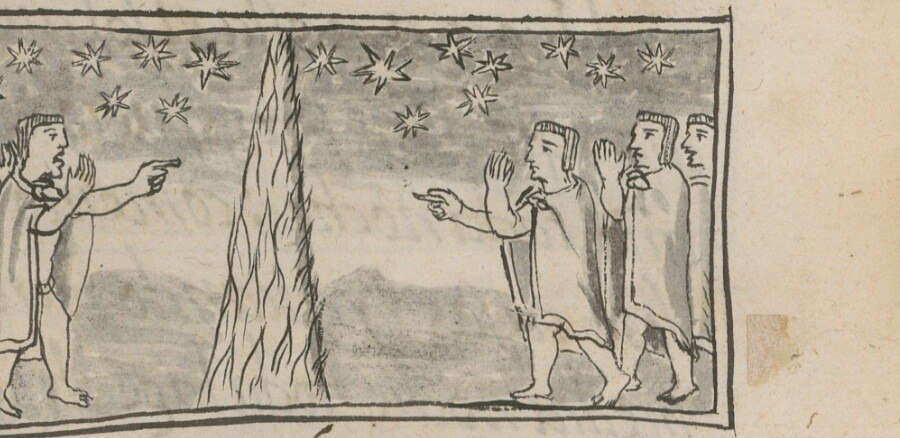
The Aztec "Eight Omens"
Book Twelve of the Florentine Codex — the great trilingual ethnographic encyclopedia compiled under Franciscan friar Bernardino de Sahagún with Nahua scribes, painters, and elder informants at the Colegio de Santa Cruz de Tlatelolco — opens its account of the fall of the Aztec empire with a list of eight portents said to have terrified Moctezuma II and the people of Tenochtitlan in the years before Hernán Cortés ever reached the Valley of Mexico. The first and most famous of the eight — a pyramidal flame of light that reportedly burned in the night sky, "wide at the base and narrow at the top," visible for nearly a year beginning roughly a decade before the Spaniards' 1519 arrival — is one of the most widely reproduced illustrations in the entire codex, and has been repeatedly picked up outside academic Mesoamericanist circles as a candidate pre-Columbian UFO sighting: it appears in Michel Bougard's 1977 ufological chronology La Chronique des OVNI and has circulated for decades afterward across "historical UFO sightings" and ancient-astronaut literature. This file takes that claim seriously enough to investigate it honestly, on both halves of the question this site always asks: is the primary account real, and does it actually describe something anomalous? The Florentine Codex itself is unquestionably real, a landmark of world documentary heritage. What it is not is a contemporaneous eyewitness record: its informants were interviewed roughly three and a half decades after the events they described, its finished trilingual text was not completed until the 1575–77 "clean copy" now held in Florence, and a substantial, credentialed body of Mesoamericanist scholarship — Felipe Fernández-Armesto, James Lockhart, Susan Gillespie, Camilla Townsend, and Matthew Restall among them — reads the Eight Omens not as real-time observation but as a post-conquest narrative convention, shaped in part by the Greco-Roman prodigy literature taught at Sahagún's own Franciscan school. This file lays out the omens themselves, the source's real strengths and real limits, the honest astronomical and volcanological candidates for what may lie behind the "fire in the sky," and exactly how and why this 500-year-old Nahua-Spanish text keeps surfacing in modern UFO research.
Theoretical Alignment
This file occupies unusual territory for this site's Ancient Records archive. Most entries here involve a genuinely solid, well-documented artifact or event onto which a much later, unsupported "impossible" or "non-human" reading has been grafted — a claim credentialed specialists in the relevant field can and do cleanly reject. The Eight Omens are different in kind: the primary source is completely real and enormously important to world history, but the underlying historical question — did anyone actually observe and report these things before 1519, or were they composed afterward to explain a catastrophe that had already happened — is a genuine, live, still-argued question among credentialed Mesoamericanist historians, closer in shape to the debate this site already covers at Cassius Dio's Omens before Pharsalus than to a straightforwardly debunked artifact claim. The weight of current published scholarship leans toward reading the omens as a retrospective narrative convention rather than real-time reportage, for reasons this file documents in detail below — but "leans toward" is not the same as "settled," and this file tries to represent both the genuine strength of that scholarly reading and the genuine, harder-to-dismiss possibility that a real astronomical or volcanic event sits somewhere underneath the finished, stylized text.
Sensor & Instrumentation Detection Profile
As with every entry in this site's Ancient Records series, there is no modern sensor record of the events Book 12 describes; the entire evidentiary record is textual, consisting of the Florentine Codex's own parallel Nahuatl and Spanish columns and their accompanying hand-painted illustrations, a smaller number of independent or partially independent colonial-era accounts, and the methods historians have since developed to evaluate 16th-century indigenous-language testimony as historical evidence. The relevant passage is Book 12, Chapter 1, titled in Sahagún's own Spanish gloss "de las señales y pronosticos que aparecieron antes que los españoles viniesen a esta tierra, ni tuviesen noticia della" ("of the signs and omens that appeared before the Spaniards came to this land, or had any notice of it"). The chapter is organized as a numbered sequence — "la segunda señal," "la tercera señal o pronostico," and so on — each omen given its own paragraph of Spanish narrative, a parallel Nahuatl paragraph, and, for most of the eight, a dedicated woodcut-style illustration painted directly into the manuscript by Sahagún's Nahua tlacuiloque (scribe-painters). This file's own direct reading of the codex's high-resolution digitized folios (via the Getty Research Institute's Digital Florentine Codex project) confirms the omens' content, order, and illustrations match the standard modern scholarly summary drawn from the Dibble & Anderson English translation.
The "instrumentation" available to modern researchers is comparative and philological rather than physical: cross-checking Sahagún's Nahuatl and Spanish columns against each other for divergence, cross-checking Book 12 against Diego Durán's independently compiled Historia de las Indias de Nueva España (which was not based on the same interviews and drew, by Durán's own account, partly on now-lost pre-conquest pictorial materials), and tracing the omens' underlying literary structure against known classical antecedents — the specific philological method Felipe Fernández-Armesto used in his 1992 Renaissance Studies study to identify close parallels between the Aztec omens and Greco-Roman prodigy catalogs in Plutarch, Josephus, and Lucan. No independent, non-Nahua astronomical record from anywhere else in the world corroborates a specific comet at the exact 1509 date the omens narrative implies; real, independently dated volcanic activity at nearby Popocatépetl in 1509 and again in 1519, documented through modern geological fieldwork, is addressed in full in this file's Conventional Explanation Candidates section below.
Environmental & Geospatial Context
Tenochtitlan, the Mexica (Aztec) capital where Book 12 places most of the omens, sat on an island in Lake Texcoco in the Valley of Mexico, at roughly 2,240 meters elevation, connected to the mainland by a network of causeways and canals. By the time Moctezuma II took the throne in 1502, it was almost certainly one of the largest cities on Earth, with a metropolitan population most commonly estimated between 200,000 and 300,000 across the wider lake-basin urban complex — several times the size of contemporary London or Seville. Its twin city Tlatelolco, absorbed into greater Tenochtitlan by conquest in 1473 but retaining its own distinct civic identity, held the great marketplace Spanish chroniclers compared favorably to anything in Europe, and, decades later, became the site of the Franciscan Colegio de Santa Cruz de Tlatelolco (founded 1536) where Sahagún gathered the very testimony this file documents. This basin geography matters directly to the "fire in the sky" omen's leading natural candidates: the Valley of Mexico sits within direct sightline of two active volcanoes, Popocatépetl and Iztaccíhuatl, and any large, sustained eruption or nighttime volcanic glow on either would have been visible across the entire lake basin for months at a stretch — a real, geographically specific alternative to a comet that this file's Conventional Explanation Candidates section evaluates directly.
The wider Mexica political and religious world sits behind every one of the eight omens' individual details. Several are tied to specific, real named structures in the Sacred Precinct at the heart of Tenochtitlan: the second omen strikes "the temple of Huitzilopochtli called Tlacateccan," the war/sun deity's own shrine atop the Templo Mayor; the third strikes the straw-roofed temple of Xiuhtecuhtli, the fire god, at a site called Tzummulco. The omens' recurring focus on Moctezuma personally — the bird-mirror omen (seventh) and the monstrous-beings omen (eighth) are both narrated as private audiences in the ruler's own chambers — reflects the Mexica political theology in which the tlatoani ("ruler," literally "speaker") functioned as the primary intermediary between the human and divine/portentous realms; a catalog of omens addressed specifically to him is, independent of whether the events themselves are historical, an entirely conventional way for Nahua or Nahua-influenced narrators to frame impending catastrophe as a judgment on a specific ruler's reign, a pattern this file's Historical Precedents section situates within a much broader Mesoamerican and world historiographic tradition.
Observer Credibility & Occupational Profile
Every figure central to this file's primary source holds a real, checkable identity and role, though "credibility" here means something different than it does for a modern radar operator or pilot: the question is not whether named individuals lied, but how much interpretive and literary shaping sits between any real 1509–19 events and the finished 1575–77 text. Bernardino de Sahagún (c. 1499–1590) was a Franciscan friar, born in Spain and trained at the University of Salamanca, who arrived in New Spain in 1529 and spent the rest of his life immersed in Nahuatl language and Nahua culture, ultimately producing, with a team of trilingual Nahua collaborators, the twelve-book Historia General de las Cosas de Nueva España — the work now known as the Florentine Codex for the Italian library that has held its finished copy since the late 16th century. Sahagún's own working method, unusually rigorous for its era, involved structured interviews with elder informants at Tepeapulco, Tlatelolco, and Mexico City, cross-checked against each other over multiple drafting passes across more than two decades; modern ethnohistorians, including James Lockhart, generally regard the Nahuatl-language material Sahagún's team produced as an extraordinarily rich primary source for Nahua language, thought, and material culture — the credibility question this file raises is specifically about the omens narrative's status as real-time observation, not about the codex's genuineness or overall value as a source.
The informants themselves, per Library of Congress documentation of the digitized codex, are described as Nahua elders in Tenochtitlan and Tlatelolco who had lived through the conquest and were interviewed by Sahagún's team beginning around 1553–55 — roughly 34 years after Moctezuma's death in 1520, well within a single human lifetime but decisively not contemporaneous reportage. Matthew Restall's scholarship adds a specific, documented complication: Book 12's core informants were drawn specifically from Tlatelolco, the twin city that held out longest against the Spanish siege and whose residents, in the conquest's aftermath, had a real, identifiable political motive to shift blame for the empire's fall onto Tenochtitlan's own ruling house — onto Moctezuma personally, in other words, precisely the figure the omens narrative depicts as paralyzed by fear and portent before a single Spaniard arrived. This is not an allegation that individual informants invented material maliciously; it is an ordinary, well-documented historiographical observation that surviving communities routinely explain catastrophic defeat in ways that serve their own postwar position, and that professional historians read any single-community-sourced account of a rival faction's failure with that structural bias explicitly in mind.
Diego Durán (c. 1537–1588), a Dominican friar brought to New Spain as a child and fluent in Nahuatl, offers the closest thing to an independent cross-check: his own Historia de las Indias de Nueva España, completed around 1581, was compiled from different informants and, by his own account, partly from now-lost pre-conquest pictorial manuscripts, with no documented meeting or direct collaboration between Durán and Sahagún. Durán's version corroborates the broad shape of an omens tradition — including, per his account, a comet reportedly witnessed by a named individual — while differing from Sahagún's Book 12 in specific details and emphasis, a pattern historians read as evidence of a genuinely shared underlying Nahua/colonial narrative convention rather than one friar simply copying the other's finished text.
Historical Precedents & Archive Matches
Two kinds of precedent bear directly on this file. The first is internal to this site's own Ancient Records archive: the Eight Omens join Cassius Dio's Omens before Pharsalus and Mortimer's Cross's Three Suns as a real, historically documented catalog of portents attached to a specific, dated political-military event, evaluated here on the same honest, source-critical standard this site applies throughout — not automatically credited as literal observation just because a named chronicler wrote it down, and not automatically dismissed as invention just because it involves the supernatural. Unlike Mortimer's Cross, where a real, independently reconstructible astronomical event (a parhelion) sits at the documented core of the account, the Eight Omens' underlying historical status is genuinely less settled, placing this file closer in spirit to the Cassius Dio entry: a real, citable ancient prodigy list whose relationship to any actual sky-watching is itself the open historical question.
The second, more directly probative precedent is Felipe Fernández-Armesto's 1992 Renaissance Studies article "'Aztec' Auguries and Memories of the Conquest of Mexico," which traces the Eight Omens' literary structure directly to precedents in Plutarch, Josephus, and Lucan — Greco-Roman prodigy-catalog writers whose work, in Latin, was part of the humanist curriculum Sahagún's Franciscan colleagues taught at the Colegio de Santa Cruz de Tlatelolco, the very school whose trilingual Nahua alumni served as Sahagún's informants, translators, grammarians, and scribe-painters. Fernández-Armesto's source-critical review found no evidence of an omens tradition in any account earlier than the ethnographic compilations of Franciscan friar Toribio de Motolinía (writing c. 1541, roughly two decades after the conquest) and Sahagún's own later text — a genuine, citable, peer-reviewed precedent for reading the omens as a text-historical convention that entered the Nahua-Spanish record through a specific, traceable channel of classical education, not as an unmediated transcription of pre-conquest oral memory.
Historical Background
Tenochtitlan on the Eve of Conquest
When Moctezuma II (formally Motecuhzoma Xocoyotzin) became the ninth tlatoani of Tenochtitlan in 1502, he inherited the dominant power of the Triple Alliance — Tenochtitlan, Texcoco, and Tlacopan — a tributary empire that by conventional estimate controlled or extracted tribute from tens of millions of people across central Mexico, built on more than a century and a half of Mexica military expansion since the city's traditional 1325 founding. Moctezuma's own reign (1502–1520) is independently documented, through tribute records, architectural expansion of the Templo Mayor, and continued military campaigns, as a period of continued imperial consolidation rather than obvious internal crisis — a detail relevant to how much weight the "paralyzed by portents" framing of Book 12 should actually carry, since it describes a ruler whose empire, by every non-omen-related measure, was functioning normally right up until Spanish ships appeared on the Gulf Coast.
Sahagún, the Colegio de Santa Cruz, and the Making of the Florentine Codex
Bernardino de Sahagún arrived in New Spain in 1529, eight years after Tenochtitlan's fall, and by the 1530s was teaching at the newly founded Colegio de Santa Cruz de Tlatelolco, an institution built specifically to educate the sons of the Nahua nobility in Latin, Spanish, and the Christian humanist curriculum alongside their own Nahuatl language and literary traditions. Over the following decades Sahagún developed an unusually systematic ethnographic method: structured, cross-checked interviews with elder Nahua informants, recorded and drafted in Nahuatl by his own trilingual former students, revised across multiple passes, and eventually assembled into the twelve-book Historia General de las Cosas de Nueva España. The finished trilingual "clean copy" — parallel Nahuatl and Spanish text alongside roughly 2,468 hand-painted images — was completed in Mexico City around 1575–77, sent to Spain, and eventually reached the Medici court in Florence, where it has remained ever since in the Biblioteca Medicea Laurenziana, giving the work its modern name. Sahagún himself, per the documented history of the project, saw much of his life's ethnographic work confiscated or suppressed by Crown authorities suspicious of its detailed preservation of pre-Christian Nahua religion, and died in Mexico City in 1590 without full institutional recognition of what he had built.
Diego Durán's Independent Account
Diego Durán, a Dominican friar working independently of Sahagún's Franciscan circle, compiled his own Historia de las Indias de Nueva España y Islas de Tierra Firme across the 1570s, completing it around 1581. Durán's account of the conquest-era omens overlaps with Sahagún's in broad outline — including a comet or fire in the sky witnessed, in Durán's telling, by a named individual — while diverging in specific detail, a pattern Mesoamericanist historians read as evidence that some version of an omens narrative was already circulating among Nahua and mestizo communities by the 1570s across more than one informant network, rather than being invented wholesale by either friar individually. Neither friar's manuscript can independently confirm the other's specific claims about events supposedly occurring six decades earlier.
Complete Timeline
| Date | Event |
|---|---|
| 1325 | Traditional founding date of Tenochtitlan on an island in Lake Texcoco. |
| 1499 | Bernardino de Sahagún born in Sahagún, León, Spain (approximate). |
| 1502 | Moctezuma II becomes ninth tlatoani of Tenochtitlan. |
| c. 1509 | Narrative date of the first omen's onset, per Book 12: "ten years before the Spaniards came to this land." |
| 1509 & 1519 | Independently documented eruptive episodes at Popocatépetl, per modern geological fieldwork (Martin-Del Pozzo et al., 2016) — addressed in this file's Conventional Explanation Candidates section. |
| 1520 | Colegio de Santa Cruz de Tlatelolco founded by Franciscan friars (approximate; formally established 1536). |
| 1529 | Sahagún arrives in New Spain. |
| April 1519 | Hernán Cortés's expedition lands on the Gulf Coast of Mexico. |
| November 8, 1519 | Cortés and his forces enter Tenochtitlan; Moctezuma receives them. |
| June 29, 1520 | Moctezuma II dies amid the uprising against the Spanish garrison, under disputed circumstances. |
| June 30–July 1, 1520 | "La Noche Triste" — Cortés's forces suffer heavy losses retreating from Tenochtitlan. |
| August 13, 1521 | Tenochtitlan falls to Spanish forces and their Indigenous allies after a prolonged siege. |
| c. 1541 | Franciscan friar Toribio de Motolinía's own early Historia de los Indios de la Nueva España — the earliest surviving written mention of an omens tradition identified by Fernández-Armesto's source-critical review. |
| c. 1553–55 | Sahagún's team conducts the core informant interviews underlying Book 12's conquest narrative, per Library of Congress documentation of the codex. |
| c. 1575–77 | The finished trilingual "clean copy" of the Florentine Codex, including Book 12's illustrated omens chapter, is completed in Mexico City. |
| c. 1581 | Diego Durán completes his independently sourced Historia de las Indias de Nueva España, corroborating a version of the omens tradition. |
| 1588 (by) | The finished codex reaches the Medici court in Florence, later housed permanently in the Biblioteca Medicea Laurenziana. |
| 1590 | Sahagún dies in Mexico City. |
| 1977 | Michel Bougard publishes La Chronique des OVNI, a French ufological chronology of historical aerial phenomena, including the pre-conquest Mexico account among its pre-1947 entries. |
| 1989 | Susan D. Gillespie publishes The Aztec Kings: The Construction of Rulership in Mexican History, situating the omens within a broader Aztec cyclical-historiographic tradition. |
| 1992 | Felipe Fernández-Armesto publishes "'Aztec' Auguries and Memories of the Conquest of Mexico" in Renaissance Studies, tracing the omens' structure to classical Greco-Roman prodigy literature. |
| 1993 | James Lockhart publishes We People Here: Nahuatl Accounts of the Conquest of Mexico, presenting Book 12 alongside five other Nahuatl conquest texts with facing English translation. |
| 2003 | Matthew Restall publishes Seven Myths of the Spanish Conquest, connecting the omens/paralysis narrative to Tlatelolco informant bias against Tenochtitlan's ruling house. |
| 2016 | Ana Lillian Martin-Del Pozzo and colleagues publish "Reconstructing 800 years of historical eruptive activity at Popocatépetl Volcano, Mexico" in Bulletin of Volcanology, documenting real dated 1509 and 1519 eruptive episodes. |
| 2019 | Camilla Townsend publishes Fifth Sun: A New History of the Aztecs, arguing Sahagún's Nahua students "wrote down what no indigenous person had ever said before" about pre-conquest paralysis by omens. |
| 2023 | The Getty Research Institute launches the Digital Florentine Codex, a fully searchable open digitization of the manuscript used directly in this file's own research. |
The Primary Source Document
The Eight Omens, As Book 12 Actually Describes Them
This file's own direct reading of Book 12's Spanish and Nahuatl text, cross-checked against the standard modern secondary summaries, confirms the following as the eight omens in the order the codex itself presents them:
- The fire in the sky. "Ten years before the Spaniards came to this land," a marvelous and frightening thing appeared in the sky: a great, resplendent flame of fire, wide at its base and narrowing to a point at the top, seeming to reach toward the middle of the heavens. It appeared nightly for roughly a year, so bright it was mistaken for daybreak, and its disappearance each dawn was met with public wailing and fear that it portended some great evil.
- The temple of Huitzilopochtli burns. The thatched temple of Huitzilopochtli, the Mexica patron war and sun deity, called Tlacateccan, spontaneously caught fire "miraculously," with flames appearing to burst from inside the wooden support columns; despite efforts to extinguish it, the structure burned to the ground.
- Lightning strikes the temple of Xiuhtecuhtli. A bolt of lightning, unaccompanied by thunder, struck and burned the straw-roofed temple of Xiuhtecuhtli, the fire god, at a site called Tzummulco — alarming precisely because it was raining only lightly at the time, not the kind of storm during which lightning normally struck.
- A daytime "comet." While the sun was still up, a fiery object — described as resembling three stars traveling together, blazing and trailing long tails — crossed the sky from west to east, throwing off sparks and provoking a great public outcry.
- Lake Texcoco boils and floods the city. The lake surrounding Tenochtitlan began to boil and churn without any wind, then rose suddenly, flooding homes and buildings along the shoreline.
- The weeping woman. On multiple nights, a woman's voice was heard crying out in anguish, warning her children that they must flee because ruin was coming — a figure later scholarship identifies as an early precursor to the still-current Mexican folk legend of La Llorona.
- The bird with the mirror. Hunters on Lake Texcoco captured an unusual ash-gray bird bearing a round, mirror-like disc in the middle of its head, in which the sky and stars — "especially those near the Pleiades" — were visible. Brought before Moctezuma, the mirror is said to have shown him first the night sky, then, on a second look, a great multitude of armed people advancing, mounted on animals resembling deer; when he looked a third time, the bird had vanished.
- Monstrous beings. On several occasions, deformed, two-bodied beings were reportedly found and brought to Moctezuma; when he viewed them in his private chamber, called Tlillancalmecac, they immediately disappeared.
Dibble & Anderson and the Standard Modern Edition
The standard modern scholarly edition of this text is Arthur J. O. Anderson and Charles E. Dibble's English translation, published across thirteen parts by the University of Utah Press between 1950 and 1982 as part of the complete Florentine Codex: General History of the Things of New Spain, with Book 12 (The Conquest of Mexico) issued as its own dedicated volume. This translation remains the reference standard cited by essentially every serious modern study of the omens, including all of the historiographical scholarship this file draws on below.
Confirmed Institutional & Archival Holdings
The Getty's fully searchable digitization of Sahagún's manuscript, including the folios illustrating the Eight Omens, used directly in this file's own research.
OFFICIAL INSTITUTIONAL RECORDA second, independently produced digitization of the same manuscript, undertaken jointly by the Library of Congress, the Biblioteca Medicea Laurenziana, and Italy's Ministry for Cultural Heritage and Activities.
OFFICIAL INSTITUTIONAL RECORDThe peer-reviewed geological study documenting independently dated 1509 and 1519 eruptive episodes at Popocatépetl, addressed in this file's Conventional Explanation Candidates section.
PEER-REVIEWED ACADEMIC RECORDSearch Institutional & Academic Archives Directly
Evidence Assessment
Supporting the Omens as Reflecting a Real Underlying Tradition or Event
- Diego Durán's independently compiled Historia de las Indias de Nueva España, drawn from different informants and partly from now-lost pictorial sources, corroborates a version of the omens tradition circulating by the 1570s–80s
- Real, independently dated volcanic eruptions at Popocatépetl in 1509 and 1519 (Martin-Del Pozzo et al., 2016) provide a genuine, geologically documented candidate for a real "fire" visible across the Valley of Mexico
- The omens' recurring focus on specific, real, named structures in Tenochtitlan's Sacred Precinct (the temples of Huitzilopochtli and Xiuhtecuhtli) is consistent with genuine local knowledge of the city's actual religious topography
- Sahagún's overall ethnographic method, cross-checked across multiple informant rounds over decades, is regarded by modern ethnohistorians as an unusually rigorous project for its era
Undermining Real-Time, Pre-Conquest Observation Specifically
- Book 12's core interviews were conducted roughly 34 years after the events described, and the finished illustrated text another two decades after that — not contemporaneous reportage
- Matthew Restall's scholarship documents a real, specific political motive for Tlatelolco informants to shift blame for the conquest onto Moctezuma and Tenochtitlan's ruling house
- Felipe Fernández-Armesto's 1992 source-critical study traces the omens' literary structure to Greco-Roman prodigy catalogs (Plutarch, Josephus, Lucan) taught at Sahagún's own school, with no earlier surviving mention identified
- No independent, non-Aztec astronomical record anywhere in the world corroborates a specific comet at the claimed 1509 date; different secondary sources assign the "comet" to years ranging from 1509 to 1520/21, a pattern more consistent with retrospective reconstruction than a fixed, dateable event
Comparative Analysis
A Genuine Historiographical Debate, Not a Closed Case
It is worth stating plainly what this file is and is not claiming. It is not asserting that the Eight Omens are fabricated in the sense of being invented from nothing by a dishonest source; the Florentine Codex is one of the most important, carefully produced ethnographic documents to survive from the entire colonial Americas, and its informants were real people describing real memories of a real catastrophe. What the weight of current Mesoamericanist scholarship questions is narrower and more specific: whether this particular chapter's content reflects real-time observation transmitted faithfully across three and a half decades, or a retrospective narrative shaped by classical literary convention, post-conquest political motive, and the ordinary human tendency to reorganize memory of a catastrophe around meaningful warning signs once the catastrophe's outcome is already known. Both readings are held by credentialed, publishing Mesoamericanist historians; this file's own position, reflected in its DISPUTED stamp, is that the retrospective-narrative reading currently carries the stronger evidentiary weight without being definitively proven, and that a real natural-phenomena kernel underneath the finished text remains a live, credible, separate possibility.
The Pattern Elsewhere on This Site
Compared to Cassius Dio's Omens before Pharsalus, this file's underlying evidentiary shape is strikingly similar: a real, named ancient historian recording a cluster of portents attached to a specific, dated political-military catastrophe, in a text written after the fact, drawing on a recognizable and citable prodigy-literature convention. Compared to Mortimer's Cross's Three Suns, this file lands in a genuinely different place: Mortimer's Cross rests on a real, independently reconstructible atmospheric-optics event (a parhelion) recorded close to the time it happened, earning that file this site's VERIFIED stamp, while the Eight Omens' underlying real-time-observation claim lacks equivalent independent corroboration — the honest reason this file's own verdict lands on DISPUTED rather than VERIFIED or DEBUNKED.
Material Analysis: The Manuscript, Its Sources, and Its Own Internal Evidence
Because this file's evidentiary record is textual rather than physical, its "material analysis" is manuscript and source analysis. The strongest direct evidence bearing on the omens' real-time-observation claim comes from comparing three independent lines of textual evidence against each other: Sahagún's own parallel Nahuatl and Spanish columns, Diego Durán's separately sourced account, and the identifiable classical literary precedents Felipe Fernández-Armesto traced in his 1992 study. Sahagún's Nahuatl and Spanish columns are not a simple word-for-word translation of each other — philologists studying the codex have long noted places where the Spanish gloss condenses, reorders, or omits material present in the fuller Nahuatl text — a genuine complexity for anyone treating either column as a transparent window onto the informants' original testimony, since Sahagún himself was actively shaping the material at the translation stage, decades after the informant interviews that fed it.
James Lockhart's 1993 We People Here: Nahuatl Accounts of the Conquest of Mexico situates Book 12 alongside five other independent Nahuatl-language conquest accounts, allowing direct textual comparison across sources that were not all drawn from the same Tlatelolco informant network; Lockhart's own assessment, cited across the secondary literature, treats the omens specifically as "a vanquished group's attempt to explain, after the fact, what happened" — a characterization grounded in comparative reading of multiple Nahuatl sources side by side, not a single scholar's isolated opinion about one text. Susan Gillespie's 1989 The Aztec Kings extends this into a broader argument about Mexica historiography generally: that Nahua dynastic history was routinely reworked by its 16th-century recorders, within a cyclical rather than strictly linear conception of time, specifically to make continuous, meaningful sense of trauma and catastrophe — a documented pattern of historiographic practice the omens narrative fits cleanly into, independent of whether any individual omen has a real natural referent.
Consistent With a Genuine, Real 16th-Century Nahua-Spanish Ethnohistorical Source
- The manuscript, its informants, its production process, and its 1575–77 completion date are all independently, institutionally documented and not in scholarly dispute
- Cross-source comparison with Durán and other Nahuatl conquest texts (per Lockhart's 1993 comparative edition) shows a genuinely shared underlying narrative tradition, not one friar's invention
- Sahagún's overall ethnographic method is regarded by modern ethnohistorians as unusually rigorous and valuable for Nahua language and culture generally
Undermining the Chapter's Specific Real-Time-Observation Claim
- No omens narrative is attested in any source earlier than Motolinía's c. 1541 text, roughly two decades after the conquest, per Fernández-Armesto's review
- The omens' literary structure closely parallels Greco-Roman prodigy catalogs (Plutarch, Josephus, Lucan) taught in the Latin curriculum at Sahagún's own school — the same school whose alumni served as his informant network
- Book 12's informants were drawn specifically from Tlatelolco, a community with a documented postwar political motive to shift blame onto Tenochtitlan's ruling house
- Sahagún's own Nahuatl and Spanish columns show editorial divergence from each other, evidencing active authorial shaping rather than a transparent, unmediated transcription
The Paleocontact / Ancient-UFO Interpretation
The claim this file exists to evaluate is specific: that the first omen — the year-long "fire in the sky" — represents a genuine pre-Columbian sighting of an unidentified aerial phenomenon, cited as such within actual ufological literature rather than merely resembling one in retrospect. That citation history is real and traceable. French ufologist Michel Bougard's 1977 book La Chronique des OVNI, a chronology explicitly organized to demonstrate that reports of anomalous aerial phenomena predate the modern 1947 "flying saucer" era by centuries, includes the pre-conquest Mexico account among its pre-modern entries, alongside other historical prodigy and portent reports drawn from chronicles worldwide. The same account — typically summarized as a "flame" or "pillar of fire" seen nightly in the sky for roughly a year, a decade before Cortés's arrival — recurs across decades of subsequent ancient-astronaut and "historical UFO sightings" web literature, most commonly citing the Sahagún/Florentine Codex account (sometimes conflated in less careful retellings with Durán's independent, partially overlapping version) as a pre-Columbian data point in a longer chronological catalog of claimed anomalous sky phenomena stretching back to antiquity.
What this citation history does not establish, and does not claim to establish on its strongest, most careful presentations, is that any credentialed Mesoamericanist historian endorses a UAP or extraterrestrial reading of the account. No historian cited anywhere in this file's Sources section makes that argument; the citation runs entirely through a separate, parallel literature — historical-sightings cataloguers and ancient-astronaut writers — that treats the Florentine Codex's own genuine, real, well-documented existence as raw material for a chronology-of-anomalies project distinct from, and not in dialogue with, the Mesoamericanist historiographical debate this file's Historical Precedents and Material Analysis sections document in full. Per this site's standing editorial policy, History Channel's Ancient Aliens franchise, where it has touched on Aztec or Mesoamerican material at all, is treated strictly as a documented cultural-impact fact where directly relevant, never as a citable source of evidence for any claim in this file.
The Mainstream Historiographical Interpretation
The Retrospective-Narrative Case
The dominant current scholarly reading, built on Fernández-Armesto's source-critical philology, Lockhart's comparative Nahuatl-text analysis, Gillespie's historiographic framework, and Restall's political-motive analysis, treats the Eight Omens as a genuine, historically important, but retrospectively composed narrative device — a documented convention, paralleled across Mesoamerican and world historiography generally, in which societies process a catastrophic, civilization-ending defeat by reorganizing memory around meaningful warning signs that, in hindsight, seemed to predict what was coming. Camilla Townsend's 2019 Fifth Sun states this reading in especially direct terms, arguing that Sahagún's own Nahua students, writing decades after the conquest under the friar's Franciscan direction, "wrote down what no indigenous person had ever said before" about a Mexica population paralyzed by pre-conquest terror — a claim about the omens' composition history, not an accusation that any specific informant lied, but a direct challenge to the idea that Book 12 offers a transparent window onto real 1509–19 events.
The Real Natural Phenomena Case
A separate, non-exclusive strand of scholarship asks a narrower physical-science question: independent of when or how the narrative was composed, could a real astronomical or geological event have supplied the underlying "kernel" later reworked into the finished omen-catalog? Popular secondary literature routinely identifies the first omen as "most likely a comet," but a genuine problem undermines that specific identification: different chroniclers and modern authors assign the comet to different years across a full decade (1509, 1511, 1515–19, and 1520/21 all appear in the secondary literature), and no independent, non-Aztec astronomical record anywhere in the world corroborates a bright, sustained comet at any single one of those specific dates — a pattern more consistent with a retrospectively reconstructed "sometime in that decade" memory than a precisely dateable sky event. A real, credentialed alternative comes from volcanology rather than astronomy: Tenochtitlan sat within direct sightline of Popocatépetl, and geologist Ana Lillian Martin-Del Pozzo and colleagues, reconstructing the volcano's eruptive history from historical and geological evidence in a 2016 Bulletin of Volcanology study, documented real, independently dated eruptive episodes in 1509 and again in 1519 — precisely the decade the omens narrative spans. A sustained volcanic glow or ashfall on Popocatépetl, visible across the entire Valley of Mexico for weeks or months, offers a real, geographically local, geologically documented candidate that a much later comet-focused retelling could plausibly have absorbed and stylized into a single dramatic "flame in the sky," without requiring any anomalous or unidentified phenomenon at all.
Five Observables Assessment
The Five Observables framework, developed decades later by former AATIP director Luis Elizondo to classify modern UAP performance characteristics that exceed known technology, is included here for structural consistency with the rest of OverClassified's case files, but does not meaningfully apply to a 500-year-old textual account with no flight-performance detail, propulsion signature, or direct modern observational data of any kind.
Assessment: As with this site's other pre-modern, text-based Ancient Records entries, the Five Observables framework is the wrong instrument here. Its inclusion should not be read as suggesting genuine exotic-performance or non-human-technology evidence exists for this case.
Conventional Explanation Candidates
Four candidates are assessed below.
Post-Conquest Retrospective Narrative Device (Mainstream Consensus Reading)
Highly PlausibleDirectly supported by Fernández-Armesto's 1992 source-critical philology, Lockhart's comparative Nahuatl-text analysis, Gillespie's historiographic framework, and Restall's documented Tlatelolco-informant political motive. This is the position most current published Mesoamericanist scholarship favors, without being unanimous or absolutely proven.
Real Volcanic Activity at Popocatépetl, Later Stylized as a Single "Flame"
Plausible, Not Fully SettledSupported by independently dated 1509 and 1519 Popocatépetl eruptions (Martin-Del Pozzo et al., 2016) and the volcano's direct sightline from Tenochtitlan. A genuine, credentialed alternative to the comet reading, though it cannot be definitively proven to be the specific referent behind the finished, decades-later text.
A Real, Specific Comet (Popular "Most Likely a Comet" Reading)
InconclusiveWidely repeated in secondary literature but undermined by the lack of any independent, non-Aztec astronomical corroboration and by different sources assigning the event to years spanning a full decade (1509 to 1520/21) — a pattern more consistent with retrospective reconstruction than a single dateable sighting.
Genuine Pre-Columbian UFO/UAP Sighting
UnprovenNo credentialed Mesoamericanist historian who has studied the primary sources endorses this reading; it exists entirely within a separate ufological-cataloguing literature (Bougard, 1977, and later web treatments) not in dialogue with the historiographical evidence this file documents. Not disprovable in the way a physical artifact claim can be, but unsupported by anything beyond the account's genuine, dramatic imagery.
Why "Disputed"
This file receives a DISPUTED classification — a different, more genuinely uncertain verdict than the DEBUNKED stamp this site has applied to artifact claims like Puma Punku or the Nazca Lines, and deliberately so, because the underlying evidence here genuinely does not support as clean a resolution. This is not a case of a fringe reading invented from nothing and rejected by every specialist who has examined it: the Florentine Codex is a real, monumental, carefully produced 16th-century ethnographic document, its production history is thoroughly documented, and a genuine, independently sourced corroborating account exists in Diego Durán's parallel history. What is genuinely disputed — among credentialed, publishing Mesoamericanist historians, not between mainstream scholarship and a fringe claim — is whether the omens chapter reflects real-time pre-conquest observation transmitted faithfully across roughly three and a half to five decades, or a retrospective narrative shaped by classical literary convention and identifiable post-conquest political motive. The weight of currently published scholarship (Fernández-Armesto, Lockhart, Gillespie, Restall, Townsend) leans toward the retrospective-narrative reading, for the specific, citable, source-critical reasons this file has laid out in full — but "leans toward" is an honest description of where a live scholarly debate currently stands, not a synonym for "settled" or "debunked."
On the narrower question this file was specifically tasked with evaluating — whether the first omen represents a genuine pre-Columbian UFO/UAP sighting — this file finds a real, traceable, and honestly reportable citation history within ufological "historical sightings" literature (Bougard's 1977 La Chronique des OVNI chief among the credentialed early examples, with decades of subsequent ancient-astronaut web treatment following it), satisfying this site's threshold for genuine topical relevance to a UFO/UAP research archive. But that citation history runs through a literature that does not engage with, and in most popular retellings does not even acknowledge, the Mesoamericanist historiographical debate documented above. Distinguishing "this account is genuinely, repeatedly invoked in UFO-sightings literature" from "credentialed historians who study the primary sources think something anomalous was actually observed" is the single most important distinction this file makes, and it is a distinction most of the source material circulating online about the Eight Omens collapses.
Related Entries
Further Reading — Recommended Literature
Florentine Codex, Book 12: The Conquest of Mexico
The standard modern English translation of the primary source this entire file is built on, including the Eight Omens chapter itself in full.
Fifth Sun: A New History of the Aztecs
A Cundill Prize-winning history built from Nahuatl-language sources, including a direct, pointed challenge to the omens' status as real-time pre-conquest testimony.
The Aztec Kings: The Construction of Rulership in Mexica History
The foundational study of how post-conquest Nahua recorders reworked dynastic history and omen-narratives to process catastrophe, central to this file's historiographical framework.
We People Here: Nahuatl Accounts of the Conquest of Mexico
Presents Book 12 alongside five other independent Nahuatl conquest texts with facing English translation, the comparative source base for this file's Material Analysis section.
Wonders in the Sky: Unexplained Aerial Objects from Antiquity to Modern Times
The standard modern reference catalog for the genre of "historical UFO sightings" literature this file's Paleocontact/Ancient-UFO Interpretation section documents and evaluates.
DISCLOSURE: Some links above are affiliate links. If you purchase through them, OverClassified receives a small commission at no additional cost to you. This helps support independent research.
Essential Viewing
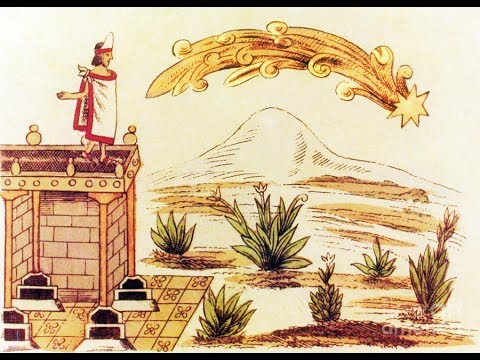
The 8 Omens of Montezuma and the End of the Aztec Empire
Mexico Unexplained — a dedicated episode-length treatment of all eight omens directly from the primary source material.
Rethinking Conquest: The Florentine Codex
Los Angeles County Museum of Art — an institutional curator-led lecture on the codex's production and historical significance.
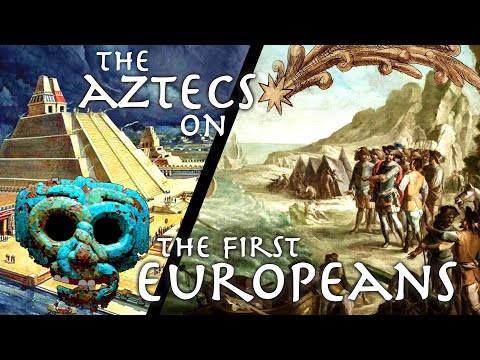
Aztec Perspective on First Contact with Europeans
Voices of the Past — a direct reading of translated Book 12 primary-source text covering the conquest narrative this file's omens chapter opens.
Sources
- Sahagún, Bernardino de. Florentine Codex: Book 12: The Conquest of Mexico. Translated by Arthur J. O. Anderson and Charles E. Dibble. Salt Lake City: University of Utah Press, 1975 (revised ed.).
- Getty Research Institute. "Digital Florentine Codex, Book 12." florentinecodex.getty.edu
- Library of Congress / World Digital Library. "General History of the Things of New Spain by Fray Bernardino de Sahagún: The Florentine Codex. Book XII: The Conquest of Mexico." loc.gov
- Library of Congress. "World Digital Library Adds Florentine Codex." Press release, October 31, 2012. loc.gov
- Fernández-Armesto, Felipe. "'Aztec' Auguries and Memories of the Conquest of Mexico." Renaissance Studies 6, no. 3–4 (1992): 287–305. onlinelibrary.wiley.com
- Lockhart, James, ed. and trans. We People Here: Nahuatl Accounts of the Conquest of Mexico. Berkeley: University of California Press, 1993.
- Gillespie, Susan D. The Aztec Kings: The Construction of Rulership in Mexica History. Tucson: University of Arizona Press, 1989.
- Townsend, Camilla. Fifth Sun: A New History of the Aztecs. New York: Oxford University Press, 2019.
- Restall, Matthew. Seven Myths of the Spanish Conquest. New York: Oxford University Press, 2003.
- León-Portilla, Miguel, ed. The Broken Spears: The Aztec Account of the Conquest of Mexico. Translated by Lysander Kemp. Boston: Beacon Press, expanded ed., 1992.
- Martín-Del Pozzo, Ana Lillian, et al. "Reconstructing 800 Years of Historical Eruptive Activity at Popocatépetl Volcano, Mexico." Bulletin of Volcanology 78, no. 4 (2016). link.springer.com
- Vallée, Jacques, and Chris Aubeck. Wonders in the Sky: Unexplained Aerial Objects from Antiquity to Modern Times. New York: Tarcher/Penguin, 2010.
- Bougard, Michel. La Chronique des OVNI. Paris: J.-P. Delarge, 1977.
- Mexicolore. "The Myth of the Omens." mexicolore.co.uk
- "Florentine Codex." Wikipedia. en.wikipedia.org
- "Bernardino de Sahagún." Wikipedia. en.wikipedia.org
- "Moctezuma II." Encyclopedia Britannica. britannica.com
- "Diego Durán." Wikipedia. en.wikipedia.org
- "Tenochtitlan." Wikipedia. en.wikipedia.org
- Getty Research Institute. "A Rare 500-Year-Old Manuscript Gets a Second Life Online." Getty News, 2023. getty.edu
- Getty. "Florentine Codex." Getty Projects. getty.edu
- "Fifth Sun: A New History of the Aztecs." Hispanic American Historical Review, review essay. read.dukeupress.edu
- "File:Florentine Codex Book 12 Folio 1r.jpg" and related folios. Getty Research Institute Digital Florentine Codex, IIIF image archive. florentinecodex.getty.edu
See something inaccurate? Have additional information or sources?
Suggest an Edit →Last Updated: August 2026