
The Antikythera Mechanism's "Impossible" Origin
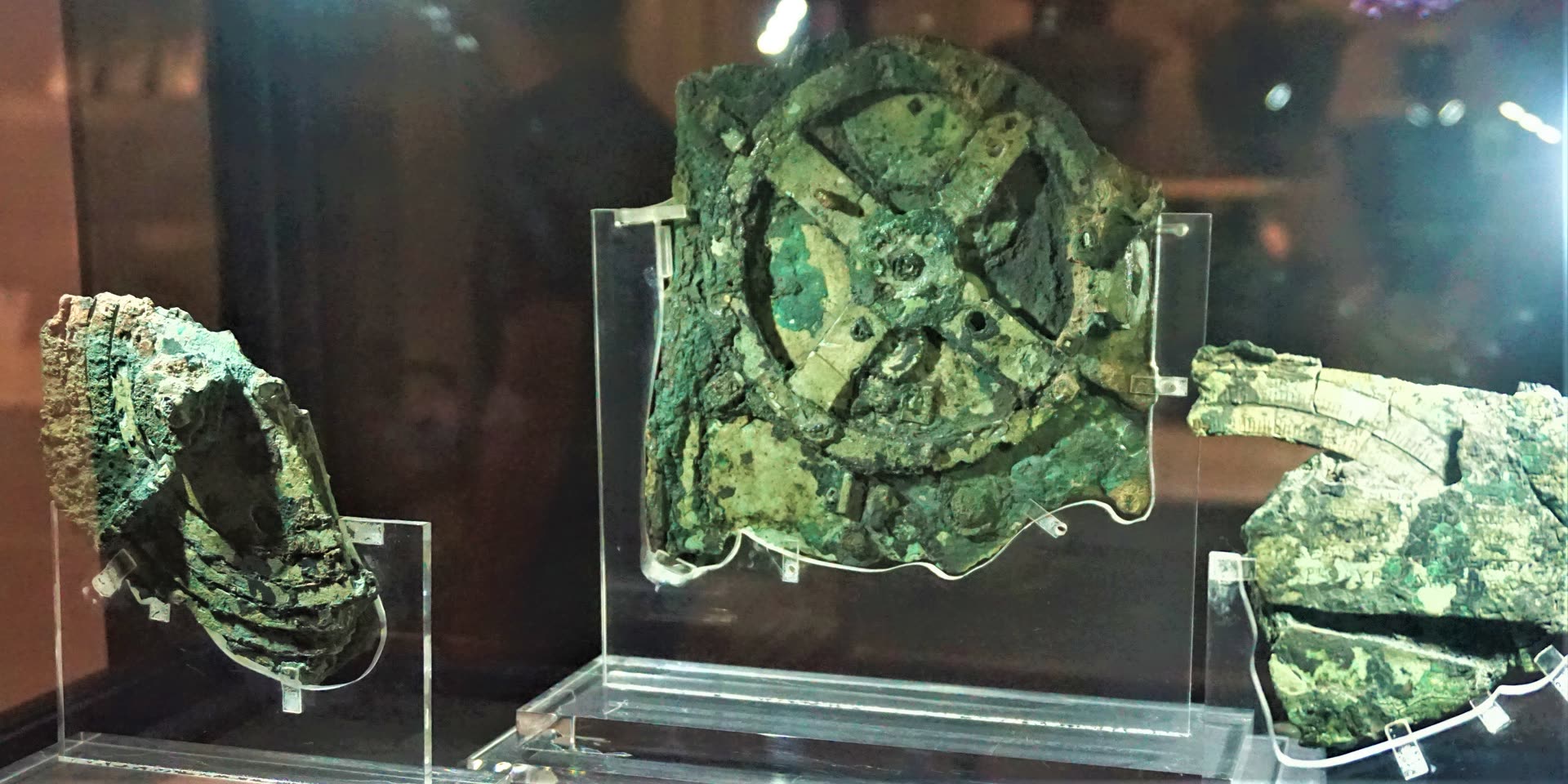
In the spring of 1900, a crew of Greek sponge divers sheltering from a storm off the tiny island of Antikythera stumbled onto a Roman-era cargo wreck and, over the following year's excavation, hauled up an unremarkable-looking, badly corroded lump of bronze along with statues, glassware, and coins. It sat catalogued but unexamined at the National Archaeological Museum in Athens until 1902, when staff archaeologist Valerios Stais noticed a gear wheel embedded in the rock-like mass and realized it was a machine. Across more than a century of subsequent research — Yale historian of science Derek de Solla Price's pioneering 1970s X-ray studies, the Antikythera Mechanism Research Project's 2005–06 industrial CT tomography under Tony Freeth and Mike Edmunds, and a continuing string of peer-reviewed refinements running through 2024 — that lump has been identified as a hand-cranked bronze astronomical calculator: a geared analog computer, built in the Hellenistic Greek world around 150–100 BCE, that modeled the Sun and Moon's motion, predicted eclipses using the ancient Babylonian Saros cycle, and tracked the four-year calendar of the Panhellenic games. Because devices of remotely comparable mechanical complexity are not otherwise known to survive from anywhere in the ancient world for well over a thousand years afterward, the object has become a recurring exhibit in ancient-astronaut media — most visibly Erich von Däniken's own writing and repeated segments on History Channel's Ancient Aliens franchise — as supposed evidence that its makers had non-human or "lost civilization" help. This file documents both halves of that story honestly: the object's construction, function, and modern decoding are genuine, extraordinary, and entirely explicable as sophisticated human engineering grounded in real, independently attested Hellenistic mathematics and astronomy; and the "impossible technology" reading built on top of that real achievement is not supported by the specialists who have actually spent decades taking the mechanism apart, gear by gear.
Theoretical Alignment
This file sits closest, among this site's Ancient Records entries, to the Piri Reis map and the Saqqara Bird: a real, extensively studied, entirely genuine artifact, around which a specific and identifiable strand of ancient-astronaut media has built a "this could not have been made by the people who supposedly made it" claim that the relevant specialists do not share. The mechanism's physical reality, its function, and the broad outline of its Hellenistic Greek origin are not disputed by anyone who has actually worked with the fragments — not by the historians of science, classicists, and engineers who have spent decades X-raying, CT-scanning, and hand-reconstructing it, and, notably, not even by the ancient-astronaut media making the "impossible" claim, which does not dispute the device's basic archaeological facts so much as add an unsupported interpretive layer on top of them. What remains genuinely open, and is treated honestly in this file's Historical Precedents and Mainstream Interpretation sections below, is a narrower historical puzzle: why so little else of comparable gearing survives from the centuries immediately before and after it. That is a real archaeological preservation question with real partial answers, not evidence of non-human intervention.
Sensor & Instrumentation Detection Profile
As with every entry in this site's Ancient Records series, there is no modern sensor record of the object in use; the entire evidentiary record consists of the surviving bronze fragments themselves and the instruments researchers have since built to look inside and around them without destroying fragile, corroded metal. The mechanism survives as 82 recovered fragments — seven substantial pieces (labeled Fragments A through G) and 75 smaller ones — together preserving at least 30 hand-cut bronze gear wheels, the largest roughly 13 centimeters across with 223 teeth, meshing in gear trains precise enough that full reconstructions calculate the device's original complement at around 37 gears. Front and back dial faces, graduated rings, and pointers survive in enough detail to reconstruct their layout with confidence; the wooden and leather casing that once housed the mechanism did not survive underwater for two millennia and is known only from small surviving fragments and inferred design.
The "instrumentation," in this file's case, is almost entirely a sequence of ever-more-capable imaging campaigns run by outside researchers on an object that cannot itself be safely disassembled further. Derek de Solla Price, a Yale historian of science who first examined the fragments directly in 1958, partnered in 1971 with Greek nuclear physicist Charalampos Karakalos to take the first gamma-ray and X-ray radiographs of the pieces, work Price published as the landmark 1974 monograph Gears from the Greeks — the first serious attempt to map the internal gear train and propose that the device predicted eclipses. Science Museum London curator Michael Wright, working with computer scientist Allan Bromley through the 1990s, built improved linear X-ray tomography equipment specifically for the fragments, correcting and extending several details of Price's gear count and layout. The most decisive imaging campaign came in September 2005, when the Antikythera Mechanism Research Project — a UK-Greek collaboration founded in 2000–01 by Tony Freeth and Mike Edmunds of Cardiff University together with John Seiradakis (Aristotle University of Thessaloniki) and Xenophon Moussas and Yanis Bitsakis (University of Athens) — brought an eight-tonne, custom-built 450kV micro-focus X-ray computed-tomography scanner (built by X-Tek Systems, nicknamed the "BladeRunner") to the museum in Athens, alongside Hewlett-Packard reflectance-imaging equipment for reading worn surface text. That scan, published in Nature in November 2006, revealed internal gear teeth and roughly 3,000 characters of previously unreadable inscribed Greek text out of an estimated 15,000 characters originally present — a scale of hidden internal detail no earlier researcher, including Price, had been able to see at all.
Environmental & Geospatial Context
The wreck lies off Antikythera, a small, sparsely populated island roughly midway between Crete and the Peloponnese, at the point where the Aegean opens onto the wider Mediterranean — a genuine maritime chokepoint that has wrecked ships for millennia and would go on to sink at least four more known ancient vessels in the same general waters. The ship carrying the mechanism was a substantial merchant vessel, its exact home port unknown, whose cargo of predominantly Rhodian- and Koan-style amphorae, together with coins, points to a final voyage that had called at ports across the eastern Mediterranean — plausibly Rhodes, Kos, Ephesus, or Pergamon — likely bound for Rome or another major Italian port when it sank, radiocarbon and ceramic dating placing the sinking at roughly 70–60 BCE. That wider cargo is itself richly documented and entirely undisputed: bronze and marble statuary (including the life-sized bronze "Antikythera Youth"), glassware, jewelry, and luxury goods consistent with a high-value shipment moving from the Greek East toward the growing markets of the late Roman Republic, not a mysterious or otherwise unexplained assemblage.
The Hellenistic eastern Mediterranean this ship sailed through was, in genuine, well-documented historical fact, the most scientifically and technically advanced culture then on Earth in exactly the areas the mechanism draws on: geometric astronomy descending from Eudoxus and Apollonius, a large corpus of Babylonian observational eclipse records that had been transmitted into Greek scholarship by this period (most influentially through Hipparchus of Rhodes's work merging Babylonian arithmetic with Greek geometric models), and an island, Rhodes, that ancient sources independently and repeatedly describe as a center of exactly this kind of instrument-making. The leading scholarly hypothesis for where the mechanism itself was built — based on the ship's Rhodian-heavy cargo and on Rhodes's well-attested reputation as an astronomical and mechanical center associated with Hipparchus and later the Stoic philosopher Posidonius — places its manufacture in or near a real, textually corroborated technical milieu, not a cultural vacuum an "impossible" artifact would actually require.
A separate, more recent line of calendar-ring research complicates that picture usefully rather than undermining it. Careful re-examination of the mechanism's front calendar-ring hole spacing — most recently a 2024 statistical study by University of Glasgow astrophysicists Graham Woan and Joseph Bayley, applying Bayesian techniques originally developed for detecting gravitational-wave signals at LIGO — found the ring almost certainly held 354 or 355 holes, matching a lunar rather than solar calendar year. A 2020 study by Freeth and Alexander Jones had already argued this calendar could not be that of Syracuse, Archimedes's home city, but instead most closely matches the "Corinthian family" of calendars used in Epirus and other Corinthian colonies — evidence for a specific regional calendrical tradition embedded in the device's design, genuinely still being worked out in the peer-reviewed literature, but a question about which of several real, well-documented Greek city-state calendar systems the makers were drawing on, not about whether the makers were human.
Observer Credibility & Occupational Profile
Every substantive figure who has reshaped this object's interpretation across more than a century holds a real, checkable credential in a directly relevant field — a very different profile from the "ancient aliens"-adjacent media that most often repeats the "impossible" framing today. Valerios Stais, the Greek archaeologist who first noticed the embedded gear in 1902, was a working museum professional cataloguing excavated material, not an outside theorist. Derek de Solla Price held a PhD in the history of science from Cambridge, taught at Yale as the Avalon Professor of the History of Science, and is widely regarded as a founding figure of the modern discipline of scientometrics; his 1974 monograph remains the acknowledged foundation of all subsequent mechanism research, even where later X-ray work corrected specific details of his gear count. Michael Wright spent more than three decades as a curator of mechanical engineering at the Science Museum in London and at Imperial College, combining formal historical scholarship with hands-on instrument-making skill; his working bronze reconstructions, cut with tools and techniques directly attested in the ancient record, are addressed in detail below because they speak directly to the "impossible to build" claim.
The Antikythera Mechanism Research Project that produced the decisive 2005–06 breakthrough was, and remains, a formal academic consortium: Tony Freeth, a mathematician and documentary filmmaker turned mechanism researcher, now an honorary professor of mechanical engineering at University College London; Mike Edmunds, emeritus professor of astrophysics at Cardiff University; John Seiradakis of Aristotle University of Thessaloniki; and Xenophon Moussas and Yanis Bitsakis of the National and Kapodistrian University of Athens, working in direct, credentialed partnership with the National Archaeological Museum's own curatorial staff, who supervised every scan and handling of the fragments. Their published output has run through the discipline's normal peer-review channels — Nature (2006, 2008), PLOS ONE (2014), Archive for History of Exact Sciences (2019), and Scientific Reports (2021) among them — not press releases or television specials. Science journalist and author Jo Marchant, who holds a PhD in genetics and medical microbiology and has served as a contributing editor at both Nature and New Scientist, spent years directly interviewing this research community for her 2008 book Decoding the Heavens, the standard popular account of the century-long decoding effort, shortlisted for the Royal Society Science Book Prize. Set against this record, the "impossible technology" claim's own most prominent proponent, Swiss hotelier-turned-author Erich von Däniken, holds no credential in archaeology, classics, astronomy, or engineering, and neither he nor the Ancient Aliens television franchise that has repeated his framing has ever conducted or published original research on the fragments themselves.
Historical Precedents & Archive Matches
Two kinds of precedent bear directly on this file. The first is internal to this site's own Ancient Records archive: the Antikythera Mechanism joins the Piri Reis map and the Saqqara Bird as a real, well-documented artifact around which a specific "impossible" or "lost advanced technology" reading has grown up, independent of and generally rejected by the specialists who actually study it. Unlike the Piri Reis map's falsifiable ice-free-Antarctica claim, though, the Antikythera case does not turn on a single disprovable detail; it turns on a genuine, if frequently overstated, observation — that surviving evidence of comparably complex ancient gearing is sparse for a long stretch of subsequent history — being treated as though sparse evidence were the same thing as no evidence.
The second, more directly probative precedent is textual and archaeological, and it complicates the "total gap" framing considerably. The Roman statesman and philosopher Cicero, writing in the mid-first century BCE — within living memory of this ship's own voyage — described in his dialogue De Re Publica two bronze devices built by Archimedes of Syracuse (d. 212 BCE) and brought to Rome as war booty after the fall of Syracuse: one a solid star-globe, the other a genuine mechanical planetarium modeling the Sun, Moon, and five known planets, which Cicero says he personally saw demonstrated by the Roman senator Gaius Sulpicius Gallus. This is not a description of the Antikythera Mechanism itself — Archimedes died decades before the mechanism's own construction — but it is independent, non-archaeological literary confirmation that Hellenistic Greek craftsmen were already known, in exactly this period and exactly this cultural milieu, for building sophisticated geared or pseudo-geared astronomical models, corroborating the broader technical tradition the mechanism belongs to rather than standing as an isolated, contextless anomaly.
A second, physical piece of comparanda closes part of the "1,400 years of silence" gap directly. A small bronze geared sundial-calendar, now held at the Science Museum in London and dated on stylistic grounds to the late fifth or early sixth century CE — roughly half the temporal distance between the Antikythera Mechanism and the first medieval European mechanical clocks — survives with a sundial plate, a Moon-phase display, and two well-formed gear wheels. Michael Wright published the first detailed scholarly study of this "Byzantine sundial-calendar" in 1985, establishing it as a genuine geared descendant of the same broad Hellenistic mechanical tradition the Antikythera Mechanism represents, and noting its gearing scheme closely resembles calendrical devices later described by the medieval Islamic scholar al-Bīrūnī around 1000 CE and preserved in a Persian geared astrolabe dated 1221–22 CE. Read together, the Byzantine sundial-calendar and the Islamic geared-astrolabe tradition it connects to do not eliminate the real gap in the surviving record between the Antikythera Mechanism and later medieval clockwork — that gap is genuine, and this file's Mainstream Interpretation section below addresses it directly rather than minimizing it — but they are hard physical evidence that the underlying tradition of small-scale precision geared astronomical instruments did not vanish from human hands for over a millennium, only that very little of it happened to survive in a form and material that could reach us.
Historical Background
The 1900 Wreck and the 1900–1901 Excavation
Around Easter 1900, a small crew of sponge divers from the island of Symi, working under Captain Dimitrios Kontos, was sailing toward fishing grounds off the coast of North Africa when bad weather forced them to shelter near Antikythera. While waiting out the storm, diver Elias Stadiatis descended in a canvas-and-copper diving suit to look for sponges at a depth of roughly 45 meters and surfaced badly shaken, reporting a field of "rotting corpses" and horses on the seabed. Kontos went down himself and returned holding the bronze arm of a statue, confirming the divers had found an ancient shipwreck rather than a scene of recent disaster. The crew reported the find to Greek authorities, and the Greek Ministry of Education, working with the Hellenic Royal Navy, organized what became one of the first systematic underwater archaeological excavations in history, running from November 1900 through September 1901 and using the same sponge divers as the recovery crew, working at real and serious personal risk — the excavation's demanding depths contributed to at least one diver's death and several cases of decompression sickness among the crew.
The excavation recovered an extraordinary haul: bronze and marble statues (including the life-sized "Antikythera Youth," now among the most celebrated works in the National Archaeological Museum's collection), glassware, jewelry, coins, and a number of shapeless, heavily concreted lumps of corroded bronze that crumbled and cracked as they dried after two millennia underwater. These fragments were catalogued alongside the more obviously valuable statuary and largely set aside; nothing about their outward appearance suggested they were anything other than unidentifiable scrap.
Valerios Stais and the 1902 Identification
The fragments sat in the National Archaeological Museum's collection for roughly a year before Valerios Stais, a museum archaeologist cataloguing the recovered material, noticed on May 17, 1902, that one fragment had what was unmistakably a gear wheel embedded in it, along with visible inscriptions in ancient Greek. Stais proposed the object was some kind of astronomical instrument, a conclusion most contemporary scholars initially resisted — a geared mechanism of this apparent sophistication simply did not fit prevailing assumptions about ancient Greek technology, and for decades the object was treated by many specialists as an anomaly best set aside rather than seriously investigated. That early skepticism is itself instructive: the "this shouldn't exist" reaction the mechanism still provokes today is not new, but for most of the twentieth century it came from cautious, credentialed archaeologists declining to overinterpret a badly damaged object, not from writers proposing extraterrestrial explanations.
Price, Karakalos, and the First X-Rays (1951–1974)
Derek de Solla Price began studying the fragments directly in 1951 and examined them again in 1958, gradually becoming convinced the device was more sophisticated, and considerably more comprehensible, than prior scholarship had allowed. In 1971, Price traveled to Athens and, working with Greek nuclear physicist Charalampos Karakalos, took the first gamma-ray and X-ray radiographs of the major fragments — a genuinely novel application of medical and industrial imaging technology to a fragile archaeological object, allowing Price to see internal gear teeth and plate layers without further damaging the corroded bronze. His resulting 1974 monograph, Gears from the Greeks: The Antikythera Mechanism — A Calendar Computer from ca. 80 B.C., published by the American Philosophical Society, proposed for the first time a comprehensive gear-train scheme and argued the device functioned as a calendrical and eclipse-predicting computer — establishing, for the modern scientific literature, exactly the "genuine ancient astronomical calculator" identification that later, far more detailed imaging would refine but never overturn.
Wright, Bromley, and the AMRP's 2005–06 Breakthrough
Through the 1990s, Michael Wright, then curator of mechanical engineering at the Science Museum in London, working with computer scientist Allan Bromley of the University of Sydney, built dedicated linear X-ray tomography equipment to re-examine the fragments, correcting several specific errors in Price's gear count and proposing improvements to the reconstructed gear train. The decisive breakthrough came in September 2005, when the newly formed Antikythera Mechanism Research Project — led by Tony Freeth and Mike Edmunds of Cardiff University, in partnership with Greek researchers John Seiradakis, Xenophon Moussas, and Yanis Bitsakis and the National Archaeological Museum's own staff — brought the custom-built, eight-tonne "BladeRunner" micro-focus X-ray CT scanner to Athens, imaging every fragment at a resolution no prior technology had achieved. The team published its findings in Nature in November 2006 under the title "Decoding the ancient Greek astronomical calculator known as the Antikythera Mechanism," revealing the internal gearing behind the back-dial eclipse-prediction system in unprecedented detail and roughly 3,000 newly readable characters of internal Greek inscription describing the device's own operation — effectively an ancient instruction manual, hidden inside the bronze for two thousand years.
Complete Timeline
| Date | Event |
|---|---|
| c. 212 BCE | Archimedes of Syracuse dies at the Roman siege of Syracuse; per Cicero, two of his geared/mechanical astronomical devices are later brought to Rome as war booty. |
| c. 150–100 BCE | Current scholarly best estimate for the Antikythera Mechanism's own construction, based on inscription lettering style and internal dial calibration. |
| c. 70–60 BCE | A merchant ship carrying the mechanism, statuary, and Rhodian/Koan amphorae sinks off Antikythera. |
| Spring 1900 | Sponge divers under Capt. Dimitrios Kontos discover the wreck while sheltering from a storm. |
| Nov. 1900–Sept. 1901 | The Greek Ministry of Education and Hellenic Royal Navy conduct one of history's first systematic underwater excavations, recovering statues, glassware, coins, and the corroded bronze fragments. |
| May 17, 1902 | Valerios Stais, cataloguing the recovered material at the National Archaeological Museum, notices a gear wheel embedded in one fragment and proposes the object is an astronomical instrument. |
| 1951–58 | Derek de Solla Price begins direct study of the fragments. |
| 1971 | Price and physicist Charalampos Karakalos take the first gamma-ray and X-ray radiographs of the fragments in Athens. |
| 1974 | Price publishes Gears from the Greeks, the first comprehensive gear-train reconstruction, identifying the device as a calendrical/eclipse computer. |
| 1980s–90s | Michael Wright and Allan Bromley build improved linear X-ray tomography equipment and revise Price's gear-train model; Wright separately publishes the first scholarly study of the comparable Byzantine sundial-calendar (1985). |
| 2000–01 | The Antikythera Mechanism Research Project (AMRP) is founded by Freeth, Edmunds, John Seiradakis, Xenophon Moussas, and Yanis Bitsakis. |
| Sept.–Oct. 2005 | The AMRP's custom 450kV micro-focus X-ray CT scanner, built by X-Tek Systems, images every fragment at the National Archaeological Museum, Athens. |
| Nov. 2006 | Freeth, Edmunds, et al. publish "Decoding the ancient Greek astronomical calculator known as the Antikythera Mechanism" in Nature, revealing the eclipse-prediction Saros dial and roughly 3,000 characters of internal inscription. |
| 2008 | Jo Marchant publishes Decoding the Heavens, the standard popular account of the century-long decoding effort; shortlisted for the Royal Society Science Book Prize. |
| 2008 | Freeth et al. publish a follow-up Nature paper detailing the Olympiad dial and refined calendar functions. |
| 2014 | A PLOS ONE study refines the interpretation of the eclipse-prediction glyphs on the back-dial Saros spiral. |
| 2017 | Alexander Jones publishes A Portable Cosmos, the leading academic monograph synthesizing the mechanism's astronomy, construction, and cultural context. |
| 2020 | Freeth and Alexander Jones argue in Hesperia that the mechanism's calendar ring matches the Corinthian family of Greek calendars rather than that of Syracuse. |
| 2021 | Freeth, Higgon, Dacanalis, MacDonald, Georgakopoulou, and Wojcik (UCL) publish "A Model of the Cosmos in the ancient Greek Antikythera Mechanism" in Scientific Reports, proposing a reconstruction of the front planetary display. |
| 2024 | University of Glasgow astrophysicists Graham Woan and Joseph Bayley apply gravitational-wave-detection statistical methods to confirm the calendar ring held 354 or 355 holes, consistent with a lunar calendar. |
The Primary Source Document
The Mechanism's Own Inscribed Text
Unlike several other files in this site's Ancient Records archive, the single most important primary source for the Antikythera Mechanism is not a later commentator's account but the object's own surviving inscriptions, engraved directly onto its bronze plates and largely illegible to the naked eye until the 2005 CT scan recovered them. The back cover carries what researchers have described as an ancient instruction manual: descriptive text explaining the dial functions, including glyphs marking predicted eclipses with their timing and likely visibility, organized around the 223-lunar-month Saros cycle. Roughly 3,000 characters have now been transcribed out of an estimated 15,000 originally inscribed across the whole device — meaning the majority of the mechanism's own explanatory text remains lost to corrosion and missing fragments, a genuine, honestly acknowledged limit on how completely the device's own self-documentation can ever be recovered.
The 2021 Reconstruction Team's Own Assessment
"Ours is the first model that conforms to all the physical evidence and matches the descriptions in the scientific inscriptions engraved on the Mechanism itself."
Tony Freeth, Professor of Mechanical Engineering, University College London, on the 2021 planetary front-dial reconstruction; quoted in University College London/Scientific Reports press coverage, March 12, 2021
This quote is worth reading carefully for what it does and does not claim: even the most complete and internally consistent reconstruction of the mechanism's front planetary display to date is explicitly presented by its own authors as a best-fit model built to match surviving physical and textual evidence, not as a certainty beyond revision. That kind of calibrated, falsifiable claim — stated by name, in a peer-reviewed venue, open to correction by the next fragment or the next imaging pass — is the normal texture of how this device has actually been studied for more than a century, a sharp contrast with the flat, unfalsifiable certainty of the "this could not have been built by humans" claim addressed later in this file.
Confirmed Institutional & Archival Holdings
The landmark peer-reviewed paper announcing the AMRP's 2005 CT tomography findings and the reconstructed eclipse-prediction system.
PEER-REVIEWED ACADEMIC RECORDThe UCL Antikythera Research Team's peer-reviewed reconstruction of the front planetary display, open access.
PEER-REVIEWED ACADEMIC RECORD (OPEN ACCESS)An open-access peer-reviewed refinement of the Saros-dial eclipse-glyph interpretation.
PEER-REVIEWED ACADEMIC RECORD (OPEN ACCESS)The museum's own official collection page for the shipwreck finds, including the mechanism fragments.
OFFICIAL INSTITUTIONAL RECORDSearch Institutional & Academic Archives Directly
Evidence Assessment
Supporting the Object's Genuine Hellenistic Human Origin
- Continuous, peer-reviewed decoding from Price (1974) through the AMRP (2006) to the present has mapped the gear train, dial functions, and internal inscriptions in ever-increasing detail with no findings pointing away from ordinary, if highly skilled, Hellenistic bronze-casting and gear-cutting
- Multiple independent researchers, most notably Michael Wright, have built fully functioning bronze reconstructions using only tools and cutting techniques directly attested in the ancient archaeological record
- Cicero's mid-first-century-BCE account of Archimedes's planetarium devices provides independent literary corroboration that Hellenistic Greek craftsmen were already known for building sophisticated geared or mechanical astronomical models in this exact period and cultural milieu
- The mechanism's own internal inscriptions, recovered via CT scan, are written in ordinary contemporary Greek describing the device's astronomical functions — not in any anomalous script, material, or technique
Undermining the "Impossible/Non-Human Technology" Interpretation Specifically
- No credentialed archaeologist, historian of science, or engineer who has directly studied the fragments has ever endorsed a non-human or extraterrestrial origin
- The device's construction materials, gear-cutting marks, and inscriptions are entirely consistent with attested Hellenistic technology and leave no anomalous physical trace of any kind
- The "total silence" framing used to argue the mechanism is contextless is factually incomplete: Cicero's textual account and the physical Byzantine sundial-calendar both provide real, if sparse, evidence the broader tradition persisted in human hands
- Erich von Däniken and the Ancient Aliens franchise, the claim's most prominent popularizers, have never conducted or published original fragment research and hold no relevant credential
Comparative Analysis
A Genuine Engineering Achievement, Not a Contextless One
It is worth stating plainly, because it cuts against a purely dismissive reading without supporting the "impossible" claim either: the Antikythera Mechanism really is an extraordinary object, arguably the single most sophisticated known machine to survive from anywhere in the ancient world. Nothing about documenting its human origin requires minimizing that achievement. What separates a genuinely extraordinary human artifact from an "impossible" one is exactly the kind of evidence this file has laid out — attested materials, attested tools, a traceable research and cultural context, and independent textual corroboration of the broader tradition it belongs to — all of which the mechanism has, and all of which a true out-of-place artifact, by definition, would lack.
The Pattern Elsewhere on This Site
Compared to the Baghdad Battery, this file resolves more cleanly in one respect and less cleanly in another. The Baghdad Battery's own physical electrochemical properties are genuinely, narrowly still debated by credentialed researchers; here, no comparable narrow research question exists about whether the mechanism functions as described — that has been settled since 2006. What remains open, addressed in full in the next section, is the separate historical question of why so little intermediate evidence of the broader gear-cutting tradition survives — a real gap in the archaeological record, but, as with the Saqqara Bird's undocumented findspot, a gap in the surviving evidence rather than a gap that requires a non-human explanation to fill.
Material Analysis: The Gears, the Cutting Marks, and What Ancient Tools Could Actually Do
The strongest direct physical rebuttal to the "impossible to build" claim comes not from documentary or textual argument but from hands-on experimental archaeology: researchers actually attempting to cut equivalent gears with equipment demonstrably available in the Hellenistic world. Michael Wright, drawing on his Science Museum reconstruction work, has argued explicitly that the ancient Greeks possessed exactly what was needed — bronze-casting technology, compasses and dividers for precise geometric layout, and saws and files with V-shaped cutting edges, a technique directly comparable to cutting the teeth of a gear wheel by hand. Wright built several working replicas by hand using only these attested methods, including the mechanism's most mechanically inventive component: a pin-and-slot mechanism modeling the Moon's variable orbital speed (its real elliptical, non-circular path around Earth), a genuinely precocious engineering solution not seen again in the historical record until medieval European clockmakers reinvented broadly similar variable-motion gearing centuries later. That a single credentialed engineer, working alone with tools no more advanced than a Hellenistic bronzesmith's, could physically reproduce the mechanism's most sophisticated feature is direct, testable evidence against the claim that its construction exceeded ancient human capability.
The gear-cutting itself, examined under magnification during the AMRP's tomography work, shows hand-filed teeth of variable, imperfect spacing — not the machine-uniform precision a lathe or powered cutting tool would produce, and exactly what patient, skilled hand-finishing with period tools would leave behind. This detail matters directly to the "impossible" claim: if the gears had shown perfectly uniform, machine-cut tooth spacing inconsistent with any tool attested in the ancient world, that would be a genuine anomaly worth serious scrutiny. Instead, the visible manufacturing imperfections are fully consistent with a highly skilled artisan working by hand, under real time and material constraints, exactly as the surrounding historical record of Hellenistic Greek metalworking would predict.
Consistent with Ordinary, Highly Skilled Hellenistic Bronze-Working
- Cast and hand-finished bronze construction throughout, using metallurgy directly attested elsewhere in the Hellenistic archaeological record
- Gear teeth show hand-filed, non-uniform spacing consistent with period tools rather than any anomalous cutting method
- Every reconstructed function — including the pin-and-slot lunar-anomaly mechanism — has been successfully hand-built by modern researchers using only attested ancient techniques
No Physical Trace Supporting Non-Human or Anachronistic Manufacture
- No component, material, alloy, or cutting mark examined across a century of imaging is inconsistent with attested Hellenistic technology
- No tool, material, or technique found with the device (or absent from it) points to any technology beyond the ancient Mediterranean world's own documented capability
- The device's own internal inscriptions are ordinary contemporary Greek text, not an unknown or undeciphered script
The Ancient-Astronaut Interpretation
The claim this file exists to evaluate is narrower and more specific than "the Antikythera Mechanism is remarkable" — it is the assertion, made in identifiable fringe literature and popular media, that the device's sophistication exceeds what Hellenistic Greek civilization could plausibly have achieved unaided, implying either direct extraterrestrial contact or knowledge transferred from a vanished, more advanced human civilization. Swiss author Erich von Däniken, the writer most responsible for popularizing the modern "ancient astronaut" hypothesis beginning with his 1968 bestseller Chariots of the Gods?, discusses the mechanism directly in his later book Odyssey of the Gods: The History of Extraterrestrial Contact in Ancient Greece, arguing that devices of this kind were either built by extraterrestrial visitors or by humans working from knowledge those visitors supplied. Von Däniken holds no credential in archaeology, classics, engineering, or any directly relevant field, and neither Odyssey of the Gods nor his broader body of work involves original examination of the fragments, engagement with the peer-reviewed decoding literature summarized throughout this file, or any attempt to test whether the device's construction genuinely exceeds attested ancient capability — a test Michael Wright's own hand-built replicas have already answered directly, and in the opposite direction.
The claim reaches a far larger modern audience through television than through print. History Channel's long-running Ancient Aliens franchise has featured the mechanism repeatedly, including as an entry in a 2024 episode counting down the "Top Ten Mysterious Devices" and again in the 2024 spinoff Ancient Aliens: Origins, in an episode titled "Extraterrestrial Devices." These segments present the device's genuine complexity and the real, if overstated, gap in surviving intermediate evidence as though sophistication and rarity alone constituted evidence of non-human intervention, without engaging the specialist literature's own explanation for either. Per this site's standing editorial policy, Ancient Aliens and the History Channel are treated here strictly as a documented, real cultural-impact fact — the claim genuinely does circulate through this specific, identifiable, high-reach media franchise — and never as a citable source of evidence for the claim itself.
What makes the Antikythera version of this argument different from many other "ancient astronaut" claims catalogued elsewhere on this site is that it does not dispute the device's basic archaeological facts — its findspot, its approximate date, its Hellenistic Greek inscriptions, or its function as a real astronomical calculator are all accepted by fringe and mainstream accounts alike. The interpretive leap is narrower and more specific: treating the real, still-being-refined historical puzzle of why comparably complex gearing does not densely resurface in the surviving record for well over a millennium as though that puzzle could only be resolved by positing help from outside the human timeline, rather than by the more mundane, better-evidenced explanations — bronze recycling, differential preservation, and a technical tradition that may simply have been rarer, more localized, and more poorly documented than its own makers' skill deserved — addressed directly in the section immediately below.
The Mainstream Historical & Engineering Interpretation
What the Mechanism Actually Did
Decades of imaging and reconstruction now support a confident, peer-reviewed account of the device's function, even where a handful of secondary details remain actively debated. Operated by a hand crank on its side, the mechanism drove a front dial showing the Sun's position against a fixed zodiac ring and a movable 365-day Egyptian calendar ring, together with the Moon's position and phase (via a rotating, half-silvered ball). Two spiral dials on the back tracked longer cycles: an upper spiral implementing the 19-year, 235-lunar-month Metonic cycle (the standard ancient method for reconciling lunar months with the solar year), with a small sub-dial for the 76-year Callippic cycle refining it further, and a lower spiral implementing the 223-lunar-month, roughly 18-year-11-day Saros eclipse cycle inherited from Babylonian astronomy, complete with inscribed glyphs predicting the timing and likely visibility of specific solar and lunar eclipses, and a small Exeligmos sub-dial correcting the Saros cycle's own built-in third-of-a-day rounding error over three repetitions. A separate small dial tracked the four-year cycle of the Panhellenic games — Olympia, Nemea, Isthmia, Pythia, and two more localized games, Naa and Halieia — a calendrical rather than astronomical function, but one that helps date and regionally place the mechanism's own calendar tradition. Internally, a pin-and-slot gear pairing modeled the Moon's variable orbital speed, arising from its genuinely elliptical orbit — a solution so mechanically sophisticated that no comparably precise variable-motion gearing is known to reappear in the surviving historical record until medieval European clockmaking, centuries later.
A more speculative, actively researched layer sits on the mechanism's front face: a 2021 reconstruction by Tony Freeth's UCL team proposed that concentric rings on the front dial displayed the positions of all five planets known in antiquity (Mercury, Venus, Mars, Jupiter, and Saturn), using period-appropriate Greek epicyclic and eccentric planetary theory, alongside the Sun and Moon — a genuine ancient "Cosmos" display. This reconstruction is mathematically elegant and consistent with the surviving inscriptions and tooth-count evidence, but no physical gearing for this specific front-dial section actually survives; it remains, honestly, the leading scholarly hypothesis rather than a directly observed certainty, precisely the calibrated distinction Freeth's own quoted statement above draws.
Who Built It, and Where
No inscription names a builder, and no ancient text unambiguously describes this specific device, so attribution remains genuinely open — but "genuinely open" here means a debate between several well-documented historical candidates within a known cultural and technical milieu, not a mystery requiring anything outside it. The ship's predominantly Rhodian and Koan cargo, combined with Rhodes's independently attested reputation as a center of astronomical and mechanical scholarship, makes the "School of Posidonius" on Rhodes the leading manufacture-location hypothesis; Hipparchus of Rhodes, whose surviving astronomical work directly underlies several of the mechanism's lunar and eclipse calculations, is the individual most commonly proposed as the intellectual source (if not necessarily the builder) of its core astronomy. Cicero's account of Archimedes's own planetarium devices, discussed above, establishes that broadly comparable Greek mechanical astronomy predates this specific object by decades to a century, situating it within an ongoing tradition rather than crediting it as an unprecedented singular invention. None of these attributions is settled beyond dispute, but all of them are disputes between real historical candidates grounded in textual and material evidence — the normal condition of ancient-history scholarship, not evidence of an unexplained gap.
The Real Gap, and Why It Is Not Evidence of Non-Human Origin
The observation underlying the "impossible" claim is not fabricated: no other surviving ancient artifact matches the Antikythera Mechanism's specific combination of gear count and precision, and directly comparable complexity does not densely reappear in the archaeological record until medieval astronomical clocks emerge in Islamic workshops by roughly the eleventh century and in European cathedral clocks by the thirteenth and fourteenth. Historians of technology, including Freeth and Marchant in their own published and popular writing, treat this gap as real and worth explaining, not as something to minimize. Several well-evidenced, entirely mundane factors converge to explain it without positing lost or non-human technology: bronze was a valuable, endlessly recyclable metal throughout antiquity and the medieval period, routinely melted down for coinage, weapons, or new instruments once an object's original owner or purpose was gone, meaning the overwhelming majority of ancient precision bronze-work is expected to have been destroyed rather than preserved — the Antikythera Mechanism itself survives only because it sank in deep water, sealed away from exactly this recycling pressure. Complex geared instruments were also, by every indication, rare, expensive, custom-built objects even in their own time, likely produced by a small number of specialist workshops for wealthy or institutional patrons, not a mass-market technology whose loss would require large-scale civilizational collapse to explain. And the gap is not, on inspection, actually empty: Cicero's independent textual account and the physical, scholarly-published Byzantine sundial-calendar (5th–6th century CE) — itself gear-linked by later researchers to Islamic geared calendrical devices attested by al-Bīrūnī around 1000 CE and a surviving 1221–22 CE Persian geared astrolabe — together sketch a thin but genuine chain of surviving evidence connecting Hellenistic gearing to medieval clockwork, rather than eighteen centuries of total silence. A sparse, unevenly preserved record is exactly the pattern ordinary archaeological preservation bias predicts for a rare, valuable, recyclable ancient technology; it is not, on its own, evidence that the technology's origin lay outside human hands.
Five Observables Assessment
The Five Observables framework, developed decades later by former AATIP director Luis Elizondo to classify modern UAP performance characteristics that exceed known technology, is included here for structural consistency with the rest of OverClassified's case files, but does not meaningfully apply to a static, excavated bronze instrument with no flight characteristics, propulsion signature, or direct observational encounter of any kind.
Assessment: As with this site's other pre-modern and artifact-based files, the Five Observables framework is the wrong instrument here. Its inclusion should not be read as suggesting genuine exotic-performance or non-human-technology evidence exists for this case.
Conventional Explanation Candidates
Four candidates are assessed below.
Sophisticated Hellenistic Greek Astronomical Calculator (Mainstream Consensus)
Highly PlausibleSupported by continuous, peer-reviewed decoding from 1974 through 2024, working hand-built reconstructions using only attested ancient tools and techniques, internal inscriptions in ordinary contemporary Greek, and independent literary corroboration (Cicero) of the broader Hellenistic mechanical-astronomy tradition it belongs to. This is the position of essentially every credentialed researcher who has directly studied the fragments.
Rhodian "School of Posidonius" Manufacture, Hipparchan Astronomy
Plausible, Not Fully SettledThe leading scholarly hypothesis for where and from whose astronomical work the device was built, grounded in the ship's Rhodian-heavy cargo and Hipparchus of Rhodes's independently attested lunar theory. A real, active scholarly debate among specialists working from genuine evidence, not an unresolved mystery pointing outside the historical record.
Undiscovered Human Precedent Tradition, Poorly Preserved
Inconclusive, Genuinely Active ResearchThe specific question of how densely populated the broader gear-cutting tradition once was, and why so little of it survives between this device and medieval clockwork, remains a genuine, ongoing subject of archaeological and historical research. Real partial evidence (Cicero's account; the Byzantine sundial-calendar) supports a continuous, if thin, human tradition rather than a void, but the full picture is not yet completely reconstructed.
Extraterrestrial or Lost-Advanced-Civilization Manufacture
ImplausibleContradicted on multiple independent grounds: no credentialed researcher who has studied the fragments endorses it; every material, tool mark, and inscription examined across a century of imaging is consistent with attested Hellenistic technology; and Michael Wright's own hand-built replicas, made using only ancient tools, directly demonstrate the device's most sophisticated feature was within genuine ancient human capability. Its most prominent proponents (von Däniken; Ancient Aliens) have conducted no original research on the object.
Why "Debunked"
This file receives a DEBUNKED classification for the specific claim it exists to evaluate: that the Antikythera Mechanism's sophistication exceeds what Hellenistic Greek civilization could plausibly have achieved without extraterrestrial or otherwise non-human assistance. That claim is not a close call among the researchers who have actually spent decades taking the object apart, gear by gear. Every material, tool mark, and inscription examined across more than a century of increasingly capable imaging — Price's 1971 radiographs, Wright's 1990s tomography, the AMRP's 2005 CT scan, and refinements running through 2024 — is fully consistent with attested Hellenistic Greek bronze-casting, hand gear-cutting, and geometric astronomy. Michael Wright's own working replicas, built using only tools and techniques directly documented in the ancient archaeological record, physically demonstrate that even the mechanism's most inventive component, its pin-and-slot lunar-anomaly gearing, was genuinely achievable by a skilled ancient artisan. And the mechanism's own internal inscriptions, recovered from inside the bronze itself, are ordinary contemporary Greek explaining an ordinary, if extraordinary, Greek astronomical instrument — not an anomalous script, material, or technology of any kind.
This DEBUNKED verdict should not be read as dismissing the object's genuine, remarkable significance, or as papering over the real historical puzzle this file has tried to represent honestly rather than explain away: comparably complex gearing is not densely attested again in the surviving archaeological record for well over a millennium, and exactly how widespread the underlying tradition once was, and why so little of it survives, remains a live, ongoing subject of peer-reviewed research (most recently the 2020 calendar-ring/Corinthian-calendar work and the 2024 Glasgow gravitational-wave-statistics study). That is a genuine gap in the surviving evidence, with real, partial, well-sourced explanations — bronze recycling, the likely rarity and cost of these instruments even in their own time, and thin-but-real surviving links through Cicero's textual account and the physical Byzantine sundial-calendar — not a gap that requires, or that any credentialed specialist has ever concluded requires, an explanation outside ordinary human history. Distinguishing "we don't yet fully understand how a real human tradition was preserved and transmitted" from "this could not have been built by humans at all" is the single most important analytical move this file makes, and it is the distinction the "impossible technology" claim collapses.
Related Entries
Further Reading — Recommended Literature
Decoding the Heavens
The definitive popular account of the century-long research effort to decode the mechanism, drawing on direct interviews with Price, Wright, Freeth, and Edmunds.
A Portable Cosmos
The leading academic monograph synthesizing what the mechanism's astronomy, construction, and inscriptions reveal about its purpose and origin.
Gears from the Greeks
The 1974 monograph that first mapped the internal gear train from X-ray radiographs, founding the modern scientific study of the mechanism.
Odyssey of the Gods
The primary fringe-literature source for the "impossible technology" reading this file evaluates and rejects, included here for direct reference.
The Cult of Alien Gods
Traces the literary and pop-culture roots of ancient-astronaut claims, including how von Däniken's amplification pattern spread claims like this one.
DISCLOSURE: Some links above are affiliate links. If you purchase through them, OverClassified receives a small commission at no additional cost to you. This helps support independent research.
Essential Viewing

The Antikythera Mechanism: A Shocking Discovery from Ancient Greece.
Stanford — Dr. Tony Freeth's Eitner Lecture at the Stanford Humanities Center, laying out the mechanism's discovery, decoding, and function in detail.
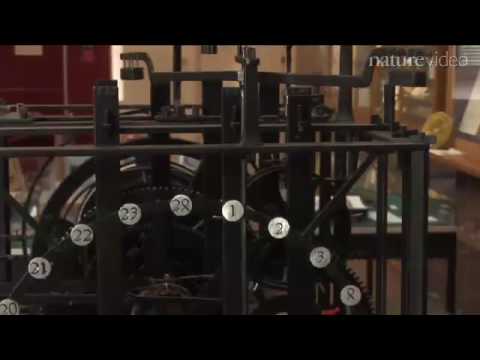
Antikythera Mechanism Part 1
Nature Video — the journal's own documentary accompanying the AMRP's landmark 2006 decoding paper.
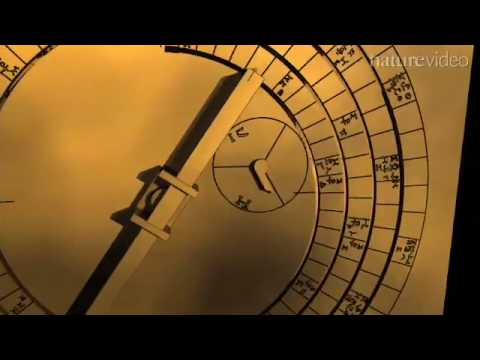
Antikythera Mechanism Part 2
Nature Video — the second part of the journal's documentary, covering the eclipse-prediction and calendar functions.

Decoding the Heavens: The Antikythera Mechanism
Darwin College Lecture Series — Jo Marchant's own lecture on the century-long research effort behind her book.
Sources
- "Antikythera mechanism." Wikipedia. en.wikipedia.org
- "Antikythera wreck." Wikipedia. en.wikipedia.org
- Freeth, T., Bitsakis, Y., Moussas, X., et al. "Decoding the ancient Greek astronomical calculator known as the Antikythera Mechanism." Nature 444 (2006): 587–591. nature.com
- Freeth, T., Higgon, D., Dacanalis, A., MacDonald, L., Georgakopoulou, M., Wojcik, A. "A Model of the Cosmos in the ancient Greek Antikythera Mechanism." Scientific Reports 11, 5821 (2021). nature.com
- Freeth, T., Jones, A. "Calendars with Olympiad display and eclipse prediction on the Antikythera Mechanism." Nature 454 (2008): 614–617. pubmed.ncbi.nlm.nih.gov
- Freeth, T., Jones, A. "Eclipse Prediction on the Ancient Greek Astronomical Calculating Machine Known as the Antikythera Mechanism." PLOS ONE 9, no. 7 (2014). journals.plos.org
- Freeth, T., Jones, A. "The Calendar on the Antikythera Mechanism and the Corinthian Family of Calendars." Hesperia 89, no. 1 (2020). jstor.org
- Price, Derek de Solla. Gears from the Greeks: The Antikythera Mechanism — A Calendar Computer from ca. 80 B.C. Transactions of the American Philosophical Society 64, part 7. Philadelphia: American Philosophical Society, 1974.
- Price, Derek de Solla. "An Ancient Greek Computer." Scientific American 200, no. 6 (1959): 60–67. scientificamerican.com
- Jones, Alexander. A Portable Cosmos: Revealing the Antikythera Mechanism, Scientific Wonder of the Ancient World. Oxford University Press, 2017.
- Marchant, Jo. Decoding the Heavens: Solving the Mystery of the World's First Computer. William Heinemann, 2008.
- Wright, M. T., Bromley, A. G. "Current work on the Antikythera Mechanism." Proceedings, National Archaeological Museum, Athens, 2003.
- Wright, M. T. "Gears from the Byzantines: A Portable Sundial with Calendrical Gearing." Annals of Science 42, no. 2 (1985): 133–151. tandfonline.com
- "Byzantine sundial-calendar." Science Museum Group Collection. collection.sciencemuseumgroup.org.uk
- Woan, G., Bayley, J. "An improved calendar ring hole-count for the Antikythera mechanism." University of Glasgow preprint, 2024. arxiv.org
- Iversen, P. A. "The Calendar on the Antikythera Mechanism and the Corinthian Family of Calendars." Hesperia, 2020, discussion in Project MUSE. muse.jhu.edu
- Jones, Alexander. Review discussion and "Who Built It?" candidates (Hipparchus, Posidonius, Archimedes). Antikythera Mechanism Research Project. antikytheramechanism.com
- "What Is the Antikythera Mechanism, the World's First Computer?" Smithsonian Magazine. smithsonianmag.com
- "Scientists May Have Discovered How the Ancient Greeks' 'First Computer' Tracked the Cosmos." Smithsonian Magazine. smithsonianmag.com
- "Antikythera shipwreck." Woods Hole Oceanographic Institution. whoi.edu
- "Experts recreate a mechanical Cosmos for the world's first computer." ScienceDaily, March 12, 2021. sciencedaily.com
- Cicero, Marcus Tullius. De Re Publica, Book I, secs. 21–22 (on the planetarium devices of Archimedes), c. 54–51 BCE.
- "Erich von Däniken." Wikipedia. en.wikipedia.org
- Von Däniken, Erich. Odyssey of the Gods: The History of Extraterrestrial Contact in Ancient Greece. New Page Books, 2002.
- "Ancient Aliens: Origins," Season 1, "Extraterrestrial Devices." A&E Television Networks (History Channel), 2024 — noted here strictly as a documented cultural-impact fact of the claim's media circulation, not cited as evidentiary support.
- "Antikythera Mechanism – National Archaeological Museum, Athens." File description and licensing. Wikimedia Commons (CC BY-SA 4.0), photo by Joyofmuseums. commons.wikimedia.org
- "National Archaeological Museum, Athens." Official collection page: the Antikythera shipwreck. namuseum.gr
See something inaccurate? Have additional information or sources?
Suggest an Edit →Last Updated: August 2026