
The Saqqara Bird
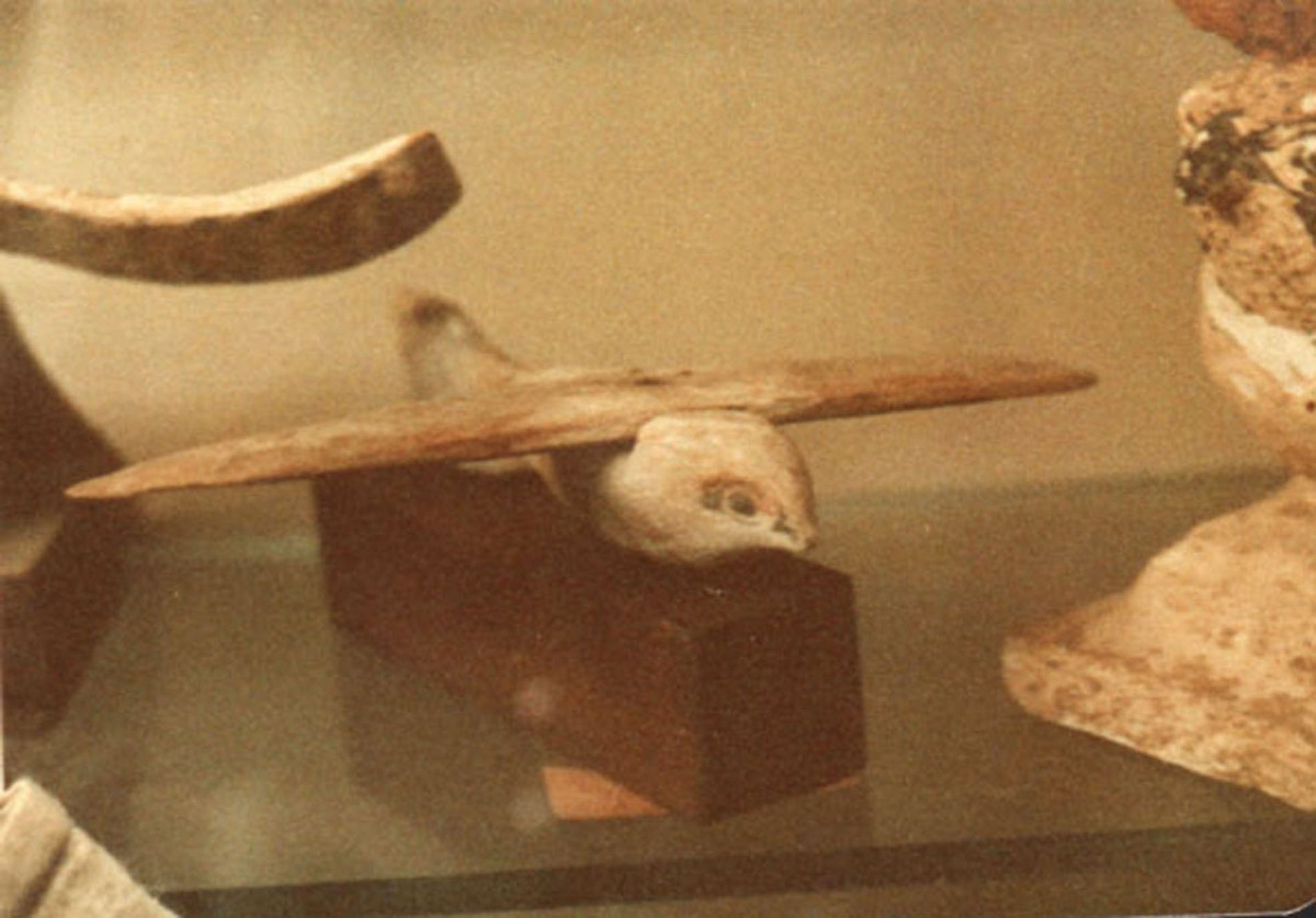
In 1898, Egyptian Antiquities Service field staff excavating at Saqqara, the vast necropolis south of Cairo that hosts the Step Pyramid of Djoser, recovered a small carved wooden bird figure from the Ptolemaic-era tomb of Pa-di-Imen. Cut from sycamore wood, roughly 14 centimeters long with an 18-centimeter wingspan and weighing under 40 grams, the object was catalogued at the Egyptian Museum in Cairo as an unremarkable bird statuette and sat in storage for some seven decades. In 1969, physician and lifelong model-aircraft hobbyist Khalil Messiha examined the piece and noticed features he considered aeronautical rather than ornithological — no legs, no painted feather detail, a flat and broken lower tail edge, and wings set stiffly perpendicular to a smooth, airfoil-like body. In 1972 he announced his conclusion: that the object was a scale model of an ancient glider, proof that Ptolemaic-era Egyptians possessed real aerodynamic knowledge millennia ahead of the Wright brothers. Messiha built a balsa-wood replica and flew it by hand — after adding a horizontal tailplane he believed had broken off the original and been lost, a component that does not exist on, and is not structurally evidenced by, the artifact as actually excavated. The claim has since been cited by ancient-astronaut and Afrocentric-pseudoscience writers alike as evidence of lost ancient aeronautics. Faithful replicas built to the object's real, finless dimensions do not fly stably; a 2023 peer-reviewed computational fluid dynamics study of a high-precision 3D scan reached the same conclusion by different means. The Egyptological mainstream reads the object as a stylized wooden bird figurine, consistent with well-documented Ptolemaic-era art conventions — most likely a votive object representing a falcon deity such as Horus, or a masthead ornament from the mast of a sacred ceremonial boat.
Theoretical Alignment
This file sits closer to the Piri Reis map than to the Baghdad Battery among this site's other Ancient Records entries built on a real, catalogued artifact. The Baghdad Battery involves a genuinely open, narrow research question layered underneath a rejected popular claim — functioning replicas really do produce voltage, and a live peer-reviewed literature keeps asking what that means. The Saqqara Bird does not have that kind of narrow, live remainder. The core claim — that Ptolemaic-era Egyptians built and flew glider aircraft, evidenced by this specific object — rests on a single, decisive, checkable physical fact: the tail fin that makes Khalil Messiha's replica fly does not exist on, and is not structurally evidenced by, the artifact as it was actually excavated. Every subsequent technical test of a faithful, finless replica has failed to reproduce stable gliding flight, most recently and rigorously in a 2023 peer-reviewed computational fluid dynamics study of a high-precision 3D scan of the real object. Egyptology's own reading of the object as a stylized bird figurine, meanwhile, sits comfortably within an extremely well-documented, independently attested category of Ptolemaic-era religious and ceremonial art. This is a case, like Piri Reis, where representing the popular claim's own best argument fairly is still consistent with a clean, well-supported verdict against it.
Sensor & Instrumentation Detection Profile
As with every entry in this site's Ancient Records series, there is no modern sensor record of the object in use; the entire evidentiary record consists of the excavated figure itself, the woodworking and carving conventions available to its Ptolemaic-era makers, and the modern replication and simulation experiments researchers have since built to test what its actual, as-excavated form can and cannot do in the air. The object's own construction is well documented and largely uncontroversial: a single piece of carved and smoothed sycamore wood (Ficus sycomorus, a common ancient Egyptian carving timber), roughly 14.2 centimeters long in the body, with a separately carved pair of wings spanning about 18 centimeters mounted rigidly perpendicular to the fuselage rather than in the folded or upswept posture typical of naturalistic Egyptian bird sculpture, a smooth, curved cross-section to both body and wings, a downturned, hooked beak carved in the manner conventional for falcon-headed figures, no legs or feet (the figure instead terminates in a short stem or dowel socket, consistent with mounting atop a pole or standard), no surviving painted plumage or feather detail, and a flat, damaged lower tail edge with no attachment points for any separate component identified by later structural examination.
The modern "instrumentation" record is a sequence of independent replication and simulation attempts, each testing a different piece of the claim. Khalil Messiha himself built the first replica around 1972, working in lightweight balsa wood rather than the original's sycamore and adding a horizontal tailplane at the tail he believed had broken away in antiquity; thrown by hand, his augmented model reportedly achieved a brief, unpowered glide. A televised 2000s test, built by aerodynamicist Simon Sanderson for a documentary production and later subjected to wind-tunnel measurement and a University of Liverpool flight-simulator trial, found that a tailless replica held stable only by support cables generated roughly four times its own weight in lift but was inherently unstable in free flight; once a tailplane comparable to Messiha's was fitted and the model was run through simulated ancient-Egyptian wind conditions, the production reported it flew successfully — a result that, like Messiha's own test, depends entirely on the added tail component and was never independently published or peer-reviewed. Working from the object's real, unmodified dimensions instead, professional glider and light-aircraft designer Martin Gregorie built a precise balsa-wood replica in 2002 and reported it was "totally unstable without a tailplane," and that even after fitting a tailplane to test the augmented claim on its own terms, "the glide performance was disappointing." Most recently and most rigorously, aerospace researchers Michel Zierow and Leon Lesemann produced a high-precision 3D photogrammetric scan of the actual artifact and ran a full computational fluid dynamics simulation across a range of angles of attack using ANSYS Fluent, publishing their results in the peer-reviewed journal Acta Mechanica et Automatica in 2023. Their findings directly contradict the glider claim on the object's own, real geometry: a low maximum glide ratio, a center of gravity positioned far aft — near the wing's trailing edge and behind the aerodynamic neutral point — producing longitudinal instability that does not meet basic modern glider stability requirements, and an asymmetric lift distribution across the wings that would drive the model into an uncontrolled roll rather than level flight. None of the pro-glider tests, including Messiha's own, has ever tested the object as it was actually excavated; every one of them modifies it first by adding the tail component that is the entire basis of the claim's flight performance.
Environmental & Geospatial Context
The figure was recovered at Saqqara, one of ancient Egypt's largest and most continuously used necropoleis, in active use as a burial ground for more than three thousand years and sited immediately adjacent to Memphis, Egypt's traditional administrative capital through much of its ancient history. This was not a marginal or poorly attested cultural context: Saqqara's Ptolemaic-era burials, including the tomb of Pa-di-Imen, belong to a well-documented final phase of pharaonic-style funerary and votive practice, contemporary with the wider Hellenistic-influenced but still deeply traditional religious culture of Ptolemaic Egypt (332–30 BCE). That context matters directly to this file's central debate: the wider archaeological and art-historical record of this period is unusually rich in exactly the categories of object Egyptology's own reading proposes the Saqqara Bird belongs to. Falcon-form imagery, representing the god Horus and the composite solar deity Ra-Horakhty among other divine figures, is one of the single most common motifs in Ptolemaic-era votive, funerary, and temple art, appearing on amulets, coffin decoration, temple reliefs, and free-standing votive statuary in enormous quantity. Bird-headed masthead finials mounted atop the masts of sacred processional boats, meanwhile, are independently attested in temple relief: carved scenes in the Temple of Khonsu at Karnak depict the sacred barques used in festival processions such as the Opet Festival under sail, their masts topped with bird-form ornaments closely comparable in general form to the Saqqara figure. A culture already producing large quantities of exactly this category of stylized bird-form ritual and ceremonial object is the environment the mainstream reading places the Saqqara Bird in; a culture that had independently discovered heavier-than-air glider aerodynamics with no other surviving trace of that knowledge anywhere in its enormous artistic, architectural, administrative, and religious textual record is the environment the glider claim requires, with nothing else in the wider Egyptological record to support the latter.
Modern institutional and excavation conditions have compounded the uncertainty around some of this object's specifics in a way better-documented sites elsewhere in this site's Ancient Records archive have not experienced. The individual excavator responsible for the 1898 Saqqara season in which the Pa-di-Imen tomb was opened is not reliably identified in the sources examined for this file; some later popular accounts describe the dig loosely as the work of "a French archaeologist," consistent with the general period in which French Egyptologist Victor Loret directed the Egyptian Antiquities Service (1897–99) and personally led excavation work elsewhere at Saqqara, but no source located for this file directly credits Loret, or any other specific named individual, with this particular tomb, and this file does not assert that connection as established fact. That gap is itself unremarkable and typical of the more routine, lower-profile excavation seasons of the era — the object was catalogued as an ordinary bird statuette and drew no scholarly attention for roughly seven decades, a strong independent indicator that nothing about its original excavation or cataloguing struck contemporary Egyptologists as unusual.
Observer Credibility & Occupational Profile
Khalil Messiha (1924–1998) was a real, credentialed Egyptian physician who also held a position as Professor of Anatomy for Artists at Helwan University in Cairo, and a genuine, lifelong aeromodeling hobbyist — a member of both the Royal Aeromodellers Club and the Egyptian Aeronautical Club. That combination gave him real, practical hands-on model-aircraft-building experience, which is precisely the background that led him to notice the artifact's non-naturalistic proportions in the first place, a reasonable observation to make and to want tested. It is also, notably, a record with no formal training in Egyptology, archaeology, art history, or aerospace engineering behind it; his 1972 announcement and subsequent 1980 academic-adjacent publication were not peer-reviewed within either the Egyptological or aeronautical-engineering fields whose combined expertise the claim actually requires to evaluate, and he never subjected a faithful, unmodified replica of the object to the same test he ran on his own tail-augmented version.
The modern research record contesting that claim is, by contrast, built substantially from within the two specialist fields the claim itself implicates. Richard P. Hallion, a credentialed aviation historian with a Ph.D. in history from the University of Maryland, a founding curatorship at the Smithsonian's National Air and Space Museum, historian posts at NASA and the U.S. Air Force, and command of the USAF History and Museums Program, directly addressed and rejected the glider claim in his 2003 Oxford University Press survey of pre-modern flight, Taking Flight, concluding the object as excavated is "far too heavy and unstable itself to fly." Martin Gregorie, a professional glider and light-aircraft designer, tested the claim hands-on in exactly the discipline Messiha's own claim rested on, building to the artifact's real dimensions rather than its augmented ones. And on the aerodynamic-engineering side proper, Michel Zierow and Leon Lesemann's 2023 study in the peer-reviewed journal Acta Mechanica et Automatica applied modern computational fluid dynamics, the same category of tool used to certify real aircraft designs, directly to a high-precision scan of the actual artifact. On the archaeological and public-science-education side, Bernard Ortiz de Montellano, an emeritus professor of anthropology at Wayne State University with a Ph.D. in organic chemistry and decades of peer-reviewed publication in medical anthropology, examined the claim's use in public education directly and in detail. Every substantive voice contesting the glider interpretation, in other words, holds a real, checkable credential in aviation history, aeronautical/aerospace engineering, professional glider design, or anthropology — a markedly different credibility profile than the claim's own primary popularizers.
Historical Precedents & Archive Matches
Two kinds of precedent bear directly on this file. The first is internal to this site's own Ancient Records archive: the Saqqara Bird joins the Piri Reis map as a real, physically documented artifact around which a specific "lost advanced technology" reading has grown up, and which is rejected cleanly and decisively by the specialists who actually study the relevant field — unlike the Baghdad Battery, which retains a genuine, narrower open research question underneath its rejected popular claim, this file's central physical fact (no tail fin on the original) resolves the core dispute about as cleanly as Piri Reis's ice-core data resolves its own.
The second, more directly probative precedent is external and specifically documented within the history of pseudo-Egyptology itself: the Saqqara Bird's promotion did not stay confined to fringe ancient-astronaut publishing. Hunter Havelin Adams III, an industrial-hygiene technician whose highest academic credential is a high school diploma despite representing himself as a research scientist affiliated with Argonne National Laboratory, authored the science portion of the Portland, Oregon public school district's 1987 "African-American Baseline Essays," a curriculum document distributed to teachers and schoolchildren, which cited the Saqqara Bird as evidence that ancient Egyptians had built and flown full-size gliders roughly 4,000 years ago "for travel, expeditions, and recreation." That claim, and others in the same essay, drew sustained and detailed criticism through the early 1990s, most notably from Bernard Ortiz de Montellano's 1991 Skeptical Inquirer article "Multicultural Pseudoscience: Spreading Scientific Illiteracy Among Minorities" and a 1993 Yearbook of Physical Anthropology follow-up, and separately by science-studies scholars Norman Levitt and Paul R. Gross in their 1994 book Higher Superstition, which examines the Baseline Essays controversy as a case study in how thinly-sourced claims can enter public science curricula when institutional review is weak. The episode is a rare case where this exact artifact's misuse became the subject of its own peer-reviewed and popular-science literature, entirely apart from the object's own archaeological interpretation.
Historical Background
The 1898 Excavation at Saqqara
Saqqara is among the largest and longest-used necropoleis in ancient Egypt, in continuous use as a burial ground for more than three millennia and home to the Step Pyramid of Djoser, generally considered the earliest large-scale cut-stone building in history. Egyptian Antiquities Service field staff working the site's 1898 season opened the tomb of a man named Pa-di-Imen, one of many Ptolemaic-era burials at Saqqara from a period when the necropolis remained in active religious and funerary use despite Egypt's political incorporation into the Hellenistic Ptolemaic kingdom. Among the tomb's contents was a small carved wooden bird figure, which entered the Egyptian Museum's collection shortly afterward and was assigned the catalogue numbers by which it is still known today: Journal d'entrée (accession register) number JE 33109, and Special Register number SR 4/6347, commonly abbreviated in later literature simply as "no. 6347." The object was catalogued and displayed as an ordinary bird statuette, one among many similar Egyptian bird-form figurines and votive objects in the museum's holdings, and drew no particular scholarly attention for roughly the next seventy years — itself a modest but real piece of evidence that nothing about its original excavation, documentation, or initial identification struck contemporary museum staff and visiting Egyptologists as anomalous.
The Ptolemaic period itself runs from Alexander the Great's conquest of Egypt in 332 BCE to the death of Cleopatra VII and Roman annexation in 30 BCE, roughly three centuries during which a Greek-Macedonian ruling dynasty presided over a still-thriving native Egyptian religious and artistic culture, funding and maintaining traditional temple cults, funerary practice, and votive art alongside its own Hellenistic institutions. Because the Saqqara Bird carries no inscription of its own, its date rests on stylistic comparison with other, better-contextualized objects from the same broad tomb assemblage and period rather than on any direct textual evidence — the commonly cited "c. 200 BCE" figure sits comfortably within this three-century range but should be read as an approximate, style-based placement rather than a precisely fixed date, the same evidentiary standard routinely applied to undecorated wooden minor objects from securely Ptolemaic-era burial contexts elsewhere in Egypt.
Messiha's 1969 Re-Examination and 1972 Announcement
Khalil Messiha, an Egyptian physician who also taught anatomy to art students at Helwan University and belonged to two aeromodeling clubs as a hobbyist, encountered the object during a 1969 visit to the Egyptian Museum's bird-figurine displays. Drawing on his own experience building and flying scale model aircraft, Messiha noticed a cluster of features he considered inconsistent with ordinary Egyptian bird sculpture: the object lacked legs and feet entirely, terminating instead in a mounting stem; it carried no painted plumage or feather detail, unlike many decorated Egyptian bird figures; its wings were fixed stiffly perpendicular to the body rather than folded or swept in a naturalistic resting posture; its body and wings shared a smooth, curved, airfoil-like cross-section; and its tail ended in a flat, damaged lower edge that Messiha interpreted as evidence a separate stabilizing tailplane had originally been attached there and had broken off and been lost sometime in the roughly 2,200 years since the object was made and buried. He brought his observations to the Egyptian Ministry of Culture, securing permission for closer technical examination of the object, and in 1972 publicly announced his conclusion that it represented a scale model of a functional ancient glider — direct physical evidence, he argued, that Ptolemaic-era Egyptians possessed real, empirically derived aerodynamic knowledge millennia before the Wright brothers' 1903 first flight. He constructed a lightweight balsa-wood replica matched to the original's overall dimensions, added a horizontal tailplane at the point where he believed the missing component had been, and reported that the model achieved brief, stable, unpowered glides when launched by hand.
Formal Publication and the Wider Reception
Messiha's claim first reached a general readership through a 1972/73 article credited to "Messiha, Hishmat" (a name variant of, or close relation to, Khalil Messiha in the surviving bibliographic record) titled "Flying in Ancient Egypt," published in Egypt Travel Magazine, a Cairo tourism-ministry publication rather than an academic or peer-reviewed venue. A more developed version of the argument appeared later under Khalil Messiha's own name as "African Experimental Aeronautics: A 2000 Year Old Model Glider," first in the Journal of African Civilizations in 1980 and reprinted in 1983 within Ivan Van Sertima's edited volume Blacks in Science: Ancient and Modern — placing the claim, deliberately, within an Afrocentric historiographical framework arguing for underrecognized African scientific achievement, a framing that would carry the claim into the 1987 Portland "Baseline Essays" controversy documented above in this file's Historical Precedents section. From there the claim spread widely through ancient-astronaut and pseudo-Egyptology publishing more broadly, part of the same popular literature that has, across decades, promoted the Tulli Papyrus and other claimed ancient-technology artifacts as evidence for lost or externally granted advanced knowledge — a literary tradition Erich von Däniken's 1968 Chariots of the Gods? did more than any other single work to popularize, and to which David Hatcher Childress's Adventures Unlimited Press catalogue, including his own survey of claimed ancient flying technology in Technology of the Gods, substantially belongs.
Complete Timeline
| Date | Event |
|---|---|
| c. 332–30 BCE | Ptolemaic period; the Saqqara Bird is conventionally dated within this range, most often cited more narrowly as c. 200 BCE. |
| 1898 | Egyptian Antiquities Service field staff excavate the tomb of Pa-di-Imen at Saqqara, recovering the wooden bird figure among the tomb's contents. |
| 1898–1969 | The object is catalogued at the Egyptian Museum, Cairo (JE 33109 / SR 4/6347) as an ordinary bird statuette and draws no particular scholarly attention for roughly seven decades. |
| 1969 | Khalil Messiha, an Egyptian physician and hobbyist aeromodeler, examines the object at the museum and identifies features he considers aeronautical. |
| 1972 | Messiha publicly announces his glider hypothesis and builds a tail-augmented balsa-wood replica that he reports glides successfully when hand-launched; a popular account appears the same year/1973 in Egypt Travel Magazine. |
| 1980 | Messiha's fuller academic-adjacent case, "African Experimental Aeronautics: A 2000 Year Old Model Glider," appears in the Journal of African Civilizations. |
| 1983 | The paper is reprinted in Ivan Van Sertima's edited volume Blacks in Science: Ancient and Modern, situating the claim within Afrocentric historiography. |
| 1987 | Hunter Havelin Adams III cites the Saqqara Bird as evidence of full-size ancient Egyptian gliders in the science section of Portland, Oregon's "African-American Baseline Essays," distributed to public school teachers and students. |
| 1991 | Bernard Ortiz de Montellano publishes "Multicultural Pseudoscience: Spreading Scientific Illiteracy Among Minorities" in Skeptical Inquirer, directly rejecting Adams's use of the artifact. |
| 1993 | Ortiz de Montellano publishes a follow-up critique, "Melanin, Afrocentricity, and Pseudoscience," in the Yearbook of Physical Anthropology. |
| 1994 | Norman Levitt and Paul R. Gross discuss the Baseline Essays controversy, including the Saqqara Bird claim, in Higher Superstition: The Academic Left and Its Quarrels with Science. |
| 2002 | Glider designer Martin Gregorie builds a balsa-wood replica matched to the object's real, finless dimensions and reports it is "totally unstable without a tailplane." |
| 2003 | Aviation historian Richard P. Hallion addresses and rejects the glider claim in Taking Flight: Inventing the Aerial Age (Oxford University Press). |
| Mid-2000s | A televised wind-tunnel and flight-simulator test (Simon Sanderson, with the University of Liverpool) finds a bare replica unstable without a tail, and reports successful flight once a tailplane is added — a result never independently published or peer-reviewed. |
| 2023 | Michel Zierow and Leon Lesemann publish a peer-reviewed computational fluid dynamics study of a high-precision 3D scan of the actual artifact in Acta Mechanica et Automatica, finding the object as excavated is aerodynamically unstable and cannot glide. |
The Primary Source Document
Messiha's Own Description of the Artifact
"The body is made of the same wood as the wings and has an aerofoil shape beautifully carved and smooth... The vertical tail is slightly slanting towards the right when looked at from the back."
Khalil Messiha, describing the artifact's carving and proportions, as reproduced across secondary accounts of his 1972 examination and 1980 published paper
This passage is worth reading closely, because Messiha's own description already contains the interpretive move his later popularizers most often flatten into simple fact: an "aerofoil shape" is Messiha's own characterization of a smoothly carved wooden cross-section, not an independently measured aerodynamic property, and the "vertical tail" he describes is the object's real, original, flat and undamaged-in-that-respect tail fin as carved — not the separate horizontal stabilizing tailplane he added afterward to his balsa replica and which is the actual, tested source of any reported gliding performance. Later researchers examining the object directly, including Martin Gregorie in 2002, found no structural evidence of an attachment point, socket, or fastening mechanism at the tail consistent with a lost separate horizontal component, a detail Messiha's own popular accounts do not resolve.
The 2023 Aerodynamic Study's Own Findings
Michel Zierow and Leon Lesemann's peer-reviewed paper, working from a high-precision photogrammetric 3D scan of the real artifact rather than a hand-built approximation, reports that the object's center of gravity sits far aft — near the wing's trailing edge and behind the aerodynamic neutral point — producing pitch instability, and that its lift distribution across the wingspan is asymmetric in a way that would drive an uncontrolled roll rather than level flight, concluding directly that "the connection between the Bird of Saqqara and an alleged knowledge of aerodynamics in ancient Egypt could not be confirmed." This is the single most rigorous primary technical document on either side of the claim, and it is unambiguous.
Confirmed Institutional & Archival Holdings
The peer-reviewed computational fluid dynamics study, based on a high-precision 3D scan of the real artifact, that found the object as excavated cannot glide stably.
PEER-REVIEWED ACADEMIC RECORDThe bibliographic record for Messiha's own fullest published statement of the glider hypothesis, indexed via AfricaBib's academic African-studies bibliography.
ACADEMIC BIBLIOGRAPHIC RECORDThe peer-engaged critique directly examining the Saqqara Bird's use as evidence of ancient Egyptian gliders in the 1987 Portland Baseline Essays.
PEER-REVIEWED SKEPTICAL LITERATUREThe public-domain front-view photograph of the actual artifact used as this file's hero image, released by Dawoud Khalil Messiha.
PUBLIC DOMAIN MEDIA RECORDSearch Institutional & Academic Archives Directly
Evidence Assessment
Supporting the Object's Real, Documented Physical Properties
- The object's construction, materials, dimensions, and excavation context are independently documented by Messiha's own description, museum catalogue records, and a 2023 high-precision 3D scan
- The artifact's non-naturalistic proportions — no legs, no painted plumage, rigid perpendicular wings, a smooth carved cross-section — are real and worth explaining, whichever explanation is correct
- Falcon-form votive iconography and sacred-barque masthead ornaments comparable in general form are independently attested elsewhere in the same Ptolemaic-era Egyptian art record
Undermining the "Functional Ancient Glider" Interpretation Specifically
- The original artifact, as excavated, has no tail fin or stabilizer of any kind; the flight performance reported in every pro-glider replica depends entirely on a component added afterward by the replica-builder, not present on the object itself
- No attachment points, sockets, or fastening evidence for a separate tail component have been identified on the original by structural examination
- A 2023 peer-reviewed computational fluid dynamics study of the real object's own geometry found it aerodynamically unstable and incapable of stable glide
- No other Egyptian archaeological, architectural, or textual evidence attests to ancient aeronautical or glider-testing knowledge anywhere else in an exceptionally well-documented three-thousand-year civilization
Comparative Analysis
A Genuinely Non-Naturalistic Object, Explained Two Different Ways
One piece of context is worth stating plainly, because it cuts against a purely dismissive reading without supporting the glider claim either: the Saqqara Bird really is unusual among surviving Egyptian bird figurines. Its legless form, unpainted surface, rigid perpendicular wings, and smooth carved cross-section do genuinely set it apart from many more naturalistic Egyptian bird sculptures, and Khalil Messiha's original observation that the object looked different from typical bird statuary was not itself unreasonable or dishonest. Where the claim breaks down is not in noticing the object is stylized, but in inferring from that stylization a specific, testable technological capability — stable glider flight — that the object's own real geometry, independently tested twice by two different methods more than twenty years apart (Gregorie's 2002 replica, Zierow and Lesemann's 2023 simulation), does not support. A legless, unpainted, stiff-winged bird figure with a downturned falcon-style beak is fully and independently explained by well-documented Egyptian religious and ceremonial art conventions, without requiring any aeronautical intent at all.
The Pattern Elsewhere on This Site
Compared to the Baghdad Battery, this file resolves more cleanly, in the direction of the Piri Reis map. The Baghdad Battery's underlying electrochemical property is not itself in dispute — only its ancient purpose and intentionality remain genuinely debated within specialist literature. The Saqqara Bird's underlying aerodynamic property is exactly what is in dispute, and it has now been tested directly, on the object's own real geometry, by a peer-reviewed engineering method purpose-built to answer exactly that question. That is a meaningfully different, more decisive evidentiary situation than Baghdad's, and this file's stamp reflects that difference.
Material Analysis: The Wood, the Carving, and the Missing Tail
The surviving physical description of the object — recorded by Messiha himself, confirmed by the object's ongoing public display at the Egyptian Museum, and most recently captured in Zierow and Lesemann's 2023 high-precision 3D scan — documents a single piece of carved sycamore wood, a common and unremarkable ancient Egyptian carving timber requiring no exotic sourcing or technique to explain. The body's smooth, curved cross-section, which Messiha and later proponents characterize as an "aerofoil shape," is fully consistent with the general aesthetic conventions of Egyptian minor sculpture, in which smoothly finished, simplified forms were routine, without requiring any understanding of aerodynamic lift to produce. The wings' rigid, perpendicular mounting, unusual next to more naturalistic Egyptian bird carvings, has a real, simpler explanation within the proposed masthead-ornament and votive-object readings: an object meant to be seen from below, mounted atop a pole, standard, or ship's mast, benefits from wings held out flat and visible rather than folded against the body in a resting posture, exactly the display logic a ceremonial or processional object would call for. The absence of legs and feet, far from being anomalous, matches the object's evident mounting method: a stem or dowel socket in place of legs is the ordinary, practical way to fix a small carved finial atop a pole.
Consistent with a Stylized Ptolemaic-Era Votive or Ceremonial Bird Figure
- Sycamore wood and simplified, smoothly finished carving are standard period Egyptian minor-sculpture materials and techniques
- Rigid, outstretched wings and a leg-free mounting stem both match a pole- or masthead-mounted display object better than a naturalistic resting bird
- Directly comparable falcon-form votive iconography and bird-headed sacred-barque masthead ornaments are independently attested in the same period's temple relief and votive-art record
No Physical Trace Supporting a Deliberately Engineered Flying Model
- No attachment points, sockets, or fastening evidence for a separate tail component exist on the original object
- The object's real center of gravity and wing-lift distribution, measured directly from a 2023 3D scan, produce pitch instability and uncontrolled roll rather than stable glide
- No large-scale prototype, wind-tunnel-adjacent test artifact, or any other physical or textual evidence of ancient Egyptian aeronautical experimentation has ever been recovered anywhere in the region's archaeological record
The Ancient-Technology Interpretation
Khalil Messiha's 1972 hypothesis argued that the artifact's non-naturalistic proportions — legless form, unpainted surface, rigid perpendicular wings, smooth airfoil-like cross-section, and a flat, damaged tail edge he read as evidence of a lost stabilizing tailplane — together indicated a deliberately engineered scale model of a functional glider, built by Ptolemaic-era Egyptians who had independently discovered real aerodynamic principles. His own test of the claim added the missing tailplane to a lightweight balsa-wood replica and reported successful hand-launched gliding flight, which he took as confirmation. The claim reached a wider readership through his 1980 Journal of African Civilizations paper and its 1983 reprint in Ivan Van Sertima's Blacks in Science: Ancient and Modern, and from there into two overlapping but distinct popular traditions: ancient-astronaut and "lost advanced technology" publishing broadly, of the kind Erich von Däniken's 1968 Chariots of the Gods? did more than any other single work to popularize and which David Hatcher Childress's Adventures Unlimited Press catalogue has continued since; and Afrocentric historiography arguing for underrecognized African scientific achievement, the framing Messiha's own 1983 republication invited and which Hunter Havelin Adams III carried directly into the 1987 Portland "African-American Baseline Essays," asserting on the strength of this single object that ancient Egyptians had built and flown full-size gliders roughly 4,000 years ago "for travel, expeditions, and recreation" — a claim distributed to public school teachers and children that substantially overstated even Messiha's own, already-disputed model-scale argument.
A televised test, conducted for a documentary production by aerodynamicist Simon Sanderson and involving wind-tunnel measurement and a University of Liverpool flight-simulator trial, represents the most technically elaborate modern attempt to support the claim. Reported results describe a tailless replica, held stable only by support cables, generating roughly four times its own weight in lift in the wind tunnel, and a tailplane-equipped version subsequently flying successfully under simulated ancient-Egyptian wind conditions in the flight simulator. Considered on its own terms, this is a genuinely more sophisticated test than Messiha's hand-thrown balsa model. It is also, on the central factual question this file turns on, no different from Messiha's own test in one critical respect: both add a tail component to the model before testing it, rather than testing the object's real, as-excavated form. Neither test was independently published in a peer-reviewed venue, and the production framed its own conclusion — "modern technology has proved beyond doubt that it could have flown" — in terms that elide the tail-addition step entirely.
The Mainstream Egyptological Interpretation
The Votive Figurine and Masthead-Ornament Case
The dominant explanation among Egyptologists reads the object as a stylized wooden bird figure, most likely serving one of two closely related ceremonial functions well attested elsewhere in Ptolemaic-era Egyptian material culture. The first is a votive or cult object representing a falcon deity — most commonly identified with Horus, though the composite solar deity Ra-Horakhty and other falcon-form divine figures are also plausible candidates — consistent with the sheer ubiquity of falcon iconography across Ptolemaic-era amulets, coffin decoration, temple relief, and free-standing votive statuary. The second is a masthead or finial ornament, mounted atop the mast of a sacred ceremonial boat used in temple processions; reliefs in the Temple of Khonsu at Karnak depict exactly this kind of bird-form masthead finial on the sacred barques carried in festival processions such as the Opet Festival, providing real, independently dated comparanda for the general form. The Opet Festival itself was one of ancient Egypt's major annual religious events, in which portable divine images were carried by boat and in procession between the temples of Karnak and Luxor; sacred barques used in processions of this kind were elaborately decorated ceremonial vessels, often carried on the shoulders of priests along a fixed processional route rather than sailed on open water, with bird- and other divine-form finials mounted at the bow, stern, or masthead as part of their standard decorative program — a well-attested category of Egyptian temple furniture entirely independent of, and considerably better evidenced than, the glider hypothesis. Secondary, less-favored explanations proposed in the literature include an elite child's toy and a weathervane, both consistent with the object's small size and pole-mountable form without requiring any aeronautical intent.
Why the Non-Naturalistic Features Do Not Require an Aeronautical Explanation
Each of the features Messiha identified as aeronautical has a more economical explanation within the votive/masthead reading. The absence of legs and feet matches a mounting stem for a pole- or mast-fixed ornament, not a design decision related to flight. The rigid, perpendicular wing posture suits an object meant to be seen clearly from below or at a distance during a procession, rather than a naturalistic resting bird. The smooth, unpainted, curved carving is consistent with the broader Egyptian minor-sculpture convention of simplified, stylized forms, seen across many bird-form votive and ceremonial objects that no one proposes were aeronautical. And the downturned, hooked beak Messiha and later proponents cite as aerodynamically shaped is, more simply, the standard convention for representing a falcon's head in Egyptian art of this and earlier periods — the same beak shape appears on countless unambiguously non-aeronautical falcon-form amulets, statuary, and hieroglyphic determinatives across the whole span of ancient Egyptian art.
The Direct Technical Rebuttals
Beyond the art-historical reading, the glider claim has been directly and repeatedly tested and rejected on its own aeronautical terms. Aviation historian Richard P. Hallion, in his 2003 Oxford University Press survey of pre-modern flight claims, Taking Flight, states plainly that the object as excavated is "far too heavy and unstable itself to fly." Professional glider designer Martin Gregorie built a precise balsa-wood replica in 2002 matched to the artifact's real, finless dimensions and reported it "totally unstable without a tailplane," with disappointing glide performance even once a tailplane was added to test the augmented claim fairly. Most decisively, Michel Zierow and Leon Lesemann's 2023 peer-reviewed computational fluid dynamics study, working from a high-precision 3D scan of the real object, found a far-aft center of gravity behind the aerodynamic neutral point and an asymmetric wing-lift distribution producing uncontrolled roll, concluding that "the connection between the Bird of Saqqara and an alleged knowledge of aerodynamics in ancient Egypt could not be confirmed." Taken together, an aviation historian, a professional glider designer, and a peer-reviewed aerospace-engineering study — three independent methods across three different decades — all reach the same conclusion working from the object's own real, unmodified geometry.
The Baseline Essays Episode as Its Own Case Study
Bernard Ortiz de Montellano, an emeritus professor of anthropology at Wayne State University, examined Hunter Havelin Adams III's use of the Saqqara Bird in the 1987 Portland "African-American Baseline Essays" directly, in a 1991 Skeptical Inquirer article and a 1993 Yearbook of Physical Anthropology follow-up, arguing that overstating thinly-sourced claims like this one in the name of minority science education ultimately undermined rather than served that goal. Science-studies scholars Norman Levitt and Paul R. Gross discuss the same episode in their 1994 book Higher Superstition: The Academic Left and Its Quarrels with Science as a case study in how weak institutional review let an unverified archaeological claim enter public school curricula distributed to teachers and children. This episode is a rare instance of a specific artifact's misinterpretation generating its own dedicated peer-reviewed and popular-science rebuttal literature, entirely apart from the object's ordinary Egyptological interpretation.
Five Observables Assessment
The Five Observables framework, developed decades later by former AATIP director Luis Elizondo to classify modern UAP performance characteristics that exceed known technology, is included here for structural consistency with the rest of OverClassified's case files, but does not meaningfully apply to a static, excavated wooden figure with no flight characteristics, propulsion signature, or direct observational encounter of any kind.
Assessment: As with this site's other pre-modern and artifact-based files, the Five Observables framework is the wrong instrument here. Its inclusion should not be read as suggesting genuine exotic-performance or non-human-technology evidence exists for this case.
Conventional Explanation Candidates
Four candidates are assessed below.
Votive/Cult Figure of a Falcon Deity (Horus or Ra-Horakhty)
Highly PlausibleThe leading explanation among Egyptologists: a stylized wooden figure representing a falcon deity, consistent with the sheer ubiquity of falcon iconography in Ptolemaic-era votive, funerary, and temple art, and with the object's downturned falcon-style beak, a standard convention appearing across countless unambiguously non-aeronautical falcon-form objects of the period.
Sacred-Boat Masthead Ornament
PlausibleA specific proposed function within the broader stylized-figurine reading, supported by real comparanda: reliefs in the Temple of Khonsu at Karnak depict bird-form masthead finials on the sacred barques used in festival processions such as the Opet Festival, closely matching the Saqqara figure's general form and pole-mountable design.
Child's Toy or Weathervane
InconclusiveSecondary explanations proposed in the literature, consistent with the object's small size and pole-mountable form, but with less direct comparative evidence than the votive-figure or masthead-ornament readings. Not mutually exclusive with a ceremonial origin later put to a secondary practical use.
Functional Ancient Glider Model (Messiha, 1972)
ImplausibleContradicted on multiple independent grounds: the tail fin that makes any replica fly is entirely absent from the original object, with no attachment evidence for one ever having existed; a 2023 peer-reviewed computational fluid dynamics study of the real artifact's own geometry found it aerodynamically unstable; and no other Egyptian archaeological or textual evidence attests to ancient aeronautical knowledge anywhere else in an exceptionally well-documented civilization. No working aviation historian, professional glider designer, or aerospace engineer who has directly tested the object's real, unmodified form endorses this reading.
Why "Debunked"
This file receives a DEBUNKED classification, the same verdict this site applied to the Piri Reis map's ice-free Antarctica claim and a stronger verdict than the Baghdad Battery's DISPUTED stamp, and deliberately so: unlike Baghdad, where a real, unresolved electrochemical research question survives underneath a rejected popular claim, this file's core dispute turns on a single physical fact that is not itself contested by anyone who has examined the object — the artifact, as excavated in 1898 and as it sits today in the Egyptian Museum, has no tail fin, no stabilizer, and no structural evidence that one was ever attached. Every reported successful "flight" of a Saqqara Bird replica, from Khalil Messiha's own 1972 balsa model through the mid-2000s televised wind-tunnel test, depends entirely on a tail component added by the replica-builder, not present on, or evidenced by, the real object. When faithful replicas built to the artifact's actual, unmodified dimensions have been tested — by professional glider designer Martin Gregorie in 2002, and by Michel Zierow and Leon Lesemann's 2023 peer-reviewed computational fluid dynamics simulation of a high-precision 3D scan — both independently found the object aerodynamically unstable and incapable of stable flight. Egyptology's own reading, meanwhile, requires no exotic explanation at all: a legless, unpainted, rigid-winged wooden bird figure with a falcon-style beak matches well-documented Ptolemaic-era votive and ceremonial art conventions directly, with real comparative evidence (Karnak's own temple reliefs) for the specific masthead-ornament function. No credentialed Egyptologist, aviation historian, professional glider designer, or aerospace engineer who has examined the real object endorses the glider interpretation. The claim's persistence owes far more to its repeated promotion across ancient-astronaut and, in the specific 1987 Portland Baseline Essays episode, Afrocentric-pseudoscience publishing — both of which added the missing tail before ever testing the object — than to any genuine, still-open evidentiary question about the artifact itself.
Related Entries
Further Reading — Recommended Literature
Taking Flight: Inventing the Aerial Age, from Antiquity Through the First World War
A credentialed aviation historian's survey of pre-modern flight claims, addressing the Saqqara Bird directly and situating it within the broader history of aeronautical myth and genuine early flight experimentation.
Higher Superstition: The Academic Left and Its Quarrels with Science
Examines the 1987 Portland "African-American Baseline Essays" controversy, including the Saqqara Bird's use as evidence of ancient Egyptian gliders, as a case study in weak institutional review of scientific claims.
The Complete Gods and Goddesses of Ancient Egypt
A reference survey of Egyptian divine iconography, including the falcon-form imagery of Horus and Ra-Horakhty central to this file's votive-figurine reading of the Saqqara Bird.
The Cult of Alien Gods
Traces the literary and pop-culture roots of ancient-astronaut claims, the same publishing tradition that carried the Saqqara Bird glider claim from a physician's hobbyist hypothesis into a widely repeated modern myth.
Encyclopedia of Dubious Archaeology
A reference work cataloguing disputed archaeological claims from Atlantis onward, from a working archaeologist specializing in separating genuine evidence from popular myth.
DISCLOSURE: Some links above are affiliate links. If you purchase through them, OverClassified receives a small commission at no additional cost to you. This helps support independent research.
Essential Viewing
No Videos Available
A reasonable search did not turn up video coverage of this specific artifact from a source meeting this site's reputable-sourcing standard; the strongest technical treatment of the claim is the peer-reviewed 2023 aerodynamic study cited throughout this file rather than any video.
Sources
- "Saqqara Bird." Wikipedia. en.wikipedia.org
- "Egyptian Museum." Wikipedia. en.wikipedia.org
- "Saqqara." Wikipedia. en.wikipedia.org
- Zierow, Michel, and Leon Lesemann. "Aerodynamic Investigation on the Artefact 'Bird of Saqqara'." Acta Mechanica et Automatica 17, no. 3 (2023): 405–409. DOI 10.2478/ama-2023-0046. reference-global.com
- Messiha, Khalil, et al. "African Experimental Aeronautics: A 2000 Year Old Model Glider." Journal of African Civilizations 2, no. 1–2 (1980): 60–67. Reprinted in Ivan Van Sertima, ed., Blacks in Science: Ancient and Modern. Transaction Books, 1983. Citation record: africabib.org
- Messiha (Hishmat). "Flying in Ancient Egypt." Egypt Travel Magazine, no. 159. Cairo: Ministry of Tourism, Department of Publicity, 1972/73: 24–29.
- Hallion, Richard P. Taking Flight: Inventing the Aerial Age, from Antiquity Through the First World War. Oxford University Press, 2003.
- Ortiz de Montellano, Bernard. "Multicultural Pseudoscience: Spreading Scientific Illiteracy Among Minorities." Skeptical Inquirer 16, no. 1 (Fall 1991): 46–50. Author archive: skepticalinquirer.org
- Ortiz de Montellano, Bernard. "Melanin, Afrocentricity, and Pseudoscience." Yearbook of Physical Anthropology 36 (1993): 33–58. onlinelibrary.wiley.com
- Gross, Paul R., and Norman Levitt. Higher Superstition: The Academic Left and Its Quarrels with Science. Johns Hopkins University Press, 1994.
- "African-American Baseline Essays." Wikipedia. en.wikipedia.org
- Orcutt, Larry. "Model Airplane?" Catchpenny Mysteries of Ancient Egypt, 2001. catchpenny.org
- Fredrik. "The Saqqara Bird — An Ancient Glider?" Digging Up Ancient Aliens, May 24, 2022. diggingupancientaliens.com
- Lienhard, John H. "An Egyptian Model Airplane." Engines of Our Ingenuity, Episode 328, University of Houston. engines.egr.uh.edu
- "The Controversial Saqqara Bird." Ancient Origins. ancient-origins.net
- "Archaeologists Thought a 2,200-Year-Old Artifact Might Be an Egyptian Flying Machine. Then Science Got Involved." Yahoo News/Popular Mechanics. yahoo.com
- "The Adventures of Skippy the Skeptic: Shooting Down the Saqqara Bird." Skippy the Skeptic, 2010. skippytheskeptic.blogspot.com
- "1898-99 Saqqara." Artefacts of Excavation, Griffith Institute, University of Oxford. egyptartefacts.griffith.ox.ac.uk
- "Victor Loret." Wikipedia. en.wikipedia.org
- "Photo 1-plane front view1.jpg." File description and licensing. Wikimedia Commons (public domain), uploaded by Dawoud Khalil Messiha. commons.wikimedia.org
- "Saqqara Bird." Wikidata Q2342614. wikidata.org
- Van Sertima, Ivan, ed. Blacks in Science: Ancient and Modern. Transaction Books, 1983.
- "Erich von Däniken." Wikipedia. en.wikipedia.org
- "David Hatcher Childress." Wikipedia. en.wikipedia.org
See something inaccurate? Have additional information or sources?
Suggest an Edit →Last Updated: August 2026