
Geometric & Symbolic Communication Hypothesis
Tests a recurring pattern already present in this site's own UAP case-file record — reported insignia, raised glyphs, claimed binary transmissions, and geometric imagery shown to witnesses — against the real, credentialed academic discipline built around the identical design problem: how to build a message a non-human intelligence could understand without sharing a single spoken word.
Interpretive UAP Pattern — Evaluated Against Real Xenolinguistics ResearchCore Thesis
Three of the most independently investigated close encounters in this site's own case-file archive share a feature that has nothing to do with any spoken exchange: a red insignia painted on the hull of a landed craft outside Socorro, New Mexico, in 1964; raised, hieroglyph-like symbols pressed into a landed triangular craft's skin in Rendlesham Forest, England, in 1980, paired with a claimed binary-code “download”; and a three-dimensional star map an abductee says she was shown, later reproduced under hypnosis in rural New Hampshire in 1961 and matched by an amateur astronomer to a real stellar configuration. This theory asks a narrow, evaluable question: could reports like these describe an attempted communication method built from geometry, arithmetic, and pictorial symbol rather than any spoken or written human language — and if so, does that method resemble anything a credentialed human scientist has ever actually proposed for the identical problem? The real, mainstream field of xenolinguistics and interstellar message design reached exactly that same design conclusion independently, on its own terms, for its own reasons, starting with a Dutch mathematician's 1960 constructed language and continuing through the Pioneer plaque, the Arecibo Message, and the Voyager Golden Record.
This file is deliberately narrower than this site's broad Extraterrestrial Hypothesis or Interdimensional Hypothesis files. It does not ask whether non-human intelligence visits Earth; it asks whether one specific, recurring reported behavior — geometric or symbolic display in place of verbal language — is a coherent, real-science-literate hypothesis or an unsupported reading of ambiguous testimony. In keeping with this site's own editorial standard, that means centering the analysis on this site's own primary UAP case-file record first, and treating the real xenolinguistics literature strictly as the yardstick used to evaluate it afterward, not the reverse. None of the scientists whose work this file relies on for that yardstick — Hans Freudenthal, Frank Drake, or Carl Sagan — ever proposed, endorsed, or commented on any connection between their work and UAP reports; that separation is stated plainly here rather than blurred.
Origin & History
The pattern this file examines was never assembled by a single researcher chasing a single hypothesis. It emerged, unplanned, from three separate, independently investigated cases spanning nineteen years and two continents, each already cataloged elsewhere on this site for unrelated reasons before the shared feature became obvious on a second look.
The earliest is also the most psychologically complex. On September 19–20, 1961, Betty Hill and Barney Hill reported an encounter on a rural stretch of the White Mountains highway (Route 3) in New Hampshire that included several hours of missing time. Under regressive hypnosis conducted by psychiatrist Dr. Benjamin Simon beginning in 1964, Betty Hill described being shown a three-dimensional star map by the craft's occupants and, while still under hypnosis, drew what she recalled of it. In 1966 and continuing for several years afterward, Ohio schoolteacher and amateur astronomer Marjorie Fish built physical three-dimensional models of nearby star systems and concluded, in a 1969 analysis published in Astronomy magazine in December 1974, that the map's pattern most closely matched the double star system Zeta Reticuli as seen from a viewpoint not available from Earth. Whatever the map actually was — and this file's Conventional Explanation Candidate section below weighs that skeptically — the case's central artifact is not a spoken message but a geometric diagram: points and connecting lines representing relative stellar positions, a format any astronomer would recognize on sight.
Three years later, the pattern's clearest documented instance occurred in daylight. On April 24, 1964, Socorro, New Mexico, police officer Lonnie Zamora approached what he described as an egg-shaped, white metallic craft resting on legs in an arroyo outside Socorro, New Mexico. On its side, Zamora reported a distinct red insignia roughly two feet across: a crescent-shaped arc over a horizontal line, with a vertical arrow or line rising from the baseline toward the arc. He sketched it for military and FBI investigators that same night. No spoken exchange, sound, or gesture from any occupant was ever reported; the insignia is the case's only claimed communicative content, and it takes the form of an abstract geometric mark rather than any recognizable script or spoken utterance.
The most elaborate instance came sixteen years later, at night, in a forest. On the night of December 25–26, 1980, U.S. Air Force security police sergeant Jim Penniston reported approaching and touching a small, triangular craft resting on the forest floor at Rendlesham Forest, near RAF Woodbridge, England. He described raised, hieroglyph-like symbols on the craft's surface and made sketches of them in his police notebook at the scene. Decades later, in 2010, Penniston publicly revealed that his same 1980 notebook also contained sixteen pages of binary digits, which he said were “downloaded” into his mind at the moment of contact; a decoding exercise he commissioned in 2010 rendered part of the sequence as a string of geographic coordinates and the phrase “Exploration of Humanity.” Whatever weight the thirty-year gap in disclosure deserves — and this file's Material Analysis section below treats it as a serious evidentiary problem rather than glossing over it — the claim, taken at face value, describes the same underlying format as the other two cases: information encoded geometrically or numerically rather than transmitted as spoken or written human language.
Only after all three cases had separately entered the UAP record did the shared feature invite comparison to the also-real, already-underway scientific project of designing outbound interstellar messages — a field whose own foundational proposal, by coincidence, predates even the earliest of the three cases by one year.
The Real Science: Xenolinguistics & Interstellar Message Design
Xenolinguistics — sometimes called astrolinguistics, or grouped under the broader SETI-adjacent acronyms CETI (Communication with Extraterrestrial Intelligence) and METI (Messaging Extraterrestrial Intelligence) — is a genuine, decades-old academic discipline occupying the intersection of linguistics, mathematics, and radio astronomy. Its founding problem is stated plainly by every serious contributor to the field: any outbound or inbound message exchanged with a non-human intelligence cannot rely on any spoken or written human language, any shared cultural reference, or even necessarily a shared sensory apparatus. The field's near-unanimous answer, reached independently and repeatedly across six decades of otherwise unrelated proposals, is that mathematics, logic, and geometry are the closest thing to a genuinely universal starting vocabulary — concepts (counting, equality, symmetry, cause and effect) that any technological civilization capable of receiving a signal at all would necessarily have derived on its own, prior to and independent of any particular spoken language.
1. Lincos (1960) — The First Formal Interstellar Language
Dutch mathematician Hans Freudenthal, who held the chair in pure and applied mathematics at Utrecht University from 1946 until 1975, spent 1957 to 1960 designing Lincos ("Lingua Cosmica"), publishing the system as Lincos: Design of a Language for Cosmic Intercourse, Part I (North-Holland, 1960). Lincos builds meaning from the ground up using only formal logic and arithmetic — starting from statements like “1 + 1 = 2” that a recipient could verify were true independent of any assumed vocabulary, then bootstrapping toward more complex concepts (time, causation, even ethics) using only previously established terms. Freudenthal never claimed any connection between Lincos and any UAP report; his interest was purely mathematical and pedagogical, consistent with his separate, extensive career in mathematics education. What matters for this file is narrower: Lincos is the first serious, published, peer-reviewed demonstration that a working non-verbal message system could be built from arithmetic and logical structure alone — the same structural category (numeric/geometric pattern standing in for language) that all three of this file's core UAP cases independently describe.
2. The Pioneer Plaque (1972) — A Physical, Pictorial Message
Pioneer 10, launched in March 1972, carried a gold-anodized aluminum plaque designed by Carl Sagan and Frank Drake, with artwork by Linda Salzman Sagan, and described in a 1972 Science paper the two men co-authored. The plaque's design logic is a direct, physical illustration of the same universal-mathematics principle Freudenthal had proposed twelve years earlier: it opens with a diagram of the hydrogen atom's hyperfine transition, chosen because hydrogen is the universe's most abundant element and the transition's exact period (roughly 0.704 nanoseconds) provides a shared, physically derivable unit of time and length any technological civilization could independently measure. That unit is then used to scale a pulsar map showing 14 pulsars' positions and periods relative to the Sun, encoding Earth's galactic address without using a single word, and a simple line drawing of a human male and female figure alongside a diagram of the solar system. Every element on the plaque is geometric, numeric, or pictorial; none is verbal.
3. The Arecibo Message (1974) — A Binary Pictogram, Not a Sentence
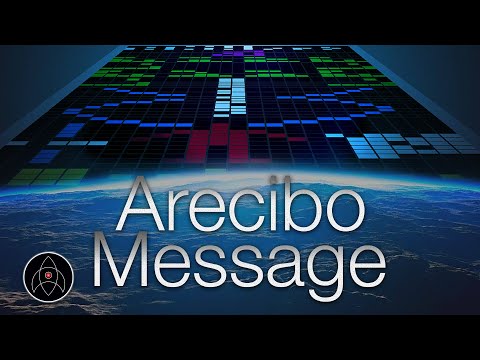
On November 16, 1974, following an upgrade to the Arecibo Observatory's dish, Frank Drake — the facility's director from 1966 to 1981 — transmitted a message toward the M13 globular cluster, roughly 25,000 light-years away, designed with contributions from Carl Sagan and the observatory's staff. The message consists of exactly 1,679 binary digits, a number Drake chose deliberately because it factors only as 23 times 73, two prime numbers; a recipient who noticed this would be led, by the same universal arithmetic logic Freudenthal had formalized, to arrange the bits into a grid of 73 rows by 23 columns, at which point a crude picture resolves: the numbers one through ten, the atomic numbers of the elements in DNA, a graphic of the DNA double helix, a stick figure of a human body, a diagram of the solar system, and a sketch of the Arecibo telescope itself. This is, point for point, the same claimed structure Jim Penniston described in his own Rendlesham notebook: an unbroken stream of binary digits that only becomes a meaningful image once arranged according to a mathematical key. The comparison does not make Penniston's claim true — this file's Material Analysis section addresses that separately — but it is a precise, testable structural match between a UAP report and an actual, physically transmitted, professionally engineered human message, not a vague thematic echo.
4. The Voyager Golden Record (1977) — A Symbol Explaining Itself
Voyager 1 and 2, launched in August and September 1977, each carried a phonograph record housed in an aluminum jacket whose cover is itself a message: a set of etched diagrams, led by a committee Carl Sagan chaired, showing the same hydrogen hyperfine-transition unit used on the Pioneer plaque, the same pulsar map reference points, and pictorial instructions — binary arithmetic and simple line diagrams, again with no words — for how to build a needle, spin the record, and decode the images encoded within it. The record's own explanatory cover is, in effect, a compact geometric “instruction manual” for a message that a recipient has not yet even opened, built entirely from the same universal-mathematics premise Freudenthal, Sagan, and Drake had each already committed to independently in their own separate projects across the preceding seventeen years.
5. The Field Today
Modern message-design work continues on the same premise, generally organized under small, specialized nonprofit and academic groups that debate not whether mathematics is the right starting vocabulary — that much is closer to consensus — but whether transmitting at all is wise, a live and unresolved ethical dispute inside the field itself. No credentialed contributor to this literature, from Freudenthal onward, has ever proposed that any UAP report documents a real instance of the method they were independently designing; that connection exists only as this file's own comparative analysis, stated as such rather than attributed to the field's founders.
Government & Military Programs
Unlike the Arecibo Message or the Pioneer and Voyager plaques — each a federally funded, publicly documented project with a clear paper trail through NASA and the National Science Foundation — no UAP case in this file's pattern has ever received sustained, on-the-record government engagement with the specific claim of a symbolic or geometric communication attempt. The one partial exception is instructive precisely because it involves deception rather than research. When Hector Quintanilla and Project Blue Book released their official public report on the Socorro sighting, they published a deliberately altered version of Zamora's insignia — a circle bisected by a diagonal line, rather than the true arc-and-arrow shape — specifically to filter out hoaxers and copycat reports who might otherwise claim knowledge of the real symbol. Zamora himself was instructed by the FBI and Air Force to keep the authentic insignia confidential. This means the U.S. government's only substantive documented engagement with a claimed UAP insignia was to manufacture and publish a false one, a fact this file's Material Analysis section treats as double-edged: it confirms officials treated the claim seriously enough to actively manage, while also proving that at least one fabricated "craft symbol" entered the historical record through confirmed government action rather than any non-human source.
The Rendlesham case reached British officialdom through a different channel. Deputy base commander Lt. Colonel Charles Halt filed an official memorandum to the UK Ministry of Defence on January 13, 1981, describing lights and physical traces at the site; the memo does not describe any symbol or binary-code claim, both of which remained undisclosed until Penniston's own public statements decades later, meaning that specific element of the case never passed through any official government reporting channel at all. AARO's March 2024 Historical Record Report, covered at length elsewhere on this site, does not address the symbolic-communication pattern as a distinct category; its findings concern recovered craft, biological material, and reverse-engineering claims specifically, leaving this file's narrower question formally untouched by the most recent U.S. government review.
Physical Evidence
The asymmetry here is the file's single most important honest finding. Every element of the real xenolinguistics record is a preserved, physically inspectable artifact: the actual flight-spare Pioneer plaques are held in museum collections, the Arecibo transmission's exact bit sequence and transmission log survive in the published scientific literature, and the Voyager Golden Record's master recordings and cover etching are documented down to the micrometer. By contrast, no physical trace of the claimed symbol or message survives independently of witness testimony in any of this file's three core UAP cases. Zamora's insignia exists solely as his own hand-drawn sketch, filtered through memory and drafting skill under extreme stress, with no paint sample, photograph, or physical specimen ever obtained from the craft itself. Penniston's glyphs and his binary sequence exist solely in his personal notebook — itself later noted by researchers to contain entries in different inks consistent with having been written at different times — with no craft fragment, casting, or independent corroborating sketch from either of the other two men present that night. Betty Hill's star map exists solely as a hypnosis-session drawing, produced years after the reported event under a technique modern psychology regards as vulnerable to confabulation and suggestion. In all three cases, the claimed communicative content is inseparable from a single witness's memory and draftsmanship; none has ever been corroborated by a second independent sketch, a physical sample, or an instrument reading.
Supporting Case Files
Theoretical Alignment
Because this file evaluates a specific reported behavior rather than a claim about UAP origin generally, its alignment with this site's other frameworks depends on how each one treats symbolic or non-verbal content specifically, not on shared mechanism alone.
Extraterrestrial Hypothesis
High OverlapA stationed insignia, deliberate glyphs, or a shown star map are all consistent with a physical, technological visitor attempting contact through a non-verbal channel — the most direct reading available under ETH.
Interdimensional Hypothesis (IDH)
Partial OverlapRendlesham's own case file already leans toward IDH on the strength of the claimed binary "download" and its decoded reference to the mythological island of Hy-Brasil — a mental transmission rather than a physical broadcast is a poor fit for straightforward ETH but a closer fit for IDH's information-transfer model.
Psycho-Social Hypothesis (PSH)
Partial OverlapJacques Vallée has argued that UAP-associated messages, including symbolic or geometric content, often serve a mythological or psychological function rather than a literal informational one — a reading PSH supports directly, though it does not require every case in this pattern to be purely psychogenic.
Sensor & Instrumentation Detection Profile
None of the three core cases in this file's pattern produced any instrumented recording of the claimed symbol or message itself, and that gap is worth stating as plainly as the real science's own record is documented. Zamora's insignia was witnessed under close-range daylight visual observation by a single trained officer, with no photograph, radar return, or physical sample capturing the mark independently of his own sketch. Penniston's glyphs and binary sequence exist only as handwritten notebook entries; no audio recorder, camera, or physiological monitor was present at the moment of the claimed "download," and Charles Halt's own contemporaneous audio recording from the second night of the Rendlesham encounter, the case's single strongest instrumented artifact, does not capture the symbol or binary claims at all. Betty Hill's star map is a hypnotic-recall drawing, produced with no instrumentation of any kind. This stands in total contrast to the real xenolinguistics record's instrumentation: the Arecibo Message's exact transmitted bit sequence, frequency, and duration are logged to engineering precision, and the Pioneer plaque's physical dimensions and material composition are a matter of public spacecraft documentation. A genuine detection of this file's proposed phenomenon would require exactly the kind of independent, real-time instrumented capture — radar, video, or physical sample — that is present in some of this site's other strongest case files and absent from all three of this one's core examples.
Environmental & Geospatial Context
The three cases share no common environmental signature: Socorro's insignia was reported in bright daylight over high desert scrubland outside Socorro, New Mexico; Rendlesham's glyphs were reported after midnight in a dense pine forest near two adjoining RAF/USAF bases in Suffolk, England; and the Hill star map was recalled from an encounter on a dark rural highway in New Hampshire's White Mountains. No shared terrain, lighting condition, season, or proximity to military or research infrastructure links the three reports, which weakens any argument that a specific environment is somehow conducive to this kind of encounter. The real science's own geography is, by contrast, entirely a function of funding and engineering rather than any environmental pattern: the Arecibo Message required a radio dish large enough to concentrate a detectable beam, which is why it originated from the 305-meter Arecibo Observatory specifically, and the Pioneer and Voyager plaques required NASA's own deep-space launch infrastructure — constraints entirely unrelated to whatever, if anything, determines where a UAP encounter of this type is reported.
Observer Credibility & Occupational Profile
The witness credentials behind this file's three core cases are unusually strong by this site's own general standards, though credibility as an observer and expertise in evaluating whether an observed mark constitutes deliberate communication are two separate questions this file keeps distinct. Lonnie Zamora was a trained police officer with a reputation, according to his own superiors, for sober and unembellished reporting; his insignia sketch was made the same night, under formal military and FBI questioning. Jim Penniston was a USAF security police patrol leader, and Charles Halt a Lieutenant Colonel and deputy base commander — both credentialed as reliable, trained observers of anomalous activity within a security context, though neither held any background in cryptography, linguistics, or message design. Betty Hill was a social worker and active community volunteer with no history of prior paranormal claims before 1961, a credential often cited in the case's favor, though her star map was produced under hypnosis, a technique modern psychiatry regards as capable of generating vivid, sincerely held, but inaccurate detail regardless of a subject's general honesty. On the science side of this file's comparison, credentials run in the opposite, purely academic direction: Freudenthal held a permanent Utrecht University chair and was elected to the Royal Netherlands Academy of Arts and Sciences; Frank Drake was Cornell- and Harvard-trained and directed Arecibo Observatory itself; Carl Sagan held a tenured Cornell professorship. Every scientist this file cites published the specific claim attributed to them in a peer-reviewed venue or an official spacecraft-documentation paper under their own name — a materially different evidentiary standard than any of the three witness-testimony cases can offer, and one this file states without softening.
Historical Precedents & Archive Matches
This file's own research turned up a specific, direct match worth stating plainly: Freudenthal's Lincos, like the technosignature-research tradition covered in this site's separate Technosignature / Interstellar Probe Hypothesis file, sat almost entirely unread outside a small specialist community for decades after its 1960 publication, revived in public attention mainly by later, more accessible projects — the Arecibo Message, the Pioneer plaque, the Voyager record — that applied the same underlying premise without always crediting Freudenthal's earlier formal system by name. A separate and more direct precedent runs between two of this file's own core cases: engineer Nikola Tesla, experimenting in Colorado Springs in 1899, reported receiving what he interpreted as structured, patterned electrical signals he believed might be extraterrestrial in origin — a claim this site covers in full elsewhere and one that predates all three of this file's core cases, establishing that the impulse to read a structured, non-verbal pattern as a deliberate non-human signal has a documented history in American technical culture reaching back more than sixty years before Rendlesham. This site's own record additionally shows the opposite risk in adjacent cases: the 1978 Emilcin abduction case file documents an investigator who later admitted deliberately planting false physical details, including a claimed bodily marking, into public case reporting as an authenticity test — a cautionary, documented example of how symbol- or marking-based claims specifically can become contaminated by investigator behavior rather than witness testimony alone, a risk this file's Material Analysis section weighs directly against all three of its own core cases.
Material Analysis
Weighed on its own physical merits, this file's pattern is evidentially thin in the specific way that matters most: not because the underlying idea is incoherent, but because none of its three core claims has ever produced a specimen, photograph, or independent second sketch that could be examined outside a single witness's own memory and hand. That is a materially different evidentiary position than the real xenolinguistics record this file uses as its comparison standard, where every artifact discussed above is preserved, catalogued, and independently reproducible from the published record.
Supporting This Pattern
- Three cases arose independently, investigated by different agencies and researchers, nineteen years and two continents apart, yet each nonetheless centers on non-verbal geometric or numeric content rather than any spoken exchange — a consistent structural pattern across otherwise unconnected reports
- The claimed format in each case (an abstract symbol, a binary-encoded pictogram, a geometric star chart) matches, without having been designed to match, the same design conclusion mainstream xenolinguistics reached independently across six decades of unrelated, peer-reviewed proposals
- Penniston's glyph sketches were made contemporaneously in a trained security patrolman's notebook at the scene, not solely reconstructed from memory afterward, unlike the binary sequence disclosed decades later
Against This Pattern
- No physical trace, specimen, or photograph of any claimed symbol or message survives independently of a single witness's own sketch or hypnotic recall in any of the three core cases
- The binary-code claim central to the Rendlesham case went undisclosed for nearly thirty years, and Penniston's own notebook shows ink and handwriting inconsistencies researchers have flagged as evidence it was not all written in a single sitting in 1980
- Project Blue Book's own confirmed publication of a deliberately false version of the Socorro insignia proves that at least one "craft symbol" entered the historical record through documented human fabrication, demonstrating the general vulnerability of this evidence category to non-alien manipulation
- Betty Hill's star map was produced under hypnosis, a technique with a well-documented capacity to generate detailed, sincerely believed, but confabulated content
Theory Development Timeline
| Date | Development |
|---|---|
| 1899 | Nikola Tesla, experimenting in Colorado Springs, reports receiving structured electrical signals he interprets as possibly extraterrestrial — an early precedent for reading patterned signals as deliberate non-human communication. |
| 1957–1960 | Hans Freudenthal develops Lincos, a constructed language built entirely from mathematical logic, intended to be comprehensible to any intelligent, technological recipient. |
| 1960 | Freudenthal publishes Lincos: Design of a Language for Cosmic Intercourse, Part I (North-Holland) — the first formally published interstellar-message system. |
| Sep 19–20, 1961 | Betty Hill and Barney Hill report their encounter on Route 3 in the White Mountains, New Hampshire. |
| 1964 | Under hypnosis with Dr. Benjamin Simon, Betty Hill recalls and draws a three-dimensional star map shown to her during the encounter. |
| Apr 24, 1964 | Lonnie Zamora reports a landed craft bearing a red insignia outside Socorro, New Mexico; he sketches the symbol for investigators that night. |
| 1964–1965 | Project Blue Book, under Hector Quintanilla, publishes a deliberately altered version of the Socorro insignia to filter out hoax reports. |
| 1966–1969 | Marjorie Fish builds 3D stellar models and concludes Betty Hill's star map most closely matches the Zeta Reticuli system. |
| Mar 1972 | Pioneer 10 launches carrying the Pioneer plaque, designed by Carl Sagan, Frank Drake, and Linda Salzman Sagan. |
| 1973 | Sagan edits Communication with Extraterrestrial Intelligence (CETI), proceedings of the 1971 Byurakan conference, published by MIT Press. |
| Nov 16, 1974 | The Arecibo Message, designed by Frank Drake with contributions from Carl Sagan, is transmitted from the Arecibo Observatory toward the M13 globular cluster. |
| Dec 1974 | Astronomy magazine publishes Marjorie Fish's Zeta Reticuli star-map analysis. |
| Aug–Sep 1977 | Voyager 1 and 2 launch, each carrying the Golden Record and its pictorial, mathematics-based decoding instructions. |
| Dec 25–26, 1980 | Jim Penniston reports touching a landed craft at Rendlesham Forest and sketches raised glyph-like symbols in his notebook. |
| Jan 13, 1981 | Charles Halt files the official Rendlesham memorandum to the UK Ministry of Defence; it does not mention any symbol or binary-code claim. |
| 2010 | Penniston publicly discloses the binary-code sequence in his 1980 notebook, thirty years after the incident, and commissions a decoding of part of the sequence. |
| 2024 | AARO's Historical Record Report, Volume I, is published; it does not address the symbolic/geometric-communication pattern as a distinct category. |
Weighing the Evidence
The central dispute is not whether mathematics and geometry are a genuinely credible universal starting point for interstellar communication — the real science answers that question affirmatively, and no credentialed critic of Freudenthal, Drake, or Sagan has ever seriously challenged that specific premise — but whether any of this file's three core UAP cases actually documents an instance of it happening, as opposed to a structurally similar-sounding claim resting entirely on unverified witness testimony. Those are two separate questions, and this file keeps them separate rather than letting the real science's credibility lend unearned weight to the UAP claims themselves.
Supporting Arguments
- Three independently investigated, well-documented UAP cases converge on the same structural claim — geometric or numeric content standing in for verbal language — without having been coordinated or compared to each other at the time
- That structural claim precisely matches the design logic mainstream xenolinguistics reached independently, across six decades of unrelated peer-reviewed work, for the identical underlying problem
- Penniston's binary-pictogram claim and the real Arecibo Message share an unusually specific structural parallel: an unbroken bit stream that resolves into an image only once arranged by a mathematical key
- Zamora's and Penniston's professional backgrounds as trained security/law-enforcement observers lend baseline credibility to their having seen something specific and reported it faithfully
Skeptical Arguments
- No physical specimen, photograph, or independent second witness sketch of any claimed symbol or message exists across all three core cases
- The Rendlesham binary claim was undisclosed for thirty years and rests on notebook pages researchers have flagged for ink and handwriting inconsistencies
- The one confirmed government engagement with a claimed UAP insignia (Blue Book's Socorro filter symbol) was itself a fabrication, proving the evidence category is demonstrably manipulable by non-alien actors
- Betty Hill's star map was produced under hypnosis, a technique with well-documented confabulation risk, and the statistical strength of its match to Zeta Reticuli has been separately disputed by astronomers
Conventional Explanation Candidate
Because this file evaluates a claimed pattern rather than a single incident, its Conventional Explanation Candidates weigh whether ordinary human psychology, investigative process, or coincidence account for the pattern as well as, or better than, an actual non-human communication attempt.
Memory Reconstruction & Hypnotic Confabulation
PlausibleDirectly applicable to the Hill star map, produced years after the event under regressive hypnosis — a technique modern psychiatry recognizes as capable of generating vivid, sincere, but inaccurate detail, independent of the subject's honesty.
Investigator or Disclosure-Delay Contamination
PlausibleApplicable most directly to Rendlesham, where the binary-code claim surfaced thirty years after the event from a notebook showing signs of multiple writing sessions — a pattern this site's own Emilcin case file shows can independently arise from investigator or witness embellishment over time.
Genuine Attempted Non-Verbal Communication, Origin Undetermined
InconclusiveThe claimed format matches real xenolinguistics design logic closely enough to be structurally coherent rather than arbitrary, but no physical specimen or independent corroboration exists in any of the three cases to move this candidate beyond speculation.
Confirmed Non-Human Symbol or Message
ImplausibleAs a fully confirmed claim, this remains unsupported: no physical symbol, transmission log, or corroborated artifact from any of the three cases has ever been independently verified by any credentialed research team.
Theoretical Assessment Profile
Six-domain evaluation of this hypothesis
Key Proponents
This section separates two distinct roles this file's sources play, and states that separation explicitly rather than letting it blur. The scientists below established the real, credentialed analytical framework — universal mathematics and geometry as a design premise — used to evaluate the UAP pattern; none of them ever endorsed, proposed, or commented on any connection between their own work and a UAP report. The witnesses and investigators below are the source of the UAP pattern itself.
Hans Freudenthal
Designed Lincos (1960), the first formally published constructed language built entirely from mathematical logic for communication with a non-human, non-Earth intelligence — this file's founding real-science reference point. Made no UAP-related claim of any kind.
Frank Drake
Designed the 1974 Arecibo Message's binary-pictogram structure and co-designed the 1972 Pioneer plaque, both built on the same universal-mathematics premise this file compares against Jim Penniston's binary-download claim.
Carl Sagan
Co-designed the Pioneer plaque, chaired the Voyager Golden Record committee, and edited the 1973 CETI conference proceedings — the single figure most responsible for consolidating this file's comparison science into a coherent public record.
Lonnie Zamora
Reported the red arc-and-arrow insignia on a landed craft outside Socorro, New Mexico, in April 1964, sketched the same night for investigators — this file's clearest single-symbol UAP case.
Jim Penniston
Reported raised glyph-like symbols on a landed craft at Rendlesham Forest in December 1980, and, decades later, a claimed binary-code "download" this file compares directly to the real Arecibo Message's own bit-to-pictogram structure.
Jacques Vallée
Has argued across decades of published work that symbolic or message-like content in encounter reports often functions mythologically or psychologically rather than as literal information transfer — the file's principal skeptical counterweight from within UFO research itself.
Related Cases
Further Reading
Extraterrestrial Languages
A full modern history of xenolinguistics, from Lincos through the Arecibo Message and beyond, covering exactly the design tradition this file uses as its evaluation standard.
Communication with Extraterrestrial Intelligence (CETI)
Proceedings of the 1971 Byurakan conference, the first international scientific gathering devoted specifically to the problem this file examines: how to design a message a non-human intelligence could actually understand.
Murmurs of Earth: The Voyager Interstellar Record
The design team's own account of building the Voyager Golden Record's pictorial, mathematics-based cover instructions — the clearest real-world example of a physically executed, non-verbal geometric message.
Is Anyone Out There? The Scientific Search for Extraterrestrial Intelligence
Drake's own memoir of his SETI career, including a firsthand account of designing and transmitting the Arecibo Message this file treats as the closest real analog to Jim Penniston's binary-pictogram claim.
Passport to Magonia: On UFOs, Folklore, and Parallel Worlds
Vallée's foundational argument that UAP-associated symbolic and message-like content often carries mythological rather than literal informational weight — this file's principal skeptical counterpoint from within UFO research.
DISCLOSURE: Some links above are affiliate links. If you purchase through them, OverClassified receives a small commission at no additional cost to you. This helps support independent research.
Essential Viewing
Sources Cited
- Freudenthal, H. Lincos: Design of a Language for Cosmic Intercourse, Part I. North-Holland, 1960.
- "Hans Freudenthal," MacTutor History of Mathematics Archive, University of St Andrews.
- "Hans Freudenthal," Wikipedia.
- "Lincos (language)," Wikipedia.
- Sagan, C., Drake, F., et al. "A Message from Earth," Science 175, 881–884, 1972.
- "Pioneer Plaque," Wikipedia.
- "The Pioneer Plaque: Science as a Universal Language," The Planetary Society.
- "Arecibo Message," Wikipedia.
- "40 Years Ago, Earth Beamed Its First Postcard to the Stars," National Geographic.
- Sagan, C., Drake, F., Druyan, A., Ferris, T., Lomberg, J., & Sagan, L. S. Murmurs of Earth: The Voyager Interstellar Record. Random House, 1978.
- "Voyager Golden Record," Wikipedia.
- Sagan, C. (ed.) Communication with Extraterrestrial Intelligence (CETI). MIT Press, 1973.
- Drake, F. & Sobel, D. Is Anyone Out There? The Scientific Search for Extraterrestrial Intelligence. Delacorte Press, 1992.
- Vallée, J. Passport to Magonia: From Folklore to Flying Saucers. Henry Regnery Co., 1969.
- Project Blue Book Case Files, "Socorro, New Mexico – April 24, 1964," National Archives and Records Administration (NARA).
- Hynek, J. Allen. "Field Investigation Report: Socorro Landing Case," Center for UFO Studies (CUFOS) archives, April 1964.
- Quintanilla, Maj. Hector. "Project Blue Book Investigation Logs: Case #029," U.S. Air Force, May 1964.
- Pope, N., Burroughs, J., & Penniston, J. Encounter in Rendlesham Forest: The Inside Story of the World's Best-Documented UFO Incident. Thomas Dunne Books, 2014.
- Halt, Charles I. "Unexplained Lights" (official memorandum to the UK MoD), January 13, 1981. Released via FOIA, 1983.
- "Rendlesham Forest Incident," Wikipedia.
- Fish, Marjorie. "Zeta Reticuli Star Map Analysis," Astronomy magazine, December 1974.
- Webb, Walter N. NICAP Field Investigation Report: Sighting of September 19–20, 1961, October 26, 1961.
- "Barney and Betty Hill Incident," Wikipedia.
- "Report on the Historical Record of U.S. Government Involvement with Unidentified Anomalous Phenomena (UAP), Volume I," AARO, March 8, 2024.
Have corrections, additional research, or peer-reviewed sources? Help improve this entry.
Suggest an Edit