
Exotic Biologics Hypothesis
Centers on claims of recovered non-human biological material — addressed directly, and denied, in AARO's 2024 Historical Record Report — proposing that some UAP-related evidence points to genuine non-terrestrial biology rather than technology alone. Built on decades of secondhand crash-retrieval testimony, a 2023 congressional whistleblower's sworn use of the word “biologics,” and a small number of credentialed scientists now willing to publicly analyze submitted materials using real forensic and genomic methods — methods that, so far, have never once confirmed a non-terrestrial biological origin for anything actually tested.
Non-Terrestrial Biology — Claimed, Not VerifiedCore Thesis
If any UAP-related craft has ever actually crashed and been recovered by a government or private party, and if that craft was occupied or otherwise carried organic material, then physical, testable biological evidence of a non-terrestrial origin should in principle exist somewhere — tissue, blood, or cellular material whose genetic code, isotopic ratios, or cellular architecture would differ unmistakably from anything found in Earth's own biosphere. Under this theory, decades of secondhand testimony about recovered “biologics,” culminating in a 2023 sworn congressional statement from a named former intelligence officer, describe exactly this scenario, and a small number of credentialed scientists are now attempting to apply real, peer-reviewable forensic methods to material submitted to them for exactly that purpose. The theory's central, unresolved tension is that every method capable of confirming it is also fully capable of falsifying it, and no submitted sample has yet survived that test.
Origin & History
Unlike this site's Machine Intelligence Hypothesis, which traces to credentialed radio astronomy published in Nature, the exotic biologics hypothesis originates almost entirely inside ufology's own oral tradition — a claim that grew for more than four decades primarily through secondhand and thirdhand witness testimony, gathering specificity and drama with each retelling, before finally producing, in 2023, a single named, sworn, on-the-record source willing to use the word “biologics” in a public congressional hearing.
The claim's earliest identifiable root is the Roswell Incident of July 1947, but it is worth being precise about timing, because the popular image of Roswell as a story about recovered alien bodies is itself a later addition to the record. The original July 8, 1947 Roswell Army Air Field press release, and the immediate several days of national wire-service coverage that followed, described only a recovered “flying disc” and its wreckage — debris later identified by the Army as a crashed Project Mogul balloon train. No contemporaneous 1947 newspaper account, military record, or witness statement described bodies of any kind. The bodies narrative entered the record more than thirty years later, beginning with nuclear physicist Stanton Friedman's 1978 interview of former intelligence officer Jesse Marcel Sr., and was assembled into a full account by researchers Charles Berlitz and William L. Moore in their bestselling 1980 book The Roswell Incident — the specific text most responsible for fixing “alien bodies were recovered at Roswell” in the public imagination, built substantially on witness recollections recorded three decades after the fact. The claim escalated further with mortician Glenn Dennis's 1989 account of being asked hypothetical questions about preserving small bodies, and cratered into open fraud with the notorious 1995 “Alien Autopsy” film promoted by British entrepreneur Ray Santilli, which its own creator admitted in 2006 was staged, using a mix of a genuine autopsy specimen dressing and prosthetic effects, not any real film footage from 1947.
A second, less publicly visible current fed into the same claim through the 1970s and 1980s: the American Southwest's cattle mutilation phenomenon, in which ranchers across New Mexico, Colorado, and neighboring states reported livestock found dead with precise, bloodless incisions and specific organs removed. Investigative journalist Linda Moulton Howe's Emmy-winning 1980 documentary A Strange Harvest, later expanded into her 1989 book An Alien Harvest, argued the mutilations reflected a systematic, non-human biological sampling program. A federally funded investigation led by retired FBI agent Kenneth Rommel in 1979 reached the opposite conclusion, attributing the great majority of cases to ordinary scavenger and predator activity following natural death, a conclusion the veterinary and forensic mainstream has generally supported since. The mutilation narrative matters to this theory's history less as evidence in its own right than as an early template: an unverified claim of non-human interest in terrestrial biological material, investigated by credentialed government personnel, and resolved toward a mundane explanation without ever fully displacing the original claim in popular belief.
The modern, government-adjacent phase of the claim runs through the Advanced Aerospace Weapon System Applications Program (AAWSAP), the Defense Intelligence Agency-funded UAP study active from 2008 to 2010 and led by aerospace executive Robert Bigelow, which included research into Skinwalker Ranch and, according to the 2021 book Skinwalkers at the Pentagon by program veterans James Lacatski, Colm Kelleher, and journalist George Knapp's longtime broadcast partner, examined reported biological and physiological effects on personnel and animals near the ranch. AAWSAP's successor program, the more widely known Advanced Aerospace Threat Identification Program (AATIP), became public in December 2017 through New York Times reporting, and the network of officials, contractors, and researchers who moved through both programs is the same network AARO's own 2024 report would later describe as the recurring source of unverified “biologics” claims.
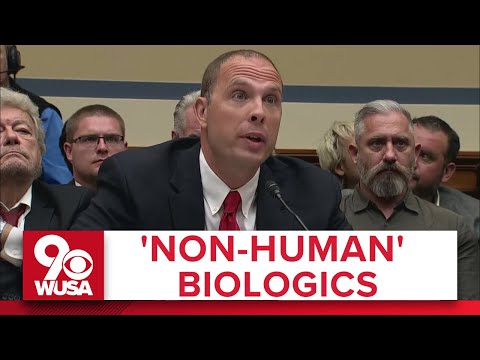
The claim reached its current, named form on June 5 and July 26, 2023, when former National Geospatial-Intelligence Agency and National Reconnaissance Office officer David Grusch filed a formal Inspector General complaint and then testified under oath before the House Oversight Committee, stating that the United States operated a decades-long UAP crash-retrieval and reverse-engineering program and that, in his words during a prior NewsNation interview he reaffirmed under oath, “biologics came with some of these recoveries.” Grusch's testimony — covered in depth on this site's own David Grusch Whistleblower Testimony case file — is the first instance of a named, credentialed former government official using the specific term “biologics” in a sworn, public setting, rather than the term surfacing only through anonymous sourcing or researcher paraphrase. His account was amplified through 2023 and 2024 by journalists Ross Coulthart, whose 2021 book In Plain Sight and subsequent NewsNation reporting became a primary outlet for insider crash-retrieval sourcing, and documentary filmmaker Jeremy Corbell, who has repeatedly pressed the Department of Defense to release material connected to alleged biologics programs. In October and November 2024, journalist Michael Shellenberger entered a document describing a previously unreported program named “Immaculate Constellation” into the congressional record, which he described as a repository cataloguing UAP intelligence including alleged biologics references; the Pentagon has stated it has no record of any special access program by that name, and neither the document's authenticity nor the Pentagon's denial has been independently verified as of this writing.
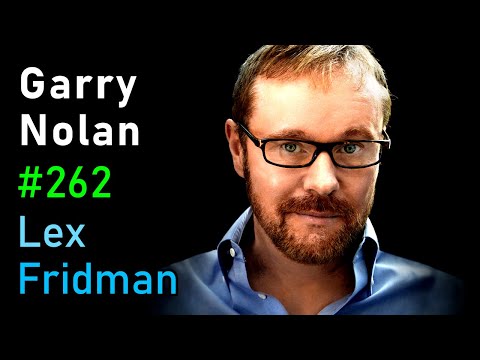
Running in parallel to, and increasingly overlapping with, this crash-retrieval thread is the entry of a small number of credentialed working scientists willing to publicly analyze submitted materials using standard laboratory methods. The most prominent is Stanford University pathology professor Garry Nolan, whose parallel and much older forensic-genomics work — including his role in scientifically resolving the Atacama “alien” skeleton case, discussed in detail below — gives this theory's modern phase a genuinely credentialed, testable dimension it lacked during its earlier, purely testimonial decades. Nolan co-founded the SOL Foundation in August 2023 with anthropologist Peter Skafish specifically to create an academic forum for this kind of research, a direct institutional response to the same wave of public attention Grusch's testimony generated.
Scientific Foundations
The exotic biologics hypothesis differs from most theories on this site in an important structural way: it does not require any new physics. Unlike faster-than-light propulsion or interdimensional travel, verifying or falsifying a claim of non-terrestrial biological material is, in principle, a solved problem in ordinary molecular biology and analytical chemistry — which is exactly what makes the theory's total lack of a single confirmed result so scientifically significant, in either direction.
1. The Universal Genetic Code as a Built-In Test
Every confirmed terrestrial organism, from bacteria to blue whales, shares the same fundamental biochemistry: DNA built from the same four nucleotide bases, the same genetic code translating those bases into the same twenty amino acids, and near-universal molecular chirality (naturally occurring terrestrial amino acids are overwhelmingly “left-handed,” L-form, while terrestrial sugars are overwhelmingly “right-handed,” D-form). This universality is not a coincidence of convenience; it is strong, independently corroborated evidence that all terrestrial life shares a single common ancestor. A genuinely non-terrestrial organism, by contrast, would have no reason to reproduce this exact chemistry, since it evolved along an entirely separate biochemical history. This gives the theory an unusually sharp, built-in test: modern whole-genome sequencing, mass spectrometry, and chirality assays can determine within days whether a submitted biological sample's fundamental chemistry matches known terrestrial life or diverges from it — a genuinely non-terrestrial sample should be almost immediately, unambiguously distinguishable from a terrestrial one using equipment and methods that already exist in any well-equipped genomics or analytical chemistry laboratory.
2. Isotopic and Elemental Fingerprinting
A second, independent line of forensic evidence comes from isotope ratio analysis, the same general family of technique Garry Nolan has applied to physical (non-biological) UAP-associated materials, most notably a magnesium fragment from the 1957 Ubatuba, Brazil incident (see this site's own Ubatuba Magnesium Fragments case file), which Nolan's team measured as having magnesium isotope ratios roughly 30 percent off naturally occurring terrestrial baselines using nanoscale secondary ion mass spectrometry (nanoSIMS). The same underlying instrumentation and methodology applies directly to biological tissue: stable isotope ratios of carbon, nitrogen, oxygen, and other bio-relevant elements vary measurably and predictably across different terrestrial food webs and environments, meaning any biological sample can, in principle, be isotopically screened against the full range of known terrestrial isotopic signatures. A sample whose isotope ratios fell genuinely and reproducibly outside every known terrestrial range, replicated independently by multiple laboratories, would constitute serious physical evidence requiring an extraordinary explanation — though isotopic anomaly alone is a necessary, not sufficient, test, since laboratory contamination, unusual (but terrestrial) dietary or environmental exposure, or instrument calibration error can all produce anomalous readings that a full genomic analysis would resolve more conclusively.
3. Astrobiological Plausibility — A Real, Open Scientific Question
Separately from any specific claimed sample, the underlying premise that non-terrestrial biology could exist at all rests on genuine, actively researched mainstream astrobiology rather than speculation invented for ufology's purposes. NASA's own astrobiology program, and the broader scientific search for biosignatures on Mars, Europa, Enceladus, and exoplanets, treats the existence of extraterrestrial microbial or more complex life as a serious open question, and origin-of-life researchers have long debated whether Earth's own specific biochemistry (DNA, the standard genetic code, L-amino-acid chirality) is a universal chemical necessity or a contingent, one-time historical accident that could easily have gone differently elsewhere. This is directly relevant to the exotic biologics hypothesis's scientific standing: it means the theory's core premise — that non-terrestrial biology could exist and could, in principle, be chemically distinguishable from terrestrial life — is not itself fringe. What remains entirely unestablished is the much larger and more specific further claim that such biology has already reached Earth, been recovered by a government or private party, and is sitting in a lab or storage facility somewhere, undetected by the scientific community for decades.
4. The Chain-of-Custody Problem
The single largest scientific obstacle facing this theory is not analytical chemistry — it is provenance. Every method described above only produces meaningful evidence if the sample being tested can be reliably shown to have come from where its submitter claims it came from, at the time claimed, without contamination, substitution, or degradation in between. Nolan has been direct about this limitation in his own public statements: describing his general approach as “creating data out of whatever materials it is that seem to have reasonable chain of custody and provenance, and then just getting the data out there after peer review,” while separately acknowledging that blood and tissue samples from purported anomalous-exposure incidents have often reached him only years after the reported event — explicitly stating he needs access to such samples “while the case is still acute,” within weeks rather than years, for the results to carry real scientific weight. A biological sample with no verified chain of custody, submitted privately by an anonymous or pseudonymous source, cannot be distinguished analytically from a deliberate hoax, a contaminated terrestrial specimen, or an honest but mistaken submission, regardless of how sophisticated the laboratory testing itself is — a limitation intrinsic to the evidence this theory currently has access to, not to the underlying science.
Government & Military Programs
This theory's government record is unusually direct, because the same 2024 AARO report that addresses nearly every other theory on this site by omission addresses this one by name. On March 8, 2024, the Pentagon's All-domain Anomaly Resolution Office released its unclassified Historical Record Report, Volume I, a review of U.S. government UAP-related investigation programs from 1945 through October 2023, produced from dozens of interviews and an archival records review conducted specifically, in the report's own stated purpose, to investigate claims that the government had recovered and was hiding off-world technology and biological material. Its conclusion on this specific point was unambiguous: AARO stated it “has not discovered any evidence that any USG or USG contractor investigation, review, or assessment has confirmed that any sighting of a UAP represented [non-human] activity,” and separately, that it found no verifiable evidence of recovered non-human biological material.
The report's most specific and checkable finding on this exact subject concerns a claimed program named KONA BLUE. Multiple interviewees told AARO investigators that KONA BLUE was a sensitive Department of Homeland Security compartment established specifically to protect the retrieval and exploitation of “non-human biologics.” AARO's own investigation determined that KONA BLUE was, in fact, only ever a prospective special access program proposal briefed to DHS leadership — it was never formally approved or established, never received funding, and never received any actual materials, meaning the elaborate secrecy narrative interviewees had built around it described a program that functionally never existed in the form claimed. AARO was equally specific in tracing where the broader claim came from, stating that “modern allegations that the USG is hiding off-world technology and beings largely originate from the same group of individuals who have ties to the cancelled AAWSAP/AATIP program,” and that this same small, overlapping group “have not provided any empirical evidence of their claims to AARO,” despite AARO's own investigation working to disprove — in the report's word — the majority of the specific claims traced back to them.
AARO's report and Grusch's testimony are formally in direct conflict, and the conflict has played out publicly rather than remaining a paper dispute. Then-AARO director Sean Kirkpatrick stated after Grusch's July 2023 hearing that Grusch had declined AARO's repeated requests — by Kirkpatrick's count, four or five separate invitations — to meet with the office and provide supporting evidence; Grusch publicly disputed this characterization, stating he had received no such outreach and calling Kirkpatrick's account false. Neither party's account has been independently, publicly verified through documentary evidence as of this writing, leaving the dispute over process itself — who reached out to whom, and when — as unresolved as the underlying biologics claim.
The most recent government-adjacent development is more ambiguous still. In October and November 2024, journalist Michael Shellenberger placed a document into the congressional record describing a program called “Immaculate Constellation,” which he characterized as a Pentagon-run repository consolidating UAP imagery, sensor data, and, according to the document, alleged non-human biologics references, dating to around 2017 and never disclosed to Congress. A Pentagon spokesperson responded that the Department of Defense has “no record, present or historical, of any type of SAP called ‘IMMACULATE CONSTELLATION,’” a denial that itself does not explain how a detailed document using that name came to be written and entered into the congressional record in the first place. As of this writing, more than a year after the document surfaced, neither the program's existence nor a specific account of how the document originated has been independently confirmed by any government source, leaving it an open, unresolved data point rather than either confirming or discrediting evidence for this theory.
NASA has approached the underlying question from a different institutional angle than either AARO or Congress, and its position is worth noting because it comes from the government's own civilian science agency rather than a defense or intelligence body with an obvious institutional interest in the outcome. NASA's September 2023 UAP Independent Study Team report, the product of a nine-month external review chaired by astrophysicist David Spergel, found no evidence in the cases it examined of extraterrestrial origin for any UAP report, biological or technological, while explicitly recommending that NASA apply its own scientific credibility and modern data-analysis tools to future UAP study rather than leaving the subject entirely to classified defense channels. At the September 14, 2023 press conference releasing that report, NASA Administrator Bill Nelson stated the agency's goal as moving the UAP conversation “from sensationalism to science,” a framing that applies with particular force to the biologics question specifically: unlike a radar track or a pilot's visual report, a claimed biological specimen is, in principle, the single most directly and rapidly testable category of UAP-related evidence NASA's own scientific toolkit could evaluate — if any government or private party holding such material were to submit it for open, credentialed analysis, which as of this writing none has.
Physical Evidence
No sample of alleged non-human biological material has ever been independently examined, replicated across multiple laboratories, and published in a peer-reviewed scientific journal as showing a genuinely non-terrestrial biochemical signature. This is the theory's central evidentiary gap, and it is worth stating precisely what does and does not exist rather than treating the absence as total silence.
What does exist is Garry Nolan's ongoing, publicly described but not yet fully peer-reviewed effort to apply exactly this kind of testing to submitted materials. In interviews, Nolan has described examining roughly ten to twelve physical samples submitted as possible UAP-associated material and studying blood, imaging, and case data from approximately one hundred individuals who reported unusual health effects following a claimed close encounter, work conducted in part at the request of intelligence-community and defense-contractor representatives who approached him at Stanford. His stated findings on the biological side include distinctive structural features in the caudate nucleus and putamen — brain regions involved in motor control and reward processing — among a subset of the individuals studied, a finding he has connected to broader research into anomalous health incidents including Havana Syndrome. As of this writing, this specific biological-effects work has been described publicly in interviews and conference talks but has not been published as a peer-reviewed paper specifically presenting non-human biological material or its analysis; Nolan's own explicitly stated standard — publish only material with a defensible chain of custody, after peer review — has, by his own account, not yet been met for a genuine biological specimen, as distinct from the physical, non-biological metamaterial samples (Ubatuba, Council Bluffs) he has separately published.
What also exists, and is frequently conflated with the above in less careful reporting, is Nolan's actual, real, peer-reviewed publication record on a directly adjacent question: whether a specific set of skeletal remains claimed to be non-human were, in fact, human. In 2018, Nolan's team published “The Atacama skeleton,” a whole-genome sequencing analysis in the peer-reviewed journal Genome Research, of the “Ata” specimen — a roughly six-inch mummified skeleton found in Chile's Atacama Desert that had circulated in UFO documentaries since 2013 as possible non-human remains. The team's genomic analysis concluded definitively that Ata was human, specifically a female fetus with a gestational age of approximately eight to nine weeks or a severely premature infant, carrying multiple real genetic mutations linked to skeletal dysplasia that plausibly explained the specimen's unusual proportions and bone density. This is directly relevant to evaluating this theory's overall evidentiary record: it demonstrates that Nolan's laboratory genuinely applies rigorous genomic methodology capable of producing a firm, negative, non-sensational result when the data supports one, rather than reflexively confirming an extraordinary premise — a point discussed further, alongside the study's own significant ethical criticism, in Material Analysis below.
Beyond Nolan's work, no other claimed biological specimen connected to this theory has reached even this level of scientific scrutiny. The alleged bodies described in Roswell-era secondhand testimony were never physically produced for any independent examination. The creature reportedly encountered and, according to some witness accounts, briefly hospitalized following the January 1996 Varginha, Brazil incident (see this site's own Varginha UFO Incident case file) was never produced as a physical specimen for outside analysis; the case rests entirely on witness testimony, with no tissue, fluid, or remains ever independently verified. And the two purportedly non-human mummified specimens presented to the Mexican Congress on September 12, 2023 by journalist Jaime Maussan — discussed in full on this site's own Mexican Congress UAP Hearing case file — were radiocarbon dated to several hundred years old and contained real human DNA mixed with other materials including animal bone and, according to Mexico's own National Institute of Anthropology and History, synthetic glue, a finding widely interpreted as evidence the specimens had been artificially assembled and altered rather than representing any coherent biological organism, human or otherwise.
Supporting Case Files
Theoretical Alignment
This theory is best understood as a narrower, more specific subset of the classic Extraterrestrial Hypothesis rather than a fully independent framework: it shares ETH's premise of genuine non-human visitation, but stakes its entire case on a single, sharply falsifiable evidentiary category — physical biological material — rather than ETH's broader mix of sighting reports, radar returns, and craft performance. It shares almost no common ground with this site's own Machine Intelligence Hypothesis, which explicitly proposes an unoccupied, non-biological explanation for the same UAP phenomenon; the two theories are, in a meaningful sense, direct rivals for the same evidentiary territory. It has minimal overlap with the Psycho-Social Hypothesis, which treats reports as products of human perception and narrative rather than physical objects with recoverable material components.
Extraterrestrial Hypothesis (ETH)
High OverlapA direct subset: shares ETH's core premise of genuine biological, non-human visitors, but narrows the evidentiary claim specifically to recoverable physical tissue or cellular material rather than sighting reports or craft performance generally.
Non-Human Machine Intelligence Hypothesis
Low Overlap / RivalStructurally opposed: the machine intelligence hypothesis explicitly proposes an unoccupied, non-biological mechanism for UAP behavior, meaning confirmed evidence for one theory would tend to weaken, not support, the other for any given case.
Psycho-Social Hypothesis (PSH)
Low OverlapPSH explains reports as a product of perception, memory, and cultural narrative; this theory instead stakes its claim entirely on the existence of a specific, physically recoverable, laboratory-testable biological substance.
Sensor & Instrumentation Detection Profile
Because this theory's central claim is chemical and genetic rather than kinematic, its relevant “sensors” are not radar or infrared systems but laboratory instrumentation, and its detection profile is correspondingly unusual among the theories this site catalogues. The primary instrument class is next-generation whole-genome and whole-transcriptome sequencing, capable of resolving a sample's complete genetic code and comparing it against the full reference database of known terrestrial life within days; a secondary, complementary instrument class is high-resolution isotope-ratio mass spectrometry, including the nanoSIMS technique Nolan's laboratory has already applied to physical (non-biological) UAP-associated materials, capable of resolving elemental isotope ratios at sub-micron spatial resolution. A third relevant category is standard forensic pathology and histology — light and electron microscopy of tissue architecture, cell structure, and any preserved organelles — capable of identifying whether a sample's basic cellular organization resembles known terrestrial biology (cells bounded by lipid membranes, DNA organized in a nucleus or nucleoid, etc.) or diverges from it structurally, independent of its genetic content. None of these instruments require exotic new technology; all exist today in well-equipped university and government forensic laboratories, including Nolan's own. What has been genuinely, consistently absent is a sample with adequate chain-of-custody documentation reaching such instrumentation while still analytically viable — the specific gap Nolan has himself identified publicly, noting that blood and tissue samples connected to reported anomalous-exposure cases have often reached him only years after the reported incident, long past the point at which meaningful biological analysis remains possible.
Environmental & Geospatial Context
As a claim about recovered material and testimony rather than a site-specific phenomenon, this theory's supporting evidence spans a geographically and institutionally scattered set of locations with no shared physical environment. The original crash-retrieval narrative is anchored at Roswell, New Mexico, where the 1947 incident occurred and where decades of later testimony placed the alleged recovery and autopsy of bodies. The 1996 Varginha creature encounter is anchored in and around Jardim Andéré in Varginha, Minas Gerais, Brazil, where local residents reported an unusual creature and its subsequent hospitalization. David Grusch's 2023 testimony took place on Capitol Hill in Washington, D.C., describing programs he alleged operated at unnamed, compartmented facilities. The 2023 Mexican Congress hearing took place in the Chamber of Deputies in Mexico City, with the specimens themselves reportedly originally recovered from the Nazca region of Peru decades earlier before being presented in Mexico. Nolan's own laboratory work is based at Stanford University in Stanford, California, geographically and institutionally separate from every testimonial case this theory draws on. This dispersion is itself analytically relevant: unlike a sighting-cluster theory tied to a specific base, range, or region, no single environmental or geospatial pattern connects this theory's evidentiary base, meaning any correlation would have to emerge from the claims' content rather than their location.
Observer Credibility & Occupational Profile
This theory's observer credibility profile is unusually bimodal, splitting sharply between credentialed institutional insiders on one side and a documented history of hoax and fraud on the other, with comparatively little middle ground. David Grusch is a decorated former military intelligence officer and reserve U.S. Air Force officer who served as the National Reconnaissance Office's representative to the Pentagon's own UAP task force before becoming a named, sworn congressional witness — a credentials profile that gives his testimony real institutional weight even though it remains uncorroborated by any document or physical evidence made public as of this writing. Garry Nolan holds an endowed chair at Stanford University School of Medicine, has authored more than 600 scientific publications, and built his reputation over three decades in mainstream cancer immunology and computational systems biology entirely separate from ufology — directly comparable, in institutional standing, to Avi Loeb's role in this site's Machine Intelligence Hypothesis file. Sean Kirkpatrick, AARO's first director and Grusch's most direct public critic, is a physicist with a doctorate in the field and a career background in national laboratory and defense intelligence work, giving the skeptical side of this dispute a comparably credentialed voice.
Set against this, the theory's evidentiary record also includes a documented, specific history of hoax and misattribution that any fair accounting has to weigh seriously. The 1995 “Alien Autopsy” film was produced by British entrepreneur Ray Santilli and admitted by Santilli himself in 2006 to be substantially staged reconstruction, not genuine 1947 footage. The two specimens presented to the Mexican Congress in 2023 by journalist Jaime Maussan were subsequently found by Mexico's National Institute of Anthropology and History to be composite objects assembled from human and non-human remains bound with synthetic material, and Maussan's own decades-long career includes multiple previous incidents — including his promotion of purported UFO footage during the 1991 Mexico City solar eclipse that was later identified as a Venus and aircraft misidentification — that have led much of the mainstream ufology community, not only outside skeptics, to treat his claims with heightened caution. This split matters analytically: it means the theory's strongest evidentiary claims (Grusch, Nolan) and its weakest, most discredited ones (Santilli, Maussan) come from observers with dramatically different, independently checkable credibility profiles, and treating them as a single undifferentiated body of “biologics evidence” understates how much the theory's real evidentiary weight rests on a small handful of its more credentialed sources.
Historical Precedents & Archive Matches
The specific pattern this theory follows — an extraordinary biological claim, investigated using real forensic science, resolving toward a mundane or fraudulent explanation — has a direct, well-documented precedent within this exact research network. The Atacama skeleton case, discussed at length in Physical Evidence and Material Analysis, is the clearest example: a specimen actively promoted in UFO documentaries as possible non-human remains was genomically sequenced by Nolan's own laboratory and definitively identified as a human fetus with real genetic mutations, the identical evidentiary category (recovered physical remains, tested using genomic methods) this theory's current, unresolved claims occupy. The Mexican Congress mummies follow the same arc on a compressed, far more public timeline: presented to a national legislature as physical non-human specimens, radiocarbon dated and genetically analyzed within weeks, and found to be composite fabrications. The 1995 Santilli “Alien Autopsy” film follows the same pattern over an eleven-year span between its release and its creator's confession.
A partial counter-precedent worth noting for balance is the Ubatuba, Brazil magnesium fragment, also analyzed by Nolan's laboratory, where the isotopic irregularity found (roughly 30 percent off natural terrestrial magnesium ratios in one measured fragment) remains, per Nolan's own public statements, unexplained by any conventional industrial or natural process he has identified — the one physical-materials result in this research network that has not resolved toward a mundane explanation after testing, though it concerns manufactured metal, not biological tissue, and does not itself constitute biologics evidence.
Cross-referenced against this site's own case-file library, the pattern of testimony escalating over decades without physical corroboration, seen throughout the Roswell bodies narrative, recurs closely in the broader crash-retrieval literature this theory draws on: claims typically originate as vague, secondhand accounts and accumulate specific, dramatic detail (body counts, autopsy descriptions, storage locations) with each retelling across subsequent decades, a pattern folklorists and cognitive researchers studying rumor transmission have documented across many unrelated subject areas, not unique to ufology, and one AARO's own report gestures toward directly in describing the modern biologics claim as substantially the product of “circular reporting” within a small, overlapping community of sources.
Material Analysis
The Atacama skeleton case is this theory's single most instructive material-evidence episode, precisely because it is the one case in this entire evidentiary category that was actually carried all the way through peer-reviewed genomic analysis to a firm conclusion. The specimen, nicknamed “Ata,” was a roughly six-inch mummified skeleton reportedly found in Chile's Atacama Desert region in the early 2000s, with an unusually elongated skull, reduced rib count, and other proportions that led to its promotion in UFO-themed documentaries, including Steven Greer's 2013 Sirius, as possible evidence of non-human biology. Garry Nolan's team obtained access to the specimen and, in a 2018 paper published in the peer-reviewed journal Genome Research, presented whole-genome sequencing results definitively identifying Ata as human — specifically consistent with a severely premature female fetus or stillbirth of Chilean/Andean ancestry, carrying multiple real, identifiable genetic mutations (including in genes associated with skeletal dysplasia) that plausibly accounted for the skeleton's unusual bone density, rib count, and cranial proportions without requiring any non-terrestrial explanation.
The study is directly relevant to evaluating this theory's overall credibility for two opposite reasons that both deserve to be stated. First, positively: it demonstrates Nolan's laboratory applying real, rigorous, falsifiable genomic methodology to an extraordinary biological claim and reaching a firm, negative, entirely mundane conclusion when the data supported one — the opposite of a research program structurally incapable of disconfirming its own premise. Second, critically: the study itself became the subject of a serious, published ethical rebuktal. A team of bioarchaeologists led by Siân Halcrow published a formal critical response in the peer-reviewed International Journal of Paleopathology in 2018, arguing that several of the skeletal features Nolan's team had characterized as unusual and linked to genetic mutation were more plausibly explained by normal fetal skeletal development, cranial molding during delivery, and ordinary post-mortem taphonomic (decay and preservation) processes rather than genuine pathology, and separately raising a distinct ethical objection: that analyzing and publishing genomic data from what was, on the study's own conclusion, a human fetal or infant specimen, without established provenance, community consultation, or repatriation consideration, risked exactly the kind of human-remains research practice the bioarchaeology field has spent decades working to move away from. Both critiques stand independently of each other — the ethical concern does not depend on whether the genomic conclusion was correct, and the genomic conclusion (that Ata was human) has not itself been seriously disputed by any subsequent published analysis.
No comparably rigorous, peer-reviewed genomic or isotopic analysis exists for any of this theory's more recent, higher-profile claims. Grusch's 2023 testimony described alleged biologics only in general terms, without producing or identifying a specific physical sample for independent testing. Nolan's own more recent work on blood and tissue from individuals reporting anomalous health effects, while using directly comparable genomic and imaging methodology, remains, by his own public description, unpublished as formal peer-reviewed findings specifically concerning non-human biological material, distinct from his separately published, non-biological metamaterials work. The Varginha creature was never produced as a physical specimen for any laboratory to examine at all.
Supporting This Hypothesis
- The underlying premise — that non-terrestrial biology could exist and would be chemically distinguishable from terrestrial life — is grounded in mainstream, actively funded astrobiology research, not speculation invented for ufology
- A named, credentialed former intelligence officer testified under oath, on the record, that biological material accompanied alleged recoveries — a first for this specific claim after decades of only anonymous or secondhand sourcing
- A tenured Stanford immunologist with a genuine, three-decade mainstream publication record has staked real professional credibility on applying rigorous, falsifiable genomic and isotopic methods to submitted materials, rather than the claim resting solely on unverifiable testimony
- The Ubatuba magnesium fragment's isotopic anomaly remains, per its own published analysis, unexplained by any identified conventional process, showing the underlying research program is capable of producing genuinely anomalous, not-yet-resolved results
Against This Hypothesis
- No biological sample connected to this theory has ever completed peer-reviewed genomic or isotopic analysis and been published as showing a non-terrestrial biochemical signature
- Every physical specimen actually carried through rigorous forensic or genomic testing under this theory's own umbrella — the Atacama skeleton, the Mexican Congress mummies — has been conclusively identified as human, composite, or fabricated, not non-terrestrial
- AARO's 2024 investigation traced the modern biologics claim to a small, overlapping group tied to the cancelled AAWSAP/AATIP program who have not provided AARO with empirical evidence, and found the specific KONA BLUE program cited as biologics-related had never been formally established
- Chain-of-custody failures — samples reaching researchers only years after a reported incident, by Nolan's own account — undermine the scientific value of testing even when it is performed, independent of the testing method's own validity
Theory Development Timeline
| Date | Development |
|---|---|
| Jul 1947 | The Roswell Incident occurs; contemporaneous coverage describes only recovered debris, later identified as a Project Mogul balloon train, with no mention of bodies. |
| 1978–1980 | Stanton Friedman's interviews with Jesse Marcel Sr. and Charles Berlitz and William L. Moore's book The Roswell Incident introduce and popularize the alien-bodies narrative, more than three decades after the original event. |
| 1979–1989 | The Southwestern cattle mutilation phenomenon is investigated federally (the 1979 Rommel report) and promoted as evidence of alien biological sampling in Linda Moulton Howe's documentary and book work. |
| 1995 | Ray Santilli releases the “Alien Autopsy” film, later admitted by Santilli in 2006 to be substantially staged. |
| 2008–2010 | The AAWSAP program, including research at Skinwalker Ranch, investigates alleged biological and physiological effects connected to UAP encounters, later detailed in the 2021 book Skinwalkers at the Pentagon. |
| 2018 | Garry Nolan's team publishes a peer-reviewed whole-genome analysis in Genome Research identifying the “Atacama skeleton” as a human fetus/stillbirth with genetic mutations, drawing a published ethical critique the same year in the International Journal of Paleopathology. |
| Jun–Jul 2023 | David Grusch files an Inspector General complaint and testifies under oath before the House Oversight Committee that the U.S. operates a UAP crash-retrieval program and that “biologics” accompanied some recoveries. |
| Aug 2023 | Garry Nolan and Peter Skafish co-found the SOL Foundation to support academic UAP research, including materials and biological-effects analysis. |
| Sep 12, 2023 | Jaime Maussan presents two purported non-human mummified specimens to the Mexican Congress; Mexico's National Institute of Anthropology and History subsequently finds them to be composite fabrications. |
| Mar 8, 2024 | AARO releases its Historical Record Report, Volume I, finding no verifiable evidence of recovered non-human biological material and tracing the KONA BLUE and broader biologics claims to a small, uncorroborated source network. |
| Oct–Nov 2024 | Michael Shellenberger enters a document describing the “Immaculate Constellation” program into the congressional record; the Pentagon denies any record of the program by that name. |
Weighing the Evidence
The central dispute here is not over whether the relevant science exists — genomic sequencing, isotope-ratio mass spectrometry, and forensic pathology are all mature, well-validated fields fully capable of resolving a genuine biological-origin question — but over whether any specific claimed sample has ever actually been subjected to that science under conditions rigorous enough to trust the result. On that narrower, more precise question, the record is close to one-sided: every specimen connected to this theory that has been carried through independent, credentialed forensic or genomic analysis has resolved toward a terrestrial, and in several cases fabricated, explanation, while the theory's more recent and more credible-sounding claims (Grusch's sworn testimony, Nolan's unpublished biological-effects work) remain, as of this writing, exactly that — claims not yet tested to the same standard, rather than claims that have been tested and passed. This is a meaningfully different, and more precise, position than either uncritical acceptance or blanket dismissal: the theory's scientific machinery is real and sound; its evidentiary record, so far, is not.
Supporting Arguments
- A named, credentialed former intelligence officer testified under oath that biological material accompanied alleged UAP recoveries, a first for this specific claim after decades of anonymous sourcing
- A tenured Stanford immunologist with a genuine mainstream publication record has staked real professional credibility on applying peer-reviewable genomic and isotopic methods to this question
- The theory's core premise — non-terrestrial biology existing and being chemically distinguishable from terrestrial life — is grounded in mainstream, government-funded astrobiology research
- The Ubatuba magnesium fragment's isotopic anomaly remains genuinely unexplained by any identified conventional process as of this writing, showing this research program is not incapable of producing an unresolved anomalous result
Skeptical Arguments
- No biological sample connected to this theory has ever completed independent, peer-reviewed testing and been published as non-terrestrial in origin
- Every specimen actually tested under this theory's own evidentiary umbrella (Atacama skeleton, Mexican Congress mummies) was conclusively identified as human, composite, or fabricated
- AARO's federal investigation traced the modern biologics claim to a small, overlapping source network tied to a cancelled program, none of whom provided empirical evidence to investigators
- Chain-of-custody failures undermine the scientific value of testing even the samples that have been submitted, a limitation the theory's own leading proponent has publicly acknowledged
Conventional Explanation Candidate
Because this theory rests on a specific, discrete category of physical claim rather than a single incident, its Conventional Explanation Candidates evaluate whether the strongest evidence offered in its support — sworn testimony, credentialed scientific involvement, and specific claimed specimens — requires an actual non-terrestrial biological origin, or whether well-documented mundane, human, and psychological explanations account for the same evidence just as well.
Deliberate Fraud or Fabrication
Plausible / Confirmed in Specific CasesDirectly confirmed for the two Mexican Congress specimens (composite human/non-human/synthetic material per Mexico's own National Institute of Anthropology and History) and the 1995 Alien Autopsy film (admitted staged by its own creator in 2006) — the strongest, most directly evidenced conventional explanation for any specific claimed physical specimen this theory has produced to date.
Terrestrial Misidentification of Genuine Human or Animal Remains
Plausible / Confirmed for AtacamaDirectly confirmed for the Atacama skeleton, genomically sequenced and identified as a human fetus/stillbirth with real, identifiable genetic mutations explaining its unusual proportions — the clearest demonstration that an object promoted for years as possible non-human remains can resolve to an entirely mundane, if medically unusual, terrestrial explanation once rigorously tested.
Decades-Long Testimonial Escalation Without Physical Corroboration
PlausibleThe Roswell bodies narrative's documented growth from a bodies-free 1947 press account to a detailed autopsy narrative only after 1978, and AARO's own description of the modern biologics claim as substantially “circular reporting” within a small source network, both fit a well-documented rumor-transmission pattern independent of whether any individual account is offered in good faith.
Genuine, Not-Yet-Verified Non-Terrestrial Biological Material
Implausible / UnprovenAs a complete, confirmed explanation for any specific claim reviewed for this file, this remains unsupported: no biological sample connected to this theory has been independently, peer-reviewed tested and published as showing a non-terrestrial biochemical signature, and AARO's federal investigation found no credible evidence for the underlying recovery claims after direct access to the U.S. government's own historical UAP investigation record.
Theoretical Assessment Profile
Six-domain evaluation of this hypothesis
Read together, the four supporting case files this theory draws on illustrate both its genuine, if narrow, scientific opening and its consistent evidentiary failure to date. The 2018 Atacama skeleton study — not itself one of this file's four listed case files, but the single most directly relevant precedent — shows the theory's own core methodology working exactly as designed, and returning a firm negative result. The Roswell bodies narrative shows how a claim can grow enormously in specificity over decades without ever producing a physical specimen for that same methodology to test. The 2023 Mexican Congress hearing shows what happens when a physical specimen is finally produced and tested quickly: rapid, conclusive identification as fabricated. David Grusch's 2023 sworn testimony remains this theory's strongest single data point precisely because it has not yet been resolved either way — no specimen has been produced for testing, and no independent corroboration has been made public, leaving it in the same unresolved position AARO's own report describes for the broader biologics claim generally. Until a specific, chain-of-custody-verified sample is subjected to the genomic and isotopic testing this file's Scientific Foundations section describes, and published through ordinary peer review regardless of outcome, this theory will remain exactly where it has stood since 1980: scientifically testable in principle, and untested — not disproven, but not confirmed — in every specific case examined so far.
Key Proponents
David Grusch
Filed a formal Inspector General complaint and testified under oath before Congress in 2023 that the United States operates a decades-long UAP crash-retrieval program and that non-human biologics accompanied some recoveries, the first named, sworn source for this specific claim.
Dr. Garry Nolan
Applies genomic sequencing and isotopic mass spectrometry to materials and biological samples submitted as possibly UAP-associated, co-founder of the SOL Foundation, and the researcher whose own 2018 Atacama skeleton study became this theory's clearest evidentiary precedent, in either direction.
Ross Coulthart
Author of the 2021 book In Plain Sight and a primary broadcast outlet for insider crash-retrieval and biologics sourcing, including extended reporting on and interviews connected to David Grusch's allegations.
Jeremy Corbell
Has repeatedly pressed the Department of Defense to release material connected to alleged biologics and crash-retrieval programs, and has worked closely with sourcing connected to David Grusch's testimony.
Michael Shellenberger
Entered a document describing the alleged “Immaculate Constellation” program, which he says references non-human biologics, into the congressional record in late 2024 — a claim the Pentagon has denied while not accounting for the document's origin.
Related Cases
Further Reading
The Roswell Incident
The bestselling original account most responsible for fixing the alien-bodies narrative in popular culture, built substantially on witness testimony gathered three decades after the actual 1947 event — essential for understanding this theory's own origin, not as a factual reference.
In Plain Sight: An Investigation into UFOs and Impossible Science
The investigative journalist's own account of interviewing insider sources on alleged crash-retrieval and biologics programs, the primary sourcing thread connecting this theory's modern, government-adjacent phase.
Skinwalkers at the Pentagon: An Insiders' Account of the Secret Government UFO Program
Program veterans' own account of the DIA-funded AAWSAP effort, including its research into alleged biological and physiological effects — the specific government research network AARO's 2024 report later traced the modern biologics claim back to.
American Cosmic: UFOs, Religion, Technology
A religious-studies scholar's ethnography of the same informal network of credentialed scientists Garry Nolan belongs to, offering essential sociological context for how and why this theory's more credentialed proponents engage with it privately.
Bad UFOs: Critical Thinking About UFO Claims
A veteran skeptical columnist's mundane-explanation-first methodology, useful as a direct counterweight for evaluating exactly the kind of extraordinary physical-specimen claims this theory is built on.
DISCLOSURE: Some links above are affiliate links. If you purchase through them, OverClassified receives a small commission at no additional cost to you. This helps support independent research.
Essential Viewing
Sources Cited
- "Report on the Historical Record of U.S. Government Involvement with Unidentified Anomalous Phenomena (UAP), Volume I," AARO, March 8, 2024.
- Full-text transcription, AARO Historical Record Report Volume I, Section 6 (Non-Human Biologics / KONA BLUE), Wikisource.
- All-domain Anomaly Resolution Office (AARO), official website.
- "Pentagon Says No Verifiable Evidence of Extraterrestrial Technology, Beings, Activity," Fox News, 2024.
- Romo, Vanessa & Chappell, Bill. "U.S. Recovered Non-Human 'Biologics' from UFO Crash Sites, Former Intel Official Says," NPR, July 27, 2023.
- "Ex-Pentagon Official Claims US Has Recovered Nonhuman Specimens," NewsNation.
- "AARO Boss Sean Kirkpatrick on David Grusch Claims," NewsNation.
- West, Mick. "UFO Whistleblowers Go to Washington," Skeptical Inquirer, October 2023.
- Bhattacharya, S. et al. "The Atacama Skeleton," Genome Research 28(5), 607, 2018.
- Halcrow, S. E. et al. "On Engagement with Anthropology: A Critical Evaluation of Skeletal and Developmental Abnormalities in the Atacama Preterm Baby and Issues of Forensic and Bioarchaeological Research Ethics," International Journal of Paleopathology 22, 97–100, September 2018.
- "Researchers Solve the Mystery of the Atacama 'Alien' Mummy," Smithsonian Magazine, 2018.
- "Garry Nolan," Wikipedia.
- "Stanford Professor Garry Nolan Is Analyzing Anomalous Materials from UFO Crashes," Vice, 2023.
- "Garry Nolan: A Stanford Professor's Quest to Resolve Unidentified Anomalous Phenomena," The Debrief.
- Garry Nolan faculty profile, Stanford University School of Medicine.
- "Ex-Pentagon Official Alleges US Has Recovered Nonhuman Specimens," The Hill, 2023.
- "Sean M. Kirkpatrick," Wikipedia.
- "Immaculate Constellation" description document, Office of the Director of National Intelligence FOIA release, October 22, 2024.
- "Immaculate Constellation: The Unconfirmed UAP Program," The Exclusion Zone.
- "Atacama Skeleton," Wikipedia.
- "Roswell Incident," Wikipedia.
- Berlitz, C. & Moore, W. L. The Roswell Incident, Grosset & Dunlap, 1980.
- Howe, L. M. An Alien Harvest: Further Evidence Linking Animal Mutilations and Human Abductions to Alien Life Forms, L.M. Howe Productions, 1989.
- Lacatski, J. T., Kelleher, C. A. & Knapp, G. Skinwalkers at the Pentagon: An Insiders' Account of the Secret Government UFO Program, RTMA, LLC, 2021.
- Coulthart, R. In Plain Sight: An Investigation into UFOs and Impossible Science, HarperCollins, 2021.
- NASA UAP Independent Study Team Report and ongoing research page.
- This site's own case file: David Grusch Whistleblower Testimony.
- This site's own case file: The Roswell Incident.
- This site's own case file: The Mexican Congress UAP Hearing.
- This site's own case file: AARO Historical Record Report, Volume I.
- This site's own case file: Varginha UFO Incident.
- This site's own case file: Ubatuba Magnesium Fragments.
Have corrections, additional research, or peer-reviewed sources? Help improve this entry.
Suggest an Edit