
EmDrive / RF Resonant Cavity Thruster Hypothesis
Proposes that a sealed, asymmetric metal cavity could generate net thrust from microwaves bouncing inside it — with no propellant expelled at all — and that this "reactionless" effect might explain the silent, exhaust-free acceleration reported in cases like USS Nimitz and GOFAST. NASA's own Eagleworks lab tested it and reported an anomalous signal in 2016; a definitive 2021–2022 study then traced the entire effect to ordinary thermal expansion and unshielded magnetic-field interference, closing the case.
Debunked — Systematic Measurement ErrorCore Thesis
A sealed, tapered metal cavity, pumped with microwaves at a resonant frequency, produces slightly more radiation pressure at its narrow end than its wide end. Proponents argued that this asymmetry could push a craft forward indefinitely without expelling any propellant — explaining how a UAP might accelerate instantly and silently, with no visible exhaust, wings, or control surfaces.
Origin & History
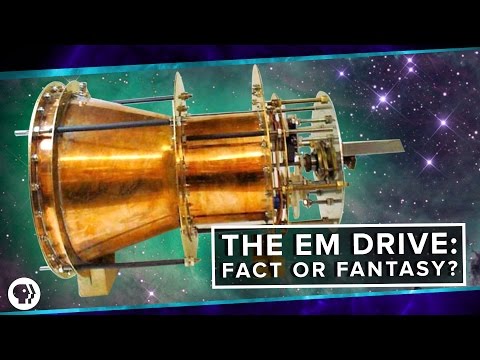
The EmDrive is the invention of Roger Shawyer, a British chartered electrical engineer who spent the 1970s and 1980s in mainstream UK space and defense engineering — including a stint at Sperry Gyroscope working on the UK's strategic missile program, and a long run at Marconi Space and Defence Systems as payload project manager on four Eutelsat high-power television broadcast satellites and technical manager on the early payload design for the Galileo European satellite navigation system. In 2001, drawing on that conventional aerospace background rather than any fringe or amateur tradition, Shawyer founded a small research company, Satellite Propulsion Research Ltd. (SPR), specifically to develop an idea he called the "EmDrive": a sealed, asymmetric, tapered metal cavity into which a magnetron injects microwave energy at a carefully tuned resonant frequency. Because the cavity is wider at one end than the other, Shawyer argued, the radiation pressure exerted by the standing electromagnetic wave bouncing inside it would be very slightly greater on the wide end than on the narrow end, producing a small, continuous net thrust in the direction of the narrow end — without ejecting any propellant, exhaust, or reaction mass whatsoever. The venture received real, if modest, government backing: a Small Business Research Initiative "SMART" award grant from the UK Department of Trade and Industry supplied roughly five years of seed funding for SPR's early work.
Shawyer went public with his concept in the early 2000s and by December 2002 was describing a working prototype that he said produced about 0.02 newtons of thrust from an 850-watt cavity magnetron — a claim that, notably, was never independently verified or published in a form other detectors could replicate. He nonetheless pursued the idea through the UK's conventional patent system rather than as an unpatented fringe claim: an early EmDrive patent, GB2399601, was granted by the UK Intellectual Property Office on 13 March 2003, describing a superconducting second-generation design, and a further application, GB2493361, was published in February 2013. By the mid-2010s Shawyer held three granted UK patents on EmDrive variants, with additional applications still in process — a genuinely unusual amount of formal intellectual-property paper trail for a concept that violates one of physics' most basic conservation laws.
The concept first drew wide public attention in 2006, when New Scientist ran a cover story on the EmDrive that immediately triggered a backlash from working physicists. Mathematician John Baez and science-fiction author and physics popularizer Greg Egan both published pointed public criticism of the coverage itself, with Egan denouncing it for what he called outright "scientific illiteracy" in treating an unverified, unreplicated claim as a credible breakthrough. Shawyer, for his part, said in 2004 that seven independent expert reviews had supported his work — a claim directly contradicted by EADS Astrium's own former technical director, who stated publicly that on close examination he had found "both theory and experiment were fatally flawed." No fully independent, third-party laboratory ever built and tested a first-generation EmDrive prototype to the point of confirming Shawyer's own thrust figures during this early period; the concept spent most of the 2000s as a UK cottage-industry claim viewed with near-total skepticism by mainstream physics and aerospace engineering, kept alive mainly by Shawyer's own conference presentations, patent filings, and later a joint venture (Universal Propulsion Ltd, launched in 2016 with the Gilo Industries Group) that likewise never produced a publicly verified working demonstrator.
What changed the EmDrive's trajectory from UK curiosity to a genuinely global, multi-national research question was a decision, around 2008, by Chinese aerospace researcher Yang Juan of the College of Astronautics at Northwestern Polytechnical University (NWPU) in Xi'an to build and test her own resonant-cavity thruster based on Shawyer's published design, followed a few years later by NASA's own Advanced Propulsion Physics Laboratory — nicknamed "Eagleworks" — at the Johnson Space Center in Houston, under the leadership of aerospace engineer and applied physicist Harold "Sonny" White. It is those two credentialed, institutional testing programs, and the far more rigorous independent replication effort that ultimately falsified both of them, that this theory file exists to document, alongside their eventual, unusually clean scientific resolution.
Scientific Foundations
Unlike several other propulsion hypotheses this site catalogues, the EmDrive's proposed mechanism is not exotic or difficult to state — it is a simple, testable claim built from real, well-understood physics taken one step further than mainstream physicists believe is legitimate. Understanding both the claim and why it drew such fast, near-universal skepticism from working physicists requires walking through three linked ideas.
1. Radiation Pressure and the Asymmetric Cavity
It is genuine, uncontroversial physics that electromagnetic radiation carries momentum and therefore exerts a real, measurable force — radiation pressure — on anything that absorbs or reflects it. This is the same principle that makes solar sails work: sunlight striking a large reflective sail transfers momentum to the spacecraft, producing thrust with no propellant, because the sail is open to space and the reflected photons carry momentum away from the system in one direction while the sail (and craft) recoils in the other, exactly conserving total momentum. Shawyer's EmDrive borrowed the language of radiation pressure but applied it to a sealed, closed cavity rather than an open sail: microwaves generated by a magnetron are pumped into a tapered, cone- or frustum-shaped metal chamber and allowed to resonate as a standing wave. Because the cavity is wider at one end than the other, the group velocity and thus the calculated radiation pressure of the resonant wave differs slightly between the two end plates, and Shawyer's derivation claimed this difference produces a small net force pushing the entire sealed cavity toward its narrower end.
2. Why It Violates Conservation of Momentum
This is precisely where mainstream physics parts ways with the EmDrive concept, and why so many physicists rejected it on paper alone, long before any lab ever tested it. In a legitimate photon drive or solar sail, momentum is conserved because the photons doing the pushing are not part of the closed system — they arrive from outside (the Sun) or are permanently radiated away, carrying momentum with them. The EmDrive, by contrast, is a fully sealed cavity: the same microwave photons that supposedly produce thrust at the narrow end are reflected back and forth inside the chamber indefinitely, never escaping and never being converted into an external reaction mass. If a net, sustained thrust really were produced by a closed system doing nothing but reflecting the same internally-generated radiation back and forth forever, with nothing at all leaving the system in the opposite direction, that would amount to a genuine violation of the conservation of momentum — one of the most thoroughly tested principles in all of physics, verified to extraordinary precision across a century of particle physics, orbital mechanics, and everyday engineering. This is the single specific claim that separates the EmDrive from every other propulsion hypothesis on this site that merely proposes new physics operating within existing conservation laws (vacuum-engineering or inertial-mass-reduction theories, for instance, at least attempt to describe some external interaction the momentum is being exchanged against); the EmDrive's own original derivation offered no such external interaction at all.
3. The "Quantum Vacuum as Pilot Wave" Rationalization
Faced with this objection, later EmDrive proponents — including, cautiously, the NASA Eagleworks team itself in its 2016–2017 published paper — floated a more exotic possible resolution: that the quantum vacuum itself might function as a kind of pilot-wave medium the cavity could push against, providing the missing reaction mass that ordinary electromagnetism does not. Crucially, the Eagleworks authors themselves were explicit in their own paper that this was a speculative hypothesis offered to explain an already-measured signal, not a validated mechanism, and that the underlying physical cause of whatever they had measured remained genuinely unconfirmed. Independent theoretical physicists went further: a 2018 paper by physicist C.-W. Wu, published in Acta Astronautica, examined the EmDrive's own published thrust derivations directly and found that they invoked and violated the conservation of momentum simultaneously and self-contradictorily within the same calculation — meaning the theoretical case for a resonant-cavity thrust effect was not merely unconfirmed but internally inconsistent on its own mathematical terms, independent of any experimental result at all.
4. Legitimate Radiation-Pressure Analogs: Solar Sails and Photon Drives
The clearest way to see exactly where the EmDrive's physics goes wrong is to compare it to propulsion concepts that use the same underlying radiation-pressure principle correctly. Japan's IKAROS spacecraft, launched in 2010, and NASA's own solar-sail demonstrators since, use large, thin reflective membranes deployed in open space: sunlight strikes the sail, transfers momentum, and is reflected away from the spacecraft, with the photons' departing momentum exactly balancing the spacecraft's gained momentum in the opposite direction — textbook conservation of momentum, no violation required. Breakthrough Starshot, a privately funded research initiative exploring laser-driven sails for interstellar probe concepts, works on an identical principle at a much higher power level: an external laser array on Earth pushes a sail via reflected photons that carry momentum away from the system permanently. In every one of these legitimate designs, the momentum-carrying photons leave the system; nothing is reflected back and forth forever inside a sealed container the way Shawyer's design specifies. This comparison is precisely why so many physicists rejected the EmDrive concept on paper alone, well before any laboratory ever tested it: the underlying radiation-pressure physics it borrows from is completely real and already flight-proven, but only in an open configuration the EmDrive's own sealed-cavity design specifically does not have.
Government & Military Programs
The EmDrive's government-adjacent research record runs through two parallel, entirely independent national programs rather than a single classified project, giving this theory an unusually well-documented paper trail for a UAP-propulsion hypothesis. In the United States, NASA's Advanced Propulsion Physics Laboratory ("Eagleworks") at the Johnson Space Center in Houston, led by Harold "Sonny" White, began preliminary resonant-cavity testing around 2011–2012 as one strand of a broader advanced-propulsion research portfolio that also included Quantum Vacuum Plasma Thruster work and White's own Alcubierre warp-drive research. Eagleworks first presented tentative, non-peer-reviewed positive results (roughly 91.2 micronewtons at 17 watts, tested in ordinary air rather than vacuum) at the AIAA Joint Propulsion Conference in 2014. The lab's much more rigorous, peer-reviewed follow-up — a genuine vacuum-chamber test campaign described in detail in the Physical Evidence section below — was published in the AIAA Journal of Propulsion and Power in 2016–2017. Public reporting has also connected DARPA funding to Eagleworks-adjacent advanced-propulsion research during this period, with that funding stream reported to have lapsed around May 2021, roughly coincident with the publication of the definitive independent refutation described later in this file. Eagleworks' own EmDrive-related testing activity wound down after 2019, and White subsequently moved his advanced-propulsion research work to the Limitless Space Institute, a nonprofit propulsion-education and research organization, rather than continuing it inside NASA.
China pursued an independent, unconnected replication effort on a genuinely national scale. Yang Juan, a professor at Northwestern Polytechnical University's College of Astronautics in Xi'an, began investigating Shawyer's design around 2008 and published a series of papers between 2010 and 2013 (including in Acta Physica Sinica and Chinese Physics B) reporting measured net thrust, with some early claims reaching several hundred millinewtons — orders of magnitude larger than anything NASA ever reported. Her own team's later, more careful work told a very different story: by 2014 they had traced their strongest early positive signal to a false-positive artifact caused by an improperly shielded power cable, and a corrected 2016 study found no thrust at all within the sensitivity of their equipment, an internal retraction of their own earlier headline result. That retraction did not end China's institutional interest: in December 2016, Dr. Chen Yue of the China Academy of Space Technology (CAST) publicly confirmed that China's national space agency had funded roughly five years of "key technology research" into EmDrive-type propulsion and stated an intention to move toward satellite-scale prototype testing "as soon as possible," even though CAST's own prototype reportedly produced only millinewtons of measured thrust against the 100-millinewton-to-1-newton range needed for genuinely useful satellite station-keeping. No Chinese satellite has ever been publicly confirmed to have flown an operational EmDrive-type thruster.
A third, commercially oriented effort ran in parallel to the NASA and Chinese government programs, illustrating how far the EmDrive's public credibility had spread by the mid-2010s. Guido Fetta, an American chemical engineer and founder of Cannae Inc., had independently developed his own closed-cavity thruster variant, commonly called the Cannae Drive or Q-Drive, as early as 2006, marketing it through his company from 2011 onward as a more efficient refinement of Shawyer's basic concept. In 2016, Fetta announced plans, in partnership with Tempe-based LAI International and Fairfax, Virginia-based SpaceQuest Ltd., to fly a Cannae Drive-equipped 6U CubeSat as a real-world orbital demonstration, intended to keep the small satellite aloft for at least six months on thrust alone. As of this writing, no launch of that demonstrator has ever been publicly confirmed to have taken place, leaving the Cannae Drive, like Shawyer's own original design, without any independently verified in-space or laboratory validation.
Physical Evidence
Because this theory concerns a laboratory propulsion device rather than a recovered UAP artifact, its "physical evidence" is the actual test hardware and measured data from three independent, credentialed research efforts — and it is unusual among this site's propulsion hypotheses in that the strongest evidence ultimately cuts decisively against the theory rather than for it. NASA Eagleworks' peer-reviewed 2016–2017 paper, "Measurement of Impulsive Thrust from a Closed Radio-Frequency Cavity in Vacuum" (authored by White, Paul March, James Lawrence, Jerry Vera, Andre Sylvester, David Brady, and Paul Bailey), described a genuine vacuum-chamber test campaign — pressure below roughly 8×10⁻⁶ torr — using a tapered copper RF cavity excited in the TM212 resonant mode at approximately 1937 MHz, run through forward-thrust, reverse-thrust, and null-test configurations at 40, 60, and 80 watts of input power. The team reported a thrust-to-power ratio of roughly 1.2 ± 0.1 millinewtons per kilowatt, consistent across configurations, and the paper passed formal AIAA peer review — a genuinely higher evidentiary bar than most claims in this space ever clear. Critically, even the paper's own authors were candid about its limits: White later told Aerospace America that the team had, at best, "put a little bit of a pencil mark through" certain potential error sources rather than definitively ruling them out, and the paper's own discussion explicitly flagged that the underlying physical cause of the measured signal remained unconfirmed.
That candor proved warranted. Independent testing at TU Dresden's Chair of Space Systems, led by Martin Tajmar, found in preliminary 2018 results that the measured thrust signal did not scale down to zero as input power was reduced toward zero — a strong indicator that the effect was not actually being produced by the RF cavity at all, since a genuine cavity-driven thrust should track power output. The Dresden team traced the residual signal instead to Earth's own magnetic field interacting with inadequately shielded power cables in the test chamber, a limitation shared with NASA's original test setup, which likewise lacked comprehensive magnetic shielding. Tajmar's group then built a dramatically more rigorous instrument: an inverted, counterbalanced double-pendulum thrust balance, with the test article mounted on a bearing below its own suspension point specifically to eliminate thermal-drift artifacts, and powered entirely from an onboard battery pack rather than external cabling, removing any possibility of feedthrough-cable interference altogether. Using this apparatus on a geometry and power range closely matching both the original Eagleworks configuration and Yang Juan's Chinese design, Tajmar's team (with co-authors Oliver Neunzig and Marcel Weikert) published "High-Accuracy Thrust Measurements of the EMDrive and Elimination of False-Positive Effects" in the CEAS Space Journal in 2021–2022: they measured no thrust whatsoever across a wide frequency band, constraining any possible anomalous signal to below the level expected from ordinary classical radiation pressure — ruling out the original NASA and Chinese claims by more than three orders of magnitude. Tajmar's own summary of the result was blunt: "Our measurements refute all EmDrive claims by at least 3 orders of magnitude," and, in a subsequent interview, "I believe that the EMDrive story is now closed."
One further physical-evidence detail is worth stating plainly, because it was itself a red flag mainstream physicists pointed to years before the concept was formally refuted: the three positive results that existed prior to Tajmar's definitive study did not actually agree with one another. Shawyer's original 2002 prototype claim (0.02 N from an 850 W magnetron) implied a thrust-to-power ratio orders of magnitude larger than NASA Eagleworks' 2016 vacuum-chamber figure of roughly 1.2 mN/kW, which was in turn dramatically smaller than Yang Juan's earliest NWPU claims of several hundred millinewtons. A genuine, real physical effect tied to a specific, well-understood cavity geometry and resonant mode would be expected to scale in a broadly consistent, predictable way across similarly designed test articles; three independent groups reporting positive signals differing by several orders of magnitude from broadly similar hardware is itself a strong indicator that each program was separately measuring its own distinct combination of experimental artifacts — thermal drift, cable interaction, air currents — rather than a shared, reproducible physical phenomenon, exactly as Tajmar's subsequent work went on to demonstrate directly.
Crash Retrievals
This hypothesis makes no claim whatsoever about recovered UAP craft, crash debris, or reverse-engineered biological material. It is, and was always intended by its proponents to be, a mechanism theory about how an already-observed, already-flying object might achieve its reported performance envelope — specifically, silent, exhaust-free, instantaneous acceleration — not a claim about where such an object came from or what may have happened to it afterward. The closest thing to a "retrieval" narrative anywhere in this theory's real, documented history is entirely institutional and entirely mundane: NASA's own Eagleworks laboratory building, testing, and ultimately setting aside its resonant-cavity hardware once independent testing found no genuine effect to explain, and the Chinese NWPU team's parallel decision to publicly retract its own earlier positive thrust claim once it traced the signal to a shielding fault. No alleged crash site, wreckage fragment, or occupant account is invoked anywhere in the sourced record for this theory, and unlike several other propulsion hypotheses on this site, its evidentiary arc runs cleanly from an initial positive claim through credentialed institutional testing to a definitive, published null result — the scientific process working exactly as intended, rather than an open or contested case.
Supporting Case Files
Proponents who took the EmDrive seriously as a candidate UAP propulsion mechanism, before its 2021–2022 refutation, most often pointed to the small number of instrument-tracked encounters in which a craft is reported to accelerate abruptly, silently, and with no visible exhaust plume, sonic boom, or control surface — the specific observable profile a genuinely reactionless, sealed-cavity drive would be expected to produce if it worked as originally claimed:
Theoretical Alignment
Even at the height of its credibility, before independent testing refuted it, the EmDrive was always a comparatively weak fit for the case files its proponents cited. Its own best-documented laboratory result — roughly 1.2 millinewtons per kilowatt from NASA's 2016 vacuum test — is a vanishingly small force, many orders of magnitude short of anything that could plausibly accelerate a multi-ton airframe from a hover to hypersonic speed in seconds, the kinematic signature reported in the USS Nimitz and GoFast encounters. What made the theory attractive to some UAP researchers anyway was not its raw thrust figures but its qualitative observable profile: a genuinely closed, propellant-free cavity drive would, if real, produce exactly the silent, exhaust-free, structurally simple flight signature witnesses in both cases described — no visible plume on FLIR, no sonic boom, no external control surface a sealed metal box would need. That qualitative appeal is precisely why this theory's collapse matters for the broader UAP propulsion discussion: it was the closest thing available to a real-world, laboratory-testable version of "reactionless propulsion," and its rigorous, replicated failure is now the strongest available piece of evidence that ordinary electromagnetic engineering, at least in the specific form Shawyer and Eagleworks proposed, cannot explain the observed cases. Proponents of other mechanism theories on this site, including this site's own Vacuum Polarizability hypothesis, explicitly distinguish their own proposed physics from the EmDrive's now-refuted closed-cavity mechanism specifically to avoid inheriting its discredited status. That distinction matters for readers weighing the credibility of UAP propulsion theories generally: a hypothesis that at least proposes some external interaction partner for the momentum it claims to generate, however exotic, sits on stronger theoretical ground than one that does not, and the EmDrive's specific failure to do so — not merely its failure to produce a working prototype — is the deeper reason mainstream physics rejected it even during the period when NASA's own laboratory data still looked ambiguous.
Sensor & Instrumentation Detection Profile
An EmDrive-type thruster, if it had worked as originally proposed, would have been almost uniquely difficult to detect at range compared to the other propulsion mechanisms this site catalogues, which is itself a large part of why it briefly appealed to UAP researchers. A sealed resonant cavity generates no exhaust plume, so it would leave no thermal signature for infrared search-and-track (IRST) or FLIR sensors of the kind that recorded the USS Nimitz encounter's Tic Tac object; it requires no ionization of the surrounding air, so it would produce none of the visible glow, corona, or radar-attenuating plasma sheath this site's plasma-sheath/MHD hypothesis proposes for other cases; and because the claimed thrust arises entirely inside a closed metal box rather than from any external field projected beyond the hull, a craft using it would present an ordinary metallic radar cross-section, no different from any other solid object of the same size and shape, to systems such as the AN/SPY-1 radar that tracked the Nimitz object or the airborne intercept radar used in the GoFast encounter. The one genuinely distinctive instrumentation signature this theory's own laboratory history actually generated was not sensor data from any UAP case at all, but the thrust-balance and magnetometer data from the Eagleworks and TU Dresden test campaigns themselves — specialized, laboratory-grade force and field measurement equipment, not the radar, IRST, or optical sensors that feature in this site's case files. That gap is telling: no instrument aboard any aircraft, ship, or ground station in any case file on this site has ever recorded a signature specific to a resonant-cavity thrust effect, because the only rigorous measurements of that effect ever taken were made inside sealed laboratory vacuum chambers in Houston and Dresden, and the more precise of the two found nothing to detect at all.
The instrumentation history of this theory is itself worth understanding on its own terms, since it illustrates exactly how such a small claimed effect can be measured, misread, and finally correctly nulled out. A thrust balance of the kind used at both Eagleworks and TU Dresden works by suspending the test article on a low-friction pivot or pendulum and measuring its tiny angular displacement, typically with a laser interferometer or capacitive sensor, as thrust is applied — a measurement technique sensitive enough to register forces in the micronewton range, roughly one hundred-thousandth the weight of a single sheet of paper. At that sensitivity, mundane confounds that would be utterly negligible in ordinary engineering become dominant: a few degrees of thermal expansion in a metal mounting bracket, or a stray magnetic field acting on a current-carrying cable, can produce a displacement signal larger than the claimed thrust itself. This is precisely why Tajmar's team's key innovation was not a more sensitive balance in the abstract, but a balance specifically engineered to be blind to those two known confounds — the inverted, counterbalanced pendulum geometry to cancel thermal drift, and onboard battery power to eliminate cable-borne electromagnetic interference — rather than simply repeating earlier designs at higher precision.
Environmental & Geospatial Context
As a laboratory mechanism theory rather than a site-specific one, the EmDrive hypothesis carries no dedicated sighting geography of its own — its evidentiary anchor is a small number of specific research institutions rather than any UAP encounter location. Those institutions are themselves geographically scattered and largely disconnected from one another: Roger Shawyer's Satellite Propulsion Research Ltd. operated from the UK; NASA's Eagleworks laboratory was based at the Johnson Space Center in Houston, Texas; Yang Juan's replication and later retraction took place at Northwestern Polytechnical University in Xi'an, in China's Shaanxi province; and the definitive refutation was carried out at the Technische Universität Dresden's Chair of Space Systems in Saxony, Germany. None of these research sites has any documented connection to a UAP sighting location anywhere in this site's catalogue. The cases its proponents pointed to as kinematically consistent are similarly scattered: the USS Nimitz encounter occurred over the Pacific Ocean off San Diego, Southern California, tracked by a carrier strike group's own AN/SPY-1 radar and F/A-18 FLIR pods, while the GoFast video was recorded over the Atlantic Ocean off the East Coast of the United States by a Navy fighter's targeting pod. That total absence of overlap between the theory's own research geography and its supporting case geography is itself a limitation worth stating plainly: unlike hypotheses built around a specific recovered object or documented test range, the EmDrive has no environmental or geospatial dataset of its own to test against, only whichever silent, exhaust-free acceleration cases elsewhere in this catalogue happen to match the qualitative flight profile its now-refuted mechanism once predicted. Guido Fetta's Cannae Inc., the third commercial venture pursuing a related closed-cavity design, adds a fourth, entirely separate American research effort to a theory whose institutional geography already spanned the UK, Texas, China, and Germany without ever converging on a single research campus or shared test range the way several other propulsion hypotheses on this site do; Fetta's planned CubeSat demonstration was to have flown in partnership with Tempe, Arizona-based LAI International and Fairfax, Virginia-based SpaceQuest Ltd.
Observer Credibility & Occupational Profile
This hypothesis is distinguished among UAP-adjacent propulsion theories by resting entirely on named, credentialed scientists and engineers working inside mainstream institutions, rather than anonymous witnesses or unaffiliated researchers — which is precisely what makes its ultimate refutation so scientifically clean. Roger Shawyer is a real Chartered Electrical Engineer and Fellow of the Royal Aeronautical Society with a genuine, conventional career managing satellite payload programs before founding SPR Ltd.; his EmDrive claims were never fringe in the sense of coming from an unqualified source, only in the sense of contradicting established physics. Harold "Sonny" White held a Ph.D. in physics from Rice University and led a real, funded NASA research laboratory; his 2016–2017 paper cleared formal AIAA peer review, an outcome that would have been essentially impossible for an unqualified claim to achieve regardless of how badly the review process may have underestimated the paper's error sources in retrospect. Yang Juan held a professorship at a major Chinese aerospace university and published her positive results in peer-reviewed Chinese physics journals before her own team identified and openly corrected its error. And Martin Tajmar, the physicist whose work ultimately closed the case, holds an endowed chair at a major German technical university and has spent much of his career building instrumentation specifically capable of distinguishing genuine anomalous thrust from mundane artifacts — the same skill set he had already applied, seventeen years earlier, to definitively debunking T. Townsend Brown's Biefeld-Brown "electrogravitics" claims. A fifth figure, Guido Fetta, occupies a somewhat different position on this spectrum: a working chemical engineer and company founder rather than an academic or government researcher, whose commercial Cannae Drive venture generated real press coverage and a real partnership with two named aerospace contractors, but whose promised in-space demonstration was never confirmed to have actually flown, leaving his own specific thrust claims the least independently tested of any figure in this file. The pattern across all five figures is nonetheless genuinely instructive: none of them were cranks in the colloquial sense, nearly all of their positive work passed some form of institutional or peer review, and the theory was ultimately falsified not by dismissal or ridicule but by better-instrumented, more rigorous testing from within the same scientific and engineering community that had produced the original claim — arguably the system working exactly as intended, if considerably more slowly than a purely armchair objection to the underlying physics would have suggested was necessary.
Historical Precedents & Archive Matches
The EmDrive is not the first claimed "reactionless" or propellant-free thrust effect this site has documented, and its resolution follows an almost identical historical template to the one that came before it. In the 1950s, American inventor T. Townsend Brown claimed that high-voltage asymmetric capacitors produced a genuine link between electricity and gravity — the "Biefeld-Brown effect" — and pursued it through his 1952 Project Winterhaven proposal and later aerospace-industry demonstrations. The U.S. Navy's Office of Naval Research commissioned physicist Willoughby Cady to formally evaluate Brown's claims in 1952, and Cady's report attributed the observed thrust to ordinary ion wind and corona discharge rather than any genuine gravitational or antigravity effect. Decades later, in 2004, Martin Tajmar personally repeated and extended that verdict with modern instrumentation, publishing "Biefeld-Brown Effect: Misinterpretation of Corona Wind Phenomena" in the AIAA Journal; by enclosing his test electrodes in a sealed housing that physically excluded corona wind, he found no residual thrust at all, confirming ion wind as the complete explanation. That Tajmar is the same physicist who, seventeen years later, applied an almost identical methodology — isolate the test article from every plausible mundane force, then see if any signal survives — to definitively debunk the EmDrive is not a coincidence of career overlap; it reflects a consistent, repeatable scientific approach to evaluating claimed reactionless-thrust effects that has now been validated twice against two structurally similar claims separated by nearly seventy years. The EmDrive's own historical arc also directly echoes the Biefeld-Brown pattern in miniature: an initial claim from a credentialed but non-mainstream inventor, a period of both public fascination and institutional skepticism, at least one seemingly positive institutional test result, and a final, rigorous, independently replicated null result that traced the entire effect to ordinary physics — corona wind and ion drift in Brown's case, thermal expansion and unshielded magnetic-cable interaction in the EmDrive's.
The broader twentieth-century archive of claimed "impossible" propulsion and antigravity effects supplies further, if less directly comparable, context. Patent offices in the UK, US, and elsewhere have granted or examined a long, largely forgotten procession of perpetual-motion and reactionless-drive patent applications since at least the nineteenth century, almost none of which were ever built into a working, independently verified device; Shawyer's own EmDrive patents are notable specifically because they cleared formal patent examination on originality and enablement grounds without requiring proof the device actually worked as claimed, a distinction between "patentable" and "physically real" that this theory's own timeline illustrates about as clearly as any case on this site. The EmDrive's ultimate resolution — institutional testing, initial ambiguous positive signals, and eventual rigorous falsification — is also the closest real-world precedent available for how this site's other still-unresolved propulsion hypotheses, including Vacuum Polarizability and the Pais-effect-derived Inertial Mass Reduction theory, might eventually be settled one way or the other, if a comparably well-funded, comparably rigorous independent test were ever run against them.
Material Analysis
Because this theory concerns a laboratory device rather than a recovered UAP artifact, its "material" evidence trail is the physical test hardware and instrumentation itself, and the specific engineering explanation for its false-positive signal is now well documented. Tajmar's team identified the dominant source of NASA's and other groups' apparent thrust readings as thermal expansion: as electrical power flows into a resonant cavity, the cavity itself and its supporting fasteners warm and physically expand, subtly shifting the test article's center of mass relative to its measurement balance and producing a slow, direction-consistent drift that reads, on an insufficiently isolated instrument, exactly like a genuine steady thrust. A second, independently identified contributor was electromagnetic in nature: Earth's own ambient magnetic field interacting with inadequately shielded power cables and feedthroughs running into the test chamber, producing small forces on the current-carrying wires themselves rather than on the cavity under test — a completely mundane effect with nothing to do with the cavity's resonant microwave field. A third, secondary contributor identified across the broader test history was ordinary convective air movement: NASA Eagleworks' earliest 2014 result was measured with the cavity operating in open air rather than vacuum, a setup in which the warm cavity heats the surrounding air and sets up small convective currents that push against a sensitive balance in a way that is easily mistaken for thrust, which is exactly why Eagleworks' own 2016 vacuum-chamber test campaign was designed specifically to remove that variable, even though it turned out not to be the only mundane factor still present. Tajmar's team eliminated both remaining error sources simultaneously in their definitive apparatus: an inverted, counterbalanced double-pendulum thrust balance that placed the test article's mounting bearing below its own suspension point specifically to cancel thermal-drift effects, combined with an onboard battery power supply that removed external cabling from the measurement loop entirely. With both mundane force sources engineered out of the system, the measured thrust signal did not merely shrink — it disappeared completely, to a sensitivity better than 0.1 micronewtons even at input powers up to 100 watts, conclusively distinguishing "real anomalous thrust" from "measurement artifact" for the first time in the concept's twenty-year history. Cross-referenced against this site's case files, this theory is invoked purely to explain flight kinematics rather than any physical residue, and it shares that limitation with several other propulsion hypotheses here; cases built around actual recovered trace evidence, such as Rendlesham Forest's ground impressions, sit entirely outside what this theory, even at its most credible, was ever proposed to explain. The instrumentation itself is, in a real sense, the only "material" this theory ever produced that is worth archiving: the specific combination of an inverted counterbalanced pendulum, battery-only power delivery, and wide-frequency-band scanning that Tajmar's team assembled directly addresses the same thermal-drift and magnetic-cable pitfalls that misled three separate research programs across three different countries, and stands as a template for how any future claimed reactionless-thrust device, EmDrive-related or otherwise, ought to be tested before its results are taken seriously.
Theory Development Timeline
| Date | Development |
|---|---|
| 2001 | Roger Shawyer founds Satellite Propulsion Research Ltd. (SPR) in the UK, backed by a Department of Trade and Industry SMART award, to develop the EmDrive concept. |
| Dec 2002 | Shawyer describes a prototype he says produced roughly 0.02 newtons of thrust from an 850-watt cavity magnetron; the claim is never independently replicated in this form. |
| 13 Mar 2003 | UK patent GB2399601, describing a superconducting second-generation EmDrive design, is granted by the UK Intellectual Property Office. |
| 2004 | Shawyer states seven independent expert reviews supported his work; EADS Astrium's former technical director publicly disputes this, calling the theory and experiment "fatally flawed." |
| 2004 | Physicist Martin Tajmar publishes "Biefeld-Brown Effect: Misinterpretation of Corona Wind Phenomena" in the AIAA Journal, debunking a structurally similar earlier reactionless-thrust claim using the same isolate-and-shield methodology he later applies to the EmDrive. |
| 2006 | New Scientist runs a cover story on the EmDrive; mathematician John Baez and author Greg Egan publicly criticize the coverage as scientifically illiterate. |
| 2008 | Professor Yang Juan begins independently researching and building a resonant-cavity thruster based on Shawyer's design at Northwestern Polytechnical University (NWPU), Xi'an, China. |
| 2010–2013 | Yang Juan's NWPU team publishes a series of papers, including in Acta Physica Sinica and Chinese Physics B, reporting measured net thrust from their cavity, with early claims reaching several hundred millinewtons. |
| Feb 2013 | UK patent GB2493361, describing a further EmDrive refinement using superconducting end plates, is published. |
| Aug 2014 | NASA's Eagleworks laboratory, led by Harold White, presents tentative, non-peer-reviewed positive results (about 91.2 μN at 17 W, tested in air) at the AIAA Joint Propulsion Conference. |
| 2014–2016 | Yang Juan's NWPU team traces its own earlier strongest positive signal to a false positive caused by an improperly shielded power cable; a corrected 2016 study finds no thrust within measurement sensitivity. |
| Nov 2016 | NASA Eagleworks' peer-reviewed paper, "Measurement of Impulsive Thrust from a Closed Radio-Frequency Cavity in Vacuum," clears AIAA review and is accepted for publication, reporting roughly 1.2 ± 0.1 mN/kW from vacuum-chamber testing. |
| 13 Dec 2016 | China's Academy of Space Technology (CAST) publicly confirms roughly five years of national EmDrive research funding and states an intention to pursue satellite-scale testing. |
| 2018 | Preliminary tests by Martin Tajmar's group at TU Dresden find the measured thrust signal does not scale to zero with input power, pointing toward magnetic-field/cable interaction rather than genuine cavity thrust. |
| 2019 | Kößling, Monette, Weikert, and Tajmar publish "The SpaceDrive Project" in Acta Astronautica, detailing an improved thrust-balance methodology built to eliminate the identified error sources; NASA Eagleworks' own EmDrive-related testing activity winds down the same year. |
| May 2021 | DARPA funding reportedly connected to Eagleworks-adjacent advanced-propulsion research lapses. |
| 2021–2022 | Tajmar, Neunzig, and Weikert publish "High-Accuracy Thrust Measurements of the EMDrive and Elimination of False-Positive Effects" in the CEAS Space Journal, measuring no thrust across a wide frequency band and ruling out prior positive claims by more than three orders of magnitude. |
Weighing the Evidence
The EmDrive presents an unusually clean case study in how a genuinely testable UAP-adjacent claim should be resolved: real institutional credibility and a real positive result on one side, met by progressively more rigorous, ultimately conclusive independent testing on the other.
Supporting Arguments (Historical)
- NASA Eagleworks' 2016–2017 paper cleared formal AIAA peer review and was conducted in a genuine vacuum chamber, addressing a major early objection (air currents) to the 2014 preliminary results
- Three independent teams — UK, US, and Chinese — reported measuring a broadly similar small positive thrust signal from structurally similar cavities, initially suggesting a possibly common, repeatable effect rather than isolated noise
- Eagleworks' own paper was candid that its proposed quantum-vacuum explanation was speculative and that the underlying cause remained unconfirmed, a genuinely honest framing rather than overclaiming
- The concept's qualitative observable profile — silent, exhaust-free thrust with no visible control surface — closely matched reported UAP flight characteristics, which is why it briefly drew serious attention from propulsion researchers at all
Skeptical Arguments
- The core claim requires violating conservation of momentum with no external interaction to conserve it against, unlike legitimate photon-drive or solar-sail concepts
- A 2018 theoretical analysis (Wu, Acta Astronautica) found the EmDrive's own published thrust derivation self-contradictorily invokes and violates momentum conservation within the same calculation
- China's own NWPU team retracted its strongest early positive result after tracing it to an improperly shielded power cable
- Tajmar's 2021–2022 high-precision, self-powered, magnetically isolated thrust balance measured zero thrust, ruling out all prior claims by more than three orders of magnitude
- No fully shielded, independently replicated positive result has ever been produced by any laboratory anywhere
Conventional Explanation Candidate
Unlike most theories on this site, the EmDrive's Conventional Explanation Candidate is not a matter of ongoing debate — it is the settled conclusion of the same rigorous testing program that once treated the anomalous-thrust claim as a live scientific question. Three specific, independently documented mundane mechanisms, working individually or in combination, account for every positive EmDrive result ever reported.
Thermal Expansion of Test-Fixture Hardware
PlausibleAs input power flows into a resonant cavity, the cavity and its mounting hardware physically warm and expand, shifting the test article's center of mass relative to its thrust balance and producing a slow, direction-consistent drift that reads as apparent steady thrust. Tajmar's team identified this as the dominant error source in prior positive results and specifically engineered it out with an inverted, counterbalanced double-pendulum balance design.
Unshielded Magnetic-Field / Cable Interaction
PlausiblePreliminary 2018 TU Dresden testing found the measured thrust signal did not scale to zero as input power was reduced, pointing to Earth's ambient magnetic field acting on inadequately shielded power cables and feedthroughs rather than the cavity itself — a limitation shared by NASA's original test setup. Powering the test article from an onboard battery, removing external cabling entirely, eliminated this effect.
Air Currents in Non-Vacuum Preliminary Testing
PlausibleNASA Eagleworks' earliest 2014 positive result was measured in ordinary air rather than vacuum, a setup in which convective air currents from a warming cavity are a well-documented source of false-positive thrust readings on sensitive balances. Eagleworks' own move to vacuum-chamber testing for its 2016–2017 paper was a direct, if ultimately insufficient, attempt to rule this specific factor out.
Theoretical Assessment Profile
Six-domain evaluation of this hypothesis
Key Proponents
Roger Shawyer
British aerospace and defense engineer who founded Satellite Propulsion Research Ltd. in 2001 to develop the EmDrive, patenting several cavity designs in the UK and remaining the concept's most consistent public advocate for two decades, despite no independently verified working prototype ever being produced.
Dr. Harold "Sonny" White
Principal investigator of NASA's Advanced Propulsion Physics Laboratory, who led the team behind the 2016–2017 peer-reviewed AIAA Journal of Propulsion and Power paper reporting a small anomalous thrust signal from a vacuum-tested resonant cavity — the single most credentialed positive EmDrive result ever published, though White himself was candid that its underlying cause remained unconfirmed.
Prof. Yang Juan
Chinese aerospace researcher whose team's 2010–2013 papers reported the largest positive EmDrive thrust measurements ever published, and whose own subsequent, more careful testing then traced that signal to a shielding fault — an unusually candid self-correction that helped set the stage for the concept's eventual, fuller refutation.
Key Witnesses & Analysts
One figure did more than any other to move the EmDrive question from open scientific debate to settled conclusion, applying the same rigorous, isolate-and-shield methodology he had already used once before against a structurally similar claim:
Prof. Martin Tajmar
The aerospace physicist whose 2021–2022 paper, "High-Accuracy Thrust Measurements of the EMDrive and Elimination of False-Positive Effects," built a purpose-designed, magnetically isolated, thermally stabilized thrust balance and measured no anomalous thrust at all, ruling out every prior positive EmDrive claim by more than three orders of magnitude. Tajmar had applied an almost identical isolate-and-shield methodology in 2004 to debunk T. Townsend Brown's Biefeld-Brown "electrogravitics" effect, making him the single physicist most directly responsible for closing two of this site's best-documented claimed reactionless-propulsion effects.
Related Cases
Further Reading
EmDrive: Advances in Spacecraft Thrusters and Propulsion Systems
The inventor's own account of the EmDrive's gestation and development, and his description of the underlying theory of operation, direct from the source the entire controversy traces back to.
Voodoo Science: The Road from Foolishness to Fraud
A working physicist's field guide to how claims that violate established physics gain traction inside credentialed institutions before rigorous testing catches up with them — the exact pattern this theory file documents.
Frontiers of Propulsion Science
A comprehensive survey of breakthrough-propulsion concepts, including reactionless and propellantless drive claims, evaluated against the conservation laws they would need to overturn to actually work.
Physics of the Impossible
Ranks speculative and "impossible" technologies — including reactionless drives — by how directly they conflict with known physics, useful context for understanding exactly which law the EmDrive was always going to have to break.
The Hunt for Zero Point: Inside the Classified World of Antigravity Technology
Traces the decades-long history of claimed antigravity and reactionless-propulsion research this theory's own historical section connects the EmDrive back to, from T. Townsend Brown's electrogravitics onward.
DISCLOSURE: Some links above are affiliate links. If you purchase through them, OverClassified receives a small commission at no additional cost to you. This helps support independent research.
Essential Viewing
Sources Cited
- White, H.; March, P.; Lawrence, J.; Vera, J.; Sylvester, A.; Brady, D.; Bailey, P. "Measurement of Impulsive Thrust from a Closed Radio-Frequency Cavity in Vacuum," Journal of Propulsion and Power, Vol. 33, 2017, pp. 830–841.
- Tajmar, M.; Neunzig, O.; Weikert, M. "High-Accuracy Thrust Measurements of the EMDrive and Elimination of False-Positive Effects," CEAS Space Journal, Vol. 14, 2022, pp. 31–44.
- Kößling, M.; Monette, M.; Weikert, M.; Tajmar, M. "The SpaceDrive Project — Thrust Balance Development and New Measurements of the Mach-Effect and EMDrive Thrusters," Acta Astronautica, Vol. 161, 2019, pp. 139–152.
- Scogin, T. "Advanced Propulsion Physics Lab: Eagleworks Investigations," NASA Technical Reports Server, JSC-CN-30913, 2014.
- Wu, C.-W. "Comments on Theoretical Foundation of EM Drive," Acta Astronautica, arXiv:1801.02975, 2018.
- Coppinger, R. "Flights of Fancy?" Royal Aeronautical Society, 3 February 2017.
- Hadhazy, A. "Fuel-Free Space Travel," Aerospace America (AIAA), 9 February 2017.
- Siegel, E. "The EmDrive, NASA's 'Impossible' Space Engine, Really Is Impossible," Forbes, 23 May 2018.
- Schultz, I. "EmDrive, the 'Impossible' Engine Tested by NASA, Is Knocked Down Once Again," Gizmodo, 7 April 2021.
- Drake, N. "NASA's 'Impossible' EmDrive Engine Tested—Here Are the Results," National Geographic, 22 May 2018.
- Dussault, J. "NASA's Fuel-Less EmDrive Thruster: Viable Propulsion Solution or Sci-Fi?" The Christian Science Monitor, 23 November 2016.
- Russon, M.-A. "EmDrive: Chinese Space Agency to Put Controversial Tech Onto Satellites 'As Soon As Possible,'" IBTimes UK, 13 December 2016.
- "'Impossible' EmDrive Space Thruster May Really Be Impossible," Space.com, 2018.
- "Martin Tajmar," Chair of Space Systems, Technische Universität Dresden, official faculty biography.
- "Roger Shawyer," Alternative Propulsion Engineering Conference, speaker biography.
- "EmDrive," Wikipedia, background and timeline overview (light-use, cross-checked against primary sources above).
- "Harold G. White," Wikipedia, background biographical overview (light-use, cross-checked against primary sources above).
- "The EM Drive: Fact or Fantasy?" PBS Space Time, YouTube, 12 January 2017.
- "What is the EM Drive? And Does it Really Work?" Scott Manley, YouTube, 21 November 2016.
- "NASA's Eagleworks Lab: Pushing The Boundaries Of Physics," Answers With Joe, YouTube.
- Tajmar, M.; Neunzig, O.; Weikert, M. "High-accuracy thrust measurements of the EMDrive and elimination of false-positive effects," ResearchGate preprint record, 2021.
Have corrections, additional research, or peer-reviewed sources? Help improve this entry.
Suggest an Edit