
UFOs
Reframing the Debate
Core Thesis
UFOs: Reframing the Debate opens from a blunt editorial premise: that organized ufology, seven decades after Kenneth Arnold's 1947 sighting, has produced remarkably little genuine forward motion, because — in editor Robbie Graham's own words framing the collection — "UFO study has always suffered from major organizational and methodological problems." Rather than adding a fifteenth voice defending or debunking the extraterrestrial hypothesis, Graham assembled fourteen working researchers and writers, prefaced by a foreword from religious-studies scholar Diana Walsh Pasulka, and asked each to interrogate a specific failure mode in how the subject gets studied: its dependence on a narrow nuts-and-bolts materialism, its unexamined borrowing of science-fiction narrative structure, its neglect of parapsychology and consciousness research, its treatment of "government disclosure" as the field's only meaningful endpoint, and its habitual sidelining of the experiencer's own testimony in favor of physical-trace evidence. The book's animating claim is not that UFOs are unreal or unworthy of study, but that the intellectual toolkit ufology has used to study them — borrowed wholesale from Cold War-era intelligence analysis and updated only cosmetically since — is no longer capable of accounting for the full range of what witnesses actually report, particularly the high-strangeness, consciousness-adjacent dimensions of close encounters that a strictly technological framework has always struggled to fit inside a flight-hardware paradigm.
About the Author
Robbie Graham (May 9, 1981 – February 17, 2023) was a British writer, editor and publisher who approached ufology from a media-studies rather than an investigative-case angle for essentially the whole of his working life. He held first-class degrees in Film, Television and Radio Studies (B.A. Hons, Staffordshire University) and Cinema Studies (M.A., University of Bristol), and built his career on a single, sustained argument: that the UFO subject cannot be understood in isolation from the movies, television and popular culture that have shaped public expectation of what a "close encounter" is supposed to look like since long before most witnesses ever reported one. His byline appeared in The Guardian, New Statesman, Filmfax and Fortean Times, and he was interviewed on the subject by the BBC, Coast to Coast AM, Canal+ TV, Channel 4 and Vanity Fair.
Graham's first book, Silver Screen Saucers: Sorting Fact from Fantasy in Hollywood's UFO Movies (White Crow Books, 2015), examined seven decades of UFO cinema — interviews with screenwriters and directors whose work was shaped by their own UFO fixations, alleged CIA and Pentagon script influence on UFO-themed productions, and the two-way traffic between Hollywood imagery and real-world witness testimony — and remains, as of this writing, its own title not yet separately catalogued in this site's Essential Reading library, a gap worth flagging given how directly it anticipates the media-and-belief arguments this later anthology builds on. He was also a close, longtime research associate of Matthew Alford and Tom Secker, whose own FOIA-driven National Security Cinema: The Shocking New Evidence of Government Control in Hollywood (2017) — documenting Pentagon and CIA script-revision leverage over more than 800 Hollywood films, and endorsed on publication by Oliver Stone — drew on the same government–entertainment-industry terrain Graham had already been mapping specifically within UFO cinema.
Graham was, notably, not a credentialed scientist, a former intelligence official, or a case investigator in the Joe Nickell or Chris Rutkowski mold; his authority on this book's subject rested instead on a genuinely distinct methodological lane within ufology — treating belief formation, image culture and narrative convention as primary evidence in their own right, rather than as noise to be filtered out before the "real" investigation begins. That specific angle is what this anthology sets out to institutionalize across fourteen other contributors' work, rather than argue alone.
Beyond his own writing, Graham founded August Night Press and ran it alongside the wider White Crow Books UFO imprint, publishing other researchers' work through the years following this anthology — including Chris A. Rutkowski's Canada's UFOs: Declassified (August Night Press, May 2022), a collection edited on paranthropology by Jack Hunter, MJ Banias's The UFO People, and a White Crow Books republication of psychiatrist John Mack's Passport to the Cosmos. Rutkowski, notably, is one of this anthology's own fourteen contributors, making his 2022 August Night Press book a direct downstream product of the same publishing relationship this 2017 collection first established. Graham died on February 17, 2023, at age 41; colleagues in the field, including several contributors to this same anthology, described him in tributes published shortly afterward as an editor and publisher whose influence on the subject's more critical, self-reflective wing was disproportionate to how widely his own name circulated outside it.
Historical Context & Origins
Graham compiled this anthology across a period, roughly 2015 to 2017, when organized ufology's mainstream center of gravity was still firmly fixed on hardware and disclosure: the field's most prominent public conversations concerned Bob Lazar-style reverse-engineering claims, MUFON and NICAP-descended case-investigation methodology, and a still-building expectation that the U.S. government was on the verge of releasing definitive proof. The book arrived several months before that expectation was seemingly vindicated by the December 2017 New York Times reporting on the Pentagon's AATIP program and the Navy pilot encounter videos — meaning Graham's own core complaint, that ufology had over-invested in disclosure as an endpoint rather than building durable investigative methodology, was published just before the subject's most consequential disclosure moment in decades, an unusual and largely unremarked-upon timing coincidence in the book's own publication history.
The volume also entered a UFO-literature landscape in which the specific complaint it organizes itself around — that mainstream ufology had become too narrowly materialist and needed to reconnect with parapsychology and consciousness research — had a real prior lineage but no recent large-scale advocate. Jacques Vallée's 1969 Passport to Magonia and John Mack's 1990s Harvard-based abduction research had both made adjacent arguments decades earlier, but by the mid-2010s those threads had become minority positions within a field whose loudest voices, per several of this book's own contributors, had drifted toward treating the extraterrestrial-hypothesis-plus-government-coverup framework as settled background assumption rather than one hypothesis among several.
Diana Walsh Pasulka's presence as foreword author is itself a piece of this book's own historical context worth stating plainly: she contributed it two full years before her own landmark American Cosmic (Oxford University Press, 2019) made her the field's most visible academic voice arguing that UFO belief functions as an emergent American religion. Her involvement here, while she was still a comparatively unknown quantity to ufology at large, places this anthology among the first UFO-community publications to platform the specific religious-studies and belief-formation lens she would later build into a full academic monograph — a connection this site's own American Cosmic entry does not itself document, since it predates that book's writing rather than following from it.
Core Arguments & Key Concepts
The book's most direct methodological argument, developed at length in contributor Joshua Cutchin's essay "In for a Penny, In for a Pound: Moving Ufology Beyond Materialism," is that mainstream ufology's insistence on a purely physical, extraterrestrial-hardware explanation for UFO reports forces investigators to discard or downplay the substantial minority of cases involving apparent precognition, synchronicity, telepathic communication and other phenomena more traditionally associated with parapsychology than aerospace engineering. Cutchin's chapter explicitly revives the case Vallée made decades earlier for treating UFO investigation and psychical research as overlapping fields rather than separate disciplines that happen to share some witnesses.
A second major thread, carried by Susan Demeter-St. Clair's essay "Making Mountains out of Mashed Potatoes: UFOs as a ParaPsychological Event," opens with a first-person case account rather than abstract theory, arguing that individual close-encounter experiences frequently carry the structural hallmarks of documented parapsychological events — altered states of consciousness, information transfer that resists conventional explanation, lasting psychological transformation in the experiencer — regardless of whatever physical craft or entity may or may not have been objectively present. Red Pill Junkie's contribution, "Anarchy in the UFO," pushes a related but more explicitly anti-institutional argument: that ufology's own internal gatekeeping, competing organizations and credentialing disputes have done as much to stall genuine inquiry as any government secrecy has.
Contributor Greg Bishop's essay takes a more deliberately agnostic position that several readers flagged as one of the collection's more quietly influential arguments: rather than assigning the phenomenon a specific origin or ultimate meaning, Bishop urges researchers to redirect more attention toward the psychology and physiology of the experiencer — what happens inside a witness's nervous system and belief structure during and after an encounter — treating that internal process as legitimate primary data in its own right rather than a confound to be subtracted out before the "real" phenomenon can be assessed.
Running beneath these individual essays is Graham's own organizing thesis, framed most explicitly in his editor's introduction: that ufology's default equation of progress with government disclosure — the assumption that the field's central problem is access to withheld official evidence rather than the field's own interpretive tools — has functioned as a kind of intellectual deferral, letting researchers postpone the harder work of building better methodology while waiting for a revelation that, disclosure advocates' own decades of predictions notwithstanding, keeps not quite arriving on schedule.
Key Cases & Evidence Discussed
Unlike this site's own skeptical case-file anthology or its investigative counterparts, UFOs: Reframing the Debate is not built around named historical sightings, and the book's own critical reception — discussed below — specifically flags this as a genuine limitation: it is a collection of theoretical and methodological essays first, with individual case examples deployed sparingly and largely assumed to be familiar background rather than laid out and argued from scratch.
Where the book does connect most directly to this site's own case-file library is through its contributors' other, more case-specific work rather than through incidents its own chapters analyze in depth. Contributor Chris Rutkowski, the Canadian UFO Survey compiler, later published Canada's UFOs: Declassified (2022) through Graham's own August Night Press — a book built entirely around named, government-documented Canadian cases including Falcon Lake and Shag Harbour, applying the same case-by-case, non-materialist-friendly rigor this anthology's introduction calls for in the abstract.
The David Grusch Whistleblower Testimony (Case #019, 2023) arrived six years after this book's publication but tests its central complaint about disclosure-as-endpoint from the opposite direction: Grusch's sworn congressional claims about alleged government crash-retrieval programs generated exactly the disclosure-focused media cycle Graham's introduction argues the field over-invests in, while leaving the deeper methodological questions this anthology raises — how to actually evaluate testimony, consciousness-linked encounter reports, and experiencer psychology — substantially untouched by the same news cycle.
The Chris Bledsoe "UFO of God" Contact Events (Case #191, 2007) connects to this book's Bishop and Demeter-St. Clair chapters on a thematic level: Bledsoe's own account foregrounds precisely the transformative, consciousness-linked, difficult-to-materially-verify dimensions of contact experience that this anthology's contributors argue mainstream ufology has historically been poorly equipped to take seriously on its own terms.
This book's own contributor roster includes no essay specifically addressing the Rendlesham Forest Incident (Case File #004, 1980) at Rendlesham Forest, Suffolk — Britain's most-cited UFO case and one that occurred within Graham's own home country — but the case's central evidentiary dispute, over how much weight to give first-person military witness testimony against the U.K. Ministry of Defence's own contemporaneous paper trail, sits squarely inside the broader testimony-versus-institutional-record tension this anthology's contributors argue the field needs better tools to navigate.
Critical Reception & Controversies
Reviewing the book for the Society for Psychical Research, Chris Jensen Romer praised its central project — bridging the historically separate communities of organized ufology and academic psychical research — and singled out Cutchin's and Demeter-St. Clair's essays specifically as effective, well-argued contributions. He was more measured about the collection as a whole, however, writing that its coverage of complex research areas was often "sparse in actual UFO case examples" and tended to assume reader familiarity with cases and arguments the essays did not fully re-establish, a structural limitation Romer attributed to the anthology format itself rather than to any single contributor's individual chapter.
General reader reception, reflected in a 3.86-out-of-5 average across 51 Goodreads ratings and 13 written reviews, ran along a similar fault line: several reviewers welcomed the book as, in one reader's words, "a much needed breath of fresh air and a call to break out of preconceived notions," specifically praising its focus on the experiencer's own account over hardware-centric analysis. A more critical reader assessment described the collection as "a mixed affair, with some entries being of greater interest than others," language that echoes Romer's own point about uneven depth across a fourteen-contributor volume compiled from writers working in substantially different registers.
The book's most structurally honest limitation, acknowledged implicitly by its own format, is one shared by nearly every multi-contributor UFO anthology this site's Essential Reading catalogue has covered: a fourteen-essay collection assembled from working researchers with genuinely different specialties — film studies, parapsychology, folklore, science journalism, government-document research — cannot offer the sustained, single-argument development of a book-length monograph, and several of its individual chapters function better as position papers gesturing toward a research program than as completed investigations in their own right.
No dedicated trade review from Kirkus, Publishers Weekly, or a comparable mainstream outlet appears to have covered this specific title on publication, consistent with the more specialist, small-press positioning White Crow Books titles have generally occupied relative to the university-press and major-trade UFO books — such as Pasulka's own subsequent American Cosmic — that have drawn wider mainstream critical attention.
Influence & Legacy
The book's most concrete legacy runs through the publishing operation Graham built in its wake rather than through the anthology's own direct citation record: August Night Press, which he founded and ran alongside the broader White Crow Books UFO catalogue, went on to publish contributor Chris Rutkowski's Canada's UFOs: Declassified in May 2022, alongside MJ Banias's The UFO People, a paranthropology essay collection edited by Jack Hunter, and a White Crow Books edition of John Mack's Passport to the Cosmos — continuing to platform exactly the non-materialist, experiencer-centered research this 2017 anthology's introduction had called for, right up until Graham's death the following year.
Diana Walsh Pasulka's foreword, contributed two years before her own American Cosmic made her the field's most prominent academic voice on UFO belief-as-religion, gives this book a modest but genuine claim to having platformed her specific interpretive approach earlier than the book that would make it famous — a connection this site's own catalogue had not previously documented before this article.
Within organized ufology's own internal conversation, this anthology's central complaint — that the field over-invests in government disclosure as an endpoint at the expense of methodological development — has aged into something closer to consensus among the field's more self-critical researchers than it was in 2017, a shift the 2017–2023 wave of Pentagon-driven disclosure reporting arguably accelerated by giving disclosure advocates exactly what they had asked for without producing the field-wide clarity many had predicted it would.
On this site specifically, this book already functions as working infrastructure across several pages published before this article: it is cited as recommended context on the Yeni Kent Compound Sighting and 2019 Navy Destroyer Drone Swarm case files and on the Secret Space Program Hypothesis theory page, each drawing on its argument for separating a case's genuinely anomalous pattern from the interpretive framework applied to it after the fact.
The Book
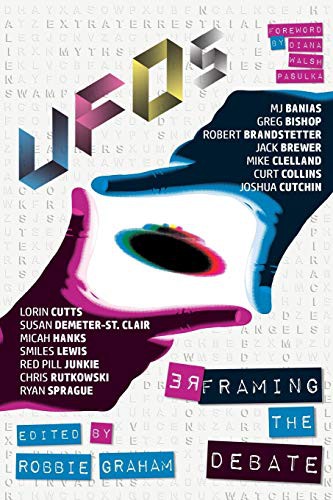
As an Amazon Associate, OverClassified may earn from qualifying purchases made through this link, at no extra cost to you.
Why This Is Essential Reading
UFOs: Reframing the Debate earns its place on this list less as a definitive argument than as a working record of ufology's own most serious internal self-critique in recent decades — fourteen contributors and an editor, Robbie Graham, all willing to say plainly that the field's dominant materialist, disclosure-focused framework had stopped producing new insight, two years before Diana Walsh Pasulka's own foreword contribution here would harden into American Cosmic's full academic argument for taking UFO belief seriously as religion rather than only as intelligence failure. The book's own reviewers, from the Society for Psychical Research's Chris Jensen Romer to its general Goodreads readership, are right that a fourteen-voice anthology trades argumentative depth for breadth, and that its case coverage is thinner than a reader coming from this site's own case-file-heavy catalogue might expect. What it offers instead is a genuine methodological corrective: a sustained, multi-author case that parapsychology, consciousness research and the experiencer's own testimony belong inside ufology's toolkit rather than outside it — an argument Graham kept building institutionally through August Night Press until his death in February 2023, and one this site's own Canada's UFOs: Declassified entry shows he was still actively publishing right up to that point.
Related Cases & Theories
Essential Viewing
Robbie Graham Busts the UFO Paradigm |358|
Skeptiko — Robbie Graham, joined by book contributor Robert Brandstetter, discusses this anthology's central argument directly with host Alex Tsakiris: that mainstream ufology's attachment to the extraterrestrial hypothesis forecloses the consciousness- and psychology-linked dimensions of close encounters this book's contributors argue deserve equal weight. Verified via YouTube oEmbed before inclusion.
UFOs and Disclosure: A Fresh Perspective
Robbie Graham — A lecture delivered by Graham on his own YouTube channel in October 2016, several months before this anthology's publication, laying out the same core critique of disclosure-as-endpoint thinking that became the book's organizing editorial argument. Verified via YouTube oEmbed before inclusion.
Sources Cited
- "UFOs: Reframing the Debate." White Crow Books (official publisher page: ISBN 978-1-78677-023-3 pb. / 978-1-78677-024-0 eBook, May 2017, 300 pp., full contributor and foreword credits). whitecrowbooks.com
- "UFOs: Reframing the Debate." Amazon.com product listing for ISBN 1786770237 / 9781786770233 (cited here), with editor, foreword, and contributor credits. amazon.com
- "UFOs: Reframing the Debate by Robbie Graham." Goodreads (reader ratings: 3.86/5 across 51 ratings and 13 reviews; synopsis and reader review excerpts). goodreads.com
- "UFOs: Reframing the Debate." Anomaly Archives collection listing (structural details: foreword, editor's introduction, fourteen essays, contributor biographies, endnotes, index; individual essay titles). anomalyarchives.org
- Romer, Chris Jensen. "UFOs: Reframing the Debate, edited by Robbie Graham." Society for Psychical Research book review (critical assessment: bridging ufology and psychical research, praise for Cutchin and Demeter-St. Clair essays, critique of sparse case coverage). spr.ac.uk
- "Robbie Graham Busts the UFO Paradigm |358|." Skeptiko, hosted by Alex Tsakiris (interview with Graham and contributor Robert Brandstetter discussing the book's critique of the extraterrestrial-hypothesis paradigm). skeptiko.com
- "Robbie Graham." IMDb biography (education, career, publications, film and broadcast credits). imdb.com
- "A note to our readers." The Daily Grail, February 2023 (editorial note regarding coverage of Robbie Graham's death). dailygrail.com
- Sentes, Bryan. "Robbie Graham. May 9, 1981~Feb 17, 2023." Skunkworks, February 19, 2023 (tribute covering Graham's career, August Night Press and White Crow Books publishing legacy, and death). skunkworksblog.com
- "Robbie Graham." International UFO Congress speaker biography (career summary and lecture description, "Searching for Truth in All the Wrong Places"). ufocongress.com
- "Silver Screen Saucers: Sorting Fact from Fantasy in Hollywood's UFO Movies." White Crow Books (Graham's 2015 solo book, publisher listing). whitecrowbooks.com
- Alford, Matthew, and Secker, Tom. National Security Cinema: The Shocking New Evidence of Government Control in Hollywood. 2017 (Goodreads listing; Graham credited as a close research associate). goodreads.com
- This site's own essential-reading entry: Canada's UFOs: Declassified, Chris Rutkowski's 2022 August Night Press book, for the direct publishing link back to this anthology's contributor roster.
- This site's own essential-reading entry: American Cosmic, Diana Walsh Pasulka's 2019 book, for the foreword-author connection to this anthology two years earlier.
- This site's own key-figures entry: Diana Pasulka, for her full biography and this book's foreword credit.
- This site's own key-figures entry: Chris Rutkowski, for his contributor role in this anthology and his subsequent August Night Press book.
- This site's own resources library: Full Reading List, where this 2017 paperback edition (ISBN 1786770237) is cited across multiple case-file and theory pages.
Have corrections, additional research, or peer-reviewed sources? Help improve this entry.
Suggest an Edit