
UFOs: Myths, Conspiracies, and Realities
A Retired Army Colonel's Insider Case Against Both the True Believers and the Cover-Up Theorists
Core Thesis
UFOs: Myths, Conspiracies, and Realities stakes out a position its author insists is more radical than either side of the UFO debate wants to admit: that the phenomenon is physically real, tracked on sophisticated defense instrumentation, and apparently displaying flight performance beyond known aircraft — and that almost everything popularly believed about a government cover-up protecting that fact is fabrication, misremembering, or wishful thinking. John B. Alexander, a retired U.S. Army colonel who spent the 1980s running a classified interagency study group with participants from the Army, Navy, Air Force, CIA, NSA, DIA, and the aerospace industry, argues from that same insider vantage point that no hidden deep-black budget exists for a crashed-saucer retrieval-and-reverse-engineering program, that the Roswell mythology built up around Philip Corso's claims does not survive scrutiny, that the Majestic 12 documents are almost certainly fabrications, and that Bob Lazar's Area 51 employment story collapses under direct fact-checking — while maintaining, in the same book, that dismissing the underlying sighting reports as swamp gas or mass hallucination is its own kind of intellectual laziness. The result is less a debunking than a demolition of the entire cover-up framework from someone who says he would have known if the cover-up were real, paired with an argument that the genuine mystery is more interesting, and more unresolved, than either the true believers or the reflexive skeptics generally allow.
About the Author
John B. Alexander was born in 1937 and enlisted in the U.S. Army as a private in 1956, rising through the enlisted ranks to sergeant first class before earning a commission through Officer Candidate School — a career path the Army calls a "mustang." He commanded Army Special Forces (Green Beret) teams in Thailand and Vietnam from 1966 to 1969, then spent the following two decades moving through a series of increasingly senior staff and intelligence assignments: Chief of the Human Resources Division at Fort McPherson, Georgia; Inspector General for the Department of the Army in Washington; Chief of Human Technology at the Army's Intelligence and Security Command (INSCOM); and Director of Advanced System Concepts at the Army Laboratory Command, before retiring as a colonel of Infantry in 1988. Alongside his military service he earned a B.G.S. in sociology from the University of Nebraska-Lincoln, a master's degree in education from Pepperdine University, and a Ph.D. in education from Walden University, later adding executive coursework at MIT's Sloan School and Harvard's Kennedy School.
It was Alexander's INSCOM-era work that made him a genuinely controversial figure years before this book was published. In 1980 he authored an article for the Army's own Military Review titled "The New Mental Battlefield: 'Beam Me Up, Spock,'" arguing that remote viewing and other purported psychic phenomena had military applications worth serious study — a position that placed him inside the same orbit as the Army's Stargate remote-viewing program. He collaborated with Lieutenant Colonel Jim Channon on the First Earth Battalion manual, an experimental effort to fold meditation, visualization, and non-lethal tactics into infantry doctrine that later became shorthand for the Army's "Jedi warrior" concept. That chapter of his career became broadly, if satirically, famous when journalist Jon Ronson profiled Alexander at length in his 2004 book The Men Who Stare at Goats, later adapted into the 2009 film of the same name starring George Clooney — a pop-culture footprint few other authors on this site's Essential Reading list can claim, and one Alexander has had to publicly navigate ever since as a mix of comic distortion and genuine biography.
After retiring from the Army in 1988, Alexander joined Los Alamos National Laboratory as project manager for non-lethal defense technology, where he became one of the field's leading public advocates, briefing the White House, the National Security Council, Congress, and NATO officials on electromagnetic-pulse, high-power-microwave, and acoustic non-lethal systems — work he had already documented in two earlier books, Future War: Non-Lethal Weapons in Modern Warfare (1999) and Winning the War: Advanced Weapons, Strategies, and Concepts for the Post-9/11 World (2003). In parallel, Alexander pursued paranormal and consciousness research that ran well beyond UFOs: he served as president of the International Association for Near-Death Studies, sat on the board of the remote-viewing firm PSI-TECH alongside fellow Stargate figure Major General Albert Stubblebine, and consulted for aerospace entrepreneur Robert Bigelow's National Institute for Discovery Science (NIDS), the organization whose investigations of Utah's Skinwalker Ranch this site's own Skinwalker Ranch case file (Case File #296) documents in detail. By the time this book appeared in 2011, that combination — genuine military-intelligence credentials, decades inside the Pentagon's most unconventional research programs, and an openly stated belief that UFOs deserve serious study — made Alexander one of the few writers positioned to credibly claim insider knowledge of whether a UFO cover-up existed, rather than merely speculating about one from outside.
Historical Context & Origins
Alexander places the book's origin specifically in the early 1980s, when he says he organized an informal, unofficial interagency working group of officers and civilians holding Top Secret clearances — drawn from the Army, Navy, Air Force, CIA, NSA, DIA, and defense contractors — to examine what the U.S. government actually knew about UFOs, separate from any official program of record. That claim is the book's central credential: rather than writing as an outside researcher filing Freedom of Information Act requests, Alexander presents himself as someone who was inside the rooms where classified UFO-adjacent material would have surfaced if it existed, across a career that ran from Vietnam-era Special Forces command through senior INSCOM intelligence postings.
The book arrived into a UFO-research landscape still dominated by two competing narratives it directly targets. One was Philip J. Corso's 1997 bestseller The Day After Roswell, discussed at length on this site as Essential Reading ER-087, which claimed a retired Army colonel had personally overseen the seeding of recovered alien technology into American defense contractors. The other was the Majestic 12 document set, a collection of purported top-secret memos describing a Truman-era body established to manage recovered UFO wreckage, first circulated in 1984 and never authenticated by mainstream document examiners. Alexander's own career — another retired Army colonel, from the same INSCOM-adjacent intelligence world Corso claimed to have worked in — gave him an unusually direct platform to check those claims against people he says he actually knew, rather than against documents alone.
The book also followed decades after the U.S. Air Force's official position on UFOs had been set by Edward Condon's 1968 scientific study (this site's ER-080, tied to the Condon Report case file, Case File #227), which recommended against further government-funded UFO investigation and effectively closed Project Blue Book in 1969. Published in 2011, six years before the December 2017 New York Times report on the Pentagon's Advanced Aerospace Threat Identification Program reopened mainstream interest in the subject, Alexander's book sits in an unusual gap in the UFO literature's own timeline: written by a genuine Pentagon-adjacent insider, but published years before the post-2017 wave of retired officials and pilots who would later legitimize public UAP discussion in Congress. It reads today as an early, largely overlooked preview of the insider-credentialed-skeptic voice that would become far more common a decade later.
Core Arguments & Key Concepts
The book's organizing move is structural: rather than building toward a single conclusion, Alexander devotes individual chapters to systematically testing specific, named claims against his own insider knowledge and against publicly available records, discarding most of them along the way. "The Corso Conundrum" chapter takes on Philip Corso's account point by point, and "Majestic 12" does the same for the purported Truman-era oversight documents, while "The Condon Report Revisited" and "The Congressional Hearings That Never Happened" reassess the official record rather than the conspiracy record. A description of the book circulated by its publisher states plainly that Alexander intended it to contain "no conspiracy theories here — only hard facts," and Publishers Weekly's contemporary review credited him with succeeding at exactly that separation, writing that "Alexander succeeds in separating solid facts and credible witnesses from the myths and conspiracy theorists."
Its most concrete debunking targets Bob Lazar, whose claimed employment reverse-engineering alien craft at a facility near Area 51 remains one of ufology's most cited insider accounts; Alexander's book directly disputes the story, citing Lazar's purported former supervisor, who stated he had never hired Lazar and did not know who he was — a direct contradiction of Lazar's own account that this site's own Bob Lazar case file (Case File #005) documents from the opposite direction, cataloguing the fabrications independent researchers have since found throughout Lazar's claimed education and employment history. Alexander applies the same insider fact-checking method to questions like "What was really in Hangar 18?" and whether a UFO actually landed at Holloman Air Force Base in the 1960s, generally concluding that the popular version of each story does not survive contact with the people who were actually there.
Running underneath the debunking, though, is an argument Alexander is careful to keep distinct from it: that the underlying sighting data — drawn from military radar, gun-camera and infrared footage, and trained observers with no incentive to fabricate — documents objects with flight performance that exceeds known aircraft, and that this residue of genuinely unexplained cases is exactly what gets lost when the conversation collapses into cover-up mythology on one side or reflexive dismissal on the other. Publishers Weekly captured that double argument in its review, quoting Alexander's own observation that "every time we think we have an answer, new observations make the problem more complex" — a formulation that refuses both the comfort of a solved mystery and the comfort of a fully debunked one.
The book's later chapters, "Sworn to Secrecy," "What NATO Knows," and "The UK Connection," extend the same insider-access method internationally, drawing on Alexander's contacts with foreign military and intelligence officials to argue that if a coordinated multinational cover-up existed, the compartmentalization required to keep it airtight across NATO allies for six decades is implausible on its face — an argument about institutional plausibility rather than direct evidence, and one of the places where the book's reception, discussed below, was most split.
Key Cases & Evidence Discussed
Roswell and the Corso claims (1947 / 1997): Alexander devotes a full chapter, "The Corso Conundrum," to directly rebutting the account in Philip J. Corso's The Day After Roswell, which this site covers as Essential Reading ER-087 and which connects to the underlying Roswell Incident case file (Case File #001) — giving readers of both entries an unusual opportunity to read the insider claim and an insider's rebuttal of it side by side.
Majestic 12 documents: The chapter titled simply "Majestic 12" applies Alexander's own intelligence-community background to the purported Truman-era oversight memos first circulated in 1984, treating their authenticity with the same skepticism mainstream document examiners have applied since their release.
Bob Lazar's Area 51 claims: The book directly disputes Lazar's account of having worked reverse-engineering alien technology, an account this site's own Bob Lazar case file (Case File #005) independently documents as riddled with unverifiable and contradicted claims about his education and employment history.
Holloman Air Force Base and "Hangar 18": Alexander investigates the popular claim that a UFO landed at Holloman Air Force Base in the 1960s and the broader "Hangar 18" crashed-saucer-storage legend, tracing both against people who were stationed there rather than against secondhand retellings.
The Condon Report (1968): "The Condon Report Revisited" reassesses Edward Condon's 1968 scientific study (ER-080) and the underlying Condon Report case file (Case File #227), treating it as a flawed but genuine scientific effort rather than a knowing cover-up, a more measured reading than much of the UFO-research community has historically given it.
Skinwalker Ranch (adjacent, not covered in the book): Alexander's own consulting role with Robert Bigelow's National Institute for Discovery Science places him directly inside this site's own Skinwalker Ranch case file (Case File #296), even though this specific 2011 book does not itself cover the ranch — a case where the connection runs through the author's biography rather than the book's own text.
Critical Reception & Controversies
Trade coverage was genuinely positive on the book's central method. Publishers Weekly praised Alexander for successfully "separating solid facts and credible witnesses from the myths and conspiracy theorists," a notably specific endorsement of the insider-fact-checking approach that runs through every chapter, and the book carries a foreword by physicist and longtime UFO investigator Jacques Vallée, an introduction by aerospace engineer Burt Rutan, and commentary by novelist Tom Clancy — a lineup of contributors that gave the book unusual mainstream visibility for a UFO title.
The reception from within the UFO research community itself was considerably rougher, and split along exactly the lines the book's own argument predicts. At the 2011 MUFON International UFO Symposium, Alexander's talk denying the existence of a coordinated government cover-up or any campaign to silence or harass researchers was reportedly jeered by attendees — a striking real-world confirmation of the book's own thesis that the UFO research community has a stronger emotional investment in the cover-up narrative than in the underlying sighting data. That same year, Alexander appeared in a widely discussed debate against nuclear physicist Stanton Friedman — the original civilian investigator of the Roswell case and one of Majestic 12's most prominent defenders — at the 2011 International UFO Congress, moderated by attorney Danny Sheehan, putting the book's central disagreement with Roswell-crash-retrieval advocates on a public stage the same year it was published.
Reviewers closer to the UFO-research side of the field were more circumspect about specific arguments in the book, with at least one review noting that Alexander sometimes leans on his own personal unfamiliarity with a claim as evidence against it — effectively arguing that a story must be false because he, with his decades of insider access, had never heard it corroborated — a pattern critics flagged as a weaker form of argument than the book's more rigorously sourced chapters, where Alexander cites named individuals who directly contradict specific claims (as with Lazar's purported employer) rather than simply asserting his own lack of awareness.
Taken together, the book's reception illustrates a genuinely unusual position in the UFO literature: skeptical researchers who normally dismiss UFO-themed books outright had comparatively little to object to in Alexander's methodology, since his conclusions about Roswell mythology, Majestic 12, and Lazar's Area 51 claims track closely with mainstream skeptical consensus, while a meaningful part of the UFO research community — the audience the book was ostensibly written for — reacted to those same conclusions as a betrayal from someone they expected to validate, not dismantle, the field's most cherished cover-up stories.
Influence & Legacy
Alexander's continued public profile after 2011 kept this book's insider-skeptic argument in circulation well past its initial release. He followed it in 2017 with Reality Denied: Firsthand Experiences with Things That Can't Happen — But Did, a book that opens with the declaration "UFOs are real" and closes by arguing that "whatever this is, is more complex than we can ever imagine" — carrying this book's core physical-reality argument forward into the years immediately preceding the Pentagon's own 2017 UAP disclosures, without revisiting most of this book's specific cover-up debunking.
The book's position anticipated, without directly causing, the credentialed-insider-skeptic voice that became far more prominent in UAP discourse after December 2017, when retired military and intelligence officials began speaking publicly about unexplained sightings while remaining openly doubtful of extraterrestrial-cover-up narratives — the same combination Alexander had already staked out six years earlier, from inside a career that predates almost every other insider voice the post-2017 disclosure wave produced.
On a more local level, the public 2011 debate with Stanton Friedman at the International UFO Congress remains one of the more concrete, citable instances of this book's argument being tested directly against its most articulate opposing voice in the same calendar year of publication, giving researchers an unusually clean before-and-after record of how the book's central claims held up under direct challenge from a defender of the Roswell-crash-retrieval position.
Within this site's own library, the book now functions as a direct rebuttal companion to The Day After Roswell (ER-087) and a complementary insider perspective alongside the Condon Report entry (ER-080), while its author's own consulting history with Robert Bigelow's NIDS project ties it directly to this site's Skinwalker Ranch case file (Case File #296) — giving this new key-figures reciprocal link a genuinely dense set of existing cross-references to plug into.
The Book
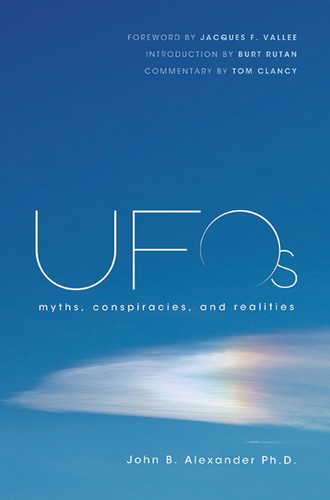
UFOs: Myths, Conspiracies, and Realities
A Retired Army Colonel's Insider Case Against Both the True Believers and the Cover-Up Theorists
Find on Amazon →As an Amazon Associate, OverClassified may earn from qualifying purchases made through this link, at no extra cost to you.
Why This Is Essential Reading
UFOs: Myths, Conspiracies, and Realities earns its place on this list precisely because its author cannot be dismissed from either direction. John B. Alexander spent a career inside the same INSCOM-adjacent intelligence world Philip Corso claimed to have worked in, and used that access not to confirm the field's favorite cover-up stories but to dismantle them — directly rebutting Corso, treating Majestic 12 with open skepticism, and citing a named source who contradicts Bob Lazar's own account of his Area 51 employment. That the 2011 MUFON Symposium audience jeered him for saying so, and that a leading Roswell researcher like Stanton Friedman debated him publicly the same year, is itself evidence of how uncomfortable the book's actual argument is for a research community more invested in the cover-up narrative than in the underlying data. What keeps this from reading as a simple skeptic's takedown, though, is Alexander's insistence — echoed by Publishers Weekly's own review — that the residue of genuinely unexplained cases his own defense-community sources documented is real, unresolved, and worth taking seriously on its own terms, without either alien spacecraft in a hangar or a six-decade conspiracy to explain it away.
Related Cases & Theories
Essential Viewing
Col. John Alexander - Military Applications of the Paranormal | SRS #96
Shawn Ryan Show — A long-form 2024 interview with Alexander covering his Vietnam Special Forces service, his role in the Army's Stargate-era remote-viewing research, and his decades-long investigation into UFOs and other unexplained military-adjacent phenomena.
Skinwalker Ranch and UFOs: Col. John Alexander and George Knapp
Vail Symposium — A recorded public talk connecting Alexander to the National Institute for Discovery Science's investigation of Skinwalker Ranch, the case this site documents in its own Skinwalker Ranch case file.
Sources Cited
- "John B. Alexander." Wikipedia (biography: military career, INSCOM, non-lethal weapons, paranormal research, bibliography). en.wikipedia.org
- "UFOs: Myths, Conspiracies, and Realities." Open Library / Internet Archive bibliographic record (publisher, pagination, ISBN, full table of contents). openlibrary.org
- "UFOs : myths, conspiracies, and realities." Internet Archive item record. archive.org
- "UFOs: Myths, Conspiracies, and Realities." Amazon.com product listing for ISBN 0312648340 / 9780312648343 (hardcover edition cited on this site). amazon.com
- "UFOs: Myths, Conspiracies, and Realities by John B. Alexander." Publishers Weekly (contemporary trade review, "separating solid facts and credible witnesses from the myths and conspiracy theorists"). publishersweekly.com
- "UFOs: Myths, Conspiracies, and Realities: A Book Review." UFO Digest (contemporary review discussing the book's chapter-by-chapter debunking of Lazar, Corso, and Majestic 12 claims). ufodigest.com
- "UFOs: Myths, Conspiracies, and Realities by John B. Alexander." Goodreads (reader ratings and edition record). goodreads.com
- "UFOs: Myths, Conspiracies, and Realities." Biblio.com bookseller listing (pagination xxv + 305 p., Thomas Dunne Books, New York, 2011). biblio.com
- "VIDEO | 2011 International UFO Congress | Stanton Friedman vs. Dr. John Alexander in UFO Debate." The UFO Chronicles, August 2011 (Danny Sheehan-moderated public debate the same year this book was published). theufochronicles.com
- "Biography: John B. Alexander." HandWiki (military career details, First Earth Battalion, NIDS/Bigelow consulting, PSI-TECH board). handwiki.org
- "John Alexander: Paranormal Colonel." Boing Boing, June 2010 (profile covering his paranormal and non-lethal-weapons research career). boingboing.net
- Ronson, Jon. The Men Who Stare at Goats. Simon & Schuster, 2004 (the book profiling Alexander's First Earth Battalion and paranormal-research career, later adapted into the 2009 film of the same name). Referenced via en.wikipedia.org
- "Col. John Alexander — Military Applications of the Paranormal." Shawn Ryan Show, Episode #96 (2024 long-form interview covering Alexander's Vietnam service, Stargate-era remote-viewing research, and UFO investigations). youtube.com
- "Skinwalker Ranch and UFOs: Col. John Alexander and George Knapp." Vail Symposium (recorded talk connecting Alexander to the NIDS-era investigation of Skinwalker Ranch). youtube.com
- This site's own key-figures entry: John B. Alexander, for his full biography and case connections.
- This site's own essential-reading entry: The Day After Roswell, for the Philip Corso account this book directly rebuts.
- This site's own case file: Bob Lazar, for the independent documentation of the Area 51 employment claims this book disputes.
- This site's own resources library: Full Reading List, where this 2011 hardcover edition (ISBN 0312648340) is cited.
Have corrections, additional research, or peer-reviewed sources? Help improve this entry.
Suggest an Edit