
UFO's: A Scientific Debate
The Published Proceedings of the December 1969 AAAS Symposium — Mainstream Science's One Structured, On-the-Record Argument Over the UFO Question
Core Thesis
UFO's: A Scientific Debate is the published proceedings of a real, structured, on-the-record argument among credentialed scientists — not an advocacy book and not a skeptical debunking, but a transcript of mainstream science actually disagreeing with itself about UFOs in public. Organized by Carl Sagan, Thornton Page, physicist Philip Morrison, and AAAS president Walter Orr Roberts, the American Association for the Advancement of Science's General Symposium on Unidentified Flying Objects convened on December 26–27, 1969, at the AAAS's 134th annual meeting in Boston — barely eleven months after the Condon Report's dismissive "Conclusions" chapter had, in the view of a substantial number of scientists, closed the UFO question far more decisively than the report's own case-by-case findings actually supported. Sixteen scientists took part, from astronomy, physics, meteorology, psychiatry, psychology, sociology, and aeronautical engineering; fifteen of their papers became this book's fifteen chapters, running from J. Allen Hynek's case for taking the subject seriously and James E. McDonald's detailed, case-by-case rebuttal of the Condon Report, through Donald H. Menzel's skeptical counter-argument, to methodological chapters on radar, photography, sociology, psychology, psychiatry, witness reliability, and press coverage, closing with Sagan's own chapter on the extraterrestrial hypothesis and Morrison's summary essay on the nature of scientific evidence itself. The symposium happened only because its organizers won a fight to hold it at all: Edward Condon tried to have it cancelled.
About the Author
By December 1969, Carl Sagan was an astronomer at Cornell University who had already spent three years engaged with the UFO question through official channels — he had participated in the 1966 National Academy of Sciences review of the Condon Committee's methodology, and would testify before Congress alongside Hynek and McDonald the following July at Rep. J. Edward Roush's House symposium, a hearing this site's own Condon Report case file documents in detail. His fuller biography, including his Pulitzer Prize, the Voyager Golden Record, and Cosmos, is covered at length in this site's own essential-reading entry on The Demon-Haunted World, his 1995 book; this article's focus is narrower — Sagan's specific role, alongside Page, Morrison, and Roberts, in organizing and later co-editing this 1969 symposium into book form, and his own contributed chapter arguing for the extraterrestrial hypothesis as one legitimate possibility among several, to be weighed by evidence rather than dismissed by reflex.
Dr. Thornton Leigh Page (1913–1996) did the bulk of the organizing legwork and carried far deeper institutional history with the UFO question than his co-editor. Born in New Haven, Connecticut, to a Yale physics instructor, Page earned a B.S. in physics from Yale in 1934, won a Rhodes Scholarship, and completed a D.Phil. at Oxford before a career that ran through Bikini atomic-test reporting, the Army's Operations Research Office (1951–1958, where he became the first editor of the Journal of the Operations Research Society of America), and, in 1953, service on the CIA's Robertson Panel — the body whose debunking-oriented UFO review this site's own case file treats as the direct institutional template the Condon Report would later follow. Page became professor and head of the astronomy department at Wesleyan University in 1958, a post he held through the entire span of this symposium's planning and execution; he resigned from Wesleyan in 1971 to join the U.S. Naval Research Laboratory, retiring in 1976, and died in Houston on January 2, 1996. In a 1992 letter to researcher James Klotz, Page became the only Robertson Panel member to state on record that the panel's chairman had privately told the group its job was "to reduce public concern" — making Page, uniquely among this book's editors, a figure with firsthand experience of exactly the kind of predetermined-conclusion science this 1969 symposium was organized, at least in part, to avoid repeating.
Formal planning for the symposium began in April 1968, when Page proposed it to the AAAS; the original target was the association's 1968 annual meeting in Dallas, but the plan was postponed a year. Two other organizers rounded out the team: physicist Philip Morrison of MIT, who would go on to write the book's closing summary chapter, and astronomer Walter Orr Roberts, director of the National Center for Atmospheric Research and the AAAS's own sitting president — whose institutional backing was, as the fight over whether the symposium would happen at all soon made clear, not a formality but a necessity.
Historical Context & Origins
This symposium exists, in a direct and documented sense, because of dissatisfaction with the Condon Report. Released in January 1969, the University of Colorado study's headline conclusion — that "nothing has come from the study of UFOs in the past 21 years that has added to scientific knowledge" — was reached, in the view of Hynek, McDonald, and a number of other scientists, well ahead of what the report's own roughly 400 pages of case-by-case investigation actually supported; this site's own case file on the report documents that gap at length, including the November 1970 AIAA subcommittee finding that Condon's own summary "did not adequately reflect the body of the report." The AAAS symposium was organized, in real part, as a venue where that disagreement could be argued out in public by credentialed scientists on both sides, rather than settled by a single report's opening chapter.
That the symposium happened at all was not a foregone conclusion. According to Paul E. McCarthy's 1975 University of Hawaii doctoral dissertation on McDonald's UFO career, which devotes a full chapter to this event, Edward Condon refused to participate and threatened not to attend any AAAS functions at all if the symposium were held, circulating copies of his objections to prominent scientists and government officials, including members of Congress and Vice President Spiro Agnew's office, warning of the precedent it would set for future UFO-research funding. Harvard psychologist Hudson Hoagland and Lick Observatory astronomer C. D. Shane wrote formal protest letters to the AAAS Board of Directors. Donald Menzel, the Harvard astronomer who would become the symposium's leading skeptical voice, initially opposed holding it at all before agreeing to participate himself. The Air Force, for its part, declined to provide a speaker. Radio astronomer R. E. McCrosky withdrew, citing Condon's opposition, and Air Force Scientific Advisory Board member Brian O'Brien and University of Chicago meteorologist David Atlas were both absent as well. The AAAS Board approved the symposium over this opposition, and it went forward as scheduled.
The symposium itself convened during the AAAS's 134th annual meeting, held in Boston, Massachusetts, on December 26 and 27, 1969, in the middle of a heavy East Coast snowstorm. Sixteen scientists ultimately took part: J. Allen Hynek (Northwestern), James E. McDonald (University of Arizona), astronomer Franklin Roach, psychiatrist Lester Grinspoon, aeronautical engineer R. M. L. Baker Jr., meteorologist Kenneth R. Hardy, physicist Philip Morrison, astronomer Donald H. Menzel, planetary scientist William K. Hartmann, sociologist Robert L. Hall, psychologist Douglass R. Price-Williams, New York Times science editor Walter Sullivan, RAND Corporation analyst George Kocher, radio astronomer Frank Drake, Carl Sagan, and Thornton Page. Because Menzel had a heart condition his doctors did not want strained by public argument, Walter Orr Roberts read Menzel's paper aloud on his behalf. Rather than fracturing the AAAS, the symposium proceeded without major disruption — there were no mass resignations, and twelve of the sixteen panelists, together with Roberts, jointly signed a letter to the Secretary of the Air Force requesting that the roughly 12,000 Project Blue Book case files be preserved and declassified, a concrete outcome the participants agreed on even where they disagreed on almost everything else.
Core Arguments & Key Concepts
The book's fifteen chapters are genuinely arranged as a debate rather than a single argument, and their sequence matters. Page's own opening chapter, "Education and the UFO Phenomenon," frames the subject as a case study in public science literacy before William Hartmann's "Historical Perspectives: Photos of UFO's" and Franklin Roach's "Astronomers' Views on UFO's" lay out the observational record. The book's center of gravity is its two most directly opposed chapters, placed back to back: J. Allen Hynek's "Twenty-One Years of UFO Reports," arguing from his own decade-plus as Project Blue Book's scientific consultant that a genuine residue of unexplained cases warranted serious study, followed immediately by James E. McDonald's "Science in Default: Twenty-Two Years of Inadequate UFO Investigations" — and then, as the book's explicit counterweight, Donald H. Menzel's "UFO's, the Modern Myth," the collection's fullest skeptical statement.
McDonald's chapter is the book's longest and most technically detailed single contribution, and it is worth describing on its own terms because it is, in effect, a point-by-point cross-examination of the Condon Report by a scientist who had spent three years independently re-investigating dozens of its cases. Delivered December 27, 1969, and introduced from the podium by Sagan, McDonald's paper argues that of roughly 90 cases the Condon study specifically confronted, "over 30 are conceded to be unexplained," and asks how Condon's own team "felt justified in concluding" the study supported ending UFO research. McDonald builds his case around four detailed illustrations, each involving a case this site independently documents: the September 1957 RB-47 Bomber Chase, in which he personally interviewed all six crew members and reconstructed a roughly hour-long, 600-mile pursuit the Condon Report's own account compressed and omitted key details from; the August 1956 Lakenheath-Bentwaters Incident, where he located and re-examined a 30-page Bluebook case file the Colorado project itself never fully investigated on the ground; the August 1952 Haneda Air Base Radar-Visual Sighting, whose Condon Report explanation — diffraction and mirage distortion of the star Capella — McDonald methodically dismantles on optical-physics grounds; and a November 4, 1957 sighting at Kirtland Air Force Base, New Mexico, in which he tracked down the two CAA control-tower witnesses himself and found, in his words, that "no one on the Condon Project ever contacted these two men." (This 1957 Kirtland sighting is a separate, unrelated incident from the landing case this site's own Kirtland AFB Sighting case file covers from 1980; the two share only a location.) McDonald's summary judgment — "I see grand foulup but not grand coverup" — is his own explicit rejection of secrecy-based explanations in favor of an argument about sheer scientific carelessness.
Between the Hynek/McDonald and Menzel poles, the book's remaining chapters function as methodological cross-sections rather than advocacy for either side: Kenneth Hardy on unusual radar echoes, R. M. L. Baker Jr. on the analysis of motion-picture UFO footage, Robert L. Hall on sociological patterns in UFO reporting, Douglass R. Price-Williams on the psychology and epistemology of UFO interpretation, Lester Grinspoon and Alan D. Persky on the psychiatric dimension of contactee and abduction claims, and Walter Sullivan — the New York Times's own science editor — on how the press covers the subject. One chapter stands out for a contributor whose fame lay almost entirely in his future: "On the Abilities and Limitations of Witnesses" was written by Frank D. Drake, the radio astronomer who had already formulated the Drake Equation for estimating the number of communicating civilizations in the galaxy and would go on to co-found the SETI Institute. Drake's chapter argues that "even honest normal people make errors, because the human mind does not always have perfect sensors," treating witness fallibility as a topic for rigorous psychophysical study rather than an excuse to dismiss testimony outright.
The book closes with two chapters that function as its actual synthesis. Sagan's own contribution, "UFO's: The Extraterrestrial and Other Hypotheses," lays out the extraterrestrial hypothesis as one candidate explanation to be weighed against its own prior probability and the available evidence, not as a conclusion the book endorses; and Philip Morrison's closing essay, "The Nature of Scientific Evidence: A Summary," steps back from the UFO question specifically to ask what standard of evidence any of the preceding fourteen chapters would need to meet before a genuinely settled answer, in either direction, would be possible — the book's final word is a question about method, not a verdict on the phenomenon.
Key Cases & Evidence Discussed
James McDonald's four detailed illustrative cases anchor this book's most substantive overlap with this site's own case-file library. The September 19, 1957 RB-47 Bomber Chase (Case File #150) receives McDonald's most extensive individual treatment: drawing on nine separate interviews with the six-man crew, he documents a multi-channel sighting — simultaneous visual, ground-radar, and airborne electronic-countermeasures detections — that the Condon Report itself conceded was unexplained but, in McDonald's account, described far less completely than the underlying Bluebook file supported.
The August 13–14, 1956 Lakenheath-Bentwaters Incident (Case File #015) is McDonald's second illustration, built around a 30-page Bluebook case file recording roughly six hours of radar and visual sightings, including an RAF Venom interceptor that briefly found an unidentified target apparently maneuvering into a tail-chase position behind it. McDonald notes the Condon Report itself concluded "the probability that at least one genuine UFO was involved appears to be fairly high" — the same finding this site's own Condon Report essential-reading entry highlights as one of the clearest gaps between the study's case-by-case findings and its dismissive opening summary.
The August 5–6, 1952 Haneda Air Base Radar-Visual Sighting (Case File #279), at the Haneda Air Base outside Tokyo, is McDonald's third case, and the one he subjects to the most detailed technical rebuttal: he argues in careful optical terms that the Condon Report's proposed explanation, diffraction of the star Capella combined with an atmospheric mirage effect, cannot account for the reported brightness, configuration, or motion of the object as described by two independent USAF control-tower crews.
McDonald's fourth case, a November 4, 1957 sighting of an egg-shaped object at Kirtland Air Force Base, New Mexico, does not correspond to this site's own Kirtland AFB Sighting case file, which documents an unrelated 1980 landing incident at the same base; readers should not conflate the two. McDonald's 1957 case is nonetheless notable for his own follow-up investigation: locating and interviewing the two CAA tower controllers directly, he found neither had ever been contacted by the Condon project despite 23 combined years of tower-control experience between them.
This book's connection to this site's own catalogue extends beyond McDonald's chapter. The Michigan Swamp Gas UFO Wave case file already cites this exact 1972 volume directly, describing it as containing "contemporaneous scientific perspectives on exactly the kind of case Michigan represented" — the March 1966 controversy whose fallout, including Hynek's derided "swamp gas" press conference, helped trigger the Condon study this symposium was itself responding to. And this site's own essential-reading entry on Firestorm, Ann Druffel's biography of McDonald, documents the same 1966–1971 stretch of his career this symposium chapter falls within, including the professional costs — skeptic Philip J. Klass's funding-misconduct accusation, a humiliating 1970 Congressional hearing exchange — that followed within months of this symposium's close.
Critical Reception & Controversies
Physicist Peter A. Sturrock reviewed the finished book in Science in 1973, under the section header "Unexplained Phenomena." Sturrock's own later career gives that review an unusual retrospective weight: in 1997–1998, working from a Rockefeller-funded workshop at the Pocantico Conference Center, he would lead the review this site covers in its own essential-reading entry on The UFO Enigma (ER-043) — making him, alongside McDonald, one of a small handful of scientists this site documents engaging seriously and repeatedly with UFO physical evidence across multiple decades, roughly thirty years apart, each time under mainstream scientific auspices.
The symposium's reception split largely along the same lines its pre-publication controversy had already drawn. From the sympathetic side, McDonald's own paper functioned as a direct, public indictment of the Condon Report's methodology delivered in front of the very scientific establishment Condon's study claimed to speak for; from the skeptical side, Menzel's "modern myth" chapter and the Condon Report's continuing institutional authority meant that, whatever the symposium itself demonstrated about the possibility of serious debate, it changed remarkably few minds within organized science. According to Paul McCarthy's 1975 dissertation account, contemporaries judged the resulting papers "largely conservative" with the notable exceptions of Hynek's and McDonald's contributions — an assessment consistent with the book's own visible structure, in which the methodological middle chapters mostly avoid taking a strong position on the extraterrestrial hypothesis one way or the other.
The clearest concrete outcome the symposium produced was not scientific consensus but a shared institutional request: twelve of the sixteen participating scientists, plus Roberts, jointly petitioned the Secretary of the Air Force to preserve and declassify Project Blue Book's roughly 12,000 case files, a request that came only days before the Air Force's own December 17, 1969 announcement terminating Blue Book outright — timing that this site's own Condon Report case file documents from the government-decision side. That a room of scientists who agreed on almost nothing else about the UFO question could still agree that the underlying case files deserved to be preserved is, in its own way, as telling a verdict on the symposium's actual achievement as anything printed in its fifteen chapters.
No systematic follow-up symposium of comparable scale, bringing together a similarly balanced roster of pro-investigation and skeptical scientists under a major scientific society's own banner, has been organized in the more than five decades since. Sturrock's later Pocantico workshop came closest in spirit, but drew a smaller, more specialized group focused specifically on physical evidence rather than the full range of psychological, sociological, and observational questions this 1969 symposium attempted to cover in a single two-day event.
Influence & Legacy
This book's most durable institutional legacy is negative: it remains, more than fifty years later, essentially the only instance of a major mainstream scientific society formally sponsoring a structured, multi-day, on-the-record debate over the UFO question with speakers representing genuinely opposed positions. Later efforts — Sturrock's 1997–1998 Pocantico review, congressional and Pentagon UAP hearings since 2017 — have each been narrower in scope, smaller in scale, or organized outside a scientific society's own institutional structure, which leaves this symposium's format, however limited its actual persuasive impact, without a direct successor.
Within this site's own catalogue, this book's influence runs primarily through James E. McDonald's chapter, which stands as one of his most detailed and technically rigorous public presentations, delivered roughly a year and a half before his June 1971 death and covered at length in this site's own essential-reading entry on Firestorm, Ann Druffel's biography of him. A recording of McDonald's actual December 27, 1969 delivery of this chapter, introduced from the podium by Sagan, survives and is held by the Internet Archive — audio rather than video, consistent with how little of this era's UFO discourse was captured on the video formats this site otherwise draws on for its Essential Viewing sections.
The book also cemented the working relationship between its two editors: Carl Sagan and Thornton Page would remain linked in the UFO literature's institutional memory as co-organizers of mainstream science's one serious structured engagement with the subject, a partnership this site's own essential-reading entry on The Demon-Haunted World cites as evidence that Sagan "spent decades pushing for the UFO question to be treated as a legitimate, if almost always disappointing, subject for scientific debate rather than dismissed outright" — a description this earlier, 1972 book substantiates directly rather than merely echoing.
Within this site's own resources library, this exact 1972 volume is already cited directly by the Michigan Swamp Gas UFO Wave case file, making this essential-reading entry the first place on the site to treat the book as a standalone subject in its own right rather than a supporting citation for another case.
The Book
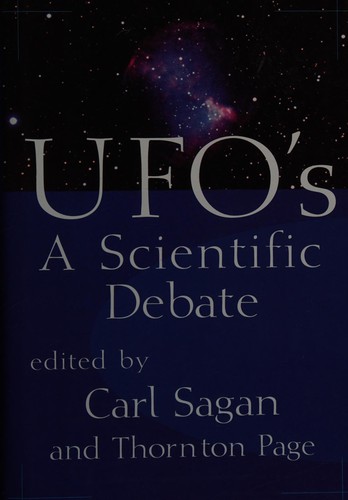
UFO's: A Scientific Debate
The Published Proceedings of the December 1969 AAAS Symposium — Mainstream Science's One Structured, On-the-Record Argument Over the UFO Question
Find on Amazon →As an Amazon Associate, OverClassified may earn from qualifying purchases made through this link, at no extra cost to you.
Why This Is Essential Reading
UFO's: A Scientific Debate earns its place on this list for a reason none of this site's other Essential Reading titles quite share: it is not an advocacy book, and it is not a skeptical debunking — it is a transcript of mainstream science genuinely arguing with itself, in public, under a major scientific society's own banner, at the exact moment that argument mattered most. Organized by Carl Sagan and Thornton Page over Edward Condon's own attempt to have it cancelled, and convened barely eleven months after the Condon Report's rushed dismissal, this symposium put J. Allen Hynek and James E. McDonald's case for serious investigation directly against Donald Menzel's skeptical counter-argument, with methodological chapters on radar, photography, psychiatry, and witness reliability supplying the connective tissue between them. McDonald's own chapter, a detailed technical rebuttal of four specific Condon Report cases this site independently documents — the RB-47 Bomber Chase, Lakenheath-Bentwaters, and the Haneda Air Base Radar-Visual Sighting among them — remains one of the single most rigorous published pieces of pro-investigation UFO scholarship this site's library contains. Read it alongside the Condon Report case file it directly answers and Firestorm's account of what that fight cost McDonald personally, and this book stands as the clearest documented proof that, for two days in December 1969, the UFO question got the kind of structured, credentialed, on-the-record scientific hearing it has rarely if ever received before or since — and that even that hearing settled nothing.
Related Cases & Theories
Sources Cited
- Sagan, Carl, and Thornton Page, eds. UFO's: A Scientific Debate. Cornell University Press, 1972 (ISBN 0801407400 / 9780801407406, hardcover); Barnes & Noble Books, 1996 hardcover reprint (ISBN 0760701962 / 9780760701966, cited here, matching the edition already cited across this site's own resources library). amazon.com
- McDonald, James E. "Science in Default: Twenty-Two Years of Inadequate UFO Investigations." Paper delivered at the AAAS General Symposium on Unidentified Flying Objects, December 27, 1969, hosted by Princeton University (full text of McDonald's symposium paper, including his four detailed case studies and direct quotations from Condon Report case files).
- McCarthy, Paul E. "Politicking and Paradigm Shifting: James E. McDonald and the UFO Case Study," Chapter VI: The 1969 AAAS UFO Symposium. Ph.D. dissertation, University of Hawaii, December 1975, hosted by the National Capital Area Skeptics (organizing history, opposition from Condon/Hoagland/Shane, full participant list, and symposium outcomes).
- "1969 Science In Default By Dr. James McDonald AAAS Symposium Lecture Introduced By Carl Sagan." Internet Archive (public-domain audio recording of McDonald's actual December 27, 1969 symposium delivery, 40 min. 30 sec., introduced by Sagan). archive.org
- "UFO's--a scientific debate." Internet Archive (digitized copy of the original book, bibliographic record and full-text access). archive.org
- Sturrock, Peter A. "Unexplained Phenomena" (review of UFO's: A Scientific Debate). Science, vol. 180, no. 4086, 1973, pp. 593–595. science.org
- "UFO's--a scientific debate." Open Library (bibliographic record, Cornell University Press, 1972, ISBN 0801407400 / 9780801407406, 310 pp.). openlibrary.org
- "UFO's-A Scientific Debate." Open Library (bibliographic record, Barnes & Noble Books, 1996 hardcover reprint, ISBN 0760701962 / 9780760701966). openlibrary.org
- "Thornton Leigh Page." Wikipedia (biography: birth/death dates, education, Robertson Panel service, Wesleyan University astronomy department 1958–1971, Naval Research Laboratory career). en.wikipedia.org
- "Carl Sagan." Wikipedia (biography, Cornell career, 1968 Congressional testimony). en.wikipedia.org
- "Frank Drake." Wikipedia (biography: Drake Equation, SETI Institute co-founding, radio astronomy career). en.wikipedia.org
- "Condon Committee." Wikipedia (Condon Report publication details and case statistics referenced in McDonald's rebuttal). en.wikipedia.org
- This site's own case file: The Condon Report (Case File #227), the study this symposium was organized substantially in response to.
- This site's own case file: The RB-47 Bomber Chase (Case File #150), McDonald's first detailed illustrative case in his symposium chapter.
- This site's own case file: The Lakenheath-Bentwaters Incident (Case File #015), McDonald's second detailed illustrative case.
- This site's own case file: The Haneda Air Base Radar-Visual Sighting (Case File #279), McDonald's third detailed illustrative case.
- This site's own case file: Michigan Swamp Gas UFO Wave, which already cites this exact 1972 volume directly.
- This site's own essential-reading entry: Scientific Study of Unidentified Flying Objects (ER-080), the Bantam paperback of the report this symposium responded to.
- This site's own essential-reading entry: Firestorm (ER-112), Ann Druffel's biography of James E. McDonald, covering the same 1966–1971 period as this symposium.
- This site's own essential-reading entry: The Demon-Haunted World (ER-058), which documents Sagan's decades-long push for the UFO question to receive legitimate scientific debate.
- This site's own essential-reading entry: The UFO Enigma (ER-043), Peter Sturrock's 1999 book, connected to this volume through Sturrock's own 1973 review of it in Science.
- This site's own key-figures entry: Carl Sagan, for his broader site-wide case connections beyond this book.
- This site's own key-figures entry: Dr. Thornton L. Page, for his Robertson Panel service and full biography.
- This site's own key-figures entry: James E. McDonald, for his full biography and further case connections.
Have corrections, additional research, or peer-reviewed sources? Help improve this entry.
Suggest an Edit