
Sungods in Exile
Secrets of the Dzopa of Tibet — The Confessed Hoax That Gave the Dropa Stones an Eyewitness
Core Thesis
This is a fabricated book, and its author says so. Sungods in Exile was published in 1978 as the posthumous manuscript of Dr. Karyl Robin-Evans, an Oxford academic said to have reached a surviving community of the Dropa in Tibet in 1947 and to have learned from them that their ancestors arrived from the Sirius system in a craft that could not leave again. Robin-Evans never existed. The book was written from beginning to end by the British writer David Gamon, under the pseudonym "David Agamon," as a satire on the ancient-astronaut publishing boom — a fact he stated publicly in Fortean Times and has restated since. It belongs on this shelf for one reason: the specific inventions in it are still circulating as evidence, nearly fifty years after they were made up and thirty after the confession.
About the Author
The credited author, "Dr. Karyl Robin-Evans," is described in the book as an Oxford academic who died in 1974 leaving unpublished notes. Researchers who went looking for him found nothing — no Oxford record, no academic register, no obituary, no publication, no trace of any kind.
The real author is David A. Gamon, a British writer who published the book under the pseudonym "David Agamon" and presented himself in it as Robin-Evans's former secretary, merely editing a dead man's manuscript for publication. That framing is part of the fabrication.
Gamon's motive, in his own account, was satirical. He said the book was written "partly a tribute to, but mainly a satire upon the many books aimed at the credulous" — that is, at the ancient-astronaut paperback market that Erich von Däniken had opened a decade earlier and that was still enormously profitable in 1978.
He has been consistent about it since. He admitted the hoax in Fortean Times issue 75 (page 57), restated it in issue 109 in 1998, and in private correspondence quoted by the French researcher Patrick Gross described it as his favourite hoax, adding — with some regret — that it had not been as successful as The Da Vinci Code.
His stated raw material is worth recording, because it is unusually candid for the genre: a 1960s Russian digest article on the Dropa story, and a 1973 French science-fiction novel, Daniel Piret's Les disques de Biem-Kara. A magazine piece and an acknowledged work of fiction. Nothing else.
Neville Spearman, the London house that issued the hardcover, specialised in occult, Fortean and fringe titles, and the Sphere paperback that followed in 1980 is the edition most readers encountered. That commercial machinery is the reason the invention travelled.
Historical Context & Origins
To see what this book did, you have to know what the Dropa story looked like before it. This site's ancient record file traces the whole chain and stamps it Hoax; the short version is that the legend has no existence of any kind before 1960.
Its earliest fully formed appearance is July 1962, in a German magazine about vegetarianism, Das vegetarische Universum, under the byline "Reinhardt Wegemann" — a name matching no known German writer — sourced to a Tokyo "DINA news agency" that has left no trace in any press directory or wire archive. That is the foundation document.
It claimed a 1938 expedition to the Bayan Har mountains on the Qinghai–Tibet border, led by an archaeologist named "Chi Pu Tei," which recovered 716 grooved granite discs and small-bodied, large-skulled remains. No such expedition is documented anywhere.
The story then accreted in stages, each retelling adding material the previous one lacked and citing its predecessor rather than any primary source. The Soviet philologist Vyacheslav Zaitsev added the metallurgical and electrical claims in Sputnik; von Däniken and Peter Kolosimo carried it into the global paperback market around 1969–71.
By the mid-1970s the story had one conspicuous hole. Everything in it was hearsay at several removes: a German magazine quoting a nonexistent agency, a Soviet writer quoting the magazine, a Swiss author quoting a Soviet novelist in a car on the way to the Pushkin Museum. There was no Western observer who had gone and looked.
Sungods in Exile filled exactly that hole, and it is hard to believe the fit was accidental. It supplied a named Western academic with an institutional affiliation, a date, an itinerary, informants, photographs and a coherent origin story. It gave the legend the one thing it had never had.
The confession came in the mid-1990s, in the letters and features pages of a specialist magazine, and it reached a tiny fraction of the audience the book had. That asymmetry — claim through mass-market paperback, retraction through a Fortean journal — is the whole story of what happened next.
Core Arguments & Key Concepts
A Western scholar reached the Dropa in 1947. The book's central device and its most consequential invention. Robin-Evans is placed in Tibet, meeting the young 14th Dalai Lama in Lhasa and travelling on into the Bayan Har region. None of it happened, and the man it happened to did not exist.
The Dropa survive as an identifiable community. Presented as ethnographic observation: a small-statured people living in the mountains, distinct from their neighbours, remembering their origins. The word Dropa is in fact ordinary Tibetan — 'brog pa, drokpa, "people of the high pastures" — the standard term for Tibetan highland pastoralists, a large living population reassigned by this literature to a fictional alien race.
Their ancestors came from the Sirius system. The origin claim, delivered in the book through a religious guardian named Lurgan-La. It has no source outside this book, and its author says he made it up.
Their craft crashed and could not be repaired. The stranding narrative, which gives the story its pathos and its title — sun gods in exile, marooned among people who hunted them. It is a good novelistic premise, which is what it was.
Photographs corroborate the account. The book carries images presented as showing the people and the discs. Photographs of Tibetan highlanders are not evidence of extraterrestrial ancestry, and no disc has ever been produced for examination by any institution anywhere.
The manuscript is a posthumous scholarly document. The framing that carries all the rest: a dead academic's notes, edited by a former secretary, reluctantly published. This is a literary device with a long history, and here it is doing the work of an entire evidentiary apparatus.
What the book is actually arguing, in Gamon's account, is the opposite of what it says. He wrote it as satire on credulous publishing. Read that way, it is a demonstration that the genre's standards were low enough to accept an invented scholar, an invented institution and an invented expedition without checking any of them — a demonstration that succeeded completely and was then mistaken for the thing it was mocking.
Key Cases & Evidence Discussed
The Dropa stones. The 716 alleged grooved discs at the centre of the legend. Not one has ever been produced for examination; no museum, university or national archive anywhere has confirmed holding one. See this site's Ancient Record File #007.
The claimed 1947 Robin-Evans expedition. The book's own contribution: a journey through Tibet, an audience with the Dalai Lama, months among the Dzopa. Undocumented in every particular, by an undocumented person.
The Bayan Har Mountains. A real range in southern Qinghai, part of the Kunlun system and the watershed between the Yellow and Yangtze headwaters. Genuinely remote, high, and thinly populated — which is why the story is set there rather than somewhere checkable.
The Lolladoff plate. A related artefact claim — an inscribed disc said to have been found in Nepal — which the book's own marketing copy ties to Robin-Evans's search. Like the Dropa discs, it has never been produced for study.
The Banpo Museum at Xi'an. The real Neolithic site museum named in adjacent strands of the legend as the place two discs were displayed and then made to vanish. The only photographs ever offered appear to show ordinary Chinese bì ritual discs.
Daniel Piret's Les disques de Biem-Kara (1973). The French science-fiction novel Gamon names as one of his two sources. A confessed hoax drawing on an acknowledged novel is about as far from a documentary chain as it is possible to get.
The Fortean Times confessions. Issue 75, page 57, and again issue 109 in 1998. The primary documents for everything on this page.
Hartwig Hausdorf's The Chinese Roswell (1998). Published the same year as Gamon's second confession, repackaging the legend for an American audience with further additions. This site covers it separately.
Critical Reception & Controversies
The book was not widely reviewed on publication, which is itself informative. It appeared through a fringe imprint into a market that did not fact-check, and it was absorbed — not assessed — by the literature it was written to mock.
The failure to find Robin-Evans came first. Researchers who went looking through Oxford records, academic registers and biographical sources found no such person, and by the late 1980s the book's provenance was under open suspicion in Fortean circles.
Then Gamon settled it himself. In Fortean Times issue 75 he stated that he had written the entire book, that Robin-Evans was an invention, and that the work was satire. He repeated it in issue 109. There is no ambiguity here, no disputed attribution, no anonymous debunker — the author put his name to the admission twice.
The archaeologist Keith Fitzpatrick-Matthews reconstructed the whole citation chain for the Bad Archaeology project, and his account is the one most subsequent debunkings rely on. He later noted that the Dropa stones were the single most-searched subject on the site — a measure of how thoroughly the invention outran its retraction.
Jacques Vallée and Chris Aubeck examined the case in Wonders in the Sky, reporting that no record of the stones exists in any of the world's museums and no record exists of any person involved in their claimed discovery or translation. Vallée classifies the tale as a hoax.
Jason Colavito, whose subject is the intellectual history of the ancient-astronaut movement, has documented both the original citation cascade and its television afterlife, including a 2017 Ancient Aliens episode that omits the 1962 vegetarian-magazine origin entirely and treats the absence of evidence as proof of suppression.
One structural point deserves emphasis, because it explains why the exposure did so little damage. The Dropa legend was never resting on this book alone; it had four or five apparently independent sources by 1978, and a reader could lose any one of them and still feel the rest held. That impression is false — the sources are copies of one another, all descending from a single 1962 magazine article — but it is the impression a citation cascade is designed to produce. Removing a confessed hoax from such a chain does not visibly weaken it, which is precisely why the chain has to be traced rather than sampled.
The honest verdict on the book as a book is that it is competently done. The voice is plausible, the structure is right, the apparatus of scholarly modesty is convincing. That is the problem: it is a demonstration of how little it took.
Influence & Legacy
The specific things this book invented are now load-bearing parts of the popular Dropa story. The surviving tribe, the eyewitness contact, the Sirius origin — those are not older elements of the legend that Gamon reported. They are his, and they are what makes the modern retelling feel textured rather than thin.
That is the reason to read it. Almost nowhere else in this literature can you point at a specific set of widely repeated "facts," name the person who made them up, and quote him saying so. Most fringe claims dissolve into an untraceable haze; this one has an author with a byline and a confession.
The second lesson is about the asymmetry of retraction, and it is the more important one. Gamon's admission is thirty years old and has changed almost nothing. Material from Sungods in Exile continues to appear as fact in books, in videos and on television. A claim distributed through mass-market paperbacks and cable documentaries does not get recalled by a paragraph in a specialist magazine.
There is a third point that cuts against easy amusement. Satire that is indistinguishable from its target does not function as satire; it functions as supply. Gamon wrote a book to show how credulous the genre was, and the genre absorbed it as evidence, which proved his thesis and simultaneously made the problem worse. Anyone tempted to expose a field by feeding it a convincing fake should read this outcome carefully. The joke lands once. The fabrication circulates forever, and the people who repeat it in good faith fifty years later have no idea they are quoting a novel.
The Book
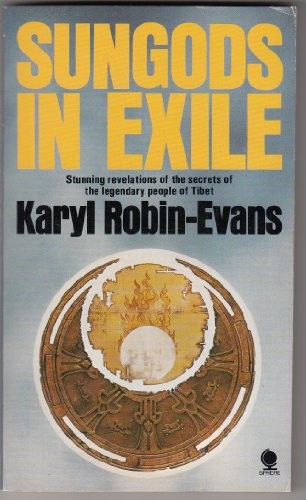
Sungods in Exile
Secrets of the Dzopa of Tibet — The Confessed Hoax That Gave the Dropa Stones an Eyewitness
Find on Amazon →As an Amazon Associate, OverClassified may earn from qualifying purchases made through this link, at no extra cost to you.
Why This Is Essential Reading
Read this one as a document about the field, not about Tibet. Sungods in Exile is a fabricated book by a named living author who has said in print, twice, that he fabricated it — and that makes it the cleanest specimen available of how the ancient-astronaut literature actually works. In 1978 the Dropa story had everything except a witness; this book supplied a witness, an Oxford affiliation, a date, an itinerary, informants and a Sirius homeworld, and the genre took all of it without checking any of it. David Gamon named his sources when he confessed: a Russian digest article and a French science-fiction novel. Nothing else was ever behind it. Thirty years on, the confession has barely dented the story, because retractions do not travel the routes that claims do. Read it alongside this site's Dropa Stones file, The Cult of Alien Gods and The Chinese Roswell, and note which of the details you already believed came from a book its own author calls a joke.
Related Cases & Theories
Sources Cited
- Robin-Evans, Karyl [pseud.], ed. David Agamon [David Gamon]. Sungods in Exile: Secrets of the Dzopa of Tibet. Neville Spearman, Sudbury, 1978; Sphere Books paperback, London, 1980, 150 pp. ISBN-10 0722174179 / ISBN-13 9780722174173. amazon.com
- Wikipedia, "Sungods in Exile" — the 1978 Neville Spearman publication, the Robin-Evans attribution, the claimed 1947 Bayan Har expedition, and David Gamon's admission in Fortean Times that he wrote the book under the Agamon pseudonym. en.wikipedia.org
- Wikipedia, "Dropa stones" — the wider legend, its 1960–62 print origin, the absence of any specimen or expedition record, and the role of this book in the chain. en.wikipedia.org
- Patrick Gross, "The Dropas lore — David Agamon's book," UFOs at close sight — the fullest dossier on the book itself: Neville Spearman 1978 (ISBN 0854353143), the Sphere and Spanish editions, the Lhasa and Lurgan-La narrative, Gamon's Fortean Times no. 75 admission, and his 2006 correspondence describing the work as "partly a tribute to, but mainly a satire upon the many books aimed at the credulous." ufologie.patrickgross.org
- Patrick Gross, "The Dropas lore" — the companion dossier tracing the legend's documentary chain from the 1960 Soviet material forward. ufologie.patrickgross.org
- Open Library edition record, Sungods in exile (Sphere, 1980) — bibliographic verification, 150-page extent, and cover-art source. openlibrary.org
- AbeBooks catalogue record, ISBN 9780722174173 — independent listing of the Sphere paperback. abebooks.com
- Google Books record, Sungods in Exile: Secrets of the Dzopa of Tibet — catalogue metadata for the title. books.google.com
- Keith Fitzpatrick-Matthews, "The Dropa (or Dzopa) stones," Bad Archaeology — the detailed reconstruction of the story's citation chain, including this book's place in it (archived copy). web.archive.org
- Keith Fitzpatrick-Matthews, "Why are the Dropa stones the most searched-for subject on Bad Archaeology?", 16 October 2011 — on the story's persistence and its "very, very dubious" pedigree. badarchaeology.wordpress.com
- Jason Colavito, "Visitors from Outer Space" — archived text of Vyacheslav Zaitsev's Sputnik article, the stage of the legend immediately preceding this book. jasoncolavito.com
- Jason Colavito, "Review of Ancient Aliens S12E15: The Alien Disks" — documentation of the claim's television afterlife, including the omission of its print origins. jasoncolavito.com
- Wikipedia, "Drokpa" — the real Tibetan pastoralist population whose ordinary ethnonym ('brog pa) this literature reassigned to a fictional extraterrestrial race. en.wikipedia.org
- Wikipedia, "Bayan Har Mountains" — the real range in southern Qinghai in which the claimed expedition is set. en.wikipedia.org
- Wikipedia, "Fortean Times" — the magazine in which Gamon's admissions appeared (issue 75, p. 57; restated in issue 109, 1998). en.wikipedia.org
Have corrections, additional research, or peer-reviewed sources? Help improve this entry.
Suggest an Edit