
Not of This World
Peter Kolosimo's Italian Case for Ancient Extraterrestrial Visitors
Core Thesis
Not of This World, first published in Italy in 1968 as Non è terrestre, argues in the same discursive, evidence-by-accumulation mode as its better-known contemporaries that extraterrestrial visitors shaped humanity's deep past — leaving behind out-of-place artifacts ("OOPArts"), garbled myths, and unexplained ancient technology across cultures from the Andes to Tibet to India. Author Peter Kolosimo, the pen name of Italian journalist Pier Domenico Colosimo, was already one of the genre's founding Italian-language voices by the time this book made him internationally famous, winning Italy's Premio Bancarella prize in 1969 and going on to sell in the tens of thousands within its first year and reach translation in roughly sixty countries. The book makes its case less through sustained argument than through sheer accumulation of anomaly after anomaly, most drawn from secondary and tertiary sources rather than firsthand investigation — a methodology this entry treats honestly rather than charitably, because independent research conducted for this article, most substantially a rare book-specific four-part review by researcher Jason Colavito, documents specific instances of Kolosimo presenting science fiction, including H.P. Lovecraft's invented Cthulhu Mythos, as though it were factual ancient testimony.
About the Author
Peter Kolosimo was born Pier Domenico Colosimo on December 15, 1922, in Modena, Italy, to an Italian father who served as a Carabinieri officer and an American mother; he was raised largely in Bolzano, in Italy's German-speaking South Tyrol, an upbringing that left him fluent in Italian, German, and English alike. He went on to earn a degree in modern Germanic philology from the University of Leipzig. Multiple independent Italian-language biographical sources — the Wu Ming literary collective's own retrospective essay on Kolosimo prominent among them — describe his Second World War service as unusually dramatic even by wartime standards: conscripted into the German Wehrmacht as a South Tyrolean, he deserted and joined partisan resistance forces in Bohemia, reportedly among the first Allied-aligned fighters to link up with the advancing Red Army in the Pilsen–Písek area. This entry flags that specific wartime claim as resting on retrospective biographical sourcing rather than a contemporary documentary record, in keeping with this site's general practice for facts this difficult to independently verify at this remove.
After the war Kolosimo became a committed Marxist-Leninist and worked as a journalist and foreign correspondent for l'Unità, the Italian Communist Party's newspaper — by several accounts the only Italian reporter present at the October 1949 proclamation of the German Democratic Republic. He subsequently directed the Trieste-area station Radio Capodistria before Yugoslav authorities removed him over his pro-Soviet, "Cominformist" sympathies; from that platform he is credited with announcing the Sputnik 1 launch and later reporting Valentina Tereshkova's 1963 spaceflight to Italian audiences. He began publishing science fiction under the pseudonym "Omega Jim" before turning, from the late 1950s onward, to the popular nonfiction on ancient mysteries and "space archaeology" that would define his career — starting with Il pianeta sconosciuto ("The Unknown Planet," 1957) and Terra senza tempo ("Timeless Earth," 1964), both discussed on this site's own key-figures archive in connection with the Dropa Stones case, before Non è terrestre made him an international bestseller in 1968.
Kolosimo maintained his political commitments alongside his paranormal writing for the rest of his career, aligning at various points with the Italian Communist Party and the further-left Lotta Continua movement, and by some accounts refusing to promote his books in Francoist Spain in protest of that regime's political imprisonments. He founded and coordinated the Associazione di Studi Preistorici Italia–RDT (ASP), a private organization devoted to prehistoric-mystery research, and from November 1972 to October 1973 edited Pi Kappa, a monthly magazine covering "mysterious archaeology," parapsychology, and exobiology. He continued publishing prolifically — Astronavi sulla preistoria (1972), Odissea stellare (1974), Italia mistero cosmico (1977), and further titles into the early 1980s, including a final collaboration with his wife Caterina — until his death in Milan on March 23, 1984. Held no academic training in archaeology, Sinology, or any other field directly relevant to his central claims; his formal education was in philology.
Historical Context & Origins
Non è terrestre arrived in the Italian market in 1968, the same year Erich von Däniken's German-language Chariots of the Gods? appeared and roughly eight years after Brinsley Le Poer Trench's English-language The Sky People had already made a structurally similar argument in Britain. This entry is careful not to overstate the relationship between these near-simultaneous books: no source located in researching this article demonstrates that Kolosimo drew directly on von Däniken, or the reverse, and Kolosimo had in fact already been publishing in this same speculative-archaeology vein for over a decade, going back to Il pianeta sconosciuto in 1957. What can be said is that Non è terrestre represents a genuinely independent, Italian-language node in what was becoming, by the late 1960s, a near-simultaneous international publishing phenomenon, one this site's own key-figures archive already tracks converging from multiple national traditions at once.
The book's commercial success in Italy was immediate and substantial by the standards of the genre: it won the Premio Bancarella, Italy's oldest and most prominent bookseller-voted popular-literature prize, in 1969, reportedly reaching a fifth Italian printing by March of that year and roughly 70,000 copies sold by September. Multiple sources describe its eventual translation into as many as sixty countries, a claim consistent with the extensive multi-language edition record — including English, Spanish, Turkish, and others — documented on the book's own Goodreads work page. That scale of international circulation, for a book with essentially no contemporary English-language critical or journalistic review located in researching this article, is itself a useful reminder of how large the ancient-astronaut publishing wave grew outside English- and German-language markets, and how thin the surviving anglophone documentary record can be even for a book that sold this widely.
Kolosimo wrote from within a specifically Italian tradition of popular science and speculative-mystery publishing, one adjacent to but distinct from the British contactee scene that produced Trench and the German-Swiss market that produced von Däniken. His own retrospective champions, notably the Wu Ming literary collective, situate the book's argument inside his broader Marxist-Leninist politics: on their reading, Kolosimo's paranormal writing was never separable from his revolutionary commitments, framing knowledge of humanity's extraterrestrial origins as a step toward a transformed political consciousness rather than as apolitical entertainment. This entry treats that framing as a genuine and documented interpretive lens on the author's intent, not as a defense of the book's evidentiary claims, which this entry's Critical Reception section addresses on their own terms.
Core Arguments & Key Concepts
Kolosimo's central claim, consistent across the book's sprawling, loosely organized chapters, is that extraterrestrial visitors reached Earth in antiquity and left behind physical and textual traces still recoverable today — anomalous metal artifacts, "melted" ruins, and technology no contemporary ancient culture is credited with possessing. Contemporary Italian publisher and bookseller descriptions of the book specifically cite the so-called "Astronaut of Palenque" (the carved sarcophagus lid of the Maya ruler K'inich Janaab' Pakal, which mainstream Maya epigraphy identifies as a portrait of the ruler with the Maya World Tree, not a rocket pilot) and an allegedly anomalous bison figure held at a Moscow paleontology museum among the specific anomalies the book presents; this entry cites those as reported by the book's own Italian marketing copy rather than from firsthand examination of the full text.
Independent research conducted for this article confirms, through Jason Colavito's rare book-specific four-part review of the English translation, that Kolosimo's method throughout is citation without verification: Colavito documents the book presenting material from science fiction as though it were nonfiction testimony, including a retold plot from a Wilson Tucker novel and, at greatest length, extended and repeated use of H.P. Lovecraft's invented Cthulhu Mythos — the fictional "Old Ones," the Mi-Go, and the plateau of Leng from At the Mountains of Madness — treated as though it recorded genuine ancient testimony, corroborated, Kolosimo claims, by unspecified "certain Tibetan texts" and attributed in part to a scholar, "William Bennett," whom Colavito was unable to verify existed. Colavito separately documents the book presenting Murray Leinster's 1954 science fiction novel The Forgotten Planet and Donald Wandrei's novel The Web of Easter Island (which Kolosimo misidentifies as an Italian work) in similarly unflagged, fact-presenting form.
Kolosimo's sourcing for material he does present as genuinely historical is, per Colavito's review, frequently corrupted by translation: several passages are traced through chains running from Arabic or French originals into Italian and then into English, each step introducing further distortion, with Kolosimo in at least one documented instance copying material verbatim from the French popularizer Serge Hutin rather than consulting any original source directly. Colavito's review also documents specific fabrications and misattributions within the book, including an invented Mayan quotation about beings "arriving from the sky," a mischaracterization of the naturally occurring meteoric iron specimen known as Gurlt's Cube as an impossibly engineered artifact, claims attributed to Soviet scientists that Colavito traces instead to Soviet science fiction, and a recycling of the discredited early-20th-century writer James Churchward's racialized claims about "white" rulers of ancient Asian civilizations.
The book also serves, per this site's own key-figures archive, as one of the principal vehicles that carried the Dropa Stones story — a supposed set of inscribed stone discs recording an ancient crash-landed extraterrestrial expedition to the Bayan Har Mountains of the Qinghai–Tibet border — from its obscure 1960s European origins into the wider anglophone fringe-archaeology market, a claim covered at length in this site's own Dropa Stones case file, which rates the underlying story a HOAX.
Key Cases & Evidence Discussed
This book's most substantial, page-to-page overlap with this site's own case-file library is the Dropa Stones file, which names Not of This World directly as "a principal vector" — alongside Erich von Däniken's contemporaneous Return to the Stars — by which the Dropa claim, first reported in a 1962 German vegetarian magazine and relayed through Soviet science-fiction writer Alexander Kazantsev, entered the international paperback market in 1969–71. That case file rates the Dropa story a HOAX, citing an admitted 1995 fabrication by "David Agamon" that extended the myth, and identifies Kolosimo among a small group of writers — including von Däniken and, decades later, Hartwig Hausdorf — who relayed the claim without the source-checking a story of this magnitude would require. As with those other writers, this entry does not find evidence that Kolosimo knowingly fabricated the Dropa material himself; the HOAX rating attaches to the claim's documented origin and later confirmed extension, not uniformly to every author who repeated it in good faith.
This book's relationship to Chariots of the Gods? (Essential Reading ER-022) is chronological and parallel rather than a matter of direct citation in either direction: both appeared in 1968, in different languages and different national markets, making broadly similar arguments about ancient extraterrestrial visitation from broadly similar categories of anomalous evidence. This site's own Chariots of the Gods? entry already documents von Däniken's key-figures archive placing Kolosimo among the ancient-astronaut writers who followed in that book's commercial wake; this entry's own research did not locate evidence resolving priority or direct influence between the two 1968 books, and this entry states that limit plainly rather than asserting a lineage it cannot verify.
This book's relationship to The Sky People (Essential Reading ER-070), Brinsley Le Poer Trench's 1960 British predecessor in the same genre, is more clearly one of chronological precedence: Trench's book reached English-language readers eight years before Kolosimo's Italian original appeared, making The Sky People and Not of This World useful bookends for this site's coverage of the ancient-astronaut genre's earliest, pre-von-Däniken international phase — one British, one Italian, both predating the genre's later commercial dominance by writers working in English and German.
The book's overall framework — ancient anomalies, garbled myth, and out-of-place artifacts read as evidence of extraterrestrial contact — is the same one this site's own Ancient Astronaut Hypothesis theory file (Theory File AAH-001) surveys at the level of the broader movement; this entry supplies one of that movement's earliest and, by international sales figures, most commercially successful non-English-language examples.
Critical Reception & Controversies
This is a genuinely obscure book by contemporary anglophone critical standards, and this entry is honest about the limits of the record: no contemporary 1971 or 1988 English-language newspaper, magazine, or trade review of Not of This World was located in researching this article, and readers should treat that as a real documentary gap rather than assume broader coverage exists but was simply missed. What can be documented directly is reader response: the book's Goodreads page for this exact Citadel Press edition shows a 3.34-average rating from 38 ratings, while the aggregated Goodreads work page across all 34 tracked editions and languages shows 3.38 from 102 ratings and 13 written reviews — reviews split between readers finding the anomaly-collecting approach entertaining ("a hidden gem," one wrote) and readers explicitly faulting the English translation's quality ("does not translate well from Italian to English," per another).
The most substantial documented critical engagement with this specific book is Jason Colavito's four-part review, published on his own website in February 2014 — a genuinely rare instance, for a book this obscure, of chapter-by-chapter, claim-by-claim scrutiny rather than a general genre survey. Colavito's stated verdict is unambiguous: he describes the book as "a discursive pile of Fortean nonsense in the very worst of the European tradition," documents its presentation of H.P. Lovecraft's invented fiction and other science-fiction sources as literal ancient testimony, and concludes in his final installment that Kolosimo "decided that science fiction is simply true, or at least true enough that his readers would never know the difference." Colavito further faults the book's almost total absence of verifiable citations, writing that "with no citations, there is no way to check the sources or the accuracy of his claims" — a criticism this site's own key-figures archive already summarizes in stating that Kolosimo's work "has been criticized for fabricated evidence, mistranslation, and the conflation of science fiction with fact."
A genuinely different, more sympathetic critical lens comes from the Italian literary collective Wu Ming, whose retrospective essay on the thirtieth anniversary of Kolosimo's death argues that his books were, in their words, "great popular narrative disguised as nonfiction" best read within their 1970s ideological context rather than judged purely as failed scholarship, describing Kolosimo as "a visionary Marxist-Leninist" who believed that popularizing extraterrestrial-origin claims could advance revolutionary human consciousness. This entry presents that reading as a genuine, documented alternative critical framework — a case for reading the book as a document of its author's politics and era — without treating it as any kind of rebuttal to Colavito's specific, textually grounded findings about fabricated citations and misrepresented fiction, which concern factual accuracy rather than literary or political intent.
None of this should obscure a distinction worth stating plainly: nothing located in researching this article suggests Kolosimo invented the Dropa Stones story himself, or that his relaying of it was knowingly dishonest in the way later hoaxer "David Agamon" openly admitted his own contribution to be. The honest critical picture is of an author working from poor, multiply-translated secondary sources with little apparent effort at independent verification, compounded, on the specific evidence of Lovecraft's fiction, by a genuine, repeated blurring of the line between science fiction and reported fact.
Influence & Legacy
The book's most durable, independently verifiable legacy is commercial and linguistic rather than evidentiary: a Premio Bancarella win, documented sales in the tens of thousands within its first year in Italy alone, and translation into dozens of languages establish Not of This World as one of the ancient-astronaut genre's genuine international bestsellers, on a scale this site's own English-language-focused case-file archive can otherwise understate. It remains, alongside Chariots of the Gods?, one of the two books this site's own Dropa Stones case file credits with carrying that specific hoax from obscure European magazine origins into the mass anglophone paperback market.
Within Italy specifically, Kolosimo's influence persisted well beyond his 1984 death: the Wu Ming collective's 2022 novel UFO 78 features a protagonist, the writer Martin Zanka, described by its authors as loosely inspired by Kolosimo, a genuine, documented instance of his life and public persona — rather than his specific factual claims — continuing to generate new creative work decades later. His centenary in December 2022 was marked by multiple public commemorative events in Italy, including a recorded academic talk by philosopher and pseudoscience researcher Stefano Bigliardi, indicating a persistent, if specialist, Italian cultural memory of Kolosimo distinct from his declining credibility as a source of fact.
Within the English-language ancient-astronaut literature this site covers most directly, Not of This World's clearest documented legacy is negative: it stands, per Jason Colavito's review, as a specific, well-documented case study in how thoroughly citation-free popular "paleocontact" writing could blur science fiction and claimed fact even by the genre's own permissive standards, and per this site's own key-figures and Dropa Stones coverage, as one of the concrete vehicles by which at least one specific hoax reached a global audience.
On this site specifically, this book was already cited once, by exact edition and ISBN, on the resources library in connection with the Dropa Stones case file, and its author already held a key-figures card crediting him as a principal Dropa-story vector before this dedicated Essential Reading entry existed; this article formalizes that existing citation trail with its own full biographical and critical-reception treatment.
The Book
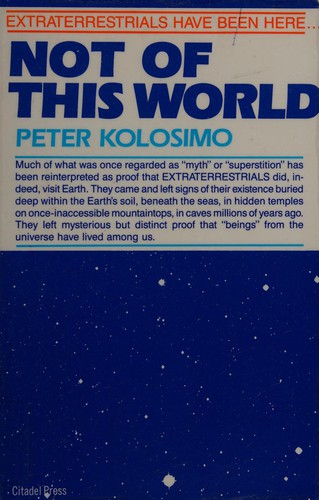
Not of This World
Peter Kolosimo's Italian Case for Ancient Extraterrestrial Visitors
Find on Amazon →As an Amazon Associate, OverClassified may earn from qualifying purchases made through this link, at no extra cost to you.
Why This Is Essential Reading
Not of This World earns its place on this list as the Italian-language node this site's ancient-astronaut coverage would otherwise be missing: a genuine, Premio Bancarella-winning international bestseller that appeared the same year as Chariots of the Gods? and helped carry the same broad claims — and, in the specific, documented case of the Dropa Stones, the same specific hoax — into a worldwide paperback market this site's largely anglophone case files can otherwise understate. This entry has tried to be honest throughout about where the record is thin: no contemporary English-language review of the book was located, several striking biographical claims about the author's wartime service rest on retrospective rather than contemporary sourcing, and this entry's account of some of the book's specific anomaly claims relies on Italian publisher marketing copy rather than firsthand examination of the full text. What is unusually well documented, for a book this obscure, is the critical case against it: Jason Colavito's rare book-specific four-part review traces, chapter by chapter, exactly how Kolosimo turned H.P. Lovecraft's fiction and other science fiction into claimed ancient testimony. Read Peter Kolosimo's book not as a credible account of humanity's ancient visitors, but as a primary document of just how far, and how far outside the English-speaking world, the 1968 ancient-astronaut wave actually traveled.
Related Cases & Theories
Essential Viewing
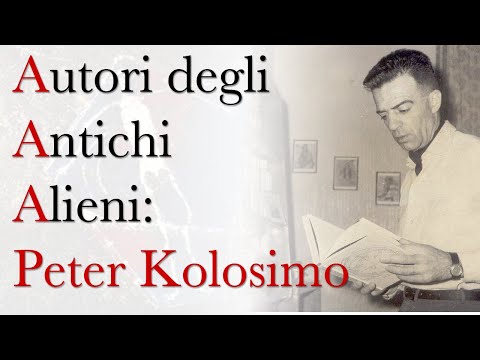
Peter Kolosimo: Le mille anime di un narratore stellare
Cùscito, ergo sum — An Italian-language talk on Kolosimo's life and work featuring philosopher and pseudoscience researcher Stefano Bigliardi, Ph.D., whose own published research covers religion, science, and pseudoscience including ancient-astronaut literature. Verified via YouTube oEmbed before inclusion; no book-specific English-language video coverage of this title was located, so this entry uses the closest verifiable substitute: a scholarly discussion of the author himself.

Peter Kolosimo a 100 anni dalla nascita
Upad — Italian-language coverage of a December 2022 commemorative event marking the 100th anniversary of Kolosimo's birth, part of a wider cluster of centenary events and broadcasts in Italy that year. Included to document the persistent, specifically Italian cultural memory of the author discussed in this entry's Influence & Legacy section. Verified via YouTube oEmbed before inclusion.
Sources Cited
- "Peter Kolosimo." Wikipedia (English) (biography, education, career, bibliography, Premio Bancarella win, international translation). en.wikipedia.org
- "Peter Kolosimo." Wikipedia (Italian) (biography: birth/death, family background, University of Leipzig, wartime service, journalism career, Radio Capodistria, bibliography). it.wikipedia.org
- Colavito, Jason. "Review of Peter Kolosimo's 'Not of This World' (Pt. 1)." jasoncolavito.com (February 2014; content summary, translation quality, sourcing problems, initial fabrication examples). jasoncolavito.com
- Colavito, Jason. "Review of Peter Kolosimo's 'Not of This World' (Pt. 2): In Which the Cthulhu Mythos Is Taken as Real!" jasoncolavito.com (February 2014; documents Kolosimo's use of Lovecraft's fiction as claimed factual evidence). jasoncolavito.com
- Colavito, Jason. "Review of Peter Kolosimo's 'Not of This World' (Pt. 3)." jasoncolavito.com (February 2014; further sourcing and fabrication examples, chapters 9-15). jasoncolavito.com
- Colavito, Jason. "Review of Peter Kolosimo's 'Not of This World' (Last Part)." jasoncolavito.com (February 2014; concluding verdict and further fabrication/mistranslation documentation). jasoncolavito.com
- Wu Ming. "Peter Kolosimo, 30 anni «across the universe» (1984 - 2014)." Giap / Wu Ming Foundation (retrospective biographical and critical essay: wartime service, journalism, Radio Capodistria, Marxist-Leninist politics, and the collective's own literary assessment of his work). wumingfoundation.com
- "Not of this world." Open Library (bibliographic record for the University Books, New Hyde Park NY, 1971 first English-language edition; 245-280pp.; LCCN 77153999; LC class AG243.K6313 1971). openlibrary.org
- "Not of this world." Open Library (bibliographic record for ISBN 9780806510705, Citadel Press/Carol Publishing Corp., 1988 pbk., 245pp. — the exact edition cited on this site). openlibrary.org
- "Editions of Not of This World / Non è terrestre." Goodreads (work page: 34 tracked editions across multiple languages including Italian, English, Spanish, and Turkish; aggregate ratings). goodreads.com
- "Not of This World." Goodreads (book page for this edition: reader ratings and review excerpts). goodreads.com
- "Not of this world." Internet Archive (digitized scan of the University Books 1971 English edition). archive.org
- "Ancient astronauts." Wikipedia (chronological list of proponents placing Kolosimo's Il pianeta sconosciuto, 1957, and Terra senza tempo, 1964, among the movement's early works). en.wikipedia.org
- This site's own key-figures entry: Peter Kolosimo, for the Premio Bancarella citation and existing Dropa Stones connection.
- This site's own case file: The Dropa Stones, which names this book a principal vector for the claim's entry into anglophone fringe archaeology and rates the underlying story HOAX.
- This site's own essential-reading entry: Chariots of the Gods?, for the contemporaneous 1968 von Däniken bestseller.
- This site's own essential-reading entry: The Sky People, for the earlier 1960 British predecessor in the same genre.
- This site's own theory file: The Ancient Astronaut Hypothesis, for the broader movement this book is part of.
- This site's own resources library: Full Reading List, where this exact edition (ISBN 0806510706) is cited in connection with the Dropa Stones case file.
Have corrections, additional research, or peer-reviewed sources? Help improve this entry.
Suggest an Edit