
The Sky People
An Earl's Case That Adam, Eve, and Noah Were Martian Colonists
Core Thesis
The Sky People argues, in plain and unhedged terms, that the biblical figures of Adam, Eve, and Noah were not the first humans but colonists from Mars: that Eden itself sat on a Mars whose visible "canals" (a real, if by-then-contested, feature of turn-of-the-century astronomy) supported an advanced civilization, that Adam and Eve were experimental creations of that civilization's science rather than divine handiwork, and that when a melting polar ice cap made the planet uninhabitable, their descendants migrated to Earth in vessels later garbled by oral tradition into the story of Noah's Ark. Author Brinsley Le Poer Trench — at the time a working UFO researcher and former editor of Flying Saucer Review, not yet the peer he would become in 1975 — builds the case largely by reading Genesis and related ancient texts literally and mapping their details onto contemporary flying-saucer reports, folding in the disputed Tulli Papyrus (a supposed ancient Egyptian record of "fiery discs") as corroborating evidence. Published in 1960, eight years before Erich von Däniken's far more commercially successful Chariots of the Gods?, it is one of the earliest full-length British articulations of what would become the ancient-astronaut genre — a genuinely obscure, thinly documented book this entry treats with the same skeptical care applied to its far more famous descendants, being honest throughout about where the record is thin.
About the Author
William Francis Brinsley Le Poer Trench was born September 18, 1911, the fifth son of William Frederick Le Poer Trench, 5th Earl of Clancarty, and educated at Pangbourne Nautical College. He was not yet a peer when he wrote The Sky People: he inherited the earldom, and with it a seat in the House of Lords, only in 1975, on the death of his elder half-brother Greville Trench, 7th Earl of Clancarty. For the first six decades of his life he was simply Brinsley Trench, a UFO enthusiast who had begun collecting newspaper clippings on flying-saucer reports after the Second World War and, through a chance meeting with fellow early ufologist Desmond Leslie, found his way to London's amateur saucer-research circles in the early 1950s.
That involvement became institutional in 1955, when Trench was one of the founding figures — alongside former RAF pilot Derek Dempster and others — behind Flying Saucer Review, still-running today and one of the longest-lived UFO periodicals in the world. He edited it directly from 1956 to 1959, a period retrospective accounts of the magazine's history describe as giving it an early reputation for being comparatively uncritical of extraordinary claims, before the more skeptically minded Charles Bowen took over the editorship and built the publication's later reputation for rigor. The Sky People, published in 1960 by Neville Spearman in London and by the small American press Venture Bookshop of Evanston, Illinois in 1963, appeared at almost exactly the point Trench's own editorship of FSR ended, and reads very much as the fuller argument he had been building toward in the magazine's pages.
Trench kept writing and organizing for the rest of his life. He founded the International Unidentified Flying Object Observer Corps and, in 1967, Contact International, an amateur UFO-research network that at its peak claimed contacts in more than thirty countries and published its own quarterly journal, Awareness. He served as a vice-president of the British UFO Research Association (BUFORA), and was, by his Wikipedia biography's own account, an honorary life member of the now-defunct Ancient Astronauts Society, the organization built around Erich von Däniken's ideas — a real, if largely honorary, institutional link between the earlier British wave of ancient-astronaut writing this book represents and the far more commercially successful movement von Däniken's books ignited eight years later.
His most consequential and most independently verifiable achievement came after he inherited the earldom in 1975: using his new seat in the House of Lords, Trench founded a UFO Study Group among fellow peers, placed copies of Flying Saucer Review in the Lords' library, pressed the Ministry of Defence's Whitehall headquarters for the declassification of its UFO files, and on January 18, 1979, opened the only full debate on UFOs ever held in the British Parliament — a roughly four-hour session in which at least fourteen peers spoke on the record, formally recorded in Hansard, before Lord Strabolgi, replying for the Government, stated there was nothing to convince the Ministry of Defence that any alien spacecraft had visited Earth. Every available copy of that day's Hansard reportedly sold out within forty-eight hours. Trench went on to publish the debate's full transcript, with notes by fellow writer John Michell, as The House of Lords U.F.O. Debate later that year. He continued publishing UFO and paranormal books — including a 1974 turn toward hollow-earth theory in Secret of the Ages: UFOs from Inside the Earth, a claim The Sky People itself does not make — until his death in Bexhill-on-Sea, East Sussex, on May 18, 1995, at age 83.
Historical Context & Origins
The Sky People arrived in 1960 into a UFO-literature landscape still dominated by the 1950s contactee boom — George Adamski's claimed meetings with a Venusian pilot, Desmond Leslie's co-authored Flying Saucers Have Landed (1953), and a wider Theosophy-adjacent tradition, tracing back through the Shaver Mystery of the mid-1940s to nineteenth-century occult writing, that had long speculated about advanced beings connected to Earth's ancient past. Trench's specific contribution was to fuse that older speculative tradition directly with contemporary scripture: rather than treating UFO reports and biblical text as separate subjects, he read Genesis itself as a corrupted eyewitness record, and Mars — then still widely discussed in both popular and some scientific circles as a candidate for intelligent life, thanks to Percival Lowell's decades-old, by-1960 largely discredited but not yet fully abandoned, claims of artificial "canals" — as the literal point of origin.
The book also functioned as an extension of Trench's own editorial project at Flying Saucer Review, which he had just finished editing the year before its publication. Central to its argument is the Tulli Papyrus, a supposed ancient Egyptian record of "fiery discs" over Egypt during the reign of Thutmose III, first published in 1953 in the small Fortean newsletter Doubt. As this site's own Tulli Papyrus case file documents, Trench is the figure most responsible for carrying that claim out of Fortean obscurity and into mainstream UFO publishing, repeating it across three of his own books between 1960 and 1974 without engaging the provenance problems — the original document has never been located, photographed, or catalogued by any museum — that skeptics had already begun raising.
Viewed against the genre it is now retrospectively grouped within, The Sky People is a genuine chronological outlier: Wikipedia's own timeline of ancient-astronaut proponents lists Trench's 1960 book ahead of fellow Briton W. Raymond Drake's Gods or Spacemen? (1964) and well ahead of Erich von Däniken's Chariots of the Gods? (1968), the book that would turn the same basic idea into a global publishing phenomenon nearly a decade later. This entry is careful not to overstate the connection: no source located in researching this article demonstrates that von Däniken read or drew directly on Trench's work, and earlier speculative traditions (Theosophy, the Shaver Mystery, contactee literature) had floated similar ideas before either author. What can be said with confidence is that Trench's book predates von Däniken's by eight years and sits, chronologically and thematically, at the front of the same specifically British wave of ancient-astronaut writing that included Drake and, a few years later, writer John Michell.
Core Arguments & Key Concepts
Trench's central claim is that the Genesis account of Eden is a garbled record of an actual, physical Mars. He argues the biblical description of a well-watered paradise contradicts everything then known about Earth's early climate but matches, in his reading, an ancient and more hospitable Mars — a planet whose surface was in 1960 still popularly associated with Percival Lowell's decades-old claim of artificial "canals," a claim already losing scientific credibility by the time Trench wrote but not yet definitively closed by spacecraft data. On this reading, Adam and Eve were not the first humans but colonists, quite possibly genetically engineered by a more advanced Martian civilization, placed in this Martian Eden as an experiment.
The book's second major claim concerns planetary catastrophe and migration: Trench argues that the melting of Mars's polar ice cap, and the resulting loss of surface water, forced the descendants of this Martian population to abandon their world for Earth. He reads the Noah's Ark narrative as a folk-memory distortion of this migration — not a wooden boat riding a terrestrial flood, but a vessel, or fleet of vessels, that carried survivors and their technology to a new home. Later biblical episodes involving divine visitation, in this framework, become garbled memories of ongoing contact between Earth's new colonists and the Martian civilization they had left behind.
Woven through both claims is Trench's reliance on the Tulli Papyrus as corroborating physical evidence: he treats the papyrus's alleged description of "fiery discs" over Thutmose III's Egypt as an independent ancient record of the same visiting technology his reading of Genesis describes, using it to argue that his interpretation of the biblical text is not an isolated inference but part of a wider pattern of ancient testimony. As this site's own Tulli Papyrus case file lays out at length, that supporting evidence is itself unusually weak even by ancient-astronaut standards: the document has never been produced, photographed, or independently authenticated by any Egyptological institution.
Unlike Trench's later work, The Sky People does not yet incorporate hollow-earth theory — that claim, and the argument that many UFOs originate from inside a hollow Earth rather than from other planets, appears specifically in his 1974 book Secret of the Ages: UFOs from Inside the Earth. Readers researching Trench's overall body of work should not assume the two frameworks are combined in this particular 1960 text; they are best understood as two distinct claims from two different points in his career.
Key Cases & Evidence Discussed
The book's single most important connection to this site's own case-file library is the Tulli Papyrus, which Trench's own key-figures entry on this site identifies him as "the figure most responsible for moving the disputed Tulli Papyrus from Fortean obscurity into mainstream UFO literature." That case file rates the underlying papyrus claim UNVERIFIED, leaning toward hoax or fabrication, and lists Trench alongside Boris de Rachewiltz, Tiffany Thayer, and Erich von Däniken as one of its key proponents — a direct, page-to-page overlap between this book and this site's own paleocontact archive.
This book's relationship to Chariots of the Gods? (Essential Reading ER-022), already covered on this site, is chronological rather than a matter of direct citation: Trench's book predates von Däniken's by eight years and makes a structurally similar move — reading an ancient religious text as a garbled record of extraterrestrial technology — but this entry does not claim von Däniken drew on Trench specifically, since no source located in researching this article demonstrates that link. Readers interested in tracing the ancient-astronaut genre's development should read the two entries as bookends of its earliest and its most commercially successful phase, not as directly connected texts.
The book's overall framework — ancient religious and mythological texts reinterpreted as garbled encounters with visiting extraterrestrial technology — is the same one this site's own Ancient Astronaut Hypothesis theory file (Theory File AAH-001) surveys at the level of the broader movement; this entry supplies one of that movement's earliest full-length British examples, written eight years before the framework's more famous popularizer.
Critical Reception & Controversies
This is a genuinely obscure book, and this entry is honest about the limits of what could be verified about its original 1960 reception: no substantive contemporary newspaper or magazine review of The Sky People was located in researching this article, and readers should treat the absence of such reviews as a real gap in the record rather than assume they exist but were simply missed. What can be documented is retrospective, reference-work coverage: the Isaac Koi UFO History archive's own bibliography of the 1979 House of Lords debate — a separate but closely related work by the same author — identifies more than two dozen UFO reference books, including Jerome Clark's UFO Encyclopedia, already covered on this site's own Essential Reading entry, as discussing Trench's parliamentary work at some length, indicating his standing as a recognized, if eccentric, figure within the field's own historical literature.
The book's central evidentiary claim has not held up well against the discipline it borrowed some of its imagery from. Trench's Mars argument leans on Percival Lowell's canal hypothesis, already a minority position within professional astronomy by 1960; the question was effectively closed a few years later when NASA's Mariner 4 flyby in 1965 returned the first close-up photographs of the Martian surface, showing a cratered, dry world with no canals and no evidence of the ancient civilization the book's central argument requires. This entry treats that as a straightforward, verifiable fact about how the book's premise has aged, rather than a claim from any specific named critic.
The book's supporting evidence fares no better under this site's own scrutiny: the Tulli Papyrus material Trench relies on for corroboration is, per this site's own case file, unverified and leaning toward fabrication, resting on a secondhand 1953 account by a man who never claimed to have personally examined the alleged original document. Trench's own editorship of Flying Saucer Review from 1956 to 1959, the years immediately preceding this book, has itself been retrospectively characterized as giving the magazine a reputation for being comparatively uncritical of extraordinary claims, before his successor Charles Bowen built the publication's later reputation for greater rigor — a characterization consistent with this book's own evidentiary methods.
None of this should obscure a real distinction this entry treats as worth stating plainly: Trench was never a fraud in the manner of some later ancient-astronaut authors, and nothing in the record located for this article suggests he did not sincerely believe his own arguments. The honest critical verdict is methodological rather than personal — a case of an enthusiastic amateur reading ancient text and contemporary astronomy through an already-settled conclusion, not a case of deliberate deception.
Influence & Legacy
The book's most durable, independently documented legacy is not literary but institutional: the same author's 1979 House of Lords UFO debate — the only full parliamentary debate on the subject the United Kingdom has ever held — remains a unique achievement within ufology's history, discussed in UK Parliament's own historic Hansard record and in retrospective ufological and journalistic accounts alike. No other author covered in this site's Essential Reading shelf can claim to have moved the specific subject of UFOs onto the floor of a national legislature.
Within the ancient-astronaut genre specifically, Wikipedia's own article on the History Channel's long-running Ancient Aliens franchise lists Brinsley Trench directly among the writers — alongside Erich von Däniken, Zecharia Sitchin, Graham Hancock, and others — whose work the series describes itself as drawing on, a documented, if modest, line connecting this 1960 book's core idea to a television franchise still airing more than six decades later. Trench's own honorary life membership in the now-defunct Ancient Astronauts Society, the organization built around von Däniken's ideas, is a further real, if largely symbolic, link between this book's earlier British wave of ancient-astronaut writing and the movement's later, more commercially dominant American-European phase.
The book itself has stayed in print, in one form or another, for well over sixty years: beyond its original 1960 Neville Spearman hardcover and 1963 American edition, a 1970 Award Books paperback kept it circulating through the following decade, and a 2012 compilation, Legacy of the Sky People, credited to "the 8th Earl of Clancarty" alongside later writers including Nick Redfern, republished and extended Trench's core Adam-and-Eve-on-Mars argument for a new generation of readers — a rare case, for a book this obscure, of continuous republication across more than five decades.
On this site specifically, this book was already cited once, by exact ASIN, in the resources library, and its author already carried a key-figures card crediting him with popularizing the Tulli Papyrus claim before this dedicated Essential Reading entry existed; this article formalizes and extends that existing citation trail with a full biographical and critical-reception treatment.
The Book
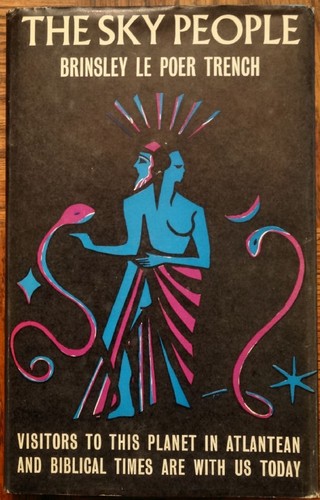
As an Amazon Associate, OverClassified may earn from qualifying purchases made through this link, at no extra cost to you.
Why This Is Essential Reading
The Sky People earns its place on this list less for the durability of its central argument — which a few years of NASA spacecraft photography quietly closed — than for what it represents: one of the earliest full-length British articulations of the ancient-astronaut hypothesis, written eight years before Chariots of the Gods? made the same basic move into a global publishing phenomenon, by an author whose later, entirely real achievement — organizing the only full UFO debate the British House of Lords has ever held — gives this obscure book a documented afterlife most fringe 1960s paperbacks never get. This entry has tried to be honest throughout about where the record is thin: no substantive contemporary review of the book was located, its central Martian-canal premise rests on astronomy that was already fading by 1960 and definitively closed within five years, and its supporting Tulli Papyrus evidence is, on this site's own separate investigation, unverified and probably fabricated. Read Brinsley Le Poer Trench's book not as a credible account of human origins but as a primary document in the genre's own prehistory — and as a reminder that the line between a country's most eccentric aristocratic UFO enthusiast and a genuine, Hansard-recorded moment of national legislative history can, on rare occasion, be a single hereditary title away.
Related Cases & Theories
Essential Viewing

1982-05-11: Lord Clancarty's UFO Redemption
Tom Owens UAP — Archival footage of Terry Wogan's 1982 BBC interview with Trench, by then the 8th Earl of Clancarty, discussing his UFO research three years after his House of Lords debate. A rare surviving piece of broadcast footage of the author speaking in his own words. Verified via YouTube oEmbed before inclusion; the original interview is independently corroborated by the BBC Archive's own social-media posting of the same footage.

MYSTERY WIRE - UK House of Lords debate on US UFO Report
Mystery Wire — Coverage of a 2021 House of Lords discussion of the U.S. government's UAP report — not Trench's original 1979 debate, but a direct institutional echo of it, held in the same chamber more than four decades after his own initiative first put the subject on Parliament's record. Included to show the long tail of the precedent Trench set. Verified via YouTube oEmbed before inclusion.
Sources Cited
- Trench, Brinsley Le Poer. The Sky People. Neville Spearman, 1960 (224 pp., matching this site's own resources-library citation under ASIN B000AOKY7A; no standard ISBN exists, as the book predates the ISBN system). amazon.com
- "Brinsley Le Poer Trench, 8th Earl of Clancarty." Wikipedia (biography, education, career, bibliography, Ancient Astronauts Society membership, House of Lords debate, death). en.wikipedia.org
- "Trench, (William) Brinsley Le Poer (1911-1995)." Encyclopedia of Occultism and Parapsychology, reproduced via Encyclopedia.com (biography, Flying Saucer Review founding, Contact International, House of Lords debate). encyclopedia.com
- "Ancient Aliens." Wikipedia (lists Brinsley Trench among the writers the History Channel franchise credits as inspirations). en.wikipedia.org
- "Ancient astronauts." Wikipedia (chronological list of proponents placing Trench's 1960 book ahead of W. Raymond Drake's 1964 Gods or Spacemen? and Erich von Däniken's 1968 Chariots of the Gods?). en.wikipedia.org
- "UNIDENTIFIED FLYING OBJECTS." UK Parliament, Historic Hansard, House of Lords, 18 January 1979 (the primary record of the debate Trench organized). api.parliament.uk
- "1979.0118 House of Lords debate." Isaac Koi UFO History Archive (bibliography of more than two dozen UFO reference books, including Jerome Clark's UFO Encyclopedia, discussing the debate). isaackoi.com
- "Revisiting the famous 1979 UFO Debate at the House of Lords." Openminds.tv (retrospective account of the debate's scope, participants, and aftermath). openminds.tv
- "The sky people" (1960 edition). Open Library (bibliographic record: Neville Spearman, 1960, hardcover, 224 pp.; no ISBN listed). openlibrary.org
- "The sky people." Internet Archive (Neville Spearman, 1960 edition scan, 238 pp., item skypeople0000brin; cover art sourced from this edition's dust jacket via Open Library's cover API). archive.org
- "The Sky People." Weiser Antiquarian Books (bookseller bibliographic description of the 1963 Venture Bookshop, Evanston IL, first American edition). weiserantiquarian.com
- "Flying Saucer Review." SourceWatch (magazine history, including its 1956-59 editorship under Trench and later Charles Bowen era). sourcewatch.org
- This site's own case file: The Tulli Papyrus, which names Trench as a key proponent and documents this book's role in popularizing the claim.
- This site's own essential-reading entry: Chariots of the Gods?, for the 1968 book that made the same genre commercially dominant eight years later.
- This site's own key-figures entry: Brinsley Le Poer Trench, 8th Earl of Clancarty, for further case connections beyond this book.
- This site's own resources library: Full Reading List, where this exact edition (ASIN B000AOKY7A) is cited in connection with the Tulli Papyrus case file.
Have corrections, additional research, or peer-reviewed sources? Help improve this entry.
Suggest an Edit