
Space-Time Transients and Unusual Events
The Founding Data Study of the Tectonic Strain Theory — and the First Attempt to Put Anomalous Reports Through a Computer
Core Thesis
Space-Time Transients and Unusual Events is the most quantitatively ambitious book in this library and one of the most contested. In 1977, the Laurentian University neuroscientist Michael A. Persinger and his co-author Gyslaine F. Lafrenière did something nobody in this field had attempted: they assembled a large corpus of anomalous reports — UFO sightings, poltergeist activity, Bermuda Triangle incidents, falls of objects from clear skies, cryptid and out-of-place-animal claims — coded them by time and location, and ran them through a computer looking for structure. The pattern they reported became the Tectonic Strain Theory: that anomalous luminous phenomena and earthquakes are generated by the same underlying process, stress and strain in the Earth's crust, and that most UFO reports are therefore produced by crustal deformation rather than by anything airborne. The theory requires analysis at three levels — the large-scale space-time pattern, the individual event, and the neuropsychological contribution of the observer — and it is the third that made Persinger's later career, and the second that has drawn the most damaging criticism.
About the Author
Michael A. Persinger (1945–2018) was a neuroscientist at Laurentian University in Sudbury, Ontario, with a substantial and genuinely mainstream publication record in behavioural neuroscience and geophysical influences on behaviour. He is best known outside that literature for the 'God helmet' experiments — attempts to induce sensed-presence experiences by applying weak, complex magnetic fields to the temporal lobes — and for the tectonic strain work this book founded.
The two lines of work are connected and the connection is the key to reading him. Persinger's hypothesis is not merely that crustal stress produces luminous phenomena in the air; it is that the same electromagnetic activity acts on the temporal lobes of nearby observers, producing altered perception, sensed presences, missing time and encounter narratives. That is a genuinely unified explanation covering both the light in the sky and the experience of the person watching it, and no other proposal in this field attempts as much.
Gyslaine F. Lafrenière's contribution was substantially the data work — the compilation and coding of the report corpus that made the statistical analysis possible. That labour is invisible in the theory's later reputation, which is attached almost entirely to Persinger's name, and it is worth naming.
Persinger's later reputation is complicated in ways that bear on this book. The God-helmet experiments faced serious replication problems, most notably a Swedish attempt that found suggestibility rather than magnetic field strength predicted the reported experiences. His publication style — long series of numbered papers in Perceptual and Motor Skills, a journal with a permissive reputation — drew criticism. None of that retroactively invalidates the 1977 data work, but it does mean the theory's principal advocate spent four decades defending it in venues where it was rarely seriously challenged.
Historical Context & Origins
1977 was the right moment for this book and the wrong moment for its reception. The Condon Report had closed official American investigation eight years earlier; the field was dominated by abduction narratives and crash claims; and a quantitative geophysical hypothesis had no natural constituency. Proponents did not want their sightings explained by rocks, and mainstream science was not reading UFO books.
Earthquake lights — luminous phenomena genuinely observed before, during and after seismic events — were and are a real if poorly-understood subject with a scientific literature of its own. Persinger's contribution was to propose that the mechanism operated far more widely and at far lower seismic energies than the earthquake-light literature described, which is simultaneously his boldest move and his most criticised one.
The book appeared the same year the Hessdalen research programme's subject was still four years from beginning, and this site's own Hessdalen case file describes it as 'the foundational Tectonic Strain Theory text… the theoretical seed later applied directly to Hessdalen's own data.' The Norwegian valley became the theory's principal field test, and it is still running.
Persinger's work converged with Paul Devereux's from the opposite direction. Devereux, writing from British earth-mysteries fieldwork in 1982, arrived at a geologically-driven luminous-phenomena hypothesis by mapping recurring sites against fault structure; Persinger arrived at a compatible conclusion from statistical correlation of report clusters with seismic activity. Two independent routes to the same place is a large part of why the hypothesis was taken seriously, and this site maintains a dedicated Earth Lights & Tectonic Strain Hypothesis page covering both.
The methodological environment matters too. In 1977 the phrase 'applied computer technology to' a body of reports was itself a claim to seriousness, and the book's framing leans on it. Modern readers should recognise that the statistical tools available, the quality of the underlying report data, and the standards for multiple-comparison correction were all very different from what would be required today.
A word about why a book of this kind is so rare, since the answer explains a great deal about the state of the field. Quantitative analysis of anomalous reports requires three things simultaneously: a large, consistently-coded corpus; someone with real statistical training; and a willingness to publish a negative result. Almost no one has had all three. The corpora exist but are inconsistently coded and privately held; the people with statistical training are mostly not interested; and the publishing incentives in this subject reward a striking conclusion over a null one. Persinger and Lafrenière had the training and built the corpus, and the theory they produced was striking — which is arguably how it survived four decades of results that should have constrained it faster.
Core Arguments & Key Concepts
Anomalous reports have geographic and temporal structure. The book's foundational empirical claim, and the one that makes it worth reading regardless of the theory built on it. Reports are not randomly distributed; they cluster in space and time in ways that demand explanation.
The structure tracks crustal stress. The theory proper: that report clusters correlate with tectonic strain, including low-magnitude seismic activity, and that the correlation is causal rather than coincidental.
The mechanism is electromagnetic. Stressed rock — particularly quartz-bearing rock — generates electrical and electromagnetic effects capable of producing luminous plasma at the surface. This is the same physics Devereux proposes, and the same energy-budget objection applies to both.
The observer is part of the phenomenon. Persinger's distinctive third level: that the same fields act on the temporal lobes of nearby witnesses, producing the experiential content — presences, communication, missing time — that a purely optical explanation cannot account for. This is the most ambitious element and the most difficult to test.
One theory, many phenomena. The book's scope covers UFOs, poltergeists, the Bermuda Triangle, anomalous falls and cryptid reports under a single explanatory framework. That unification is intellectually attractive and evidentially expensive: a theory that explains everything is under more obligation to make failed predictions, and this one struggles to.
The parameters are the problem. The most serious criticism, made by Chris Rutkowski, is that Persinger progressively widened the theory's tolerances until it could not fail: extending the effective range from near an epicentre to more than a hundred miles, admitting very low-magnitude seismic events, and permitting a lag between the seismic event and the sighting. Rutkowski's characterisation — that this is fitting the theory to the data rather than the reverse — is the objection the theory has never adequately answered.
Key Cases & Evidence Discussed
The report corpus itself. The book's real subject is not any individual case but the aggregate: decades of UFO, poltergeist, Fortean and cryptid reports coded by date and location. It is one of very few genuine attempts to treat this material as a data set rather than a collection of stories.
Hessdalen. Not in the 1977 book — the Norwegian sequence began in December 1981 — but the theory's most important field test since. This site's Hessdalen Lights case file cites this book as the foundational text whose theoretical seed was later applied directly to Hessdalen's own instrumented data.
Rutkowski's Manitoba test. The most consequential attempted replication, and a negative one. Chris Rutkowski examined Manitoba's own sighting waves — a record that includes the well-documented Carman and Winnipeg concentrations — against fault-line locations, using Persinger's own generous parameters, and found no correlation. This site covers Rutkowski's Canadian work in its breakdown of Canada's UFOs: Declassified.
Earthquake lights. The real, documented phenomenon the theory extrapolates from — and the difference between the established literature's near-epicentre, high-energy observations and Persinger's hundred-mile, low-magnitude extension is where the argument lives.
The Bermuda Triangle and Fortean falls. Included in the corpus, and the sections that have aged worst. The Bermuda Triangle's statistical anomaly had already been substantially dismantled by Lawrence Kusche's 1975 investigation two years before this book appeared, and its inclusion as data weakens the whole exercise.
The temporal-lobe experiments. Not in this book but flowing directly from its third level, and the reason Persinger's name is now more associated with the God helmet than with the tectonic strain data.
Critical Reception & Controversies
The theory has received far more genuine scientific engagement than any other UFO hypothesis, and that is the strongest thing that can be said for it. Persinger published extensively in the peer-reviewed literature, the theory generated testable predictions, and researchers attempted replication — a normal scientific process that almost nothing else in this field has undergone.
The results of that engagement have been largely negative. Chris Rutkowski's Manitoba work is the clearest instance: applying Persinger's own parameters to a well-documented regional sighting record produced no correlation with fault lines. Persinger responded in the journals, the exchange ran for years, and no resolution emerged.
The parameter-widening criticism is the one that should govern a modern reader's assessment. A hypothesis that begins as 'lights appear near earthquake epicentres' and ends as 'lights may appear up to a hundred miles from low-magnitude seismic events, possibly after an unspecified delay' has lost most of its predictive content. That is not a claim of bad faith; it is a description of what happens to a theory defended for four decades against accumulating negative results.
The energy-budget objection applies here as it does to Devereux: piezoelectric and related effects in stressed rock are real and small, and producing a persistent metre-scale luminous ball at the surface requires several orders of magnitude more energy than straightforward calculation supplies. Neither author has closed that gap.
The observer-effects strand has been damaged by association with the God-helmet replication failures. If weak complex magnetic fields do not reliably produce sensed-presence experiences in a controlled laboratory, the claim that ambient geomagnetic variation does so in the field is considerably harder to sustain.
Against all of that: the book's foundational observation stands and has been independently confirmed many times over. Anomalous reports do cluster geographically and temporally. Whatever explains that clustering — and population density, observation opportunity, media contagion and reporting infrastructure explain a great deal of it — the pattern is real, and Persinger and Lafrenière were the first to demonstrate it quantitatively.
It is worth being precise about what a fair modern verdict looks like, because both the enthusiastic and the dismissive readings are wrong. The Tectonic Strain Theory is not pseudoscience: it names a physical mechanism, makes geographic and temporal predictions, was published in peer-reviewed venues, and was tested. It is a failed scientific hypothesis, which is a different and more respectable category, and the difference matters for how this field should think about itself. Almost nothing else here has ever reached the point of being falsifiable enough to fail properly. A subject with more failed hypotheses in it would be a healthier subject than one with more unfalsifiable ones.
Influence & Legacy
This book created the only UFO hypothesis that has ever been treated as a normal scientific proposition — published in peer-reviewed venues, subjected to attempted replication, argued about in journals, and progressively constrained by negative results. Whether it survives is a separate question from whether it was worth proposing, and it was.
Its most durable practical legacy is the method. Treating anomalous reports as a spatially and temporally distributed data set, and asking what the distribution correlates with, is now standard in serious UAP analysis. This site's own computed proximity-analysis series — water, nuclear facilities, bolides — is doing exactly what Persinger and Lafrenière did in 1977, with better data and better tools.
It also supplies a cautionary case study that this site's own analytical pages take seriously. The lesson of the parameter-widening criticism is that a correlation analysis is only as good as the constraints declared before the data are examined, and that a hypothesis permitted to loosen its tolerances in response to failure stops being a hypothesis. That is a discipline the proximity-analysis pages here try to observe by publishing the computation rather than only the conclusion.
Within this site's library it anchors the geophysical shelf alongside Earth Lights and Earth Lights Revelation, and it is cited by the Hessdalen case file as the theoretical origin of the research programme running in that valley today.
There is also a straightforwardly historical reason to keep this book visible. It is the earliest sustained attempt anyone made to ask what a UFO report is evidence OF, as opposed to whether it is true — to treat the reporting itself as a measurable natural phenomenon with causes, distribution and structure. That question has since been taken up by researchers who would not recognise Persinger as an ancestor: the reporting-rate analyses in the modern UAP literature, the media-contagion studies, the work correlating sighting density with observation opportunity and population, all descend from the same move. Being wrong about the answer does not diminish having asked first.
The Book
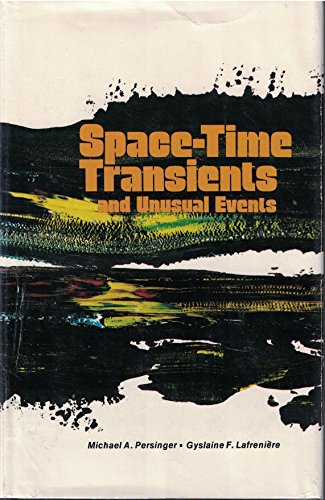
Space-Time Transients and Unusual Events
The Founding Data Study of the Tectonic Strain Theory — and the First Attempt to Put Anomalous Reports Through a Computer
Find on Amazon →As an Amazon Associate, OverClassified may earn from qualifying purchases made through this link, at no extra cost to you.
Why This Is Essential Reading
The most scientifically ambitious book in this library, and the one whose central theory has held up least well. Persinger and Lafrenière did something genuinely original in 1977: they treated decades of anomalous reports as a data set, coded them by time and place, and looked for structure. The structure is real. The explanation they built on it — that crustal stress produces both the lights and, via the observer's temporal lobes, the experience of them — is the most unified proposal this subject has ever produced and has been steadily eroded by four decades of testing, most damagingly by Chris Rutkowski's finding that Manitoba's sighting waves show no correlation with fault lines even under Persinger's own generous parameters. Read it for the method, which this site's own analytical pages descend from, and for the object lesson in what happens to a theory whose tolerances are widened each time it fails.
Related Cases & Theories
Sources Cited
- Persinger, Michael A., and Gyslaine F. Lafrenière. Space-Time Transients and Unusual Events. Chicago: Nelson-Hall, 1977, 267 pp. ISBN-10 0882293346 / ISBN-13 9780882293349. amazon.com
- Google Books record, Space-time Transients and Unusual Events by Michael A. Persinger and Gyslaine F. Lafrenière — bibliographic data and the description of the authors' application of computer analysis to UFO, Bermuda Triangle, anomalous-fall and cryptid reports. books.google.com
- AbeBooks bibliographic record, ISBN 9780882293349 — Nelson-Hall 1977 edition and the 0882294628 paperback. abebooks.com
- BetterWorldBooks listing, Space-Time Transients and Unusual Events — independent bibliographic confirmation. betterworldbooks.com
- Persinger, Michael A. "Geophysical Variables and Human Behavior: XV. Tectonic Strain Luminosities (UFO Reports)…" Perceptual and Motor Skills, 1983 — a representative entry in the long peer-reviewed series developing the theory. journals.sagepub.com
- Persinger, Michael A. "Geophysical Variables and Behavior: XXVI. A Response to Rutkowski's Critique of the Tectonic Strain Hypothesis," Perceptual and Motor Skills, 1985 — Persinger's reply to the Manitoba negative result. journals.sagepub.com
- Magonia archive, "Persinger's Tectonic Strain Theory: Strengths and Weaknesses" — a sustained critical assessment from the British psychosocial school. magoniamagazine.blogspot.com
- Rutkowski, Chris A. Critique of the tectonic strain hypothesis, Perceptual and Motor Skills (1984) — the Manitoba fault-line test to which Persinger's 1985 reply above responds. journals.sagepub.com (Persinger reply, citing Rutkowski)
- ResearchGate record, "Transient Geophysical Bases for Ostensible UFO-Related Phenomena and Associated Verbal Behavior" — a representative Persinger paper developing the observer-effects strand of the theory. researchgate.net
- Persinger, Michael A. "Michael Persinger's Tectonic Strain Theory — Replies to Critics" — the author's own collected responses, including to Rutkowski's range, magnitude and lag objections. god-helmet.com
- Devereux, Paul. Earth Lights: Towards an Understanding of the UFO Enigma, Turnstone Press, 1982 — the independently-derived geophysical hypothesis. OverClassified breakdown
- Devereux, Paul. Earth Lights Revelation, 1989. OverClassified breakdown
- Rutkowski, Chris A. Canada's UFOs: Declassified — the Canadian researcher whose Manitoba fault-line test produced the theory's most damaging negative result. OverClassified breakdown
- OverClassified case file, Hessdalen Lights — cites this book as the foundational Tectonic Strain Theory text and the theoretical seed later applied directly to Hessdalen's own instrumented data.
- OverClassified theory page, Earth Lights & Tectonic Strain Hypothesis — this site's full treatment of the proposal.
Have corrections, additional research, or peer-reviewed sources? Help improve this entry.
Suggest an Edit