
Earth Lights
Towards an Understanding of the UFO Enigma — The 1982 Book That Named a Phenomenon and Founded a Research Tradition
Core Thesis
Earth Lights: Towards an Understanding of the UFO Enigma is one of the very few UFO books that created a category. Before 1982 the recurring luminous phenomena at fixed geographic sites — the lights of Hessdalen, Marfa, Brown Mountain, the Welsh and Pennine 'spooklights' — were scattered across regional folklore, ufology and meteorology with no shared vocabulary and no shared framework. Paul Devereux, then editor of the British earth-mysteries journal The Ley Hunter, gave them a name and a hypothesis: earth lights, understood as luminous plasma or electromagnetic phenomena generated by strain in the Earth's crust and therefore correlated with fault systems, tectonically active rock, and particular geological structures rather than with observers, aircraft corridors or intelligent control. The book's argument is that a substantial fraction of what gets reported as UFO activity is a real, physical, unrecognised natural phenomenon — not a misidentification of something ordinary, and not a craft. That is a genuinely third position, and it is the reason this book still matters.
About the Author
Paul Devereux came to this subject from earth mysteries rather than from ufology, and the difference in intellectual formation shows on every page. He was editor of The Ley Hunter, the British journal of ley-line and sacred-landscape research, when he wrote this book — a milieu concerned with the relationship between prehistoric monuments, geology and anomalous experience, and one with essentially no investment in the extraterrestrial hypothesis. His later career took him further into archaeoacoustics, consciousness studies and the anthropology of altered states, and he has published widely on the sensory properties of prehistoric sites.
That background produced a researcher genuinely uninterested in whether UFOs are spacecraft. Devereux's question throughout is geographic and geological: why do these lights appear here, repeatedly, over decades or centuries, at a small number of specific places? A researcher who starts from that question ends up doing fieldwork with maps and geological surveys rather than witness interviews, and the resulting book reads more like regional geography than like ufology.
The 1982 edition credits additional material to Paul McCartney — the earth-mysteries researcher of that name, not the musician, a coincidence that has confused catalogue records for four decades and is worth stating plainly to save the next reader a search.
Devereux returned to the subject seven years later with Earth Lights Revelation: UFOs and Mystery Lightform Phenomena (1989), which this site covers separately and which considerably expands the piezoelectric mechanism into ufology's most developed geophysical alternative to a craft hypothesis. He also co-wrote UFOs and Ufology: The First 50 Years (1997) with Peter Brookesmith. The 1982 book is where all of it starts.
Historical Context & Origins
British ufology in the late 1970s and early 1980s was unusually receptive to non-craft explanations, and this book belongs to that moment. The extraterrestrial hypothesis had never held the near-monopoly in Britain that it held in the United States; the psychosocial school around Magonia was actively arguing that UFO reports were culturally structured experiences; and the earth-mysteries movement was already investigating relationships between geology, prehistoric sites and anomalous experience. Devereux's contribution was to take that milieu's instincts and give them a testable physical mechanism.
The specific evidence base was regional light phenomena with long documentary records. Some of these predate powered flight by centuries, which is the single most important fact about them and the one that makes them resistant to any misidentified-aircraft explanation. Brown Mountain, North Carolina has reports going back into the nineteenth century; Marfa, Texas likewise; and the British spooklight sites Devereux surveyed have folkloric records older still.
The Norwegian case arrived almost immediately afterwards and transformed the field. Beginning in December 1981, an intense sequence of light phenomena in the Hessdalen valley drew Norwegian and Swedish researchers into what became the longest-running instrumented field study of an anomalous light phenomenon anywhere — four decades of radar, magnetometer and spectroscopic data, with Erling Strand and colleagues maintaining an automatic measurement station in the valley. This site's Hessdalen Lights case file cites Devereux's book directly as foundational to the piezoelectric research tradition that grew up around that station.
The parallel American development was Michael Persinger's tectonic strain theory, whose data foundation is Space-Time Transients and Unusual Events (1977, with Gyslaine Lafrenière). Persinger and Devereux arrived at compatible conclusions from opposite directions — Persinger from a statistical correlation of report clusters with seismic activity, Devereux from field geography — and the convergence of two independent approaches is a large part of why the hypothesis was taken seriously. This site maintains a dedicated Earth Lights & Tectonic Strain Hypothesis theory page covering both.
Core Arguments & Key Concepts
Recurring lights cluster geologically, not culturally. The book's central empirical claim. Devereux argues that plotting light phenomena against geological maps — fault systems, tectonically stressed rock, particular mineralogies — produces a correlation that plotting them against population, roads or airports does not. This is a testable claim, and it is the reason the book has a research tradition behind it rather than only a readership.
The mechanism is strain-generated electromagnetic activity. The proposed physics is that mechanical stress in crustal rock, particularly quartz-bearing rock, produces piezoelectric and related electrical effects capable of ionising air at the surface and generating luminous plasma. The mechanism is real in the laboratory; whether it scales to the observed phenomena is the open question, and it remains open.
Earth lights are a distinct natural phenomenon, not a misidentification. This is the argument that separates Devereux from conventional debunking and is regularly missed. He is not saying witnesses saw Venus or a helicopter; he is saying they saw a real luminous object that science has not characterised. That makes the hypothesis a rival to the extraterrestrial one rather than a dismissal of the reports.
The phenomenon has a consciousness-adjacent component. Devereux's earth-mysteries background surfaces in his suggestion that close proximity to these fields may produce perceptual and experiential effects in witnesses — the seed of what Persinger developed into a full neurological account. This is the book's most speculative strand and the one that has aged least well, since Persinger's own later laboratory work on magnetically-induced experience has faced serious replication problems.
Long historical records are the strongest evidence. The recurring-site argument depends on phenomena documented before aviation, before electric lighting, and before UFO culture existed. Devereux leans on this hard, and correctly: a light reported at the same valley in 1870 and 1980 is not explained by anything invented in between.
A prediction that has largely held. The book's most checkable claim is that earth-light sites should be persistent and geographically fixed rather than following observers or fashions. Four decades later that has held up better than almost anything else in this literature: Hessdalen, Marfa, Brown Mountain and the British spooklight sites are all still producing reports at the same coordinates, and the Hessdalen phenomenon has been repeatedly captured on instruments at a fixed location. A hypothesis that made a falsifiable geographic prediction in 1982 and has not been falsified by forty years of monitoring deserves more attention than it gets.
Key Cases & Evidence Discussed
The Hessdalen lights (Norway, 1981–present). Not covered in the 1982 first edition — the Norwegian sequence began the December before publication — but the case that the book's framework was immediately applied to and that has tested it ever since. This site's Hessdalen Lights file covers four decades of instrumented data and cites this book as foundational to the piezoelectric research tradition around it.
British spooklight sites. The book's original fieldwork base: recurring luminous phenomena at named British locations with long folkloric and documentary records, surveyed against geological structure. This is the material that gave the hypothesis its name and its method.
Brown Mountain, North Carolina. One of the longest-documented American recurring-light sites, with reports spanning more than a century and multiple official investigations (including U.S. Geological Survey studies in 1913 and 1922 that attributed the lights to distant train and automobile headlights, an explanation that does not cover the pre-automobile reports). See this site's registered location for Brown Mountain.
Marfa, Texas. The most-visited recurring-light site in the United States, with reports predating the highway whose traffic is the standard conventional explanation. See Marfa.
The Yakima Indian Reservation lights (Washington State). Not a Devereux case originally but the closest American parallel to his method: a fire-lookout observation programme run by W. J. 'Bill' Vogel through the 1970s that produced systematic, dated, positioned reports of luminous phenomena from trained observers at a single geographic area. See Yakima.
What is deliberately absent. There are no abductions here, no crash retrievals, no government cover-up, and no occupants. A reader coming from the American literature will find the omissions striking, and they are the point: Devereux is arguing that a large slice of the phenomenon can be accounted for without any of that machinery.
Critical Reception & Controversies
The hypothesis has been taken more seriously by scientists than any other UFO-adjacent proposal, for a straightforward reason: it names a physical mechanism, predicts a geographic distribution, and can be tested with instruments. The Hessdalen research programme — radar, magnetometry, spectroscopy, automated monitoring stations, published papers — exists in a form that no other UFO hypothesis has ever attracted, and it exists substantially because Devereux and Persinger made the subject legible to people with instruments.
The results of that testing have been genuinely mixed, and honesty requires saying so. Four decades of Hessdalen data have confirmed that something physical and luminous is occurring, produced spectroscopic evidence of ionised material, and shown correlations worth pursuing — but they have not established the piezoelectric mechanism, and the valley's phenomena remain scientifically unresolved. This site's Hessdalen file describes the debate over its cause as genuine and ongoing.
What the instrumented testing has actually produced is worth stating precisely, since both proponents and critics tend to summarise it wrongly. Erling Strand and colleagues first brought magnetometric, radiometric and radar instrumentation to Hessdalen in 1984, during a roughly forty-day campaign that coincided with a flap phase; the permanent Automatic Measurement Station — the 'Blue Box,' carrying a magnetometer and three television cameras — has run continuously since August 7, 1998. Spectroscopic work during the Italian-led EMBLA campaigns obtained a small number of usable low-dispersion spectra of the classic 'blinking light,' which showed a continuum with no emission lines, and the lights' point spread function has been reported as gaussian — both consistent with a plasma radiation mechanism rather than with a reflective solid object. That is real physical evidence for the general class of explanation Devereux proposed. It is not evidence for the piezoelectric source specifically, and there is still no consensus explanation for the phenomenon.
The strongest technical objection is one of scale. Piezoelectric effects in laboratory quartz are real but small, and the energy budget required to produce a persistent, manoeuvring, metre-scale luminous ball at the surface is orders of magnitude larger than straightforward strain calculations appear to supply. Proponents argue that focusing mechanisms and unusual local conditions could close the gap; sceptics note that this has not been demonstrated.
The consciousness strand has fared worst. Persinger's tectonic strain theory eventually extended into claims about magnetically-induced religious and anomalous experience, and his laboratory work in that area faced significant replication failure, including a well-known Swedish attempt that found suggestibility rather than magnetic field strength predicted reported experiences. Devereux's 1982 version of the idea is far more tentative than what it became, but the association has cost the geophysical hypothesis credibility it did not need to lose.
Within ufology the reception has always been ambivalent, and for a revealing reason: earth lights are the one alternative explanation that concedes the phenomenon is real and unexplained while denying it is intelligent. That satisfies almost nobody. Craft proponents regard it as a reductive move; hard sceptics regard it as an unnecessary new entity when headlights and Venus are available. Its persistence despite pleasing neither camp is a point in its favour.
Influence & Legacy
The term itself is the most durable contribution. 'Earth lights' entered the vocabulary in 1982 and is now used by researchers who have never read Devereux and by some who reject his mechanism entirely — the mark of a genuinely successful conceptual intervention. It gave a scattered set of regional folklore traditions a single research category.
The research programme is the second. This site's Earth Lights & Tectonic Strain Hypothesis theory page exists because this book and Persinger's Space-Time Transients between them created a testable framework, and the Hessdalen station in Norway is its longest-running experimental arm.
Its third and least-noticed legacy is methodological: Devereux demonstrated that geography is data. Plotting anomalous reports against physical substrate rather than against witness demographics was not standard practice in 1982 and is now routine in serious UAP analysis. This site's own computed proximity-analysis series — the water, nuclear facility and bolide pages — is doing the same kind of thing with better tools.
Finally, the book is a standing rebuke to the framing that treats UFO research as a binary between spacecraft and nothing. Devereux's third option — a real, physical, uncharacterised natural phenomenon — has never been refuted, has genuine instrumented support at Hessdalen, and remains the most scientifically respectable position anyone in this field has articulated. That it satisfies neither believers nor debunkers is not evidence against it.
The Book
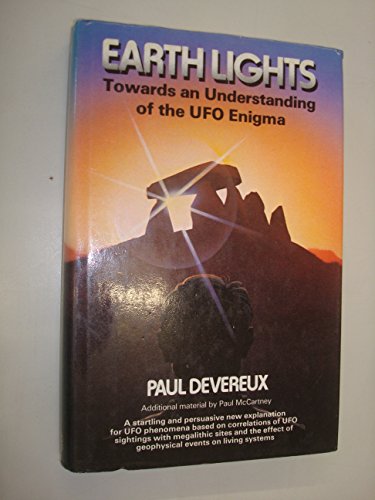
Earth Lights
Towards an Understanding of the UFO Enigma — The 1982 Book That Named a Phenomenon and Founded a Research Tradition
Find on Amazon →As an Amazon Associate, OverClassified may earn from qualifying purchases made through this link, at no extra cost to you.
Why This Is Essential Reading
Essential, and the least-read essential book in this library. Earth Lights named a category, proposed a mechanism, and started the only UFO-adjacent research programme that has ever attracted forty years of continuous instrumented field study. Devereux's core claim — that recurring luminous phenomena cluster against geological structure and represent a real, physical, uncharacterised natural process rather than either craft or misidentification — remains unrefuted, and Hessdalen has confirmed that something genuinely physical is happening at at least one such site without confirming the mechanism. Read it for the third position it stakes out, read the 1989 sequel for the developed argument, and read Persinger and Lafrenière for the statistical case that arrived at the same place from a different direction. The energy-budget objection is real and unanswered; so is the observation that lights reported at the same valley in 1870 and 1980 need some explanation.
Related Cases & Theories
Sources Cited
- Devereux, Paul, with Paul McCartney. Earth Lights: Towards an Understanding of the UFO Enigma. Wellingborough: Turnstone Press, 1982, hardcover with colour photographic section. ISBN-10 0855001232 / ISBN-13 9780855001230. amazon.com
- Open Library edition record OL8300314M, Earth Lights — Turnstone Press, 1982, hardcover, OCLC 10125864, full subtitle 'Towards an Understanding of the Unidentified Flying Objects Enigma.' openlibrary.org
- Goodreads edition record, Earth Lights by Paul Devereux — cover art source and edition data. goodreads.com
- Devereux, Paul. Earth Lights Revelation: UFOs and Mystery Lightform Phenomena — The Earth's Secret Energy Force. Blandford, 1989. OverClassified breakdown
- Devereux, Paul, and Peter Brookesmith. UFOs and Ufology: The First 50 Years. Facts on File, 1997. OverClassified breakdown
- Persinger, Michael A., and Gyslaine F. Lafrenière. Space-Time Transients and Unusual Events. Nelson-Hall, 1977 — the statistical arm of the same hypothesis. OverClassified breakdown
- Internet Archive, scanned copy of Earth lights revelation (Devereux, 1989) — the sequel, consulted for the development of the mechanism. archive.org
- Wikipedia, "Hessdalen AMS" — the Automatic Measurement Station ("Blue Box") in service since August 7, 1998, carrying a magnetometer and three television cameras. en.wikipedia.org
- Wikipedia, "Hessdalen lights" — the 1984 Strand instrumentation campaign, the EMBLA spectroscopic results (a continuum with no lines; gaussian point spread function consistent with a plasma), and the absence of consensus on a cause. en.wikipedia.org
- Society for UAP Studies, "Project Hessdalen" — institutional overview of the long-running Norwegian field study. societyforuapstudies.org
- Project Gutenberg / Center for Inquiry archives of Skeptical Inquirer back issues — the standing venue for published criticism of geophysical UFO hypotheses. skepticalinquirer.org
- OverClassified case file, Hessdalen Lights — four decades of radar, magnetometer and spectroscopic data from the Norwegian valley, the researchers who have studied it since 1981, and the genuine unresolved scientific debate over its cause. Cites this book as foundational to the piezoelectric research tradition.
- OverClassified theory page, Earth Lights & Tectonic Strain Hypothesis — this site's full treatment of the proposal that UAP are natural self-organising plasma or electromagnetic spheres generated by tectonic strain, crystal friction and piezoelectric currents.
- OverClassified data page, Water Proximity Analysis — a modern computed instance of the geography-as-data method this book pioneered.
- OverClassified data page, Nuclear Facility Proximity Analysis — likewise.
- OverClassified data page, Bolide & Fireball Proximity Analysis — likewise.
Have corrections, additional research, or peer-reviewed sources? Help improve this entry.
Suggest an Edit