
Ovnis dans le ciel corse
Mythes et phénomènes étranges — The First Book-Length Study of the UFO Phenomenon in Corsica
Core Thesis
Corsica is 8,700 square kilometres of mountain in the middle of the western Mediterranean, with a population smaller than a mid-sized French city and an intellectual life largely conducted in its own language and its own publishing houses. It also has a real body of aerial-phenomena reporting, some of it examined by GEIPAN, almost none of it collected in one place. Christophe Canioni's Ovnis dans le ciel corse is the first book devoted to it, and it is organised in three parts: an opening chapter on the wider investigation, a central chapter of testimonies gathered across the island — several of them previously unpublished, including accounts from Zonza and from Corte — and a closing chapter of analysis. The testimony is the reason to read it. The framing around the testimony is where a reader should be careful, and this article will say why.
About the Author
Christophe Canioni is a Corsican author who published this book with Éditions Anima Corsa in Bastia in 2011, and followed it with a second volume on the same subject, Ovnis, enquête et témoignages inédits en Corse. Beyond that publishing record and his own account of the fieldwork behind it, very little biographical information about him is publicly available, and this article will not invent any.
What is documented is the work. The book was built from testimony he gathered directly across the island, over roughly two years of fieldwork, from people who had observed something in the Corsican sky — a collection method that is ordinary in principle and unusually rare in practice, because it requires living somewhere long enough that people will talk to you.
The préface is by André-Jean Bonelli. The book carries the imprint of a genuine regional publisher, Anima Corsa, and inaugurated that house's Mythes et phénomènes étranges series — which is to say a Corsican press decided the island's anomalous material was worth a dedicated list, and chose this book to open it.
The institutional traces are the useful check on all of this. The book is catalogued by the library service of the Collectivité de Corse-du-Sud and holds a record in M3C, the Université de Corse's digital heritage platform. Those are real holdings in real institutions, and they distinguish this from the print-on-demand titles that this site has declined for exactly the absence of any such trace.
One point about local publishing is worth making because it applies across this whole category of book. A regional press with a hundred titles and a bookshop distribution network in Bastia and Ajaccio is a small operation, but it is a real one: it has an address, a VAT number, a catalogue and a reputation among its neighbours to protect. That is a materially different situation from an author uploading a file to a platform, and it is why a book like this clears a bar that superficially similar titles do not.
Historical Context & Origins
France has had a state body studying aerial phenomena since March 1977, when CNES created GEPAN at Toulouse under Claude Poher — later SEPRA, and since 2005 GEIPAN. It publishes its case files, classifies them A through D, and releases statistics. That is an unusual degree of institutional openness, and it means French regional reports have somewhere official to go.
It also means that a French regional researcher is working alongside an official archive rather than against a vacuum, which changes what a book like this is for. Canioni is not filling in for an absent state; he is collecting the accounts that never entered the state's system, and noting which ones did.
Corsica's own position is particular. The island is administratively French and culturally distinct, with its own language, its own press and its own publishing. Its aerial-phenomena reports have been covered for years by regional outlets including the online Corse Net Infos, but had never been assembled. Anything not gathered locally in Corsica tends not to be gathered at all.
The geography matters for the reports themselves. Corsica is dominated by a mountain spine rising above 2,700 metres, with very dark interior skies, a long coastline, and heavy seasonal air and sea traffic around its edges. It sits under Mediterranean flight corridors, within reach of French military aviation, and it is a place where an unfamiliar light can be genuinely difficult to resolve. That combination produces both real anomalies and a rich supply of conventional stimuli, and any honest regional survey has to grapple with both.
The book's own back cover situates it in the international moment of the late 2000s: official voices in France, the United States, Russia, Belgium, South America, Scandinavia and Japan speaking publicly about the subject, and formerly classified material being released. That framing is accurate as a description of the period — the COMETA report, the French archive release, the Belgian wave's official handling — and it is also the point at which the book's argument becomes more confident than its evidence.
This site's own Corsican case, the Zonza sighting of 28 August 2014, post-dates the book by three years and is a separate event. The Zonza testimony Canioni publishes is an earlier one, and its existence establishes something useful: Zonza is not a one-off in the island's record.
Core Arguments & Key Concepts
Corsica has a UFO record, and nobody had collected it. The book's founding claim and its genuine contribution. First book-length treatment of the subject on the island, built from fieldwork rather than from press cuttings.
The testimonies are the substance. The central chapter is the book: multiple accounts from people the author judged credible, gathered directly, most of them never previously published.
Some of the cases went to GEIPAN. A real and checkable claim, and the most valuable single feature of the collection — it means part of the corpus has a parallel official record.
Two accounts are singled out. The Zonza and Corte testimonies, described on the book's own cover as never before revealed to the public.
Corsican reports resemble reports elsewhere. The analytical chapter's central observation, and one the book reads as significant: the same features recur here as in France, the Americas and Scandinavia, which the author takes to give the phenomenon a universal dimension and to reduce its strangeness.
Official disclosure is under way. The book's framing argument: figures from scientific and military circles in several countries have been releasing formerly classified information, and the author reads this as pointing toward an extraterrestrial presence.
The nature question is open, and the book answers it anyway. The back cover poses the alternatives fairly — an unknown complex atmospheric phenomenon, or something of extraterrestrial origin — and then states that the first chapter's material leaves little doubt about the second. That gap between the question asked and the answer asserted is the book's central weakness.
Key Cases & Evidence Discussed
A note on scope. This article works from the book's own published description, its cover text, its catalogue records and its documented three-chapter structure. It has not read the book, and does not claim to summarise the individual testimonies it contains.
The Zonza testimony. Named on the book's own cover as one of two accounts never before made public. Zonza is a village of a few hundred people in the Alta Rocca, at the foot of the Aiguilles de Bavella and a gateway to the GR20 — and, three years after this book, the site of the sighting in this site's own Corsican case file. Canioni's account is a different, earlier event; that two separate reports come from the same small commune is a genuinely interesting fact about the island's record.
The Corte testimony. The second of the two singled out. Corte sits in the mountainous interior and is the seat of the Università di Corsica Pasquale Paoli — the same institution whose digital heritage platform now catalogues the book.
The great UFO wave of 1974. Named as a section of the testimony chapter. A significant French wave three years before GEPAN existed, and one for which regional accounts are correspondingly scarce.
Cases examined by GEIPAN. The subset of the corpus with an official parallel record — the most valuable material in the book precisely because it can be checked against something outside it.
Previously unpublished accounts. The bulk of the testimony chapter, gathered directly from witnesses across the island. Whatever one concludes about the framing, an unpublished regional corpus is an addition to the record rather than a rearrangement of it.
The international disclosure material. The opening chapter's subject: public statements by scientific and military figures in France, the United States, Russia, Belgium, South America, Scandinavia and Japan. For the French and Belgian strands see The COMETA Report and Vague d'OVNI sur la Belgique.
The cross-national similarity argument. The closing chapter's analytical move, and the one most worth arguing with: whether recurring features across cultures indicate a common external cause or a common reporting culture is precisely the question Bertrand Méheust spent a career on.
Critical Reception & Controversies
No review of this book could be located in any venue, French or otherwise, and its reader footprint is small — a Babelio entry, bookseller listings, two library records. That is unremarkable for a regional-press title in a language community of a few hundred thousand people, and it is the honest starting point for any assessment.
What can be established is provenance, and it is good. A real Corsican publisher with a real catalogue and a real address in Bastia; an ISBN in the French 2-912819 block; holdings in the Collectivité de Corse-du-Sud library system and in the Université de Corse's M3C platform; distribution through French booksellers including Mollat, Dialogues and Fnac. This is a properly published regional book, not an untraceable upload.
The methodological limitation is inherent to the form and worth stating plainly. A single collector gathering testimony across an island over two years, without an institutional framework, produces a corpus whose quality varies with his own interviewing practice — and none of that practice is documented for an outside reader. How witnesses were found, what they were asked, in what order, and whether their accounts were checked against weather, air traffic or astronomical data are all unknown from outside the book.
The framing is the substantive problem, and it should be met head-on rather than passed over politely. The back cover poses the nature question fairly — unknown atmospheric phenomenon, or extraterrestrial origin? — and then declares that the first chapter's material leaves little doubt about the extraterrestrial answer. That is not a conclusion the stated evidence supports. Public statements by former officials, however senior, are statements; the release of previously classified files establishes that files existed. Neither is evidence about the origin of anything, and treating institutional candour as though it were a finding is the single most common error in this literature.
This site's standing position on official pronouncements cuts both ways here, and that is worth being explicit about. Government and military bodies have a documented history of incomplete and later-revised explanations, and their conclusions are one input to weigh rather than a verdict — which is why an official denial settles nothing. By exactly the same reasoning, an official's assertion that something is extraterrestrial settles nothing either. Scepticism about institutional statements has to be symmetrical or it is not scepticism.
The similarity argument in the closing chapter has a serious answer that the book does not engage. Recurring features across cultures are consistent with a common external cause; they are equally consistent with a common stock of transmitted imagery, which is the mimetic effect Méheust identified in 1985 and which Vallée had traced through pre-modern material sixteen years before that. A regional survey published in 2011 could have taken that objection seriously, and does not appear to.
Set against all of this, the collection itself remains a real addition. Unpublished first-hand testimony from an under-documented region, some of it with a parallel GEIPAN record, is material that did not previously exist in any accessible form. A future researcher can disagree with every word of Canioni's analysis and still be glad he did the interviews.
Influence & Legacy
The book's clearest achievement is that it exists. Before 2011 Corsica's aerial-phenomena reports lived in regional press coverage, private memory and, for a minority, GEIPAN case files. Afterwards there was a book, in a library catalogue, with an ISBN.
It also created a slot. Anima Corsa built the Mythes et phénomènes étranges series around it, and Canioni followed with a second Corsican volume — the ordinary way a regional literature establishes itself, one title at a time.
Its value to this site has been concrete. This site's own Zonza case file cites the book as evidence that Corsica has a real, independently documented tradition of aerial-phenomena reporting distinct from GEIPAN's official archive — the context that makes a single 2014 GEIPAN case legible as part of something rather than as an isolated curiosity.
The Zonza connection deserves emphasis because it was found while writing this article. The book's own cover names a previously unpublished Zonza testimony, gathered before 2011; this site's case file covers a separate Zonza sighting of 28 August 2014. Two independent reports from one commune of a few hundred people, three years apart, is not proof of anything — small mountain villages with dark skies and hiking traffic generate reports — but it is exactly the kind of local density that only a regional collector would ever surface.
The general lesson is about where the record actually lives. National archives hold what was reported to national institutions. Everything else is held by whoever bothers to knock on doors in their own region, in their own language, over years. Most countries have no such person for most of their territory, and the resulting gaps are invisible precisely because nobody has looked.
The Book
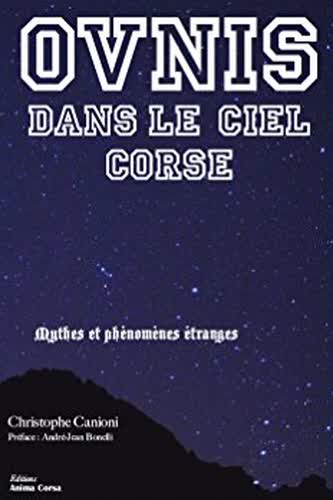
Ovnis dans le ciel corse
Mythes et phénomènes étranges — The First Book-Length Study of the UFO Phenomenon in Corsica
Find on Amazon →As an Amazon Associate, OverClassified may earn from qualifying purchases made through this link, at no extra cost to you.
Why This Is Essential Reading
Take the testimony and leave the framing. Ovnis dans le ciel corse is the first and, so far, the principal book-length treatment of the UFO phenomenon in Corsica: three chapters from a genuine Bastia publisher, built on roughly two years of fieldwork across the island, catalogued by the Collectivité de Corse-du-Sud library service and by the Université de Corse's own heritage platform. Its central chapter collects accounts that had not been published anywhere, some of them examined by GEIPAN, including testimonies from Zonza and Corte named on the cover as never previously revealed — and the Zonza one matters here, because this site's own Corsican case file covers a separate Zonza sighting three years later. That is a real addition to the record. The framing is where a reader should push back: the book poses the nature question fairly and then treats public statements by former officials and the release of classified files as though they settled it, which they do not. Institutional candour is not evidence about origin, and scepticism about official pronouncements has to run in both directions. Read it for the interviews, and read Méheust for the objection its closing chapter does not answer.
Related Cases & Theories
Sources Cited
- Canioni, Christophe. Ovnis dans le ciel corse: mythes et phénomènes étranges. Éditions Anima Corsa, Bastia, 2011. 225 pp., 16 × 24 cm. ISBN-10 2912819989 / ISBN-13 9782912819987. amazon.com
- AbeBooks listing for ISBN 9782912819987 — the source of the wraparound jacket image reproduced here, from which the book's back-cover text was read directly: its status as the first work on the subject in Corsican publishing, the inauguration of the Mythes et phénomènes étranges collection, the three-chapter structure, the statement that several testimonies were studied by GEIPAN and that most were previously unpublished, the singling out of the Zonza and Corte accounts as never before revealed, the cross-national similarity argument, the imprint details for Éditions Anima Corsa at Bastia, and the 23-euro cover price. pictures.abebooks.com
- Bibliothèque de la Collectivité de Corse-du-Sud, catalogue record ALOES 0568728 for Ovnis dans le ciel corse: mythes et phénomènes étranges — an institutional library holding for the title (the catalogue's own host no longer resolves as of September 2026, so it is cited here without a direct link; the Université de Corse record below is live).
- M3C, Université de Corse Pasquale Paoli, record for OVNIs dans le ciel de Corse — the university's digital heritage platform entry. m3c.universita.corsica
- Librairie Mollat catalogue record — independent French bookseller listing. mollat.com
- Librairie Dialogues catalogue record — further independent bookseller listing confirming publisher and edition. librairiedialogues.fr
- Fnac Belgique catalogue record — the source for the 1 May 2011 publication date, 226-page extent and 16 × 24 cm format, and for the co-credit to A.-J. Bonelli. fr.fnac.be
- Babelio record for OVNIS dans le ciel corse — independent French bibliographic and reader record. babelio.com
- Les Libraires (French independent booksellers' network), record for Canioni's second Corsican volume Ovnis, enquête et témoignages inédits en Corse, Éditions Anima Corsa — confirmation of the author's continued work on the subject. leslibraires.fr
- Librairie La Bailleuloise author page, Christophe Canioni — independent bookseller author record. la-bailleuloise.fr
- Amazon France listing for the same edition — independent confirmation of author, publisher and ISBN. amazon.fr
- GEIPAN (CNES) — the French state study group whose case files provide the parallel official record for part of this book's corpus, and whose institutional history runs GEPAN (1977) to SEPRA (1988) to GEIPAN (2005). geipan.fr
- Wikipedia, “Zonza” — the Alta Rocca commune named on the book's cover as the source of one of its two previously unpublished testimonies, and the location of this site's own 2014 Corsican case. en.wikipedia.org
- Wikipedia, “Corte, Haute-Corse” — the interior town that supplies the book's second singled-out testimony and hosts the Università di Corsica Pasquale Paoli. en.wikipedia.org
- OverClassified, Zonza, Corsica Sighting — this site's case file on the 28 August 2014 event, which already cited this book as evidence of a real independent Corsican reporting tradition.
- OverClassified, Les OVNI du CNES — the critical study of the French state's own UFO investigation programme, the institutional context this book's Corsican cases sit alongside.
Have corrections, additional research, or peer-reviewed sources? Help improve this entry.
Suggest an Edit