
Maritime UFO Files
Personal Accounts Taken From Actual Military and RCMP Documents — Atlantic Canada's Sighting Record, Decade by Decade
Core Thesis
Maritime UFO Files does for Atlantic Canada what a national survey cannot: it works one region's record exhaustively, decade by decade, from the documents the region's own institutions generated. Don Ledger's subtitle states the method plainly — 'personal accounts taken from actual military and RCMP documents' — and that combination is what makes the book unusual. The Maritimes and Newfoundland have produced a disproportionate share of the best-documented UFO cases in North America, and the reason is structural rather than mysterious: they combine heavy maritime and air traffic, a coastline dense with fishing communities where anything on the water is noticed, Canadian Forces and Coast Guard installations that generate incident paperwork, and an RCMP detachment system whose officers write reports as a matter of routine. Ledger's book is the survey of what those institutions actually wrote down, running from the 1950s through the end of the century and covering pilots, ordinary citizens and RCMP officers alike, from unexplained lights to a handful of claimed abductions.
About the Author
Don Ledger is a Nova Scotian pilot, aviation writer and UFO researcher, and the flying background matters more here than in most author biographies in this library. A researcher who holds a licence and knows Atlantic Canadian airspace reads a pilot's report differently — he knows the traffic patterns, the weather, the navigation aids and what a Maritime night sky over water actually looks like from a cockpit.
His standing rests principally on Dark Object: The World's Only Government-Documented UFO Crash (2001), co-written with Chris Styles, the definitive account of the October 4, 1967 Shag Harbour incident. That book's claim in its own subtitle — the world's only government-documented UFO crash — rests on the fact that Canadian federal departments generated a paper trail treating the event as a possible downed object, with RCMP, Royal Canadian Navy and Department of National Defence records surviving. Ledger and Styles found and published them.
This book is the wider net around that case. Where Dark Object works a single incident to exhaustion, Maritime UFO Files surveys the regional record it sits inside, and the two are best read in that order — the survey establishes that Shag Harbour was not an isolated anomaly in the Atlantic provinces but the most consequential entry in a long series.
Ledger has continued as an investigator and commentator on Canadian cases, and his documentary approach — go to the RCMP detachment report, the DND file, the Transport Canada record — puts him in the same methodological family as David Clarke in Britain and Keith Basterfield in Australia, working a national or regional archive that nobody else had systematically read.
Historical Context & Origins
Canada's official UFO record has a distinctive institutional shape. The National Research Council took over civilian UFO report handling from the Department of National Defence in 1968 and maintained a file series until 1995, and its holdings — along with RCMP detachment reports and DND correspondence — are now with Library and Archives Canada. That means Canadian researchers have had access to a genuinely official, genuinely preserved report series for decades, in a way American researchers largely have not since Blue Book closed.
Atlantic Canada's geography produces an unusual reporting environment. The coastline is long, the population is coastal and maritime, and a substantial fraction of the working population spends nights outdoors on or near water. Anything in the sky over the sea is noticed by people whose livelihood depends on knowing what is normally there — which is why fishermen and RCMP officers recur so often as witnesses in this record.
The 1967 Shag Harbour incident, on the night of October 4, is the region's defining case and one of the very few anywhere in which multiple national agencies treated a UFO report as a possible search-and-rescue or downed-aircraft event in real time. Its documentary trail is the reason it is discussed seriously, and Ledger's work is a substantial part of why that trail is public.
The autumn of 1978 produced a distinct Newfoundland wave that this book is the principal source for. Its best-known incident is the October 26, 1978 Clarenville sighting, in which RCMP Constable James Blackwood and roughly a dozen residents watched a large fin-tailed object hover over Random Sound for nearly two hours — Blackwood retrieving his detachment's high-powered surveillance telescope and reporting that the object's underside light flashed in apparent response when he activated his cruiser's roof lights. The National Research Council's proposed explanation, the planet Jupiter reflected low over the water, never satisfied witnesses who had watched at close range for two hours.
That case's afterlife is worth recording because it says something about how Canadian institutions treat this material. In 2020 the Royal Canadian Mint issued a commemorative silver coin marking the Clarenville sighting — a national mint striking a UFO case is not a thing that happens in most countries, and it reflects a Canadian public culture considerably more comfortable with the subject than the American one.
There is a further reason Atlantic Canada's record is unusually good, and it has nothing to do with the phenomenon. The four provinces have an exceptionally dense network of small communities whose institutional memory is long and whose local newspapers were, until recently, genuinely local — meaning a sighting reported to an RCMP detachment in 1978 typically also produced a contemporaneous newspaper account, community recollection, and in many cases named witnesses still resident decades later. Ledger was working a region where the human record and the documentary record could be checked against each other, which is a rarer research condition than it sounds and is a large part of why cases like Clarenville have survived in usable form.
Core Arguments & Key Concepts
Regional exhaustiveness beats national breadth. The book's governing choice. A researcher who works one region completely can establish base rates, spot genuine waves, identify recurring witnesses and locations, and cross-check reports against each other — none of which a national survey sampling the famous cases can do.
The documents come first. Ledger's sourcing is military, RCMP and departmental paperwork rather than interviews conducted decades later. That inverts the usual priority in popular UFO writing and produces a much less dramatic but much more checkable book.
Police officers are the region's most valuable witness class. RCMP constables recur throughout, and for good reason: they are trained observers, they file written reports as routine, their reports are preserved, and they have careers to lose. The Clarenville case is the clearest instance — an officer who retrieved a telescope, made a deliberate signalling test with his vehicle lights, and documented the result.
Maritime settings produce a specific evidentiary texture. Objects over water are seen against a dark, featureless background by observers who know the local light sources — navigation aids, fishing fleets, coastal towns — extremely well. That cuts both ways: it makes some misidentification less likely, and it makes reflection, mirage and unusual atmospheric propagation over water more so.
Shag Harbour is the anchor, not the exception. The survey's implicit argument is that the 1967 case's exceptional documentation reflects the region's institutional density rather than the incident's uniqueness — that similar events elsewhere simply had nobody generating paperwork about them.
What the book does not do. It is 162 pages covering half a century across four provinces, which means the treatment is necessarily brief per case. It is a regional index rather than an investigation, and readers wanting depth on any individual incident need to go to the dedicated sources — Dark Object for Shag Harbour, and this site's own case files elsewhere.
Base rates are the quiet payoff. The most useful thing a genuinely exhaustive regional survey provides is not any individual case but a sense of what the ordinary reporting volume looks like. Once a reader knows roughly how many reports a given decade produced in Nova Scotia, New Brunswick, Prince Edward Island and Newfoundland, a wave becomes visible as a statistical event rather than an impression, and a famous case can be located inside or outside one. Almost no popular UFO writing supplies that, because almost none of it works a defined population of reports rather than a selection of interesting ones.
Key Cases & Evidence Discussed
The Shag Harbour incident (Nova Scotia, October 4, 1967). The book devotes a chapter to the case Ledger later treated at book length, and the reason it matters is documentary rather than narrative: RCMP officers, the Royal Canadian Navy and the Department of National Defence all generated records treating the event as a possible downed object requiring search. See this site's Shag Harbour UFO Incident file and the Dark Object breakdown.
The Clarenville sighting (Newfoundland, October 26, 1978). This site's Clarenville UFO Sighting file relies on this book specifically for the wider autumn-1978 Newfoundland sighting wave that followed — the regional context no other source assembles. The case itself: Constable James Blackwood, roughly a dozen residents, a large dull-grey oval or cigar-shaped hull with a stubby tail fin, two hours of observation over Random Sound, the telescope, the signalling exchange, and the NRC's contested Jupiter explanation.
The 1978 Newfoundland wave. The book's most useful single contribution to this site's own research, and a good illustration of why regional surveys matter: a famous case becomes a different object once you know it sat inside a cluster.
Pilot reports across the Atlantic provinces. Ledger's own flying background makes this the section where his judgement is most worth having. Atlantic Canada sits under transatlantic routing and hosts significant military aviation, and the pilot-report subset of the regional record is correspondingly substantial.
RCMP detachment reports, 1950s onward. The book's spine and the reason its subtitle names them. Reports filed by serving officers, in the course of duty, into a preserved records system, are the highest-quality routine documentation this subject produces anywhere.
The abduction claims. A small number appear in the regional record and Ledger includes them. They are the weakest material in the book by his own evidentiary standard, since they generally lack the contemporaneous documentation everything else here rests on, and he handles them accordingly.
Critical Reception & Controversies
The book was published by Nimbus Publishing, an established Halifax regional press, and was reviewed in the Canadian Book Review Annual — which is more mainstream critical attention than most UFO titles receive and reflects its status as a regional-interest book as much as a ufological one.
Its reception has been shaped by its modesty. At 162 pages it makes no large claims, proposes no theory, and does not argue for extraterrestrial origin; it presents a regional record. That has kept it out of the arguments and also out of the citations, which is unfortunate, because the material it assembles is not available elsewhere.
The substantive limitation is depth. A book covering five decades of four provinces in 162 pages cannot do more than sketch any individual case, and readers arriving from the American literature expecting sustained investigation will find summaries instead. The correct comparison is not to a case study but to a regional gazetteer.
A second limitation is that the documentary sourcing, while real, is not always specified to a level that lets a reader retrieve the original. Ledger names RCMP and military documents as his basis but the book does not carry the file references that would let a later researcher pull them — a common failing in regional-press UFO publishing and the main thing separating this book from David Clarke's National Archives work.
The strongest thing that can be said for it is empirical: this site's own Clarenville case file could not have been written to its current standard without it, because no other published source establishes the autumn-1978 Newfoundland wave that the Clarenville sighting belongs to. A book that supplies a context nobody else has assembled has earned its place regardless of its page count.
Influence & Legacy
Ledger's principal legacy is Shag Harbour, and it belongs mostly to Dark Object: he and Chris Styles established that a Western government had generated a documented, multi-agency response to a UFO report treated as a possible downed object, and that claim has held up. Very few researchers in this field have produced a result of that class.
Maritime UFO Files' own contribution is contextual, and this site uses it exactly that way: as the source for the regional wave structure around individual Atlantic Canadian cases. That is a narrow but genuinely irreplaceable function.
It also belongs to a small and important category this site keeps returning to: the regional or national documentary survey, produced by one researcher working an archive nobody else had read. Clarke did it for Britain, Basterfield for Australia, Chris Rutkowski for Canada nationally, and Ledger for the Atlantic provinces. Between them these books constitute most of what is reliably known about the non-American record.
The Royal Canadian Mint's 2020 Clarenville coin is a small but real measure of how far the Canadian material has travelled. A case documented in a 162-page regional paperback ended up commemorated in silver by a national mint, and the documentary work that made it discussable is largely Ledger's.
A last note about why regional books like this one are undervalued. The economics of UFO publishing reward national and international surveys that reach the largest audience, and they punish exhaustive local work that will sell a few thousand copies within one region's bookstores. The result is a literature top-heavy with breadth and desperately short of depth — dozens of books retelling the same forty famous cases, and a handful quietly establishing what actually happened in one place. This site's own case files depend far more on the second category than on the first, and Maritime UFO Files is a clean illustration of the disproportion between a book's commercial footprint and its research value.
The Book
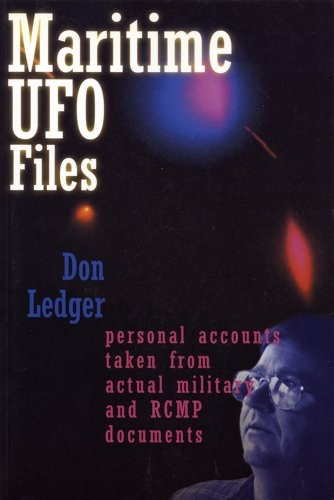
Maritime UFO Files
Personal Accounts Taken From Actual Military and RCMP Documents — Atlantic Canada's Sighting Record, Decade by Decade
Find on Amazon →As an Amazon Associate, OverClassified may earn from qualifying purchases made through this link, at no extra cost to you.
Why This Is Essential Reading
Short, unglamorous, and genuinely irreplaceable for its region. Don Ledger is a Nova Scotian pilot who co-wrote the definitive account of Shag Harbour, and this is his wider survey of what Atlantic Canada's military, RCMP and departmental records actually contain — decade by decade, from the 1950s on, with pilots, fishermen and serving police officers as the recurring witnesses. It will not satisfy a reader wanting depth on any single case; at 162 pages it cannot, and the documentary sourcing is not specified tightly enough to let you retrieve the originals. What it does supply is the regional context that makes individual Atlantic Canadian cases legible — the autumn-1978 Newfoundland wave behind the Clarenville sighting is the clearest example, and this site's own case file depends on it. Read it with Dark Object for the case that anchors the whole record.
Related Cases & Theories
Sources Cited
- Ledger, Don. Maritime UFO Files: Personal Accounts Taken From Actual Military and RCMP Documents. Halifax: Nimbus Publishing, first edition 1998; reissued May 15, 2007, 162 pp. ISBN-10 1551092697 / ISBN-13 9781551092690. amazon.com
- Nimbus Publishing catalogue page, Maritime UFO Files — publisher record, including the decade-by-decade structure and the dedicated Shag Harbour chapter. nimbus.ca
- Canadian Book Review Annual Online, review record for Maritime UFO Files — mainstream Canadian critical notice. cbra.library.utoronto.ca
- AbeBooks bibliographic record, Maritime UFO files, ISBN 9781551092690. abebooks.com
- Google Books record, Maritime UFO Files by Don Ledger — bibliographic data. books.google.com
- McNally Robinson Booksellers listing, Maritime UFO Files — independent Canadian bookseller record. mcnallyrobinson.com
- Doull Books listing, Maritime UFO Files: Personal accounts of UFO sightings in the Atlantic Provinces taken from actual military and RCMP documents, first edition paperback — the full original subtitle. doullbooks.com
- ThriftBooks edition record, Maritime UFO Files by Don Ledger — printing and format data. thriftbooks.com
- Ledger, Don, and Chris Styles. Dark Object: The World's Only Government-Documented UFO Crash. Dell, 2001. OverClassified breakdown
- Rutkowski, Chris A. Canada's UFOs: Declassified — the national Canadian counterpart to this regional survey. OverClassified breakdown
- Clarke, David. The UFO Files: The Inside Story of Real-Life Sightings. The National Archives, 2009 — the British archival parallel. OverClassified breakdown
- OverClassified case file, Clarenville UFO Sighting — cites this book as its source for the wider autumn-1978 Newfoundland sighting wave; source for Constable James Blackwood's two-hour observation over Random Sound, the detachment telescope, the roof-light signalling exchange, the NRC's Jupiter explanation, and the 2020 Royal Canadian Mint commemorative coin.
- OverClassified case file, The Shag Harbour UFO Incident — the October 4, 1967 case at the centre of Ledger's work.
Have corrections, additional research, or peer-reviewed sources? Help improve this entry.
Suggest an Edit