
LightQuest
Your Guide to Seeing and Interacting with UFOs, Mystery Lights and Plasma Intelligences — A Field Guide With a Metaphysics Attached
Core Thesis
LightQuest takes the earth-lights tradition and pushes it somewhere its originators declined to go. Andrew Collins argues across 415 pages that UFOs, mystery lights and the intelligences reported in connection with them are best understood as sentient energy forms — complex plasma constructs manifesting from a higher-dimensional reality — and that a person can learn to perceive and interact with them. The book is two things bound together: a practical field guide to light-phenomenon hotspots in Britain and the United States, and a creative-visualisation method for what Collins calls light questers to commune with the intelligences. The first half is genuinely useful. The second is unfalsifiable by construction, and the book does not mark the join.
About the Author
Andrew Collins is an Essex-based writer who has been active in this field since the mid-1970s, and his UFO credentials are substantial. He conducted a multi-year investigation into the 1974 Aveley abduction, arranging hypnotic regression sessions with Dr. Leonard Wilder and compiling a January 1978 report he called probably the most important British case ever.
His conclusion about that case is the key to this book. Collins came to believe the Aveley family's experience most likely occurred within what he called some form of astral domain rather than aboard a physical craft — a position he reached in the 1970s and has developed ever since. LightQuest is the mature statement of it.
His subsequent career has been mostly outside ufology. He has written more than a dozen books on ancient history and prehistoric archaeology, including work on Göbekli Tepe and on the astronomical significance of Cygnus, and he is better known to general readers for that material than for anything in this volume.
He also comes out of the British psychic questing tradition, which is directly relevant to the book's method. Psychic questing combined fieldwork at historic sites with intuitive and visionary techniques, and the visualisation exercises in LightQuest are recognisably a development of it applied to light phenomena rather than to landscape mysteries.
The introduction is by Gregory L. Little, a psychologist and writer who has worked on similar territory, and the publisher, Eagle Wing Books, is a small independent specialising in this material. That places the book on a metaphysical rather than an investigative list, which is the correct shelf for it.
Historical Context & Origins
The earth-lights hypothesis is the book's immediate ancestor. Paul Devereux's Earth Lights (1982) argued that a proportion of UFO reports describe naturally generated luminous phenomena associated with geological stress in particular landscapes — a physical hypothesis with a proposed mechanism.
Michael Persinger's work supplied the scientific underpinning, and this library covers it through Space-Time Transients. Persinger proposed that tectonic strain could produce both luminous displays and, through electromagnetic effects on the temporal lobe, anomalous experiences in observers — a two-part mechanism connecting the lights to the strangeness reported around them.
That framework is where Collins begins and where he departs. Devereux and Persinger proposed a physical cause with psychological consequences; Collins proposes that the lights are themselves conscious, which is a different claim requiring different evidence and offering none.
The hotspot geography he covers is real and well documented. Hessdalen in Norway has hosted an instrumented observation station since the 1980s and produced published measurements; Marfa in Texas has a documented partial explanation in vehicle headlights with a residue that predates the road; Brown Mountain in North Carolina has a reporting history stretching back over a century.
The plasma physics Collins invokes is a real and active field, and some of it is genuinely relevant. Ball lightning remains incompletely explained, earthquake lights are a documented phenomenon with proposed mechanisms in stressed-rock physics, and self-organising plasma structures have been produced in laboratory conditions. None of that literature supports sentience.
The 2012 publication sits in a specific moment for the light-phenomena question. Hessdalen's automated station had been running for two decades, producing data that established the lights were real, physical and unexplained without establishing what they were — a gap into which a book of this kind naturally moves.
The book's practical half also reflects a real change in what was possible by 2012. Consumer digital cameras, GPS, online sighting databases and cheap spectrometry had made amateur field observation of light phenomena feasible in a way it had not been, and a hotspot guide aimed at people who intended to go and look was a reasonable thing to write.
Core Arguments & Key Concepts
Light phenomena at hotspots are real, recurrent and worth going to observe. The book's foundational and best-supported claim, and the reason its field-guide half has value. Hessdalen in particular has been instrumented for decades and the lights there are not in dispute; what they are is.
The phenomena are plasma or plasma-like, not solid craft. A defensible position with real support from the observational record. Light phenomena that change shape, split, merge, vary in brightness and leave no physical trace behave much more like ionised gas than like structured vehicles, and Collins is on solid ground in preferring that reading.
Hotspots correlate with geology, and that correlation is informative. Inherited from Devereux and still the strongest structural argument in this tradition. Recurrent light phenomena cluster in particular landscapes, often ones with distinctive fault structures or mineralisation, and a purely psychological or cultural explanation has to account for that geographic specificity.
The plasma constructs are sentient and manifest from a higher-dimensional reality. The book's distinctive claim and the point where it leaves anything testable. Nothing in the plasma physics literature, the earth-lights observational record, or the Hessdalen data bears on consciousness, and Collins offers no criterion by which the presence or absence of sentience could be established.
An observer can learn to interact with the intelligences through visualisation. The practical corollary, and it inherits every problem of the CE-5 contact tradition. A protocol whose success is judged by the practitioner's own subjective experience of contact cannot distinguish contact from expectation, and the book proposes no external check.
The field-guide material is the book's real contribution and it is buried. Location information, access, observing conditions, what to look for and what has been reported at each site is practical, checkable content of the kind almost nothing else in this literature supplies. It sits inside a metaphysical argument that will deter exactly the readers most likely to use it well.
The book does not distinguish its own registers. The structural criticism that matters. Instrumented Hessdalen data, geological correlation, plasma physics, sentience claims and visualisation exercises appear in one continuous argument at one level of confidence, and a reader is given no signal about which parts rest on measurement and which on the author's interpretive tradition.
Key Cases & Evidence Discussed
Hessdalen, Norway. The valley with an automated instrumented observation station running since the 1980s — the only light-phenomenon site subject to sustained scientific monitoring, and the strongest evidence in the book. Covered in this site's case file.
Marfa, Texas. The lights, the public viewing area, and the documented attribution of most observations to vehicle headlights on US Route 67 with a residual set predating the highway. This site's case file covers both halves.
Brown Mountain, North Carolina. The Appalachian light phenomenon with a reporting history of more than a century and successive official investigations, examined in this site's case file.
The British hotspots. The English and Welsh sites Collins covers from his own fieldwork — the material closest to his personal experience and the part of the guide most usable by a British reader.
The Aveley abduction, 1974. Not a light case, but the investigation that shaped Collins' whole framework. His conclusion that the family's experience occurred within an astral rather than a physical domain is the seed of this book's metaphysics, and this site covers the case in its own file.
Ball lightning and earthquake lights. The real, incompletely explained plasma phenomena Collins draws on for physical plausibility — genuine science that supports the plasma reading and says nothing about sentience.
The visualisation protocol. The creative-visualisation technique the book supplies for light questers to commune with the intelligences — the practical expression of its metaphysics and the element that cannot be assessed by any external means.
The geological correlation. The fault structures, mineralisation and landscape features Collins associates with hotspot locations, inherited from the earth-lights tradition and still the most testable structural claim in it.
Critical Reception & Controversies
The book was published by a small independent metaphysical press and has no reviews of record. Its reception has been within the light-phenomena and experiencer communities, where Collins has a long-established following from both his UFO work and his ancient-history writing.
The sceptical objection is straightforward: the book asserts consciousness in a physical phenomenon without offering any criterion by which consciousness could be detected, distinguished from its absence, or ruled out. That is not a claim that has been refuted; it is a claim that cannot be engaged.
The more interesting criticism comes from within the earth-lights tradition itself. Devereux and Persinger proposed a physical mechanism precisely because it was testable, and their framework's whole appeal was that it offered an alternative to the untestable claims dominating the field. A development that adds sentience and a visualisation protocol takes the tradition back toward exactly what it was constructed to avoid.
The visualisation material also invites the criticism that has been made of every contact protocol from the contactee era to CE-5. A method whose outcome is judged by the practitioner's subjective sense of having made contact cannot distinguish contact from expectation, and a book supplying such a method to readers who have travelled to a hotspot specifically hoping for contact is stacking the conditions.
Against that, the field-guide content deserves to be taken seriously on its own terms and rarely is. Practical information about where recurrent light phenomena are reported, how to get there, when to go and what has been recorded is genuinely scarce, and a reader who ignores the metaphysics can use the rest.
The plasma reading also deserves more credit than a hostile assessment might give it. Light phenomena that split, merge, change colour and leave nothing behind are much better described as ionised gas than as vehicles, and a substantial part of the historical UFO record consists of exactly such reports. Collins is right about the physics and wrong about what follows from it.
The fair placement is as a hotspot guide with an untestable metaphysics wrapped around it. Use the locations, the observing advice and the reporting histories; treat the sentience claim and the visualisation protocol as belonging to the author's interpretive tradition rather than to the evidence.
It is also worth being fair about the position Collins occupies, because it is a difficult one and he has held it consistently for fifty years. Since the Aveley investigation in the 1970s he has argued that the phenomenon is real, that it is not solid extraterrestrial hardware, and that the experiences reported around it are not simply hallucination — a set of commitments that satisfies neither the nuts-and-bolts camp nor the psycho-social one. That position is genuinely harder to occupy than either alternative, and the fact that it has driven him toward untestable formulations is a comment on the difficulty of the problem as much as on his answer to it.
Influence & Legacy
The book's practical legacy is as one of very few usable field guides to recurrent light phenomena. Anyone intending to go and observe at a hotspot in Britain or the United States will find more usable information here than in the academic literature, which describes sites without telling a visitor how to reach or watch them.
Its theoretical legacy is the sentient-plasma reading, which has circulated widely in the experiencer and consciousness-oriented parts of the field and now appears regularly in discussions that do not credit its source. Whether that is an influence to welcome depends entirely on one's view of the claim.
For the earth-lights tradition specifically, the book marks the point at which one branch left physics behind. Devereux's line continues as a geophysical hypothesis; Collins' continues as a metaphysics, and the two have not converged since.
The cautionary legacy is about hotspot expeditions generally. Travelling to a location known for anomalous lights, at night, expecting contact, having read a book that supplies a visualisation protocol for achieving it, is a set of conditions under which almost anyone will experience something. The field guide and the protocol are safe apart and hazardous together, and the book does not warn its reader about the combination.
One last observation about the geography, because it is the part of the book most likely to matter in twenty years. Collins compiled a list of places where luminous phenomena are recurrently reported, with practical detail about reaching and observing at each. That is exactly the input a systematic instrumented survey would need, and the Hessdalen station demonstrates what such a survey produces when someone builds one. A hotspot list is a research asset regardless of what its compiler thinks the lights are, and this one may end up serving purposes its author did not intend.
The Book
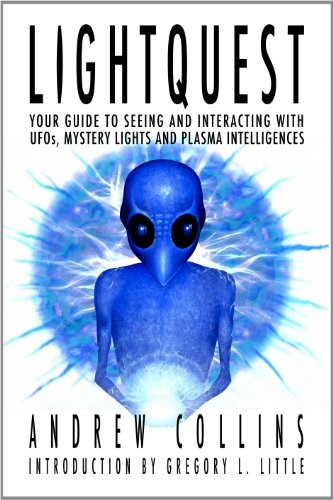
LightQuest
Your Guide to Seeing and Interacting with UFOs, Mystery Lights and Plasma Intelligences — A Field Guide With a Metaphysics Attached
Find on Amazon →As an Amazon Associate, OverClassified may earn from qualifying purchases made through this link, at no extra cost to you.
Why This Is Essential Reading
Take the field guide and leave the metaphysics. LightQuest is two books in one binding: a practical, genuinely scarce guide to where recurrent light phenomena are reported in Britain and the United States, with access, conditions and reporting histories; and an argument that those phenomena are sentient plasma constructs manifesting from a higher-dimensional reality, complete with a visualisation protocol for communing with them. Andrew Collins is right that the observational record describes something much more like ionised gas than like structured craft, and the geological correlation he inherits from Devereux is the most testable idea in this whole tradition. He supplies nothing at all in support of consciousness, and no criterion by which it could be detected or excluded. Use the locations, read this site's case files on Hessdalen, Marfa and Brown Mountain before you go, and be aware that a night-time vigil undertaken with a contact protocol in hand is a set of conditions under which almost anyone experiences something.
Related Cases & Theories
Sources Cited
- Collins, Andrew. LightQuest: Your Guide to Seeing and Interacting with UFOs, Mystery Lights and Plasma Intelligences. Eagle Wing Books, June 7, 2012. 415 pp. Introduction by Gregory L. Little. ISBN-10 0940829495 / ISBN-13 9780940829497. amazon.com
- Open Library edition record, ISBN 0940829495 — bibliographic verification and cover-art source. openlibrary.org
- AbeBooks catalogue record, ISBN 9780940829497 — edition verification, the Eagle Wing Books June 2012 imprint, the 415-page extent, and the publisher description of UFOs, mystery lights and alien intelligences as sentient energy forms and complex plasma constructs manifesting from a higher-dimensional reality, with a field guide to hotspots in Britain and the United States and a creative visualisation technique for light questers. abebooks.com
- ThriftBooks catalogue record — independent bibliographic listing and description. thriftbooks.com
- Goodreads edition record, LightQuest — edition data and reader reception. goodreads.com
- Wikipedia, "Andrew Collins" — the author's career, his UFO work and his subsequent writing on prehistory and archaeoastronomy. en.wikipedia.org
- Wikipedia, "Hessdalen lights" — the Norwegian valley, its automated instrumented observation station and the published measurements that make it the strongest site in the book. en.wikipedia.org
- Wikipedia, "Marfa lights" — the Texas phenomenon and the documented headlight attribution for most observations. en.wikipedia.org
- Wikipedia, "Brown Mountain Lights" — the North Carolina phenomenon, its century-long reporting history and the official investigations of it. en.wikipedia.org
- Wikipedia, "Ball lightning" — the incompletely explained luminous phenomenon Collins draws on for physical plausibility. en.wikipedia.org
- Wikipedia, "Earthquake light" — the documented luminous phenomenon associated with seismic activity, and the mechanism underlying the earth-lights tradition. en.wikipedia.org
- Wikipedia, "Plasma (physics)" — the state of matter Collins proposes the phenomena consist of, and the laboratory literature on self-organising plasma structures. en.wikipedia.org
- Wikipedia, "Tectonic strain theory" — Michael Persinger's proposed mechanism linking geological stress to both luminous phenomena and anomalous experience in observers. en.wikipedia.org
- Wikipedia, "Will-o'-the-wisp" — the older folk tradition of anomalous lights in particular landscapes, and its documented natural explanations. en.wikipedia.org
Have corrections, additional research, or peer-reviewed sources? Help improve this entry.
Suggest an Edit