
Foundations of Atlantis, Ancient Astronauts and Other Alternative Pasts
148 Documents Cited by Writers of Fringe History, Translated and Annotated
Core Thesis
Foundations of Atlantis, Ancient Astronauts and Other Alternative Pasts is not an argument so much as an evidentiary exhibit: a curated collection of 148 primary ancient and historical documents — Mesopotamian creation myths, Egyptian papyri, Hermetic and Gnostic texts, Enochic and biblical pseudepigrapha, classical Greek and Roman historians including Plato's own Atlantis account in the Timaeus and Critias, medieval chronicles, and post-medieval hoax documents up through the Kensington Runestone — that fringe-history writers on Atlantis, ancient astronauts, giants, the Great Flood, pre-Columbian transatlantic contact, and "lost" advanced technology have cited, quoted, misquoted, or in some documented cases fabricated outright as supporting evidence. Jason Colavito translates or adapts each text into readable English and adds his own introductory annotation explaining its real provenance, what it actually says, and how a specific popular writer has used or distorted it — including several documents the collection itself identifies as later forgeries, presented so readers can see exactly how a fabricated "ancient" source enters circulation. Where Colavito's 2005 The Cult of Alien Gods traced the ancient-astronaut hypothesis's literary genealogy as a connected narrative, this 2015 book supplies the underlying primary documents themselves, functioning less as an argument to be read start to finish than as a reference shelf to be consulted claim by claim.
About the Author
Jason Colavito's full biography — his 2003–2004 authorship of The Cult of Alien Gods, his Ithaca College education, and his subsequent career as one of pseudoarchaeology's most prominent living critics — is covered at length in this site's own Essential Reading entry on that earlier book. What is specific to this later work is its publisher and its place in his bibliography: Foundations of Atlantis is Colavito's first traditionally published book since The Cult of Alien Gods a decade earlier, and it came from a genuinely different kind of house. McFarland & Company is an independent academic-reference publisher, not a self-publishing platform — a distinction worth stating plainly, since the book's obscurity can otherwise read as a sign of vanity publishing it does not deserve. The two books Colavito published between them, A Critical Companion to Ancient Aliens (2012) and Faking History (2013), were both self-published, through Lulu.com and CreateSpace respectively; Foundations of Atlantis marks his return to a professional publisher's editorial and review process.
The book also grew out of an ongoing project visible on Colavito's own website: a free, running "Ancient Texts" library of English translations of exactly this kind of primary source, maintained alongside his blog's real-time critiques of the History Channel's Ancient Aliens franchise. Foundations of Atlantis selects, polishes, and annotates 148 of those documents for print and Kindle publication. The book's own introduction, quoting Yale sociologist William Graham Sumner's 1906 observation that a genuinely unbiased history "hardly exists" and every student should trace one historical claim back to its ultimate sources, frames the project's purpose directly: to let readers check fringe-history claims about ancient astronauts, Atlantis, and pre-Columbian contact against the documents actually being cited, rather than take any writer's paraphrase on faith. Colavito went on to apply the same institutionally published, document-grounded approach to The Mound Builder Myth (University of Oklahoma Press, 2020) and Legends of the Pyramids (Red Lightning Books, 2021).
Historical Context & Origins
Colavito wrote Foundations of Atlantis in the years immediately following the History Channel's Ancient Aliens premiere in 2009–2010, a period in which the ancient-astronaut hypothesis moved from paperback fringe shelves onto basic-cable television and reached a far larger audience than it had in the four decades since Chariots of the Gods? (1968). Colavito's own blog, running episode-by-episode critiques of the series since its early seasons, repeatedly confronted the same practical problem: on-screen commentators and the popular books behind them routinely referenced "ancient texts" supporting extraordinary claims without quoting them directly, in more cases than not because the commentator had never read the original, and in some cases because no such original existed at all.
That recurring gap — a claim asserted to rest on an ancient document, with no actual excerpt of that document supplied for a reader to check — is what Foundations of Atlantis was built to close. Colavito's introduction states the book's purpose in similarly direct terms: to collect "the ultimate sources for many of the most popular 'alternative' history claims," spanning ancient astronauts, Atlantis, pre-Columbian Old World contact with the Americas, and claims about descendants of Jesus and Mary Magdalene, so that each claim could be weighed against the primary document rather than a paraphrase of it. The book followed a decade after The Cult of Alien Gods had made a structurally similar move at the level of literary history — tracing the ancient-astronaut idea back to H.P. Lovecraft's fiction rather than any genuine ancient tradition — but where that book argued a connected narrative, this one supplies the underlying evidence in unmediated form.
It also arrived into a publishing landscape with real precedent for item-by-item rebuttal: Ronald Story's The Space-Gods Revealed (1976) had already spent nearly four decades as the standard reference for debunking specific von Däniken claims about the Nazca Lines, the Piri Reis map, and similar individual pieces of "evidence." Foundations of Atlantis takes a related but distinct approach: rather than rebutting each claim in prose, it reprints the actual ancient document the claim depends on, letting readers reach their own conclusions once the source text and its real context are in front of them.
Core Arguments & Key Concepts
The book organizes its 148 documents around the specific claim categories fringe-history writers have built on them: Atlantis (led by Plato's own Timaeus and Critias, the only genuine ancient sources for the story), ancient-astronaut and "visitor god" claims, fallen angels and giants (drawing on the Book of Enoch and related Enochic fragments preserved by Syncellus and in Old Slavonic translation), the Great Flood (Mesopotamian antecedents including the Atrahasis Epic and the flood episode in the Epic of Gilgamesh), pre-Columbian transatlantic contact (including the Kensington Runestone, a document the collection treats as a documented hoax rather than genuine evidence), and claims of "lost" advanced ancient technology. Later entries also address claims of a bloodline descended from Jesus and Mary Magdalene, a strand of alternative history adjacent to, but distinct from, the ancient-astronaut material that dominates the collection.
Colavito's method throughout is textual, not narrative: each document gets a fresh or adapted English translation followed by an annotation identifying who first published it, who has since cited it in fringe-history writing, and where that citation departs from what the source actually says. Several entries are themselves flagged as later forgeries or fabrications — material such as the pseudo-Berossus "Chaldean" extracts long known to circulate as spurious — presented specifically so a reader can see how a fabricated "ancient" source gets manufactured and then cited as if genuine, a distinct case from a real ancient document simply being misread.
The book's underlying argument, stated in its own introduction, is that fringe-history claims about prehistory routinely name-check "ancient texts" as their evidentiary foundation without quoting them, and that this omission is not incidental: many popular writers, in Colavito's telling, have never read the primary sources they invoke, while others have altered or reworded them until the connection to the real document is difficult to trace at all. Rather than arguing this point at length, Foundations of Atlantis simply removes the gap — supplying the actual text, in English, with its real history attached.
This is a fundamentally different kind of book from The Cult of Alien Gods, and this entry treats that difference as the point rather than a flaw: the earlier book builds a connected argument a reader follows chapter to chapter, while this one is designed for selective use, consulted the way a library reference volume is consulted — opened to the one document a specific fringe claim depends on, rather than read start to finish.
Key Cases & Evidence Discussed
This book is already cited by this exact edition (ASIN B00VGU9F9K) on this site's own Alexander the Great's "Flying Shields" case file (Ancient Record File #005), where Colavito's own key-figures entry credits his broader body of work with supplying "the general methodological toolkit — checking a popular claim's cited 'ancient' source against the real text, and tracing the claim backward through its print history when no such source exists." This book is the concrete published form of exactly that toolkit, applied across 148 separate documents rather than one case at a time.
The book's relationship to this site's own The Cult of Alien Gods entry (ER-023) is direct and sequential: that 2005 book traces the ancient-astronaut hypothesis back through Jacques Bergier and Louis Pauwels to H.P. Lovecraft's invented Cthulhu Mythos as a matter of literary history, while this 2015 book supplies primary-source documentation for the claims later writers in that same lineage — including Erich von Däniken — have themselves cited as supposed ancient evidence, independent of the Lovecraft connection.
Chariots of the Gods? (ER-022) sits directly inside this book's subject matter: von Däniken's 1968 bestseller is one of the central sources of the citation-without-verification pattern Foundations of Atlantis was built to address, and several of the ancient documents von Däniken invoked are represented, translated, and annotated within this collection.
The Space-Gods Revealed (ER-048), Ronald Story's 1976 claim-by-claim rebuttal of von Däniken, is this book's closest methodological cousin already on this site's shelf: both works exist to check a specific extraordinary claim against verifiable fact rather than argue a broader thesis, though Story's book rebuts individual archaeological claims in prose while Colavito's supplies the primary documents themselves and lets the comparison speak for itself.
The book's whole project runs directly parallel to this site's own Tulli Papyrus case file — a genuinely alleged ancient document that, unlike everything collected in Foundations of Atlantis, has never been produced, photographed, or verified by any institution, including its supposed custodian, the Vatican Museums. Read side by side, the two make an instructive contrast: one archive of ancient sources that are real but routinely misused, and one purported ancient source that appears not to exist at all.
Critical Reception & Controversies
This is a genuinely niche academic-reference title, and this entry is honest about the limits of its documented reception: no mainstream newspaper, magazine, or major review outlet coverage of Foundations of Atlantis was located in researching this article, and its Goodreads footprint is thin — a 3.88-average rating from only 8 ratings, well below the 111 ratings The Cult of Alien Gods has accumulated on the same platform. Readers should treat that gap as real rather than assume broader coverage exists but was simply missed.
What the book does have is genuine, credentialed academic-library endorsement, and it is worth stating clearly that this is not a self-published title: Choice, the American Library Association-affiliated review journal that guides academic library acquisitions, reviewed it favorably, with reviewer Ronald H. Fritze — a historian at Athens State University and author of Invented Knowledge: False History, Fake Science and Pseudo-Religions (2009), itself a scholarly study of Atlantis claims, Afrocentric pseudohistory, and von Däniken — calling it "a fine piece of scholarly editing of historical documents and a welcome resource for studying and teaching critical thinking and the methodology of historical research." That a specialist in the same subject reviewed it positively for an academic-library audience is a meaningfully different kind of validation than a trade-press bestseller list, and this entry treats it as such.
The long-running Fortean and UFO-folklore journal Magonia separately described the book as "a valuable resource," a second endorsement from within the specialist literature the book itself sits inside, rather than from a general-interest outlet.
The honest overall picture is a book that succeeded exactly at the narrow, specialist task it set for itself — becoming a citable reference source for researchers and librarians checking fringe-history sourcing claims — without ever reaching, or apparently aiming for, the wider trade readership The Cult of Alien Gods found a decade earlier. That is a real difference in scale, not a hidden flaw in the later book; a 268-page academic-reference sourcebook from an independent scholarly press is not built to top bestseller lists, and its reviewers judged it by the standard appropriate to what it actually is.
Influence & Legacy
The book's most concrete, ongoing legacy is as a working reference tool: because it collects primary sources for dozens of separate fringe-history claims in one annotated volume, it functions as a first stop for researchers, students, and fellow skeptical writers checking a specific ancient-astronaut or Atlantis citation against the real historical record, a role distinct from — and complementary to — the narrative argument of The Cult of Alien Gods.
It also marked a durable shift in how Colavito's subsequent books reached print. Where his 2012 and 2013 titles had gone the self-publishing route, Foundations of Atlantis re-established him with an independent academic press, a pattern he continued and escalated with The Mound Builder Myth (University of Oklahoma Press, 2020) and Legends of the Pyramids (Red Lightning Books, 2021) — both institutionally published, both document-grounded in the same tradition this book established.
The free "Ancient Texts" library Colavito maintains on his own website continues to extend this book's underlying project beyond its print and Kindle purchasing audience, keeping many of the same primary-source translations publicly accessible at no cost — a genuinely useful afterlife for a book whose commercial reach, per its own thin sales-tracking metrics, has stayed modest.
On this site specifically, this book was already cited once, by exact ASIN, on the Alexander the Great's "Flying Shields" case file before this dedicated Essential Reading entry existed, and its author already held a key-figures card crediting his broader primary-source method; this article formalizes that existing citation trail with its own dedicated breakdown and a direct cross-link back to Colavito's earlier, better-known Cult of Alien Gods.
The Book
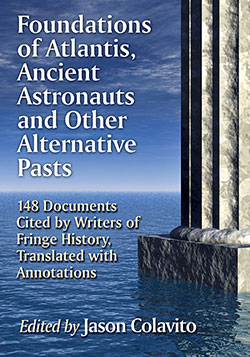
Foundations of Atlantis, Ancient Astronauts and Other Alternative Pasts
148 Documents Cited by Writers of Fringe History, Translated and Annotated
Find on Amazon →As an Amazon Associate, OverClassified may earn from qualifying purchases made through this link, at no extra cost to you.
Why This Is Essential Reading
Foundations of Atlantis earns its place on this list for a reason distinct from most of the books already on it: it is not an argument to be persuaded by but a primary-source archive to be consulted, letting any reader check a specific ancient-astronaut, Atlantis, or pre-Columbian-contact claim against the actual document it supposedly rests on — and, in several documented cases, against a document that turns out to be a later forgery rather than a genuine ancient source at all. This entry has been honest about the book's real scale: it is a niche, independently published academic-reference title with a thin Goodreads footprint and no located mainstream review coverage, a meaningfully different reception than The Cult of Alien Gods found a decade earlier. But its two genuine endorsements — from Choice, reviewed by a working historian of pseudohistory, and from the Fortean journal Magonia — are exactly the kind of specialist validation a reference sourcebook should be judged by, and this site's own case files already draw on it directly. Read Jason Colavito's two books as a matched pair: one tells the story of where the ancient-astronaut idea actually came from, and the other lets you open the ancient book being misquoted and check for yourself.
Related Cases & Theories
Essential Viewing
Ancient Alien Fraud: Nuclear Fallout in the Mahabharata?
Jason Colavito — Colavito investigates the widely repeated claim that the ancient Indian epic the Mahabharata accurately describes radiation poisoning from nuclear fallout — the same primary-source-checking method this book applies across 148 documents, demonstrated on a single case. Verified via YouTube oEmbed before inclusion; this exact video is listed on Colavito's own site (jasoncolavito.com/videos.html).
Ancient Alien Fraud: A Flying Wagon in the Kebra Nagast?
Jason Colavito — Colavito checks Erich von Däniken's claim, made in Signs of the Gods, that the Ethiopian king Menelik flew on a wagon supplied by extraterrestrials, against the actual text of the Kebra Nagast — a direct demonstration of the citation-verification method that produced this book. Verified via YouTube oEmbed before inclusion; this exact video is listed on Colavito's own site (jasoncolavito.com/videos.html).
Sources Cited
- "Jason Colavito." Wikipedia (biography, education, career, bibliography including Foundations of Atlantis, 2015, McFarland & Company). en.wikipedia.org
- Colavito, Jason. "Foundations of Atlantis." jasoncolavito.com (author's own book page: description, ISBNs, Choice review quote attributed to Ronald Fritze, and excerpt from the book's own introduction). jasoncolavito.com
- "Foundations of Atlantis, Ancient Astronauts and Other Alternative Pasts." McFarland & Company product page (publisher record: ISBNs, page count, price, subject categories, Choice and Magonia review blurbs). mcfarlandbooks.com
- "Foundations of Atlantis, Ancient Astronauts and Other Alternative Pasts." Amazon.com Kindle Store listing, ASIN B00VGU9F9K (edition already cited on this site's resources library and Alexander's Flying Shields case file). amazon.com
- "Foundations of Atlantis, Ancient Astronauts and Other Alternative Pasts." Amazon.co.uk print listing, ISBN 0786496452 / 9780786496457 (print-edition bibliographic confirmation). amazon.co.uk
- "Foundations of Atlantis, Ancient Astronauts and Other Alternative Pasts." Goodreads work/editions page (aggregate rating: 3.88 average across 8 Kindle-edition ratings). goodreads.com
- "Foundations of Atlantis, Ancient Astronauts and Other Alternative Pasts." Open Library (bibliographic record: ISBN 9780786496457, McFarland & Company, 2015, 268 pp., Library of Congress classification D10.F678 2015). openlibrary.org
- "Ronald H. Fritze." Wikipedia (reviewer biography: PhD, Cambridge University; Dean, College of Arts and Sciences, Athens State University; author of Invented Knowledge: False History, Fake Science and Pseudo-Religions, 2009, covering Atlantis, von Däniken, and pseudohistory). en.wikipedia.org
- "A Critical Companion to Ancient Aliens Seasons 3 and 4: Unauthorized." Wikipedia bibliography entry (Lulu.com, 2012, self-published, confirming this book's traditionally published status by contrast). en.wikipedia.org
- Colavito, Jason. "Ancient Texts." jasoncolavito.com (the author's free online library of primary-source translations, the parallel ongoing project this book draws its 148 selections from). jasoncolavito.com
- This site's own essential-reading entry: The Cult of Alien Gods, for Colavito's 2005 book and full author biography.
- This site's own essential-reading entry: Chariots of the Gods?, for the von Däniken book whose sourcing this collection directly documents.
- This site's own essential-reading entry: The Space-Gods Revealed, for Ronald Story's 1976 claim-by-claim methodological predecessor.
- This site's own case file: Alexander the Great's "Flying Shields", which already cites this exact edition and credits Colavito's broader method.
- This site's own case file: The Tulli Papyrus, for a contrasting case of an alleged ancient document that has never been verified to exist.
- This site's own key-figures entry: Jason Colavito, for further case connections beyond this book.
- This site's own resources library: Full Reading List, where this exact edition (ASIN B00VGU9F9K) is cited in connection with the Alexander's Flying Shields case file.
Have corrections, additional research, or peer-reviewed sources? Help improve this entry.
Suggest an Edit