
Flying Saucers
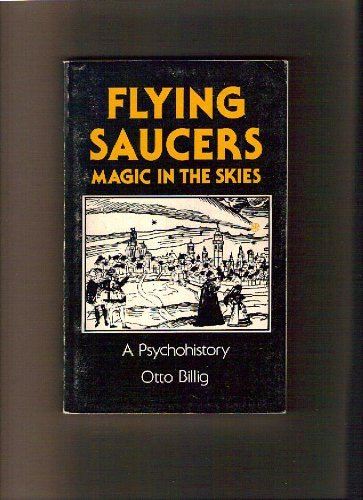
Magic in the Skies, a Psychohistory
Core Thesis
Writing as a practicing psychiatrist rather than a ufologist, Otto Billig argues that flying saucer belief — sightings, contactee testimony, and abduction narratives alike — is best understood through the same clinical and cross-cultural apparatus he had spent forty years applying to schizophrenic and "primitive" art: as "magic thinking," a normal, patterned psychological response by which individuals and whole societies process anxiety, crisis, and the unknown by projecting structured, often ancient imagery onto ambiguous stimuli in the sky. Billig treats the saucer wave less as a discrete modern mystery than as the latest costume worn by a much older human habit of populating the heavens with meaningful figures — contactees recast as folkloric "heroic figures," abduction accounts shaped by hypnagogic imagery and the psychology of sensory deprivation and hypnosis — explicitly building on, while narrowing and clinicizing, the archetypal framework C.G. Jung had proposed for the same phenomenon twenty-four years earlier.
About the Author
Otto Billig, M.D. (1910–1989), was not a ufologist or a fringe figure; he was a career academic psychiatrist. Born in 1910 and trained in Vienna, where he earned his medical degree in 1937, he had emigrated to the United States by 1939, when he became Clinical Director of the Department of Neuro-Psychiatry at Highland Hospital in Asheville, North Carolina, a position he held until 1946. He then moved to Duke University's clinical faculty (1946–1948) before settling at Vanderbilt University School of Medicine, where he remained on the clinical faculty from 1948 until his death in Nashville on January 17, 1989 — a single-city, four-decade academic career of the kind that leaves a real institutional footprint but almost no public one. He also served as Acting Chair of the Department of Psychiatry at Meharry Medical College from 1952 to 1961, and sat on Nashville's Metro Board of Health from 1963 to 1973.
Billig's scholarly reputation, such as it survives, rests on a research specialty that reads today as strikingly ahead of its time: the psychiatric analysis of artwork made by psychotic patients, studied comparatively across cultures. He built exhibitions of art by patients with schizophrenia and argued for structural similarities between the imagery of Western psychotic patients and the imagery of non-Western, so-called "primitive" societies — work that culminated in his 1978 book The Painted Message, co-authored with Papua New Guinea psychiatrist B.G. Burton-Bradley and published, like the saucer book four years later, in a small academic edition (John Wiley & Sons and Schenkman, 260 pp.), and formally reviewed in the British journal Psychological Medicine in 1979. That book is the direct methodological ancestor of Flying Saucers: Magic in the Skies: both apply the same comparative, cross-cultural clinical eye — first to psychotic art in the Highlands of New Guinea, then to flying saucer belief in postwar America — treating both as data about how the human mind organizes and expresses anxiety under pressure, rather than as evidence to be adjudicated true or false.
Nothing in the available record suggests Billig had any prior involvement in ufology, UFO investigation, or paranormal research before this one book; he does not appear in the standard UFO-research biographical literature the way contactees, investigators, or even skeptic-debunkers like Donald Menzel do. What he brought instead was forty years of unrelated clinical authority — a working psychiatrist's diagnostic vocabulary for magical thinking, hypnagogic imagery, and sensory-deprivation-induced hallucination, applied for the first and, as far as this research could establish, only time to the flying saucer phenomenon specifically.
Vanderbilt University's Eskind Biomedical Library holds the Otto Billig Papers, a small manuscript collection (roughly 0.37 cubic feet) that includes his birth certificate, school and medical diplomas, Vienna police correspondence, naturalization documents, photographs, and reprints of his published work, alongside a separate biographical file. A copy of Flying Saucers: Magic in the Skies itself is catalogued in Box 1, Folder 14 of that collection — meaning the book's most substantial institutional home today is not a ufology archive at all, but a history-of-medicine special collection built around its author's four-decade clinical career.
Historical Context & Origins
Billig published in 1982, a full generation after the postwar saucer wave Jung had responded to in 1958, and well into a very different phase of the UFO field. Project Blue Book, the U.S. Air Force's official investigative program headquartered at Wright-Patterson Air Force Base, had closed in 1969; J. Allen Hynek's 1972 book The UFO Experience and his subsequent founding of the Center for UFO Studies had helped establish a more organized, semi-scientific civilian ufology; historian David M. Jacobs' 1975 doctoral-thesis-turned-book The UFO Controversy in America had given the field its first serious academic institutional history; and astronomer Donald Menzel, together with psychiatrist Ernest Taves, had published a fresh skeptical broadside, The UFO Enigma, in 1977. Billig's own bibliography and index terms show engagement with several of these figures and titles directly, situating his book as a response to an already decades-deep, factionalized literature rather than to a fresh news phenomenon the way Jung's had been.
The book also arrived alongside the rise of the hypnosis-driven abduction narrative as ufology's dominant new subgenre — the pattern inaugurated by the Betty and Barney Hill case a generation earlier and mainstreamed through the 1970s. Billig gave that development an entire early chapter, "Abductions by Flying Saucers," beginning on page 15 of the book's 265 pages; the specific incidents he drew on within that chapter could not be confirmed from the bibliographic and index material available for this research (his own bibliography runs from page 255 to 259, behind the text itself), so this entry describes his general clinical framework for hypnosis and hypnagogic imagery rather than asserting which named cases he cites.
Billig was also, at least loosely, writing under the banner of a specific and genuinely contemporary academic label: "psychohistory." Historian Lloyd deMause had founded what became The Journal of Psychohistory in 1973 (retitled from History of Childhood Quarterly in 1976) and the International Psychohistorical Association in 1977, establishing psychohistory as a small but organized quasi-discipline devoted to explaining collective political and social behavior through psychological, often psychoanalytic, method. Billig's subtitle borrows that same vocabulary, though his own approach — a working clinician's comparative-cultural analysis rather than deMause's more specifically childhood-and-trauma-centered psychohistorical method — sits at some distance from deMause's school; nothing in the available record ties Billig directly to deMause's circle or journal.
Schenkman Publishing Company, the small Cambridge, Massachusetts academic press that issued the book, was the same house that had co-published Billig's earlier The Painted Message in 1978, suggesting an existing author-publisher relationship rather than a mainstream trade house taking a flier on saucer publishing during the period's broader paperback UFO boom. That placement — small academic press, cross-listed under both "Body, Mind & Spirit" and "UFOs & Extraterrestrials" subject codes, catalogued by the Library of Congress under call number TL789 .B54 — is itself a useful data point about how marginal even a credentialed psychiatrist's serious treatment of the subject remained within academic publishing in the early 1980s, a full generation before university presses like Stanford's and Oxford's would publish comparable work by scholars such as David J. Halperin and Diana Walsh Pasulka.
Core Arguments & Key Concepts
The book's title supplies its central concept: "magic thinking." Index terms drawn from the book's own text ("magic," "Magic thinking," "hypnagogic," "Sensory Deprivation") indicate that Billig treats belief in flying saucers as a normal, patterned outgrowth of magical thinking — a mode of cognition in which ambiguous stimuli are organized into meaningful, often anxiety-resolving form — rather than as either delusion in a strictly pathological sense or as straightforward misperception. Where a strict skeptic like Menzel treated saucer reports as simple observational error and Jung treated them as archetypal projection from the collective unconscious, Billig's clinical framing sits between the two: ordinary psychological mechanisms, documented in his own clinical practice, scaled up to a mass phenomenon.
Two specific clinical mechanisms recur throughout the book's index terms and appear to do much of its explanatory work. The first is the hypnagogic state — the transitional, dreamlike consciousness between waking and sleep, well documented in sleep research as capable of producing vivid, involuntary imagery that can be mistaken for external perception. The second is sensory deprivation, a research area active in psychiatry and psychology through the 1950s-70s that demonstrated reduced or ambiguous sensory input (a dark sky, an isolated road at night) can itself trigger structured hallucinatory content. Billig appears to apply both mechanisms specifically to the abduction chapter's discussion of hypnosis-elicited testimony, treating the hypnotic interview itself as a context capable of generating, rather than merely recovering, vivid imagery.
The book's second chapter, "Heroic Figures and Lesser Ones" (beginning page 31), turns from perception to belief, and from witnesses to contactees. The index term "George Adamski" appears prominently among the book's indexed names, indicating sustained engagement with the contactee movement Adamski led in the 1950s — figures who claimed friendly personal contact with benevolent human-like beings from other worlds. Billig's chapter title itself — casting contactees explicitly as "heroic figures" alongside unnamed "lesser ones" — suggests a psychiatric reading of contacteeship as a form of self-mythologizing, structurally comparable to shamanic or messianic figures documented across cultures, rather than as either fraud or genuine contact.
Consistent with his prior cross-cultural comparative work in The Painted Message, Billig extends his analysis beyond twentieth-century America. The index term "Tlaloc" — the Aztec deity of rain, storms, and the sky — indicates he draws at least one explicit parallel between UFO imagery and pre-Columbian Mesoamerican sky mythology, a move structurally similar to Jung's own use of the 1561 Nuremberg celestial broadsheet, and to Jacques Vallée's roughly contemporaneous argument in Passport to Magonia (1969) that modern UFO reports and older fairy and folklore traditions draw on a shared substrate of human experience; the index terms "fairy" and "fairy tales" alongside "Tlaloc" suggest Billig was working a similar, though independently sourced, folklore-continuity argument from his own clinical rather than folkloric training.
Throughout, Billig explicitly positions his own work against the existing UFO literature: index terms for J. Allen Hynek, Edward Ruppelt (the Air Force officer who ran Project Blue Book's early years and coined the term "unidentified flying object"), David Jacobs, and Donald Menzel and Ernest Taves indicate he read and cited across the believer-to-skeptic spectrum of contemporary ufology rather than working in isolation from it, and an index entry for "Billig and Burton-Bradley" shows he cited his own earlier Painted Message as a methodological precedent within the saucer book itself.
Key Cases & Evidence Discussed
The Kenneth Arnold sighting (Case File #007, June 24, 1947, near Mount Rainier, Washington) supplies the book's historical starting point in its opening chapter, "Contacts Then and Now," as the conventional origin point for the entire modern UFO era that every other chapter in the book responds to.
George Adamski's contactee claims — the 1950s-era assertions of friendly personal meetings with human-like beings from other planets that made Adamski the most famous and most imitated contactee of his era — are discussed at length in the book's "Heroic Figures and Lesser Ones" chapter, treated by Billig as a case study in the psychiatric structure of self-mythologizing contacteeship rather than adjudicated as either fraud or genuine encounter.
Project Blue Book, the U.S. Air Force's official UFO investigation program headquartered at Wright-Patterson Air Force Base in Dayton, Ohio, and its early director Edward Ruppelt, appear as index terms indicating the book engages directly with the government's own investigative record and its 1969 closure as part of the institutional backdrop against which 1970s-80s saucer belief persisted despite official disinterest.
The book's dedicated abduction chapter, "Abductions by Flying Saucers" (beginning page 15), addresses the hypnosis-driven abduction-narrative genre that the Betty and Barney Hill case (1961) is generally credited with originating; this entry cannot confirm from available bibliographic and index sources which specific abduction cases Billig names within that chapter, and describes his general clinical framework — hypnagogic imagery and sensory-deprivation-induced hallucination applied to hypnotically elicited testimony — rather than claim a specific case citation that could not be independently verified.
An index reference to "Tlaloc," the Aztec sky and rain deity, indicates the book also reaches outside twentieth-century American ufology entirely, drawing at least one explicit comparison between contemporary saucer imagery and pre-Columbian Mesoamerican sky mythology as part of its broader argument that saucer belief updates much older patterns of magical thinking about the sky.
Critical Reception & Controversies
The single most striking fact about this book's critical reception, established directly through this research, is how little of it exists. As of this writing the book carries zero ratings and zero reviews on Goodreads across its cataloged editions — a near-total absence of even informal public reader response, in sharp contrast to the hundreds of ratings this list's other psychiatric/psychological entries, such as Jung's Flying Saucers or Halperin's Intimate Alien, have accumulated. No contemporary review in a skeptical outlet such as The Skeptical Inquirer, no ufological-press review, and no academic psychiatric-journal review of the saucer book specifically could be located during this research, despite an extensive search.
That silence is genuinely notable set against Billig's other work: his 1978 book The Painted Message, applying the same comparative cross-cultural method to psychotic art rather than saucer belief, did receive a formal academic review in the British journal Psychological Medicine in 1979 — meaning Billig's scholarship was capable of drawing serious peer engagement when it stayed within conventional psychiatric subject matter, and apparently was not able to draw comparable engagement once it crossed into UFO topics, even coming from a credentialed academic author at an established university press's sister imprint.
This entry treats that scarcity itself as the most honest available verdict on the book's reception rather than manufacturing a controversy or critical consensus that the surviving record does not support. The book's primary institutional legacy today is archival rather than critical: its retention, alongside Billig's personal papers, in Vanderbilt's Eskind Biomedical Library history-of-medicine special collection, catalogued as part of a working psychiatrist's professional archive rather than as a landmark or even a notably controversial contribution to ufology's own literature.
Where reviewers of Jung's 1958 book argued over whether his synchronicity hedge let him have it both ways on the physical reality of saucers, and reviewers of Halperin's and Pasulka's 21st-century academic treatments engaged substantively with their methodology in dedicated religious-studies journals, Billig's book appears never to have generated a comparable public debate on either side — not embraced by believers the way Jung's book briefly and mistakenly was, and not singled out for rebuttal by skeptics the way more prominent contactee or abduction literature routinely was.
Influence & Legacy
Measured by citation trail, Flying Saucers: Magic in the Skies appears to have left little visible mark on either psychiatry or ufology; this research did not locate later UFO-research or psychohistory literature that cites Billig's book directly, and it is not discussed in Jerome Clark's standard reference work The UFO Encyclopedia or in the psychosocial-hypothesis literature that traces its own lineage instead through Jung's 1958 book. That absence is itself worth stating plainly rather than papering over: this is a title whose importance to this list rests on what it represents — a credentialed clinical psychiatrist independently extending Jung's psychological approach into the specific mechanics of hypnosis, hypnagogic imagery, and sensory deprivation a generation later — more than on any documented downstream influence.
The book's real, if modest, legacy is best understood as a data point within the small history of psychiatrists and psychologists taking UFO belief seriously as clinical and cultural material across five decades: Carl Jung's 1958 Flying Saucers: A Modern Myth of Things Seen in the Skies, Billig's own 1982 book, and the more recent, far better-resourced academic treatments by David J. Halperin (2020) and Diana Walsh Pasulka (2019) at major university presses. Billig's book occupies the least-visited, most obscure point on that timeline, but its existence demonstrates that the psychiatric interest Jung opened in 1958 did not go dormant for the sixty-two years between his book and Halperin's — it simply, in Billig's case, found a very small academic press and a readership too thin to leave much of a trace.
Within the broader psychohistory movement Billig's subtitle invokes, the field did continue engaging with UFO material after 1982 — the Journal of Psychohistory published Alvin H. Lawson's "Perinatal Imagery in UFO Abduction Reports" in its Fall 1984 issue, arguing that abduction narratives echo birth-trauma imagery — but nothing in the available record establishes a direct citation link between Lawson's later work and Billig's book specifically, and this entry does not claim one.
On this site, Billig's book functions primarily as a comparison point rather than as infrastructure the way Jung's does: it demonstrates a second, independent, clinically grounded psychiatric argument for treating saucer belief as a normal outgrowth of magical thinking rather than as either fraud or genuine extraterrestrial contact, cross-referenced here against this site's own Psycho-Social Hypothesis and Egregore & Collective Thoughtform Hypothesis theory files.
The Book
As an Amazon Associate, OverClassified may earn from qualifying purchases made through this link, at no extra cost to you.
Why This Is Essential Reading
Flying Saucers: Magic in the Skies earns its place on this list less for the influence it had than for the influence it should honestly be understood not to have had, and for what it demonstrates by its very obscurity: that a credentialed academic psychiatrist, four decades into a serious clinical career studying schizophrenic art across cultures, could independently extend Carl Jung's 1958 psychological argument about flying saucers into the specific clinical mechanics of hypnagogic imagery, sensory deprivation, and hypnosis — and still vanish almost entirely from both ufology's and psychiatry's collective memory, down to a book with zero public reader reviews decades later. Read it as the missing middle chapter between Jung's 1958 archetypal treatment and the well-resourced, widely reviewed academic religious-studies work of Halperin and Pasulka a generation further on — and as a genuine caution about how thin the evidentiary record can get for even a legitimately credentialed, seriously intended contribution to this literature once it is published by a small press and left to go quietly out of print.
Related Cases & Theories
Sources Cited
- Billig, Otto. Flying Saucers: Magic in the Skies: A Psychohistory. Schenkman Publishing Co., 1982. Bibliographic record via Open Library. openlibrary.org
- Open Library API record (title, subtitle, pagination, LCCN 81009298, OCLC 7671913, LC classification TL789 .B54). openlibrary.org
- "Flying Saucers: Magic in the Skies: A Psychohistory." Google Books (table of contents excerpt and indexed common terms and phrases). books.google.com
- "Collection: Otto Billig Papers." Vanderbilt University Eskind Biomedical Library, Collection Guides (biographical note, career timeline, collection contents). collections.library.vanderbilt.edu
- "Collection: Otto Billig (1910-1989) biographical file." Vanderbilt University, Collection Guides. collections.library.vanderbilt.edu
- "Flying Saucers: Magic In the Skies, 1982." Vanderbilt University, Collection Guides (archival object record within the Otto Billig Papers, Box 1, Folder 14). collections.library.vanderbilt.edu
- "[Otto Billig]." National Library of Medicine, Images from the History of Medicine (portrait record, Vanderbilt University, 1955/1956). collections.nlm.nih.gov
- Billig, Otto, and B.G. Burton-Bradley. The Painted Message. John Wiley & Sons, 1978. Review citation, Psychological Medicine, Vol. 9, Issue 3 (August 1979), Cambridge University Press. cambridge.org
- "Flying saucers: Magic in the skies: a psychohistory by Otto Billig." Goodreads (0 ratings, 0 reviews as of research date). goodreads.com
- Menzel, Donald H., and Ernest H. Taves. The UFO Enigma: The Definitive Explanation of the UFO Phenomenon. Doubleday, 1977 (contemporary skeptical work indexed within Billig's book, cited here for its own bibliographic details).
- Jacobs, David M. The UFO Controversy in America. Indiana University Press, 1975 (contemporary ufological-history work indexed within Billig's book, cited here for its own bibliographic details).
- "Lloyd deMause & Psychohistory." The Association for Psychohistory (founding of the Journal of Psychohistory in 1973/1976 and the International Psychohistorical Association in 1977). psychohistory.com
- "Journal of Psychohistory." Wikipedia (founding date, editorial history, and Alvin H. Lawson's 1984 "Perinatal Imagery in UFO Abduction Reports"). en.wikipedia.org
- This site's own essential-reading entry: Flying Saucers: A Modern Myth of Things Seen in the Skies (C.G. Jung, 1958), the direct psychological-analysis precedent for this book.
- This site's own theory file: Psycho-Social Hypothesis (PSH).
- This site's own theory file: Egregore & Collective Thoughtform Hypothesis.
- This site's own case file: Kenneth Arnold Sighting (Case File #007, 1947), the book's own historical starting point.
- This site's own key-figures entry: Otto Billig, for his full biography and case connections.
Have corrections, additional research, or peer-reviewed sources? Help improve this entry.
Suggest an Edit