
China's Major Mysteries
Paranormal Phenomena and the Unexplained in the People's Republic — Paul Dong's Survey of a Research Culture the West Never Saw
Core Thesis
China's Major Mysteries is a substantially revised edition of Paul Dong's 1984 book The Four Major Mysteries of Mainland China, and its value to a UFO library is not primarily what it says about UFOs. It is what it documents about the institutional environment in which Chinese UFO research took place. Between 1979 and 1997 the People's Republic hosted a national UFO research association with more than forty branch organisations, thousands of members and a regularly published journal — an organisational scale comparable to anything in the West, embedded in a state science bureaucracy that had no Western equivalent and operating alongside an officially tolerated 'human body science' programme that at its height claimed to have identified tens of thousands of children with extraordinary abilities. Dong writes about UFOs, qigong, extra-human function and the Wildman as a single interlocking cultural formation, because in China they genuinely were one. That framing is the book's real contribution, and it is also the source of the caution a careful reader has to bring to it.
About the Author
Paul Dong — also credited as Paul 'Moon Wai' Dong — is a Chinese-American writer and researcher who spent decades acting as an intermediary between Chinese-language paranormal literature and English-speaking readers. His significance rests on a specific and genuinely scarce qualification: he could read the source material. For most of the period he wrote about, Chinese UFO reports, qigong research papers and Wildman expedition accounts existed almost exclusively in Chinese, in journals and mass-circulation magazines that no Western researcher was reading.
This site already knows Dong from earlier work. He co-authored UFOs Over Modern China (1983) with Wendelle Stevens, compiling more than five hundred Chinese case reports for what remains one of the earliest systematic English-language surveys of the subject. The first edition of the present book, The Four Major Mysteries of Mainland China, followed in 1984 and covered UFOs, psychic phenomena, qigong and the Wildman — the four subjects Dong regarded as China's principal unexplained-phenomena research streams.
His other principal work, China's Super Psychics (1997, with Thomas E. Raffill), is the most contentious thing he wrote and it bears directly on how to read this book. In it Dong argues that qigong practice generates genuine psychic ability and that the Chinese state has supported psychic research for medical and military purposes since 1982. Those claims have never been substantiated under controlled conditions, and the field they describe has been criticised inside China as vigorously as outside it.
The honest summary of Dong's position is that he is an excellent reporter and a credulous evaluator. He knows what was published, by whom, when and where, and he reports it accurately. He is much less reliable when assessing whether the underlying claims are true, and he tends to treat official Chinese interest in a phenomenon as evidence for the phenomenon rather than as a fact about Chinese science policy. A reader who keeps that distinction in view will get a great deal from this book. A reader who does not will come away believing things that are not established.
Both editions were issued by China Books & Periodicals, the long-running San Francisco importer and publisher of Chinese-interest titles — a small specialist house rather than a trade publisher, which explains both the book's obscurity and its survival in a niche where nothing else covers the same ground.
Historical Context & Origins
The founding date matters. The China UFO Enthusiasts' Liaison Office was established at Wuhan University on September 20, 1979 — three years after Mao's death, at the very beginning of the reform era, and at almost exactly the moment the Cultural Revolution's restrictions on independent association began to lift. By May 1980 it had reconstituted as the China UFO Research Association, with branch organisations in several major cities. It began publishing the Journal of UFO Research in February 1981. By the mid-1980s it claimed more than forty branches and thousands of members.
What made this possible was not a relaxation of ideology but a particular reading of it. Chinese UFO research positioned itself explicitly as materialist: extraterrestrial life was a legitimate scientific hypothesis about the physical universe, and investigating anomalous atmospheric reports was empirical work. That framing let a UFO organisation exist inside a state that was, in the same years, tightening controls on religious and quasi-religious movements. Dong's book is written from inside that framing and largely accepts it.
The parallel development was the qigong and 'extraordinary human function' movement, and it was far larger. The All-China Qigong Science Research Association was established in 1981; by 1986, with the support of Qian Xuesen — the American-trained aerodynamicist who founded China's missile and space programmes and who argued for the systematic study of what he called somatic science — it had become a national-level umbrella body. Reports of children with 'extra-human function' had circulated since 1979, and by the late 1990s advocates claimed over a hundred thousand had been identified. In January 1988 the UFO association affiliated to the qigong body as a second-level study society.
That affiliation is the pivot of the whole story and Dong's book straddles it. The UFO researchers had made a materialist case for their existence; qigong's extraordinary-powers claims were, to many of them, precisely the kind of thing they had positioned themselves against. At the association's fourth national congress in Beijing in May 1992, members protested against pseudoscience and reasserted a dialectical-materialist guiding principle. The field was arguing with itself in public.
It then ended abruptly. The state's 1995 campaign against pseudoscience raised the pressure; Falun Gong's founder had joined the qigong association in July 1993, and after the movement's suppression the whole umbrella structure became untenable. The China UFO Research Association lost its organisational status in September 1997 and was compelled to disband. Delegates reconstituted in September 1998, and the International Chinese UFO Association was formed in Hong Kong in April 1999 — outside the mainland's regulatory reach.
Dong's 2000 revision therefore sits at a precise historical hinge. He is describing a research culture that had just been dismantled, from the vantage point of someone who had watched it for twenty years. He does not always say this explicitly, and a reader who does not know the chronology will miss that much of what the book describes in the present tense had already ended.
The case material behind Chinese ufology is real and independently documented. The most significant single event is the July 24, 1981 spiral seen across a vast area of China, examined on this site as the 1981 Chinese spiral mass sighting. The planetary astronomer Wang Sichao of the Purple Mountain Observatory in Nanjing spent decades collecting and analysing such reports; Sun Shili, a former foreign ministry official who had served as Mao's Spanish interpreter, became one of the association's chairmen after a 1971 sighting of his own.
Core Arguments & Key Concepts
China ran a large, organised, semi-official UFO research culture that Western ufology was almost entirely unaware of. This is Dong's central and best-supported claim, and it is independently confirmable. A national association, forty-plus branches, thousands of members, a journal running from 1981, university affiliation, and participation by working scientists at national institutes. Western surveys of the field's history routinely go straight from the United States to France to Britain to the Soviet Union and stop. Dong's book is one of the few English sources that fills in the largest missing piece.
The four subjects belong together because Chinese institutions treated them together. To a Western reader, bundling UFOs with qigong, ESP and a Bigfoot analogue looks like the classic error of the undiscriminating paranormal survey. Dong's defence is structural rather than evidential: in China these were adjacent fields with overlapping membership, shared publication venues and, after January 1988, a formal organisational relationship. Whether or not the phenomena are related, the research communities demonstrably were, and you cannot describe one accurately without the others.
State tolerance is a fact about the state, not about the phenomenon. Dong does not put it this way, and this is where the reader must supply what the book does not. Repeatedly, the evidence offered for a claim's seriousness is that official bodies studied it or that a senior figure endorsed it. Qian Xuesen's support for somatic science is presented as weight. But Qian's authority was in rocketry, his advocacy here was contested by other Chinese scientists at the time, and institutional sponsorship of a research programme establishes only that the programme was sponsored.
Language access is a real methodological advantage and the field has never taken it seriously enough. Dong's implicit argument — sharpest in his account of how much Chinese material had gone untranslated for decades — is that ufology's evidence base is shaped less by what happened than by what happened in languages its researchers read. That is a substantial criticism of the field, and it applies well beyond China: the Spanish, Brazilian, Russian and Japanese case literatures are all under-represented in English-language surveys for the same reason.
The Wildman material is the book's clearest demonstration of how Chinese research handled an anomaly. Whatever one thinks of the yeren reports from the Shennongjia forests of Hubei, they were investigated with real institutional resources — funded expeditions, Chinese Academy of Sciences involvement, physical-evidence collection — on a scale that the equivalent North American claims have never received. Dong's account of that programme is useful precisely because it shows a state science system taking a fringe claim seriously enough to test it, and finding nothing conclusive.
Chinese reports show the same structure as reports elsewhere, which is itself a datum. The nocturnal lights, the discs, the spirals, the beam effects, the occasional close-encounter narrative — the Chinese corpus Dong summarises does not look categorically different from the American or European corpus, despite a completely different media environment, a different vernacular tradition and a forty-year period of near-total informational isolation. Both the sociological and the physical hypotheses have to account for that, and neither does so easily.
The book's weakest argument is its treatment of extraordinary human function. Dong reports the EHF children claims largely at face value, and they do not survive contact with controlled testing. Chinese sceptics made this point at the time, the 1992 congress protest was substantially about it, and the eventual state campaign against pseudoscience targeted exactly these claims. A reader should treat this section as evidence about what was believed and promoted in China, not as evidence about human capabilities.
Key Cases & Evidence Discussed
The Chinese UFO wave and the 1981 spiral. The mass sighting of July 24, 1981, visible across an enormous area and reported by thousands, remains the single most significant Chinese UFO event and is examined separately in this site's case file. Dong's treatment sits alongside Wang Sichao's much more technically rigorous analysis from the Purple Mountain Observatory.
The founding of Chinese ufology at Wuhan University, 1979–81. The Liaison Office of September 1979, the reconstitution as a national association by May 1980, and the launch of the Journal of UFO Research in February 1981. Dong is one of very few English-language sources to narrate this sequence from the inside.
The extra-human function children. The claims that began circulating in 1979 of children able to read with their ears or armpits, to see through opaque barriers, and to move objects — the movement that consumed substantial research funding and that advocates said had identified over a hundred thousand subjects by 1997. Dong reports it sympathetically; the reader should read it as a case study in institutional credulity.
Qigong and the somatic-science programme. The 1981 founding of the qigong research association, its elevation to national-level status in 1986 under Qian Xuesen's patronage, and the mass practice movement that at its peak involved tens of millions of people. This is the largest paranormal-adjacent social movement of the twentieth century anywhere, and it is barely known in the West.
The Wildman (yeren) of Shennongjia. The state-funded expeditions into the Hubei forests, the hair and footprint evidence, the Chinese Academy of Sciences' involvement, and the inconclusive results. The best-resourced cryptozoological search programme ever conducted.
The 1994 Guiyang forest incident. Not in Dong's book, but the natural continuation of it and covered on this site as the Guiyang (Guizhou) forest incident — the December 1994 destruction of a section of the Duxi Forest Farm that became the Chinese association's most-investigated physical-trace case, and one that Sun Shili personally pursued.
The 1997 dissolution and the Hong Kong reconstitution. The loss of organisational status in September 1997 in the wake of the state's move against the qigong umbrella, and the 1999 formation of the International Chinese UFO Association outside the mainland. The book's final chapter of history, and the one Dong is most guarded about.
Critical Reception & Controversies
The book has effectively no critical reception in the usual sense. It was issued by a small San Francisco specialist publisher in 2000, received no notice in the mainstream press, and has never been reviewed in an academic venue. What reception it has consists of citation: writers dealing with Chinese ufology reach for it because there is very little else in English.
The 1984 first edition, The Four Major Mysteries of Mainland China, had a slightly wider circulation and was received as an exotic curiosity — a report from behind the bamboo curtain about what Chinese scientists were supposedly investigating. That framing did the book no favours, because it encouraged readers to treat the whole subject as an oddity rather than as a research culture with its own institutions and internal arguments.
The most serious criticism is one Dong shares with almost all single-author paranormal surveys: he does not distinguish clearly enough between reporting a claim and endorsing it. The UFO chapters are the most defensible, because there the underlying reports are of the same kind as reports everywhere and Dong is mostly summarising a documented literature. The extra-human function material is the least defensible, and it is presented in the same register.
Chinese scepticism about these claims was substantial and contemporaneous, and readers should know that the book does not represent it fairly. The 1992 congress protest against pseudoscience came from within the UFO association's own membership. The physicist and science writer Lin Zixin edited a volume, Qigong: Chinese Medicine or Pseudoscience?, making the sceptical case at length. The state's own 1995 campaign, whatever its political motives, was aligned with the position of many Chinese working scientists.
There is also a straightforward sourcing problem. Dong frequently attributes claims to Chinese publications without giving citations a reader could follow, which is disabling for exactly the audience the book is most useful to — researchers who want to go back to the original material. Given that his unique qualification is access to that material, the absence of a proper apparatus is the book's most avoidable failing.
Against all of that, the alternative is nothing. Encyclopaedic reference works on China and UFO research exist but are thin. Journalism has covered the subject episodically — a 1992 UPI wire story on Chinese scientists investigating UFOs, later retrospectives in the South China Morning Post and Sixth Tone — but no other English-language book attempts the whole picture. Scholarly treatment arrived only much later, most usefully in Malcolm Thompson's 2020 essay on the fate of Chinese ufology, which is more rigorous than Dong and much narrower.
The fair verdict is that this is a useful book by an unreliable evaluator, and that its usefulness is inseparable from its author's position. Dong is not a scientist assessing evidence; he is a bilingual writer describing a world that English-speaking readers had no other way of seeing. Read as ethnography of a research community it is valuable. Read as an assessment of whether the phenomena are real it is worse than useless, because it will persuade a trusting reader of several things that are false.
Influence & Legacy
The book's principal legacy is corrective. Anglophone histories of ufology are overwhelmingly histories of American ufology with European appendices, and Dong's two surveys are among the very few things that force the recognition that the largest single national research community of the 1980s was Chinese and that essentially none of its output was read outside China. That point has not been absorbed by the field even now.
It also sits at the head of a small but growing literature on how UFO belief interacts with state ideology. The Chinese case is unusually clean because the boundaries were explicit: materialist framing permitted, spiritual framing forbidden, and the whole structure dissolved when the boundary was crossed. Scholars working on ufology and politics — Thompson's essay is the best example — have found the Chinese material more analytically tractable than the American, precisely because the state's position was stated rather than implied.
For readers of this site, its most practical function is as background to the Chinese case files. The 1981 spiral, the 1994 Guiyang forest incident and the 2010 Hangzhou Xiaoshan airport closure all took place inside an investigative culture that this book describes and that almost nothing else in English does.
Its cautionary legacy is about the temptation of institutional endorsement. The most seductive argument in the book is that these phenomena must be worth taking seriously because the Chinese state took them seriously — the same argument structure that has been deployed with the Soviet Union, with the Pentagon's more recent programmes, and with every government interest in the subject before and since. Governments fund research for many reasons, most of them not evidential, and Chinese somatic science is the clearest available demonstration of how large and how well-supported such a programme can get while still being wrong.
The Book
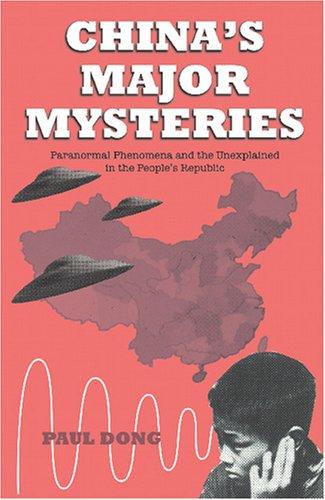
China's Major Mysteries
Paranormal Phenomena and the Unexplained in the People's Republic — Paul Dong's Survey of a Research Culture the West Never Saw
Find on Amazon →As an Amazon Associate, OverClassified may earn from qualifying purchases made through this link, at no extra cost to you.
Why This Is Essential Reading
Read it, with a specific and non-negotiable filter. China's Major Mysteries is the best English-language account of a research culture that Western ufology has essentially never engaged with, written by one of the few people who could read its primary literature, and for that reason it belongs in any serious library. It is also an uncritical book by an author who does not reliably distinguish reporting from endorsement, and its chapters on extraordinary human function will mislead anyone who takes them at face value. The discipline the book requires is simple: treat every factual statement about who published what, when, under whose auspices as probably reliable, and treat every evaluative statement about whether the underlying claims are true as unsupported until checked elsewhere. Read alongside Dong's earlier UFOs Over Modern China, which is narrower and better, and against this site's Chinese case files, which apply a standard of evidence Dong does not.
Related Cases & Theories
Sources Cited
- Dong, Paul. China's Major Mysteries: Paranormal Phenomena and the Unexplained in the People's Republic. China Books & Periodicals, 2000. 224 pp. ISBN-10 0835126765 / ISBN-13 9780835126762. amazon.com
- Google Books edition record, China's Major Mysteries — publisher, April 2000 publication date, 224-page extent, subject classification and publisher description identifying the book as an updated edition of the 1984 Four Major Mysteries of Mainland China. books.google.com
- Open Library edition record, ISBN 0835126765 — bibliographic verification and cover-art source. openlibrary.org
- ThriftBooks author record for Paul Dong — the full run of his English-language titles, including UFOs Over Modern China and China's Super Psychics. thriftbooks.com
- Malcolm Thompson, "On UFOlogy with Chinese Characteristics and the Fate of Chinese Socialism," Made in China Journal, October 19 2020 — the scholarly account of the September 1979 Wuhan founding, the May 1980 reconstitution as the China UFO Research Association, the February 1981 launch of the Journal of UFO Research, the forty-plus branches, the January 1988 affiliation to the qigong association, the May 1992 congress protest against pseudoscience, the September 1997 dissolution and the April 1999 Hong Kong reconstitution. madeinchinajournal.com
- Sixth Tone, "The Astronomer Who Calmed China's UFO Craze" — profile of Wang Sichao of the Purple Mountain Observatory and his role in Chinese UFO investigation. sixthtone.com
- UPI Archives, "Chinese scientists explore UFO mysteries," May 11 1992 — contemporaneous wire reporting on the scale and membership of Chinese UFO research organisations. upi.com
- South China Morning Post, "Is anyone out there? The days when UFO fever gripped China" — retrospective on the 1980s and 1990s Chinese UFO movement and its decline. scmp.com
- Encyclopedia.com, "China and UFO Research" — reference summary of Chinese UFO organisations, publications and case history. encyclopedia.com
- Wikipedia, "Qian Xuesen" — the aerodynamicist and founder of China's missile and space programmes whose advocacy of somatic science gave the extraordinary-human-function movement its institutional cover. en.wikipedia.org
- Wikipedia, "Qigong" — the practice, the 1980s mass movement, and the scientific assessment of external qigong claims. en.wikipedia.org
- Wikipedia, "Falun Gong" — the qigong-derived movement whose 1993 entry into the qigong association and subsequent suppression precipitated the collapse of the umbrella structure the UFO association had joined. en.wikipedia.org
- Wikipedia, "Yeren" — the Shennongjia Wildman reports and the state-supported expeditions Dong describes. en.wikipedia.org
- CIA Reading Room, "Parapsychology in the People's Republic of China: 1979–1989" — declassified US assessment of the Chinese extra-human function and somatic science programmes over exactly the period Dong covers. cia.gov
- Lin Zixin (ed.), Qigong: Chinese Medicine or Pseudoscience?, Prometheus Books — the principal Chinese sceptical response to the claims Dong reports sympathetically. amazon.com
- Bitter Winter, "UFO Beliefs Growing (and Increasingly Repressed) in China" — the later regulatory environment for UFO belief in the People's Republic. bitterwinter.org
Have corrections, additional research, or peer-reviewed sources? Help improve this entry.
Suggest an Edit