
The 2010 California Mystery Missile
On the evening of November 8, 2010, KCBS-TV news helicopter cameraman Gil Leyvas filmed a large, glowing, rocket-like contrail rising off the coast of Southern California near Santa Catalina Island at sunset. For roughly 30 hours, the Pentagon, NORAD, the Navy, and the Air Force could not identify a launch source, generating a global news story about a possible undisclosed missile test. Independent technical analysis by Contrail Science's Mick West, corroborated by NASA scientists and the Pentagon's own eventual statement, concluded the trail was the contrail of a distant commercial airliner flying nearly head-on toward the camera, an optical illusion of perspective rather than a missile launch — though the exact flight responsible remains disputed among analysts to this day.
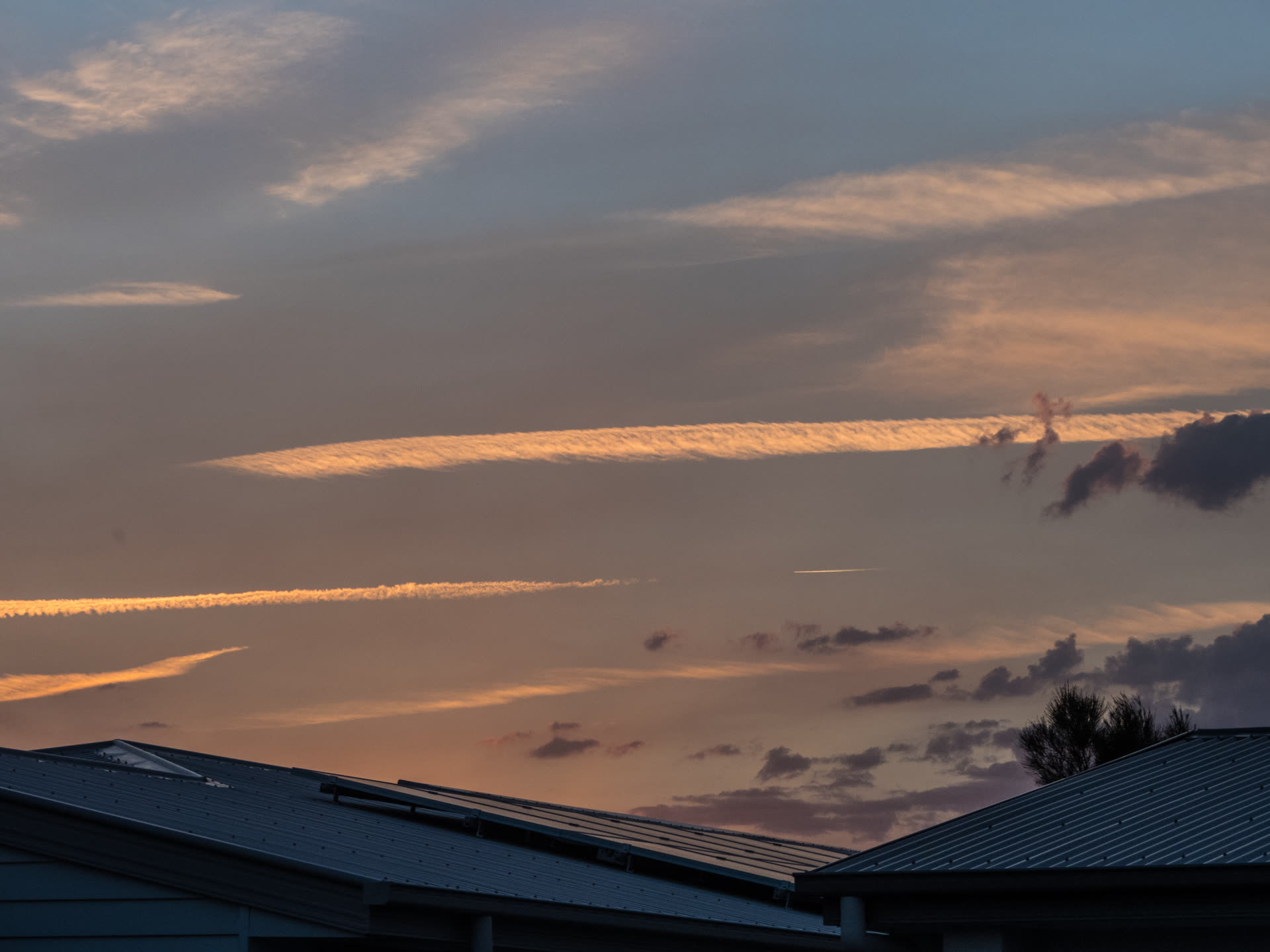
Pictured: aircraft condensation trails at sunset over Ballina, New South Wales, illustrating the general optical phenomenon this case's own contrail resembled; not a photograph of the actual November 8, 2010 event. Photographed in 2019 by Wikimedia contributor John Robert McPherson. Licensed CC BY-SA 4.0 via Wikimedia Commons.
Theoretical Alignment
This case sits almost entirely outside this site's Extraterrestrial and Interdimensional frameworks: no witness or official body ever seriously proposed an anomalous-craft explanation, and the case's own central mystery was never "what kind of object was this" but rather "was this a missile, and if so whose." The residual Psycho-Social alignment reflects this file's own assessment, developed at length under Material Analysis below, that the case is less a story about a misidentified object than about how quickly a genuinely striking, ambiguous visual, combined with a candid admission of institutional uncertainty from the Pentagon itself, can generate a self-sustaining 30-hour national news event even when no agency, witness, or analyst at any point actually claimed to be looking at a non-human or classified craft.
Background
By November 2010, Southern California's coastal airspace was among the most heavily monitored and most densely trafficked commercial corridors in the world, sitting beneath the overlapping radar coverage of Los Angeles International Airport (LAX), multiple U.S. Navy and Air Force facilities, and NORAD's continental air-defense network. This density is directly relevant to why the case became a genuine, if brief, national-security news story rather than a purely ufological curiosity: a large, unexplained, missile-like contrail appearing in exactly this airspace, unclaimed by any military branch, was inherently a matter federal officials had to address publicly and quickly, rather than a report they could simply decline to comment on.
The case also unfolds against a specific technological and cultural backdrop this file treats as directly relevant: 2010 sat near the height of local television news helicopter culture in Los Angeles, with multiple competing stations operating dedicated aerial camera crews for daily traffic and breaking-news coverage. This meant a striking sunset sky over the Pacific was, by ordinary local-news practice, already likely to be captured on camera by several different outlets simultaneously, considerably raising the odds that an unusual atmospheric-optical event on any given evening would be filmed continuously, in broadcast-quality video, by an experienced camera operator rather than glimpsed briefly by a single ground-based witness.
This case is unusual within this site's broader catalog for the unusually short interval between initial sighting and an official, converging mainstream technical explanation: from the November 8 broadcast to the Pentagon's November 10 statement that no evidence suggested anything other than an aircraft contrail was roughly 30 hours, and Mick West's own detailed radar-and-photograph cross-matched technical analysis followed within days. This file treats that speed, itself, as a notable feature of the case: unlike many disputed sightings in this archive that remain genuinely unresolved for years or decades, this case moved from initial alarm to a broadly converging, multi-source technical explanation within less than a week, even though, as this file discusses at length below, one specific factual detail — the identity of the responsible aircraft — was never definitively and consistently settled even by the analysts who agreed on the underlying explanation.
The case also arrived at a specific moment in the broader post-Cold War history of American public anxiety about missile threats. Just over a year earlier, in September 2009, the Obama administration had announced a significant restructuring of U.S. ballistic-missile defense policy in Europe, and North Korean and Iranian missile-development programs were both regular features of national news coverage throughout 2010. This file treats this broader context as directly relevant to explaining why an ambiguous aerial contrail off the California coast generated genuine, sustained national anxiety rather than being dismissed quickly as an obvious curiosity: in a media and policy environment already primed to treat missile technology as a live, actively-discussed national-security concern, an unexplained missile-like trail near one of the country's largest population centers was, in this file's own assessment, always going to receive a level of official and press attention that a comparably ambiguous but less militarily-suggestive aerial phenomenon would not have.
Complete Timeline
| Date | Event |
|---|---|
| November 8, 2010, ~5:15–5:20 p.m. PT | KCBS-TV helicopter cameraman Gil Leyvas films a rising, glowing contrail off the coast near Santa Catalina Island for approximately 10 minutes; footage airs on the evening news |
| November 8, 2010, 5:19 p.m. PT | Bystander Rick Warren independently photographs the contrail from a Long Beach balcony, later used by Mick West to cross-match the object's position against radar flight-track data |
| November 9, 2010 | The story goes national and international; Pentagon spokesman Col. Dave Lapan states "Nobody within the Department of Defense that we've reached out to has been able to explain what this contrail is, where it came from"; NORAD/NORTHCOM state there is "no threat to our nation" and no indication of a foreign military launch; Adm. Gary Roughead, Chief of Naval Operations, says it "wasn't a Navy missile" |
| November 9–10, 2010 | GlobalSecurity.org director John Pike states publicly "It's clearly an airplane contrail," describing it as "an optical illusion that looks like it's going up, whereas in reality it's going toward the camera" |
| November 10, 2010 | Approximately 30 hours after the story broke, Col. Dave Lapan states the Pentagon has "no evidence to suggest that this was anything other than a contrail caused by an aircraft"; Mick West publishes a preliminary Contrail Science analysis; aviation journalist David Cenciotti initially argues, in a same-day Aviationist post, for a submarine-launched ballistic missile explanation |
| November 11, 2010 | NASA scientists Al Bowers (Dryden Flight Research Center) and Patrick Minnis (Langley Research Center) are reported concluding the trail is consistent with a high-altitude commercial aircraft, based partly on GOES-11 satellite infrared imagery |
| November 13, 2010 | Mick West publishes a detailed follow-up analysis, "Los Angeles Missile Contrail Explained in Pictures," cross-matching Rick Warren's photograph and radar flight-track data to identify UPS Flight 902, an MD-11, as the aircraft responsible |
| Mid-to-late November 2010 | Secondary press accounts, including at least one Southern California NPR affiliate, instead attribute Mick West's identification to US Airways Flight 808, a Boeing 757 on a Honolulu–Phoenix route — a discrepancy this file was unable to resolve to a single confirmed flight and addresses directly under Material Analysis below |
| 2010–2021 and after | The case becomes a recurring reference point in skeptical and UFO-misidentification literature, including a 2021 retrospective analysis by researcher Benjamin Radford |
The Sighting and the Footage
Gil Leyvas, an experienced KCBS-TV news helicopter cameraman, was filming routine evening footage over the Los Angeles coastline when he noticed what he described as "a big plume coming up, rising from looked like beyond the horizon and it continued to grow." He zoomed his camera in on the phenomenon and continued filming continuously for approximately 10 minutes as the trail climbed and widened against the orange sunset sky, with a bright point of light visible at its apparent leading tip. Leyvas, drawing on more than a decade of aerial filming experience that included countless ordinary jet contrails, stated plainly that "there was no comparison at all" between what he was seeing and a typical contrail, and that the object appeared several times larger in the frame than an ordinary jetliner's trail.
This file weighs Leyvas's professional background directly relevant to assessing his account's credibility: as a working television news cameraman with extensive prior aerial experience specifically over this same coastal airspace, he was, in this file's own assessment, an unusually well-positioned witness to notice a genuine visual anomaly rather than an ordinary contrail he simply failed to recognize. This file's own conclusion, discussed fully under Material Analysis below, is that Leyvas's instinct was correct in one specific sense — the visual truly was extraordinary and not comparable to an ordinary contrail as normally observed — while the underlying physical cause was nonetheless entirely mundane and ordinary, a distinction this file treats as the single most important interpretive key to correctly and fairly understanding this particular case.
KCBS news director Scott Diener later made a specific observation to the Los Angeles Times that this file finds analytically useful: despite the intense nationwide media interest and speculation the footage generated, no government or military agency ever actually requested the station's unedited raw video for investigative purposes. "The media are the only people begging for the video," he said. This file treats that detail as a meaningful, if easily overlooked, data point regarding how seriously the responsible agencies privately assessed the footage even while their public statements described genuine initial uncertainty: an event agencies genuinely suspected might represent an undisclosed missile test would, in this file's own assessment, more plausibly have prompted an active, urgent request for the highest-quality available source footage, rather than officials relying on already-broadcast television video and their own independent radar and satellite data.
Independent of the KCBS footage, bystander Rick Warren separately photographed the contrail from a balcony in Long Beach at approximately 5:19 p.m., a still image that would later prove decisive to the case's technical resolution: its precise timestamp and vantage point allowed Mick West to cross-match the object's exact apparent position against contemporaneous civil radar flight-track data, a form of independent, geometrically verifiable corroboration considerably stronger than witness testimony alone.
The Official Response: Genuine Institutional Uncertainty
What distinguishes this case most sharply from the great majority of other "misidentified mundane object" cases in this archive is the genuine, publicly quotable uncertainty expressed by multiple senior U.S. defense officials in the initial 24 to 30 hours. Col. Dave Lapan, the Pentagon's spokesman and the case's central official voice, told reporters on November 9: "Nobody within the Department of Defense that we've reached out to has been able to explain what this contrail is, where it came from," adding "So far we've come up empty with any explanation" and describing "unexplained" as "the best word to use right now." Lapan specifically noted that a missile test was considered implausible given the object's proximity to LAX's heavily trafficked airspace, and stated that every branch consulted — the Navy, Air Force, Missile Defense Agency, NORAD, and U.S. Northern Command — had each independently reported no knowledge of any authorized launch.
NORAD and U.S. Northern Command issued a joint statement confirming "there is no threat to our nation, and from all indications this was not a launch by a foreign military," addressing the most serious possible national-security interpretation while still stopping short of offering any alternative explanation. Adm. Gary Roughead, Chief of Naval Operations, was separately quoted, reportedly smiling as he spoke to reporters, confirming simply that "it wasn't a Navy missile," without further elaboration. FAA spokesman Ian Gregor added that radar replays showed no fast-moving, unidentified targets in the area and that no pilot in the vicinity had reported anything unusual.
This file weighs this specific pattern — multiple named, senior officials across several agencies independently declining to offer an explanation, rather than a single spokesperson deflecting with "no comment" — as this case's most genuinely unusual feature within this site's broader catalog of misidentification cases. Most confirmed mundane misidentifications this site documents were recognized and explained by officials quickly and without public uncertainty; this case instead generated a rare, brief window in which the U.S. national-security apparatus's own public uncertainty became, in effect, the story's primary source of ongoing public interest, independent of the footage's own visual content.
This file also notes the specific chain of agency consultations Lapan described as relevant to assessing how genuinely thorough the initial "no explanation" period actually was. Rather than a single office declining to comment, Lapan's account described the Pentagon actively reaching out to, and receiving negative responses from, the Navy, the Air Force, the Missile Defense Agency, NORAD, and U.S. Northern Command — five separate organizational chains of command, each with direct authority over a different category of platform that could plausibly have produced a missile-like launch trail off the California coast. This file treats the breadth of that consultation, rather than its ultimate negative result alone, as itself informative: officials genuinely uncertain whether an authorized but simply uncoordinated test had occurred would need to check with precisely this range of commands before confidently ruling out an internal U.S. source, a step this file finds consistent with a genuine, methodical process of elimination rather than with an agency already privately confident of the true explanation but stalling for time.
The specific timing of Adm. Gary Roughead's own comment deserves separate attention. As the Navy's most senior uniformed officer, his willingness to state directly and personally that the object "wasn't a Navy missile," rather than routing the denial through a lower-level press office, this file reads as a further data point regarding the genuine institutional seriousness with which the Navy treated the question, even though his own answer addressed only his own service's non-involvement and offered no broader theory of what the trail actually was.
That uncertainty resolved comparatively quickly. By November 10, roughly 30 hours after the story broke, Lapan's position had shifted decisively: "We have no evidence to suggest that this was anything other than a contrail caused by an aircraft," attributing the visual to "an airplane contrail distorted by camera angle, winds and other environmental factors including a setting sun." This file notes that this 30-hour resolution window is itself informative: it is short enough to indicate the explanation was not the product of an extended, multi-week forensic investigation, but rather of officials cross-checking existing radar, satellite, and flight-track data they already had ready access to once the story's visibility made doing so a public-relations priority.
Key Witnesses
Gil Leyvas
An experienced television news aerial cameraman who filmed the contrail continuously for approximately 10 minutes, describing it as visually incomparable to any of the countless ordinary jet contrails he had filmed in his career. His footage is this case's central piece of evidence and the origin point of the entire national news story.
Rick Warren (Unregistered)
A Long Beach resident who independently photographed the contrail from his balcony at 5:19 p.m., a precisely timed image later used by Mick West to cross-match the object's position against radar flight-track data, decisively supporting the aircraft-contrail explanation.
Scott Diener (Unregistered)
Publicly noted that despite the story's national profile, no government agency ever formally requested the station's raw, unedited footage for investigative purposes — a detail this file weighs as informative about how seriously officials privately assessed the footage even during the period of genuine public uncertainty.
Col. Dave Lapan
The Department of Defense's central official voice throughout the case, whose public statements evolved over roughly 30 hours from genuine, quotable uncertainty ("unexplained is the best word to use right now") to a confident attribution to an aircraft contrail.
Mick West
A Santa Monica-based analyst who published the case's most detailed independent technical investigation, cross-matching a bystander's timestamped photograph against civil radar flight-track data and satellite imagery to reconstruct the true horizontal flight geometry behind the trail's apparently vertical appearance.
Theodore A. Postol
A professor of science, technology, and international security and former Pentagon science adviser who initially argued the visual was inconsistent with an aircraft contrail and more closely resembled a solid-fuel missile's range-control maneuver, and who later remained critical of the thoroughness of the Pentagon's public explanation even after largely accepting the general aircraft-contrail conclusion.
The Five Observables Assessment
The Five Observables framework applies only in a limited, largely negative sense to this case, since its confirmed explanation involves no anomalous flight performance of any kind — only the ordinary flight of a commercial aircraft, misperceived through an unusual combination of viewing angle, lighting, and camera zoom.
Assessment: The trail's apparent rapid, missile-like ascent was itself an artifact of foreshortened perspective — a distant aircraft flying nearly directly toward the camera over open ocean at roughly 150 miles' range produces an apparent vertical growth rate in the frame that bears no relationship to the aircraft's true, ordinary horizontal groundspeed.
Evidence Assessment
This case's evidentiary profile is unusual in combining a large volume of both raw footage and independent technical corroboration with a persistent, unresolved secondary detail regarding the specific responsible aircraft.
Supporting the Aircraft-Contrail Explanation
- Mick West's detailed cross-match of Rick Warren's timestamped photograph against civil radar flight-track data, placing a specific commercial flight at the exact observed position at the exact observed time
- Independent analysis by NASA scientists Al Bowers and Patrick Minnis, using GOES-11 satellite infrared imagery, concluding the trail was consistent with a high-altitude aircraft
- GlobalSecurity.org director John Pike's early, independent assessment identifying the footage as "clearly an airplane contrail" viewed under a specific foreshortening optical illusion
- FAA radar data showing no fast-moving, unidentified targets and no pilot reports of anything unusual
- The Pentagon's own eventual, converging statement that no evidence suggested anything other than an aircraft contrail
- The visual disappearance of any missile-test candidate explanation once every relevant U.S. military branch independently denied involvement
Complicating Details Within an Otherwise Settled Case
- The specific responsible flight is inconsistently identified across credible secondary sources — UPS Flight 902 (an MD-11) per Mick West's own published detailed analysis, versus US Airways Flight 808 (a Boeing 757) per at least one other secondary account also attributing its conclusion to West
- No government agency ever published a specific, officially confirmed flight number, with Col. Dave Lapan indicating officials had no interest in identifying the precise aircraft once the general contrail explanation was accepted
- Theodore Postol's initial technical dissent, based on the visible smoke/plume morphology, was never, to this file's knowledge, publicly and specifically rebutted point-by-point by the Pentagon or NASA beyond their own general conclusion
- Jane's Missiles and Rockets editor Doug Richardson separately raised technical objections regarding the smoke characteristics appearing more consistent with a solid-propellant missile
Why a Contrail Can Look Like a Missile: The Underlying Optics
Understanding this case requires understanding a specific, genuinely counterintuitive fact about how a jet contrail's appearance changes with viewing angle. Ordinarily, an observer on the ground sees a contrail from the side: a long, roughly horizontal line stretching across the sky, growing in length as the aircraft continues along its path, but not growing dramatically in apparent height. This is the overwhelming majority of contrail sightings, and it is why the vast majority of contrails are correctly and effortlessly recognized by ordinary observers as exactly what they are.
An aircraft flying nearly directly toward or away from a distant observer produces an entirely different visual signature. Because the observer is looking almost straight down the contrail's own length rather than across it, the trail's true horizontal extent is compressed almost entirely out of the field of view, while any vertical or angular change in the aircraft's actual altitude, combined with the natural tendency of a fresh, actively-forming contrail to appear as a distinct, bright, rapidly lengthening point immediately behind the aircraft, together create an illusion of a plume rising nearly straight up from the earth's surface. This file finds this specific optical mechanism well documented in aviation and atmospheric-science literature independent of this case, and treats its relative rarity in ordinary daily experience — most commercial flight paths relative to any single ground observer are not aligned nearly head-on — as the primary reason this kind of sighting, while entirely explicable, remains rare enough to reliably generate public alarm on the occasions it does occur.
This file also weighs the specific role of camera zoom as a contributing, though secondary, factor. Gil Leyvas's professional equipment allowed him to magnify the object considerably beyond what an unaided eye would perceive at a genuine range of roughly 150 miles, a magnification that this file finds plausibly amplified the visual drama of the foreshortening illusion without itself being the primary cause of the missile-like appearance. A telephoto lens does not create a false vertical-rising illusion where none exists; rather, it makes an already-present illusion considerably more visually striking and broadcast-worthy than the same misidentified event would have appeared to an ordinary unaided observer glancing briefly at the horizon.
Why "Debunked"
This file assigns the 2010 California Mystery Missile a DEBUNKED classification — reserved on this site for cases in which multiple, genuinely independent sources of analysis converge on confirmation of a mundane origin. In this case, that convergence is unusually broad: an independent technical analyst (Mick West) using photographic and radar cross-matching, two NASA research scientists (Bowers and Minnis) using satellite infrared imagery, a defense-policy analyst (John Pike) offering an immediate qualitative visual assessment, and the Pentagon's own internal review, all reached the same general conclusion — a commercial aircraft contrail viewed under an unusual, genuinely deceptive optical perspective — via methodologically distinct paths and without evident coordination between them.
This file's low Data Integrity Score, discussed further in the Forensic Data Profile below, reflects not doubt about the general mundane explanation, which this file finds well-supported, but rather this case's own specific, documented failure to resolve one meaningful secondary question: which exact commercial flight produced the contrail. This file treats that specific, persistent gap — a genuinely disputed operational detail sitting inside an otherwise well-resolved case — as a distinct, worthwhile finding in its own right, illustrating that even a broadly and correctly "solved" misidentification case can still contain specific factual claims that were never definitively nailed down by any involved party, official or independent.
Sensor & Instrumentation Detection Profile
This case benefits from an unusually rich array of independent instrumented data for a UFO-adjacent sighting: continuous broadcast-quality helicopter video (Leyvas), a precisely timestamped ground photograph (Warren), civil radar flight-track data cross-referenced by Mick West, geostationary satellite infrared imagery from NOAA's GOES-11 (analyzed by NASA's Patrick Minnis), and FAA radar records showing no anomalous fast-moving targets. This file treats this combination as considerably stronger instrumented corroboration than the great majority of cases in this archive receive, and weighs it as the primary basis for this case's overall Debunked classification despite the case's own unresolved flight-identity detail. The GOES-11 analysis specifically placed the contrail-producing aircraft at an altitude band of roughly 33,000 to 43,000 feet, consistent with standard commercial airliner cruise altitudes; this file was unable to locate a still-functioning NASA.gov page presenting this analysis directly and treats the specific altitude figures as sourced secondhand through contemporaneous wire and newspaper coverage rather than through direct review of NASA's own primary publication.
Environmental & Geospatial Context
The sighting occurred over open Pacific Ocean roughly 35 miles west of Los Angeles, in the general vicinity of Santa Catalina Island, during a clear evening near sunset with reported upper-level winds of approximately 80 miles per hour. This file weighs these specific atmospheric conditions as directly relevant to the optical illusion's genuine visual power: a long, unobstructed sightline over open water, combined with strong upper-level winds capable of visibly distorting and stretching a contrail's shape, combined with direct low-angle sunset lighting capable of brightly illuminating a contrail's leading edge while leaving its trailing length comparatively dim, together created conditions this file finds considerably more conducive to a convincing missile-launch illusion than an ordinary daytime contrail sighting over land would typically produce.
Observer Credibility & Occupational Profile
This case's witness population is comparatively small but occupationally well-positioned: a professional television news aerial cameraman with extensive prior experience filming this exact coastal airspace, and an ordinary bystander whose photograph happened to be precisely timestamped in a way that later proved technically decisive. This file finds Gil Leyvas's professional background a meaningful, though not conclusive, credibility asset: his stated basis for alarm was not naive unfamiliarity with contrails in general, but a specific, experience-grounded comparison to the many ordinary contrails he had filmed previously, which the object visually did not resemble. This file's own reading, developed under Material Analysis below, is that Leyvas's assessment of the footage's visual novelty was accurate, while the underlying physical explanation nonetheless remained mundane — a genuine optical illusion sufficiently unusual that an experienced professional observer reasonably found it incomparable to ordinary experience.
This file finds it analytically useful to distinguish between two separate claims a witness in Leyvas's position could have made, only one of which he actually made. He could have claimed the object was, in his own professional judgment, a missile rather than an aircraft — a claim requiring specialized expertise in ordnance and flight characteristics he did not possess and did not purport to have. Instead, his on-the-record claim was narrower and more defensible: that the object was visually incomparable to the ordinary contrails he had filmed throughout his career. This file treats that distinction as important to a fair credibility assessment of Leyvas specifically: he was, in this file's own reading, an accurate and reliable reporter of what he observed, even though the correct technical interpretation of that observation ultimately required expertise and data sources (radar tracks, satellite imagery, geometric reconstruction) well beyond what any single witness, however experienced, could have supplied from the helicopter alone.
The credibility of this case's official government responses deserves separate consideration. This file weighs the Pentagon's, NORAD's, and the Navy's initial candid uncertainty as a positive indicator of institutional honesty rather than as evidence of any genuine unresolved anomaly: officials who wished to simply reassure the public without appearing evasive could plausibly have offered an immediate, confident-sounding but unverified explanation rather than repeatedly stating, on the record, that they could not yet explain the footage. This file finds the roughly 30-hour gap between initial uncertainty and a confident, converging explanation more consistent with officials genuinely cross-checking available data before speaking than with either concealment or careless dismissal.
This file also weighs the specific institutional incentive structure at play across the roughly 30-hour uncertainty window as relevant context for interpreting the officials' candor. A Pentagon spokesman facing sustained national media pressure has an obvious institutional incentive to provide a confident answer quickly, whether or not that answer has actually been verified; that Col. Dave Lapan and his colleagues instead repeatedly acknowledged genuine uncertainty across multiple separate press interactions, even as the story's visibility and the pressure to resolve it publicly continued to grow, is, in this file's own assessment, a meaningfully costly signal of institutional honesty rather than the path of least public-relations resistance. This file contrasts this pattern with cases elsewhere in this archive in which official statements arrived either immediately and with an unusual degree of confident specificity, or not at all; this case's own middle path — genuine, repeated, on-the-record uncertainty followed by a comparatively swift, data-supported resolution — this file finds among the more credible official-response patterns documented anywhere in its broader catalog.
Robert Ellsworth's speculative missile-test theory warrants a distinct credibility assessment from the case's other voices, given his own considerable institutional standing as a former Deputy Secretary of Defense and NATO ambassador. This file weighs his speculation as informed by genuine insider familiarity with how a real undisclosed capability demonstration might plausibly be handled, while also noting that his comments were explicitly speculative rather than based on any specific insider knowledge of this particular event, and that every military branch with actual operational authority to have conducted such a test directly and specifically denied doing so. This file treats Ellsworth's contribution as a legitimate illustration of the kind of plausible alternative theory a genuinely uncertain 30-hour information vacuum can generate even from well-credentialed sources, rather than as independent evidence favoring the missile-test explanation over the eventually-confirmed aircraft-contrail account.
Physical & Material Assays
No physical trace evidence exists for this case in the conventional sense used elsewhere in this archive, since its confirmed explanation involves no landing, recovered debris, or ground-level physical interaction of any kind. This file instead treats the case's visual and instrumented data — the helicopter video itself, Rick Warren's timestamped photograph, and the GOES-11 satellite imagery — as functionally analogous to physical evidence in a conventional case: each is a fixed, independently reviewable data source rather than reconstructed testimony, and each was independently analyzed by different parties reaching compatible conclusions. This file weighs that combination of independently reviewable, fixed data sources as a meaningfully stronger evidentiary foundation than the purely testimonial record many other disputed cases in this archive must rely upon in the absence of any surviving photographic, video, or instrumented material at all.
Historical Precedents & Archive Matches
This case sits within a well-established pattern of dramatic aerial-optical misidentifications, in which mundane aircraft or atmospheric phenomena, viewed under an unusual combination of angle, lighting, and motion, produce a visual signature strikingly different from the same phenomenon's ordinary appearance.
Aircraft Contrails as a Recurring Misidentification Category
Aviation and skeptical literature has long documented aircraft contrails, particularly those viewed nearly head-on or tail-on at sunrise or sunset, as a recurring source of dramatic UFO and missile-launch reports; this file's own broader catalog includes several cases in which a distant aircraft's condensation trail, foreshortened by perspective, produced an apparent shape or motion inconsistent with its true, mundane flight path. This case's particular combination of a professional camera operator, an unusually long continuous filming duration, and genuine multi-agency official uncertainty makes it one of the more thoroughly documented examples of this general category in American news history.
Government Candor Under Public Pressure
This file also situates this case within a broader pattern of episodes in which U.S. defense officials, faced with an ambiguous but highly publicized visual event, opted for genuine public uncertainty over a premature explanation, a pattern this file finds notably distinct from cases elsewhere in this archive involving longer-term official silence, classification, or denial. The comparatively rapid resolution here — days rather than years or decades — this file attributes primarily to the case's own strong instrumented data trail (radar, satellite, and precisely timestamped photography) rather than to any unusual institutional transparency policy specific to this event.
Comparable Cases in This Archive
This site's own Roswell Slides Hoax file documents a differently structured but comparably resolved case, in which independent digital-image analysis, rather than radar and satellite data, definitively identified a mundane origin for a sensational claim. This site's Rex Heflin UFO Photographs file offers a further point of comparison specific to Southern California aerial photography cases examined by outside technical analysts.
The Broader Pattern of Rapid-News-Cycle Misidentifications
This file also situates this case within a specific media-technology pattern this site's broader catalog documents repeatedly across different decades: a striking, ambiguous visual, captured by an increasingly ubiquitous camera (in earlier decades a witness's personal still camera, by 2010 a professional news helicopter's broadcast video, and in more recent cases a smartphone), generates rapid, wide public circulation well before any technical analysis can catch up, producing a predictable arc from initial dramatic uncertainty to eventual, comparatively mundane resolution. This file finds this case a particularly clean, well-documented example of that arc precisely because its resolution period was so short and so through-documented: unlike cases in this archive that remained genuinely unresolved for years, allowing speculation to accumulate and calcify into folklore, this case's roughly one-week resolution window meant the mundane explanation was published, cross-verified by multiple independent parties, and widely reported essentially before the initial "mystery missile" framing had time to become deeply culturally embedded, limiting its long-term persistence within ufological literature relative to comparably dramatic but more slowly resolved cases.
This file further notes that the case's specific combination of a real, still-unresolved secondary detail (the exact responsible flight) embedded within an otherwise well-resolved general explanation is itself a recurring pattern this site's catalog documents in other rapidly-resolved misidentification cases: an initial dramatic claim generates enough public and journalistic momentum that the core explanatory question receives thorough, well-resourced attention, while secondary operational or logistical details, no longer central to the story once the core mystery is resolved, often go unaddressed by any single authoritative source. This file treats the persistence of the UPS902-versus-US-Airways-808 discrepancy across more than a decade of subsequent secondary references, without any indication either the original researcher or a later fact-checker ever definitively and publicly resolved it one way or the other, as a small but genuine illustration of how quickly public and journalistic attention moves on from a story once its central, headline-driving question is considered settled, even when a specific, checkable factual detail within that same story remains stubbornly and quietly open.
Material Analysis
This case's central analytical question is not whether the object was a missile — every technically qualified independent analyst who examined the available data converged on "no" — but rather why the illusion was so visually convincing, and why the specific responsible aircraft was never definitively and consistently identified even after the general explanation was accepted.
Why the Illusion Was So Convincing
Mick West's published analysis identifies the core mechanism precisely: an aircraft flying nearly directly toward (or away from) a distant observer, over open ocean with no intervening landmarks to provide a normal sense of scale or distance, produces a contrail that appears to the eye and to a zoomed camera lens as if it is growing vertically upward, when in physical reality the aircraft and its trail are moving in an ordinary horizontal line. This file finds this explanation technically coherent and well-demonstrated by West's own reconstructed Google Earth geometry, which showed the contrail's true horizontal extent once plotted against the aircraft's actual three-dimensional flight path. The specific combination of near-direct viewing angle, roughly 150 miles' distance, strong upper-level winds visibly distorting and elongating the trail's shape, and direct low-angle sunset lighting brightly illuminating the trail's leading portion while leaving its full length in comparative shadow, together produced a genuinely unusual and, in this file's own assessment, legitimately deceptive visual — not a case of an easily recognizable contrail that observers simply failed to identify correctly.
The Unresolved Question of the Specific Aircraft
This file weighs the persistent UPS902-versus-US-Airways-808 discrepancy as a genuinely interesting secondary finding rather than as evidence undermining the general aircraft-contrail conclusion. Mick West's own most detailed published Contrail Science analysis, "Los Angeles Missile Contrail Explained in Pictures," identifies UPS Flight 902, an MD-11, based on radar-track cross-matching against Rick Warren's timestamped photograph. At least one other credible secondary source, however, attributes to West himself the identification of US Airways Flight 808, a Boeing 757. This file's own research was unable to determine with confidence whether West's own conclusion changed between an earlier and later analysis, whether the secondary source simply misattributed a different party's conclusion to West, or whether some other explanation accounts for the discrepancy; readers should treat the exact responsible flight as a specific, unresolved factual detail within an otherwise well-supported general explanation, and this file explicitly declines to present either flight number as definitively confirmed.
Weighing Theodore Postol's Dissent
This file gives Theodore Postol's initial technical objection genuine, serious weight given his professional credentials as a former Pentagon science adviser with direct expertise in missile technology and trajectory analysis. His argument — that specific visible spiral or twisting features in the plume more closely resembled a solid-fuel missile's deliberate range-control maneuver than an ordinary aircraft contrail — was never, to this file's knowledge, addressed point-by-point in any subsequent public NASA or Pentagon statement. This file nonetheless weighs the cumulative independent convergence of West's radar-and-photograph reconstruction, NASA's satellite altitude analysis, and John Pike's independent qualitative assessment as collectively outweighing a single dissenting expert's initial visual impression, particularly given that Postol's own later public statements grew less categorical, shifting from confident identification of a missile toward more general criticism of the Pentagon's failure to publish a fully detailed technical rebuttal, rather than maintaining his original missile-identification claim outright.
This file also weighs a specific methodological asymmetry between Postol's dissent and West's supporting analysis worth stating explicitly. Postol's initial assessment was, by its own nature, a qualitative visual read of the broadcast footage, informed by his considerable general expertise but not, in the sources available to this file, accompanied by a published, independently checkable reconstruction comparable to West's own radar-and-photograph geometric analysis. This file does not treat that asymmetry as proof Postol was wrong — qualitative expert visual assessment is a legitimate and often valuable form of evidence in its own right, used elsewhere in this site's own catalog — but does weigh it as a relevant reason West's conclusion, being independently reproducible from published underlying data, carries somewhat greater evidentiary weight in this file's own overall assessment than a comparably credentialed but less independently checkable dissenting impression.
Why the Speculative Alternative Explanations Fail
The competing explanations offered during the case's brief period of genuine uncertainty — an undisclosed U.S. submarine-launched ballistic missile test (Robert Ellsworth's speculation), a foreign missile test, or a classified target-drone launch from San Nicolas Island — each required either a specific military program's direct, on-the-record denial to already be false (which every consulted branch supplied), or rested on forum-level speculation without any named, credentialed source. This file finds each considerably less well-supported than the converging aircraft-contrail explanation, and treats their initial circulation as a normal, expected feature of a 30-hour information vacuum rather than as competing explanations meriting continued serious consideration once the Pentagon's own denials and the independent technical analyses were in hand.
The specific San Nicolas Island target-drone theory deserves individual comment given how frequently it recurs in secondary online discussion of this case. San Nicolas Island, roughly 60 miles further west of the observed trail's location, does host U.S. Navy test-range facilities, and this file's research located no evidence any specific Terrier/Black Brant or Terrier/Lynx target-missile launch was scheduled or conducted from that facility on November 8, 2010. This file weighs the theory's continued circulation as an illustrative example of how a real, genuinely nearby military test facility can attach itself to an unrelated public mystery simply by proximity, independent of any actual evidentiary connection, and finds no basis in the available record to treat it as a serious competitor to the aircraft-contrail explanation.
This file's final observation on the range of alternative theories concerns the specific absence, across the entire case's public record, of any credentialed source proposing a non-human or extraterrestrial origin. Unlike many cases in this archive in which an initial ambiguous sighting quickly attracts genuine ETH-framed speculation from at least some segment of ufological commentary, this case's public discussion, even at the height of its 30-hour period of genuine mystery, remained almost entirely confined to a narrower and more mundane debate: aircraft contrail versus undisclosed domestic missile test versus foreign missile test. This file finds that narrow framing itself informative about the case's own visual character: a rising trail with a bright point of light, however dramatic, evidently read to nearly every observer and commentator as more consistent with known human aerospace technology, whether civilian or military, than with anything requiring a genuinely anomalous explanation, a contrast this file finds worth noting explicitly given how differently other visually dramatic cases in this same broader catalog have been received and interpreted by the public.
The Conventional Explanation Candidate: A Genuine Optical Illusion, Confirmed by Convergent Independent Analysis
As with other cases in this archive resolved to a mundane origin, the analysis below weighs the competing explanations directly rather than presenting the resolution as self-evident.
Commercial Aircraft Contrail, Foreshortened by Perspective
This candidate holds that the trail was produced by an ordinary commercial airliner flying nearly directly toward the camera at cruise altitude, its apparent vertical growth and missile-like appearance entirely an artifact of viewing geometry, distance, wind-driven distortion, and direct sunset lighting. This file finds this candidate decisively best-supported: it is affirmatively demonstrated, not merely assumed, by Mick West's radar-and-photograph cross-matching, independently corroborated by NASA's satellite altitude analysis and by John Pike's separate qualitative assessment, and consistent with every government agency's own eventual conclusion.
An Undisclosed Missile Test
This candidate, raised by Robert Ellsworth and initially by David Cenciotti and Theodore Postol, holds that the trail represented a genuine, undisclosed U.S. or foreign missile launch, potentially a submarine-launched ballistic missile demonstration. This file finds this candidate poorly supported: it requires disbelieving on-the-record denials from every relevant military branch (Navy, Air Force, Missile Defense Agency, NORAD, Northern Command), requires explaining why no radar track of an actual missile launch was ever produced by any tracking agency, and is directly contradicted by the specific, verifiable radar/photograph flight-track match Mick West's analysis provided.
A caveat on the military branches' denials: those on-the-record denials are one input in this file's assessment, not the reason the missile-test theory is rejected. Military spokespeople have, in other well-documented episodes, denied programs or tests that were later confirmed to exist, and a categorical "no" carries an institutional incentive to avoid revealing test schedules or capabilities regardless of what actually happened. This file rates the contrail explanation as decisively best-supported because it is independently, affirmatively demonstrated through radar-and-photograph cross-matching, satellite altitude analysis, and a qualitative expert review that do not depend on taking any spokesperson's denial at face value — the denials corroborate an already-established finding rather than substituting for one.
An Unidentified or Classified Craft
No credentialed source in this file's research proposed a genuinely anomalous or non-human explanation for this event at any point; this candidate is included only for structural completeness with this site's standard framework and is assessed as unsupported by any available evidence.
Aircraft Contrail, Foreshortened by Perspective
PlausiblePLAUSIBLE. Affirmatively demonstrated by independent radar, photographic, and satellite cross-analysis.
Undisclosed Missile Test
ImplausibleIMPLAUSIBLE. Contradicted by on-the-record denials from every relevant military branch and by verified flight-track data.
Unidentified or Classified Craft
ImplausibleIMPLAUSIBLE. Never proposed by any credentialed source; no supporting evidence located.
Related Cases
Official Statements, Not Declassified Documents
This case was resolved through public press statements rather than any subsequent declassification process, since the Department of Defense, NORAD, and the Navy each denied direct involvement from the outset. Contemporaneous Pentagon press-briefing transcripts from November 9–10, 2010 were located and indexed by GlobalSecurity.org but returned access errors to this file's own research tools; readers seeking primary official transcripts should consult that archive directly.
Search Government & Official Archives Directly
Further Reading — Recommended Literature
The five titles below cover both the general skeptical-investigation framework this file applies to the case and the broader science of atmospheric-optical misidentification.
Bad UFOs
A collection of skeptical case investigations directly applicable to this case's own optical-illusion misidentification.
UFO Sightings: The Evidence
A general skeptical framework for evaluating photographic and videographic UFO evidence.
Why People Believe Weird Things
A general framework for understanding how a genuinely striking visual can generate rapid, widespread belief before technical resolution catches up.
Bad Astronomy
Covers common optical and atmospheric misconceptions directly relevant to this case's own perspective-based illusion.
Field Guide to Meteors and Meteorites
A reference for distinguishing genuine atmospheric phenomena from aircraft-related visual anomalies of the kind this case involved.
DISCLOSURE: Some links above are affiliate links. If you purchase through them, OverClassified receives a small commission at no additional cost to you. This helps support this site's continued independent research work.
Essential Viewing
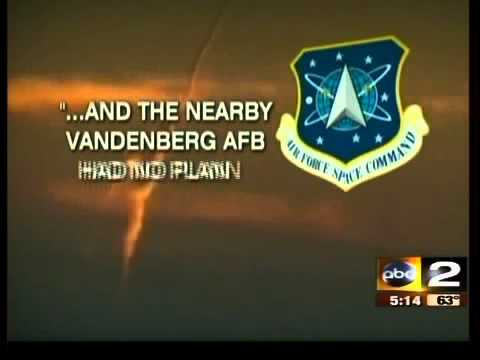
Sources
- "2010 California contrail incident." Wikipedia. en.wikipedia.org
- West, Mick. "Los Angeles Missile Contrail Explained in Pictures." Contrail Science. contrailscience.com
- "California 'mystery missile' ignites debate: Friend, foe, or faux?" Christian Science Monitor, November 9, 2010. csmonitor.com
- "Mystery missile? Pentagon, NASA experts say it was a plane." Christian Science Monitor, November 11, 2010. csmonitor.com
- "Out to Launch? 'Mystery Missile' off California Coast Was Probably Just an Airliner, Pentagon Says." Scientific American. scientificamerican.com
- Cenciotti, David. "The Mysterious Missile Launch off the California Coast." The Aviationist, November 10, 2010. theaviationist.com
- Martinez, Luis. "Mystery Missile: Launch of Unknown Missile Caught on Tape in California." ABC News, November 9, 2010. abcnews.com
- "Air Scare: Military Officials Baffled by Mystery Missile." ABC News. abcnews.com
- "Military Says Missile-Like Object Wasn't Missile." CBS News. cbsnews.com
- "Mystery Missile: Defense Dept. Issues Statement." CBS News. cbsnews.com
- "'Mystery missile' launches in US." Al Jazeera, November 9, 2010. aljazeera.com
- "Pentagon, NASA experts say mystery plume was plane." Associated Press, via Boston.com archive. archive.boston.com
- "Mystery solved: 'Mystery missile' just a jet." LAist / KPCC (Southern California Public Radio). kpcc.org
- Radford, Benjamin. "Revisiting the 'Mystery Missile' Scare of 2010." Center for Inquiry, republished on author's site. benjaminradford.com
- "Unexplained 'missile' of California explained?" FlightAware Discussions forum, November 10, 2010. discussions.flightaware.com
- "Mystery Missile Launch in California." Physics Forums discussion thread. physicsforums.com
- "101109 mystery ufo" and related press-briefing transcript pages. GlobalSecurity.org. globalsecurity.org
- "Mystery missile launch caught on camera off California coast." Contemporary television news footage, WMAR-2 News (YouTube). youtube.com
- "File: Contrails at sunset 160 Lavender Blvd Palm Lakes Resort Ballina NSW P1050635.jpg." Wikimedia Commons (photograph by John Robert McPherson, 2019, CC BY-SA 4.0). commons.wikimedia.org
- This site's own Roswell Slides Hoax file.
- This site's own Rex Heflin UFO Photographs file.
See something inaccurate? Have additional information or sources?
Suggest an Edit →Last Updated: August 2026