
The Taiwan Strait / Offshore Islands UFO Sightings
Beginning July 17, 1968, unidentified aerial objects were repeatedly sighted crossing the Taiwan Strait and its Republic of China-held offshore islands, most consistently over the fortress island of Kinmen (Quemoy), at the height of the Cold War confrontation between Taipei and Beijing. The sightings were serious enough that the Republic of China military assembled a formal three-officer technical investigation team — and serious enough that the resulting report was routed through a U.S. Army intelligence unit to the Defense Intelligence Agency and the CIA. That report, "(U) Investigation of UFO Sightings Over Off-Shore Islands and Taiwan Strait," was declassified decades later and now sits in the CIA's FOIA Electronic Reading Room as one of the few surviving official East Asian military UFO files. The investigating officers themselves could not agree on an explanation, floating four candidates — man-made satellites, "flying saucers," electronic jamming devices, and psychological-warfare balloons — without settling on one.
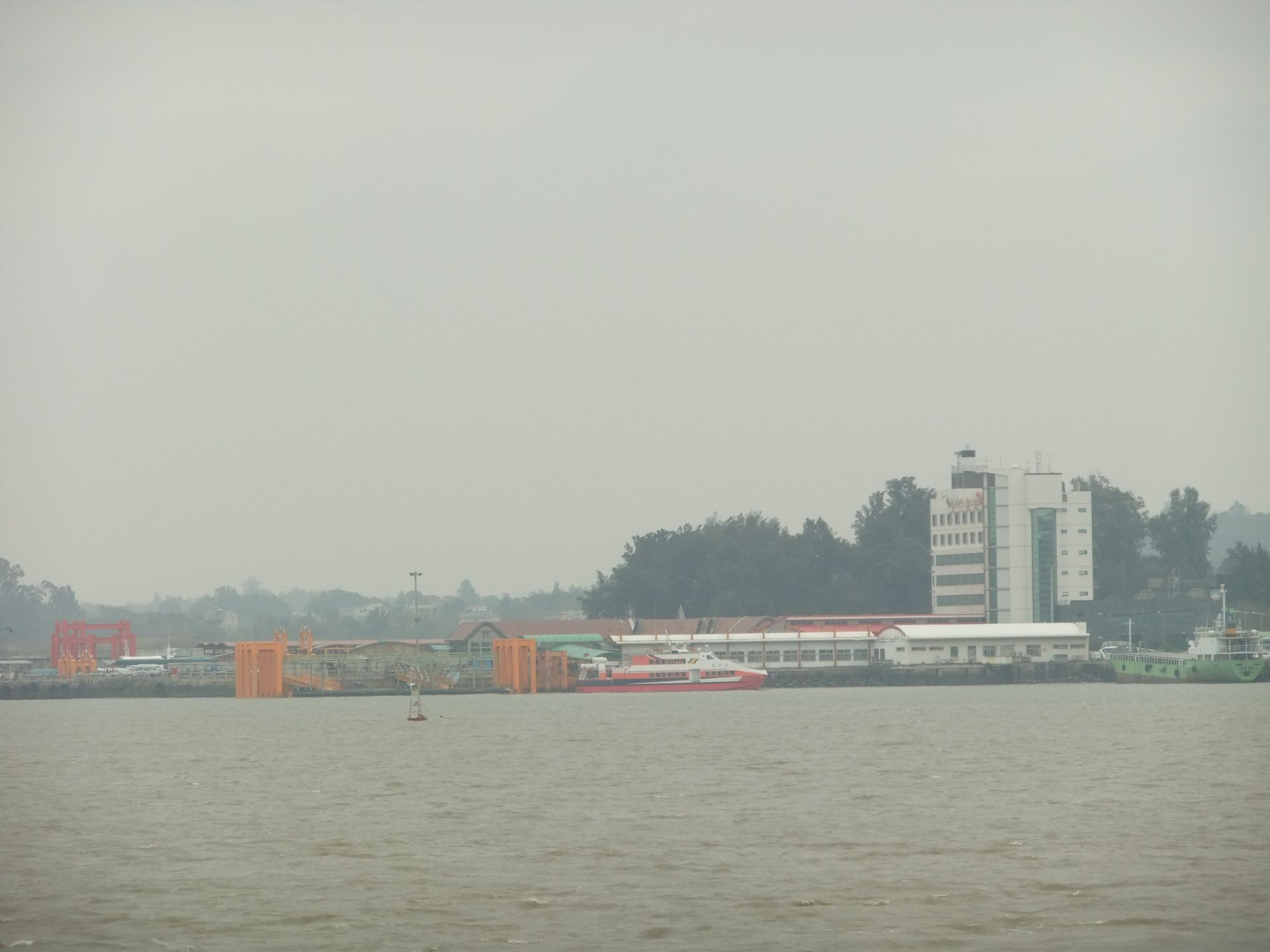
Pictured: Shuitou Harbor on Kinmen (Quemoy) Island today, looking out across the Taiwan Strait toward the Fujian coast — the same waters and offshore-island airspace where the July–August 1968 sightings occurred. This is a modern photograph of the general location, not the disputed phenomenon itself: no photograph of the 1968 objects is known to have been taken, or to survive anywhere in the declassified record. A NASA Apollo 7 orbital photograph of "the China Coast near Quemoy Island," taken October 11–12, 1968 — the same month the investigation report was written — also survives in the National Archives, but its 75% cloud cover leaves the strait itself almost entirely obscured.
Theoretical Alignment
None of the three primary frameworks fits this case especially well. The surviving declassified text contains no description of a craft's shape, structure, or behavior beyond "unidentified flying objects" moving mostly east to west at dusk — there is no debris, no close-range encounter, and no claimed occupant, so ETH alignment is low and speculative rather than supported. IDH alignment is negligible; nothing in the record suggests anything beyond a conventional aerial phenomenon. PSH alignment is also low: this was not a lone, emotionally primed witness but a recurring, multi-week pattern observed by a military garrison and reported up a formal chain of command, which argues against simple psychological misperception even as it leaves the door open to collective misidentification of a real but mundane stimulus. The case's own investigating officers effectively voted for a fourth category this framework doesn't capture at all — deliberate human activity (balloons, jamming devices) or mistaken identification of known hardware (satellites) — which is why every alignment percentage here is low.
Background
By the summer of 1968, the Taiwan Strait had already been one of the Cold War's most militarized waterways for nearly two decades. The Republic of China's retreat to Taiwan in 1949 left a handful of small, heavily garrisoned islands — Kinmen (Quemoy) and the Matsu Islands chief among them — sitting just a few miles off the mainland Chinese coast, still under Nationalist control and directly in the line of fire. The First Taiwan Strait Crisis (1954–55) saw the People's Liberation Army bombard Kinmen, Matsu, and the Tachen Islands and seize several outlying islets; the far larger Second Taiwan Strait Crisis of 1958 subjected Kinmen to roughly half a million artillery shells over 44 days, an assault the United States answered by resupplying the island under naval escort and by deploying nuclear-capable weapons to Taiwan. When that crisis eased, Beijing and Taipei settled into a strange, ritualized routine that lasted twenty years: the People's Liberation Army shelled Kinmen on odd-numbered calendar days, and Nationalist forces returned fire on Xiamen on even-numbered days, with both sides increasingly loading their shells with propaganda leaflets rather than pursuing an actual military objective. That arrangement was still in effect, week in and week out, in July and August 1968.
Kinmen's population lived under this arrangement inside one of the most fortified pieces of real estate on Earth — a warren of tunnels, gun emplacements, and a 48-loudspeaker "sonic wall" broadcasting propaganda music and slogans across the water toward Xiamen. The island doubled as a launch site for a CIA-assisted psychological-warfare program: beginning in 1967, the CIA's Far East Division encouraged balloon releases from Kinmen carrying leaflets, newspapers, and small gifts toward the mainland, using balloons in three sizes (the largest capable of carrying up to 178 pounds of payload and staying aloft as long as 72 hours), launched "whenever the wind is favorable" — a window the program's own documentation places at roughly April through October, squarely covering the July–August 1968 sighting period.
The wider U.S.-Republic of China intelligence relationship in 1968 was also unusually dense for a country of Taiwan's size. Under the 1954 Sino-American Mutual Defense Treaty, American forces (peaking at roughly 10,000 personnel that year, swollen further by Vietnam War logistics) operated alongside Nationalist Chinese units across a range of joint reconnaissance and intelligence programs run directly with the CIA. The most prominent was the 35th Squadron of the Republic of China Air Force — the "Black Cat Squadron," flying CIA-owned U-2 spy planes out of Taoyuan Air Base under the codename Project RAZOR (U.S. designation Detachment H) — which had flown roughly 220 missions over and around mainland China since 1961, with about half penetrating Chinese airspace directly. Five of its aircraft had been shot down over the mainland by 1968, with three pilots killed and two captured and held by Beijing for years. 1968 itself was a hinge year for that program: its last direct overflight of mainland Chinese airspace took place on March 16, 1968, after which the squadron pivoted — for the remainder of its operational life — to "peripheral" missions flown outside a roughly 20-nautical-mile buffer around the mainland, combining photographic reconnaissance with electronic surveillance over international waters. A separate, lower-profile unit, the 34th Squadron ("Black Bat Squadron"), had spent the 1950s and 1960s flying low-level night infiltration, leaflet, and electronic-intelligence missions over the mainland in modified B-17s, B-26s, and P-2V Neptunes. In short: by July 1968, the airspace over and around the Taiwan Strait's offshore islands was already saturated with real, classified aerial activity — balloons, agents, electronic-intelligence platforms, and reconnaissance aircraft — conducted by the very same Republic of China military establishment that would go on to investigate the UFO sightings.
1968 also fell in the middle of a documented worldwide UFO reporting wave, and Taiwan itself had at least one well-attested recent domestic precedent: on June 28, 1967, teenage stargazer Tsai Chang-hung, a relative of the observatory's chief Tsai Chang-hsien, photographed a bright light performing an abrupt turn near the Big Dipper before hovering above Guanyin Mountain, a sighting independently corroborated the same evening by a wire report describing a pale red, cigar-shaped object over the capital. Organized civilian ufology, however, essentially did not exist yet in Taiwan — researchers there date the start of a real domestic UFO research culture to translator Lu Ying-chung's introduction of Western UFO literature in the mid-1970s. That means the 1968 Taiwan Strait wave was handled entirely inside conventional military and intelligence channels, with no civilian UFO organization involved at any stage — a genuinely unusual profile for a Cold War-era sighting wave, and one that helps explain why it left behind a formal government report instead of newspaper clippings and witness interviews.
Complete Timeline
| Date | Event |
|---|---|
| Mar 16, 1968 | The Republic of China Air Force's 35th "Black Cat" Squadron flies its last direct U-2 overflight of mainland Chinese airspace. For the rest of the program's life, the CIA/ROCAF unit shifts to "peripheral" missions — combined photographic and electronic-surveillance flights over international waters outside a roughly 20-nautical-mile mainland buffer — establishing exactly the kind of increased dusk/evening aerial activity around the Strait that the coming sighting wave would unfold inside. |
| Jul 17, 1968 | First recorded sightings. Per the declassified report's own "Date of Info" and narrative text, unidentified flying objects begin to be sighted over the Taiwan Strait and its offshore islands. The report gives no name to the initial observer(s) — only that sightings "since 17 Jul 68" triggered the chain of reporting that follows. |
| Jul–Aug 1968 | The recurring pattern. Objects are sighted flying "mostly from east to west," repeatedly and "sometimes daily," most consistently over Kinmen (Quemoy) Island (24°27′N/118°23′E in the report's own coordinates) between approximately 1915 and 2130 hours local time. A second position, recorded as 26°09′N/119°23′E — a latitude matching the Matsu Islands almost exactly — is also logged, though the surviving OCR-degraded text does not name it explicitly. |
| Aug 13, 1968 | A specific cluster of sightings on this date is distinguished in the report from the rest of the wave, referred to in the analysts' own text (badly degraded in the declassified scan, but consistent with the word "Comsats") — suggesting that at least some individual nights' objects were tentatively assessed by the investigators as consistent with communications-satellite passes, distinct from the broader unresolved pattern. |
| Aug 19, 1968 (2200Z) | An earlier, interim report on the sightings is filed by the U.S. Army's 500th Military Intelligence Group (Collection) as Message DML-OT 2078 — cited in the October report as prior reporting on the same subject, but itself not attached to (and apparently not independently available in) the declassified file ("NOTAL"). |
| Aug 1968 (exact date not preserved) | The formal investigation. A technical investigation team composed of three Chinese Nationalist (Republic of China) officers is assembled to investigate the reports. The team is "assisted in its investigation by" a party whose identity is redacted in the declassified release (marked with a DIA-linked exemption code). Evaluation Reports (DD Forms 1480) generated from this investigation are separately classified above the base report's own Confidential marking. |
| Oct 14, 1968 | The report is written and disseminated. The Intelligence Information Report "(U) Investigation of UFO Sightings Over Off-Shore Islands and Taiwan Strait" is compiled, summarizing the ROC team's findings for U.S. recipients, distributed through channels connected to the Defense Intelligence Agency and ultimately retained in CIA files. The investigators conclude only that the objects "possibly were" man-made satellites, "flying saucers," electronic jamming devices, or psychological-warfare balloons — without settling on one. |
| Mar 26, 2002 | The report is formally declassified and released in full ("RIPPUB") under the CIA's CREST (CIA Records Search Tool) historical review program. |
| Dec 12, 2016 | The document's digital scan is processed and catalogued for the CIA's online FOIA Electronic Reading Room — a records-management date reflecting when the existing paper declassification was digitized, not a new historical development. |
The July–August 1968 Sightings
What survives of the primary document is short — three pages of a badly optically-scanned Intelligence Information Report, its text broken by classification stamps, exemption codes, and outright scanning artifacts — but the core facts are legible and consistent across multiple readings of the file. Starting July 17, 1968, unidentified flying objects were sighted over the Taiwan Strait and its Republic of China-held Offshore Islands. The pattern the report describes is unusually specific for a UFO case of this era: the objects "flew mostly from east to west," were seen "sometimes daily" over Kinmen (Quemoy) Island, and clustered in a consistent evening window — roughly 1915 to 2130 hours local time, meaning dusk through the first two hours of full night at that latitude in midsummer. The report gives coordinates for Kinmen itself (24°27′N/118°23′E, closely matching the island's real position of 24°26′24″N/118°19′48″E) and records a second observed position at 26°09′N/119°23′E. That second position's latitude is a striking near-exact match for the Matsu Islands (more precisely Nangan, at 26°09′N/119°56′E) — the other principal Republic of China offshore-island group, roughly 150 nautical miles north of Kinmen — though the surviving OCR text does not spell the location's name out clearly, and this site treats the identification as a strong coordinate-based inference rather than a settled fact, consistent with this site's standing policy of never asserting more certainty than a primary source actually supports.
No shape, size, color, or altitude for the objects survives anywhere in the legible portion of the report — a genuine limitation of the source, not an editorial omission. Nothing in the document claims radar corroboration, gun-camera film, or photographs; the entire evidentiary record consists of the observers' visual reports as filtered up through military channels and characterized, secondhand, in the analysts' own summary prose. That is a real evidentiary weakness by the standards of a strong UFO case, but it is also exactly consistent with what a formal, compressed Cold War intelligence report on a still-live security matter would look like — the kind of document written to inform a small distribution list of exactly what a follow-up unit needed to know, not to build an evidentiary record for a UFO investigation decades later.
The Technical Investigation Team
What elevates this case above an ordinary unresolved sighting report is the seriousness of the institutional response. Rather than being logged and set aside, the sightings prompted the Republic of China military to stand up "a technical investigation team composed of three Chinese Nationalist officers" — language taken directly from the declassified report. The word "technical" is doing real work here: Cold War-era intelligence reporting from this theater consistently used that term for personnel with a background in signals, radar, or aerial-reconnaissance analysis, rather than for line infantry or general staff officers, and it is a reasonable (though not directly confirmed) inference that the three officers were drawn from exactly the kind of ROC technical-intelligence establishment that, in the very same year, was flying CIA-liaison reconnaissance missions along this same stretch of coastline. The report further states the team "was assisted in its investigation by" a party whose identity has been redacted from the public release, marked with an exemption code tied to the Defense Intelligence Agency — meaning that, more than half a century after the fact, part of the chain of who actually looked into these sightings remains formally withheld from the public record.
None of the three officers is named anywhere in the surviving declassified text. This site's standing policy is to link every named person central to a case to a registered profile — but it applies with equal force in the other direction: where the primary source itself does not preserve a name, this site does not invent one. The investigation is instead documented here as an institutional actor, on the same basis this site already uses for other Cold War military cases with unnamed collective witnesses (see, for comparison, the anonymous Soviet conscripts of the Kapustin Yar UAP Sighting).
The Four Hypotheses
The most analytically valuable sentence in the surviving document is also its most candid: "On the basis of the investigation, the team expressed the belief that the U[FO]s possibly were" — and the report then lists four distinct candidate explanations, evidently weighed rather than dismissed out of hand. In the order the degraded text preserves them, they are man-made satellites, "flying saucers," electronic jamming devices, and psychological-warfare balloons. That a formal Republic of China military technical investigation, writing for onward transmission to U.S. defense and intelligence recipients, explicitly kept "flying saucers" on its own list of live candidate explanations — rather than treating the phrase as a synonym for "unexplained and therefore dismissible" — is an unusually candid admission for a document of this kind and era, and is one of the reasons this case is filed here as genuinely Open rather than Debunked.
The same passage records that objects sighted specifically on August 13, 1968 were referred to by the analysts using a term the declassified scan renders, almost illegibly, as something close to "Comsats" — the standard period abbreviation for communications satellites. If that reading is correct (and this site flags the uncertainty rather than asserting it outright, given the severity of the OCR degradation at exactly that point in the text), it suggests the investigators reached at least a partial, night-specific identification for some individual sightings even while leaving the broader multi-week pattern formally unresolved. The report also preserves, in unusually granular technical detail for a summary IR, that the underlying Chinese-language source material rendered the term "man-made satellite" via a four-digit Standard Telegraphic Code group — the codebook system used throughout this era to transmit Chinese-language text over telegraph and radio circuits limited to Latin/numeric characters — and states that, per the original report, these UFOs were flying "a little faster" than a man-made satellite. That comparison is almost certainly a description of apparent angular speed across the sky as judged by an experienced ground observer (a real, common way period observers characterized satellite passes), not a claim that the objects matched or exceeded genuine orbital velocity, and this site treats it as such.
From CIA-RDP81R00560R to the FOIA Reading Room: The Document's Own History
The report survives today as CIA-RDP81R00560R000100070028-5, catalogued under the CIA's CREST (CIA Records Search Tool) collection of "General CIA Records." Its own metadata is a small case study in how Cold War-era intelligence paperwork ages into public archives. It was originally marked Confidential ("C") and filed as Content Type "IRR" — an Intelligence Information Report, the standard vehicle for disseminating raw or lightly-processed field reporting to a defined distribution list rather than a finished, all-source analytic product. Publication is dated October 14, 1968, three months after the first sightings and roughly two months after the formal investigation appears to have been conducted. The file carries a Sequence Number and Case Number within a much larger CREST box of General CIA Records, and its own text notes that "Evaluation Reports, DD Forms 1480, prepared on this IR" would be classified at a level higher than the base report itself — standard tradecraft for separating a raw report from the receiving analyst's own assessment of its reliability, and a further sign that this was treated, at the time, as a live piece of intelligence reporting rather than a curiosity.
The document explicitly cross-references an earlier report on the same subject: "For an earlier report on the UFOs see 500th MI Gp Msg DML-OT 2078, DTG 192200 Aug 68 (NOTAL)" — a message from the U.S. Army's 500th Military Intelligence Group (Collection), dated August 19, 1968 at 2200 Zulu, and marked NOTAL ("not attached," i.e. not included with this release and, so far as this site's research could determine, not independently available elsewhere in the CIA's public holdings). The 500th MI Group is itself a real, well-documented unit: reactivated in 1961 at Camp Asaka, Japan as the "500th Military Intelligence Group (Collection)," it was described in its own later official history as "heading up all aspects of the HUMINT mission in the Pacific," relocated its headquarters to Hawaii in 1965, and went on to earn a Meritorious Unit Commendation for 1968–69 specifically for its contributions to the Vietnam War — an honor its own official history calls "unprecedented" for a unit that never operated inside the actual combat zone. That the 500th MI Group was the collecting and reporting unit for a UFO sighting wave over Taiwan fits comfortably inside its documented Pacific-wide HUMINT mission for exactly this period.
The report was declassified in full ("RIPPUB," Release-in-Part Public, though in this case the released text appears complete apart from the single DIA-linked exemption already noted) on March 26, 2002, and its digital scan was processed for the CIA's online FOIA Electronic Reading Room on December 12, 2016 — the date that appears, somewhat confusingly, as the file's "Document Creation Date" in the reading room's own metadata, but which this site's research confirms reflects only the digitization and cataloguing pass, not any new development in the underlying case.
The Contemporary Aerial Backdrop: 1968 in the Taiwan Strait
Understanding what else was genuinely, verifiably flying over and around the Taiwan Strait in the summer of 1968 is essential to weighing this case honestly, and it is a genuinely unusual amount of real documented activity for a single stretch of coastline. The Republic of China Air Force's 35th "Black Cat" Squadron, flying CIA-owned U-2s from Taoyuan Air Base, had just pivoted — that same March — from direct overflights of mainland Chinese airspace to "peripheral" missions combining photographic reconnaissance with electronic surveillance over international waters, exactly the kind of activity that would put classified aircraft in the air near the Strait on a regular basis without necessarily crossing into China itself. A parallel U.S. Air Force program flew Ryan/Teledyne AQM-34N Firebee reconnaissance drones — capable of operating above 60,000 feet, launched from DC-130 motherships — on a total of 139 missions into and around hostile Chinese-controlled territory between March 1967 and July 1971, with several airframes lost over the mainland during that span. On the Republic of China's own side of the ledger, Kinmen itself was an active launch site for CIA-assisted psychological-warfare balloon operations, releasing propaganda-leaflet balloons toward the mainland whenever prevailing winds were favorable — a window centered on precisely the April-through-October period that encompasses the entire 1968 sighting wave. None of this proves what any specific witness saw on any specific evening in July or August 1968; but it establishes, from solid independent documentation, that the skies over the Strait that summer were unusually busy with real classified hardware, launched and flown by the same governments that would go on to investigate the sightings.
Key Witnesses
The Investigation Team — Three Republic of China Officers (Unnamed)
Described in the declassified report only as "a technical investigation team composed of three Chinese Nationalist officers," assembled to look into the sightings over the Taiwan Strait and offshore islands. No names, ranks, or units survive in the public text. The "technical" designation, and the era's close ROCAF-CIA cooperation on reconnaissance and signals-intelligence programs, make it plausible the officers were drawn from a radar, signals, or aerial-reconnaissance background, though this site treats that as a reasonable inference rather than a documented fact. Their investigation produced the case's defining feature: an explicit, undismissed list of four candidate explanations, including "flying saucers," rather than a single tidy conclusion.
Garrison & Civilian Observers, Kinmen (Quemoy) Island
The individuals who actually first reported the objects beginning July 17, 1968 are never named or individually described in the surviving report — the text moves directly from "sighted" to institutional reporting channels. Given Kinmen's status as one of the most densely garrisoned pieces of territory in the world in 1968, these initial observers were almost certainly a mix of Republic of China military personnel on watch duty and the island's civilian population, both groups with every incentive to report an unusual nightly aerial pattern promptly given the island's frontline security posture and its two-decades-old shelling routine with the mainland.
500th Military Intelligence Group (Collection), U.S. Army
The U.S. Army HUMINT collection unit responsible for funneling Republic of China reporting on the sightings into American intelligence channels, first via an interim message (DML-OT 2078, August 19, 1968) and ultimately via the October 14, 1968 report examined here. Reactivated in 1961 at Camp Asaka, Japan and headquartered in Hawaii from 1965 onward, the 500th MI Group's documented Pacific-wide HUMINT mission — and its own Meritorious Unit Commendation for 1968–69 Vietnam War-era intelligence contributions — place this reporting squarely inside its normal, verified operational scope for the period.
The Five Observables Assessment
The Five Observables framework, developed by former AATIP director Luis Elizondo, is used to classify UAP encounters based on performance characteristics that exceed known technology:
Assessment: The surviving text supports almost none of the Five Observables directly. There is no description of the objects' structure or flight envelope beyond a consistent east-to-west direction of travel, so Anti-Gravity Lift, Hypersonic performance, and Trans-Medium behavior are all N/A — simply not addressed by the source. Low Observability is actively contradicted: these objects were seen repeatedly, by multiple observers, over multiple weeks, in a fixed and predictable evening window — the opposite of a stealthy or hard-to-detect phenomenon. The one genuinely speculative flag is Instant Acceleration, drawn solely from the report's own comparison of the objects' apparent speed to a "man-made satellite" ("a little faster"); this site reads that line as most likely describing ordinary apparent angular velocity across the night sky as judged by an experienced ground observer, not a claim of literal orbital-exceeding velocity, and marks it speculative rather than present accordingly.
Evidence Assessment
Supporting Anomalous / Unresolved Status
- A genuine, chain-of-custody-documented declassified CIA/DIA Intelligence Information Report exists, with a real CREST document number, classification history, and release date
- The sightings recurred over multiple weeks with a consistent, specific pattern (east-to-west, predominantly 1915–2130 hours) — not a single ambiguous event
- A formal three-officer Republic of China military technical investigation team was assembled specifically to look into the reports
- The investigating officers explicitly did not rule out "flying saucers," listing it alongside three other hypotheses rather than dismissing it
- A specific sub-cluster (Aug 13) was distinguished from the rest of the wave with its own tentative characterization, suggesting the analysts were making real distinctions rather than treating every report identically
- An earlier, independent report (500th MI Gp Msg DML-OT 2078) on the same subject is referenced, indicating sustained official attention over at least a month
- Part of the investigative chain (the party that "assisted" the ROC team) remains formally redacted from the public record more than fifty years later
Supporting Conventional Explanation
- No photographs, radar tracks, or physical evidence of any kind survive in or are referenced by the declassified report
- No individual witness is named, so none of the usual credibility analysis (training, corroboration, consistency across retellings) can be applied
- A real, well-documented, wind-season-matched CIA-assisted propaganda-balloon program was actively launching from the same island during the exact months of the sighting wave
- The Republic of China Air Force's own CIA-liaison U-2 reconnaissance unit pivoted, that same year, to increased "peripheral" electronic-surveillance and photographic flights over the same waters
- The investigators' own comparison of object speed to a "man-made satellite" indicates a live satellite-misidentification hypothesis was already on the table from inside the investigation itself
- The surviving text is badly degraded by OCR/scanning artifacts at several evidentially important points, limiting independent verification of exact wording
- No secondary press coverage, contemporaneous or retrospective, of this specific 1968 wave has been located outside the CIA's own declassified file
Why "Open"
This case is stamped OPEN rather than Disputed, Credible, or Debunked because that is the honest description of its actual status: a real government investigation occurred, and it did not reach a conclusion. The Republic of China's own three-officer technical team, working the case in real time with access to whatever additional information "assisted" their inquiry (redacted from the public record), explicitly declined to settle on a single explanation — leaving "flying saucers" formally on the same list as three mundane candidates. That is a meaningfully different outcome from a case where investigators concluded a mundane explanation and were later second-guessed by outside researchers (which would more properly be Disputed), or one where the file was closed with an identified, high-confidence conventional explanation (Debunked).
At the same time, the case does not clear the bar for Credible: there is no named, individually assessable witness; no instrumented data of any kind; and a specific, contemporaneous, well-documented conventional activity (the Kinmen propaganda-balloon program) that plausibly explains a meaningful share of the pattern on its own. The honest reading of the available evidence is that this is a real, formally unresolved government file about a real recurring aerial phenomenon over one of the Cold War's most surveilled and most militarized stretches of airspace — genuinely open, in the literal sense that its own investigators left it that way.
Sensor & Instrumentation Detection Profile
No radar, sonar, infrared, or other instrumented sensor data is referenced anywhere in the surviving declassified text — a real gap in the case's evidentiary record, not merely an omission from this write-up. The entire chain of evidence is human-observed and then institutionally reported: unnamed observers on Kinmen and, per the second recorded coordinate, possibly the Matsu Islands as well, reporting up Republic of China military channels to the three-officer technical investigation team, whose findings were then captured by the U.S. Army's 500th Military Intelligence Group (Collection) and forwarded into Defense Intelligence Agency and CIA channels. Given how radar-dense the Taiwan Strait already was by 1968 — both sides maintained extensive coastal air-defense radar coverage across this exact corridor, and the Republic of China Air Force operated its own U-2 and Firebee-adjacent reconnaissance infrastructure nearby — the total absence of any cited radar corroboration in the surviving report is itself analytically notable, though it may simply reflect that any radar logs were never appended to (or have not survived within) this particular three-page IR.
Environmental & Geospatial Context
The reported sighting window — approximately 1915 to 2130 hours local time in July and August, at a latitude of roughly 24–26°N — spans local sunset (typically falling around 1855–1910 local time at Kinmen's latitude in midsummer) through full darkness. That window is directly relevant to the satellite-misidentification hypothesis the investigators themselves raised: low-Earth-orbit satellites are only visible to a ground observer during a narrow twilight window, when the satellite remains illuminated by sunlight from its high altitude while the observer below is already in darkness — typically the first 60–90 minutes after local sunset, or the last 60–90 minutes before local sunrise. Sightings clustered in the earlier part of the reported window (roughly 1915–2030) are fully consistent with that physical constraint; sightings later in the window (approaching 2130, well over two hours after sunset) would fall largely outside typical satellite-visibility conditions for most low-Earth-orbit objects, meaning a single explanation is unlikely to cover the entire reported time range even if satellite transits genuinely explain some individual nights — a nuance this site did not find addressed in the surviving report itself, but one that follows directly from ordinary orbital-visibility physics. The Taiwan Strait in July and August also sits inside the region's summer monsoon and typhoon season, though no specific meteorological log for any individual sighting date survives in the declassified text.
Observer Credibility & Occupational Profile
This case presents an unusual credibility profile: institutionally strong, individually undocumented. The investigation was conducted by a formally constituted three-officer Republic of China military technical team, working through an established U.S.-allied intelligence reporting chain (Republic of China military → 500th Military Intelligence Group → Defense Intelligence Agency/CIA) that both governments treated as reliable enough to classify and retain for decades. That institutional pedigree is a real positive signal — this is not a hoax, a tabloid story, or an uncorroborated single account, but a genuine piece of Cold War government-to-government intelligence reporting. Set against that, however, is the complete absence of any individually named, individually assessable witness: no rank, no unit, no service record, no prior reliability history survives for the three investigating officers, the "assisting" party, or any of the original observers on Kinmen. The credibility assessment for this case therefore rests almost entirely on the institutional chain of custody rather than on any individual's track record — a meaningfully different basis than most named-witness case files on this site, and one this site flags explicitly rather than papering over.
Physical & Material Assays
None. No physical debris, trace evidence, or material sample of any kind was ever recovered, collected, or claimed in connection with this case. This was, on the entirety of the surviving evidentiary record, a purely visual, multi-observer aerial sighting case, reported and investigated through institutional channels rather than through physical evidence recovery.
Historical Precedents & Archive Matches
The most direct domestic precedent is Tsai Chang-hung's June 28, 1967 sighting near Taipei — just over a year before the Taiwan Strait wave began, and independently corroborated the same evening by a separate wire report of a cigar-shaped object over the capital, though officially attributed by Taiwan's Central Weather Bureau to a weather balloon. That case, like this one, was resolved (if at all) through official/institutional channels rather than civilian ufology, which in 1968 essentially did not yet exist in Taiwan. More broadly, 1968 fell within a documented worldwide UFO reporting wave, and this case joins a small but growing set of Cold War-era, declassified-government-document cases already catalogued on this site involving formal military investigation of unresolved aerial sightings in geopolitically sensitive airspace — see the Kapustin Yar UAP Sighting (Soviet military personnel, 1989) and, for the same general region decades later, the South China Sea UAP Wave (2021) and 1981 Chinese Spiral Mass Sighting. Across all of these, a consistent pattern emerges: military-adjacent airspace along contested Cold War (and post-Cold War) frontiers generates a disproportionate share of the world's best-documented, government-investigated UFO cases — not necessarily because anomalous activity concentrates there, but because that is exactly the airspace both watched most closely by radar and cameras and reported most formally up institutional chains of command.
Material Analysis
Because no physical trace evidence exists for this case, "material analysis" here means something different than it does for a debris-recovery case like Roswell: the only physical artifact this case actually produces is the declassified document itself. That artifact has its own real, verifiable chain of custody — a specific CREST document number (CIA-RDP81R00560R000100070028-5), an original Confidential classification, a formal declassification-review release decision (RIPPUB) dated March 26, 2002, and a digitization/cataloguing date of December 12, 2016 for its current online presentation in the CIA's FOIA Electronic Reading Room. Unlike a claimed metal fragment or soil sample, a government document's authenticity can be checked directly against the issuing agency's own published catalog — which this site did, confirming the document's existence, metadata, and legible body text independently via the CIA's own reading room rather than relying on a secondary summary.
What the Document Itself Establishes
The document is unambiguously genuine as a piece of Cold War government paperwork: its formatting, classification markings, exemption codes, and cross-reference to a separately identifiable military message (500th MI Gp Msg DML-OT 2078) are all internally consistent with real 1968 U.S. intelligence-community IR conventions, and none of it reads as a later fabrication or hoax. What the document does not establish is what the underlying objects actually were — its own investigators left that question open, and the severe OCR degradation of the declassified scan (a common issue with CREST-collection documents processed from aging microfilm and photocopies) means a small number of evidentially important phrases in this case file are presented here with explicit hedging rather than false confidence.
Supporting a Genuinely Unresolved Phenomenon
- The document is an authentic, verifiable piece of Cold War government intelligence reporting, not a hoax or later fabrication
- Its own investigators — with access to information redacted from the public release — explicitly declined to settle on a mundane explanation
- The recurring, multi-week, specific-time-window pattern is not easily explained by a single misidentified object or event
- "Flying saucers" was kept on the list of live hypotheses by trained military investigators, not casually dismissed
Supporting a Fully Explainable Phenomenon
- Every one of the investigators' own four hypotheses (satellites, balloons, jamming devices, and "flying saucers" as an undifferentiated fourth catch-all) is consistent with known human technology and activity already documented as active in this exact airspace in 1968
- The Kinmen propaganda-balloon program alone plausibly accounts for a recurring, evening, east-to-west-drifting light pattern across exactly this season
- No instrumented data of any kind was collected to distinguish between the four hypotheses
- The one specific night singled out for individual analysis (Aug 13) appears, on the best available reading of the degraded text, to have been tentatively attributed to communications satellites
The Conventional Explanation Candidate (CEC)
Unlike most case files on this site, the Taiwan Strait sightings arrive with their own investigators' shortlist of candidate explanations already attached. This site evaluates all four of the possibilities the Republic of China technical team itself raised — man-made satellites, "flying saucers" (treated here as the residual "genuinely unidentified" category rather than a terrestrial candidate), electronic jamming devices, and psychological-warfare balloons — plus a fourth, independently well-documented candidate this site's own research surfaced: contemporaneous military reconnaissance-aircraft activity.
Psychological-Warfare / Propaganda Balloons
This is the strongest terrestrial candidate this site's research turned up, and it was one the investigators themselves floated. Beginning in 1967, the CIA's Far East Division encouraged and assisted Republic of China psychological-warfare balloon releases from Kinmen itself, carrying leaflets, small newspapers, and gifts toward the mainland in three balloon sizes (the largest capable of 178 pounds of payload and up to 72 hours aloft), launched "whenever the wind is favorable" — a season independently documented as running roughly April through October, which fully encompasses the July–August 1968 sighting window. A large balloon released at dusk, catching the last low-angle sunlight while the ground below has already darkened, drifting with prevailing seasonal winds, would produce exactly the kind of recurring, evening, broadly directional light pattern the report describes — and would do so from the very island where the heaviest concentration of sightings was recorded. The main uncertainty is that the program's documented purpose was launching balloons from Kinmen toward the mainland (implying a westward drift, matching the report's own "mostly from east to west" description), while nothing in the public record confirms exactly how visually conspicuous a given balloon would be, at what altitude, or for how long during a single transit.
Man-Made Satellite Transits or Reentries
The investigators' own analysis explicitly weighed this option, comparing the objects' apparent speed to a known "man-made satellite" reference — strong evidence the team had genuine, practiced familiarity with what a satellite pass looked like from the ground, which by 1968 (more than a decade into the Space Age, with NORAD's Space Track program cataloguing thousands of objects) was itself becoming an ordinary part of technical-intelligence tradecraft in this theater. The August 13, 1968 sightings appear, on the best legible reading of the degraded scan, to have been specifically attributed to this category by the analysts. The environmental-context analysis above complicates a blanket satellite explanation, however: only the earlier portion of the reported time window (roughly 1915–2030) falls within the physically expected visibility period for illuminated low-Earth-orbit satellite passes at this latitude in midsummer; sightings later in the window, closer to 2130, would generally fall outside that window for most low-Earth-orbit objects. A satellite explanation is therefore plausible for at least part of the pattern, but not, on its own, for the entire multi-week wave.
Electronic Jamming Devices
The investigators' third hypothesis is the hardest to independently evaluate, precisely because electronic-warfare equipment is designed not to be visually conspicuous or independently verifiable by outside researchers decades later. It is, however, a genuinely plausible candidate given the documented density of signals-intelligence and electronic-surveillance activity in this exact theater in 1968 — the Republic of China Air Force's own U-2 unit had just pivoted to combined photographic-and-electronic-surveillance missions that March, and the U.S. Army's 500th Military Intelligence Group (Collection), the very unit that reported this case up the chain, had a documented Pacific-wide HUMINT/collection mission during exactly this period. Absent any further declassification of the "assisting" party redacted from the report, this candidate remains genuinely unverifiable one way or the other from the public record.
Military Reconnaissance Aircraft (Black Cat Squadron Peripheral Missions & Firebee Drones)
This candidate was not one the 1968 investigators themselves named, but this site's own research surfaced a striking contemporaneous parallel worth weighing on its own merits. March 16, 1968 — four months before the first reported sighting — was the exact date of the Republic of China Air Force 35th "Black Cat" Squadron's last direct U-2 overflight of mainland Chinese airspace, after which the CIA-run unit shifted its remaining operational life to "peripheral" missions combining photographic reconnaissance with electronic surveillance, flown over international waters outside a roughly 20-nautical-mile mainland buffer — precisely the kind of Strait-adjacent activity that could plausibly generate unusual aerial sightings from ROC-controlled islands nearby. Separately, U.S. Air Force Ryan/Teledyne AQM-34N Firebee drones, operating above 60,000 feet and launched from DC-130 aircraft, flew 139 missions into the broader theater between March 1967 and July 1971. Working against this candidate, however: U-2s at operational altitude (around 70,000 feet) and drones above 60,000 feet are both generally near the edge of unaided-eye visibility, particularly against a darkening evening sky, and neither platform's documented flight profile obviously matches a "mostly east to west, daily, 1915–2130 hours" pattern specifically over Kinmen at comparatively low apparent altitude. This candidate is best read as important background context for why the Republic of China military had ready technical-intelligence expertise to draw on for its investigation team, rather than as a confirmed direct explanation for the sightings themselves.
The Assessment
Psychological-Warfare / Propaganda Balloons
PlausibleThe strongest terrestrial candidate: a real, contemporaneous, wind-season-matched program launched from the same island where sightings concentrated, producing exactly the kind of recurring evening light pattern described, though unconfirmed by any direct source tying a specific balloon launch to a specific reported sighting.
Man-Made Satellite Transits
InconclusiveActively raised by the investigators themselves and plausible for the earlier portion of the reported time window on orbital-visibility physics grounds, but unable on its own to account for sightings later in the reported window that fall outside typical satellite-visibility conditions.
Electronic Jamming Devices
InconclusiveGenuinely plausible given the documented density of signals-intelligence activity in this exact theater and year, but unverifiable from the public record given the redacted identity of the party that "assisted" the investigation.
Military Reconnaissance Aircraft
InconclusiveA striking contemporaneous parallel (the Black Cat Squadron's 1968 pivot to peripheral missions, Firebee drone operations) that was never raised by the original investigators and does not obviously match the reported low-altitude, low-speed evening viewing pattern, but establishes the real technical backdrop the ROC investigation team operated inside.
Related Cases
Confirmed Documents & Official Records
The primary source for this case file. A three-page Intelligence Information Report (CIA-RDP81R00560R000100070028-5) documenting a Republic of China technical investigation into UFOs sighted since July 17, 1968, cross-referencing a prior U.S. Army 500th Military Intelligence Group message on the same subject. Declassified in full March 26, 2002.
DECLASSIFIED (originally Confidential)The CIA's dedicated FOIA Electronic Reading Room collection of declassified UFO-related documents, within which the Taiwan Strait report is catalogued alongside hundreds of other Cold War-era UFO records.
UNCLASSIFIED (declassified collection)Search Government Archives Directly
Further Reading — Recommended Literature
Cold War Island: Quemoy on the Front Line
A social and political history of Kinmen (Quemoy) as a fortified Cold War frontline, drawing on oral history and official documents to reconstruct daily life under the artillery-exchange arrangement still in effect in 1968.
The Black Bats: CIA Spy Flights Over China From Taiwan, 1951–1969
The definitive account of the Republic of China Air Force's own CIA-liaison aerial intelligence squadrons operating from Taiwan through exactly this case's period, covering the dense U.S.-ROC reconnaissance relationship active in 1968.
UFOs and Government: A Historical Inquiry
A large-format scholarly history of government responses to the UFO phenomenon worldwide, produced by the UFO History Group and useful context for how military and intelligence bureaucracies handled reports like the Taiwan Strait wave.
High Strangeness: UFOs From 1960 Through 1979
Clark's volume of the standard UFO reference encyclopedia covering exactly this case's decade, situating the 1968 Taiwan Strait wave within the broader global UFO reporting pattern of the era.
Clear Intent: The Government Coverup of the UFO Experience
A foundational study of declassified U.S. government UFO documents obtained via FOIA litigation, useful background on how and why reports like this one were classified, retained, and eventually released decades later.
DISCLOSURE: Some links above are affiliate links. If you purchase through them, OverClassified receives a small commission at no additional cost to you. This helps support independent research.
Essential Viewing
No Videos Available
A reasonable search did not surface any video genuinely and primarily focused on this specific 1968 sighting wave. Several documentaries on the Republic of China Air Force's contemporaneous Black Cat/Black Bat reconnaissance squadrons exist but cover that program itself rather than this case, and were not included per this site's policy against off-topic or loosely-related video padding.
Sources
- Central Intelligence Agency. "(U) Investigation of UFO Sightings Over Off-Shore Islands and Taiwan Strait," Intelligence Information Report, October 14, 1968. CIA-RDP81R00560R000100070028-5. cia.gov/readingroom
- Central Intelligence Agency. Primary document PDF (3 pages, declassified March 26, 2002). cia.gov/readingroom
- Central Intelligence Agency FOIA Electronic Reading Room. "UFOs: Fact or Fiction?" collection. cia.gov/readingroom
- "500th Military Intelligence Brigade (United States)," Wikipedia — unit history, Pacific HUMINT mission, 1968–69 Meritorious Unit Commendation. en.wikipedia.org
- "Black Cat Squadron," Wikipedia — 35th Squadron ROCAF U-2 operations, Project RAZOR/Detachment H, overflight and peripheral-mission history. en.wikipedia.org
- "Black Bat Squadron," Wikipedia — 34th Squadron ROCAF low-level night reconnaissance operations. en.wikipedia.org
- The National Interest. "Black Cats: Taiwan's Cold War U-2 Spy Pilots Risked Life and Limb." nationalinterest.org
- CNN. "The Black Cats: When China shot down five U-2 spy planes at the height of the Cold War," March 10, 2023. edition.cnn.com
- InsideHook. "CIA-Linked Black Cat Squadron Put Chinese Spies in the Sky." insidehook.com
- "First Taiwan Strait Crisis," Wikipedia. en.wikipedia.org
- "Second Taiwan Strait Crisis," Wikipedia. en.wikipedia.org
- Taiwan Today. "Bombardment of Quemoy." taiwantoday.tw
- Taiwan Today. "Hot Propaganda War in the Taiwan Straits" — CIA Far East Division-assisted balloon leaflet program from Kinmen, 1967 onward. taiwantoday.tw
- PsyWarrior. "Nationalist and Communist Chinese Propaganda Leaflets." psywarrior.com
- Foundation for Strategic Research (FRS). "Beyond the median line: reassessing Kinmen's geostrategic significance, past and present." frstrategie.org
- FocaalBlog. Chu, Ling-I & Hsu, Jinn-Yuh. "Cold War islands and the rebordering of the nation/state: Kinma in the Taiwan Strait." focaalblog.com
- Taipei Times. "Taiwan in Time: UFOs over the skies of Taiwan," June 23, 2024 — domestic sighting history including Tsai Chang-hung (1967) and Tsai Chang-hsien. taipeitimes.com
- "500th Military Intelligence Brigade" unit lineage — reactivation at Camp Asaka (1961), relocation to Hawaii (1965). U.S. Army official unit history, cited via Wikipedia. en.wikipedia.org
- This Day in Aviation / Museum of Aviation Foundation. Ryan/Teledyne AQM-34N Firebee reconnaissance drone operational history, 1967–1971. museumofaviation.org
- Wikimedia Commons / U.S. National Archives and Records Administration. "AS07-05-1654 — Apollo 7 Mission, China Coast near Quemoy Island," NASA orbital photograph, October 11–12, 1968, NAID 16665855. commons.wikimedia.org
- Wikimedia Commons. "Category:Kinmen" — hero image source (Shuitou Harbor, Kinmen), CC BY-SA 3.0. commons.wikimedia.org
- "Kinmen," Wikidata — official coordinates and administrative data. wikidata.org
- "Nangan, Lienchiang," Wikipedia — Matsu Islands coordinates and administrative data. en.wikipedia.org
- Szonyi, Michael. Cold War Island: Quemoy on the Front Line. Cambridge University Press, 2008.
- Pocock, Chris & Fu, Clarence. The Black Bats: CIA Spy Flights Over China From Taiwan, 1951–1969. Schiffer Publishing, 2010.
See something inaccurate? Have additional information or sources?
Suggest an Edit →Last Updated: August 2026