
War of the Words
The True but Strange Story of the Gulf Breeze UFO — The Reporter Who Found the Model
Core Thesis
War of the Words is the Gulf Breeze case told by the reporter who dismantled it, and it occupies a place almost nothing else in this library occupies: it is contemporaneous working journalism turned into a book, written by the person who physically held the object that ended the argument. From 1989 to 1995 Craig R. Myers covered Gulf Breeze, Florida for the Pensacola News Journal, the daily paper across the bay from the community weekly that had made Ed Walters famous. On June 10, 1990 Myers published the story of a nine-inch model UFO — four plastic foam plates, blue gel, an orange paper ring, hand-punched windows, and a piece of drafting paper carrying house dimensions in what Walters acknowledged was his own handwriting — found in the attic of a home Walters had vacated in 1988. Working with a staff photographer, Myers used that model to reproduce the world's most famous UFO photographs almost exactly. This site's case file on Gulf Breeze is stamped Debunked, and this book is the single most important reason why.
About the Author
Craig R. Myers graduated from Troy University in 1986 with a degree in journalism and minors in French and history, and spent roughly twenty-five years as a reporter and editor at newspapers in Florida and Alabama. He was a staff reporter at the Pensacola News Journal from 1989 to 1995 — the years that bracket almost the whole life of the Gulf Breeze controversy — covering local news, politics, criminal justice, education and economic development. From 1995 to 2010 he was an editor and reporter at Newhouse Publishing's Mobile Register. He later moved into higher education at Middle Tennessee State University, where he has taught journalism and took a master's degree in international affairs in 2022.
That biography matters more than an author biography usually does, because it establishes what kind of book this is. Myers is not a ufologist and was never a member of any UFO organisation. He did not come to Gulf Breeze with a theory of the phenomenon, and he does not offer one. He came to it as a general-assignment reporter at a mid-sized regional daily who was handed a story that would not go away, and who kept working it for six years because the facts kept moving.
The book's authority rests on a specific and unusual kind of access. Myers was not reconstructing Gulf Breeze from documents years afterward; he was in the room. He interviewed Walters. He interviewed the family who found the model. He was present for the press conference at which a Pensacola attorney announced that his son had helped fake the original photographs. He attended the MUFON symposiums the case spawned. He watched the town divide and stay divided. Almost every other account of Gulf Breeze — including this site's own case file — ultimately traces back through reporting Myers or his colleagues did at the time.
It should also be said plainly what the book is not. Myers is a working journalist who self-published through Xlibris in 2006, sixteen years after the story broke and eleven years after he left Pensacola. There was no trade publisher, no fact-checking department, and no editorial apparatus behind it. Readers should weigh it accordingly — and then notice that its central factual claims are the ones that have survived every subsequent examination, while the claims in the trade-published books it opposes are the ones that have not.
Historical Context & Origins
To understand the book, you have to understand the newspaper war it is named after. Gulf Breeze in 1987 was a peninsula town of roughly six thousand people served by a community weekly, the Gulf Breeze Sentinel, edited by Duane Cook. Across Pensacola Bay sat the Pensacola News Journal, the regional daily. When Walters brought his first five Polaroids to Cook in mid-November 1987, asking for anonymity, Cook published them on November 19 under the pseudonym 'Mr. X' along with a letter purportedly written by the anonymous photographer. The Sentinel had the story, and it ran with it for months. The News Journal did not, and the resulting rivalry — one paper promoting the case, the other checking it — is the 'war of the words' in the title.
The scale of what followed is easy to underestimate. Walters produced roughly three dozen further Polaroids and about ninety seconds of videotape through May 1, 1988. He passed a polygraph examination in February 1988. In June 1988 Walt Andrus, international director of the Mutual UFO Network, called it 'the best case we've ever had.' National television arrived. Hundreds of other Gulf Breeze residents reported sightings over the following three and a half years. MUFON began holding annual symposiums in Pensacola in 1990. For a period of about two years, Gulf Breeze was simply the most important UFO case in the world.
The corroboration was less independent than it looked, and this is the detail Myers' reporting is best remembered for establishing. The 'Mr. X' letter published alongside the very first photographs — the case's first apparent piece of outside confirmation — had been written by Walters himself. The first brick in the structure was self-manufactured.
Then, in June 1990, the story turned. The new owners of Walters' former house on the Gulf Breeze peninsula found a foam-and-paper model in the attic while looking for a water shutoff valve during renovations. It measured about nine inches across and five inches deep. On the reverse of the drafting paper used in its construction were dimensions for houses on Jamestown Drive — properties Walters had built. Myers got the model, and the News Journal published on June 10.
Nine days after the model story ran, a Pensacola attorney named Tom Smith called a press conference to say that his son, Tommy Smith Jr., had known of Walters' intentions two years earlier: 'We do know that what Ed disclosed early on was a fabrication.' The younger Smith subsequently stated on camera that he had participated in faking the original double-exposure photographs. The News Journal reported the fuller account in February 1993.
The response inside organised ufology was, by any reasonable standard, a scandal in its own right. Andrus assigned Rex and Carol Salisberry — investigators MUFON had honoured the previous year for what it called unsurpassed investigative skill — to re-examine the case. They concluded the photographs were double exposures reproducible with a small model held near the lens. They were subsequently forced out of the organisation, along with several other members who reached the same conclusion. MUFON did not withdraw its endorsement.
Myers also reported the money, and the money mattered. The News Journal established that Walters had received a $200,000 book advance and had been offered $450,000 for an ABC miniseries — directly contradicting supporters' public insistence that he had sought no financial benefit. The paper also established that Walters had served eighteen months in the late 1960s for forgery and auto theft, and had been pardoned by Florida governor Bob Martinez in March 1990, at the height of the controversy. None of this proves a hoax by itself. All of it was material a reader deciding whom to believe was entitled to have, and none of it appeared in the case's promotional literature.
Core Arguments & Key Concepts
The model is a physical object, and physical objects are the only things in this field that settle arguments. Myers' central point is not rhetorical. Ufology's evidentiary problem is that it deals almost exclusively in testimony, imagery and inference, none of which can be examined in the way an object can. Gulf Breeze produced an object. It matched the photographs. It was found where the photographer had lived. It was built partly from paper carrying his handwriting. Whatever one thinks of Myers' tone, the artefact is the argument, and it is the only artefact of its kind the subject has ever produced.
Reproduction, not accusation, is the load-bearing step. The book's most important passage is the reconstruction. Myers and a News Journal photographer took the recovered model and produced images that closely duplicate Walters' published photographs. This is the step that converts a suspicious find into a demonstration: it establishes that the model is sufficient to account for the pictures, which is exactly the claim the case's defenders had spent two years saying no one could make. It also independently corroborates the Salisberrys' double-exposure conclusion, reached separately and by a different route.
A community weekly can create a national phenomenon, and there is no correction mechanism when it does. Myers' account of the Sentinel's coverage is the most journalistically interesting thread in the book. Cook's paper published photographs it could not authenticate, under a pseudonym, alongside a letter it did not know had been written by the photographer, and then continued to publish the resulting sighting reports as news. Nothing about this violated any law, and the paper was not the only party at fault. But it is a clean demonstration of how a small outlet's editorial choices can seed a phenomenon that then becomes far too large for that outlet to check.
The secondary sighting wave was real, and the hoax finding does not explain it away. Myers is careful here in a way careless sceptics often are not. Somewhere between one and two hundred Gulf Breeze residents reported sightings between 1987 and 1991. They were not conspirators; most had nothing to gain and many had reputations to lose. Something happened in that town. The available explanations — social contagion, newly directed attention to ordinary lights, activity from the very substantial military aviation infrastructure at Eglin Air Force Base and the Pensacola naval complex nearby, plain misidentification, and a smaller number of copycat reports — are mundane, but they are also genuinely a phenomenon requiring explanation.
Organisations that endorse cases cannot then investigate them. The Salisberry episode is Myers' strongest institutional criticism and it is difficult to answer. MUFON's international director declared Gulf Breeze the best case the organisation had ever had before its own re-investigation had concluded. When that re-investigation returned a hoax finding, the investigators were removed rather than the endorsement. A research body that behaves this way is not doing research; it is doing public relations, and the distinction is the whole point of having a research body.
The believer–sceptic frame is a media artefact that served everybody except the reader. Myers watched the national coverage arrive and sort the town into two camps, and he is clear that this framing was useful to television, useful to both books, useful to MUFON, and useful to Walters. It was not useful to anyone trying to find out what had happened. The book's title is partly ironic: the 'war' generated enormous volumes of words and remarkably little resolution, and the thing that finally resolved it was not an argument at all but a piece of foam in an attic.
Humour is a legitimate epistemic instrument, and Myers uses it deliberately. The book incorporates outside commentary including a column by the syndicated humorist Dave Barry, who visited Gulf Breeze during the flap. Some readers will find this tonally jarring in a book about people's sincerely held beliefs, and the criticism is fair. But Myers' implicit argument is that a story which had become impervious to evidence was not impervious to ridicule, and that in a media environment where the sceptical case could not get equal airtime, comedy was one of the few remaining routes to proportion.
Key Cases & Evidence Discussed
The November 11, 1987 first sighting. Walters' account of a bluish-grey top-shaped craft above his front yard, the five Polaroids, and the blue beam that he said briefly immobilised and lifted him. Myers treats this as the origin claim and traces every later development back to it.
The 'Mr. X' letter, November 19, 1987. The Sentinel's first publication, under a pseudonym, with an accompanying letter later established to have been written by Walters himself. In Myers' reconstruction this is the case's structural flaw: the first corroboration was manufactured by the person being corroborated.
The February 1988 polygraph. Walters passed, with examiners concluding he believed his photographs were real. Myers reports the result accurately and then notes what it does and does not establish — a distinction the case's promotional coverage consistently blurred.
The June 1990 attic discovery. The new owners of Walters' former home found the nine-inch foam-and-drafting-paper model during renovations. Myers' June 10 story and the photographic reconstruction that accompanied it are the book's centrepiece and the case's turning point.
The Tommy Smith disclosure, June 1990 and February 1993. The Smith family's press conference nine days after the model story, and the fuller News Journal account in 1993 in which Tommy Smith Jr. described having seen Walters produce faked photographs. Independent human testimony arriving on top of independent physical evidence.
The Salisberry re-investigation and expulsion. MUFON's own decorated field investigators concluding double exposure, and being removed from the organisation for it. Myers reports this as a story about institutions rather than about photographs.
The Gulf Breeze skywatch years and the 1990–91 symposiums. The transformation of a small Florida town into a pilgrimage destination, complete with annual MUFON gatherings, a sighting hotline that ran until 2000, and the concurrent episode of the Gulf Breeze Six — US Army intelligence personnel who went absent without leave and were arrested in the area in July 1990. Myers covered the aftermath as a local reporter, and his account of what the case did to the town is the part of the book with no substitute anywhere else.
Critical Reception & Controversies
The book's reception is best described as narrow and durable. Xlibris is a self-publishing operation, and War of the Words received no reviews in the mainstream press, no coverage in the literary supplements, and no trade distribution to speak of. It has never been a widely read book. What it has been, consistently since 2006, is the source that people who write seriously about Gulf Breeze cite.
That pattern is worth stating precisely, because it inverts the usual relationship between a book's commercial standing and its evidentiary standing. The two trade-published Gulf Breeze books — Walters' own The Gulf Breeze Sightings (1990) and UFO Abductions in Gulf Breeze (1994) — sold in numbers this one never approached, and their central claims have not survived. Myers' self-published account sold almost nothing and its central claims have survived everything.
The sceptical literature had largely reached Myers' conclusion before the book appeared. Robert Sheaffer covered the case's collapse in his Skeptical Inquirer 'Psychic Vibrations' column in 1991; Philip J. Klass examined the drafting-paper dimensions and dated the associated house plans to early 1987, within the photographic period; the physician and sceptical writer Gary P. Posner summarised the whole sequence in a 1992 column. The book's function is therefore less to make the case than to record it from inside, with the reporting notes attached.
Criticism from the proponent side has focused on Myers' tone and on his professional position rather than on his facts. He was a reporter at the rival paper; he had an institutional stake in the Sentinel being wrong; the book is unmistakably enjoying itself. All of that is true. None of it is a rebuttal, and in nineteen years no substantive rebuttal has appeared. Walters' own response has remained what it was in 1990: that the model was planted. Police found no evidence of a break-in at the house, and no one has ever produced a candidate planter.
There is a defensible criticism about proportion. Myers occasionally writes as though the sincerity of the town's other witnesses is on trial along with Walters' honesty, and it is not. A woman who saw an orange light over the bay in 1989 and reported it in good faith has done nothing wrong, and the book's comic register does not always make room for that distinction. This is a real flaw and readers should notice it.
The most substantial gap is one of self-examination. Myers is excellent on the Sentinel's failures and comparatively quiet about how a regional daily and a national television industry between them turned a local curiosity into a phenomenon. The News Journal checked the story, which is to its credit, but it also covered it heavily, and the book is less curious about that than a reader might want.
One further point of fairness, which Myers himself makes. Being wrong about a photograph is not a moral failure, and a great many decent people in Gulf Breeze were wrong about these photographs, including trained investigators and at least one credentialed physicist. The book's target is not the people who believed; it is the institutions that kept insisting after the evidence had turned, and that is a much narrower and much more defensible target than the book's tone sometimes suggests.
Influence & Legacy
The book's practical legacy is that it made Gulf Breeze's Debunked status stick. Cases in this subject rarely close; they fade, get periodically revived, and accumulate defenders. Gulf Breeze did not fade, because there is a physical object, a photographic reproduction, a named witness, and a documented paper trail, and Myers assembled all of it in one place. That is why this site's case file can be stamped the way it is, and why the stamp has not required revisiting.
It also stands as an unusually clear demonstration of what local journalism can do that no research organisation managed to do here. MUFON had field investigators, a national structure, a symposium programme and a decade of institutional experience, and it endorsed the case and expelled the people who disagreed. A reporter at a regional daily got the physical evidence, photographed it, and published. The comparison is uncomfortable and it is the reason this book belongs in a UFO library rather than only in a journalism one.
For the study of sighting waves, Gulf Breeze remains the best-documented instance of a single unverified claim seeding a genuine mass phenomenon, and Myers' contemporaneous reporting is the reason the timeline is reconstructible at all. Researchers arguing either side of the social-contagion question keep returning to this material because it is the only case where the origin point, the amplification mechanism, the propagation, and the eventual refutation are all documented as they happened.
Its cautionary legacy is about evidence hierarchy. Gulf Breeze had everything the field usually asks for — volume of images, video, polygraphs, expert endorsement, multiple witnesses, sustained duration, an ordinary and initially reluctant claimant — and it was a hoax anyway. Every one of those markers failed. That is not an argument that all cases are hoaxes. It is an argument that the markers the field habitually treats as decisive are not decisive, and any reader who takes only that away from this book has taken away the most useful thing in it.
The Book
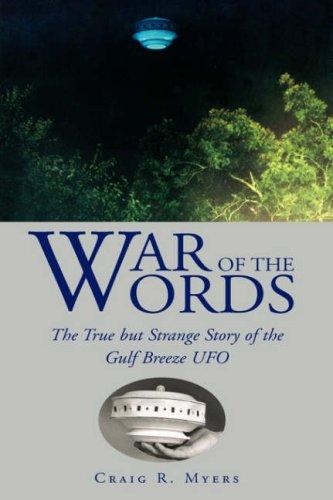
War of the Words
The True but Strange Story of the Gulf Breeze UFO — The Reporter Who Found the Model
Find on Amazon →As an Amazon Associate, OverClassified may earn from qualifying purchases made through this link, at no extra cost to you.
Why This Is Essential Reading
Read it, and read it in sequence. War of the Words is a self-published book by a regional newspaper reporter, it is short, it is uneven in tone, and it is one of the three or four most evidentially important books in this entire library — because its author is the only person in the history of ufology who was handed the physical object that explained a world-famous case and then photographed it to prove the point. The proper order is Walters' The Gulf Breeze Sightings first, so you meet the claim at full strength and understand why serious people believed it; then this book, for what a reporter found in an attic; then UFO Abductions in Gulf Breeze, to watch a refuted photographic claim reappear four years later as an untestable abduction narrative. Taken together those three volumes are the most complete anatomy of a UFO case's rise and collapse that the literature contains. Myers' contribution is the middle one, and it is the one that does the work.
Related Cases & Theories
Sources Cited
- Myers, Craig R. War of the Words: The True but Strange Story of the Gulf Breeze UFO. Xlibris Corporation, 2006. 191 pp. ISBN-10 1425716547 / ISBN-13 9781425716547. amazon.com
- Google Books edition record, War of the Words — publisher, October 27 2006 publication date, 191-page extent, publisher description and cover art. books.google.com
- Barnes & Noble catalogue record, War of the Words by Craig R. Myers — edition and format verification. barnesandnoble.com
- Apple Books edition record, War of the Words — ebook edition and publisher description. books.apple.com
- Wikipedia, "Gulf Breeze UFO incident" — the November 1987 – May 1988 photographic sequence, the Duane Cook and 'Mr. X' publication, the June 10 1990 model discovery and its composition, the Jamestown Drive dimensions, Tommy Smith's February 1993 statements, Craig Myers' role, the $200,000 advance and $450,000 miniseries offer, Walters' forgery conviction and 1990 pardon, Walt Andrus' endorsement, and the CUFOS and Rodeghier findings. en.wikipedia.org
- Gary P. Posner, "Skeptically Speaking" column #10, July 1992 — contemporaneous sceptical summary of the model discovery, the Smith press conference, Philip Klass's dating of the drafting-paper house plans to early 1987, and Myers' photographic reconstruction. gpposner.com
- St. Petersburg Times / Tampa Bay Times archive, "UFO model suggests photos fake," June 11 1990 — the contemporaneous wire-service report of the Pensacola News Journal's model story, one day after publication. tampabay.com
- Wikipedia, "Pensacola News Journal" — the paper Myers reported for from 1989 to 1995, its history and regional standing. en.wikipedia.org
- Wikipedia, "Mutual UFO Network" — organisational background for Walt Andrus' 1988 endorsement and the Salisberry expulsions. en.wikipedia.org
- Wikipedia, "Bruce Maccabee" — the optical physicist whose analysis and public defence of the Walters photographs divided the research community. en.wikipedia.org
- Wikipedia, "Philip J. Klass" — the sceptical investigator who examined the model's drafting-paper dimensions and dated the associated plans. en.wikipedia.org
- Wikipedia, "Robert Sheaffer" — the Skeptical Inquirer 'Psychic Vibrations' columnist who covered the Gulf Breeze collapse in 1991. en.wikipedia.org
- Wikipedia, "Gulf Breeze Six" — the July 1990 disappearance and arrest of six US Army intelligence personnel in the Gulf Breeze area during the height of the flap. en.wikipedia.org
- Wikipedia, "Gulf Breeze, Florida" — the Santa Rosa County peninsula city, its size and setting between Pensacola and Pensacola Beach. en.wikipedia.org
- Wikipedia, "Xlibris" — the self-publishing imprint through which Myers issued the book in 2006. en.wikipedia.org
- Wikipedia, "Dave Barry" — the syndicated humorist whose Gulf Breeze column is reproduced in the book. en.wikipedia.org
- Center for Inquiry / Skeptical Inquirer archives — the standing venue for published criticism of the Gulf Breeze photographs, including Sheaffer's contemporaneous coverage. skepticalinquirer.org
Have corrections, additional research, or peer-reviewed sources? Help improve this entry.
Suggest an Edit