
The Gulf Breeze Sightings
The Most Astounding Multiple Sightings of UFOs in U.S. History
Core Thesis
The Gulf Breeze Sightings: The Most Astounding Multiple Sightings of UFOs in U.S. History is Ed Walters and Frances Walters's own first-person account of the photographic UFO case that made the small Florida panhandle town of Gulf Breeze, Florida nationally known, published by William Morrow & Co. on March 1, 1990 with a foreword by veteran abduction researcher Budd Hopkins. This site's own Gulf Breeze UFO Sightings case file already documents the full, independently sourced case history in exhaustive detail and rates the underlying case DEBUNKED; this article does not repeat that ground. What it examines instead is the book itself as a publishing artifact — and one specific, easily overlooked fact about it matters more than any other: it went to print roughly three months before the June 10, 1990 discovery that undid it. Read today, it is less a UFO case study than a time capsule of exactly how completely a supportive narrative had calcified into a bestselling, TV-optioned media phenomenon in the narrow window just before the physical evidence that unraveled it became public.
About the Author
Ed Walters was a 39-year-old building contractor in Gulf Breeze, Florida when he reported the first of what became roughly three dozen Polaroid photographs of a hovering, top-shaped craft on November 11, 1987. What the book's own jacket copy does not mention, and what multiple independent sources confirm, is that Walters had a prior criminal record: a late-1960s conviction for forgery and auto theft that resulted in an 18-month sentence, for which Florida Governor Bob Martinez granted him a gubernatorial pardon in March 1990 — the same month the book itself was published. Neither fact appears in the book's own author biography, and readers encountering Walters solely through his own account would have no way to know either was part of the record.
Frances Walters is credited as co-author, and the book presents her as a corroborating secondary witness — she is described, both in the book and in this site's own case file, as having witnessed and partly shared in several of the reported encounters, including a December 1987 incident in which she said she pulled her husband free of the phenomenon's reported paralyzing beam. This article could not independently verify any professional background for Frances Walters prior to 1987 beyond her role as Ed's spouse and co-author; unlike her husband, no retailer listing, obituary, or profile turned up in this research documents an independent career, credential, or occupation of her own. That gap is worth stating plainly rather than papering over: half of this book's authorial byline remains, on the public record available, essentially undocumented as an individual apart from the case itself.
The book's foreword author, Budd Hopkins, was already one of the most prominent alien-abduction researchers in the United States by 1990, known for his own books on hypnotically recovered abduction narratives; his willingness to introduce the Walters account lent it a specific kind of movement credibility distinct from the separate, more skeptical MUFON investigative apparatus this site's case file documents in depth. Hopkins continued to publicly support Walters even after the 1990 controversy broke, a position this article's Critical Reception section addresses directly rather than eliding.
Historical Context & Origins
The book arrived at the peak of Gulf Breeze's national visibility: Walters had already appeared on NBC's Unsolved Mysteries in October 1988, and MUFON International Director Walt Andrus had been publicly calling the case the best-documented in the organization's history since mid-1988. Per the Pensacola News Journal's later financial reporting — documented in this site's own case file — Walters received a book advance reported at roughly $200,000 and a separate ABC television-rights offer reported at roughly $450,000, figures that directly contradicted the "reluctant witness" framing supporters including Hopkins had publicly credited him with maintaining.
The book's March 1, 1990 publication date is the single most important piece of context for reading it honestly today: it appeared three months before the Pensacola News Journal, led by reporter Craig Myers, reported on June 10, 1990 that the new owners of Walters's former home had found a foam-and-cardboard model closely matching his photographs hidden in the attic — a discovery that this site's case file treats, alongside the model's handwriting-matched blueprint backing and Tommy Smith Jr.'s subsequent account of watching Walters stage double-exposure photographs, as decisive. The book, in other words, is not a document written in defiance of that evidence; it is a document that could not have addressed it, because it did not yet exist in public form when the manuscript went to press.
That timing also means the book predates MUFON's own internal reckoning with the case: the Rex and Carol Salisberry reinvestigation that identified serious procedural flaws in Walters's original polygraph examinations and reproduced his most disputed photograph using a small hand-held model did not report its findings until September 1990, six months after publication. Read in sequence, the book represents the high-water mark of the case's public credibility — written and printed in the narrow interval after national television exposure but before either of the two events that would most directly undermine it.
Even skeptical analysis of the underlying photographs predates the book, however, which is a detail popular retellings of the case (including, implicitly, the book's own framing) tend to omit: physicist Willy Smith of UNICAT had already published a 26-page report describing "evidence of deception" in September 1988, and the Center for UFO Studies had already circulated an internal "apparent hoax" assessment in April 1988 — both more than a year before Walters and his wife sat down to write the book presenting the case, without qualification, as genuine.
Core Arguments & Key Concepts
The book's structure follows Walters's escalating encounters chronologically, from the initial November 11, 1987 sighting through the final reported loss of consciousness on May 1, 1988, reproducing what the book presents as roughly 70 photographs alongside first-person narrative description. Its central argument is cumulative rather than singular: Walters and his co-author present the sheer photographic volume, the physicist's technical endorsement, and MUFON's organizational backing as jointly establishing authenticity, rather than resting the case on any one image or claim.
The book leans heavily on Bruce Maccabee's ninety-page technical analysis, which found no conclusive evidence of double exposure in the prints he examined and calculated that reproducing the photographs' ground illumination by conventional means would have required an implausibly large staged lighting rig — an argument that, at the time of publication, was among the strongest technical points in the case's favor, before Maccabee's own later recalculation of the disputed photograph's key distance figure (from roughly 185 feet to roughly 370 feet) called his original analysis into question.
As a piece of advocacy writing, the book does not engage with the skeptical record that already existed by 1990 — the Willy Smith and CUFOS assessments noted above — and its narrative arc treats institutional validation (MUFON's endorsement, national television coverage, a mainstream publisher's advance) as itself a form of evidentiary weight. That rhetorical move is worth naming directly: a case being widely covered and well-funded is a fact about its media career, not independent confirmation of what was photographed.
Key Cases & Evidence Discussed
This site's own Gulf Breeze UFO Sightings case file covers the full case history — the Gulf Breeze Sentinel's role in amplifying Walters's claims, the escalating 1987-88 encounter timeline, MUFON's investigation and endorsement, the June 1990 attic discovery, Tommy Smith Jr.'s confession, and the Salisberry reinvestigation that split MUFON internally — in far greater depth than a book review needs to repeat, and readers wanting the complete, independently sourced account should read that case file directly.
What is specific to the book itself, rather than to the case generally, is what it does not and could not contain: no mention of the attic model, no mention of the blueprint-paper handwriting match Philip J. Klass would later report, and no mention of Tommy Smith Jr.'s account, since none of those developments had occurred yet. The book instead closes on an entirely unqualified note of vindication — institutional backing, photographic volume, and physicist endorsement presented as a settled case for authenticity, three months before that settlement began to unravel in the pages of a local newspaper.
Two specific episodes the book presents in full first-person narrative detail are worth naming directly, since both later became evidentiary liabilities rather than strengths: the December 17, 1987 encounter, which Walters describes as involving multiple craft and a partial abduction later reconstructed under hypnosis, and the February 1988 episode in which he photographed his own wife's alleged encounter with the phenomenon's paralyzing beam. The book presents both as escalating confirmation of an ongoing, deepening contact; read alongside this site's own case file, both instead mark the points at which the narrative's dependence on hypnotic regression and on photographs Walters himself controlled and took became most pronounced — a structural feature of the book's own storytelling that a first read, absent that context, would be unlikely to flag as a weakness rather than a dramatic high point.
Critical Reception & Controversies
As of this article's research (August 2026), the book carries roughly a 3.37-to-3.39-out-of-5 average rating on Goodreads across a comparatively small base of around 82 ratings and 9 written reviews — modest numbers reflecting a 35-year-old, long-out-of-print title rather than an actively promoted current release. Search-result summaries of Amazon reviews describe a genuinely split reception even among modern readers: one reviewer rated it three stars, calling it "a hoax but a pretty good read," while another gave it five stars as one of the finest UFO nonfiction books they had encountered; this article could not directly retrieve full Amazon review text due to repeated fetch errors, and so does not quote either review beyond these search-snippet characterizations.
The most substantial published skeptical treatment of the case — and, by direct implication, of the book's central claims — is Robert Sheaffer's "War of the Words: The True but Strange Story of the Gulf Breeze UFO," his Skeptical Inquirer review of reporter Craig Myers's own 2006 book-length account of the case's unraveling (Vol. 31 No. 5, Sept/Oct 2007). This article could confirm the review's existence, publication venue, and date directly, but repeated fetch attempts on the full article text failed, so its specific arguments are not quoted here beyond what this site's own case file, drawing on the same skeptical record, already documents in detail. Sheaffer had separately tracked the case's decline in an earlier "Psychic Vibrations" column (Skeptical Inquirer, 1991); that piece was likewise confirmed to exist via its own archived PDF link, which returned an access error on direct fetch.
Bruce Maccabee and Budd Hopkins are the case's most prominent and most durable public defenders: Maccabee went on to co-author a further book with Walters, UFOs Are Real (1997), continuing to argue for the photographs' authenticity years after the attic model, the handwriting match, and Tommy Smith Jr.'s account had all become public. That continued defense by two credentialed, independent figures is a genuine part of the book's reception record and is presented here as such — not as evidence the underlying case was correctly decided in Walters's favor, given the specific, itemized physical and testimonial evidence this site's case file weighs against that conclusion, but as an honest accounting of who continued to stand behind the account and why readers will still encounter defenses of it today.
No review or coverage of the book itself was found on The Debrief, on Kevin Randle's UFO-research blog, or via a dedicated MUFON position statement on the book specifically (as opposed to MUFON's own institutional involvement in the underlying case, which this site's case file documents at length) — an absence worth stating explicitly rather than assuming coverage exists simply because the underlying case was, for a time, one of the most famous in American ufology.
Influence & Legacy
The book's most durable legacy is arguably not literary but investigative: its central claims prompted two of the more substantial book-length rebuttals in modern UFO skepticism, Craig Myers's War of the Words: The True But Strange Story of the Gulf Breeze UFO (2006, drawing on Myers's own original reporting that broke the attic-model story) and, from a more sympathetic angle decades later, Gary Covella's Captured in Gulf Breeze (2024). Both remain in this site's own case file's Further Reading list alongside the original book, giving readers three distinct vantage points on the same underlying claims.
The case's cultural footprint outlasted the book's own commercial run: it was referenced directly in a 1994 episode of The X-Files, in which FBI agent Fox Mulder states that he knows the Gulf Breeze photographs "were fakes," and Walters appeared as himself defending his original account as late as a 1996 Strange But True? television segment, six years after the book's publication and the controversy that followed it.
Within ufology specifically, the book's central technical arguments — particularly Maccabee's lighting-rig calculation and the object's apparent symmetry across successive photographs — became recurring reference points in later photo-hoax-detection literature, cited on both sides as a case study in how a photographic case can accumulate seemingly serious technical support before independent forensic photography analysis (from MUFON's own reinvestigation team, JPL's Robert Nathan, and forensic expert William G. Hyzer) ultimately displaces it.
The Book
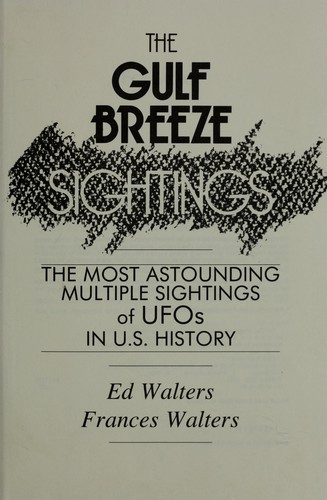
The Gulf Breeze Sightings
The Most Astounding Multiple Sightings of UFOs in U.S. History
Find on Amazon →As an Amazon Associate, OverClassified may earn from qualifying purchases made through this link, at no extra cost to you.
Why This Is Essential Reading
The Gulf Breeze Sightings earns a place on this reading list not as reliable evidence of what it claims to document, but as an unusually clean natural experiment in timing: a book written and published entirely within the window when the case's public credibility was at its peak, three months before the single most damaging piece of physical evidence against it became public. Read against this site's own far more exhaustive Gulf Breeze UFO Sightings case file, the book functions less as a UFO account to be evaluated on its own claims and more as a preserved snapshot of institutional and media credibility being built — MUFON's endorsement, a physicist's technical report, a six-figure book advance, a foreword from a leading abduction researcher — in the exact months before that same edifice began to come apart in a local newspaper's reporting. Readers should approach it as this article does: alongside the case file's full account of what came next, and alongside the continued, genuine disagreement between defenders like Maccabee and Hopkins and the itemized physical and testimonial evidence assembled against the case by Myers, the Salisberrys, and Philip J. Klass.
Related Cases & Theories
Sources Cited
- Walters, Ed, and Frances Walters. The Gulf Breeze Sightings: The Most Astounding Multiple Sightings of UFOs in U.S. History. Foreword by Budd Hopkins. William Morrow & Co., March 1990 (ISBN 0688090877 / 9780688090876). amazon.com
- "The Gulf Breeze Sightings." Goodreads (reader rating approx. 3.37/5, ~82 ratings, 9 reviews, as fetched Aug 2026). goodreads.com
- "The Gulf Breeze Sightings, first edition." AbeBooks (bibliographic record, ISBN, page count, foreword credit). abebooks.com
- "The Gulf Breeze Sightings." Biblio.com (bibliographic record, publisher, foreword credit). biblio.com
- "The Gulf Breeze Sightings." Google Books entry. books.google.com
- "Gulf Breeze Sightings." Internet Archive (scanned copy, catalog record). archive.org
- "Gulf Breeze UFO incident." Wikipedia (case timeline, publication date, financial reporting, aftermath). en.wikipedia.org
- Sheaffer, Robert. "War of the Words: The True but Strange Story of the Gulf Breeze UFO." Skeptical Inquirer, Vol. 31 No. 5, Sept/Oct 2007 (review of Craig Myers's book-length investigation). skepticalinquirer.org
- Sheaffer, Robert. "Psychic Vibrations: Gulf Breeze Flap Fades." Skeptical Inquirer, Vol. 15, 1991. Center for Inquiry archive
- "Who Was Bruce Maccabee." NICAP biographical archive (Maccabee's Gulf Breeze analysis and broader career). nicap.org
- This site's own Gulf Breeze UFO Sightings case file, drawing on Craig Myers's original Pensacola News Journal reporting, the Salisberry MUFON reinvestigation, and Philip J. Klass's blueprint-paper analysis (full sourcing documented there).
- G.P. Posner. "Gulf Breeze UFOs" (skeptical analysis of the photographic evidence). gpposner.com
- "The Gulf Breeze UFO Incident." PensacolaBeach.com (local historical account). pensacolabeach.com
- "The Gulf Breeze Sightings, Avon paperback edition (1991)." Amazon listing (ISBN 0380708701). amazon.com
Have corrections, additional research, or peer-reviewed sources? Help improve this entry.
Suggest an Edit