
The US Navy's Secret Space Program and Nordic Extraterrestrial Alliance
Secret Space Programs Series, Book Two
Core Thesis
If Selected by Extraterrestrials is the testimony, this is the case built on it. Michael Salla takes William Tompkins' recollections and assembles them into a continuous institutional narrative: that the February 1942 Los Angeles air raid prompted a covert U.S. Navy research programme into antigravity propulsion; that Navy operatives inside Nazi-occupied Europe found the Germans were being helped by two extraterrestrial groups with opposed agendas; that Tompkins carried those debriefings to American contractors; and that the resulting Navy space programme, built with the help of “Nordic” extraterrestrials, became operational in the 1980s. The book's real distinguishing feature is not its content but its form. It is written like a work of political science — chronology, actors, institutional interests, footnotes — by an author with the training to write one. Whether that form is doing evidentiary work or presentational work is the question a reader has to answer.
About the Author
Michael E. Salla's academic credentials are real, and this site's own key-figures card says so plainly because the alternative — dismissing him as an unqualified enthusiast — would be false and would leave a reader unable to understand why his work carries the weight it does.
He holds a Ph.D. in Government from the University of Queensland in Australia. He held academic appointments at the Australian National University from 1994 to 1996, at American University in Washington from 1996 to 2004, and at George Washington University in 2002. His early published work was in conflict resolution and international politics, in the ordinary academic literature of those fields.
In 2005 he founded the Exopolitics Institute, and from that point his output moved outside peer review entirely. “Exopolitics” is his own coinage for the study of the political implications of extraterrestrial contact treated as an established fact rather than a hypothesis, and the institute publishes his books, runs conferences and issues certificates.
The distinction that matters for a reader is between a credential and its jurisdiction. A doctorate in government establishes that its holder was trained to analyse institutions, sources and political behaviour. It establishes nothing at all about whether particular institutions exist. Salla's training is genuinely visible in this book — the structure, the attention to bureaucratic motive, the disciplined chronology — and it is precisely that competence which makes the underlying evidentiary problem easy to miss.
He brought Randy Cramer's “Mars Defense Force” testimony to public attention and has published extensively promoting the Secret Space Program claims of Tompkins, Corey Goode and others. The foreword to this volume is by Dr. Robert M. Wood, the aerospace physicist who edited Tompkins' memoir — the same small circle of endorsement recurring across the series.
Salla has continued the series since, extending the narrative to Antarctica, to a claimed “US Air Force Secret Space Program,” and to galactic federations. The books are prolific, consistent and internally coherent, which is worth noting as a fact about them.
Historical Context & Origins
This book was published in February 2017, fourteen months after Tompkins' memoir, and the timing is the key to what it is for.
Tompkins had supplied a first-person account. What he had not supplied — what a memoir by definition cannot supply — was an institutional framework: which agency, which budget line, which decision, in what sequence, for what stated reason. Salla's contribution is to provide that framework, and it is genuinely the thing his training equips him to do.
The moment was also unusually favourable. Cosmic Disclosure was in its second year on Gaia and pulling a large paying audience. Corey Goode and Randy Cramer were established public figures within that audience. And a new American administration had just taken office amid widespread speculation in the field that disclosure might be imminent — a hope the book's own closing material explicitly entertains, which now reads as a useful, dateable marker of the mood in early 2017.
The raw historical materials the book draws on are all real. Operation Paperclip brought German aerospace personnel into American programmes. Nazi Germany did pursue unconventional aircraft projects, though the disc programmes specifically are poorly evidenced — see Man-Made UFOs. The Battle of Los Angeles happened. The U.S. Navy did fund exotic-propulsion studies at various times, and this site examines the surviving documentary trace of the 1950s version in Electrogravitics Systems.
Where the book departs from that record is not in inventing events but in connecting them. Every joint in the chain — from “the Navy studied antigravity” to “the Navy built a fleet” — is supplied by testimony rather than by documents, and the joints are where the entire structure's weight is carried.
One more piece of context explains the book's shape better than anything else: the word “exopolitics” in the imprint on its spine. Salla's framework does not treat extraterrestrial presence as a hypothesis to be established and then acted on. It treats it as a settled background condition, and asks the political-science question that follows — given that non-human actors are present and that governments know it, how do institutions, alliances and secrecy regimes arrange themselves around that fact? Every book in the series is written from inside that assumption. This is not a hidden agenda; it is stated openly, and a reader who understands it will find the book much easier to evaluate. It explains why the volume spends its effort on organisational detail and almost none on whether the underlying premise holds.
It is also worth reading this alongside the broader claim it belongs to. This site's Breakaway Civilization file examines the general proposition that a technologically separated group has operated apart from public society; Secret Space Program Hypothesis tests the specific spaceflight version against what real crewed programmes demonstrably cost.
Core Arguments & Key Concepts
The 1942 Los Angeles air raid was the trigger. The book's founding event: an unexplained object over a wartime American city prompted a covert Navy research effort into exotic propulsion. The barrage is real; the causal link is asserted.
Navy operatives were embedded in Nazi-occupied Europe. Salla accepts Tompkins' figure of a network reporting on German flying-disc work, and treats the debriefing material Tompkins says he carried as the programme's evidentiary foundation.
Two extraterrestrial factions were assisting or contesting Germany. The book's most consequential structural claim — it converts a technology story into a geopolitical one with non-human actors, which is what makes an “exopolitics” treatment possible in the first place.
The Nordics allied with the United States. Human-appearing extraterrestrials are presented as active participants in American aerospace design, working through Douglas Aircraft and other contractors.
Tompkins designed deep-space battle groups. Salla treats the kilometre-scale vessel designs described in Tompkins' memoir as real programme deliverables rather than speculative design-group exercises.
The programme became operational in the 1980s. The claim that the fleet exists and flies. This is the point at which the argument becomes, in principle, testable by ordinary means — industrial capacity, launch signatures, personnel numbers, budget — and the book does not engage those means.
Documentation supports the whole. The book's own framing. In practice the documentation establishes that companies, people and programmes existed, not that they did what is claimed.
Key Cases & Evidence Discussed
The Battle of Los Angeles, 24–25 February 1942. The originating event of the whole chronology. A genuine, still-unexplained anti-aircraft barrage over Los Angeles, examined in detail in this site's own case file.
Tompkins' wartime courier service. Documented as a role; undocumented as to content. The book rests on the second, not the first.
German wartime aerospace research and Operation Paperclip. Real, thoroughly documented history, used here as the bridge between the 1940s and the post-war American programme.
Douglas Aircraft's advanced design groups. Real study organisations at a real firm, presented here as the Navy programme's design bureau.
The “Nordic” contactee typology. Tall, fair, human-passing extraterrestrials, a fixture of the literature since the 1950s — see Flying Saucers Have Landed. Salla's contribution is to give them a foreign policy.
Randy Cramer's Mars Defense Force account. Brought to public attention by Salla himself, and cited across the series as an independent line of support for a claim it shares an origin with.
Antarctica. Extended at length in Salla's later volumes. This site's Deception Island file covers what the real Antarctic UFO record consists of, which is a small number of visual sightings by scientific and naval personnel.
The 1956 Aviation Studies electrogravitics reports. The one place where the antigravity thread has genuine period documents behind it — and where, as Electrogravitics Systems sets out, the documents record expectation rather than achievement.
Critical Reception & Controversies
No academic journal has reviewed this book, and none was ever going to. Its reception has been split between an enthusiastic readership inside the exopolitics community and a critical response that is essentially uniform outside it.
The recurring criticism is not that Salla is unqualified or careless in presentation — both would be easy to refute — but that the entire structure rests on testimony from individuals whose claims cannot be independently checked, and that the book's apparatus of citation obscures rather than reveals that dependency. A footnote to a named source is doing real work when the source is a document; it is doing something else when the source is an interview in which a man says he remembers something.
Two further sourcing problems are specific and worth naming. First, several of Salla's key witnesses are pseudonymous or have credentials that could not be confirmed. Second, the witnesses are not independent of one another: Tompkins, Goode and Cramer appeared on the same programme, read each other's material, and had every ordinary opportunity to converge. Treating their agreement as mutual corroboration requires assuming the independence that is exactly what is in question.
One analysis of Salla's method, published in 2025, put the point more sympathetically and, I think, more usefully than a flat dismissal does: the appeal of this body of work is coherence rather than proof. It offers a single storyline in which UFO lore, Cold War secrecy, corporate power, black budgets, Antarctic mystique and whistleblower testimony all fit together and nothing is accidental. That is a real intellectual satisfaction, and it is not the same thing as being true.
Reader reception on Goodreads is polarised in the way one would expect: high ratings from readers who find the synthesis compelling, low ratings from readers who regard it as speculative fiction presented as history. There is very little middle.
The most useful test a reader can apply is the one the book's own strongest claim invites. Salla says the fleet became operational in the 1980s. A crewed spaceflight capability of that scale is not a secret of the kind that can be kept by classification alone: it requires a workforce, an industrial supply chain, launch and recovery infrastructure, tracking, and a budget large enough to be visible as an absence somewhere. The Apollo programme, which involved substantial genuinely classified subsystem work, became independently verifiable almost immediately because those requirements cannot be hidden. This book does not address that comparison, and this site's Secret Space Program Hypothesis file exists largely to make it.
There is a second, subtler problem worth naming because it recurs throughout this literature and is easy to miss. The book's chronology is load-bearing in a way its evidence is not. Once a sequence is established — 1942 raid, wartime intelligence, post-war programme, 1980s fleet — each element is thereafter supported by its position in the sequence rather than by anything outside it. The Los Angeles barrage is presented as significant because of what followed; what followed is presented as explicable because of the barrage. Narrative order does a great deal of the work that citation appears to be doing, and the effect is strongest precisely where the documentary record is thinnest.
The 2017 publication date has also aged into a useful test of its own. The book's closing material entertained the possibility that the incoming administration would move toward disclosure. Nine years on, that has not happened, and the intervening period has instead produced a real official process — AARO, congressional hearings, released Navy footage — that has generated a substantial public record about anomalous aerial objects and nothing whatever resembling the Navy fleet described here. A prediction that fails is not proof that a book is wrong about everything, but it is the only part of this account that was ever exposed to the ordinary passage of time, and it is worth noticing which way it went.
In fairness: Salla does not claim to have physical evidence and does not pretend the testimony is documentary. He is explicit that he is building an interpretive framework on witness accounts. The criticism that lands is not that he concealed his method but that the framework's confidence far outruns what the method can bear.
Influence & Legacy
This is the book that turned the Secret Space Program from a collection of personal claims into something with the shape of history. Whatever one thinks of it, that is a real accomplishment and it explains the book's continuing centrality.
Its most visible downstream effect is that the specific vocabulary Salla systematised — the Navy programme, the Nordic alliance, the Paperclip-to-Douglas pipeline, the operational-by-the-1980s timeline — is now the default framing in which these claims are discussed online, by people who have often never heard of Tompkins.
It also established a template that has been widely copied: take a first-person claim, supply it with institutional scaffolding and a citation apparatus, and the result reads as scholarship. The template is worth recognising because it is now used far beyond this subject.
The series continued into Antarctica volumes and beyond, each extending the same chronology into new territory, and each drawing on the earlier ones as established background — a citation structure that, over enough volumes, can make an unevidenced starting point look like settled ground.
The honest legacy assessment is that this book made the claim legible without making it evidenced, and that those two things are easy to confuse. Its value to a serious reader is as the most competent, most fully worked-out statement of a position — the version worth arguing with, rather than a strawman.
The Book
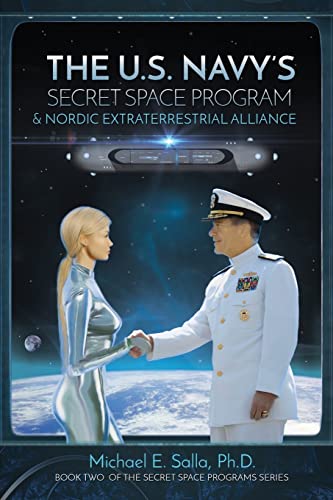
The US Navy's Secret Space Program and Nordic Extraterrestrial Alliance
Secret Space Programs Series, Book Two
Find on Amazon →As an Amazon Associate, OverClassified may earn from qualifying purchases made through this link, at no extra cost to you.
Why This Is Essential Reading
This belongs on the shelf as the definitive statement of a case, read alongside the testimony it is built from. Michael Salla holds a genuine Ph.D. in government and held real academic posts, and it shows: this is a disciplined, structured, internally consistent institutional history of a covert U.S. Navy space programme, from the 1942 Los Angeles air raid through Operation Paperclip to a fleet he says became operational in the 1980s. The problem is not competence or candour. It is that every joint in the chain is supplied by testimony — principally William Tompkins', published sixty years after the fact, with a supporting cast who were not independent of one another — while the citation apparatus reads as though documents were doing the work. And the book's boldest claim is the one it engages least: an operational crewed space fleet is not the kind of secret classification alone can keep, because the workforce, industry, infrastructure and budget it requires are visible whether or not anyone is allowed to talk about them. Read it with Tompkins' own memoir, then with this site's Secret Space Program Hypothesis file, which applies exactly that test.
Related Cases & Theories
Sources Cited
- Salla, Michael E. The US Navy's Secret Space Program and Nordic Extraterrestrial Alliance (Secret Space Programs Book 2). Exopolitics Consultants, 28 February 2017. Paperback, 340 pp. ISBN-10 0998603805 / ISBN-13 9780998603803. amazon.com
- AbeBooks catalogue record, ISBN 9780998603803 — the source for publisher (Exopolitics Consultants), year, 340-page extent, binding, and the publisher's own synopsis, including the claims that the programme originated with the 1942 Los Angeles air raid and became operational in the 1980s. abebooks.com
- Kindle edition record, ASIN B01NAS4M58 — the simultaneous digital edition. amazon.com
- Barnes & Noble catalogue record — independent bibliographic listing crediting Robert Wood alongside the author. barnesandnoble.com
- ThriftBooks catalogue record — independent listing and description. thriftbooks.com
- Google Books record for the title — independent bibliographic confirmation. books.google.com
- Goodreads edition record — the polarised reader reception described above. goodreads.com
- Tompkins, William Mills. Selected by Extraterrestrials. Self-published, December 2015 — the testimony this book is built on. amazon.com
- “Michael Salla: Conspiracy, Myth, and the ‘Secret Space Program’” — the 2025 critical analysis quoted in substance above, arguing that the work's appeal lies in narrative coherence rather than empirical support. socialecologies.wordpress.com
- Wikipedia, “Operation Paperclip” — the documented transfer of German aerospace personnel into American programmes after 1945. en.wikipedia.org
- Wikipedia, “Battle of Los Angeles” — the February 1942 barrage treated here as the programme's originating event. en.wikipedia.org
- Wikipedia, “Nordic aliens” — the 1950s contactee typology the book's non-human actors belong to. en.wikipedia.org
- Wikipedia, “Apollo program” — the real crewed programme against which the industrial, personnel and budgetary requirements of any covert equivalent can be measured. en.wikipedia.org
- OverClassified, Secret Space Program Hypothesis — this site's own analysis, including Salla's academic record and the Exopolitics Institute's founding.
- OverClassified, The Battle of Los Angeles — this site's case file on the 1942 barrage.
- OverClassified, Electrogravitics Systems — the surviving 1956 primary documents on Navy-adjacent antigravity research, and what they actually record.
Have corrections, additional research, or peer-reviewed sources? Help improve this entry.
Suggest an Edit