
Electrogravitics Systems
Reports on a New Propulsion Methodology — The 1956 Documents Behind the Antigravity Story
Core Thesis
This is a document collection, not an argument, and that is exactly why it belongs on the shelf. In February 1956 the Gravity Research Group — a unit of Aviation Studies (International) Limited, a London aviation-intelligence firm — issued report GRG-013/56, Electrogravitics Systems: An Examination of Electrostatic Motion, Dynamic Counterbary and Barycentric Control, followed by a companion titled The Gravitics Situation. Those two reports describe what they present as a serious, industry-wide American interest in electrogravitic propulsion, and they are the origin of the entire antigravity thread that runs through UFO literature from the 1950s to Nick Cook and beyond. Thomas Valone reprinted them here in 1993, with patents, historical material and an essay by Paul LaViolette arguing the B-2 uses the principle. The documents are real. What they mean is the question.
About the Author
Thomas Valone is a physicist and licensed professional engineer, and his credentials need stating precisely because they are frequently overstated by others and occasionally by his own publicity.
The solid parts are solid. He holds a master's degree in physics from the State University of New York at Buffalo, he is a licensed Professional Engineer, and he worked as a patent examiner at the US Patent and Trademark Office in the physics, measuring and instrumentation art unit — from 1996 to 1999 and again from 2005 to 2017.
The doctorate is a different matter and a reader should know about it. It was awarded by Kennedy-Western University, an unaccredited distance-learning institution described as a diploma mill by federal investigators, which was never accredited by any recognised US body and which closed in 2009 after failing to obtain accreditation. This volume, to Valone's credit, credits him on its own cover as "M.A., P.E." — it predates the doctorate.
He founded and runs the Integrity Research Institute, which publishes on future-energy topics, and he has organised conferences in the same area. His practical engineering record includes instrumentation design work, which is real and relevant.
The editorial role here is the right one for him. He is not making a physical claim from first principles; he is putting hard-to-find primary documents in front of readers, with commentary. That is a legitimate and useful function, and it does not depend on the editor's own theoretical positions.
The foreword is by Elizabeth Rauscher, a physicist who worked at Lawrence Berkeley and later became associated with fringe-adjacent research programmes — a signal of the audience the volume was aimed at.
Historical Context & Origins
The mid-1950s were the one period when antigravity was a respectable-sounding aerospace topic, and understanding why is most of what a reader needs.
Aviation had just been transformed twice in fifteen years, by the jet engine and by nuclear energy, and the industry had every reason to believe the next transformation was near. Gravity was the obvious remaining obstacle, general relativity was still being digested by engineers, and the field-propulsion idea did not sound absurd to people who had watched the impossible become routine.
Into that atmosphere, in 1955 and 1956, came a series of public articles and the Aviation Studies reports, describing an American effort involving major aircraft firms and research institutes. The reports read as intelligence assessments, because that is what the firm produced.
It is worth pausing on what Aviation Studies (International) Limited actually was, because the reports' authority depends on it. The firm was a commercial aviation-intelligence publisher operating from Cheval Place, Knightsbridge, producing subscription assessments of technical and industrial developments for clients in the aerospace business; its Gravity Research Group, styled a Special Weapons Study Unit, was an internal analytical unit rather than a laboratory. The report is explicit about its own purpose. Its list of references, it explains, documents a campaign the firm itself had begun eighteen months earlier — a “drive… to suggest to aviation business” that the rewards of success were too great to ignore. It is, on its own account, advocacy addressed to an industry, not a report of results.
The technical claim underneath them was Thomas Townsend Brown's. Born in Zanesville, Ohio, Brown had observed as a teenager that a high voltage applied across an asymmetric capacitor produces a net force toward the smaller electrode. Working with the physicist Paul Biefeld, he named the effect and interpreted it as a coupling between electricity and gravity — "electrogravitics."
Brown pursued the idea for decades, including work connected to the Naval Research Laboratory, and proposed a flying-wing configuration in the 1950s. This site covers his life in The Man Who Mastered Gravity.
Then the subject vanished from the open literature. That disappearance is the second half of the story and the part every antigravity book turns on: either the research failed and was quietly abandoned, or it succeeded and was classified. The documents themselves cannot settle which.
The thread was revived in the 1990s. Valone's reprint made the primary documents available in 1993; Nick Cook, then aviation editor at Jane's Defence Weekly, spent years pursuing the same trail for The Hunt for Zero Point; and LaViolette developed the B-2 argument at book length in Secrets of Antigravity Propulsion.
Core Arguments & Key Concepts
The 1956 reports exist and say what they say. The volume's foundational and unimpeachable claim. Aviation Studies (International) Limited was a real firm producing real intelligence assessments for the aviation industry, and its Gravity Research Group issued these documents in February 1956.
Major aerospace firms were interested. The reports name American aircraft companies and research organisations as engaged with the subject, and the mid-1950s open literature corroborates that the topic was being discussed publicly by industry figures.
The Biefeld–Brown effect is real and measurable. True, and important to concede plainly: apply enough voltage across an asymmetric capacitor in air and you get thrust. Anyone can build one. The observation is not in dispute.
The effect is gravitational. Brown's interpretation, carried through the reports, and the load-bearing claim of the entire tradition. It is the claim that fails.
The research went classified rather than being abandoned. The historical claim, and the one the documents cannot decide. Public discussion stopped around 1957. Silence is consistent with classification and equally consistent with a line of research that did not work.
The B-2 uses the principle. LaViolette's contribution here and his later book's thesis: that the aircraft's charged leading edge and exhaust constitute an operational electrogravitic system. It is an inference from the aircraft's electrostatic characteristics, not from any disclosed design document.
The documents should be read directly. Valone's actual editorial argument, and the correct one. A literature had grown up citing these reports at second and third hand; putting them in print let readers check what they say against what they are said to say.
Key Cases & Evidence Discussed
Report GRG-013/56, February 1956. Electrogravitics Systems: An Examination of Electrostatic Motion, Dynamic Counterbary and Barycentric Control, from the Gravity Research Group's Special Weapons Study Unit at Aviation Studies (International) Limited, London — the central document.
The Gravitics Situation. The companion Aviation Studies report, assessing the state of the field and the firms involved.
The Biefeld–Brown effect. Thrust from an asymmetric capacitor under high voltage, first observed by T. Townsend Brown in the 1920s and named for him and Paul Biefeld.
Brown's Naval Research Laboratory work. His pursuit of the effect through the American defence establishment, including the flying-wing proposal of the 1950s made at the Naval Research Laboratory in Washington.
The 1988 Talley vacuum test. R. L. Talley measured no thrust from Brown-type electrodes at 10−6 torr under direct-current potentials — force appeared only during electrical breakdown, when current was flowing.
Banesh Hoffman's negative-mass paper. Reprinted here at p. 73: “Negative Mass As a Gravitational Source of Energy in the Quasi-Stellar Radio Sources,” by Einstein's collaborator — a genuine piece of theoretical physics sitting alongside the intelligence reports, and the volume's most respectable inclusion.
The 2004 Tajmar experiment. Martin Tajmar enclosed the electrodes in a suspended box to exclude corona wind and observed no linear thrust, concluding the Biefeld–Brown effect is the well-studied corona wind.
The ionocraft. The "lifter" devices hobbyists build from foil and balsa, which fly in air and do not fly in vacuum — the effect's most accessible demonstration and its clearest limitation.
The B-2 argument. LaViolette's contention that the aircraft's charged leading edge and exhaust represent an electrogravitic system in service, developed here and at length in his own book.
Critical Reception & Controversies
The volume has never been reviewed in aerospace or physics literature, and it does not really invite that; it is a reprint collection from a small institute. Its influence has been entirely within the antigravity and UFO-adjacent literature, where it is the standard citation.
The documentary claim is sound and should be granted without argument. The reports are genuine, the firm was real, the mid-1950s interest was real, and making the primary material available was a service. Every subsequent writer on this subject who worked from the documents rather than from summaries owes something to this book.
A second observation follows from reading the document rather than the literature about it, and it is the single most useful thing this volume makes possible. The 1956 report opens by stating that insufficient attention has been paid to gravity research and that success would transform aviation; it summarises work said to be under way, outlines possible lines of research, and lists opinions on the feasibility of various systems. What it does not contain is a device, a flight test, or a measurement. It is a survey of expectation and of the state of an idea — which is what a commercial intelligence firm produces, and not what the later literature has generally represented it as being.
The physical claim is where it comes apart, and the case against it is experimental rather than theoretical, which makes it hard to argue with. The test is simple: if the effect is gravitational, it works in vacuum; if it is ion wind, it does not.
R. L. Talley ran that test in 1988 and measured no thrust at 10−6 torr under direct-current potentials. Martin Tajmar ran a more refined version in 2004, enclosing the apparatus to exclude corona wind, and observed no linear thrust. The consensus that followed is that the Biefeld–Brown effect is corona discharge and ionic wind — a real electrohydrodynamic phenomenon that needs air to push against.
Valone himself does not ignore the vacuum problem, and it is only fair to say so. His editor's introduction acknowledges Talley's replication work for Edwards Air Force Base and argues that the applied voltages were too low — pointing to figures in the reprinted reports and to Brown's own recommendations. That is a real response rather than an evasion. It is also a response that has now had thirty years to produce a positive vacuum result, and has not.
That does not make the effect worthless, and it is worth saying so. Electrohydrodynamic thrust is an active research area with genuine applications in atmospheric flight; a solid-state aircraft flew on it in the 2010s. It is simply not antigravity, and it will not work in space.
The B-2 argument has the structure that recurs throughout this literature. The aircraft does carry electrostatic charge, for documented and mundane reasons connected with signature management and static dissipation. Reading that as an operational field-propulsion system requires an inferential jump that no disclosed design document supports.
The historical question stays open, and honestly so. Public discussion did stop around 1957. Classification is one explanation and failure is another, and the documents in this book cannot distinguish them — which is why Nick Cook, who went looking with a defence journalist's access, is the more useful guide to what happened next.
Influence & Legacy
This book is why the 1956 reports are quotable. Before 1993 they circulated as photocopies and rumours; afterwards they were a citation, and the whole modern antigravity literature — Cook, LaViolette, the secret-space-programme writers — rests on the text Valone put back into print.
That is a genuine contribution and it cuts both ways. Making primary documents available lets a reader check the claims made about them, and a great many claims made about these reports do not survive the check. The documents describe interest and expectation, not achievement.
The book also marks a useful boundary in this subject. Everything before the vacuum tests is a live technical question; everything after them is a question about why a refuted interpretation kept circulating. Talley in 1988 and Tajmar in 2004 answered the physics, and the literature largely continued as though they had not.
The lasting lesson is about what a document proves. A 1956 intelligence report showing that serious people expected electrogravitic propulsion to work is excellent evidence about 1956 — about the mood of an industry that had just been remade twice and assumed it would be remade again. It is not evidence that the propulsion works, and no amount of reprinting it makes it so. Read the documents; then read the experiments.
The Book
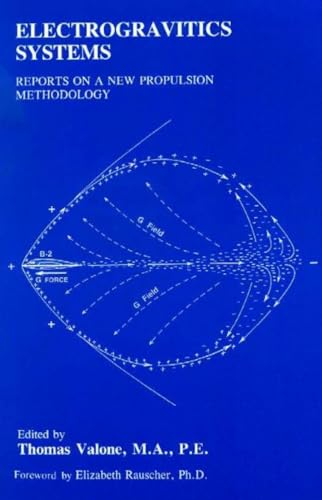
Electrogravitics Systems
Reports on a New Propulsion Methodology — The 1956 Documents Behind the Antigravity Story
Find on Amazon →As an Amazon Associate, OverClassified may earn from qualifying purchases made through this link, at no extra cost to you.
Why This Is Essential Reading
Buy it for the documents and read the vacuum tests afterwards. This slim 1993 volume put the February 1956 Aviation Studies reports — Electrogravitics Systems and The Gravitics Situation, from the Gravity Research Group in London — back into print, and those reports are the origin of the entire antigravity thread in UFO literature. That makes it a primary-source collection worth owning, and Thomas Valone's editorial instinct was right: a literature that cites documents at third hand should be made to face them. What the documents show is that in the mid-1950s a serious aviation-intelligence firm believed an industry-wide push toward field propulsion was under way. What they do not show is that it worked. The Biefeld–Brown effect is real and anyone can build one, but R. L. Talley found no thrust in vacuum in 1988 and Martin Tajmar, excluding corona wind in 2004, found none either — the effect is ionic wind, a genuine electrohydrodynamic phenomenon that needs air to push against and will not work in space. Read this with The Hunt for Zero Point, The Man Who Mastered Gravity and LaViolette — and note which of them tell you about the vacuum results.
Related Cases & Theories
Sources Cited
- Valone, Thomas, ed. Electrogravitics Systems: Reports on a New Propulsion Methodology, Volume 1. Integrity Research Institute, 1993, 102 pp., illustrated, foreword by Elizabeth Rauscher. ISBN-10 0964107007 / ISBN-13 9780964107007. amazon.com
- Google Books record — Integrity Research Institute, 1993, 102 pages, and the contents description: foreword, historical documents and patents, sections on gravitics and negative mass, T. Townsend Brown's 1950s flying-wing proposal to the Naval Research Lab, and Paul LaViolette's essay on electrogravitics in contemporary military aircraft. books.google.com
- Internet Archive scanned copy of the volume — the full text, from which this article's account of the contents is taken directly: Rauscher's foreword, Valone's editor's introduction, the Aviation Studies report Electrogravitics Systems (p. 11), The Gravitics Situation by Gravity Rand Ltd., a division of Aviation Studies (p. 42), Banesh Hoffman's “Negative Mass As a Gravitational Source of Energy in the Quasi-Stellar Radio Sources” (p. 73), LaViolette's “The U.S. Antigravity Squadron” (p. 78), and an appendix of T. T. Brown's patents (p. 97); also the report's own title page giving Report GRG-013/56, February 1956, Gravity Research Group, Special Weapons Study Unit, Aviation Studies (International) Limited, 29–31 Cheval Place, Knightsbridge, London. archive.org
- Open Library record, ISBN 9780964107007 — Integrity Research Institute, 102 pages. openlibrary.org
- AbeBooks catalogue record, ISBN 9780964107007 — independent bibliographic listing and cover-art source; the same seller listings identify the February 1956 Gravity Research Group report GRG-013/56 and the companion Gravitics Situation as the reprinted documents. abebooks.com
- ThriftBooks catalogue record — independent listing and description, including the LaViolette B-2 essay. thriftbooks.com
- Goodreads edition record — edition history and reader reception. goodreads.com
- Wikipedia, "Biefeld–Brown effect" — Brown's original observation and anti-gravity interpretation, the corona-discharge and ionic-wind explanation, R. L. Talley's 1988 finding of no thrust at 10−6 torr under DC potentials, Martin Tajmar's 2004 enclosed-electrode experiment finding no linear thrust, and the resulting consensus. en.wikipedia.org
- Wikipedia, "Thomas Townsend Brown" — his birth in Zanesville, Ohio, the teenage observation, his work with Paul Biefeld, and his pursuit of the effect through the American defence establishment. en.wikipedia.org
- Wikipedia, "Ionocraft" — the lifter devices that demonstrate the effect in air, and the atmospheric dependence that defines its limits. en.wikipedia.org
- Wikipedia, "Electrohydrodynamics" — the physics of the momentum transfer that produces the observed thrust. en.wikipedia.org
- Wikipedia, "Corona discharge" — the ionisation mechanism at the sharp electrode that drives the effect. en.wikipedia.org
- Wikipedia, "Anti-gravity" — the standing of gravity-shielding and gravity-coupling claims in physics. en.wikipedia.org
- Wikipedia, "Northrop B-2 Spirit" — the aircraft at the centre of the LaViolette electrogravitics argument. en.wikipedia.org
- Wikipedia, "Warren National University" — formerly Kennedy-Western University, the unaccredited distance institution described as a diploma mill by federal investigators, never accredited by any recognised US body, closed 31 March 2009 after failing to obtain accreditation; the source of the editor's later doctorate, which this 1993 volume predates. en.wikipedia.org
Have corrections, additional research, or peer-reviewed sources? Help improve this entry.
Suggest an Edit