
The Others
UFOs, AI, and the Secret Forces Guiding Human Destiny — Pasulka's Third Book, and Her Most Contested
Core Thesis
The Others is the third and most ambitious book in D. W. Pasulka's sequence on nonhuman intelligence, and its argument is a single large claim: that religion is the structure human beings developed in order to survive contact with intelligences they could not comprehend, and that artificial intelligence is simply the newest instance of the same encounter. Published by St. Martin's Essentials on July 28, 2026, it moves between early twentieth-century Catholic visionaries, the science fiction of Arthur C. Clarke, the mimetic theory of René Girard, the evolutionary theology of Teilhard de Chardin, and interviews with Silicon Valley figures who believe they receive information from non-human sources. Whether that constitutes a synthesis or a chain of unexamined anecdotes is the question every reviewer has had to answer, and they have not agreed.
About the Author
Diana Walsh Pasulka is a professor of religious studies at the University of North Carolina Wilmington, where her research bridges Catholic history, religious practice, emerging technology and reports of nonhuman intelligence. She took her doctorate at Syracuse University in 2003, and her academic standing is real rather than decorative — she is a working scholar of religion who came to the UFO subject through her own discipline rather than from within ufology.
That route matters. Pasulka's first book, Heaven Can Wait, was a study of purgatory in the Catholic imagination. In cooperation with the Vatican in Rome she leads a translation project on the canonisation records of Joseph of Copertino, the seventeenth-century friar whose reported levitations are among the most extensively documented anomalous-phenomena testimonies in any archive. Her professional expertise is in exactly the kind of material ufology tends to invoke loosely and rarely examines.
American Cosmic (2019) was the breakthrough, and it remains her best-regarded work. Built on a six-year ethnographic study, it followed scientists, professionals and Silicon Valley figures who believed in extraterrestrial intelligence, and treated their belief as a religion in formation rather than as a claim to be adjudicated. It is the book that put a credentialed religious-studies scholar inside the subject and it changed the terms of academic engagement with it.
Encounters (2023) extended the ethnography and drew a sharper divide. Readers who wanted the scholarly detachment of the first book found the second more committed; readers who wanted a UFO book found it too theological. The Others pushes further in both directions at once, which is why its reception has been the most divided of the three.
It should be said plainly that Pasulka's method is ethnographic, not evidential. She reports what her subjects believe, describes the structures those beliefs take, and analyses them as religious phenomena. She does not, as a rule, assess whether the underlying claims are true. In her earlier work that stance read as disciplinary rigour. In this book, where several interviewees make specific factual claims about the origins of their own ideas, it reads to some reviewers as an abdication — and that shift in perception is the central critical question about the book.
Historical Context & Origins
The book arrives at a genuinely unusual moment, and understanding that moment is most of what explains it. Two subjects that had been separately marginal — unidentified aerial phenomena and machine intelligence — became simultaneously central to public discourse in the 2020s, the first through official acknowledgement and congressional hearings, the second through the sudden capability jump in large-scale AI systems. Pasulka's wager is that this convergence is not a coincidence of news cycles but a single phenomenon: humanity, again, encountering something it did not make and cannot model.
The academic backdrop is a discipline that had been slowly opening. Religious studies had been treating UFO belief as a legitimate object since the 1990s, but almost always from a safe distance and almost always as a delusion to be explained. Pasulka's contribution across three books has been to conduct the fieldwork from inside, among the technically sophisticated and professionally successful rather than among the marginal — which is both the reason her work is taken seriously and the reason its critics find it credulous.
The intellectual lineage she draws on is old and specific. Teilhard de Chardin's noosphere — a planetary layer of thought converging toward an Omega Point — is the direct ancestor of the technological-singularity narrative, and Teilhard's rehabilitation among Silicon Valley readers is one of the odder facts of contemporary intellectual life. Marshall McLuhan's media theory supplies the vocabulary for treating technology as an environment rather than a tool. René Girard's mimetic theory, itself enormously influential in the Bay Area, supplies the account of how imitation and rivalry structure belief.
The science-fictional lineage is equally deliberate. Clarke's Childhood's End — in which humanity is guided to transcendence by an incomprehensible intelligence that appears in the shape of its own demons — is treated as a philosophical text rather than as entertainment. So, to a lesser degree, is Timothy Leary's late transhumanist writing. Pasulka's argument requires fiction to have been doing genuine anticipatory work, and a reader who does not accept that premise will find several chapters hard going.
The Catholic material is the strand only Pasulka could have written. Early twentieth-century visionary reports, the apparatus of discernment the Church developed for evaluating them, and the canonisation records she works on professionally give her a comparison class that no other writer in this field has: a documented, institutionally adjudicated body of anomalous-experience testimony stretching back centuries, with a formal methodology for separating the credible from the fraudulent.
Finally, the commercial context. St. Martin's Essentials is a trade imprint, not a university press, and the book carries a trade subtitle promising secret forces guiding human destiny. Readers should notice the gap between that packaging and the book's actual contents, which are considerably more academic and considerably less revelatory than the cover implies. Several reviewers reacted to the gap rather than to the argument.
For readers of this site, the relevant recent history is that the UFO subject has spent five years acquiring official legitimacy without acquiring any new evidence. That vacuum — institutional seriousness with an empty evidentiary centre — is precisely the space that interpretive books like this one have moved into, and it is worth asking whether the growth of the interpretive literature is a sign of maturity or of a field with nothing new to examine.
Core Arguments & Key Concepts
Religion is the technology humans built for handling contact with incomprehensible intelligence. This is the book's central and most defensible claim, and Kirkus identified it correctly as the load-bearing thesis: that religious frameworks developed historically to help people navigate encounters with nonhuman minds, and that as machine intelligence emerges, religion may supply the most resilient available structure for making sense of it. Stated at that level it is a serious proposition in the anthropology of religion and does not depend on any UFO claim being true.
The UFO and AI phenomena are the same encounter in different technological dress. The more contentious version of the thesis. Pasulka's argument is that the pattern — an intelligence that is not human, not fully comprehensible, apparently purposive, and encountered by individuals who then organise their lives around it — is structurally identical whether the intelligence is described as an angel, an extraterrestrial, or a model running in a data centre. The structural claim is interesting; the inference that the structural similarity implies any shared underlying reality is the step critics reject.
Elite belief is the story, not fringe belief. Across all three books Pasulka's real subject has been that highly credentialed, professionally successful people — scientists, venture capitalists, technologists — hold beliefs about nonhuman contact that they conceal from their colleagues. This is genuinely important and largely unreported. It is also, as her critics note, reported here without much curiosity about whether those beliefs are correct, or about what it means for institutions when the people running them believe things they will not say aloud.
Fiction did anticipatory philosophical work and should be read as such. The extended treatment of Childhood's End is the clearest instance. Pasulka's claim is that Clarke's novel articulated the structure of the contact problem decades before anyone had the vocabulary for it. The obvious objection — raised in review — is that Clarke himself became a firm sceptic about the paranormal, and that treating a novelist's imaginative premise as a philosophical position requires an argument the book does not fully supply.
The Catholic archive is the best available comparison set for contemporary contact testimony. This is Pasulka's strongest methodological move and the one most specific to her expertise. Centuries of visionary reports, subjected to a formal institutional process of evaluation with documented criteria and adversarial procedure, constitute a body of material with better provenance than anything in ufology. That the field has essentially ignored it is a real gap, and this book does more to close it than anything else available.
The weakest strand is the treatment of individual informants' factual claims. The book contains interviews with people who assert specific things about the world — that technologies were received through psychic vision, that knowledge came from an alternate timeline — and Pasulka's ethnographic stance means these are recorded and analysed as beliefs rather than examined as claims. In a study of religious practice that is correct method. In a book whose subtitle promises secret forces guiding human destiny, it lands very differently, and the tension is unresolved.
The book does not answer the question it raises. This is the most widely shared criticism and it is fair. Having assembled the material, Pasulka does not deliver a clear position on what religion's role in an AI-saturated society should be, or on what the nature of these intelligences actually is. The ending is abrupt. A reader who reaches the last page expecting the synthesis promised by the first will not find it.
Key Cases & Evidence Discussed
The early twentieth-century Catholic visionaries. Reported prophecies from the Catholic visionary tradition, read alongside science-fictional anticipations of humanity meeting new forms of intelligence in the twenty-first century. Pasulka's argument is that both traditions were describing the same expected encounter in their own idioms.
Joseph of Copertino and the canonisation archive. Not the book's centrepiece but its methodological foundation. The seventeenth-century friar's reported levitations were investigated by an institution with a formal, adversarial process for assessing extraordinary claims, and the surviving records — which Pasulka's Vatican translation project is making accessible — are among the best-documented anomalous testimonies in existence.
Arthur C. Clarke's Childhood's End. The novel receives extended treatment as a philosophical text: an incomprehensible intelligence guides humanity toward a transformation it cannot understand, appearing in the form of its own inherited demonology. Reviewers have divided sharply over whether this is illuminating or a category error.
Teilhard de Chardin and the noosphere. The Jesuit palaeontologist's account of an emerging planetary layer of thought converging on an Omega Point, and its direct descent into contemporary singularity thinking. The clearest historical demonstration of the book's thesis that technological eschatology is religious eschatology in new vocabulary.
René Girard and mimetic theory. The account of desire and belief as imitative, deployed to explain how contact narratives propagate through tightly networked elite communities. Girard's independent influence in Silicon Valley makes this a particularly pointed choice.
The Silicon Valley informants. The interviews that have drawn the most criticism: technologists and investors describing knowledge received from non-human or non-local sources, reported by Pasulka in their own terms and analysed as religious experience rather than assessed as factual claims. The most-discussed passages in the book and the ones a critical reader should approach most carefully.
Steven J. Dick and the astrobiological frame. The historian of astrobiology's work on postbiological intelligence — the argument that any intelligence we encounter is overwhelmingly likely to be machine rather than biological — supplies the thread that ties the UFO material to the AI material and gives the book its most scientifically respectable connective tissue.
Marshall McLuhan and Timothy Leary. Media theory and late transhumanism as twentieth-century attempts to describe technology as an environment that reshapes the humans inside it, read here as precursors to the book's account of AI as an encountered intelligence rather than a built tool.
Critical Reception & Controversies
The book was a commercial success on publication and the reviews have been genuinely divided — not the usual split between believers and sceptics, but a disagreement about whether the argument holds together at all.
Kirkus, reviewing in May 2026 ahead of the July release, called it 'a free-wheeling but never out-of-control rumination' and identified the thesis correctly: that religion may offer the most efficient structure resilient enough to make sense of machine intelligence. The review noted that readers of secular-humanist disposition would find the book's embrace of esoteric knowledge short on critical acuity, but recommended persisting for the provocations.
The most substantial negative review came from Jason Colavito, who found the book 'disjointed, unclear, overly academic, and often boring' and argued that its real subject is not contact at all but elites seeking to prostrate themselves before superior powers in order to claim authority. His central methodological objection is worth quoting because it applies well beyond this book: 'Stories are just stories. They don't automatically map onto physical reality simply by virtue of having been committed to paper.'
Colavito's specific criticisms are more damaging than his general ones. He objects that an interviewee describing patented technologies received through psychic visions is reported without any consideration of alternative explanations, including the interviewee's own disclosed history of long-term therapy; that a venture capitalist claiming knowledge from a different timeline is treated with insufficient critical distance; and that the extended Childhood's End analysis ignores Clarke's own later scepticism about the paranormal. Each is a fair point about method rather than about conclusions.
His structural criticism is that the book fails to grapple with the real philosophical and moral implications of its own material and would have required an actual philosopher to do so. That is harsh, but the abrupt ending is real and other readers have noticed it independently.
The defence available to Pasulka is disciplinary and it is not trivial. An ethnographer of religion is not obliged to adjudicate her informants' truth claims; doing so would in fact be a methodological error within her field, where the object of study is the belief and its social function. The problem is that this book, unlike American Cosmic, is packaged and argued as though it were making claims about the world rather than about believers, and the two registers are not kept apart.
Comparison with her earlier work is where most readers land. American Cosmic is the tighter book, with a clear method and a bounded claim. Encounters is more personal and more contested. The Others is the most ambitious and the least disciplined, and readers new to Pasulka should not start here.
One more point in fairness. It is much easier to write a devastating review of a synthetic book than to write the synthesis, and the convergence Pasulka is pointing at — official interest in unidentified phenomena and a step-change in machine intelligence arriving in the same five years, among substantially the same elite population — is a real feature of the present that deserves someone's serious attention. The execution is criticisable. The question is not.
Influence & Legacy
It is far too early to assess the legacy of a book published weeks ago, and this article will be revised as the reception settles. What can be said is that it is the first substantial attempt to treat the UFO subject and artificial intelligence as a single problem rather than as two adjacent curiosities, and that framing will be argued about whether or not this particular execution survives.
Its more certain contribution is the continued opening of the Catholic archive to this field. Pasulka's Vatican translation work on the Joseph of Copertino canonisation records is bringing into view a body of institutionally evaluated anomalous testimony that ufology has essentially never engaged with, and that has better documentary provenance than almost anything the field has generated itself. That work will outlast the arguments in this book.
For the sociology of the subject, Pasulka's three books together constitute the primary record of elite belief in nonhuman intelligence during the period when the topic moved from stigma to respectability. Whatever one concludes about her method, no one else was in those rooms taking notes, and future historians of this decade will use her fieldwork.
The cautionary legacy is about the interpretive turn itself. A field that produces more theory than evidence is a field that has stopped finding things, and the striking feature of the last several years is how much of the serious writing has been about what the phenomenon means rather than about what it is. This book is the most sophisticated instance of that turn, and it is worth reading partly as a symptom of it.
The Book
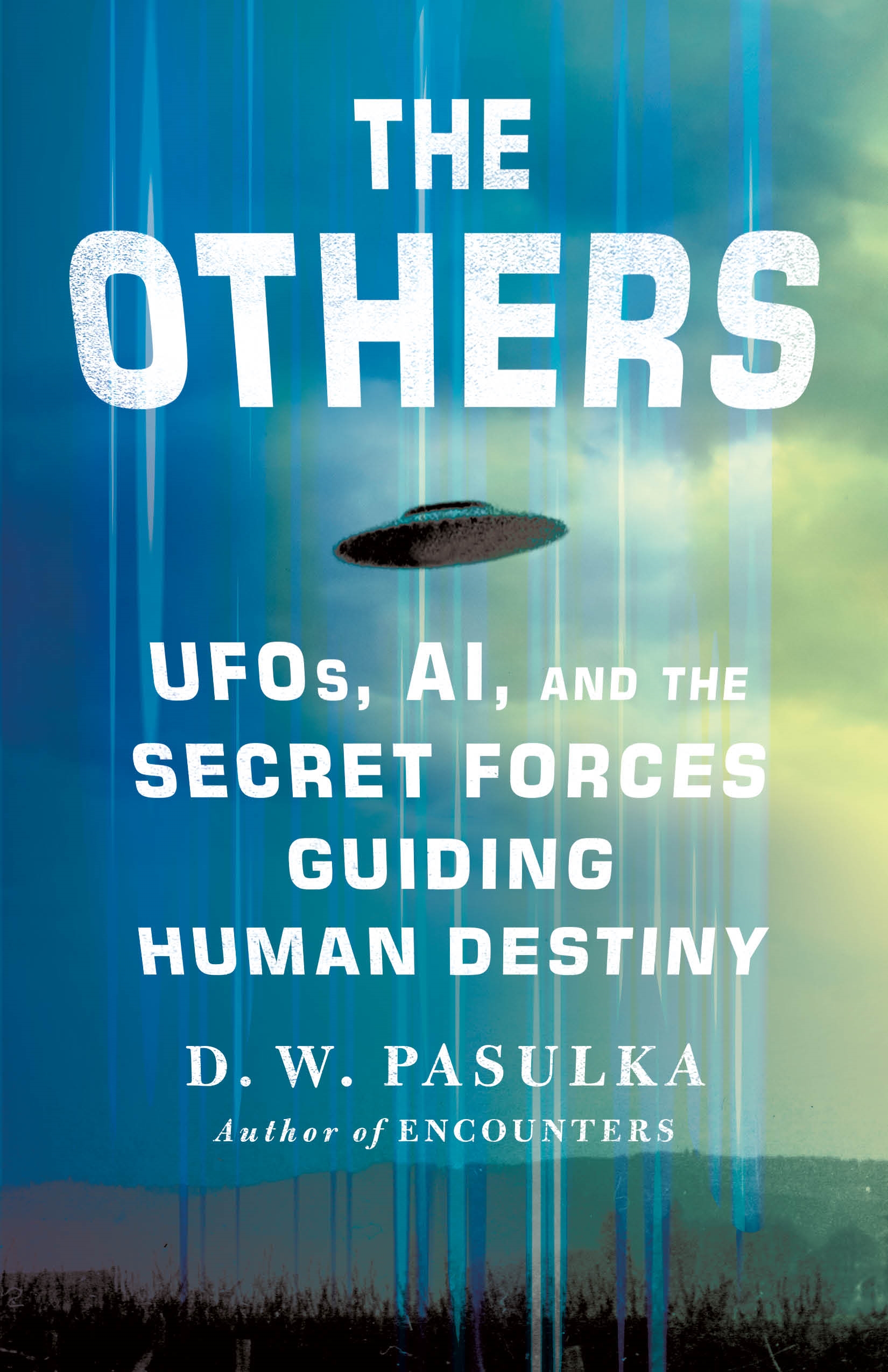
The Others
UFOs, AI, and the Secret Forces Guiding Human Destiny — Pasulka's Third Book, and Her Most Contested
Find on Amazon →As an Amazon Associate, OverClassified may earn from qualifying purchases made through this link, at no extra cost to you.
Why This Is Essential Reading
Read it after the other two, not before, and read the criticism alongside it. The Others is the most ambitious book by the most credentialed scholar working in this area, and its central proposition — that religion is the apparatus humanity built for surviving contact with minds it cannot model, and that machine intelligence is the newest such contact — is a serious idea seriously argued. It is also loosely structured, abruptly concluded, and methodologically compromised by the gap between an ethnographer's proper refusal to adjudicate her informants' claims and a trade book's implicit promise to explain the world. Start with American Cosmic, which is the disciplined version of the same project; read Encounters next; come to this one knowing that its best material is the Catholic archive and its weakest is the uninterrogated interview, and read Jason Colavito's review immediately afterward as a corrective.
Related Cases & Theories
Sources Cited
- Pasulka, D. W. The Others: UFOs, AI, and the Secret Forces Guiding Human Destiny. St. Martin's Essentials, July 28, 2026. 288 pp. ISBN-10 1250394864 / ISBN-13 9781250394866. amazon.com
- Google Books edition record, The Others — St. Martin's Publishing Group, July 28 2026 publication date, 288-page extent, and the publisher description covering the Catholic visionary material, Arthur C. Clarke, and the AI and life-extension strands. books.google.com
- Kirkus Reviews, review of The Others, May 4 2026 (June 1 2026 issue) — 'a free-wheeling but never out-of-control rumination'; the identification of the central thesis about religion as a resilient structure for making sense of machine intelligence; the named intellectual sources René Girard, Arthur C. Clarke, Marshall McLuhan, Pierre Teilhard de Chardin and Timothy Leary; and Steven J. Dick's unifying role. kirkusreviews.com
- Jason Colavito, "Review of The Others by D. W. Pasulka" — the substantial critical review: the 'disjointed, unclear, overly academic, and often boring' assessment, the objection that stories do not map onto physical reality by virtue of being written down, the criticism of the uninterrogated informant interviews, and the argument that the book's real subject is elite deference to superior powers. jasoncolavito.com
- Goodreads edition record, The Others — edition data, publisher description and cover art source. goodreads.com
- Porchlight Books catalogue record, ISBN 9781250394866 — hardcover edition verification. porchlightbooks.com
- NetGalley catalogue listing for The Others — pre-publication description and imprint data. netgalley.com
- Syracuse University College of Arts & Sciences, religion alumni profile for Diana Walsh Pasulka — her 2003 doctorate, her research bridging Catholic history and emerging technology, and the Vatican translation project on the canonisation records of Joseph of Copertino. artsandsciences.syracuse.edu
- Wikipedia, "Diana Walsh Pasulka" — biography, academic position at the University of North Carolina Wilmington, and the publication sequence Heaven Can Wait, American Cosmic, Encounters. en.wikipedia.org
- Wikipedia, "Pierre Teilhard de Chardin" — the noosphere and Omega Point, the direct ancestor of the technological-singularity narrative the book traces. en.wikipedia.org
- Wikipedia, "René Girard" — mimetic theory, and its independent influence on the Silicon Valley community Pasulka studies. en.wikipedia.org
- Wikipedia, "Childhood's End" — the Clarke novel given extended philosophical treatment in the book. en.wikipedia.org
- Wikipedia, "Arthur C. Clarke" — the novelist's career and his later scepticism about paranormal claims, which complicates the book's reading of him. en.wikipedia.org
- Wikipedia, "Marshall McLuhan" — the media theory the book uses to treat technology as an environment rather than a tool. en.wikipedia.org
- Wikipedia, "Joseph of Cupertino" — the seventeenth-century friar whose canonisation records Pasulka's Vatican project is translating. en.wikipedia.org
- Wikipedia, "Steven J. Dick" — the historian of astrobiology whose work on postbiological intelligence supplies the book's connective thread. en.wikipedia.org
- Wikipedia, "Transhumanism" — the life-extension and machine-intelligence movement whose religious structure the book analyses. en.wikipedia.org
Have corrections, additional research, or peer-reviewed sources? Help improve this entry.
Suggest an Edit