
Encounters
Experiences with Nonhuman Intelligences
Core Thesis
Encounters: Experiences with Nonhuman Intelligences is UNC Wilmington religious-studies professor D.W. Pasulka's 2023 follow-up to her influential 2019 book American Cosmic, extending her academic framework of UAP belief as contemporary techno-religion into a broader category she calls "nonhuman intelligences" -- spanning UFOs, angels, AI, and other claimed contact experiences -- through profiles of named individuals reporting sustained direct contact. This site cites the book on two case files as the closest scholarly lens available for evaluating claims of ongoing, personal contact: the Chris Bledsoe "UFO of GOD" contact events and the 2025 Jake Barber/Skywatcher crash-retrieval and "psionics" claims.
About the Author
This site's own Diana Pasulka key-figures entry documents her as a Professor of Religious Studies at UNC Wilmington, where she chaired the Department of Philosophy and Religion from 2015 to 2019, holding degrees from UC Davis, the Graduate Theological Union in Berkeley, and a PhD from Syracuse University. Before turning to UFO studies, she published the academic monograph Heaven Can Wait: Purgatory in Catholic Devotional and Popular Culture (Oxford University Press, 2014) and co-edited anthologies including Posthumanism: The Future of Homo Sapiens (2018) and Believing in Bits: Digital Media and the Supernatural (2018/2019) -- a substantial academic record predating her entry into UAP research.
That same key-figures entry documents her most consequential connection to this site's own cases: she was taken to a claimed New Mexico crash site by Tim Taylor, the figure identified pseudonymously as "Tyler D." in American Cosmic, alongside Stanford pathologist Garry Nolan -- and Taylor reappears as a recurring figure in this later book as well, meaning Encounters extends rather than departs from her earlier material. This article located a substantive independent critical review (by Tanner F. Boyle) arguing Pasulka's granting Taylor close family access, despite reported prior warnings from UFO researcher Jacques Vallée about intelligence-linked figures cultivating UFO belief, represents a genuine methodological concern about blurred scholarly distance -- a criticism this article treats as a documented, single-source but substantively argued position rather than settled consensus, since no second independent critical review raising the same concern was found.
Historical Context & Origins
The book arrived four years after American Cosmic, moving from an Oxford University Press academic imprint to the more commercially oriented St. Martin's Essentials -- a shift the same critical reviewer characterized as an "editorial downgrade" signaling a turn toward a more popular, less strictly academic register. This article treats that characterization as one critic's framing rather than an established fact about the book's rigor.
Structurally, the book profiles several named individuals reporting sustained nonhuman-intelligence contact, according to that review: a space psychologist pursuing an "earth language" project rooted in panpsychism, an AI scientist discussing transhumanist and cosmic-superintelligence themes, a former Marine teaching esoteric "organic network" techniques, and a philosophy professor with claimed secret-space-program ties, alongside Tim Taylor's continuing presence. This broader, multi-subject ethnographic approach is what this site's own case files draw on when applying the book's framework to individuals like Bledsoe and the Skywatcher claimants, who similarly report sustained rather than one-time contact.
Core Arguments & Key Concepts
The book's central argument extends Pasulka's earlier techno-religious framing to a deliberately wide category of "nonhuman intelligences" that includes UFOs and extraterrestrials alongside angels, demons, and artificial intelligence, treating all of these as structurally similar claims of contact with an intelligence beyond ordinary human experience worth academic attention regardless of ultimate truth-value.
Publishers Weekly's review, one of the few trade reviews located, called the result "an intermittently revealing yet haphazard study," praising its treatment of AI and consciousness themes while specifically criticizing an anecdote about a Nobel laureate's alleged encounter with a "glowing raccoon" as emblematic of an uneven mix of credible and dubious material throughout the book.
Key Cases & Evidence Discussed
This site's own Chris Bledsoe case file applies Pasulka's framework directly, crediting her with providing "the closest scholarly lens applied to Bledsoe's story" and noting the case has attracted sustained interest from an unusually credentialed circle including Pasulka and Garry Nolan alongside intelligence and military figures over more than a decade. Readers wanting the complete, independently sourced record of that case, including its two most concrete debunkings by Metabunk's Mick West, should consult that case file directly.
This site's own Jake Barber/Skywatcher case file cites the book for its academic treatment of consciousness, belief, and claimed contact experience as directly relevant to evaluating that case's "psionics" and summoning-type claims -- a more recent, 2025 case this book's 2023 publication predates, meaning the connection is framework-level rather than the book discussing that specific case by name.
Critical Reception & Controversies
As of this article's research (August 2026), the book holds a solidly positive aggregate reader rating of 3.90/5 on Goodreads from roughly 1,488 ratings and 164 written reviews. Publishers Weekly's trade review was mixed rather than a starred endorsement, and this article could not locate a New York Times or comparable major-newspaper review, nor a peer-reviewed academic religious-studies journal assessment -- notable gaps for an academic author's book, though the absence may simply reflect limited indexed coverage of a recent trade title rather than a deliberate critical silence.
The most substantive critical engagement located was independent culture writer Tanner F. Boyle's review, which praised American Cosmic as "genuinely novel scholarship" while raising the methodological concern described above about this later book's uncritical acceptance of intelligence-linked sources. Religious commentator Rod Dreher, by contrast, described being "knocked flat" by the book in a favorable review, framing it as a serious extension of the "epistemological shock" he attributed to Pasulka's earlier work -- illustrating a real range of serious response rather than uniform acclaim or dismissal.
Influence & Legacy
The book's legacy is still developing, but its continuity with American Cosmic -- particularly Tim Taylor's recurring presence across both books -- means its influence is best understood as an extension of that earlier book's already-established framework rather than a standalone new contribution. Pasulka went on to publish a further, subsequent book, The Others: UFOs, AI, and the Secret Forces Guiding Human Destiny, which became a New York Times bestseller -- a distinct, later work this article notes only to avoid conflating it with Encounters.
Set alongside this site's own Chris Bledsoe and Jake Barber/Skywatcher case files, this book's academic framing of sustained-contact claims as a coherent object of religious-studies inquiry remains the most serious scholarly lens either case file has found, even as this article's own research surfaces a real, documented concern about how uncritically that framework accepts its own sources.
The Book
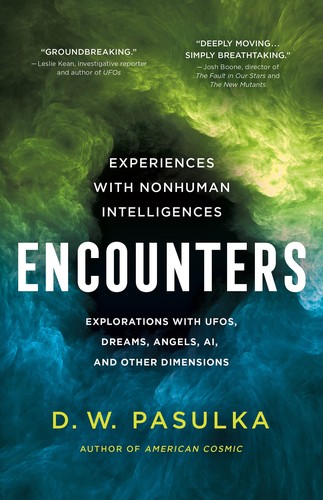
As an Amazon Associate, OverClassified may earn from qualifying purchases made through this link, at no extra cost to you.
Why This Is Essential Reading
Encounters earns its place on this reading list as the most serious available academic framework for evaluating sustained personal-contact claims like Bledsoe's and the Skywatcher case, while carrying a documented methodological caution this article treats seriously rather than glossing over: at least one substantive independent review argues Pasulka's own closeness to sources like Tim Taylor may compromise the critical distance her academic credentials would otherwise promise. Read alongside this site's own Chris Bledsoe and Jake Barber/Skywatcher case files, which apply her framework while preserving their own independent evidentiary weighing, it remains valuable as a serious scholarly entry point into contact narratives rather than a source to accept on academic authority alone.
Related Cases & Theories
Sources Cited
- Pasulka, D.W. Encounters: Experiences with Nonhuman Intelligences. St. Martin's Essentials, 2023. amazon.com
- Publishers Weekly, review of Encounters: Experiences with Nonhuman Intelligences. publishersweekly.com
- Boyle, Tanner F. Independent critical review of Encounters, Substack. (Methodological concerns regarding Tim Taylor and scholarly distance.)
- Dreher, Rod. Review and reflection on Encounters, Substack, November 8, 2023.
- Goodreads listing for Encounters: Experiences with Nonhuman Intelligences (aggregate reader rating). goodreads.com
- Open Library, cover image record for ISBN 9781250879561. openlibrary.org
- This site's own Diana Pasulka key-figures entry (her academic career and connection to Tim Taylor and Garry Nolan).
- This site's own Chris Bledsoe case file (full sourcing and this book's role as its closest scholarly framework).
- This site's own Jake Barber/Skywatcher case file (this book's application to the case's psionics claims).
- This site's own Garry Nolan key-figures entry (Pasulka's collaborator on the New Mexico crash-site visit).
- This site's own Cape Fear River, Fayetteville/Hope Mills, NC location entry (the Bledsoe case's setting).
- This site's own American Cosmic Essential Reading entry (this book's direct predecessor, covering Pasulka's earlier identification of "Tyler D.").
Have corrections, additional research, or peer-reviewed sources? Help improve this entry.
Suggest an Edit