
Ovnis desde Chile
La era contemporánea y el cambio de paradigma en el estudio de anomalías aéreas — Twenty Cases from the Country That Has Investigated Them Officially Since 1968
Core Thesis
Chile is the country that quietly did what everyone else spent seventy years arguing about: it put the study of unidentified aerial phenomena inside a civil aviation authority and left it there. Reports have been formally investigated in Chile since 1968, and since 1997 through CEFAA, a committee attached to the Dirección General de Aeronáutica Civil that convenes military officers, meteorologists, astronomers and psychologists to work individual cases. Ovnis desde Chile is written from unusually close to that process. Its three authors analyse roughly twenty Chilean cases and set them inside a broader argument — that the field entered a “contemporary era” in which the question stopped being whether governments should study these reports and became how. Read it as what it is: a national case survey by people who have sat inside a state committee, not a neutral history of one.
About the Author
Rodrigo Andrés Bravo Garrido is the reason this book carries the weight it does. Born in Santiago on 2 May 1976, he is a former Chilean Army officer who qualified as a military pilot and served with the Army Aviation Brigade at Punta Arenas, in the far south.
What makes him unusual is that he studied the subject in uniform and with permission. In 2000 he was assigned a thesis topic — “Introduction to the UFO Phenomenon and Considerations for Aerospace Security” — and worked on it with support from Chilean civilian researchers and from CEFAA itself. He is generally described as the first serving Chilean military officer to conduct formal study of the phenomenon and to open the question inside his country's aeronautical world. In December 2009 he was designated the Chilean Army's representative on CEFAA, and he later collaborated on the committee's image analysis. He has a Spanish Wikipedia biography and a Wikidata record, which is not something one can say of most people writing books on this subject.
Rodrigo Fuenzalida Herrera is the civilian counterpart. He was a collaborator in image analysis for CEFAA between 2012 and 2016 and is Director of Investigations for AION Chile — the Agrupación de Investigaciones Ovniológicas, one of the country's longest-running research organisations. His involvement in Chilean case work goes back decades.
Marcelo Moya Sanhueza, credited first on the cover, is the third of the trio and has worked with both on the case analyses; the three have now published together twice.
The prologue is by Manuel Carballal, a Spanish investigative journalist with a substantial mainstream publishing record. A foreign journalist of standing writing the front matter is a real, if modest, external check — the kind of thing that does not happen for a print-on-demand title with no traceable authorship.
The most useful thing to say about this authorship is what it does and does not confer. Three people with genuine access to a state investigative body, one of them a former army aviator who represented his service on it, can describe how that body worked, what it looked at and what it concluded, from direct knowledge. That is real and rare. It does not make their reading of any individual case correct, and proximity to an official process is not the same as independence from it — a distinction this site applies to CEFAA exactly as it applies to AARO or Project Blue Book.
Historical Context & Origins
Chile's official engagement with the subject is older and steadier than almost anyone's, and understanding why requires a little geography and a little institutional history.
The country is 4,300 kilometres long and mostly empty. It holds some of the driest, clearest skies on Earth, which is why the world's major optical observatories are there; it has a long, thinly populated Pacific coast; it has the Atacama in the north and Patagonia in the south. It is, in short, a place where an unusual thing in the sky is both more likely to be seen against a dark background and less likely to have an obvious mundane explanation nearby.
Formal investigation dates from 1968. The institutional form that matters, though, arrived in 1997, when the Dirección General de Aeronáutica Civil created CEFAA — the Comité de Estudios de Fenómenos Aéreos Anómalos. Its design is the interesting part: it is not a military intelligence function but a civil aviation safety function, staffed by a standing panel drawn from the armed forces, meteorology, astronomy, aeronautical engineering and psychology, convened to examine individual reports.
That placement has consequences. A civil aviation authority's institutional interest is in whether something in the airspace endangers aircraft, not in whether a story is embarrassing. It publishes. It talks to the press. It has, on several occasions, publicly declined to explain a case — and, on others, publicly explained one, which is the part that establishes the first is worth anything.
The book's own framing is that a paradigm shift occurred. The external evidence for that is real enough: the December 2017 New York Times story on AATIP, the 2020 Pentagon release of Navy videos, the 2021 ODNI preliminary assessment, the creation of AARO in 2022, and congressional hearings thereafter. From the perspective of a country that had been doing this openly since 1997, the last decade looks less like a revolution than like the rest of the world catching up.
The body has since been restructured. CEFAA was reorganised into SEFAA — the Sección de Estudios de Fenómenos Aéreos Anómalos — still inside the DGAC, and the change is worth registering because it is the ordinary institutional life of such an office: a committee becomes a section, directors come and go, activity waxes and wanes. Chile's continuity on this subject is real but it is not frictionless, and a book written from inside the process is describing a moving target.
Chilean cases have accordingly become international reference points. The Chilean Navy helicopter infrared footage of November 2014, released by CEFAA in 2017 after a two-year multi-agency analysis, is among the most-discussed pieces of official UAP imagery anywhere; the El Bosque air base event of 2010, filmed by multiple onlookers at an air show, is another.
Core Arguments & Key Concepts
Chile is a demonstrated high-report zone, and the reporting is institutional. Formal investigation since 1968 confirms that this stretch of the southern hemisphere generates sightings in quantity and that a state has been recording them continuously.
Roughly twenty cases carry the argument. The book's structure: a selected set of Chilean incidents analysed in depth rather than a catalogue. This is a strength for readability and a limitation for inference, and both should be stated.
A civil aviation authority is the right institutional home. Implicit throughout and the most transferable idea in the book. CEFAA's placement inside the DGAC rather than inside a defence ministry changes what the body is for and what it is willing to say in public.
A contemporary era began, and it is a change of paradigm rather than of evidence. The subtitle's claim: what shifted after 2017 was official and institutional willingness to treat the reports as a legitimate object of study, not the underlying phenomenon.
Aviation safety is the strongest available warrant for state involvement. Bravo's own 2000 thesis framed the subject as a question of aerospace security, which is the framing that got a serving officer permission to study it at all.
Multi-disciplinary panels beat single-agency verdicts. CEFAA's standing structure — military, meteorological, astronomical, engineering and psychological expertise convened together on one case — is presented as the methodological advance worth exporting.
The Chilean record deserves an international readership. The organising motive of both this book and its 2026 successor: a substantial national corpus that has been largely invisible outside the Spanish-speaking world.
Key Cases & Evidence Discussed
A note on scope. The book's own description states that it analyses about twenty cases across Chilean territory; a case-by-case list is not published in any accessible source, and this article does not claim any specific incident below appears in it. The entries that follow describe the Chilean corpus this site covers in its own right, which is the material the book is drawn from.
The Chilean Navy helicopter footage, 11 November 2014. Infrared video shot from a Navy AS-532 Cougar off the coast near San Antonio and Quintero, analysed by CEFAA for two years with input from meteorologists, astronomers and image specialists before public release in 2017. The single most internationally discussed Chilean case.
The El Bosque air base event, 2010. Objects filmed by multiple independent onlookers during a military air show at El Bosque, in southern Santiago — a rare case with several unconnected recordings of the same moment.
CEFAA itself. The committee's founding in 1997, its placement inside the civil aviation authority, its panel structure and its public case work — the institutional spine any Chilean survey has to run along.
The Collahuasi mine reports. Sightings at one of the world's largest copper operations, high in the Atacama — a class of report distinctive to Chile, from industrial sites at extreme altitude with round-the-clock shifts and professional observers.
The Licancabur area. The Atacama's high-altitude volcanic zone, adjacent to the world's major observatory infrastructure, and a recurring locus in Chilean reporting.
The 1968 origin of official investigation. The starting point the book's own description gives for formal Chilean study of the subject, and the reason the national record is continuous rather than episodic.
The post-2017 international turn. AATIP, the released Navy videos, the 2021 ODNI assessment and AARO — the external events the “paradigm change” argument is measured against.
Critical Reception & Controversies
There is no published review of this book in any venue this site could locate, in Spanish or English, and its reader-rating base on Amazon is small. That is the ordinary situation for a Spanish-language regional study published outside the major houses, and it means the assessment here rests on provenance and on what is independently checkable rather than on critical consensus.
The substantiation question has to be faced directly, because this is a self-published title carrying a 979-8 ISBN prefix — the pattern this site has repeatedly declined to publish on. It clears the bar comfortably, and the reason is the authors rather than the imprint. Rodrigo Bravo Garrido's military career, his 2000 thesis assignment and his December 2009 designation as the Army's CEFAA representative are documented independently, including in a Spanish Wikipedia biography and a Wikidata record. Rodrigo Fuenzalida Herrera's CEFAA image-analysis work between 2012 and 2016 and his role at AION Chile are likewise on the record. The prologue is by a Spanish investigative journalist with a real publishing history. And the same three authors were subsequently signed by Roca Editorial, a mainstream trade house, for a 2026 successor volume — which is about as clear an external validation of a self-published book's authors as the market ever provides.
The methodological criticism is more interesting than the provenance one. Twenty cases, selected by the authors, cannot support a claim about the Chilean phenomenon as a whole. They are illustrations, and the book's own framing as a survey of “spectacular” and unprecedented cases makes the selection criterion explicit. A reader wanting to know what fraction of Chilean reports resolve to aircraft, balloons, Starlink trains, drones or Venus will not learn it here, and that number is exactly what would let the residue mean something — the discipline this site praises in Ballester Olmos's Iberian catalogue and in Hendry's UFO Handbook.
The proximity problem is real and cuts in an unusual direction. Two of the three authors worked with CEFAA, and the book is warm about the committee's approach. That warmth may be entirely earned — CEFAA's structure genuinely is better than most — but a reader should notice that the assessment is coming from participants. This site's standing rule on official statements applies here as it does to any government body: an institutional conclusion is one input among several, weighted by what can be independently checked about how it was reached, not a verdict that closes a case. CEFAA has a better public record than most such bodies; it is not therefore exempt.
The “paradigm change” framing also deserves a sceptical look. Institutional attention did change after 2017, unmistakably. What did not change is the evidentiary situation: the 2021 ODNI assessment reported 144 incidents and explained one, and AARO's subsequent work has largely resolved cases rather than confirming anomalies. A shift in who is willing to study something is a real historical event; it is not evidence about what is being studied, and a book organised around the shift can slide between the two without meaning to.
Finally, the practical limitation: this is a Spanish-language book with no English edition, which is precisely the problem it exists to address and cannot itself solve. The 2026 Roca Editorial successor may reach further.
Set against all of that, the positive case is straightforward. The Chilean official record is genuinely under-represented in the international literature, these authors are genuinely positioned to describe it, and a survey written by a former Army aviator who sat on the state committee is a primary-adjacent document that simply does not exist for most countries.
Influence & Legacy
The book's clearest effect has been to put a Spanish-language account of the Chilean official record into circulation at a moment when the rest of the world had just discovered the question Chile had been working on since 1997.
Its most concrete legacy is the 2026 successor, Ovnis sobre Chile, by the same three authors and issued by Roca Editorial rather than self-published. A trade contract following a self-published volume is the ordinary mechanism by which a regional literature reaches a wider market, and it suggests the first book did its job.
For international readers, the durable contribution is institutional rather than evidential. CEFAA's design — a standing multidisciplinary panel inside a civil aviation authority, publishing its conclusions, willing to say both “explained” and “unexplained” in public — is a genuine alternative to the defence-intelligence model that every Anglophone programme has followed, and this book is one of the few places it is described from the inside.
It also sits alongside a small but growing Chilean shelf. This site already carries UFOs in Chile (2021), a journalist's survey of thirteen national cases, and UFOs Central & South America, a declassified-records survey of the wider region. Three independent Chilean-focused works in five years is not a coincidence; it is a national research culture becoming legible.
The honest measure of its influence is that it is early rather than settled. The Chilean corpus is still substantially untranslated, still largely uncatalogued in the systematic sense, and still awaiting the kind of complete inventory — solved cases included — that would let anyone say what fraction of it is genuinely unexplained. This book is a step toward that, not the thing itself.
The Book
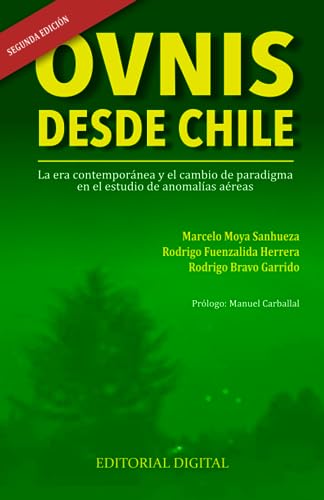
Ovnis desde Chile
La era contemporánea y el cambio de paradigma en el estudio de anomalías aéreas — Twenty Cases from the Country That Has Investigated Them Officially Since 1968
Find on Amazon →As an Amazon Associate, OverClassified may earn from qualifying purchases made through this link, at no extra cost to you.
Why This Is Essential Reading
Worth it for access rather than for method. Chile has investigated aerial anomalies through a state body since 1968 and through CEFAA — a multidisciplinary committee inside its civil aviation authority — since 1997, and Ovnis desde Chile is written by three people close to that process, including Rodrigo Bravo Garrido, the first serving Chilean Army officer to study the subject formally and later his service's own representative on the committee. That is a genuinely unusual vantage point, and it is why a self-published title with a 979-8 ISBN belongs here when several others have been declined: the authors are documented, the prologue is by a Spanish investigative journalist of standing, and the same three were subsequently picked up by Roca Editorial for a 2026 successor. The limitations are equally clear. Twenty selected cases cannot tell you what fraction of Chilean reports resolve conventionally, which is the number that would make the residue mean something; two of the three authors are describing a committee they served on; and the “paradigm change” the subtitle claims is a change in institutional attention, not in evidence. Read it with UFOs in Chile and with this site's own Navy helicopter footage file.
Related Cases & Theories
Sources Cited
- Bravo Garrido, Rodrigo, Rodrigo Fuenzalida Herrera and Marcelo Moya Sanhueza. Ovnis desde Chile: La era contemporánea y el cambio de paradigma en el estudio de anomalías aéreas. Second edition, Editorial Digital, 1 July 2023. 356 pp. ISBN-13 9798853396531. amazon.com
- Kindle edition record, ASIN B0CCK7MK2X — the simultaneous digital edition, and the source for the description of roughly twenty analysed cases and the “contemporary era” framing. amazon.com
- Amazon Mexico listing for the same edition — independent confirmation of authorship, extent and publication date. amazon.com.mx
- Buscalibre Chile catalogue search for Ovnis desde Chile — independent Chilean bookseller records for both this title and its 2026 successor. buscalibre.cl
- Penguin Libros Chile catalogue entry for Ovnis sobre Chile (Roca Editorial, 2026) — the trade-published successor volume by the same three authors. penguinlibros.com
- Barnes & Noble catalogue record for Ovnis sobre Chile — independent confirmation of the successor volume and its joint authorship. barnesandnoble.com
- Buscalibre Chile listing for Ovnis sobre Chile — Chilean trade record for the 2026 edition. buscalibre.cl
- Spanish Wikipedia, “Rodrigo Bravo” — the source for his birth in Santiago on 2 May 1976, his career as a Chilean Army officer and military pilot with the Army Aviation Brigade at Punta Arenas, his 2000 thesis on the UFO phenomenon and aerospace security, and his December 2009 designation as the Army's representative on CEFAA. es.wikipedia.org
- Wikidata entry Q16297915, Rodrigo Bravo — structured biographical record. wikidata.org
- The UFO Database profile, Rodrigo Bravo Garrido — independent record of his CEFAA role and research career. theufodatabase.com
- The UFO Database profile, CEFAA — independent record of the Comité de Estudios de Fenómenos Aéreos Anómalos, its 1997 founding and its placement inside the Dirección General de Aeronáutica Civil. theufodatabase.com
- UAPSG, “A Survey Among U.A.P. Investigators and Scholars” — the source for Rodrigo Fuenzalida Herrera's collaboration in CEFAA image analysis from 2012 to 2016 and his role as Director of Investigations for AION Chile. uapsg.com
- Visión OVNI, “En exclusiva: entrevista a Rodrigo Bravo Garrido” (2010) — a Spanish-language interview predating the book, documenting his position and approach at the time he joined CEFAA. visionovni.com.ar
- SEFAA (Sección de Estudios de Fenómenos Aéreos Anómalos), Dirección General de Aeronáutica Civil de Chile — the official successor body to CEFAA, its own institutional site and statement of mission, jurisdiction and methodology. sefaa.dgac.gob.cl
- Espírito Santo, Diana, and Alejandra Vergara. “The Possible and the Impossible: Reflections on Evidence in Chilean Ufology.” Antípoda. Revista de Antropología y Arqueología, No. 41 (2020), pp. 125–146 — peer-reviewed academic treatment of Chilean ufology and its evidentiary culture, including the official investigative apparatus.
- OverClassified, CEFAA — Chile's Official UAP Investigation Committee — this site's own file on the body two of these authors served.
- OverClassified, Chilean Navy Helicopter Video — this site's case file on the November 2014 infrared footage and CEFAA's two-year analysis of it.
Have corrections, additional research, or peer-reviewed sources? Help improve this entry.
Suggest an Edit