
Incident at Fort Benning
The Origin Document of a Claimed Mass Military Abduction — Written by Its Only Witness, Nine Years After the Hypnosis That Produced It
Core Thesis
Incident at Fort Benning is the case's sole foundational source, and that is the whole reason to read it. John Vasquez's account is that on the night of September 2, 1977, as a 25-year-old private with the 1st Battalion, 1st Infantry at Fort Benning, Georgia, he and as many as 1,300 fellow soldiers were struck by descending lights during a live-fire night exercise, lost hours they could never account for, and were afterwards quietly examined by Army medical staff who told them a measles outbreak was responsible. He did not recall any of this at the time. The account was recovered under hypnosis in 1991, fourteen years after the claimed event, and written up with Bruce Stephen Holms and published in 2000 — nine years after the regression and twenty-three years after the night in question. Every later retelling, in two decades of talk radio, podcasts and documentary television, traces back to this book. This site's case file is stamped Personal, and this article explains why the book matters anyway.
About the Author
John Vasquez served in the U.S. Army and was, on his own account, a private with the 1st Battalion, 1st Infantry at Fort Benning in 1977. His military service is the part of the claim least in question; what is at issue is everything he says happened during it and how the account came to exist.
The recovery method is the case's defining problem and cannot be set aside. Vasquez had no recollection of the events before a hypnotic regression session in 1991. By that date the professional and scientific consensus on hypnotically recovered memory was already turning sharply negative, and by the time this book appeared in 2000 it had turned decisively: hypnotically retrieved testimony had lost its standing in most American courts, and the experimental literature on suggestion and confabulation under hypnosis was extensive. A memory that did not exist until therapy produced it is not, by itself, evidence that the events occurred.
The nine-year gap between the regression and the book, filled with talk-radio appearances, matters as much as the fourteen-year gap before it. An account that circulates publicly for years before being written down is subject to the ordinary processes by which repeated telling smooths, sharpens and elaborates a story — and Vasquez's has, on the record, been told a great many times to sympathetic audiences.
The co-author, Bruce Stephen Holms, is a broadcaster and independent publisher in the paranormal media space rather than an investigator. This site's case file observes that the story was 'shaped as much by a book contract and a television camera as by anything that can be independently verified,' and the authorship arrangement is part of the evidence for that.
Historical Context & Origins
The claim belongs to the abduction paradigm at its most expansive. By 1991, when the regression took place, Budd Hopkins' Missing Time (1981) and Intruders (1987) had established the template — unexplained lost time, a therapist, a regression, a recovered narrative — and a substantial infrastructure of hypnotists, support groups and researchers existed to process claims through it.
The mass-military element is what distinguishes this claim from the thousands of individual abduction reports of the period, and it is also what makes it uniquely testable in principle. A single person's recovered memory cannot be checked. An event involving as many as 1,300 soldiers on a specific night at a named installation during a scheduled live-fire exercise should leave traces: unit records, medical logs, other witnesses, contemporaneous complaints.
It has not. This site's case file records that a single corroborating witness — Command Sgt. Maj. James Norton — did not come forward until 2011, thirty-four years after the claimed event and eleven years after the book, and died months later. Out of a claimed 1,300 participants, one corroboration arriving three decades late and unavailable for follow-up is close to the weakest possible outcome for a mass-witness claim.
The exercise itself is disputed. Vasquez identifies a specific military exercise as the setting; per this site's case file, the base and the Air Force separately deny that exercise took place as described. That is a checkable factual claim, and it has been checked.
The most consequential contextual fact is a decision by other researchers. Budd Hopkins' own investigative team interviewed Vasquez in person and then made a direct, on-the-record decision to walk away from the story. Hopkins was, by any measure, the most credulous major abduction researcher of his generation; a team working to his standards declining to pursue a claim is a signal that should be weighed heavily.
There is a reason mass-military abduction claims recur despite their poor record, and it is worth naming because it explains this book's audience. The military is the one institution in American life that combines total documentary control, a legitimate secrecy mandate, and a population trained not to question orders — which makes it the ideal setting for a story that must explain why nothing was reported. That explanatory convenience is also the reason such claims are so hard to falsify and so easy to construct, and it is why a reader should apply more scepticism to a military mass-abduction account, not less, than to an individual civilian one.
Core Arguments & Key Concepts
A mass event was covered by a cover story. The book's central claim: that hundreds of soldiers experienced the same thing, were examined, and were told a measles outbreak explained it. The measles detail is the account's most distinctive feature and the most obviously checkable — an installation-wide medical event of that kind generates records.
The memory was suppressed and later recovered. The mechanism the whole account depends on. Without it there is no explanation for why nobody reported anything at the time, and with it there is no way to distinguish a recovered memory from a constructed one.
Military structure explains the silence. Vasquez's implicit argument for why 1,300 witnesses produced no contemporaneous record: soldiers do not question orders, do not file reports about things they are told did not happen, and disperse to other postings. This has some genuine force — military reporting culture does suppress anomalous accounts — and it does not explain the absence of any documentary trace whatsoever, in an institution that generates paperwork about everything.
What the book has that most abduction claims do not. A named claimant, a named installation, a specific date, a specific unit, and a checkable exercise. Most abduction accounts offer none of this, and Vasquez's willingness to be specific is a point in his favour even though the specificity is what allowed the claim to be checked and found wanting.
What it does not have. Documentation of any kind: no unit records, no medical logs, no contemporaneous complaint, no press account, no FOIA return. One late corroboration from a witness who died shortly afterwards. A denied exercise. And a recovered-memory origin at exactly the historical moment that method was being discredited.
Why this site publishes it as Personal rather than Disputed. The distinction is deliberate and worth understanding. 'Disputed' implies a genuine evidentiary contest; 'Personal' records that the claim rests entirely on one person's experience, sincerely reported, with nothing external to weigh against or for it. This site's case file explains the choice at length, and it is the honest classification for a claim of this shape.
Key Cases & Evidence Discussed
The claimed September 2, 1977 event. Descending lights during a live-fire night exercise at Fort Benning, unaccounted-for hours, and a subsequent Army medical examination attributed to measles. See this site's Fort Benning Abduction Case file.
The 1991 hypnotic regression. The point at which the account came into existence, and the fact that governs everything downstream of it.
The disputed exercise. Vasquez names a specific military exercise as the setting; the base and the Air Force separately deny it occurred as described. A checkable claim, checked, and not supported.
James Norton's 2011 corroboration. Command Sgt. Maj. James Norton came forward in 2011, thirty-four years after the claimed event, and died months later — leaving a corroboration that could not be tested, developed or cross-examined.
The Hopkins team's decision to walk away. The most important single fact about the case's reception inside abduction research. Investigators working to the most permissive standards in the field interviewed the claimant and declined to take it further.
The comparison set. Genuine multi-witness military UAP incidents exist and look nothing like this. The Malmstrom missile shutdowns produced operational consequences and surviving personnel testimony; the Chu Lai report produced a contemporaneous unit journal entry preserved by the National Archives. The contrast is instructive: real military anomalies leave paper.
Critical Reception & Controversies
The book has no critical reception in any conventional sense. It was independently published, sold to the paranormal-media audience, and promoted through talk radio and later podcasts rather than reviewed. That is not disqualifying on its own — several genuinely valuable books in this library were self-published — but it means no external editorial process examined the claims before publication.
Its reception inside the abduction research community is the substantive story, and it is negative. Budd Hopkins' team interviewed Vasquez and walked away. That decision, from researchers whose standing complaint was that the field dismissed claimants too readily, is the strongest available signal about how the account struck people whose professional lives were spent evaluating exactly this kind of testimony.
The claim's media afterlife has been considerably more successful than its research reception, and that gap is itself the point. Two decades of appearances have given a single-witness, recovered-memory claim with a denied setting and one late uncorroborated corroboration the public profile of a documented military incident. This site's case file exists in substantial part to record the difference.
A fair note on Vasquez himself: nothing in the record suggests fabrication for gain, and this site does not allege it. Sincerity and accuracy are separable, which is the distinction the Personal stamp exists to mark. A man who genuinely believes a recovered memory is a memory is not lying about anything.
The strongest criticism of the book as a book is that it presents recovered material with the confidence of documented history, and does not tell its reader that the account did not exist before 1991 or that the method used to produce it was, by 2000, substantially discredited. A reader encountering this claim through this book alone would not know either fact.
It is worth being precise about what this site is and is not saying, because a Personal stamp is easily misread as a polite dismissal. The claim has not been disproven. No evidence establishes that nothing happened at Fort Benning on the night of September 2, 1977, and the absence of documentation for a routine training night thirty-five years past is not itself surprising. What has been established is narrower and sufficient: the account did not exist before a 1991 hypnosis session, the named exercise is denied by two separate authorities, the corroboration arrived three decades late from a witness who died before it could be developed, and the most sympathetic investigators in the field looked at it and left. A claim can be honestly held, unfalsified, and still carry no evidentiary weight, and that is the position this one is in.
Influence & Legacy
This book's legacy is entirely that of an origin document. This site's case file describes it as 'the case's sole foundational source… essential as the origin document every later retelling traces back to,' and that is exactly its function. Every subsequent version of the Fort Benning story — radio, podcast, documentary, article — is downstream of these pages.
It is also a clean worked example of how a claim propagates without evidence accumulating. Twenty-five years of retelling have added public reach, media credibility and audience familiarity, and have added no documents, no witnesses who could be examined, and no verification of the exercise. The claim in 2026 rests on exactly what it rested on in 2000, plus one corroboration that arrived too late to test.
For this site specifically, the case is the reference example for the Personal stamp. A claim that is real as testimony, unverifiable as event, and unaccompanied by any external record needs a classification that says so without either endorsing or accusing, and Fort Benning is where that distinction is worked out most explicitly.
The broader lesson concerns mass-witness claims generally. A story involving 1,300 people should be the easiest kind of claim in this field to corroborate and the hardest to fake, which is precisely why the total absence of corroboration is so damaging. Readers encountering any future claim of a mass military encounter should ask the question this case makes unavoidable: where are the other 1,299?
The Book
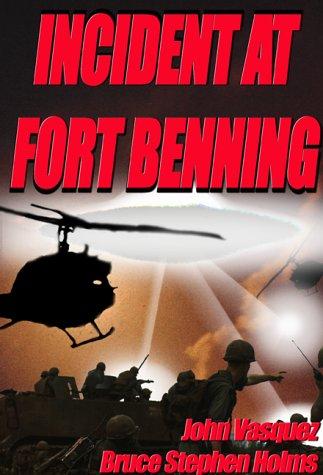
Incident at Fort Benning
The Origin Document of a Claimed Mass Military Abduction — Written by Its Only Witness, Nine Years After the Hypnosis That Produced It
Find on Amazon →As an Amazon Associate, OverClassified may earn from qualifying purchases made through this link, at no extra cost to you.
Why This Is Essential Reading
Read it only as the origin document, and read this site's case file first. Incident at Fort Benning is where a claimed mass abduction of as many as 1,300 American soldiers exists in its original form, and there is nowhere else it exists — two decades of media retelling all descend from this book. What the book does not tell its reader is that John Vasquez had no recollection of the events until a hypnotic regression fourteen years later, that the specific exercise he names is denied by both the base and the Air Force, that a single corroborating witness surfaced thirty-four years on and died within months, and that Budd Hopkins' own team interviewed him and walked away. This site publishes the case as Personal, not Disputed, and the distinction is deliberate: nothing here suggests dishonesty, and nothing here can be checked. Compare it against Chu Lai, where a single sentry's report survives because someone wrote it in a journal that night.
Related Cases & Theories
Sources Cited
- Vasquez, John, and Bruce Stephen Holms. Incident at Fort Benning. Timeless Voyager Press, 2000. ISBN-10 1892264048 / ISBN-13 9781892264046. amazon.com
- Hopkins, Budd. Missing Time: A Documented Study of UFO Abductions. Richard Marek, 1981 — the template the 1991 regression operated inside. OverClassified breakdown
- Hopkins, Budd. Intruders: The Incredible Visitations at Copley Woods. Random House, 1987. OverClassified breakdown
- Randle, Kevin D., Russ Estes and William P. Cone. The Abduction Enigma, 1999 — the sceptical assessment of recovered-memory abduction claims from inside the field. OverClassified breakdown
- National Research Council, The Polygraph and Lie Detection and the wider experimental literature on suggestion and confabulation under hypnosis — the scientific context against which a 1991 hypnotic recovery has to be read. nap.nationalacademies.org
- Wikipedia, "Recovered-memory therapy" — the professional and legal collapse of hypnotically recovered testimony over exactly the period between this case's regression (1991) and its publication (2000). en.wikipedia.org
- Loftus, Elizabeth F., and Katherine Ketcham. The Myth of Repressed Memory: False Memories and Allegations of Sexual Abuse, 1994 — the experimental case against recovered-memory testimony, published between this case's regression and its book. en.wikipedia.org (Loftus)
- American Psychological Association, working-group statements on recovered memories of childhood abuse — the professional-body position that developed over the 1990s and bears on any hypnotically recovered account from that period. apa.org
- Wikipedia, "Alien abduction" — the wider phenomenon and the standing scientific assessment of the recovered-memory abduction claim class. en.wikipedia.org
- Wikipedia, "Fort Moore" (formerly Fort Benning) — the installation's history, units and training role. en.wikipedia.org
- Open Library edition record for Incident at Fort Benning, ISBN 1892264048 — independent bibliographic confirmation and cover-art source. openlibrary.org
- Goodreads author and edition records for John Vasquez, Incident at Fort Benning — reader-side publication record. goodreads.com
- OverClassified case file, Fort Benning Abduction Case — source for the September 2, 1977 date, the 1st Battalion 1st Infantry unit and the claimed figure of as many as 1,300 soldiers, the measles cover story, the 1991 hypnotic regression, the disputed JAWS exercise and the base's and Air Force's separate denials, Command Sgt. Maj. James Norton's 2011 corroboration and death months later, Budd Hopkins' team's on-the-record decision to walk away after interviewing Vasquez in person, and this site's reasoning for publishing the case as Personal rather than Disputed.
- OverClassified case file, Chu Lai Egg-Shaped Object Incident — the contrasting case of a wartime military anomaly preserved by a contemporaneous unit journal entry.
- OverClassified case file, The Malmstrom AFB Missile Shutdowns — a genuine multi-witness military incident with operational consequences and surviving testimony.
Have corrections, additional research, or peer-reviewed sources? Help improve this entry.
Suggest an Edit