
Foxtrot 94
Fatal Accident or UFO Conspiracy? — Captain William Schaffner and Lightning XS894
Core Thesis
On the night of 8 September 1970, during a NATO Tactical Evaluation exercise, USAF exchange pilot Captain William Schaffner was scrambled from RAF Binbrook in English Electric Lightning F.6 XS894, callsign Foxtrot 94, to intercept a radar contact over the North Sea off Flamborough Head. He never came back. The aircraft was found on the seabed a month later, largely undamaged, canopy closed, ejection seat unfired, cockpit empty. Twenty-two years afterwards a regional newspaper published what it presented as the official radio transcript of the interception, in which Schaffner describes a glowing conical object closing on him. The transcript was invented. M. S. Morgan, a retired British police senior investigating officer, goes back to the source material and works the case the way an investigator would.
About the Author
M. S. Morgan is a retired British police senior investigating officer — the rank that runs major crime investigations — who writes on RAF history and on British UFO and UAP claims. The credential is directly relevant to what this book is: a re-examination of a fifty-year-old case file.
He has a substantial published record. Pen & Sword carries his work, and his titles include The Death of Guy Gibson: Who, or What, Killed the Dambuster VC, The Death of Prince George, Duke of Kent, 1942, Hitler's RAF Collaborators, The Secret Battle for Britain on RAF interrogation of Luftwaffe prisoners, and The Hurricane Pilot Who Became a Gestapo Agent.
The pattern across that list is consistent: contested aviation deaths and disputed wartime episodes, approached as investigations rather than as narratives. That is the same method applied here.
He has also written on British UAP subjects — Angels & Bogeys on radar cases, What Do They Really Know?, and The Silence is Deafening on the drone and UAP incursions reported over UK bases hosting USAF units.
This particular volume was independently published rather than issued through his trade publisher, which places it on a different documentary footing from his Pen & Sword titles. What supports it instead is the author's traceable record and the fact that the underlying case is exhaustively documented in independent sources a reader can check.
The cover carries an endorsement from Nick Pope, formerly of the Ministry of Defence's UFO desk: "I can confirm this is the definitive text on this mystery." Pope's fuller description of the book calls it "a deep-dive into a tragic aircraft accident in which it's been alleged that there's a UFO connection" — wording worth noting, because the noun in that sentence is accident.
Historical Context & Origins
The facts of the night are on the record and are not in dispute. Schaffner, born 11 September 1941, had flown two combat tours in Vietnam in the F-102 before arriving at Binbrook in July 1970 on a standard NATO exchange posting with No. 5 Squadron.
He was inexperienced on type. By early September he had roughly 121 hours on the Lightning and about 18 of them at night, and his qualification status was recorded as Limited Combat Ready after some eight weeks. That is the single most important fact in the case.
The exercise that night was a Tactical Evaluation — an unannounced test of the station's readiness — and the "intruder" was an RAF Avro Shackleton MR.3, serial WR981, flying a slow low-level track as a simulated hostile. Ground radar at RAF Patrington and RAF Staxton Wold controlled the intercept.
Schaffner took off at 22:06 GMT. His recorded transmissions are ordinary interceptor phraseology — contact with a set of lights in the area, closing, and a note that he would have to manoeuvre to slow down. There is no reference to anything unidentified in the actual radio record.
The Board of Inquiry concluded he lost height awareness while decelerating below his target during a night shadowing manoeuvre, over a dark sea with no horizon — textbook conditions for spatial disorientation, in a pilot with 18 night hours on type. The aircraft entered the water at low speed.
What happened next explains the empty cockpit. The ejection sequence failed — the canopy did not jettison, so the seat could not fire — and the evidence indicates Schaffner got out of the aircraft manually, after which the canopy settled closed as the Lightning sank. His body was never recovered. The wreck was located on 7 October 1970 and raised.
The UFO story did not exist in 1970. It appeared in 1992, in a Grimsby regional newspaper series attributed to an anonymous former RAF source, complete with a dramatic "official transcript" in which Schaffner describes a bluish conical object too bright to look at, closing on him. No such transcript exists in any official record.
The file was released in 2003 as DEFE 71/95 after sustained pressure, including from the BBC's Inside Out and from Schaffner's son Michael, who had found the fabricated transcript circulating online. The Ministry of Defence had initially said the report was destroyed. This site's case file is stamped Debunked on that record.
Core Arguments & Key Concepts
The case should be worked as an investigation, not as a mystery. The book's governing method and its reason for existing. Morgan's professional background is major-crime investigation, and the approach here is evidential: establish what the primary documents say, then test the claims against them.
The pilot's inexperience is the central fact. 121 hours on type, 18 at night, Limited Combat Ready at eight weeks, and a shadowing manoeuvre his squadron commander had not expected the exercise to include. Every account that reaches the accident conclusion goes through this.
The aircraft's condition has an engineering explanation. The intact airframe, closed canopy and unfired seat are the details that make the case feel impossible. They are also the details that a failure in the canopy jettison mechanism accounts for completely.
The 1992 transcript is not a document. It has no archival provenance, no named source and no counterpart in the released file. It is the load-bearing element of every UFO retelling of the case and it was manufactured twenty-two years after the event.
Official secrecy created the space the story grew in. The strongest point available to anyone arguing conspiracy, and it is true. The inquiry report stayed restricted for three decades, the family were not told the circumstances, and the MoD at one point stated the report had been destroyed. That is a real failure, and it is not evidence of a UFO.
Specific conspiracy claims can be tested individually. The allegations of missing components from the recovered aircraft, including the compass, are the kind of concrete assertion that either checks out against the recovery record or does not — and the book's framing question is whether they do.
The verdict. This article has not read the book, and says so plainly rather than guessing: the strongest available indications — the framing of the title as a question, Pope's description of it as a deep-dive into a tragic aircraft accident, and reader accounts emphasising the maintenance and flying-hours material — point toward the accident conclusion, but a reader who wants Morgan's answer will have to get it from Morgan.
Key Cases & Evidence Discussed
The loss of Lightning XS894, 8 September 1970. Scramble at 22:06 GMT from RAF Binbrook, contact lost within minutes, wreck located 7 October. This site's Case File #073 covers it and rates it Debunked as a UAP case while treating the death as the real tragedy it was.
The Shackleton WR981. The maritime patrol aircraft flying the simulated intruder role — the radar contact Schaffner was actually vectored onto, identified as such in the released inquiry file.
The ejection sequence failure. Canopy jettison did not occur, the seat therefore could not fire, and the pilot left the aircraft manually. The single technical fact that dissolves the "empty cockpit" mystery.
The 1992 Grimsby newspaper series. The anonymous source and the fabricated radio transcript — the origin of the entire UFO reading, published twenty-two years after the crash.
DEFE 71/95. The RAF Board of Inquiry file, restricted for three decades and released in 2003, containing the genuine transmissions and no reference to any unidentified object.
Michael Schaffner's search. The pilot's youngest son, who encountered the fabricated transcript online and pursued the real file through the Ministry of Defence with journalistic help — the human centre of the case.
The claimed 17,400 mph radar plot. The performance figure that circulates in retellings. It appears in the 1992 newspaper account and in no primary radar log or official document.
The alleged missing components. Claims that parts of the recovered aircraft, including its compass, were unaccounted for — among the specific conspiracy assertions the book sets out to test.
Critical Reception & Controversies
The book has not been reviewed in the aviation-history press, which is normal for an independently published title. Its most visible endorsement is Nick Pope's, printed on the cover, calling it the definitive text on the mystery.
Pope's endorsement should be read with the same care as any other. He is a former MoD official with genuine knowledge of how the department handled these files, and he is also a professional commentator whose blurbs appear on many books. What makes this one informative is its wording — the object of the sentence is a tragic aircraft accident.
The substantive question about any book on this case is whether it engages the released file, and the standard was set by David Clarke, whose work on Foxtrot 94 traced the fabrication in detail and reproduced the genuine transmissions against the invented ones. Clarke's treatment is the reference point, and it is covered in his Britain's X-traordinary Files.
The independent-publication route is a real limitation and worth stating. There was no editorial or fact-checking layer between the author and the reader, and the volume carries no apparatus a librarian would recognise. What offsets it here, and did not offset it for other self-published titles this site has declined to cover, is that Morgan has a verifiable body of work with a trade publisher and that the underlying case is documented independently in sources any reader can check.
The genuine grievance in this case is not about UFOs at all, and it deserves separating out. A serving officer died in a training accident and his family were left without the circumstances for over thirty years, while the department that held the file at one point said it no longer existed. Secrecy of that kind does not conceal a UFO; it manufactures the conditions in which someone can invent one and be believed.
The family's own position is the most useful corrective in the literature. Michael Schaffner, having chased down the actual file, said it was an unusual stretch of the imagination to believe UFOs and government cover-ups were responsible for his father's death.
The case's value to a reader is as a controlled demonstration. Here is a documented event, a documented fabrication with a date, and a documented official record that contradicts the fabrication — and the fabrication is still winning in popular retellings. Very few cases in this subject give you all three.
Influence & Legacy
Foxtrot 94 has become one of the standard British UFO cases, cited in books and documentaries as an interception that went wrong. Almost every element that makes it compelling in those retellings — the glowing object, the transcript, the impossible closing speed — entered the record in 1992 and has no earlier existence.
That makes it a near-perfect companion to the Sungods in Exile pattern this site has documented elsewhere: a fabrication with an identifiable date of manufacture, exposed in detail, and still circulating decades later because the exposure travels through specialist channels while the claim travels through mass media.
The case also shows why the empty-cockpit detail is so durable. It is genuinely strange until you know one technical fact about the canopy jettison mechanism, and that fact lives in an accident report that was withheld for thirty years. Withholding it did not protect anything; it guaranteed that the strangeness would be filled in by someone else.
The lesson for anyone assessing this subject is about where to put the burden. A book that revisits a contested aviation death should be judged by whether it works from the inquiry file, names its documents, and tests the specific claims one at a time — not by whether its conclusion is exciting. Morgan's professional formation is in exactly that discipline, and the case is one where the documents exist and can be checked. Read it with the released record beside it, and with Clarke's account of the fabrication, and the reader is in a position to grade the book rather than take its word for anything.
The Book
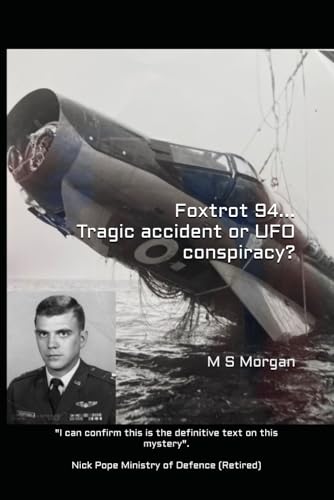
Foxtrot 94
Fatal Accident or UFO Conspiracy? — Captain William Schaffner and Lightning XS894
Find on Amazon →As an Amazon Associate, OverClassified may earn from qualifying purchases made through this link, at no extra cost to you.
Why This Is Essential Reading
Worth reading with the file open beside it. The Schaffner case is one of the few in British ufology where everything needed to settle it is a matter of public record: an inquiry report released as DEFE 71/95 in 2003, a pilot with 121 hours on type and 18 of them at night, a dark sea with no horizon, a shadowing manoeuvre his commander had not expected the exercise to include, and a canopy jettison failure that explains the intact cockpit and the unfired seat. The glowing conical object and the impossible closing speed come from a 1992 regional newspaper series with an anonymous source and a transcript that exists in no archive. M. S. Morgan, a retired police senior investigating officer with a real body of published aviation-history work, goes back to the source material and asks the question the title poses; this article has not read the book and does not pretend to know his final answer, though the framing, Nick Pope's description of it as a deep-dive into a tragic aircraft accident, and readers' accounts of its emphasis on maintenance and flying hours all point one way. Read it against this site's case file and David Clarke's reconstruction of the fabrication, and remember what the pilot's son concluded after reading the real file himself.
Related Cases & Theories
Sources Cited
- Morgan, M. S. Foxtrot 94: Fatal accident or UFO Conspiracy? Independently published, 31 May 2022, 210 pp., 14 black-and-white illustrations. ISBN-13 9798758411957. amazon.com
- M. S. Morgan, author website — the book's own description (the September 1970 loss, the ditching off Flamborough Head, the alternative claim that Schaffner was intercepting a UFO, and the conspiracy allegations about missing aircraft components including the compass), its 210-page extent and 14 illustrations, the Nick Pope endorsement, and the author's other titles. msmorganbooks.co.uk
- Pen & Sword Books author page, M. S. Morgan — his trade-published RAF history titles, establishing the author's independent publishing record. penandswordbooks.com
- AbeBooks catalogue record, ISBN 9798758411957 — independent bibliographic listing and cover-art source. abebooks.com
- David Clarke, "Foxtrot 94 and the UFO that never was" — the scramble from RAF Binbrook, the Shackleton flying the simulated intruder role, Schaffner's genuine recorded transmissions ("Contact with a set of lights in that area — closing") set against the 1992 Grimsby fabrication ("a bluish conical object"), the ejection-seat servicing failure, Michael Schaffner's discovery of the fake transcript online and his pursuit of the real file with BBC Inside Out, and the MoD's initial claim that the report had been destroyed. drclarke.substack.com
- David Clarke, "Captain Schaffner's last flight," Secret Files — the companion dossier on the case and the released inquiry file. drdavidclarke.co.uk
- Sylvia Wrigley, "The Mysterious Disappearance of Foxtrot 94," Fear of Landing — the aviation-safety reconstruction: the Shackleton at 160 knots and 1,500 feet, Schaffner's 121 Lightning hours with 18 at night and Limited Combat Ready status after eight weeks, the squadron commander's expectation that the exercise would not involve shadowing, the ejection handle pulled with the canopy failing to jettison, the manual escape, the recovery of the largely undamaged aircraft with the canopy closed, and Michael Schaffner's own conclusion. fearoflanding.com
- The National Archives, Discovery catalogue record — the Ministry of Defence file series in which the Board of Inquiry report was released. discovery.nationalarchives.gov.uk
- BBC Inside Out, Yorkshire & Lincolnshire — the programme that pursued the release of the accident report on behalf of the Schaffner family. bbc.co.uk
- Grimsby Telegraph, "I found dad and brought him back" — regional coverage of Michael Schaffner's pursuit of his father's file, in the same paper whose 1992 series originated the UFO claim. grimsbytelegraph.co.uk
- Wikipedia, "William Schaffner" — his biography, the 1970 loss, and the origin and exposure of the UFO narrative. en.wikipedia.org
- Wikipedia, "English Electric Lightning" — the F.6 interceptor Schaffner was flying, its performance and its handling characteristics. en.wikipedia.org
- Wikipedia, "RAF Binbrook" — the Lincolnshire station from which Foxtrot 94 was scrambled, and its Quick Reaction Alert role. en.wikipedia.org
- Wikipedia, "Avro Shackleton" — the maritime patrol aircraft flying the simulated intruder role that night. en.wikipedia.org
- Wikipedia, "Spatial disorientation" — the mechanism the Board of Inquiry identified, and the conditions over a dark sea with no horizon that produce it. en.wikipedia.org
Have corrections, additional research, or peer-reviewed sources? Help improve this entry.
Suggest an Edit